

ASTM F1848-14(2022)
(Classification)Standard Classification System for Canine Search Resources
General Information
- Abstract
ABSTRACT
This classification aids search and rescue managers in ordering resources for search and rescue incidents and to aid dog handlers in communicating the types of tasks for which they and their dogs have trained. This classification is intended as a supplement to the resource typing specifications of the Incident Command System and specifically as a means of typing search and rescue dog resources and is suitable for classifying dog resources for a wide variety of emergency management purposes including both search and rescue and law enforcement incidents. This classification does not attempt to put forth standards of performance or training for dogs or their handlers. Search and rescue dog under this classification is either Type I or Type II, based upon whether or not the dog can effectively discriminate between the human scent of different individuals. Kind classifications of SAR dog resources are based upon the specific tasks for which dogs are deployed and include: Kind A, area search dog; Kind B, avalanche search dog; Kind C, cadaver search dog; Kind D, disaster/collapsed structure search dog; Kind E, evidence search dog; Kind F, railing search dog; Kind G, tracking search dog; and Kind H, water search.
SIGNIFICANCE AND USE
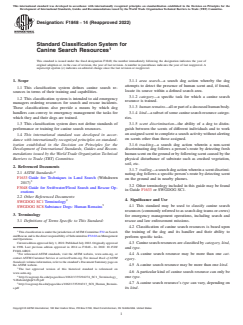
4.1 This standard may be used to classify canine search resources (commonly referred to as search dog teams or crews) for emergency management operations, including search and rescue and law enforcement missions.
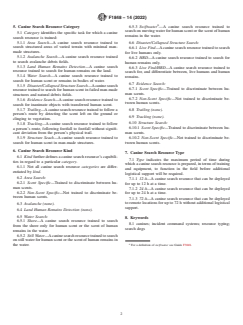
4.2 Classification of canine search resources is based upon the training of the dog and its handler and their ability to perform specific tasks.
4.3 Canine search resources are classified by category, kind, and type.
4.4 A canine search resource may be more than one category.
4.5 A canine search resource may be more than one kind.
4.6 A particular kind of canine search resource can only be one type.
4.7 A canine search resource’s type can vary, depending on its kind.
SCOPE
1.1 This classification system defines canine search resources in terms of their training and capabilities.
1.2 This classification system is intended to aid emergency managers ordering resources for search and rescue incidents. These classifications also provide a means by which dog handlers can convey to emergency management the tasks for which they and their dogs are trained.
1.3 This classification system does not define standards of performance or training for canine search resources.
1.4 This international standard was developed in accordance with internationally recognized principles on standardization established in the Decision on Principles for the Development of International Standards, Guides and Recommendations issued by the World Trade Organization Technical Barriers to Trade (TBT) Committee.
- Status
- Published
- Publication Date
- 30-Jun-2022
- Technical Committee
- F32 - Search and Rescue
- Drafting Committee
- F32.02 - Management and Operations


Overview
ASTM F1848-14(2022): Standard Classification System for Canine Search Resources provides a systematic framework for classifying canine search resources used in emergency management, search and rescue (SAR), and law enforcement operations. Developed by ASTM International, this standard enables clear communication between emergency managers and dog handlers regarding the capabilities and training of search dog teams. It serves as an essential supplement to resource typing within the Incident Command System, supporting efficient coordination and deployment of canine resources during critical incidents.
The standard does not specify performance or training requirements for search dogs or handlers. Instead, it offers a consistent method for describing and ordering canine SAR resources based on their demonstrated abilities and intended tasks.
Key Topics
- Resource Classification: Canine search resources are classified by category, kind, and type, reflecting the specific training and capabilities of both the dog and handler.
- Category: Describes the primary task or role for which the team is trained (e.g., area search, avalanche, cadaver, disaster, evidence, trailing, tracking, water, and structure search).
- Kind: Further distinguishes resources within each category, such as scent-specific or non-scent-specific capabilities.
- Type: Indicates operational readiness, based on duration the resource can be self-sufficient (e.g., 12-hour, 24-hour, 72-hour deployment types).
- Task-Specific Definitions: The standard details common SAR K9 roles, including:
- Area Search
- Avalanche Search
- Land Human Remains Detection (Cadaver Search)
- Water Search (shore, still water, swiftwater)
- Disaster / Collapsed Structure Search (live find, human remains detection)
- Evidence Search (scent-specific and non-scent specific)
- Trailing and Tracking
- Structure Search
- Scent Discrimination: Differentiates resources by their ability to distinguish human scent (scent-specific) versus general detection (non-scent-specific).
- Operational Usage: Designed for easy integration with the Incident Command System for effective incident management across various jurisdictions.
Applications
The ASTM F1848 classification system is widely applied in multiple scenarios, providing value to organizations involved in:
- Emergency Management: Streamlines the request and deployment of canine search teams during disasters, missing persons cases, and mass casualty incidents.
- Search and Rescue Operations: Ensures the right type of SAR dogs are deployed according to specific mission requirements-area, debris, avalanche, or water searches.
- Law Enforcement: Supports crime scene management and evidence location, with handlers able to specify their resource's exact capabilities.
- Multi-Agency Coordination: Enhances interoperability between local, state, federal, and volunteer resources using common terminology and standards.
- Resource Planning: Assists emergency managers and SAR coordinators in understanding available capabilities and gaps in canine search resources for better preparedness.
Related Standards
The following standards and references complement or relate to ASTM F1848-14(2022):
- ASTM F1633: Guide for Techniques in Land Search (withdrawn 2017)
- ASTM F3048: Guide for Swiftwater/Flood Search and Rescue Operations
- SWGDOG SC1: Terminology for Working Dog Functions
- SWGDOG SC8: Substance Dogs - Human Remains
These documents provide supporting definitions, best practices, and operational guidelines for search and rescue operations and canine search resources.
Keywords: ASTM F1848, canine search resources, search dog classification, search and rescue dogs, SAR dog standards, emergency management canine, incident command system, resource typing, law enforcement search dogs
Relations
- Effective Date
- 01-Dec-2013
- Effective Date
- 01-Nov-2008
- Effective Date
- 01-Nov-2003
- Effective Date
- 10-Jul-1997
Get Certified
Connect with accredited certification bodies for this standard

CIS Institut d.o.o.
Personal Protective Equipment (PPE) certification body. Notified Body NB-2890 for EU Regulation 2016/425 PPE.

Kiwa BDA Testing
Building and construction product certification.
Kmetijski inštitut Slovenije
Agricultural Institute of Slovenia. Soil testing, plant health, agricultural product analysis.
Sponsored listings
Frequently Asked Questions
ASTM F1848-14(2022) is a standard published by ASTM International. Its full title is "Standard Classification System for Canine Search Resources". This standard covers: ABSTRACT This classification aids search and rescue managers in ordering resources for search and rescue incidents and to aid dog handlers in communicating the types of tasks for which they and their dogs have trained. This classification is intended as a supplement to the resource typing specifications of the Incident Command System and specifically as a means of typing search and rescue dog resources and is suitable for classifying dog resources for a wide variety of emergency management purposes including both search and rescue and law enforcement incidents. This classification does not attempt to put forth standards of performance or training for dogs or their handlers. Search and rescue dog under this classification is either Type I or Type II, based upon whether or not the dog can effectively discriminate between the human scent of different individuals. Kind classifications of SAR dog resources are based upon the specific tasks for which dogs are deployed and include: Kind A, area search dog; Kind B, avalanche search dog; Kind C, cadaver search dog; Kind D, disaster/collapsed structure search dog; Kind E, evidence search dog; Kind F, railing search dog; Kind G, tracking search dog; and Kind H, water search. SIGNIFICANCE AND USE 4.1 This standard may be used to classify canine search resources (commonly referred to as search dog teams or crews) for emergency management operations, including search and rescue and law enforcement missions. 4.2 Classification of canine search resources is based upon the training of the dog and its handler and their ability to perform specific tasks. 4.3 Canine search resources are classified by category, kind, and type. 4.4 A canine search resource may be more than one category. 4.5 A canine search resource may be more than one kind. 4.6 A particular kind of canine search resource can only be one type. 4.7 A canine search resource’s type can vary, depending on its kind. SCOPE 1.1 This classification system defines canine search resources in terms of their training and capabilities. 1.2 This classification system is intended to aid emergency managers ordering resources for search and rescue incidents. These classifications also provide a means by which dog handlers can convey to emergency management the tasks for which they and their dogs are trained. 1.3 This classification system does not define standards of performance or training for canine search resources. 1.4 This international standard was developed in accordance with internationally recognized principles on standardization established in the Decision on Principles for the Development of International Standards, Guides and Recommendations issued by the World Trade Organization Technical Barriers to Trade (TBT) Committee.
ABSTRACT This classification aids search and rescue managers in ordering resources for search and rescue incidents and to aid dog handlers in communicating the types of tasks for which they and their dogs have trained. This classification is intended as a supplement to the resource typing specifications of the Incident Command System and specifically as a means of typing search and rescue dog resources and is suitable for classifying dog resources for a wide variety of emergency management purposes including both search and rescue and law enforcement incidents. This classification does not attempt to put forth standards of performance or training for dogs or their handlers. Search and rescue dog under this classification is either Type I or Type II, based upon whether or not the dog can effectively discriminate between the human scent of different individuals. Kind classifications of SAR dog resources are based upon the specific tasks for which dogs are deployed and include: Kind A, area search dog; Kind B, avalanche search dog; Kind C, cadaver search dog; Kind D, disaster/collapsed structure search dog; Kind E, evidence search dog; Kind F, railing search dog; Kind G, tracking search dog; and Kind H, water search. SIGNIFICANCE AND USE 4.1 This standard may be used to classify canine search resources (commonly referred to as search dog teams or crews) for emergency management operations, including search and rescue and law enforcement missions. 4.2 Classification of canine search resources is based upon the training of the dog and its handler and their ability to perform specific tasks. 4.3 Canine search resources are classified by category, kind, and type. 4.4 A canine search resource may be more than one category. 4.5 A canine search resource may be more than one kind. 4.6 A particular kind of canine search resource can only be one type. 4.7 A canine search resource’s type can vary, depending on its kind. SCOPE 1.1 This classification system defines canine search resources in terms of their training and capabilities. 1.2 This classification system is intended to aid emergency managers ordering resources for search and rescue incidents. These classifications also provide a means by which dog handlers can convey to emergency management the tasks for which they and their dogs are trained. 1.3 This classification system does not define standards of performance or training for canine search resources. 1.4 This international standard was developed in accordance with internationally recognized principles on standardization established in the Decision on Principles for the Development of International Standards, Guides and Recommendations issued by the World Trade Organization Technical Barriers to Trade (TBT) Committee.
ASTM F1848-14(2022) is classified under the following ICS (International Classification for Standards) categories: 13.200 - Accident and disaster control. The ICS classification helps identify the subject area and facilitates finding related standards.
ASTM F1848-14(2022) has the following relationships with other standards: It is inter standard links to ASTM F3048-13, ASTM F1633-97(2008), ASTM F1633-97(2003), ASTM F1633-97. Understanding these relationships helps ensure you are using the most current and applicable version of the standard.
ASTM F1848-14(2022) is available in PDF format for immediate download after purchase. The document can be added to your cart and obtained through the secure checkout process. Digital delivery ensures instant access to the complete standard document.
Standards Content (Sample)
This international standard was developed in accordance with internationally recognized principles on standardization established in the Decision on Principles for the
Development of International Standards, Guides and Recommendations issued by the World Trade Organization Technical Barriers to Trade (TBT) Committee.
Designation: F1848 −14 (Reapproved 2022)
Standard Classification System for
Canine Search Resources
This standard is issued under the fixed designation F1848; the number immediately following the designation indicates the year of
original adoption or, in the case of revision, the year of last revision. A number in parentheses indicates the year of last reapproval. A
superscript epsilon (´) indicates an editorial change since the last revision or reapproval.
1. Scope 3.1.1 area search—a search dog action whereby the dog
attempts to detect the presence of human scent and, if found,
1.1 This classification system defines canine search re-
locate its source within a defined search area.
sources in terms of their training and capabilities.
3.1.2 category—a specific task for which a canine search
1.2 This classification system is intended to aid emergency
resource is trained.
managers ordering resources for search and rescue incidents.
3.1.3 humanremains—allorpartofadeceasedhumanbody.
These classifications also provide a means by which dog
handlers can convey to emergency management the tasks for
3.1.4 kind—a subset of some canine search resource catego-
which they and their dogs are trained.
ries.
1.3 This classification system does not define standards of 3.1.5 scent discrimination—the ability of a dog to distin-
performance or training for canine search resources. guish between the scents of different individuals and to work
an assigned scent to complete a search activity without alerting
1.4 This international standard was developed in accor-
on scents other than those assigned.
dance with internationally recognized principles on standard-
ization established in the Decision on Principles for the 3.1.6 tracking—a search dog action wherein a non-scent
Development of International Standards, Guides and Recom- discriminating dog follows a person’s route by detecting fresh
mendations issued by the World Trade Organization Technical human scent on the ground or by following scent caused by the
Barriers to Trade (TBT) Committee. physical disturbance of substrate such as crushed vegetation,
soil, etc.
2. Referenced Documents
3.1.7 trailing—asearchdogactionwhereinascentdiscrimi-
2.1 ASTM Standards:
nating dog follows a specific person’s route by detecting scent
F1633 Guide for Techniques in Land Search (Withdrawn
on the ground and in nearby plumes.
2017)
3.2 Other terminology included in this guide may be found
F3048 Guide for Swiftwater/Flood Search and Rescue Op-
in Guide F1633 or SWGDOG SC1.
erations
2.2 Other Referenced Documents:
4 4. Significance and Use
SWGDOG SC1 Terminology
4.1 This standard may be used to classify canine search
SWGDOG SC8 Substance Dogs: Human Remains
resources (commonly referred to as search dog teams or crews)
3. Terminology
for emergency management operations, including search and
rescue and law enforcement missions.
3.1 Definitions of Terms Specific to This Standard:
4.2 Classification of canine search resources is based upon
the training of the dog and its handler and their ability to
This classification is under the jurisdiction ofASTM Committee F32 on Search
and Rescue and is the direct responsibility of Subcommittee F32.02 on Management
perform specific tasks.
and Operations.
Current edition approved July 1, 2022. Published July 2022. Originally approved 4.3 Canine search resources are classified by category, kind,
in 1998. Last previous edition approved in 2014 as F1848 – 14. DOI: 10.1520/
and type.
F1848-14R22.
For referenced ASTM standards, visit the ASTM website, www.astm.org, or 4.4 A canine search resource may be more than one cat-
contact ASTM Customer Service at service@astm.org. For Annual Book of ASTM
egory.
Standards volume information, refer to the standard’s Document Summary page on
the ASTM website. 4.5 A canine search resource may be more than one kind.
The last approved version of this historical standard is referenced on
4.6 A particular kind of canine search resource can only be
www.astm.org.
http://casgroup.fiu.edu/pages/docs/1062/1335294274_SC1_Terminology_ one type.
%28abcdefghijk%29.pdf
5 4.7 A canine search resource’s type can vary, depending on
http://casgroup.fiu.edu/pages/docs/1062/1335294313_SC8_Human_Remain-
s.pdf its kind.
Copyright © ASTM International, 100 Barr Harbor Drive, PO Box C700, West Conshohocken, PA 19428-2959. United States
F1848 − 14 (2022)
5. Canine Search Resource Category 6.5.3 Swiftwater —A canine search resource trained to
search on moving water for human scent or the scent of human
5.1 Category identi
...