ASTM D2506-80(1989)
(Terminology)Standard Terminology Relating to Solid Rocket Propulsion (Withdrawn 1998)
Standard Terminology Relating to Solid Rocket Propulsion (Withdrawn 1998)
General Information
Standards Content (Sample)
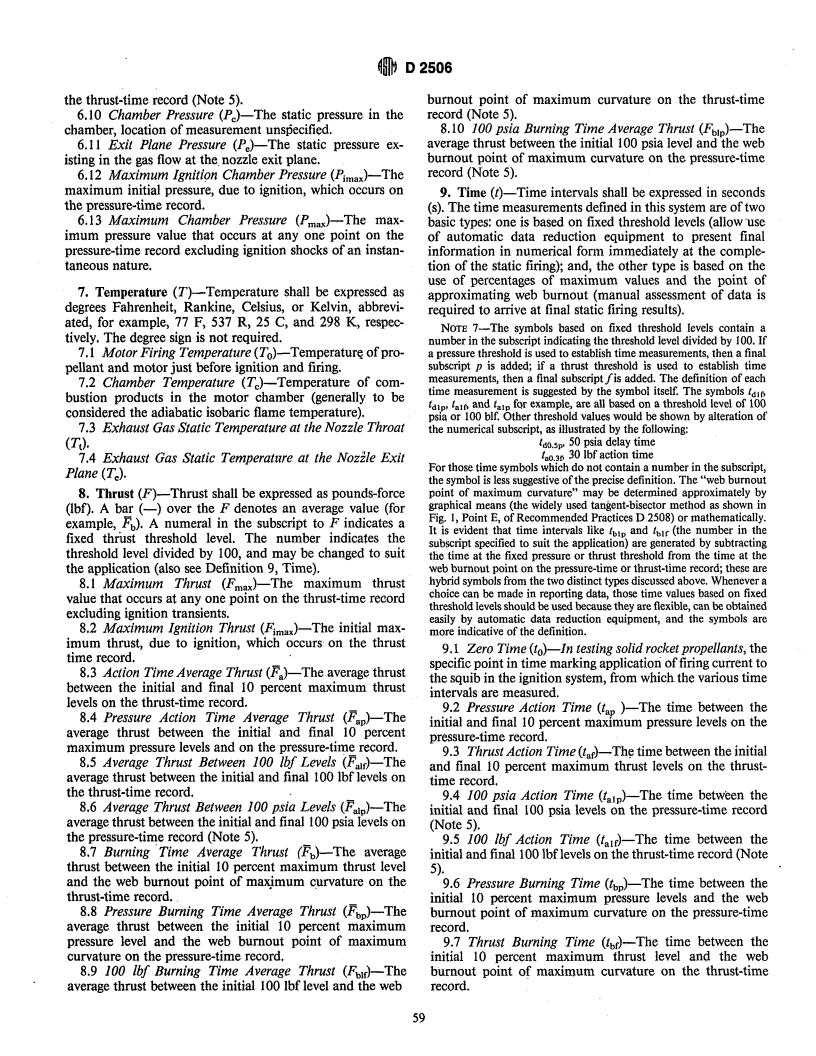
r~----'--__
ASTM D2506 80 II 0759510 0025810 6 II
---.",
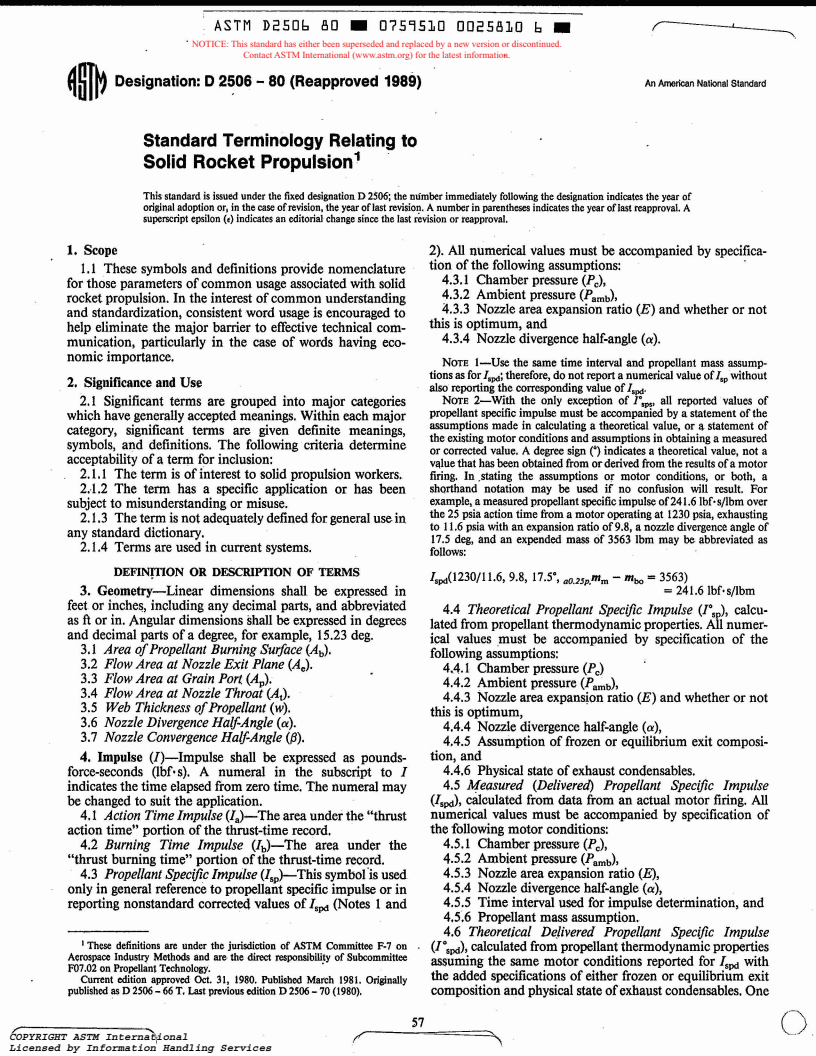
~m~ Designation: D 2506 - 80 (Reapproved 1989) An American National Standard
Standard Terminology Relating to
Solid Rocket Propulsion
This standard is issued under the fixed designation D 2506; the nlimber immediately following the designation indicates the year of
original adoption or, in the case of revision, the year of last revision. A number in parentheses indicates the year of last reapproval. A
superscript epsilon (E) indicates an editorial change since the last revision or reapproval.
1. Scope
2). All numerical values must be accompanied by specifica-
tion of the following assumptions: '
1.1 These symbols and definitions provide nomenclature
4.3.1 Chamber pressure (Pc),
for those parameters of common usage associated with solid
4.3.2 Ambient pressure (P ),
amb
rocket propulsion. In the interest of common understanding
4.3.3 Nozzle area expansion ratio (E) and whether or not
and standardization, consistent word usage is encouraged to
this is optimum, and
help eliminate the major barrier to effective technical com
4.3.4 Nozzle divergence haIf-angle (a).
munication, particularly in the case of words having eco
nomic importance.
NOTE I-Use the same time interval and propellant mass assump
tions as for lopd; therefore, do not report a numerical value oflop without
2. Significance and Use
also reporting the corresponding value of lopd'
NOTE 2-With the only exception of ["SpS' all reported values of
2.1 Significant terms are grouped into major categories
propellant specific impulse must be accompanied by a statement of the
which have generally accepted meanings. Within each major
assumptions made in calculating a theoretical value, or a statement of
category, significant terms are given definite meanings,
the existing motor conditions and assumptions in obtaining a measured
symbols, and definitions. The following' criteria determine
or corrected value. A degree sign (") indicates a theoretical value, not a
acceptability of a term for inclusion:
value that has been obtained from ol"derived from the results ofa motor
2.1.1 The term is of interest to solid propulsion workers.
firing. In .stating the assumptions or motor conditions, or both, a
2.1.2 The term has a specific application or has been shQrthand notation may be used if no confusion will result. For
example, a measured propellant specific impulse of241.6 Ibf· s/lbm over
subject to misunderstanding or misuse.
the 25 psia action time from a motor operating at 1230 psia, exhausting
2.1.3 The term is not adequately defined for general use in
to 11.6 psia with an expansion ratio of9.8, a nozzle divergence angle of
any standard dictionary.
17.5 deg, and an expended mass of 3563 Ibm may be abbreviated as
2.1.4 Terms are used in current systems.
follows:
DEFINfI10N OR DESCRIPTION OF TERMS
IOpd(l230/11.6,9.8, 17's", aO.2Sp.mm - mba = 3563)
3. Geometry-Linear dimensions shall be expressed in = 241.6 Ibf· s/lbm
feet or inche&, including any decimal parts, and abbreviated
4.4 Theoretical Propellant Specific Impulse (r ), calcu
sp
as ft or in. Angular dimensions shall be expressed in degrees
lated from propellant therm
...
This May Also Interest You
SIGNIFICANCE AND USE
4.1 Summarizing the ash mass fraction and the mass fraction of the organic constituents in a specific format under the heading, Ultimate Analysis, provides a convenient and uniform system for comparing coals or cokes. This tabulation used with that of Proximate Analysis (Practice D3172) permits cursory valuation of coals for use as fuel or in other carbonaceous processes and of cokes for metallurgical purpose.
SCOPE
1.1 This practice covers the term ultimate analysis as it is applied to the analysis of coal and coke. The information derived is intended for the general utilization by applicable industries, to provide the basis for evaluation, beneficiation, or for other purposes.
1.2 The values stated in SI units are to be regarded as standard. The values given in parentheses after SI units are provided for information only and are not considered standard.
1.2.1 All percentages are percent mass fractions.
1.3 This standard does not purport to address all of the safety concerns, if any, associated with its use. It is the responsibility of the user of this standard to establish appropriate safety, health, and environmental practices and determine the applicability of regulatory limitations prior to use.
1.4 This international standard was developed in accordance with internationally recognized principles on standardization established in the Decision on Principles for the Development of International Standards, Guides and Recommendations issued by the World Trade Organization Technical Barriers to Trade (TBT) Committee.
- Standard4 pagesEnglish languagesale 15% off
SCOPE
1.1 This terminology defines the technical terms used in standards that are the responsibility of Committee D05 on Coal and Coke. The terms are used in:
1.1.1 The sampling of coal and coke under conditions required for most commercial and technical purposes related to coal and coke.
1.1.2 Bias and related statistical testing,
1.1.3 The description of coal, both visually in the field and microscopically in the laboratory,
1.1.4 Chemical and physical analyses of coal and coke,
1.1.5 Classification of coal, and
1.1.6 Certain other related practices and guides applicable to the coal and coke industries.
1.2 This international standard was developed in accordance with internationally recognized principles on standardization established in the Decision on Principles for the Development of International Standards, Guides and Recommendations issued by the World Trade Organization Technical Barriers to Trade (TBT) Committee.
- Standard14 pagesEnglish languagesale 15% off
SIGNIFICANCE AND USE
4.1 Purpose—This guide provides a process for reclamation of existing CCPs placed in active and inactive storage areas. The guide includes information on the following activities required for the safe and effective reclamation of CCPs from storage areas: (1) Background Review of CCP Storage Areas; (2) Detailed Characterization of CCP Storage Areas; (3) Harvesting Planning and Scoping of CCP Storage Areas; (4) Harvesting Detailed Design and Approval of CCP Storage Areas; and (5) Harvesting Implementation of CCP Storage Areas. More detailed descriptions of these activities are in Sections 6 through 10.
4.2 Potential Beneficial Uses of CCPs—There are many CCP storage areas that are potentially harvestable and can provide a functional benefit in a wide variety of beneficial uses. The beneficial use of CCPs contained in these storage areas can have significant environmental and economic benefits for the facility, the facility owner and the local economy, and can significantly reduce disposal operations (1-4).4 Beneficial use of CCPs can provide industry with a safe and responsible way to economically manage the CCPs, while promoting conservation and recycling/reuse, meeting sustainability goals, and addressing the shortage of CCPs in some building product market areas (1, 2, 5). CCPs consist of fly ash, bottom ash, boiler slag, fluidized-bed combustion (FBC) ash, economizer ash, and flue gas desulfurization (FGD) material (see Terminology E2201 for definitions of CCPs) (6, 7).
4.2.1 Fly ash is the most abundant CCP in existing storage areas. Its beneficial uses include, but are not limited to: partial replacement for cement in concrete and concrete products – once in concrete, fly ash reacts with Portland cement to create additional reaction products that improve the strength and durability of concrete; raw feed for the production clinker – fly ash can be calcined along with other minerals to produce clinker; blended cements – fly ash can be an important component ...
SCOPE
1.1 This guide covers a framework to address critical aspects related to the harvesting of CCPs placed in active (operational) and inactive (closed or no longer receiving CCPs) storage areas. These storage areas may be used for wet or dry material, and may be located at active or inactive facilities (that is, coal-fired electric utilities or independent power producers that are currently generating electricity or have ceased to do so, respectively). Also, CCPs may be harvested from active or inactive storage areas located on-site or off-site of the facility.
1.2 This guide does not include information on how to determine what storage areas or facilities, or both, should be selected for potential harvesting of CCPs, as each entity may approach a harvesting program in accordance with their own harvesting pursuits and regulatory requirements. In addition, it does not include information on how an energy company or other interested parties should evaluate inventories to determine the order of their storage areas for potential harvesting, including consideration of risk, performance, and cost. This guide is intended to be used to evaluate the potential harvesting of the storage areas once the storage areas are selected for evaluation.
1.3 This guide is comprised of the following sections: Scope, Section 1; Referenced Documents, Section 2; Terminology, Section 3; Significance and Use, Section 4; Project Planning and Scoping, Section 5: Background Review of CCP Storage Areas, Section 6; Detailed Characterization of CCP Storage Areas, Section 7; Harvesting Planning and Scoping of CCP Storage Areas, Section 8; Harvesting Detailed Design and Approval (as applicable) of CCP Storage Areas, Section 9; and Harvesting Implementation of CCP Storage Areas, Section 10. Not all information within this guide will be necessary for each harvesting project, and the user should determine the applicability of each section.
1.3.1 Section...
- Guide18 pagesEnglish languagesale 15% off
SIGNIFICANCE AND USE
5.1 Activated carbons used in gas-phase adsorption may be subjected to heating, either from heat applied externally to the carbon bed, or heat generated by radioactive4 contaminants, or by the adsorption process itself. If the application of heat is sudden, or if no ample means to conduct the heat from the carbon bed exists, the carbon bed may ignite. This test method provides a controlled laboratory test to determine the temperatures at which such ignition occurs. As stated in 1.2, this does not necessarily give the temperature at which ignition will occur under a specific bed operating condition. This test method does, however, allow some ranking of carbons with regard to ignition temperature, and is a useful quality control method for unused carbons.
SCOPE
1.1 This test method covers the determination of reference ignition temperature of granular activated carbon in flowing air. This test method provides a basis for comparing the ignition characteristics of different carbons, or the change in ignition characteristics of the same carbon after a period of service.
1.2 The ignition temperature, as determined by this test method, cannot be interpreted as the probable ignition temperature of the same carbon under the operating conditions of a specific application unless those conditions are essentially the same as those in this test method.2 If it is desired to determine the ignition temperature of the carbon under a specific set of operating conditions, the test may be modified to simulate such conditions, taking into consideration the following variables: (1) air flow rate; (2) moisture content of the carbon; (3) bed depth; (4) relative humidity of the air stream; (5) heating rate; (6) contaminants (for example, hydrocarbons, etc.) in the air stream; and (7) contaminants that may have been adsorbed by the carbon under prior service conditions.
1.3 The values stated in SI units are to be regarded as standard. No other units of measurement are included in this standard.
1.4 This standard does not purport to address all of the safety concerns, if any, associated with its use. It is the responsibility of the user of this standard to establish appropriate safety, health, and environmental practices and determine the applicability of regulatory limitations prior to use. Specific precautionary statements are given in Section 7.
1.5 This international standard was developed in accordance with internationally recognized principles on standardization established in the Decision on Principles for the Development of International Standards, Guides and Recommendations issued by the World Trade Organization Technical Barriers to Trade (TBT) Committee.
- Standard4 pagesEnglish languagesale 15% off
SIGNIFICANCE AND USE
4.1 The calculations of analytical data for the coal and coke test parameters listed in Section 6, assume the analysis sample has been prepared according to Practice D2013 and Test Method D3302.
4.2 This practice provides formulas, to enable calculations of data from the as-determined analysis sample to various moisture bases, in common use by the coal and coke industry.
4.3 This practice provides guidance to enable calculations of weight-average data from various lots or sublots, which, initially, are provided at different moisture bases.
4.4 The principles given in this practice are applicable to the calculation of cumulative data (e.g., for trade purposes or for sieve analyses or washability analyses).
SCOPE
1.1 This practice lists formulas that allow analytical data to be expressed in various bases in common use. Such bases are: as received, dry, equilibrium moisture, dry ash free, and others.
1.2 The values stated in SI units are to be regarded as standard. No other units of measurement are included in this standard.
1.3 This standard does not purport to address all of the safety concerns, if any, associated with its use. It is the responsibility of the user this standard to establish appropriate safety, health, and environmental practices and determine the applicability of regulatory limitations prior to use.
1.4 This international standard was developed in accordance with internationally recognized principles on standardization established in the Decision on Principles for the Development of International Standards, Guides and Recommendations issued by the World Trade Organization Technical Barriers to Trade (TBT) Committee.
- Standard6 pagesEnglish languagesale 15% off
SIGNIFICANCE AND USE
4.1 When a fluid containing an adsorbate is passed through a bed of activated carbon, chemical reactions may take place between the activated carbon, its other noncarbonaceous constituents, and the adsorbate-containing fluid. The pH of the carbon may be a significant parameter of such a reaction and therefore may be an important characteristic of the carbon.
SCOPE
1.1 This test method covers determination of the pH of a water extract of activated carbon.
1.2 The values stated in SI units are to be regarded as standard. No other units of measurement are included in this standard.
1.3 This standard does not purport to address all of the safety concerns, if any, associated with its use. It is the responsibility of the user of this standard to establish appropriate safety, health, and environmental practices and determine the applicability of regulatory limitations prior to use. For specific hazard statements, see Section 6.
1.4 This international standard was developed in accordance with internationally recognized principles on standardization established in the Decision on Principles for the Development of International Standards, Guides and Recommendations issued by the World Trade Organization Technical Barriers to Trade (TBT) Committee.
- Standard3 pagesEnglish languagesale 15% off
SIGNIFICANCE AND USE
4.1 This standard is for determining the fusibility of ash produced from RDF.
4.2 Limitations of Ash Fusibility Data—Ash fusibility data are often over-interpreted. In practice, types of burning equipment, rate of burning, temperature and thickness of fire bed or ball, distribution of ash forming mineral matter in the RDF, and viscosity of the molten ash may influence ash behavior more than the ash fusibility characteristics determined by the laboratory test. Also, conditions existing during applied combustion of RDF are so complex that they are impossible to duplicate completely in a small-scale laboratory test. Therefore, the analysis should be considered an empirical one and the data only qualitative.
SCOPE
1.1 This test method covers the observation of the temperatures at which triangular pyramids (cones) prepared from RDF ash attain and pass through certain stages of fusing and flow when heated at a specific rate in controlled, mildly reducing, and oxidizing atmospheres.
1.2 The test method is empirical, and strict observance of the requirements and conditions is necessary to obtain reproducible temperatures and enable different laboratories to obtain comparable results.
1.3 The values stated in SI units are to be regarded as standard. The values given in parentheses are for information only.
1.4 This standard does not purport to address all of the safety concerns, if any, associated with its use. It is the responsibility of the user of this standard to establish appropriate safety, health, and environmental practices and determine the applicability of regulatory limitations prior to use.
1.5 This international standard was developed in accordance with internationally recognized principles on standardization established in the Decision on Principles for the Development of International Standards, Guides and Recommendations issued by the World Trade Organization Technical Barriers to Trade (TBT) Committee.
- Standard5 pagesEnglish languagesale 15% off
SIGNIFICANCE AND USE
5.1 The HGI is used to predict the ranking of raw petroleum cokes or calcined petroleum cokes in industrial size mills used for crushing operations. The rankings are based on energy required and feed rate or both.
5.2 The HGI is also used to select raw petroleum cokes and coals that are compatible with each other when milled together in a blend so that segregation of the blend does not occur during particle size reduction.
SCOPE
1.1 This test method covers the determination of the hardgrove grindability index (HGI) of those petroleum cokes that contain no dedusting additive. The procedure for this test method is the same as in Test Method D409. Sections of this test method contain the significance and use of the HGI of petroleum coke, preliminary sample preparation procedures, and procedure and precision and bias data specific to petroleum coke.
Note 1: The size consistency (particle size distribution) of fluid petroleum coke is generally 100 % passing a 6.7 mm [0.265 in.] sieve and greater than 80 % passing a 2 mm [No. 10] sieve. Much of fluid cokes will pass a 600 μm [No. 30] sieve. Because of this fineness the HGI value is related to the coarser particles in fluid coke and large samples are required to prepare sufficient material of the correct particle size for Test Method D409.
1.2 The values stated in either SI units or inch-pound units are to be regarded separately as standard. The values stated in each system may not be exact equivalents; therefore, each system shall be used independently of the other. Combining values from the two systems may result in non-conformance with the standard.
1.2.1 Exception—Hardgrove grindability index is unitless.
1.3 This standard does not purport to address all of the safety concerns, if any, associated with its use. It is the responsibility of the user of this standard to establish appropriate safety, health, and environmental practices and determine the applicability of regulatory limitations prior to use.
1.4 This international standard was developed in accordance with internationally recognized principles on standardization established in the Decision on Principles for the Development of International Standards, Guides and Recommendations issued by the World Trade Organization Technical Barriers to Trade (TBT) Committee.
- Standard3 pagesEnglish languagesale 15% off
SIGNIFICANCE AND USE
5.1 The bulk density is an indicator of calcined petroleum coke porosity and packing capability which is an important coke property for anode production in aluminum industry. This procedure will allow an automated measurement of specific sized fractions ranging from 8 mm to 0.25 mm coke particles.
5.2 Results from this test method are used in determining coke specifications, classification purposes, and for quality control.
SCOPE
1.1 The test method covers the determination of bulk density for a specific size fraction of calcined petroleum coke using an automated pycnometer that compacts coke by applying transaxial pressure under a controlled force.
1.2 The values stated in SI units are to be regarded as standard. No other units of measurement are included in this standard.
1.3 This standard does not purport to address all of the safety concerns, if any, associated with its use. It is the responsibility of the user of this standard to establish appropriate safety, health, and environmental practices and determine the applicability of regulatory limitations prior to use.
1.4 This international standard was developed in accordance with internationally recognized principles on standardization established in the Decision on Principles for the Development of International Standards, Guides and Recommendations issued by the World Trade Organization Technical Barriers to Trade (TBT) Committee.
- Standard5 pagesEnglish languagesale 15% off
SIGNIFICANCE AND USE
5.1 Vibrated bulk density, VBD, is an indicator of calcined petroleum coke porosity, which affects its suitability for use in pitch-bonded carbon applications. (Warning—Vibrated bulk density for a sample of calcined petroleum coke is strongly dependent upon average particle size and particle size range. Bulk density tends to increase with decreasing coke size. A narrow particle size range for this test minimizes the possibility for variation due to skewing of the test sample toward either screen defining the sample. Particle size range tested should be agreed upon by the purchaser and supplier.)
Note 1: An example of the use of VBD to characterize coke for prebaked anodes for aluminum smelting is reported by Belitskus3 who found particles passing through a 0.59 mm opening, No. 30, sieve and retained on a 0.30 mm opening, No. 50, sieve to be preferred. Other popular ranges are particles passing through a 2.36 mm opening, No. 8, sieve and retained on a 1.17 mm opening, No. 16, sieve for the continuous Soderberg anode process and particles passing through a 6.68 mm opening sieve (equivalent to a 0.265 in. USA Series) and retained on a 3.33 mm opening, No. 6, sieve for graphite electrode manufacture.
SCOPE
1.1 This test method covers the determination of bulk density of a representative 2 kg sample of calcined petroleum coke, after vibration to increase compaction.
1.2 The procedure is limited to particles passing through a 6.68 mm opening sieve (equivalent to a 0.265 in. USA Series) and retained on a 0.21 mm opening sieve (equivalent to a 70 mesh USA Series). Further, the procedure is limited to a specific test sample having particles retained between screens having openings that differ by a factor of less than and preferably less than 2.
1.3 The values stated in SI units are to be regarded as standard. No other units of measurement are included in this standard.
1.4 This standard does not purport to address all of the safety concerns, if any, associated with its use. It is the responsibility of the user of this standard to establish appropriate safety, health, and environmental practices and determine the applicability of regulatory limitations prior to use.
1.5 This international standard was developed in accordance with internationally recognized principles on standardization established in the Decision on Principles for the Development of International Standards, Guides and Recommendations issued by the World Trade Organization Technical Barriers to Trade (TBT) Committee.
- Standard5 pagesEnglish languagesale 15% off


Questions, Comments and Discussion
Ask us and Technical Secretary will try to provide an answer. You can facilitate discussion about the standard in here.