

ASTM E1379-90(2022)
(Specification)Standard Specification for Laboratory Glass Dewar Flask
General Information
- Abstract
ABSTRACT
This specification provides the material and performance requirements for glass Dewar flasks suitable for general laboratory use. Flasks shall be made of Type I, Class A borosilicate glass conforming to specified maximum residual thermal stress. The properties to which the flasks shall conform are appearance, design, capacity, and dimensions.
SCOPE
1.1 This specification provides standard material and performance requirements for glass Dewar flasks suitable for general laboratory use.
1.2 The values stated in SI units are to be regarded as standard. No other units of measurement are included in this standard.
1.3 This international standard was developed in accordance with internationally recognized principles on standardization established in the Decision on Principles for the Development of International Standards, Guides and Recommendations issued by the World Trade Organization Technical Barriers to Trade (TBT) Committee.
- Status
- Published
- Publication Date
- 31-Aug-2022
- Technical Committee
- E41 - Laboratory Apparatus
- Drafting Committee
- E41.01 - Laboratory Ware and Supplies


Overview
ASTM E1379-90(2022) is the internationally recognized standard specification covering laboratory glass Dewar flasks. Established by ASTM International, this standard outlines material and performance requirements for Dewar flasks intended for general laboratory use. It specifies the proper construction using high-quality materials such as Type I, Class A borosilicate glass, and ensures all Dewar flasks conform to strict criteria for thermal stress, design, capacity, and dimensional accuracy.
By adhering to these guidelines, laboratories achieve consistent performance, safe handling of cryogenic or low-temperature substances, and reliability in various scientific settings. Values and measurements in the standard use SI units, promoting universal applicability and compliance.
Key Topics
- Materials: Dewar flasks must be manufactured from Type I, Class A borosilicate glass, conforming to ASTM E438 for glass quality and E671 for maximum residual thermal stress.
- Design Requirements:
- Cylindrical shape with double walls.
- Inner walls are silvered for optimal insulation.
- Evacuated and sealed space between walls (to a specified vacuum level).
- Flask bases constructed from aluminum alloy conforming to ASTM B85 A380.
- Protective plastic mesh or plastisol coating over exposed glass.
- Capacity and Dimensions: Standard flask sizes include 265 mL, 665 mL, 1000 mL, 1900 mL, and 4300 mL, each with specified nominal dimensions for body diameter, height, and depth.
- Performance Criteria:
- Appearance and finish must meet defined quality standards.
- Flasks securely cemented into bases for protection.
- Compliance with government and laboratory specifications for scientific glassware.
- Standardization Principles: Developed in line with global standardization principles, including the WTO’s Technical Barriers to Trade (TBT) Committee recommendations, ensuring broad international acceptance.
Applications
Laboratory glass Dewar flasks are essential tools for:
- Cryogenic and Low-Temperature Storage: Ideal for safely holding liquid nitrogen, dry ice, or other refrigerants in scientific and industrial settings.
- Sample Preservation: Used to maintain temperature-sensitive samples, reagents, or biological materials in research, clinical laboratories, and educational institutions.
- Thermal Experiments: Suitable for controlled thermal experiments, including calorimetry or thermal conductivity testing, where reliable insulation is crucial.
- Analytical and Testing Environments: Dewar flasks ensure consistent temperature control, benefiting applications in chemical analysis, biotechnology, pharmaceuticals, and environmental science.
Adopting ASTM E1379-90(2022) guarantees laboratories use Dewar flasks that deliver robust performance, meet safety requirements, and provide effective thermal insulation and protection.
Related Standards
The following standards are referenced within ASTM E1379-90(2022) and inform its requirements:
- ASTM E438 - Specification for Glasses in Laboratory Apparatus: Defines glass quality and classification for laboratory use.
- ASTM E671 - Specification for Maximum Permissible Thermal Residual Stress in Annealed Glass Laboratory Apparatus: Outlines acceptable stress limits to ensure glass durability.
- ASTM B85 (Alloy A380) - Specification for Aluminum-Alloy Die Castings: Specifies the material properties for aluminum bases used in Dewar flasks.
By following ASTM E1379-90(2022) and the related standards, organizations assure compatibility, safety, and reliability in laboratory glassware, supporting best practices in laboratory operations and scientific research.
Relations
- Effective Date
- 01-Feb-2024
- Effective Date
- 01-Jan-2018
- Effective Date
- 01-Dec-2011
- Effective Date
- 01-Apr-2010
- Effective Date
- 01-Nov-2006
- Effective Date
- 01-May-2004
- Effective Date
- 10-Apr-2003
- Effective Date
- 10-Apr-2002
- Effective Date
- 10-Apr-2002
- Effective Date
- 10-Apr-1998
- Effective Date
- 15-Aug-1993
- Effective Date
- 15-Aug-1993
Get Certified
Connect with accredited certification bodies for this standard

ECOCERT
Organic and sustainability certification.

Eurofins Food Testing Global
Global leader in food, environment, and pharmaceutical product testing.

Intertek Bangladesh
Intertek certification and testing services in Bangladesh.
Sponsored listings
Frequently Asked Questions
ASTM E1379-90(2022) is a technical specification published by ASTM International. Its full title is "Standard Specification for Laboratory Glass Dewar Flask". This standard covers: ABSTRACT This specification provides the material and performance requirements for glass Dewar flasks suitable for general laboratory use. Flasks shall be made of Type I, Class A borosilicate glass conforming to specified maximum residual thermal stress. The properties to which the flasks shall conform are appearance, design, capacity, and dimensions. SCOPE 1.1 This specification provides standard material and performance requirements for glass Dewar flasks suitable for general laboratory use. 1.2 The values stated in SI units are to be regarded as standard. No other units of measurement are included in this standard. 1.3 This international standard was developed in accordance with internationally recognized principles on standardization established in the Decision on Principles for the Development of International Standards, Guides and Recommendations issued by the World Trade Organization Technical Barriers to Trade (TBT) Committee.
ABSTRACT This specification provides the material and performance requirements for glass Dewar flasks suitable for general laboratory use. Flasks shall be made of Type I, Class A borosilicate glass conforming to specified maximum residual thermal stress. The properties to which the flasks shall conform are appearance, design, capacity, and dimensions. SCOPE 1.1 This specification provides standard material and performance requirements for glass Dewar flasks suitable for general laboratory use. 1.2 The values stated in SI units are to be regarded as standard. No other units of measurement are included in this standard. 1.3 This international standard was developed in accordance with internationally recognized principles on standardization established in the Decision on Principles for the Development of International Standards, Guides and Recommendations issued by the World Trade Organization Technical Barriers to Trade (TBT) Committee.
ASTM E1379-90(2022) is classified under the following ICS (International Classification for Standards) categories: 71.040.20 - Laboratory ware and related apparatus. The ICS classification helps identify the subject area and facilitates finding related standards.
ASTM E1379-90(2022) has the following relationships with other standards: It is inter standard links to ASTM E438-92(2024), ASTM E438-92(2018), ASTM E438-92(2011), ASTM E671-98(2010), ASTM E438-92(2006), ASTM E671-98(2004), ASTM B85-03, ASTM B85-02, ASTM B85-99, ASTM E671-98, ASTM E438-92(1996), ASTM E438-92(2001)e1. Understanding these relationships helps ensure you are using the most current and applicable version of the standard.
ASTM E1379-90(2022) is available in PDF format for immediate download after purchase. The document can be added to your cart and obtained through the secure checkout process. Digital delivery ensures instant access to the complete standard document.
Standards Content (Sample)
This international standard was developed in accordance with internationally recognized principles on standardization established in the Decision on Principles for the
Development of International Standards, Guides and Recommendations issued by the World Trade Organization Technical Barriers to Trade (TBT) Committee.
Designation: E1379 −90 (Reapproved 2022)
Standard Specification for
Laboratory Glass Dewar Flask
This standard is issued under the fixed designation E1379; the number immediately following the designation indicates the year of
original adoption or, in the case of revision, the year of last revision.Anumber in parentheses indicates the year of last reapproval.A
superscript epsilon (´) indicates an editorial change since the last revision or reapproval.
for the cubic centimetre (cm ) and similarly the litre (L) for 1000 cubic
1. Scope
centimetres, in accordance with the International System of Units (SI).
1.1 This specification provides standard material and per-
4. Material and Annealing
formance requirements for glass Dewar flasks suitable for
general laboratory use.
4.1 Flasksshallbemadeofborosilicateglassconformingto
the requirement of Type I, Class A, Specification E438.
1.2 The values stated in SI units are to be regarded as
standard. No other units of measurement are included in this
4.2 Maximum residual thermal stress shall conform to
standard.
Specification E671.
1.3 This international standard was developed in accor-
4.3 Aluminum base alloy metal shall conform to Alloy
dance with internationally recognized principles on standard-
Number A380 of Specification B85.
ization established in the Decision on Principles for the
5. Appearance
Development of International Standards, Guides and Recom-
mendations issued by the World Trade Organization Technical
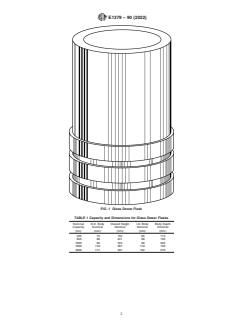
5.1 The general appearance of the flasks shall conform to
Barriers to Trade (TBT) Committee.
Fig. 1.
2. Referenced Documents
6. Design
2.1 ASTM Standards:
6.1 Flasks shall be cylindrically shaped and have double
B85Specification for Aluminum-Alloy Die Castings
walls silvered on the inside. The space between the walls shall
−7
E438Specification for Glasses in Laboratory Apparatus
be evacuated to a vacuum level of 5×10 Torr and sealed.
E671Specification for Maximum Permissible Thermal Re-
Temperatures are to be held in excess of 500°C during
sidual Stress in Annealed Glass Laboratory Apparatus
evacuation.
6.2 Flasks shall be firmly cemented into the base to protect
3. Classification
the sealing tip.
3.1 Glass Dewar flasks shall be of the following sizes: 265
6.3 Flasks shall have a protective plastic mesh, or shall be
mL, 665 mL, 1000 mL, 1900 mL, 4300 mL
coated with a baked-on plastisol over exposed glass surface.
NOTE 1—The term millilitre (mL) is commonly used as a special name
7. Capacity and Dimensions
7.1 Standard Dewar flasks for government use shall con-
This specification is under
...