

ASTM E1405-98(2022)
(Specification)Standard Specification for Laboratory Glass Distillation Flasks
General Information
- Abstract
ABSTRACT
This specification covers standard dimensional requirements for glass distillation flasks. It includes general purpose flasks and flasks designed for specific tests especially in the petroleum testing area. Distillation flasks shall be of the following types: Type I and Type II. Type II distilling flasks shall be of the following classes: Class 1; Class 2; Class 3; Class 4; and Class 5.
SCOPE
1.1 This specification covers standard dimensional requirements for glass distillation flasks. It includes general purpose flasks and flasks designed for specific tests especially in the petroleum testing area.
Note 1: For packaging standards, choose among Specifications E920, E1157, and E1133.
1.2 The values stated in SI units are to be regarded as standard. No other units of measurement are included in this standard.
1.3 This international standard was developed in accordance with internationally recognized principles on standardization established in the Decision on Principles for the Development of International Standards, Guides and Recommendations issued by the World Trade Organization Technical Barriers to Trade (TBT) Committee.
- Status
- Published
- Publication Date
- 31-Aug-2022
- Technical Committee
- E41 - Laboratory Apparatus
- Drafting Committee
- E41.01 - Laboratory Ware and Supplies


Overview
ASTM E1405-98(2022): Standard Specification for Laboratory Glass Distillation Flasks is an internationally recognized standard provided by ASTM International. This specification outlines the standard dimensional requirements and manufacturing characteristics for glass distillation flasks used in laboratories. These flasks are essential tools for performing various distillation processes, particularly in petroleum testing and general chemical analysis. The standard covers both general-purpose flasks and those designed for specific testing applications, ensuring reliability and consistency in laboratory environments.
Key Topics
Flask Types and Classes
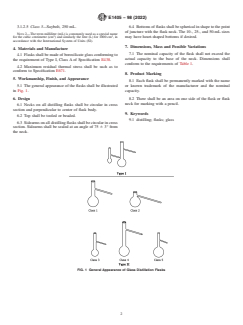
- Type I: General purpose distillation flasks available in a range of nominal capacities including 10, 25, 50, 125, 200, 250, 500, 1000, and 2000 mL.
- Type II: Flask designed for special tests, subdivided into Classes 1 to 5, each associated with specific nominal capacities and test methods (e.g., Barrett, Church, Engler, Hempel, Saybolt).
Materials and Manufacturing
- Flasks are constructed from high-quality borosilicate glass, conforming to ASTM E438 Type I, Class A for superior chemical resistance and thermal stability.
- Strict control of maximum permissible thermal residual stress in accordance with ASTM E671 ensures safety and durability in laboratory use.
Design and Dimensions
- Uniform design specifications include circular cross-sections for necks and sidearms, spherical flask bottoms, and specified wall thickness.
- Permanent marking requirements ensure clear identification of manufacturer and nominal capacity.
Standardization Principles
- The specification aligns with internationally accepted standardization practices, supporting consistency and compatibility across laboratories globally.
Applications
The ASTM E1405-98(2022) standard has widespread utility for industries and laboratories involved in:
- Petroleum Testing: Used for critical tests involving distillation of crude oils, road tars, turpentine, natural gasoline, and related products.
- Quality Control: Ensures measurements and results are consistent across tests conducted in different labs by standardizing glassware used in distillation.
- Chemical Analysis: Provides reliable glassware for the separation and analysis of volatile compounds in organic and inorganic materials.
- Industrial Laboratories: Utilized in chemical manufacturing, environmental testing, and academic research where precise distillation is required.
- Compliance and Procurement: Meeting procurement specifications based on international standards for laboratory glassware.
Related Standards
Several key ASTM standards complement and reference ASTM E1405-98(2022), enhancing laboratory practice and safety:
- ASTM E438 - Standard Specification for Glasses in Laboratory Apparatus
- ASTM E671 - Specification for Maximum Permissible Thermal Residual Stress in Annealed Glass Laboratory Apparatus
- ASTM E920, E1133, E1157 - Standards for packaging and performance of laboratory glassware
- ASTM D86, D1078, D850, D402, D447, D20, D233, D801, D802, etc. - Test methods and procedures for specific petroleum and chemical analyses
- ASTM E4 - Practices for Force Calibration and Verification of Testing Machines
- ASTM E3 - Guide for Preparation of Metallographic Specimens
Adhering to the ASTM E1405-98(2022) standard ensures high-quality, safe, and consistent laboratory operations globally, supporting both compliance and the advancement of scientific research.
Keywords: laboratory distillation flasks, ASTM E1405, borosilicate glass, petroleum testing, chemical analysis, glassware standards, laboratory glassware specification, standard dimensions, quality control.
Relations
- Effective Date
- 01-Feb-2024
- Effective Date
- 01-Dec-2023
- Effective Date
- 01-Dec-2023
- Effective Date
- 01-Jul-2019
- Effective Date
- 01-Jan-2018
- Effective Date
- 01-Jul-2016
- Effective Date
- 01-Jun-2014
- Effective Date
- 01-Nov-2013
- Effective Date
- 01-Nov-2013
- Effective Date
- 01-Jun-2013
- Effective Date
- 01-Jun-2013
- Effective Date
- 01-Nov-2012
- Refers
ASTM D86-11b - Standard Test Method for Distillation of Petroleum Products at Atmospheric Pressure - Effective Date
- 01-Dec-2011
- Effective Date
- 01-Dec-2011
- Effective Date
- 01-Dec-2011
Get Certified
Connect with accredited certification bodies for this standard

ECOCERT
Organic and sustainability certification.

Eurofins Food Testing Global
Global leader in food, environment, and pharmaceutical product testing.

Intertek Bangladesh
Intertek certification and testing services in Bangladesh.
Sponsored listings
Frequently Asked Questions
ASTM E1405-98(2022) is a technical specification published by ASTM International. Its full title is "Standard Specification for Laboratory Glass Distillation Flasks". This standard covers: ABSTRACT This specification covers standard dimensional requirements for glass distillation flasks. It includes general purpose flasks and flasks designed for specific tests especially in the petroleum testing area. Distillation flasks shall be of the following types: Type I and Type II. Type II distilling flasks shall be of the following classes: Class 1; Class 2; Class 3; Class 4; and Class 5. SCOPE 1.1 This specification covers standard dimensional requirements for glass distillation flasks. It includes general purpose flasks and flasks designed for specific tests especially in the petroleum testing area. Note 1: For packaging standards, choose among Specifications E920, E1157, and E1133. 1.2 The values stated in SI units are to be regarded as standard. No other units of measurement are included in this standard. 1.3 This international standard was developed in accordance with internationally recognized principles on standardization established in the Decision on Principles for the Development of International Standards, Guides and Recommendations issued by the World Trade Organization Technical Barriers to Trade (TBT) Committee.
ABSTRACT This specification covers standard dimensional requirements for glass distillation flasks. It includes general purpose flasks and flasks designed for specific tests especially in the petroleum testing area. Distillation flasks shall be of the following types: Type I and Type II. Type II distilling flasks shall be of the following classes: Class 1; Class 2; Class 3; Class 4; and Class 5. SCOPE 1.1 This specification covers standard dimensional requirements for glass distillation flasks. It includes general purpose flasks and flasks designed for specific tests especially in the petroleum testing area. Note 1: For packaging standards, choose among Specifications E920, E1157, and E1133. 1.2 The values stated in SI units are to be regarded as standard. No other units of measurement are included in this standard. 1.3 This international standard was developed in accordance with internationally recognized principles on standardization established in the Decision on Principles for the Development of International Standards, Guides and Recommendations issued by the World Trade Organization Technical Barriers to Trade (TBT) Committee.
ASTM E1405-98(2022) is classified under the following ICS (International Classification for Standards) categories: 71.040.20 - Laboratory ware and related apparatus. The ICS classification helps identify the subject area and facilitates finding related standards.
ASTM E1405-98(2022) has the following relationships with other standards: It is inter standard links to ASTM E438-92(2024), ASTM D86-23a, ASTM D86-23ae1, ASTM E920-97(2019), ASTM E438-92(2018), ASTM D86-16, ASTM E4-14, ASTM D233-13, ASTM E920-97(2013), ASTM D801-02(2013), ASTM D802-02(2013), ASTM D233-12, ASTM D86-11b, ASTM E438-92(2011), ASTM E1157-87(2011). Understanding these relationships helps ensure you are using the most current and applicable version of the standard.
ASTM E1405-98(2022) is available in PDF format for immediate download after purchase. The document can be added to your cart and obtained through the secure checkout process. Digital delivery ensures instant access to the complete standard document.
Standards Content (Sample)
This international standard was developed in accordance with internationally recognized principles on standardization established in the Decision on Principles for the
Development of International Standards, Guides and Recommendations issued by the World Trade Organization Technical Barriers to Trade (TBT) Committee.
Designation: E1405 −98 (Reapproved 2022)
Standard Specification for
Laboratory Glass Distillation Flasks
This standard is issued under the fixed designation E1405; the number immediately following the designation indicates the year of
original adoption or, in the case of revision, the year of last revision. A number in parentheses indicates the year of last reapproval. A
superscript epsilon (´) indicates an editorial change since the last revision or reapproval.
1. Scope D801 Test Methods for Sampling and Testing Dipentene
D802 Test Methods for Sampling and Testing Pine Oils
1.1 This specification covers standard dimensional require-
D850 Test Method for Distillation of Industrial Aromatic
ments for glass distillation flasks. It includes general purpose
Hydrocarbons and Related Materials
flasks and flasks designed for specific tests especially in the
D1078 Test Method for Distillation Range of Volatile Or-
petroleum testing area.
ganic Liquids
NOTE 1—For packaging standards, choose among Specifications E920,
D2569 Test Method for Distillation of Pitch (Withdrawn
E1157, and E1133. 3
2006)
1.2 The values stated in SI units are to be regarded as
E3 Guide for Preparation of Metallographic Specimens
standard. No other units of measurement are included in this
E4 Practices for Force Calibration and Verification of Test-
standard.
ing Machines
E438 Specification for Glasses in Laboratory Apparatus
1.3 This international standard was developed in accor-
E671 Specification for Maximum Permissible Thermal Re-
dance with internationally recognized principles on standard-
sidual Stress in Annealed Glass Laboratory Apparatus
ization established in the Decision on Principles for the
E920 Specification for Commercially Packaged Laboratory
Development of International Standards, Guides and Recom-
Apparatus
mendations issued by the World Trade Organization Technical
E921 Specification for Export Packaged Laboratory Appa-
Barriers to Trade (TBT) Committee.
ratus
2. Referenced Documents
E1133 Practice for Performance Testing of Packaged Labo-
ratory Apparatus for United States Government Procure-
2.1 ASTM Standards:
ments
D20 Test Method for Distillation of Road Tars
E1157 Specification for Sampling and Testing of Reusable
D86 Test Method for Distillation of Petroleum Products and
Laboratory Glassware
Liquid Fuels at Atmospheric Pressure
2.2 Other Documents:
D216 Method of Test for Distillation of Natural Gasoline
U.S. Bureau of Mines Technical Paper
(Withdrawn 1988)
323B Method 100.13
D233 Test Methods of Sampling and Testing Turpentine
D246 TestMethodforDistillationofCreosoteandCreosote-
3 3. Classification
Coal Tar Solutions (Withdrawn 2006)
3.1 Distillation flasks shall be of the following types and
D285 Test Method for DISTILLATION OF CRUDE PE-
TROLEUM (Withdrawn 1985) sizes:
3.1.1 Type I—General purpose distilling flasks shall be of
D402 Test Method for Distillation of Cutback Asphalt
D447 Test Method for Distillation Of Plant Spray Oils the following nominal capacities: 10 mL; 25 mL; 50 mL; 125
mL; 200 mL; 250 mL; 500 mL; 1000 mL; 2000 mL.
(Withdrawn 1998)
3.1.2 Type II—Special purpose distilling flasks shall be of
the following classes:
This specification is under the jurisdiction of ASTM Committee E41 on
3.1.2.1 Class 1—Barrett, 200 mL.
LaboratoryApparatus and is the direct responsibility of E41.01 on Laboratory Ware
3.1.2.2 Class 2—Church, in the following sizes: 300 mL;
and Supplies.
Current edition approved Sept. 1, 2022. Published September 2022. Originally
500 mL.
approved in 1991. Last previous edition approved in 2016 as E1405 – 98(2016).
3.1.2.3 Class 3—Engler, 100 mL.
DOI: 10.1520/E1405-98R22.
2 3.1.2.4 Class 4—Hempel, 500 mL.
For referenced ASTM standards, visit the ASTM website, www.astm.org, or
contact ASTM Customer Service at service@astm.org. For Annual Book of ASTM
Standards volume information, refer to the standard’s Document Summary page on
the ASTM website. Available from Standardization Documents Order Desk, DODSSP, Bldg. 4,
The last approved version of this historical standard is referenced on Section D, 700 Robbins Ave., Philadelphia, PA 19111-5098, http://
www.astm.org. dodssp.daps.dla.mil.
Copyright © ASTM International, 100 Barr Harbor Drive, PO Box C700, West Conshohocken, PA 19428-2959. United States
E1405 − 98 (2022)
3.1.2.5 Class 5—Saybolt, 250 mL. 6.4 Bottoms of flasks shall be spherical in
...