


ASTM F1936-19
(Specification)Standard Specification for Impact Attenuation of Turf Playing Systems as Measured in the Field
Standard Specification for Impact Attenuation of Turf Playing Systems as Measured in the Field
ABSTRACT
This specification covers a test method and the corresponding performance requirement for the maximum impact attenuation in all types of turf playing systems installed for North American football fields that is intended to establish a method for identifying and reporting areas within an existing playing system where shock-absorbing properties exceed recommended threshold values. The turf playing system typically includes field areas within and outside the inbound lines extending to the sport specific limit lines as defined by the appropriate regulating body or appropriate standard, or both. All of these areas are regions where an athlete should expect compliant impact attenuation characteristics, but, it does not imply that an injury cannot be incurred if the surface system complies with this specification. The test method, aptly called the free-fall drop test, shall be performed at eight different test point locations for four specific types of surface systems, namely: synthetic turf systems with resilient padding; natural turf systems; combination turf systems; and infill synthetic turf systems.
SCOPE
1.1 This specification establishes an in situ test method and maximum impact attenuation value for all types of turf playing systems and for a number of sport-specific field layouts. It also includes a protocol for determining test point locations on fields that are lined for multiple sports.
1.1.1 Turf playing systems may be located outdoors or indoors, and typically include field areas within the in-bounds lines and areas outside the in-bounds lines extending to sport-specific limit lines; areas where an athlete should expect to encounter impact attenuation performance that complies with this specification.
1.1.2 Site-specific conditions may exist wherein non-turf surface materials, such as track surfacing and/or covers over subsurface structures, are found within the boundaries of the limit lines. These alternate surface materials are not included in the scope of this specification.
1.2 This specification establishes a method for reporting test results and identifying areas within an existing turf playing system where impact attenuation measurements exceed required threshold values.
1.3 Nothing in this specification is intended to impose limitations on what fields can be tested, or how a particular field can be used. Test providers can adapt the procedures and guidelines contained herein to tests performed on any turf playing system.
1.4 This specification does not imply that an impact-related injury cannot be incurred if a turf playing system complies with its g-max performance requirement.
1.5 The values stated in inch-pound units are to be regarded as standard. The values given in parentheses are mathematical conversions to SI units that are provided for information only and are not considered standard.
1.6 This standard does not purport to address all of the safety concerns, if any, associated with its use. It is the responsibility of the user of this standard to establish appropriate safety, health, and environmental practices and determine the applicability of regulatory limitations prior to use.
1.7 This international standard was developed in accordance with internationally recognized principles on standardization established in the Decision on Principles for the Development of International Standards, Guides and Recommendations issued by the World Trade Organization Technical Barriers to Trade (TBT) Committee.
General Information
- Status
- Published
- Publication Date
- 30-Jun-2019
- Technical Committee
- F08 - Sports Equipment, Playing Surfaces, and Facilities
- Drafting Committee
- F08.65 - Artificial Turf Surfaces and Systems
Relations
- Effective Date
- 01-Jul-2019
- Effective Date
- 01-Dec-2023
- Effective Date
- 01-Sep-2023
- Effective Date
- 01-Dec-2018
- Effective Date
- 01-Dec-2018
- Effective Date
- 01-Dec-2017
- Effective Date
- 01-Oct-2017
- Refers
ASTM F2650-17e1 - Standard Terminology Relating to Impact Testing of Sports Surfaces and Equipment - Effective Date
- 15-Sep-2017
- Refers
ASTM F2650-17 - Standard Terminology Relating to Impact Testing of Sports Surfaces and Equipment - Effective Date
- 15-Sep-2017
- Effective Date
- 01-May-2017
- Effective Date
- 01-Jul-2016
- Effective Date
- 01-Jul-2016
- Effective Date
- 01-May-2014
- Effective Date
- 01-Nov-2013
- Refers
ASTM F2650-13 - Standard Terminology Relating to Impact Testing of Sports Surfaces and Equipment - Effective Date
- 01-Jun-2013
Overview
ASTM F1936-19 – "Standard Specification for Impact Attenuation of Turf Playing Systems as Measured in the Field" – is an important ASTM standard that defines an in situ test method and performance requirement for measuring the impact attenuation (shock absorption) properties of all types of turf playing systems used primarily in North American football and various other sports. The main objective of this standard is to provide a consistent procedure to identify and report field areas where impact attenuation, measured via maximum g-max value, exceeds recommended threshold levels. This helps ensure that turf fields maintain suitable surface conditions to promote player safety, although compliance does not guarantee the elimination of injury risk.
Key Topics
- Scope of Application: ASTM F1936-19 covers synthetic turf systems with resilient padding, natural turf systems, combination turf systems, and infill synthetic turf systems. It applies to both outdoor and indoor fields, within and outside the in-bounds lines up to sport-specific limit lines.
- Impact Attenuation Test: The standard relies on the free-fall drop test, using specific equipment to drop a weighted missile at predetermined field locations and record the playing surface’s ability to absorb impact (g-max value).
- Performance Requirement: The average g-max at each test point must be less than 200 g’s. Areas failing this requirement should be brought into compliance prior to use.
- Test Locations: For each field configuration (football, soccer, lacrosse, field hockey, baseball, softball, and multipurpose/unlined fields), the standard prescribes minimum test point locations to prioritize both high-wear and in-play areas.
- Reporting and Compliance: Results are documented comprehensively, including field conditions, environmental data, and specific g-max values per location.
Applications
- Facility Safety Assurance: Sports field owners, operators, and maintenance teams use this standard to evaluate and manage the safety and performance of their turf playing surfaces.
- Multi-Sport Field Testing: The protocol provides clear guidance on test point selection for fields marked for multiple sports, ensuring that athlete safety is evaluated across different usage scenarios.
- Maintenance Scheduling: Data generated allow facilities to identify sections requiring remediation or replacement, supporting preventative maintenance planning.
- Compliance and Certification: Meeting ASTM F1936-19 is often a requirement for field certification, insurance compliance, or eligibility for hosting official athletic events.
- Design and Installation Guidance: Architects, engineers, and turf system manufacturers use the standard to ensure installations deliver consistent shock-absorbing properties across all field areas.
Related Standards
If you are utilizing or referencing ASTM F1936-19, the following standards may also be relevant:
- ASTM F355 – Test Method for Impact Attenuation of Playing Surface Systems, Protective Sport Systems, and Athletic Materials
- ASTM F1292 – Specification for Impact Attenuation of Surfacing Materials within the Use Zone of Playground Equipment
- ASTM F1702 – Test Method for Measuring Impact-Attenuation Characteristics of Natural Playing Surface Systems
- ASTM F1551 – Comprehensive Characterization of Synthetic Turf Playing Surfaces
- ASTM E177 & E691 – Guidance on test method precision and conducting interlaboratory studies
- ASTM F2650 – Terminology Relating to Impact Testing of Sports Surfaces and Equipment
Practical Value
Adhering to ASTM F1936-19 helps facility managers, field owners, and sports organizations:
- Consistently evaluate turf playing surface safety and performance onsite
- Document and rectify areas where surface hardness poses elevated injury risks
- Meet regulatory and insurance criteria for field safety and maintenance
- Enhance athlete protection by maintaining compliance with accepted impact attenuation benchmarks
- Ensure uniform surface performance across high-traffic and diverse field areas
Conclusion
ASTM F1936-19 establishes standardized, field-based testing for impact attenuation on sports turf systems, supporting player safety and performance consistency. Facilities should incorporate this standard into their routine safety, maintenance, and quality assurance protocols for all turf athletic fields.
Buy Documents
ASTM F1936-19 - Standard Specification for Impact Attenuation of Turf Playing Systems as Measured in the Field
REDLINE ASTM F1936-19 - Standard Specification for Impact Attenuation of Turf Playing Systems as Measured in the Field
Frequently Asked Questions
ASTM F1936-19 is a technical specification published by ASTM International. Its full title is "Standard Specification for Impact Attenuation of Turf Playing Systems as Measured in the Field". This standard covers: ABSTRACT This specification covers a test method and the corresponding performance requirement for the maximum impact attenuation in all types of turf playing systems installed for North American football fields that is intended to establish a method for identifying and reporting areas within an existing playing system where shock-absorbing properties exceed recommended threshold values. The turf playing system typically includes field areas within and outside the inbound lines extending to the sport specific limit lines as defined by the appropriate regulating body or appropriate standard, or both. All of these areas are regions where an athlete should expect compliant impact attenuation characteristics, but, it does not imply that an injury cannot be incurred if the surface system complies with this specification. The test method, aptly called the free-fall drop test, shall be performed at eight different test point locations for four specific types of surface systems, namely: synthetic turf systems with resilient padding; natural turf systems; combination turf systems; and infill synthetic turf systems. SCOPE 1.1 This specification establishes an in situ test method and maximum impact attenuation value for all types of turf playing systems and for a number of sport-specific field layouts. It also includes a protocol for determining test point locations on fields that are lined for multiple sports. 1.1.1 Turf playing systems may be located outdoors or indoors, and typically include field areas within the in-bounds lines and areas outside the in-bounds lines extending to sport-specific limit lines; areas where an athlete should expect to encounter impact attenuation performance that complies with this specification. 1.1.2 Site-specific conditions may exist wherein non-turf surface materials, such as track surfacing and/or covers over subsurface structures, are found within the boundaries of the limit lines. These alternate surface materials are not included in the scope of this specification. 1.2 This specification establishes a method for reporting test results and identifying areas within an existing turf playing system where impact attenuation measurements exceed required threshold values. 1.3 Nothing in this specification is intended to impose limitations on what fields can be tested, or how a particular field can be used. Test providers can adapt the procedures and guidelines contained herein to tests performed on any turf playing system. 1.4 This specification does not imply that an impact-related injury cannot be incurred if a turf playing system complies with its g-max performance requirement. 1.5 The values stated in inch-pound units are to be regarded as standard. The values given in parentheses are mathematical conversions to SI units that are provided for information only and are not considered standard. 1.6 This standard does not purport to address all of the safety concerns, if any, associated with its use. It is the responsibility of the user of this standard to establish appropriate safety, health, and environmental practices and determine the applicability of regulatory limitations prior to use. 1.7 This international standard was developed in accordance with internationally recognized principles on standardization established in the Decision on Principles for the Development of International Standards, Guides and Recommendations issued by the World Trade Organization Technical Barriers to Trade (TBT) Committee.
ABSTRACT This specification covers a test method and the corresponding performance requirement for the maximum impact attenuation in all types of turf playing systems installed for North American football fields that is intended to establish a method for identifying and reporting areas within an existing playing system where shock-absorbing properties exceed recommended threshold values. The turf playing system typically includes field areas within and outside the inbound lines extending to the sport specific limit lines as defined by the appropriate regulating body or appropriate standard, or both. All of these areas are regions where an athlete should expect compliant impact attenuation characteristics, but, it does not imply that an injury cannot be incurred if the surface system complies with this specification. The test method, aptly called the free-fall drop test, shall be performed at eight different test point locations for four specific types of surface systems, namely: synthetic turf systems with resilient padding; natural turf systems; combination turf systems; and infill synthetic turf systems. SCOPE 1.1 This specification establishes an in situ test method and maximum impact attenuation value for all types of turf playing systems and for a number of sport-specific field layouts. It also includes a protocol for determining test point locations on fields that are lined for multiple sports. 1.1.1 Turf playing systems may be located outdoors or indoors, and typically include field areas within the in-bounds lines and areas outside the in-bounds lines extending to sport-specific limit lines; areas where an athlete should expect to encounter impact attenuation performance that complies with this specification. 1.1.2 Site-specific conditions may exist wherein non-turf surface materials, such as track surfacing and/or covers over subsurface structures, are found within the boundaries of the limit lines. These alternate surface materials are not included in the scope of this specification. 1.2 This specification establishes a method for reporting test results and identifying areas within an existing turf playing system where impact attenuation measurements exceed required threshold values. 1.3 Nothing in this specification is intended to impose limitations on what fields can be tested, or how a particular field can be used. Test providers can adapt the procedures and guidelines contained herein to tests performed on any turf playing system. 1.4 This specification does not imply that an impact-related injury cannot be incurred if a turf playing system complies with its g-max performance requirement. 1.5 The values stated in inch-pound units are to be regarded as standard. The values given in parentheses are mathematical conversions to SI units that are provided for information only and are not considered standard. 1.6 This standard does not purport to address all of the safety concerns, if any, associated with its use. It is the responsibility of the user of this standard to establish appropriate safety, health, and environmental practices and determine the applicability of regulatory limitations prior to use. 1.7 This international standard was developed in accordance with internationally recognized principles on standardization established in the Decision on Principles for the Development of International Standards, Guides and Recommendations issued by the World Trade Organization Technical Barriers to Trade (TBT) Committee.
ASTM F1936-19 is classified under the following ICS (International Classification for Standards) categories: 97.220.10 - Sports facilities. The ICS classification helps identify the subject area and facilitates finding related standards.
ASTM F1936-19 has the following relationships with other standards: It is inter standard links to ASTM F1936-10(2015), ASTM F355-23, ASTM F1551-23, ASTM F1292-18, ASTM F1702-10(2018), ASTM F1551-09(2017), ASTM F1292-17a, ASTM F2650-17e1, ASTM F2650-17, ASTM F1292-17, ASTM F355-16e1, ASTM F355-16, ASTM E177-14, ASTM F1292-13, ASTM F2650-13. Understanding these relationships helps ensure you are using the most current and applicable version of the standard.
ASTM F1936-19 is available in PDF format for immediate download after purchase. The document can be added to your cart and obtained through the secure checkout process. Digital delivery ensures instant access to the complete standard document.
Standards Content (Sample)
This international standard was developed in accordance with internationally recognized principles on standardization established in the Decision on Principles for the
Development of International Standards, Guides and Recommendations issued by the World Trade Organization Technical Barriers to Trade (TBT) Committee.
Designation:F1936 −19 An American National Standard
Standard Specification for
Impact Attenuation of Turf Playing Systems as Measured in
the Field
This standard is issued under the fixed designation F1936; the number immediately following the designation indicates the year of
original adoption or, in the case of revision, the year of last revision. A number in parentheses indicates the year of last reapproval. A
superscript epsilon (´) indicates an editorial change since the last revision or reapproval.
INTRODUCTION
The impact attenuation of turf playing systems can be measured in a laboratory, but such tests are
often conducted under optimal or tightly controlled conditions. To accurately assess the impact
attenuationanathletewillencounteronaninstalledfield,thatspecificfieldmustbetested in situ.That
objective was the impetus for the development of this specification. Initially, the stated scope of the
specification was limited to measuring the impact attenuation of North American football fields. The
scope of the current revision encompasses a broader range of sport-specific field configurations and
a protocol for conducting tests on multi-sport fields.
1. Scope 1.4 This specification does not imply that an impact-related
injurycannotbeincurredifaturfplayingsystemcomplieswith
1.1 This specification establishes an in situ test method and
its g-max performance requirement.
maximum impact attenuation value for all types of turf playing
systems and for a number of sport-specific field layouts. It also 1.5 The values stated in inch-pound units are to be regarded
includes a protocol for determining test point locations on as standard. The values given in parentheses are mathematical
fields that are lined for multiple sports. conversions to SI units that are provided for information only
1.1.1 Turf playing systems may be located outdoors or and are not considered standard.
indoors, and typically include field areas within the in-bounds
1.6 This standard does not purport to address all of the
lines and areas outside the in-bounds lines extending to
safety concerns, if any, associated with its use. It is the
sport-specific limit lines; areas where an athlete should expect
responsibility of the user of this standard to establish appro-
to encounter impact attenuation performance that complies
priate safety, health, and environmental practices and deter-
with this specification.
mine the applicability of regulatory limitations prior to use.
1.1.2 Site-specific conditions may exist wherein non-turf
1.7 This international standard was developed in accor-
surface materials, such as track surfacing and/or covers over
dance with internationally recognized principles on standard-
subsurface structures, are found within the boundaries of the
ization established in the Decision on Principles for the
limitlines.Thesealternatesurfacematerialsarenotincludedin
Development of International Standards, Guides and Recom-
the scope of this specification.
mendations issued by the World Trade Organization Technical
Barriers to Trade (TBT) Committee.
1.2 Thisspecificationestablishesamethodforreportingtest
results and identifying areas within an existing turf playing
2. Referenced Documents
system where impact attenuation measurements exceed re-
quired threshold values.
2.1 ASTM Standards:
E177 Practice for Use of the Terms Precision and Bias in
1.3 Nothing in this specification is intended to impose
ASTM Test Methods
limitations on what fields can be tested, or how a particular
E691 Practice for Conducting an Interlaboratory Study to
field can be used. Test providers can adapt the procedures and
Determine the Precision of a Test Method
guidelines contained herein to tests performed on any turf
F355 TestMethodforImpactAttenuationofPlayingSurface
playing system.
Systems, Other Protective Sport Systems, and Materials
This specification is under the jurisdiction ofASTM Committee F08 on Sports
Equipment, Playing Surfaces, and Facilities and is the direct responsibility of
Subcommittee F08.65 on Artificial Turf Surfaces and Systems. For referenced ASTM standards, visit the ASTM website, www.astm.org, or
Current edition approved July 1, 2019. Published July 2019. Originally approved contact ASTM Customer Service at service@astm.org. For Annual Book of ASTM
in 1998. Last previous edition approved in 2015 as F1936 – 10 (2015). DOI: Standards volume information, refer to the standard’s Document Summary page on
10.1520/F1936-19. the ASTM website.
Copyright © ASTM International, 100 Barr Harbor Drive, PO Box C700, West Conshohocken, PA 19428-2959. United States
F1936−19
Used for Athletics, Recreation and Play 3.1.11 restraining ring—a rigid circular device with a
F1292 Specification for Impact Attenuation of Surfacing smooth or polished surface, creating little or no friction, used
Materials Within the Use Zone of Playground Equipment to restrict the horizontal movement of the missile at impact.
F1551 Test Methods for Comprehensive Characterization of
3.1.12 synthetic turf system—a composite of synthetic con-
Synthetic Turf Playing Surfaces and Materials
tact surface material, any fill material used in the contact
F1702 TestMethodforMeasuringImpact-AttenuationChar-
surface, energy absorbing material, fabric layers, adhesives, if
acteristics of Natural Playing Surface Systems Using a
any, and other constructed layers (as applicable to the indi-
Lightweight Portable Apparatus
vidual system).
F2650 Terminology Relating to Impact Testing of Sports
3.1.13 test point—a location on the turf playing system at
Surfaces and Equipment
which a series of measurements is taken.
2.2 ISO Standard:
3.1.14 theoretical drop height—the drop height (h) that,
ISO 6587 Paper, board and pulps – Determination of con-
under standard conditions, would result in an impact velocity
ductivity of aqueous extracts
equal to a missile’s measured impact velocity (Vo).
NOTE1—Additionalreferencesarelistedattheendofthisspecification.
4. Summary of Test Method
3. Terminology
4.1 Turf playing systems are tested according to this speci-
3.1 Definitions: Except as noted, definitions in this standard
ficationandTestMethodF355,ProcedureA.Atheoreticaldrop
are in accordance with Terminology F2650.
height of 24 in. (61 cm), as measured from the bottom of the
3.1.1 abnormal drop—any drop of the missile which, due to
missile face to the top of the turf playing system, shall be used.
operator or equipment problem(s) or uncertainty, results in a
At each test point, the impact missile is dropped onto the turf
reading which is questionable.
playing system three times, with an interval of 1.0 6 0.5 min
3.1.2 average g-max—sum of the g-max of the second and
(60 6 30 s) between successive drops. The g-max value for
third drops divided by two and rounded to the nearest whole
each drop is recorded and reported. Following the third drop,
number.
the average g-max value for the test point is calculated and
3.1.3 combination turf system—a turf playing system con-
reported.
sisting of a natural turf surface which is enhanced by use of
synthetic elements such as synthetic turf substructures, exclud-
5. Significance and Use
ing water/drainage systems and single layer mesh fabrics,
5.1 Data obtained from the use of this specification are
which are used for the sole purpose of soil stabilization.
indicative of the impact attenuation performance of individual
3.1.4 droptest—asetofthreesuccessivedropsoftheimpact
test points on an installed turf playing system.The data may be
missileatatestpoint,whereeachdrophasbeenperformedand
used to make comparisons between values measured in accor-
recorded in accordance with prescribed guidelines.
dance with this specification and performance requirements
3.1.5 infill turf system—a turf playing system having a long herein or elsewhere specified. Data may also be used to
pile height and one or more substances in the face of the fabric
determine the need for maintenance and or replacement of the
to provide desired performance properties. Infill materials can turf playing system.
include sand, rubber, other substances, or combinations
thereof. 6. Performance Requirements
3.1.6 impact velocity—the velocity of the missile as it
6.1 When tested in accordance with this specification, the
impacts the turf playing system.
average g-max at each test point shall be less than 200 g’s.
3.1.7 limit lines—limits beyond the in-bounds boundaries
6.2 If a turf playing system is tested in accordance with this
that represent the extent to which the out-of-bounds areas
specification, and the reported average g-max of one or more
should remain free of hazards and obstructions, and where an
test points is equal to or greater than 200 g’s, the turf playing
athlete may anticipate consistent surface characteristics. These
system should be brought into compliance and should not be
limits are defined by the appropriate governing body or
used in the interim.
regulating standard for each specific sport.
6.3 Nothing in this specification is intended to keep an
3.1.8 natural turf system—a turf playing system which is
owner, architect, engineer or other specifier from establishing
comprised of living grass or similar plant materials which are
more stringent performance requirements for a turf playing
rooted in soil.
system. However, reports prepared in accordance with this
3.1.9 pile—a surface texture composed of many individual specification shall assess performance per the requirements
thin strands or groups of strands bound to a backing fabric in described in 6.1 and 6.2.
a repetitive array.
7. Test Apparatus
3.1.10 pile layover—a horizontal motion of the pile under
the influence of impact.
7.1 The impacting missile shall be cylindrical with a
circular, flat, metal, impacting surface. It shall weigh 20 lb (9.1
2 2
kg), and have a 20 in. (129 cm ) surface face with the
Available fromAmerican National Standards Institute (ANSI), 25 W. 43rd St.,
4th Floor, New York, NY 10036, http://www.ansi.org. impacting edges slightly beveled to eliminate sharp edges. The
F1936−19
design of the missile shall provide for mounting the acceler- 7.7 The minimum required system sampling rate is 20 000
ometer within 61° of the vertical axis of the missile, and allow Hz.
the missile to achieve a velocity of 11.35 6 0.56 ft/s (3.46 6
7.8 The test equipment shall be capable of visually display-
0.17 m/s) (referenced in Section 27 of Test Methods F1551 as
ing and recording the acceleration-time curve of each drop.
thevelocitycorrespondingtoatheoreticaldropheightof24in.
NOTE 2—The Clegg Hammer, as defined in Test Method F1702,isnot
(61 cm) at sea level) upon impact from the drop height.
an appropriate device for testing under this specification. Results obtained
with a Clegg Hammer and subsequently adjusted by conversion factors or
7.2 To restrict the influence of pile layover, the test equip-
regression equations are not appropriate for inclusion in a report prepared
ment shall be designed to include a rigid restraining ring with
in accordance with this specification.
a smooth or polished surface, creating little or no friction,
8. Test Point Locations
having an interior dimension not to exceed the diameter of the
missile by more than 0.039 in. (1 mm). The ring shall be
8.1 The following sections describe suggested test point
securely mounted horizontal to the surface such that a mini- locations for each listed field configuration. The descriptions
mum of ⁄4 of the missile shall freely pass through it prior to
are supplemented by accompanying illustrations. The number
striking the surface, ensuring a vertical impact and precluding of test points listed for each field configuration constitutes a
the missile’s rebound onto the top of the ring. Other guidance minimum requirement.As noted in 8.11, additional points may
systems can be utilized, provided they do not allow lateral
be tested.
movement greater than 0.039 in. (1 mm) upon impact and 8.1.1 On fields lined for multiple sports, the selection of test
rebound of the missile.
point locations will be determined by the sport which appears
first on the following list: football (American football, Cana-
7.3 The test equipment shall have sufficient stability to
dian football, and rugby), soccer, men’s lacrosse, women’s
eliminate undesirable vibrations in the apparatus which might
lacrosse, baseball, softball, field hockey.
be recorded on the acceleration-time curve. It shall also allow
8.1.2 Actualdropsitesmaybelocatedanywherewithina36
sufficient vertical fall for the missile to achieve a velocity
in. (91 cm) radius of a described test point location. Deviations
corresponding to a theoretical drop height of 24 in. (61 cm).
that exceed this requirement must be recorded as site
7.4 The signal from the acceleration transducer shall be
abnormalities, per 11.1.15.
conditioned with a low pass filter: complying to Channel Class
8.1.3 This specification cannot anticipate all possible field
1000 as specified in Specification F1292 (ISO 6587).
configurations. Persons using it are expected to select the most
7.5 The acceleration recording system must be capable of appropriate set of test points for the field being tested, from
accuratelyresolvingthedecelerationtoaminimumof 61%of among the options specified below.
true value.
8.2 Football (American football, Canadian football, and
7.6 The acceleration transducer must be capable of with- rugby) (see Fig. 1):
standing impacts of at least 1000 g without damage. 8.2.1 Point 1—Goal Line, End A, center of field;
NOTE 1—Test points 7 and 8 are shown for information purposes only. Actual locations are selected at the time of the test and may vary from those
illustrated.
FIG. 1Test Point Locations for North American Football
F1936−19
8.2.2 Point 2—10 Yard Line, End A, 63 ft from center of 8.3.4 Point 4—Center Mark;
field to Side C; 8.3.5 Point5—75ftfromHalfwayLinetoEndB,63ftfrom
8.2.3 Point 3—25 Yard Line, End A, 40 ft from center of center of field to Touch Line D;
field to Side C; 8.3.6 Point 6— ⁄2 the distance from Penalty Arc to leading
8.2.4 Point 4—Center of the field; edge of Penalty Area at End B, center of field;
8.2.5 Point 5—25 Yard Line, End B, 63 ft from center of 8.3.7 Point 7—A test point selected by the tester, with the
field to Side D; objective of identifying and testing a high-wear area located
8.2.6 Point 6—12 Yard Line, End B, center of field; anywhere within the limit lines, but outside the in-bounds
8.2.7 Point 7—A test point selected by the tester, with the lines:
objective of identifying and testing a high-wear area located 8.3.7.1 Limit lines are 10 ft beyond the in-bounds lines on
within the limit lines but outside the in-bounds lines; high school soccer fields, and 20 ft beyond the in-bounds lines
8.2.7.1 Football limit lines are typically 12 ft beyond the on NCAA soccer fields.
in-bounds lines. 8.3.8 Point 8—A test point selected by the tester, with the
8.2.8 Point 8—A test point selected by the tester, with the objective of identifying and testing a point within the limit
objective of identifying and testing an area within the limit lines (to include the in-bounds area) that may have different
lines (to include the in-bounds area) that may have different impact attenuation performance than points previously tested;
impact attenuation performance than points previously tested; 8.3.9 Point 9—3 ft from Goal Line to Halfway Line, EndA,
8.2.9 Point 9—6 ft from the Goal Line to the back of the center of field;
End Zone, End A, center of field; 8.3.10 Point 10—15 ft from Goal Line to Halfway Line,
8.2.10 Point 10—6 ft from the back of the End Zone to the End B, center of field.
Goal Line, End B, center of field. 8.3.11 If the field is less than 300 ft in length or less than
8.2.11 IfthefieldislinedforCanadianfootballorrugbyand 120 ft in width, or both, refer to 8.9.2.
not for American football, refer to 8.9.1 for instructions
8.4 Men’s Lacrosse (see Fig. 3):
regarding test point placement.
8.4.1 Point 1—25 ft from Goal Line to End Line, End A,
8.3 Soccer (see Fig. 2): center of field;
8.3.1 Point 1—Penalty Mark, End A, center of field; 8.4.2 Point2—63ftfrommid-pointofGoalLinetoSideline
8.3.2 Point 2—Corner of PenaltyArea at EndAand closest C, End A;
to Touch Line C; 8.4.3 Point 3—75 ft from Center Line to End A, 40 ft from
8.3.3 Point3—75ftfromHalfwayLinetoEndA,40ftfrom center of field to Sideline C;
center of field to Touch Line C; 8.4.4 Point 4—Center of the field;
NOTE 1—Test points 7 and 8 are shown for information purposes only. Actual locations are selected at the time of the test and may vary from those
illustrated.
FIG. 2Test Point Locations for Soccer
F1936−19
NOTE 1—Test points 7 and 8 are shown for information purposes only. Their locations are selected at the time of the test.
FIG. 3Test Point Locations for Men’s Lacrosse
8.4.5 Point 5—75 ft from Center Line to End B, 63 ft from 8.5.7 Point 7—A test point selected by the tester, with the
center of field to Sideline D; objective of identifying and testing a high-wear area located
8.4.6 Point 6—3 ft from Goal Line to Center Line, End B, anywhere within the boundary lines but outside the lined area
center of field; of the field;
8.4.7 Point 7—A test point selected by the tester, with the 8.5.7.1 Limit (boundary) lines on women’s lacrosse fields
objective of identifying and testing a high-wear area located are variable. The location of the limit lines will be determined
anywhere within the limit lines, but outside the in-bounds by conditions at each test site.
lines; 8.5.8 Point 8—A test point selected by the tester, with the
8.4.7.1 No limit lines are specified for men’s lacrosse fields. objectiveofidentifyingandtestingapointwithintheboundary
Use the 18 ft width of the Coach’s Area as the maximum lines (including the field of play) that may have different
distance from the inbounds lines for test points 7 and 8. impact attenuation performance than points previously tested.
8.4.8 Point 8—A test point selected by the tester, with the 8.5.9 Point 9—3 ft from the End Line at End A to Center
objective of identifying and testing a point within the limit Line, center of field;
lines (to include the in-bounds area) that may have different 8.5.10 Point 10—3 ft from the End Line at End B to Center
impact attenuation performance than points previously tested; Line, center of field.
8.4.9 Point 9—3 ft from the End Line to the Center Line,
8.6 Field Hockey (see Fig. 5):
End A, center of field;
8.6.1 Point 1—3 ft from Goal Line to Center Line, End A,
8.4.10 Point 10—3 ft from the End Line to the Center Line,
center of the field;
End B, center of field.
8.6.2 Point 2—30 ft from Goal Line at End A to Center
8.5 Women’s Lacrosse (see Fig. 4): Line, 63 ft from center of the field to Sideline C;
8.5.1 Point 1—3 ft from Goal Line to Center Line, End A, 8.6.3 Point 3—25 Yard Line, End A, 40 ft from center of
center of field; field to Sideline C;
8.5.2 Point 2—30 ft from Goal Line at End A to Center 8.6.4 Point 4—Center of the field;
Line, 63 ft from center of field to Side C; 8.6.5 Point 5—25 Yard Line, End B, 63 ft from center of
8.5.3 Point 3—75 ft from Goal Line at End A to Center field to Sideline D;
Line, 40 ft from center of field to Side C; 8.6.6 Point 6—12 ft from edge of Striking Circle to Goal
8.5.4 Point 4—Center of the field; Line, End B, center of field;
8.5.5 Point 5—75 ft from Goal Line at End B to Center 8.6.7 Point 7—A test point selected by the tester, with the
Line, 63 ft from center of field to Side D; objective of identifying and testing a high-wear area located
8.5.6 Point 6—3 ft from 8-Meter-Arc to Goal Line, End B, anywhere within the limit lines, but outside the in-bounds
center of field; lines;
F1936−19
NOTE 1—Test points 7 and 8 are shown for information purposes only. Their locations are selected at the time of the test and may vary from those
illustrated.
FIG. 4Test Point Locations for Women’s Lacrosse
NOTE 1—Test points 7, 8, 9, and 10 are shown for information purposes only. Their locations are selected at the time of the test and may vary from
those illustrated.
FIG. 5Test Point Locations for Field Hockey
8.6.7.1 Limit lines are 15 ft outside the in-bounds lines on 8.6.8 Point 8—A test point selected by the tester, with the
field hockey fields. objective of identifying and testing a point within the limit
F1936−19
lines (to include the in-bounds area) that may have different 8.7.11 If the turf playing system is not rectangular, or it is
impact attenuation performance than points previously tested; less than 310 ft in length or 126 ft in width, refer to 8.9.6.
8.6.9 Point 9—A test point selected by the tester, with the
8.8 Baseball and Softball (see Fig. 7):
objective of identifying and testing a high-wear area located
8.8.1 Point 1—25ftfromthetipofHomePlatetothecenter
anywhere within the limit lines, but outside the in-bounds
of the Pitcher’s Mound;
lines;
st nd
8.8.2 Point 2—6 ft from 1 Base to 2 Base;
8.6.10 Point 10—Atest point selected by the tester, with the
nd st
8.8.3 Point 3—3 ft from 2 Base to 1 Base;
objective of identifying and testing a point within the limit
rd nd
8.8.4 Point 4—4 ft from 3 Base to 2 Base;
lines (to include the in-bounds area) that may have different
rd
impact attenuation performance than points previously tested. 8.8.5 Point 5—Perpendicular to the mid-point of 3 Base
Line, half the distance from the Base Line to the Left Field
8.7 Unlined Fields (see Fig. 6):
fence or boundary line;
8.7.1 Point 1—145 ft from mid-point of base line to EndA,
nd
8.8.6 Point 6—Halfway from 2 Base to the Center Field
on base line;
fence or boundary line, in line with Home Plate;
8.7.2 Point 2—124 ft from mid-point of base line to EndA,
nd
8.8.7 Point 7—Perpendicular to the mid-point of 2 Base
63 ft from base line to Side C;
8.7.3 Point 3—75 ft from mid-point of base line to End A, Line, half the distance from the Base Line to the Right Field
fence or boundary line;
40 ft from base line to Side C;
8.7.4 Point 4—Mid-point of the base line;
8.8.8 Point 8—20 ft from the Left Field fence or boundary
nd st
8.7.5 Point 5—75 ft from mid-point of base line to End B, line toward 2 Base, in line with 1 Base;
63 ft from base line to Side D;
8.8.9 Point 9—A test point selected by the tester, with the
8.7.6 Point 6—114 ft from mid-point of base line to End B,
objective of identifying and testing a high-wear area located
on base line;
anywhere in foul territory (to include infield areas that are
8.7.7 Point 7—A test point selected by the tester, with the
outside the Base Lines);
objective of identifying and testing a high-wear area located
8.8.10 Point 10—Atest point selected by the tester, with the
anywhere within the turf playing system;
objective of identifying and testing a point within the turf
8.7.8 Point 8—A test point selected by the tester, with the
playing system that may have different impact attenuation
objective of identifying and testing a point within the turf
performance than points previously tested.
playing system that may have different i
...
This document is not an ASTM standard and is intended only to provide the user of an ASTM standard an indication of what changes have been made to the previous version. Because
it may not be technically possible to adequately depict all changes accurately, ASTM recommends that users consult prior editions as appropriate. In all cases only the current version
of the standard as published by ASTM is to be considered the official document.
Designation: F1936 − 10 (Reapproved 2015) F1936 − 19 An American National Standard
Standard Specification for
Impact Attenuation of Turf Playing Systems as Measured in
the Field
This standard is issued under the fixed designation F1936; the number immediately following the designation indicates the year of
original adoption or, in the case of revision, the year of last revision. A number in parentheses indicates the year of last reapproval. A
superscript epsilon (´) indicates an editorial change since the last revision or reapproval.
INTRODUCTION
The impact attenuation of turf playing systems can be measured in a laboratory, but such tests are
often conducted under optimal or tightly controlled conditions. To accurately assess the impact
attenuation an athlete will encounter on an installed field, that specific field must be tested in situ. That
objective was the impetus for the development of this specification. Initially, the stated scope of the
specification was limited to measuring the impact attenuation of North American football fields. The
scope of the current revision encompasses a broader range of sport-specific field configurations and
a protocol for conducting tests on multi-sport fields.
1. Scope
1.1 This specification establishes an in situ test method and maximum impact attenuation value for all types of turf playing
systems and for a number of sport-specific field layouts. It also includes a protocol for determining test point locations on fields
that are lined for multiple sports.
1.1.1 Turf playing systems may be located outdoors or indoors, and typically include field areas within the in-bounds lines and
areas outside the in-bounds lines extending to sport-specific limit lines; areas where an athlete should expect to encounter impact
attenuation performance that complies with this specification.
1.1.2 Site-specific conditions may exist wherein non-turf surface materials, such as track surfacing and/or covers over
subsurface structures, are found within the boundaries of the limit lines. These alternate surface materials are not included in the
scope of this specification.
1.2 This specification establishes a method for reporting test results and identifying areas within an existing turf playing system
where impact attenuation measurements exceed required threshold values.
1.3 Nothing in this specification is intended to impose limitations on what fields can be tested, or how a particular field can be
used. Test providers can adapt the procedures and guidelines contained herein to tests performed on any turf playing system.
1.4 This specification does not imply that an impact-related injury cannot be incurred if a turf playing system complies with its
g-max performance requirement.
1.5 The values stated in inch-pound units are to be regarded as standard. The values given in parentheses are mathematical
conversions to SI units that are provided for information only and are not considered standard.
1.6 This standard does not purport to address all of the safety concerns, if any, associated with its use. It is the responsibility
of the user of this standard to establish appropriate safety safety, health, and healthenvironmental practices and determine the
applicability of regulatory limitations prior to use.
1.7 This international standard was developed in accordance with internationally recognized principles on standardization
established in the Decision on Principles for the Development of International Standards, Guides and Recommendations issued
by the World Trade Organization Technical Barriers to Trade (TBT) Committee.
This specification is under the jurisdiction of ASTM Committee F08 on Sports Equipment, Playing Surfaces, and Facilities and is the direct responsibility of
Subcommittee F08.65 on Artificial Turf Surfaces and Systems.
Current edition approved Dec. 1, 2015July 1, 2019. Published February 2016July 2019. Originally approved in 1998. Last previous edition approved in 20102015 as
ε1
F1936 – 10 (2015). . DOI: 10.1520/F1936-10R15.10.1520/F1936-19.
Copyright © ASTM International, 100 Barr Harbor Drive, PO Box C700, West Conshohocken, PA 19428-2959. United States
F1936 − 19
2. Referenced Documents
2.1 ASTM Standards:
E177 Practice for Use of the Terms Precision and Bias in ASTM Test Methods
E691 Practice for Conducting an Interlaboratory Study to Determine the Precision of a Test Method
F355 Test Method for Impact Attenuation of Playing Surface Systems, Other Protective Sport Systems, and Materials Used for
Athletics, Recreation and Play
F1292 Specification for Impact Attenuation of Surfacing Materials Within the Use Zone of Playground Equipment
F1551 Test Methods for Comprehensive Characterization of Synthetic Turf Playing Surfaces and Materials
F1702 Test Method for Measuring Impact-Attenuation Characteristics of Natural Playing Surface Systems Using a Lightweight
Portable Apparatus
F2650 Terminology Relating to Impact Testing of Sports Surfaces and Equipment
2.2 ISO Standard:
ISO 6587 Paper, board and pulps – Determination of conductivity of aqueous extracts
NOTE 1—Additional references are listed at the end of this specification.
3. Terminology
3.1 Definitions: Except as noted, definitions in this standard are in accordance with Terminology F2650.
3.1.1 abnormal drop—any drop of the missile which, due to operator or equipment problem(s) or uncertainty, results in a
reading which is questionable.
3.1.2 average g-max—sum of the g-max of the second and third drops divided by two and rounded to the nearest whole number.
3.1.3 combination turf system—a turf playing system consisting of a natural turf surface which is enhanced by use of synthetic
elements such as synthetic turf substructures, excluding water/drainage systems and single layer mesh fabrics, which are used for
the sole purpose of soil stabilization.
3.1.4 drop test—a set of three successive drops of the impact missile at a test point, where each drop has been performed and
recorded in accordance with prescribed guidelines.
3.1.5 infill turf system—a turf playing system having a long pile height and one or more substances in the face of the fabric to
provide desired performance properties. Infill materials can include sand, rubber, other substances, or combinations thereof.
3.1.6 impact velocity—the velocity of the missile as it impacts the turf playing system.
3.1.7 limit lines—limits beyond the in-bounds boundaries that represent the extent to which the out-of-bounds areas should
remain free of hazards and obstructions, and where an athlete may anticipate consistent surface characteristics. These limits are
defined by the appropriate governing body or regulating standard for each specific sport.
3.1.8 natural turf system—a turf playing system which is comprised of living grass or similar plant materials which are rooted
in soil.
3.1.9 pile—a surface texture composed of many individual thin strands or groups of strands bound to a backing fabric in a
repetitive array.
3.1.10 pile layover—a horizontal motion of the pile under the influence of impact.
3.1.11 restraining ring—a rigid circular device with a smooth or polished surface, creating little or no friction, used to restrict
the horizontal movement of the missile at impact.
3.1.12 synthetic turf system—a composite of synthetic contact surface material, any fill material used in the contact surface,
energy absorbing material, fabric layers, adhesives, if any, and other constructed layers (as applicable to the individual system).
3.1.13 test point—a location on the turf playing system at which a series of measurements is taken.
3.1.14 theoretical drop height—the drop height (h) that, under standard conditions, would result in an impact velocity equal to
a missile’s measured impact velocity (Vo).
4. Summary of Test Method
4.1 Turf playing systems are tested according to this specification and Test Method F355, Procedure A. A theoretical drop height
of 24 in. (61 cm), as measured from the bottom of the missile face to the top of the turf playing system, shall be used. At each
test point, the impact missile is dropped onto the turf playing system three times, with an interval of 1.0 6 0.5 min (60 6 30 s)
between successive drops. The g-max value for each drop is recorded and reported. Following the third drop, the average g-max
value for the test point is calculated and reported.
For referenced ASTM standards, visit the ASTM website, www.astm.org, or contact ASTM Customer Service at service@astm.org. For Annual Book of ASTM Standards
volume information, refer to the standard’s Document Summary page on the ASTM website.
Available from American National Standards Institute (ANSI), 25 W. 43rd St., 4th Floor, New York, NY 10036, http://www.ansi.org.
F1936 − 19
5. Significance and Use
5.1 Data obtained from the use of this specification are indicative of the impact attenuation performance of individual test points
on an installed turf playing system. The data may be used to make comparisons between values measured in accordance with this
specification and performance requirements herein or elsewhere specified. Data may also be used to determine the need for
maintenance and or replacement of the turf playing system.
6. Performance Requirements
6.1 When tested in accordance with this specification, the average g-max at each test point shall be less than 200 g’s.
6.2 If a turf playing system is tested in accordance with this specification, and the reported average g-max of one or more test
points is equal to or greater than 200 g’s, the turf playing system should be brought into compliance and should not be used in
the interim.
6.3 Nothing in this specification is intended to keep an owner, architect, engineer or other specifier from establishing more
stringent performance requirements for a turf playing system. However, reports prepared in accordance with this specification shall
assess performance per the requirements described in 6.1 and 6.2.
7. Test Apparatus
7.1 The impacting missile shall be cylindrical with a circular, flat, metal, impacting surface. It shall weigh 20 lb (9.1 kg), and
2 2
have a 20 in. (129 cm ) surface face with the impacting edges slightly beveled to eliminate sharp edges. The design of the missile
shall provide for mounting the accelerometer within 61° of the vertical axis of the missile, and allow the missile to achieve a
velocity of 11.35 6 0.56 ft/s (3.46 6 0.17 m/s) (referenced in Section 27 of Test Methods F1551 as the velocity corresponding
to a theoretical drop height of 24 in. (61 cm) at sea level) upon impact from the drop height.
7.2 To restrict the influence of pile layover, the test equipment shall be designed to include a rigid restraining ring with a smooth
or polished surface, creating little or no friction, having an interior dimension not to exceed the diameter of the missile by more
than 0.039 in. (1 mm). The ring shall be securely mounted horizontal to the surface such that a minimum of ⁄4 of the missile shall
freely pass through it prior to striking the surface, ensuring a vertical impact and precluding the missile’s rebound onto the top of
the ring. Other guidance systems can be utilized, provided they do not allow lateral movement greater than 0.039 in. (1 mm) upon
impact and rebound of the missile.
7.3 The test equipment shall have sufficient stability to eliminate undesirable vibrations in the apparatus which might be
recorded on the acceleration-time curve. It shall also allow sufficient vertical fall for the missile to achieve a velocity corresponding
to a theoretical drop height of 24 in. (61 cm).
7.4 The signal from the acceleration transducer shall be conditioned with a low pass filter: complying to Channel Class 1000
as specified in Specification F1292 (ISO 6587).
7.5 The acceleration recording system must be capable of accurately resolving the deceleration to a minimum of 61 % of true
value.
7.6 The acceleration transducer must be capable of withstanding impacts of at least 1000 g without damage.
7.7 The minimum required system sampling rate is 20 000 Hz.
7.8 The test equipment shall be capable of visually displaying and recording the acceleration-time curve of each drop.
NOTE 2—The Clegg Hammer, as defined in Test Method F1702, is not an appropriate device for testing under this specification. Results obtained with
a Clegg Hammer and subsequently adjusted by conversion factors or regression equations are not appropriate for inclusion in a report prepared in
accordance with this specification.
8. Test Point Locations
8.1 The following sections describe suggested test point locations for each listed field configuration. The descriptions are
supplemented by accompanying illustrations. The number of test points listed for each field configuration constitutes a minimum
requirement. As noted in 8.11, additional points may be tested.
8.1.1 On fields lined for multiple sports, the selection of test point locations will be determined by the sport which appears first
on the following list: football (American football, Canadian football, and rugby), soccer, men’s lacrosse, women’s lacrosse,
baseball, softball, field hockey.
8.1.2 Actual drop sites may be located anywhere within a 36 in. (91 cm) radius of a described test point location. Deviations
that exceed this requirement must be recorded as site abnormalities, per 11.1.15.
8.1.3 This specification cannot anticipate all possible field configurations. Persons using it are expected to select the most
appropriate set of test points for the field being tested, from among the options specified below.
8.2 Football (American football, Canadian football, and rugby) (see Fig. 1):
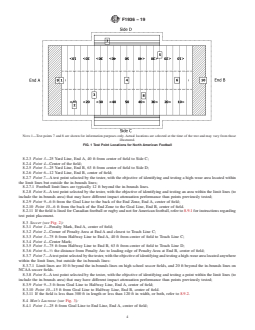
8.2.1 Point 1—Goal Line, End A, center of field;
8.2.2 Point 2—10 Yard Line, End A, 63 ft from center of field to Side C;
F1936 − 19
NOTE 1—Test points 7 and 8 are shown for information purposes only. Actual locations are selected at the time of the test and may vary from those
illustrated.
FIG. 1 Test Point Locations for North American Football
8.2.3 Point 3—25 Yard Line, End A, 40 ft from center of field to Side C;
8.2.4 Point 4—Center of the field;
8.2.5 Point 5—25 Yard Line, End B, 63 ft from center of field to Side D;
8.2.6 Point 6—12 Yard Line, End B, center of field;
8.2.7 Point 7—A test point selected by the tester, with the objective of identifying and testing a high-wear area located within
the limit lines but outside the in-bounds lines;
8.2.7.1 Football limit lines are typically 12 ft beyond the in-bounds lines.
8.2.8 Point 8—A test point selected by the tester, with the objective of identifying and testing an area within the limit lines (to
include the in-bounds area) that may have different impact attenuation performance than points previously tested;
8.2.9 Point 9—6 ft from the Goal Line to the back of the End Zone, End A, center of field;
8.2.10 Point 10—6 ft from the back of the End Zone to the Goal Line, End B, center of field.
8.2.11 If the field is lined for Canadian football or rugby and not for American football, refer to 8.9.1 for instructions regarding
test point placement.
8.3 Soccer (see Fig. 2):
8.3.1 Point 1—Penalty Mark, End A, center of field;
8.3.2 Point 2—Corner of Penalty Area at End A and closest to Touch Line C;
8.3.3 Point 3—75 ft from Halfway Line to End A, 40 ft from center of field to Touch Line C;
8.3.4 Point 4—Center Mark;
8.3.5 Point 5—75 ft from Halfway Line to End B, 63 ft from center of field to Touch Line D;
8.3.6 Point 6— ⁄2 the distance from Penalty Arc to leading edge of Penalty Area at End B, center of field;
8.3.7 Point 7—A test point selected by the tester, with the objective of identifying and testing a high-wear area located anywhere
within the limit lines, but outside the in-bounds lines:
8.3.7.1 Limit lines are 10 ft beyond the in-bounds lines on high school soccer fields, and 20 ft beyond the in-bounds lines on
NCAA soccer fields.
8.3.8 Point 8—A test point selected by the tester, with the objective of identifying and testing a point within the limit lines (to
include the in-bounds area) that may have different impact attenuation performance than points previously tested;
8.3.9 Point 9—3 ft from Goal Line to Halfway Line, End A, center of field;
8.3.10 Point 10—15 ft from Goal Line to Halfway Line, End B, center of field.
8.3.11 If the field is less than 300 ft in length or less than 120 ft in width, or both, refer to 8.9.2.
8.4 Men’s Lacrosse (see Fig. 3):
8.4.1 Point 1—25 ft from Goal Line to End Line, End A, center of field;
F1936 − 19
NOTE 1—Test points 7 and 8 are shown for information purposes only. Actual locations are selected at the time of the test and may vary from those
illustrated.
FIG. 2 Test Point Locations for Soccer
NOTE 1—Test points 7 and 8 are shown for information purposes only. Their locations are selected at the time of the test.
FIG. 3 Test Point Locations for Men’s Lacrosse
8.4.2 Point 2—63 ft from mid-point of Goal Line to Sideline C, End A;
8.4.3 Point 3—75 ft from Center Line to End A, 40 ft from center of field to Sideline C;
8.4.4 Point 4—Center of the field;
8.4.5 Point 5—75 ft from Center Line to End B, 63 ft from center of field to Sideline D;
F1936 − 19
8.4.6 Point 6—3 ft from Goal Line to Center Line, End B, center of field;
8.4.7 Point 7—A test point selected by the tester, with the objective of identifying and testing a high-wear area located anywhere
within the limit lines, but outside the in-bounds lines;
8.4.7.1 No limit lines are specified for men’s lacrosse fields. Use the 18 ft width of the Coach’s Area as the maximum distance
from the inbounds lines for test points 7 and 8.
8.4.8 Point 8—A test point selected by the tester, with the objective of identifying and testing a point within the limit lines (to
include the in-bounds area) that may have different impact attenuation performance than points previously tested;
8.4.9 Point 9—3 ft from the End Line to the Center Line, End A, center of field;
8.4.10 Point 10—3 ft from the End Line to the Center Line, End B, center of field.
8.5 Women’s Lacrosse (see Fig. 4):
8.5.1 Point 1—3 ft from Goal Line to Center Line, End A, center of field;
8.5.2 Point 2—30 ft from Goal Line at End A to Center Line, 63 ft from center of field to Side C;
8.5.3 Point 3—75 ft from Goal Line at End A to Center Line, 40 ft from center of field to Side C;
8.5.4 Point 4—Center of the field;
8.5.5 Point 5—75 ft from Goal Line at End B to Center Line, 63 ft from center of field to Side D;
8.5.6 Point 6—3 ft from 8-Meter-Arc to Goal Line, End B, center of field;
8.5.7 Point 7—A test point selected by the tester, with the objective of identifying and testing a high-wear area located anywhere
within the boundary lines but outside the lined area of the field;
8.5.7.1 Limit (boundary) lines on women’s lacrosse fields are variable. The location of the limit lines will be determined by
conditions at each test site.
8.5.8 Point 8—A test point selected by the tester, with the objective of identifying and testing a point within the boundary lines
(including the field of play) that may have different impact attenuation performance than points previously tested.
8.5.9 Point 9—3 ft from the End Line at End A to Center Line, center of field;
8.5.10 Point 10—3 ft from the End Line at End B to Center Line, center of field.
8.6 Field Hockey (see Fig. 5):
8.6.1 Point 1—3 ft from Goal Line to Center Line, End A, center of the field;
8.6.2 Point 2—30 ft from Goal Line at End A to Center Line, 63 ft from center of the field to Sideline C;
8.6.3 Point 3—25 Yard Line, End A, 40 ft from center of field to Sideline C;
8.6.4 Point 4—Center of the field;
NOTE 1—Test points 7 and 8 are shown for information purposes only. Their locations are selected at the time of the test and may vary from those
illustrated.
FIG. 4 Test Point Locations for Women’s Lacrosse
F1936 − 19
NOTE 1—Test points 7, 8, 9, and 10 are shown for information purposes only. Their locations are selected at the time of the test and may vary from
those illustrated.
FIG. 5 Test Point Locations for Field Hockey
8.6.5 Point 5—25 Yard Line, End B, 63 ft from center of field to Sideline D;
8.6.6 Point 6—12 ft from edge of Striking Circle to Goal Line, End B, center of field;
8.6.7 Point 7—A test point selected by the tester, with the objective of identifying and testing a high-wear area located anywhere
within the limit lines, but outside the in-bounds lines;
8.6.7.1 Limit lines are 15 ft outside the in-bounds lines on field hockey fields.
8.6.8 Point 8—A test point selected by the tester, with the objective of identifying and testing a point within the limit lines (to
include the in-bounds area) that may have different impact attenuation performance than points previously tested;
8.6.9 Point 9—A test point selected by the tester, with the objective of identifying and testing a high-wear area located anywhere
within the limit lines, but outside the in-bounds lines;
8.6.10 Point 10—A test point selected by the tester, with the objective of identifying and testing a point within the limit lines
(to include the in-bounds area) that may have different impact attenuation performance than points previously tested.
8.7 Unlined Fields (see Fig. 6):
8.7.1 Point 1—145 ft from mid-point of base line to End A, on base line;
8.7.2 Point 2—124 ft from mid-point of base line to End A, 63 ft from base line to Side C;
8.7.3 Point 3—75 ft from mid-point of base line to End A, 40 ft from base line to Side C;
8.7.4 Point 4—Mid-point of the base line;
8.7.5 Point 5—75 ft from mid-point of base line to End B, 63 ft from base line to Side D;
8.7.6 Point 6—114 ft from mid-point of base line to End B, on base line;
8.7.7 Point 7—A test point selected by the tester, with the objective of identifying and testing a high-wear area located anywhere
within the turf playing system;
8.7.8 Point 8—A test point selected by the tester, with the objective of identifying and testing a point within the turf playing
system that may have different impact attenuation performance than points previously tested.
8.7.9 Point 9—155 ft from mid-point of base line to End A, on base line;
8.7.10 Point 10—155 ft from mid-point of base line to End B, on base line.
8.7.11 If the turf playing system is not rectangular, or it is less than 310 ft in length or 126 ft in width, refer to 8.9.6.
8.8 Baseball and Softball (see Fig. 7):
8.8.1 Point 1—25 ft from the tip of Home Plate to the center of the Pitcher’s Mound;
st nd
8.8.2 Point 2—6 ft from 1 Base to 2 Base;
nd st
8.8.3 Point 3—3 ft from 2 Base to 1 Base;
rd nd
8.8.4 Point 4—4 ft from 3 Base to 2 Base;
F1936 − 19
NOTE 1—Test points 7 and 8 are shown for information purposes only. Their locations are selected at the time of the test.
FIG. 6 Test Point Locations for Unlined Fields
NOTE 1—Test points 9 and 10 are shown for information purposes only. Their locations are selected at the time of the test and may vary from those
illustrated.
FIG. 7 Test Point Locations for Baseball and Softball
F1936 − 19
rd
8.8.5 Point 5—Perpendicular to the mid-point of 3 Base Line, half the distance from the Base Line to the Left Field fence or
boundary line;
nd
8.8.6 Point
...
Questions, Comments and Discussion
Ask us and Technical Secretary will try to provide an answer. You can facilitate discussion about the standard in here.
Loading comments...