

ASTM D2680-20
(Specification)Standard Specification for Acrylonitrile-Butadiene-Styrene (ABS) and Poly(Vinyl Chloride) (PVC) Composite Sewer Piping
General Information
- Abstract
ABSTRACT
This specification covers acrylonitrile-butadiene-styrene (ABS) and poly(vinyl chloride) (PVC) thermoplastic composite pipe, fittings, and a joining system for use in gravity flow, nonpressure sanitary sewer, and storm drain installations. ABS or PVC composite pipes shall consist of two concentric thermoplastic tubes integrally braced across the annulus and the resultant annular space shall be filled to provide continuous support between the inner and outer tubes. Referee and quality control tests shall be conducted in the standard laboratory atmosphere under the specified temperature and humidity conditions. The pipe shall be tested for performance requirements such as stiffness, deflection without rupture, acid conditioning, joint (solvent cement and elastomeric seal joints) tightness, and extrusion quality.
SCOPE
1.1 This specification covers thermoplastic composite pipe, fittings and a joining system for use in gravity flow, nonpressure sanitary sewer, and storm drain installations. The pipe and fittings are made of ABS or PVC plastic material. Recommended installation practices are referenced in Appendix X1.
1.2 The values stated in inch-pound units are to be regarded as standard. The values given in parentheses are mathematical conversions to SI units that are provided for information only and are not considered standard.
1.3 The following safety hazards caveat pertains only to the test method portion, Section 10, of this specification: This standard does not purport to address all of the safety concerns, if any, associated with its use. It is the responsibility of the user of this standard to establish appropriate safety, health, and environmental practices and determine the applicability of regulatory limitations prior to use.
1.4 This international standard was developed in accordance with internationally recognized principles on standardization established in the Decision on Principles for the Development of International Standards, Guides and Recommendations issued by the World Trade Organization Technical Barriers to Trade (TBT) Committee.
- Status
- Published
- Publication Date
- 31-Jul-2020
- Technical Committee
- F17 - Plastic Piping Systems
- Drafting Committee
- F17.62 - Sewer
Buy Documents
ASTM D2680-20 - Standard Specification for Acrylonitrile-Butadiene-Styrene (ABS) and Poly(Vinyl Chloride) (PVC) Composite Sewer Piping
REDLINE ASTM D2680-20 - Standard Specification for Acrylonitrile-Butadiene-Styrene (ABS) and Poly(Vinyl Chloride) (PVC) Composite Sewer Piping
Overview
ASTM D2680-20 is the standard specification for Acrylonitrile-Butadiene-Styrene (ABS) and Poly(Vinyl Chloride) (PVC) composite sewer piping. Developed by ASTM International, this standard covers thermoplastic composite pipes, fittings, and joining systems designed for use in gravity flow, nonpressure sanitary sewer, and storm drain installations. Pipes must be constructed using two concentric thermoplastic tubes-either ABS or PVC-integrally braced with the annular space filled by a suitable inert material, ensuring continuous support and structural stability.
ASTM D2680-20 provides essential requirements for dimensions, workmanship, performance (including stiffness, deflection, acid resistance, and joint tightness), as well as marking and quality assurance. This standard supports consistent manufacturing, installation, and performance for non-pressure underground drainage systems.
Key Topics
- Material Requirements
- Use of rigid ABS or PVC plastics in pipe and fittings
- Requirements for inert filler materials in the pipe structure
- Composite Pipe Design
- Two concentric thermoplastic tubes, braced and filled in the annulus
- Suitable filler materials such as portland cement-perlite concrete
- Joint and Fitting Systems
- Specifications for solvent cement and elastomeric (gasketed) seal joints
- Factory-attached or loose joints and fittings, ensuring flexibility of installation
- Performance Testing
- Stiffness and deflection testing to check structural tolerances
- Acid conditioning to ensure chemical resistance
- Tightness of both solvent cemented and elastomeric seal joints
- Quality assurance for extrusion quality, dimensions, and end squareness
- Marking and Certification
- Permanent markings on pipes and fittings for traceability and compliance
- Manufacturer certification requirements for compliance verification
Applications
Sanitary Sewer Systems
- Designed specifically for gravity flow, nonpressure sanitary sewer systems, ABS and PVC composite pipes provide long-term durability and corrosion resistance.
- Suitable for municipal and private sewer infrastructure, ensuring consistent flow and robust joint integrity.
Storm Drain Installations
- Composite pipes are widely applied in storm drainage systems due to their strength, chemical resistance, and reliable installation practices, as specified in ASTM D2680-20.
- The specification includes guidance for underground installation, such as recommended bedding and backfill materials, contributing to installation efficiency and long-term performance.
Infrastructure Projects
- Used in large scale civil engineering projects, utility upgrades, and new developments where the reliable conveyance of wastewater or stormwater is essential.
- Pipe sizes, dimensional tolerances, and joint options provide project designers with flexibility to meet diverse project requirements.
Related Standards
- ASTM D1784: Classification for Rigid PVC Compounds and CPVC Compounds
- ASTM D3965: Classification System for Rigid ABS Materials for Pipe and Fittings
- ASTM D2235: Specification for Solvent Cement for ABS Pipe and Fittings
- ASTM D2564: Specification for Solvent Cements for PVC Piping Systems
- ASTM F402: Practice for Safe Handling of Solvent Cements
- ASTM F477 and ASTM F913: Specifications for Elastomeric Seals (Gaskets)
- ASTM D2321: Practice for Underground Installation of Thermoplastic Pipe for Sewers and Other Gravity-Flow Applications
For engineers, designers, and contractors, ASTM D2680-20 ensures that ABS and PVC composite sewer piping systems are manufactured, installed, and tested to meet rigorous standards for safety, reliability, and performance in gravity flow sanitary sewer and stormwater applications. Adherence to this standard supports compliance, product consistency, and the longevity of critical infrastructure.
Relations
- Effective Date
- 01-Nov-2023
- Effective Date
- 01-Aug-2020
- Effective Date
- 01-Apr-2020
- Effective Date
- 15-Mar-2020
- Effective Date
- 15-Jan-2020
- Effective Date
- 01-Jan-2019
- Effective Date
- 01-Aug-2018
- Effective Date
- 01-Mar-2018
- Refers
ASTM D1600-18 - Standard Terminology for Abbreviated Terms Relating to Plastics (Withdrawn 2024) - Effective Date
- 01-Jan-2018
- Effective Date
- 01-Nov-2017
- Effective Date
- 01-Aug-2017
- Effective Date
- 01-Feb-2017
- Effective Date
- 15-Nov-2016
- Effective Date
- 01-Aug-2016
- Effective Date
- 01-Jun-2015
Buy Documents
ASTM D2680-20 - Standard Specification for Acrylonitrile-Butadiene-Styrene (ABS) and Poly(Vinyl Chloride) (PVC) Composite Sewer Piping
REDLINE ASTM D2680-20 - Standard Specification for Acrylonitrile-Butadiene-Styrene (ABS) and Poly(Vinyl Chloride) (PVC) Composite Sewer Piping
Get Certified
Connect with accredited certification bodies for this standard

Institut za varilstvo d.o.o. (Welding Institute)
Slovenia's leading welding institute since 1952. ISO 3834, EN 1090, pressure equipment certification, NDT personnel, welder qualification. Only IIW Au
Sponsored listings
Frequently Asked Questions
ASTM D2680-20 is a technical specification published by ASTM International. Its full title is "Standard Specification for Acrylonitrile-Butadiene-Styrene (ABS) and Poly(Vinyl Chloride) (PVC) Composite Sewer Piping". This standard covers: ABSTRACT This specification covers acrylonitrile-butadiene-styrene (ABS) and poly(vinyl chloride) (PVC) thermoplastic composite pipe, fittings, and a joining system for use in gravity flow, nonpressure sanitary sewer, and storm drain installations. ABS or PVC composite pipes shall consist of two concentric thermoplastic tubes integrally braced across the annulus and the resultant annular space shall be filled to provide continuous support between the inner and outer tubes. Referee and quality control tests shall be conducted in the standard laboratory atmosphere under the specified temperature and humidity conditions. The pipe shall be tested for performance requirements such as stiffness, deflection without rupture, acid conditioning, joint (solvent cement and elastomeric seal joints) tightness, and extrusion quality. SCOPE 1.1 This specification covers thermoplastic composite pipe, fittings and a joining system for use in gravity flow, nonpressure sanitary sewer, and storm drain installations. The pipe and fittings are made of ABS or PVC plastic material. Recommended installation practices are referenced in Appendix X1. 1.2 The values stated in inch-pound units are to be regarded as standard. The values given in parentheses are mathematical conversions to SI units that are provided for information only and are not considered standard. 1.3 The following safety hazards caveat pertains only to the test method portion, Section 10, of this specification: This standard does not purport to address all of the safety concerns, if any, associated with its use. It is the responsibility of the user of this standard to establish appropriate safety, health, and environmental practices and determine the applicability of regulatory limitations prior to use. 1.4 This international standard was developed in accordance with internationally recognized principles on standardization established in the Decision on Principles for the Development of International Standards, Guides and Recommendations issued by the World Trade Organization Technical Barriers to Trade (TBT) Committee.
ABSTRACT This specification covers acrylonitrile-butadiene-styrene (ABS) and poly(vinyl chloride) (PVC) thermoplastic composite pipe, fittings, and a joining system for use in gravity flow, nonpressure sanitary sewer, and storm drain installations. ABS or PVC composite pipes shall consist of two concentric thermoplastic tubes integrally braced across the annulus and the resultant annular space shall be filled to provide continuous support between the inner and outer tubes. Referee and quality control tests shall be conducted in the standard laboratory atmosphere under the specified temperature and humidity conditions. The pipe shall be tested for performance requirements such as stiffness, deflection without rupture, acid conditioning, joint (solvent cement and elastomeric seal joints) tightness, and extrusion quality. SCOPE 1.1 This specification covers thermoplastic composite pipe, fittings and a joining system for use in gravity flow, nonpressure sanitary sewer, and storm drain installations. The pipe and fittings are made of ABS or PVC plastic material. Recommended installation practices are referenced in Appendix X1. 1.2 The values stated in inch-pound units are to be regarded as standard. The values given in parentheses are mathematical conversions to SI units that are provided for information only and are not considered standard. 1.3 The following safety hazards caveat pertains only to the test method portion, Section 10, of this specification: This standard does not purport to address all of the safety concerns, if any, associated with its use. It is the responsibility of the user of this standard to establish appropriate safety, health, and environmental practices and determine the applicability of regulatory limitations prior to use. 1.4 This international standard was developed in accordance with internationally recognized principles on standardization established in the Decision on Principles for the Development of International Standards, Guides and Recommendations issued by the World Trade Organization Technical Barriers to Trade (TBT) Committee.
ASTM D2680-20 is classified under the following ICS (International Classification for Standards) categories: 23.040.20 - Plastics pipes. The ICS classification helps identify the subject area and facilitates finding related standards.
ASTM D2680-20 has the following relationships with other standards: It is inter standard links to ASTM D2152-23, ASTM D2564-20, ASTM F412-20, ASTM D2321-20, ASTM D1784-20, ASTM F412-19, ASTM D2564-12(2018), ASTM D2321-18, ASTM D1600-18, ASTM D2152-17, ASTM F412-17a, ASTM F412-17, ASTM F412-16a, ASTM F412-16, ASTM F412-15. Understanding these relationships helps ensure you are using the most current and applicable version of the standard.
ASTM D2680-20 is available in PDF format for immediate download after purchase. The document can be added to your cart and obtained through the secure checkout process. Digital delivery ensures instant access to the complete standard document.
Standards Content (Sample)
This international standard was developed in accordance with internationally recognized principles on standardization established in the Decision on Principles for the
Development of International Standards, Guides and Recommendations issued by the World Trade Organization Technical Barriers to Trade (TBT) Committee.
Designation:D2680 −20
Standard Specification for
Acrylonitrile-Butadiene-Styrene (ABS) and Poly(Vinyl
Chloride) (PVC) Composite Sewer Piping
This standard is issued under the fixed designation D2680; the number immediately following the designation indicates the year of
original adoption or, in the case of revision, the year of last revision.Anumber in parentheses indicates the year of last reapproval.A
superscript epsilon (´) indicates an editorial change since the last revision or reapproval.
1. Scope* D2122Test Method for Determining Dimensions of Ther-
moplastic Pipe and Fittings
1.1 This specification covers thermoplastic composite pipe,
D2152Test Method for Adequacy of Fusion of Extruded
fittings and a joining system for use in gravity flow, nonpres-
Poly(Vinyl Chloride) (PVC) Pipe and Molded Fittings by
suresanitarysewer,andstormdraininstallations.Thepipeand
Acetone Immersion
fittings are made of ABS or PVC plastic material. Recom-
D2235Specification for Solvent Cement for Acrylonitrile-
mended installation practices are referenced in Appendix X1.
Butadiene-Styrene (ABS) Plastic Pipe and Fittings
1.2 The values stated in inch-pound units are to be regarded
D2321PracticeforUndergroundInstallationofThermoplas-
as standard. The values given in parentheses are mathematical
tic Pipe for Sewers and Other Gravity-Flow Applications
conversions to SI units that are provided for information only
D2412Test Method for Determination of External Loading
and are not considered standard.
Characteristics of Plastic Pipe by Parallel-Plate Loading
1.3 The following safety hazards caveat pertains only to the
D2564Specification for Solvent Cements for Poly(Vinyl
test method portion, Section 10, of this specification: This
Chloride) (PVC) Plastic Piping Systems
standard does not purport to address all of the safety concerns,
D3138Specification for Solvent Cements for Transition
if any, associated with its use. It is the responsibility of the user
Joints Between Acrylonitrile-Butadiene-Styrene (ABS)
of this standard to establish appropriate safety, health, and
and Poly(Vinyl Chloride) (PVC) Non-Pressure Piping
environmental practices and determine the applicability of
Components
regulatory limitations prior to use.
D3212Specification for Joints for Drain and Sewer Plastic
1.4 This international standard was developed in accor-
Pipes Using Flexible Elastomeric Seals
dance with internationally recognized principles on standard-
D3965ClassificationSystemandBasisforSpecificationsfor
ization established in the Decision on Principles for the
Rigid Acrylonitrile-Butadiene-Styrene (ABS) Materials
Development of International Standards, Guides and Recom-
for Pipe and Fittings
mendations issued by the World Trade Organization Technical
D4396Specification for Rigid Poly(Vinyl Chloride) (PVC)
Barriers to Trade (TBT) Committee.
and Chlorinated Poly(Vinyl Chloride) (CPVC) Com-
pounds for Plastic Pipe and Fittings Used in Nonpressure
2. Referenced Documents
Applications
2.1 ASTM Standards: F402 Practice for Safe Handling of Solvent Cements,
D618Practice for Conditioning Plastics for Testing Primers, and Cleaners Used for Joining Thermoplastic
D1084Test Methods for Viscosity of Adhesives Pipe and Fittings
D1600TerminologyforAbbreviatedTermsRelatingtoPlas- F412Terminology Relating to Plastic Piping Systems
tics F477Specification for Elastomeric Seals (Gaskets) for Join-
D1784Classification System and Basis for Specification for ing Plastic Pipe
Rigid Poly(Vinyl Chloride) (PVC) Compounds and Chlo- F913Specification for Thermoplastic Elastomeric Seals
(Gaskets) for Joining Plastic Pipe
rinated Poly(Vinyl Chloride) (CPVC) Compounds
2.2 Federal Standard:
Fed. Std. No. 123Marking for Shipment (Civil Agencies)
This specification is under the jurisdiction ofASTM Committee F17 on Plastic
Piping Systems and is the direct responsibility of Subcommittee F17.62 on Sewer.
2.3 Military Standard:
Current edition approved Aug. 1, 2020. Published September 2020. Originally
MIL-STD-129 Marking for Shipment and Storage
published as D2680 – 68 T. Last previous edition approved in 2014 as
D2680–01(2014). DOI: 10.1520/D2680-20.
For referenced ASTM standards, visit the ASTM website, www.astm.org, or
contact ASTM Customer Service at service@astm.org. For Annual Book of ASTM
Standards volume information, refer to the standard’s Document Summary page on Available from DLA Document Services, Building 4/D, 700 Robbins Ave.,
the ASTM website. Philadelphia, PA 19111-5094, http://quicksearch.dla.mil.
*A Summary of Changes section appears at the end of this standard
Copyright © ASTM International, 100 Barr Harbor Drive, PO Box C700, West Conshohocken, PA 19428-2959. United States
D2680−20
3. Terminology 5.3 The other component shall be portland cement-perlite
concrete or other inert filler material exhibiting the same
3.1 Definitions:
degreeofperformance,thatessentiallyfillsthetrussannulusto
3.1.1 General—Definitions are in accordance with Termi-
form a composite pipe that meets the requirements of this
nology F412 and abbreviations are in accordance with Termi-
specification.
nologyD1600,unlessotherwisespecified.Theabbreviationfor
acrylonitrile-butadiene-styreneisABSandtheabbreviationfor 5.4 Gaskets—Elastomeric seals (gaskets) shall comply with
poly(vinyl chloride) is PVC. requirements described in Specifications F477 and F913.
3.2 Definitions of Terms Specific to This Standard:
NOTE 1—Gasket joints manufactured for PVC composite pipe only.
3.2.1 acrylonitrile-butadiene-styrene (ABS)—plastics con-
5.5 Lubricants—The lubricant used for the assembly of
taining polymers or blends of polymers, or both, in which the
gasket joints shall have no detrimental effect on the gasket or
minimum butadiene content is 6%; the minimum acrylonitrile
on the pipe.
content is 15%; the minimum styrene or substituted styrene
content,orboth,is15%;andthemaximumcontentofallother
6. Performance Requirements
monomers is not more than 5%, plus lubricants, stabilizers,
and colorants. 6.1 Pipe Stiffness—Pipetestedinaccordancewith10.2shall
have a minimum pipe stiffness of 200 lb/in./in. (1380 kPa) at
3.2.2 poly (vinyl chloride) (PVC)—plastic compounds con-
5% deflection.
taining poly(vinyl chloride) homopolymer, and such additives
as stabilizers, lubricants, processing aids, impact improvers,
6.2 Pipe Deflection—Pipe tested in accordance with 10.2
andcolorantsasneededtoprovidetherequiredprocessingand
shall deflect a minimum of 7.5% without rupture of inner or
toughness characteristics.
outer wall.
NOTE 2—The purpose of the quality control tests in 6.1 and 6.2 is to
4. Classification
furnish test results for a consumer only upon his request at the time of
order and prior to shipment from the point of manufacture.
4.1 Pipeproducedinaccordancewiththisspecificationshall
be classified as ABS composite pipe or PVC composite pipe
6.3 Acid Conditioning—Pipe tested in accordance with 10.3
based on plastic materials used in manufacture.
shall meet the requirements of 6.1 and 6.2.
NOTE3—Thistestisintendedonlyforuseasaqualificationtest,notfor
5. Materials and Manufacture
use as a simulated service test nor a quality control test.
5.1 ABS composite pipe or PVC composite pipe shall
6.4 Joint Tightness:
consist of two concentric thermoplastic tubes integrally braced
6.4.1 Solvent Cement Joints—Pipe and fittings attached to
across the annulus. The resultant annular space is filled to
the pipe shall show no signs of leakage when tested in
provide continuous support between the inner and outer tubes.
accordance with 10.4.1 (See Note 3).
5.2 Compounds—The ABS and PVC composite pipe and
6.4.2 Gasket Joints for PVC Composite Pipe—Joints shall
fittings shall be produced from the following compounds:
show no signs of leakage when tested in accordance with
5.2.1 ABS—ThepipeshallbemadefromarigidABSplastic
10.4.2 (See Note 3).
and shall meet or exceed the requirements of Specification
6.5 Extrusion Quality—When tested in accordance with
D3965 for a minimum cell classification of 1-0-2-2-3. The
10.5, PVC extruded pipe tubes shall not flake or disintegrate.
fittings shall be made from ABS plastic and shall meet or
exceed the requirements of Specification D3965 for cell
NOTE 4—This test is intended for use as a quality control test, not for
classifications of 1-0-2-2-3 or 4-2-2-2-2. Clean rework ABS, use as a simulated service test.
generated from the manufacturer’s own pipe extrusion and
7. Other Requirements
fittings produced before filling the annulus as described in 5.3
may be used by the same manufacturer, provided that the pipe
7.1 Joints and Fittings as shown in Fig. 1 and Fig. 2, shall
and fittings produced meet all the requirements of this speci-
be molded or fabricated from materials described in Section 5.
fication.
Joints and fittings may be factory-attached to the pipe or
5.2.2 PVC—ThethermoplasticmaterialshallbearigidPVC
furnished loose, at the option of the purchaser.
plastic and shall meet or exceed the requirements of Specifi-
7.2 Solvent Cement Joints:
cation D1784, for a minimum cell classification of 12454 or of
7.2.1 Solvent Cement Joint—Inthesolventcementjoint,the
Specification D4396, for a minimum cell classification of
pipe spigot wedges into the tapered socket and the surfaces
11432. Homopolymer PVC compounds that have higher cell
fuse together.
classifications, because one or more properties are superior to
those of the specified compounds, are also acceptable. Clean 7.2.2 ABS Solvent Cement Joints—Primer for priming sol-
rework PVC, generated from the manufacturer’s own pipe and vent cemented joints shall be MEK (methyl ethyl ketone) and
fittings production produced before filling the annulus as the cement shall be MEK containing a minimum of 20% by
described in 5.3 may be used by the same manufacturer weight of dissolved ABS as described in 5.2.1. The cement
provided that the pipe and fittings produced meet all the viscositywhenmeasuredinaccordancewithMethodDofTest
requirements of this specification. Method D1084 at 70 to 75° F (21 to 23°C) with a No. 5 Zahn
D2680−20
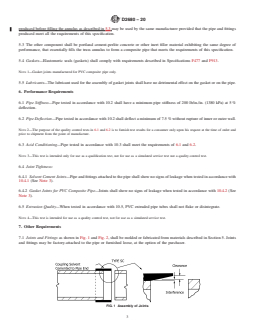
FIG. 1 Assembly of Joints
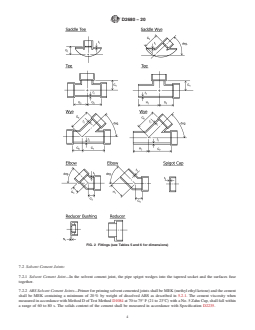
FIG. 2 Fittings (see Tables 5 and 6 for dimensions)
D2680−20
Cup, shall fall within a range of 60 to 80 s. The solids content variation.Otherlengthsmaybeprovided,ifagreeduponbythe
of the cement shall be measured in accordance with Specifi- purchaser and the seller.
cation D2235.
8.3 Straightness—Pipe intended to be straight shall have a
7.2.3 PVC Solvent Cement Joints—The cement shall com-
maximumdeviationfromstraightnessof ⁄16in./ft(4.85mm/m)
ply with Specification D2564, with the exception that the
of length, when measured in accordance with 10.6.1.
minimum resin content shall be 16% and minimum viscosity
8.4 End Squareness—Pipe ends shall be cut square to the
shall be 3500 cP (3500 mPa·s).
longitudinal axis as provided in Table 3, when measured in
7.2.4 Transition Joints (ABS to PVC)— Whenever a transi-
accordance with 10.6.3.
tion joint is to be assembled, the cement shall comply with
Specification D3138.(Warning—Solvent cements for plastic 8.5 Joint Couplings,shallconformtothedimensionsshown
pipearemadefromflammableliquidsandshouldbekeptaway
in Table 4, when measured in accordance with 10.6.1.
from all sources of ignition. Good ventilation should be
8.6 Fittings:
maintained to reduce fire hazard and to minimize breathing of
8.6.1 Molded Fittings—Thewallthicknessofthewaterway
solvent vapors. Avoid contact of cement with skin and eyes.
shallbenolessthantherespectiveminimumthicknesslistedin
Refer to Practice F402 for additional information.)
Table 5. The socket dimensions and respective wall thickness
NOTE 5—Unless otherwise specified, it is permissible to use transition shall conform to Table 4.The dimensions and wall thicknesses
joints in accordance with this specification and Specification D3138.
shall be determined in accordance with 10.6.1.
8.6.2 Fabricated Fittings—Fabricated fittings shall be con-
7.3 Elastomeric (Gasket) Joints for PVC Composite Pipe:
sidered satisfactory if made from pipe and molded fittings
7.3.1 Elastomeric joints shall be designed so that when
meeting the requirements of this specification.
assembled, the gasket will be compressed in the joint to form
8.6.3 Thespur(lateral)socketshallbesuitableforattaching
a positive seal.
the respectiveABS or PVC solid wall pipe or adapters shall be
7.3.2 The joint shall be designed to avoid displacement of
furnished for attaching other types of pipes.
the gasket when assembled in accordance with the manufac-
turers’ recommendation.
9. Workmanship
7.3.3 Theassemblyofjointsshallbeinaccordancewiththe
manufacturers’ recommendation.
9.1 The inner and outer surfaces of the pipe, joints, and
fittingsshallbehomogeneousthroughoutandfreefromvisible
8. Dimensions
cracks, holes, foreign inclusions, and other injurious defects.
8.1 Diameters and Thickness—The pipe shall conform to
The pipe, joints, and fittings shall be as uniform as commer-
the dimensions and tolerances shown in Table 1 for ABS cially practicable in other physical properties.
composite pipe, and Table 2 for PVC composite pipe, when
measured in accordance with 10.6.1 and 10.6.2. 10. Test Methods
8.2 Laying Length—Pipeshallbefurnishedinstandard12 ⁄2 10.1 Conditioning:
ft (3.82 m) lengths with a tolerance of −1 in. (−25 mm) when 10.1.1 Referee Testing—When conditioning is required for
measured in accordance 10.6.1. There is no limit for plus referee tests, condition the specimens in accordance with
TABLE 1 Pipe Dimensions for ABS Composite Pipe
Average Concentric
Outside Diameter Average Inside Diameter
Nominal
Tube Thickness
Size, in.
Average Tolerance max min max Inner, min Outer, min
Inches
8 9.41 +0.04 9.51 7.75 7.90 0.060 0.035
−0.03
10 11.75 +0.04 11.87 9.75 9.88 0.068 0.038
−0.04
12 14.07 +0.06 14.22 11.75
...
This document is not an ASTM standard and is intended only to provide the user of an ASTM standard an indication of what changes have been made to the previous version. Because
it may not be technically possible to adequately depict all changes accurately, ASTM recommends that users consult prior editions as appropriate. In all cases only the current version
of the standard as published by ASTM is to be considered the official document.
Designation: D2680 − 01 (Reapproved 2014) D2680 − 20
Standard Specification for
Acrylonitrile-Butadiene-Styrene (ABS) and Poly(Vinyl
Chloride) (PVC) Composite Sewer Piping
This standard is issued under the fixed designation D2680; the number immediately following the designation indicates the year of
original adoption or, in the case of revision, the year of last revision. A number in parentheses indicates the year of last reapproval. A
superscript epsilon (´) indicates an editorial change since the last revision or reapproval.
1. Scope Scope*
1.1 This specification covers thermoplastic composite pipe, fittings and a joining system for use in gravity flow, nonpressure
sanitary sewer, and storm drain installations. The pipe and fittings are made of ABS or PVC plastic material. Recommended
installation practices are referenced in Appendix X1.
1.2 The values stated in inch-pound units are to be regarded as standard. The values given in parentheses are mathematical
conversions to SI units that are provided for information only and are not considered standard.
1.3 The following safety hazards caveat pertains only to the test method portion, Section 1010,, of this specification: This
standard does not purport to address all of the safety problems,concerns, if any, associated with its use. It is the responsibility of
the user of this standard to establish appropriate safety safety, health, and healthenvironmental practices and determine the
applicability of regulatory limitations prior to use.Specific precautionary information is given in 7.2.4.
1.4 This international standard was developed in accordance with internationally recognized principles on standardization
established in the Decision on Principles for the Development of International Standards, Guides and Recommendations issued
by the World Trade Organization Technical Barriers to Trade (TBT) Committee.
2. Referenced Documents
2.1 ASTM Standards:
D618 Practice for Conditioning Plastics for Testing
D1084 Test Methods for Viscosity of Adhesives
D1600 Terminology for Abbreviated Terms Relating to Plastics
D1784 Classification System and Basis for Specification for Rigid Poly(Vinyl Chloride) (PVC) Compounds and Chlorinated
Poly(Vinyl Chloride) (CPVC) Compounds
D2122 Test Method for Determining Dimensions of Thermoplastic Pipe and Fittings
D2152 Test Method for Adequacy of Fusion of Extruded Poly(Vinyl Chloride) (PVC) Pipe and Molded Fittings by Acetone
Immersion
D2235 Specification for Solvent Cement for Acrylonitrile-Butadiene-Styrene (ABS) Plastic Pipe and Fittings
D2321 Practice for Underground Installation of Thermoplastic Pipe for Sewers and Other Gravity-Flow Applications
D2412 Test Method for Determination of External Loading Characteristics of Plastic Pipe by Parallel-Plate Loading
D2564 Specification for Solvent Cements for Poly(Vinyl Chloride) (PVC) Plastic Piping Systems
D3138 Specification for Solvent Cements for Transition Joints Between Acrylonitrile-Butadiene-Styrene (ABS) and Poly(Vinyl
This specification is under the jurisdiction of ASTM Committee F17 on Plastic Piping Systems and is the direct responsibility of Subcommittee F17.62 on Sewer.
Current edition approved Aug. 1, 2014Aug. 1, 2020. Published November 2014September 2020. Originally published as D2680 – 68 T. Last previous edition approved
in 20092014 as D2680 –01(2009). –01(2014). DOI: 10.1520/D2680-01R14.10.1520/D2680-20.
For referenced ASTM standards, visit the ASTM website, www.astm.org, or contact ASTM Customer Service at service@astm.org. For Annual Book of ASTM Standards
volume information, refer to the standard’s Document Summary page on the ASTM website.
*A Summary of Changes section appears at the end of this standard
Copyright © ASTM International, 100 Barr Harbor Drive, PO Box C700, West Conshohocken, PA 19428-2959. United States
D2680 − 20
Chloride) (PVC) Non-Pressure Piping Components
D3212 Specification for Joints for Drain and Sewer Plastic Pipes Using Flexible Elastomeric Seals
D3965 Classification System and Basis for Specifications for Rigid Acrylonitrile-Butadiene-Styrene (ABS) Materials for Pipe
and Fittings
D4396 Specification for Rigid Poly(Vinyl Chloride) (PVC) and Chlorinated Poly(Vinyl Chloride) (CPVC) Compounds for
Plastic Pipe and Fittings Used in Nonpressure Applications
F402 Practice for Safe Handling of Solvent Cements, Primers, and Cleaners Used for Joining Thermoplastic Pipe and Fittings
F412 Terminology Relating to Plastic Piping Systems
F477 Specification for Elastomeric Seals (Gaskets) for Joining Plastic Pipe
F913 Specification for Thermoplastic Elastomeric Seals (Gaskets) for Joining Plastic Pipe
2.2 Federal Standard:
Fed. Std. No. 123 Marking for Shipment (Civil Agencies)
2.3 Military Standard:
MIL-STD-129 Marking for Shipment and Storage
3. Terminology
3.1 Definitions:
3.1.1 General—Definitions are in accordance with Terminology F412 and abbreviations are in accordance with Terminology
D1600, unless otherwise specified. The abbreviation for acrylonitrile-butadiene-styrene is ABS and the abbreviation for poly(vinyl
chloride) is PVC.
3.2 Definitions of Terms Specific to This Standard:
3.2.1 acrylonitrile-butadiene-styrene (ABS)—plastics containing polymers or blends of polymers, or both, in which the minimum
butadiene content is 6 %; the minimum acrylonitrile content is 15 %; the minimum styrene or substituted styrene content, or both,
is 15 %; and the maximum content of all other monomers is not more than 5 %, plus lubricants, stabilizers, and colorants.
3.2.2 poly (vinyl chloride) (PVC)—plastic compounds containing poly(vinyl chloride) homopolymer, and such additives as
stabilizers, lubricants, processing aids, impact improvers, and colorants as needed to provide the required processing and toughness
characteristics.
4. Classification
4.1 Pipe produced in accordance with this specification shall be classified as ABS composite pipe or PVC composite pipe based
on plastic materials used in manufacture.
5. Materials and Manufacture
5.1 ABS composite pipe or PVC composite pipe shall consist of two concentric thermoplastic tubes integrally braced across the
annulus. The resultant annular space is filled to provide continuous support between the inner and outer tubes.
5.2 Compounds—The ABS and PVC composite pipe and fittings shall be produced from the following compounds:
5.2.1 ABS—The pipe shall be made from a rigid ABS plastic and shall meet or exceed the requirements of Specification D3965
for a minimum cell classification of 1-0-2-2-3. The fittings shall be made from ABS plastic and shall meet or exceed the
requirements of Specification D3965 for cell classifications of 1-0-2-2-3 or 4-2-2-2-2. Clean rework ABS, generated from the
manufacturer’s own pipe extrusion and fittings produced before filling the annulus as described in 5.3 may be used by the same
manufacturer, provided that the pipe and fittings produced meet all the requirements of this specification.
5.2.2 PVC—The thermoplastic material shall be a rigid PVC plastic and shall meet or exceed the requirements of Specification
D1784, for a minimum cell classification of 12454 or of Specification D4396, for a minimum cell classification of 11432.
Homopolymer PVC compounds that have higher cell classifications, because one or more properties are superior to those of the
specified compounds, are also acceptable. Clean rework PVC, generated from the manufacturer’s own pipe and fittings production
Available from Standardization Documents Order Desk, DODSSP, Bldg. 4, Section D, DLA Document Services, Building 4/D, 700 Robbins Ave., Philadelphia, PA
19111-5098, http://www.dodssp.daps.mil. 19111-5094, http://quicksearch.dla.mil.
D2680 − 20
produced before filling the annulus as described in 5.3 may be used by the same manufacturer provided that the pipe and fittings
produced meet all the requirements of this specification.
5.3 The other component shall be portland cement-perlite concrete or other inert filler material exhibiting the same degree of
performance, that essentially fills the truss annulus to form a composite pipe that meets the requirements of this specification.
5.4 Gaskets—Elastomeric seals (gaskets) shall comply with requirements described in Specifications F477 and F913.
NOTE 1—Gasket joints manufactured for PVC composite pipe only.
5.5 Lubricants—The lubricant used for the assembly of gasket joints shall have no detrimental effect on the gasket or on the pipe.
6. Performance Requirements
6.1 Pipe Stiffness—Pipe tested in accordance with 10.2 shall have a minimum pipe stiffness of 200 lb/in./in. (1380 kPa) at 5 %
deflection.
6.2 Pipe Deflection—Pipe tested in accordance with 10.2 shall deflect a minimum of 7.5 % without rupture of inner or outer wall.
NOTE 2—The purpose of the quality control tests in 6.1 and 6.2 is to furnish test results for a consumer only upon his request at the time of order and
prior to shipment from the point of manufacture.
6.3 Acid Conditioning—Pipe tested in accordance with 10.3 shall meet the requirements of 6.1 and 6.2.
NOTE 3—This test is intended only for use as a qualification test, not for use as a simulated service test nor a quality control test.
6.4 Joint Tightness:
6.4.1 Solvent Cement Joints—Pipe and fittings attached to the pipe shall show no signs of leakage when tested in accordance with
10.4.1 (See Note 3).
6.4.2 Gasket Joints for PVC Composite Pipe—Joints shall show no signs of leakage when tested in accordance with 10.4.2 (See
Note 3).
6.5 Extrusion Quality—When tested in accordance with 10.5, PVC extruded pipe tubes shall not flake or disintegrate.
NOTE 4—This test is intended for use as a quality control test, not for use as a simulated service test.
7. Other Requirements
7.1 Joints and Fittings as shown in Fig. 1 and Fig. 2, shall be molded or fabricated from materials described in Section 5. Joints
and fittings may be factory-attached to the pipe or furnished loose, at the option of the purchaser.
FIG. 1 Assembly of Joints
D2680 − 20
FIG. 2 Fittings (see Tables 5 and 6 for dimensions)
7.2 Solvent Cement Joints:
7.2.1 Solvent Cement Joint—In the solvent cement joint, the pipe spigot wedges into the tapered socket and the surfaces fuse
together.
7.2.2 ABS Solvent Cement Joints—Primer for priming solvent cemented joints shall be MEK (methyl ethyl ketone) and the cement
shall be MEK containing a minimum of 20 % by weight of dissolved ABS as described in 5.2.1. The cement viscosity when
measured in accordance with Method D of Test Method D1084 at 70 to 75° F (21 to 23°C) with a No. 5 Zahn Cup, shall fall within
a range of 60 to 80 s. The solids content of the cement shall be measured in accordance with Specification D2235.
D2680 − 20
7.2.3 PVC Solvent Cement Joints—The cement shall comply with Specification D2564, with the exception that the minimum resin
content shall be 16 % and minimum viscosity shall be 3500 cP (3500 mPa·s).
7.2.4 Transition Joints (ABS to PVC)— Whenever a transition joint is to be assembled, the cement shall comply with Specification
D3138. (Warning—Solvent cements for plastic pipe are made from flammable liquids and should be kept away from all sources
of ignition. Good ventilation should be maintained to reduce fire hazard and to minimize breathing of solvent vapors. Avoid contact
of cement with skin and eyes. Refer to Practice F402 for additional information.)
NOTE 5—Unless otherwise specified, it is permissible to use transition joints in accordance with this specification and Specification D3138.
7.3 Elastomeric (Gasket) Joints for PVC Composite Pipe:
7.3.1 Elastomeric joints shall be designed so that when assembled, the gasket will be compressed in the joint to form a positive
seal.
7.3.2 The joint shall be designed to avoid displacement of the gasket when assembled in accordance with the manufacturers’
recommendation.
7.3.3 The assembly of joints shall be in accordance with the manufacturers’ recommendation.
8. Dimensions
8.1 Diameters and Thickness—The pipe shall conform to the dimensions and tolerances shown in Table 1 for ABS composite pipe,
and Table 2 for PVC composite pipe, when measured in accordance with 10.6.1 and 10.6.2.
8.2 Laying Length—Pipe shall be furnished in standard 12 ⁄2 ft (3.82 m) lengths with a tolerance of −1 in. (−25 mm) when
measured in accordance 10.6.1. There is no limit for plus variation. Other lengths may be provided, if agreed upon by the purchaser
and the seller.
8.3 Straightness—Pipe intended to be straight shall have a maximum deviation from straightness of ⁄16 in./ft (4.85 mm/m) of
length, when measured in accordance with 10.6.1.
8.4 End Squareness—Pipe ends shall be cut square to the longitudinal axis as provided in Table 3, when measured in accordance
with 10.6.3.
TABLE 1 Pipe Dimensions for ABS Composite Pipe
Average Concentric
Outside Diameter Average Inside Diameter
Nominal
Tube Thickness
Size, in.
Average Tolerance max min max Inner, min Outer, min
Inches
8 9.41 +0.04 9.51 7.75 7.90 0.060 0.035
−0.03
10 11.75 +0.04 11.87 9.75 9.88 0.068 0.038
−0.04
12 14.07 +0.06 14.22 11.75 11.83 0.079 0.048
−0.05
15 17.62 +0.07 17.80 14.75 14.80 0.096 0.059
−0.07
Millimetres
8 239 +1.0 242 197 201 1.52 0.90
−0.8
10 298 +1.2 302 248 251 1.73 0.96
−1.0
12 357 +1.5 361 298 301 2.01 1.22
−1.2
15 447 +1.8 452 375 376 2.44 1.50
−1.5
D2680 − 20
TABLE 2 Pipe Dimensions for PVC Composite Pipe
Average Concentric
Outside Diameter Average Inside Diameter
Nominal
Tube Thickness
Size, in.
Average Tolerance max min max Inner, min Outer, min
Inches
8 9.41 +0.04 9.51 7.75 7.90 0.050 0.030
−0.03
10 11.75 +0.04 11.87 9.75 9.88 0.058 0.035
−0.04
12 14.07 +0.06 14.22 11.75 11.83 0.067 0.041
−0.05
15 17.62 +0.07 17.80 14.75 14.80 0.080 0.050
−0.07
Millimetres
8 239 +1.0 242 197 201 1.27 0.76
−0.8
10 298 +1.2 302 248 251 1.47 0.89
−1.0
12 357 +1.5 361 298 301 1.70 1.04
−1.2
15 447 +1.8 452 375 376 2.03 1.27
−1.5
TABLE 3 End Squareness
Max Allowable Gap
Nominal Size, in.
in. mm
8 0.25 6.4
10 0.33 8.4
12 0.41 10.4
15 0.50 12.8
8.5 Joint Couplings, shall conform to the dimensions shown in Table 4, when measured in accordance with 10.6.1.
8.6 Fittings:
8.6
...