

ASTM D8247-19
(Test Method)Standard Test Method for Determination of Total Fluorine and Total Chlorine in Coal by Oxidative Pyrohydrolytic Combustion Followed by Ion Chromatography Detection
General Information
- Abstract
SIGNIFICANCE AND USE
5.1 This test method covers the measurement of the chlorine and fluorine contents in coal. These halides can contribute to emissions with some undesirable environmental consequences.
SCOPE
1.1 This test method covers the determination of total fluorine and total chlorine in coal. Samples containing 200 mg/kg to 4000 mg/kg of chlorine and 20 mg/kg to 100 mg/kg of fluorine can be analyzed directly.
1.1.1 It is possible for this method to be used for the determination of total bromine in coal. No precision and bias statement will be given for the determination of total bromine.
1.2 The values stated in SI units are to be regarded as standard. The values given in parentheses after SI units are provided for information only and are not considered standard.
1.3 In determining the conformation of the test results using this method to applicable specifications, results shall be rounded off in accordance with the rounding-off method from Practice E29.
1.4 This standard does not purport to address all of the safety concerns, if any, associated with its use. It is the responsibility of the user of this standard to establish appropriate safety, health, and environmental practices and determine the applicability of regulatory limitations prior to use.
1.5 This international standard was developed in accordance with internationally recognized principles on standardization established in the Decision on Principles for the Development of International Standards, Guides and Recommendations issued by the World Trade Organization Technical Barriers to Trade (TBT) Committee.
- Status
- Published
- Publication Date
- 31-Jan-2019
- Technical Committee
- D05 - Coal and Coke
- Drafting Committee
- D05.29 - Major Elements in Ash and Trace Elements of Coal
Overview
ASTM D8247-19 is the Standard Test Method for the Determination of Total Fluorine and Total Chlorine in Coal by Oxidative Pyrohydrolytic Combustion Followed by Ion Chromatography Detection. Issued by ASTM International, this method provides a reliable approach for quantifying chlorine and fluorine in coal samples, supporting efforts to monitor and control environmentally significant emissions from coal combustion. The standard covers coal samples containing between 200 mg/kg and 4000 mg/kg of chlorine and 20 mg/kg to 100 mg/kg of fluorine. Accurate measurement of these halides is essential for regulatory compliance and environmental protection due to their potential to form harmful emissions.
Key Topics
- Scope of Analysis: The method determines total fluorine and chlorine and can be extended to bromine (with limitations on precision and bias for bromine). It is designed for coal samples, leveraging SI units and providing guidance on using significant digits in reporting.
- Test Method Summary: The process involves combusting a small, prepared coal sample in a high-temperature, humidified oxygen environment (oxidative pyrohydrolysis), capturing combustion products in an absorbing solution, and analyzing the resulting fluorine and chlorine ions by ion chromatography (IC).
- Precision and Reporting: Detailed criteria are provided for calibration standards, blank runs, and recovery checks to ensure repeatability and reproducibility. Analytical data are reported according to specific rounding and calculation practices, ensuring accuracy and comparability.
- Significance: By measuring halide content, especially chlorine and fluorine in coal, this test method helps in controlling emissions that impact environmental and human health, supporting regulatory standards on air quality and emission limits.
- Safety and Compliance: The standard emphasizes user responsibility for safety, health, and environmental practices and compliance with local regulations.
Applications
- Coal Quality Assurance: Power plants, mining companies, and laboratories use this test method to assess halide content in coal, ensuring fuel quality and suitability.
- Regulatory Reporting: Legislative authorities and regulatory bodies require halide measurements for emissions data, environmental permits, and compliance reports.
- Research and Development: Environmental scientists and engineers deploy this method to investigate sources of halide contamination and evaluate emission control technologies.
- Air Pollution Control: High concentrations of chlorine and fluorine in coal contribute to corrosive and toxic emissions during combustion. Accurate measurement enables better process management and emission reduction strategies.
Related Standards
- ASTM D2013 - Practice for Preparing Coal Samples for Analysis.
- ASTM D3173 - Test Method for Moisture in the Analysis Sample of Coal and Coke.
- ASTM D3180 - Practice for Calculating Coal and Coke Analyses from As-Determined to Different Bases.
- ASTM D7582 - Test Methods for Proximate Analysis of Coal and Coke.
- ASTM E29 - Practice for Using Significant Digits in Test Data to Determine Conformance with Specifications.
- ASTM E691 - Practice for Conducting an Interlaboratory Study to Determine the Precision of a Test Method.
- ISO 5725-6:1994 - Accuracy (Trueness and Precision) of Measurement Methods and Results – Part 6.
Practical Value
Implementing ASTM D8247-19 ensures reliable, reproducible results for monitoring total chlorine and fluorine in coal. This contributes directly to effective environmental management, supports compliance with emission standards, and helps optimize operational decisions in coal utilization sectors. The method’s traceability and compatibility with international regulation frameworks further strengthen its value across global supply chains.
Keywords: total chlorine in coal, total fluorine in coal, ion chromatography, oxidative pyrohydrolytic combustion, coal analysis, emissions control, ASTM D8247-19.
Relations
- Effective Date
- 21-Jul-2020
- Effective Date
- 01-Apr-2024
- Effective Date
- 01-Mar-2024
- Effective Date
- 01-Dec-2023
- Effective Date
- 01-Dec-2023
- Effective Date
- 01-Sep-2015
- Effective Date
- 01-Jan-2015
- Effective Date
- 01-May-2013
- Effective Date
- 01-Apr-2012
- Effective Date
- 01-Nov-2011
- Effective Date
- 01-Apr-2011
- Effective Date
- 01-Jun-2010
- Effective Date
- 01-Jun-2010
- Effective Date
- 01-Nov-2009
- Effective Date
- 01-Oct-2009
Get Certified
Connect with accredited certification bodies for this standard

Bureau Veritas Chile
Bureau Veritas certification services in Chile.
Bureau Veritas Peru
Bureau Veritas certification services in Peru.
BVQI Peru
Bureau Veritas certification in Peru.
Sponsored listings
Frequently Asked Questions
ASTM D8247-19 is a standard published by ASTM International. Its full title is "Standard Test Method for Determination of Total Fluorine and Total Chlorine in Coal by Oxidative Pyrohydrolytic Combustion Followed by Ion Chromatography Detection". This standard covers: SIGNIFICANCE AND USE 5.1 This test method covers the measurement of the chlorine and fluorine contents in coal. These halides can contribute to emissions with some undesirable environmental consequences. SCOPE 1.1 This test method covers the determination of total fluorine and total chlorine in coal. Samples containing 200 mg/kg to 4000 mg/kg of chlorine and 20 mg/kg to 100 mg/kg of fluorine can be analyzed directly. 1.1.1 It is possible for this method to be used for the determination of total bromine in coal. No precision and bias statement will be given for the determination of total bromine. 1.2 The values stated in SI units are to be regarded as standard. The values given in parentheses after SI units are provided for information only and are not considered standard. 1.3 In determining the conformation of the test results using this method to applicable specifications, results shall be rounded off in accordance with the rounding-off method from Practice E29. 1.4 This standard does not purport to address all of the safety concerns, if any, associated with its use. It is the responsibility of the user of this standard to establish appropriate safety, health, and environmental practices and determine the applicability of regulatory limitations prior to use. 1.5 This international standard was developed in accordance with internationally recognized principles on standardization established in the Decision on Principles for the Development of International Standards, Guides and Recommendations issued by the World Trade Organization Technical Barriers to Trade (TBT) Committee.
SIGNIFICANCE AND USE 5.1 This test method covers the measurement of the chlorine and fluorine contents in coal. These halides can contribute to emissions with some undesirable environmental consequences. SCOPE 1.1 This test method covers the determination of total fluorine and total chlorine in coal. Samples containing 200 mg/kg to 4000 mg/kg of chlorine and 20 mg/kg to 100 mg/kg of fluorine can be analyzed directly. 1.1.1 It is possible for this method to be used for the determination of total bromine in coal. No precision and bias statement will be given for the determination of total bromine. 1.2 The values stated in SI units are to be regarded as standard. The values given in parentheses after SI units are provided for information only and are not considered standard. 1.3 In determining the conformation of the test results using this method to applicable specifications, results shall be rounded off in accordance with the rounding-off method from Practice E29. 1.4 This standard does not purport to address all of the safety concerns, if any, associated with its use. It is the responsibility of the user of this standard to establish appropriate safety, health, and environmental practices and determine the applicability of regulatory limitations prior to use. 1.5 This international standard was developed in accordance with internationally recognized principles on standardization established in the Decision on Principles for the Development of International Standards, Guides and Recommendations issued by the World Trade Organization Technical Barriers to Trade (TBT) Committee.
ASTM D8247-19 is classified under the following ICS (International Classification for Standards) categories: 73.040 - Coals. The ICS classification helps identify the subject area and facilitates finding related standards.
ASTM D8247-19 has the following relationships with other standards: It is inter standard links to ASTM D5987-96(2015), ASTM D7582-24, ASTM D121-15(2024), ASTM D3180-15(2023), ASTM D7582-15(2023), ASTM D121-15, ASTM D3180-15, ASTM E691-13, ASTM D3180-12, ASTM E691-11, ASTM D3173-11, ASTM D7582-10, ASTM D7582-10e1, ASTM D7582-09, ASTM D121-09a. Understanding these relationships helps ensure you are using the most current and applicable version of the standard.
ASTM D8247-19 is available in PDF format for immediate download after purchase. The document can be added to your cart and obtained through the secure checkout process. Digital delivery ensures instant access to the complete standard document.
Standards Content (Sample)
This international standard was developed in accordance with internationally recognized principles on standardization established in the Decision on Principles for the
Development of International Standards, Guides and Recommendations issued by the World Trade Organization Technical Barriers to Trade (TBT) Committee.
Designation: D8247 − 19
Standard Test Method for
Determination of Total Fluorine and Total Chlorine in Coal
by Oxidative Pyrohydrolytic Combustion Followed by Ion
Chromatography Detection
This standard is issued under the fixed designation D8247; the number immediately following the designation indicates the year of
original adoption or, in the case of revision, the year of last revision. A number in parentheses indicates the year of last reapproval. A
superscript epsilon (´) indicates an editorial change since the last revision or reapproval.
1. Scope D2013 Practice for Preparing Coal Samples for Analysis
D3173 Test Method for Moisture in the Analysis Sample of
1.1 This test method covers the determination of total
Coal and Coke
fluorine and total chlorine in coal. Samples containing
D3180 Practice for Calculating Coal and Coke Analyses
200 mg⁄kg to 4000 mg⁄kg of chlorine and 20 mg⁄kg to
from As-Determined to Different Bases
100 mg⁄kg of fluorine can be analyzed directly.
D7582 Test Methods for Proximate Analysis of Coal and
1.1.1 It is possible for this method to be used for the
Coke by Macro Thermogravimetric Analysis
determination of total bromine in coal. No precision and bias
E29 Practice for Using Significant Digits in Test Data to
statement will be given for the determination of total bromine.
Determine Conformance with Specifications
1.2 The values stated in SI units are to be regarded as
E691 Practice for Conducting an Interlaboratory Study to
standard. The values given in parentheses after SI units are
Determine the Precision of a Test Method
provided for information only and are not considered standard.
2.2 ISO Standard:
1.3 In determining the conformation of the test results using
ISO 5725-6:1994 Accuracy (Trueness and Precision) of
this method to applicable specifications, results shall be
Measurement Methods and Results – Part 6: Use in
rounded off in accordance with the rounding-off method from
Practice of Accuracy Values
Practice E29.
3. Terminology
1.4 This standard does not purport to address all of the
safety concerns, if any, associated with its use. It is the 3.1 Definitions—Definitions applicable to this test method
responsibility of the user of this standard to establish appro-
are listed in Terminology D121.
priate safety, health, and environmental practices and deter-
3.2 Abbreviations:
mine the applicability of regulatory limitations prior to use.
3.2.1 IC—ion chromatograph
1.5 This international standard was developed in accor-
3.2.2 CIC—combustion ion chromatography
dance with internationally recognized principles on standard-
ization established in the Decision on Principles for the
4. Summary of Test Method
Development of International Standards, Guides and Recom-
4.1 A 50 mg to 100 mg sample is weighed into a sample
mendations issued by the World Trade Organization Technical
boat and is introduced at a controlled rate into a high
Barriers to Trade (TBT) Committee.
temperaturecombustiontubewherethesampleiscombustedin
2. Referenced Documents a humidified oxygen pyrohydrolytic environment.The gaseous
by-products of the combusted sample are trapped in an
2.1 ASTM Standards:
absorption solution where the hydrogen halides (HX) formed
D121 Terminology of Coal and Coke
-
during combustion disassociate into their respective ions (X ).
D1193 Specification for Reagent Water
An aliquot of known volume of the absorbing solution is then
injected into an ion chromatograph (IC). The halide anions are
separated by the anion separation column of the IC. The
This test method is under the jurisdiction of ASTM Committee D05 on Coal
and Coke and is the direct responsibility of Subcommittee D05.29 on Major
conductivity of the eluent is reduced with an anion suppression
Elements in Ash and Trace Elements of Coal.
device prior to detection of the chloride and fluoride ions with
Current edition approved Feb. 1, 2019. Published April 2019. DOI: 10.1520/
D8247-19.
For referenced ASTM standards, visit the ASTM website, www.astm.org, or
contact ASTM Customer Service at service@astm.org. For Annual Book of ASTM Available from International Organization for Standardization (ISO), ISO
Standards volume information, refer to the standard’s Document Summary page on Central Secretariat, BIBC II, Chemin de Blandonnet 8, CP 401, 1214 Vernier,
the ASTM website. Geneva, Switzerland, http://www.iso.org.
Copyright © ASTM International, 100 Barr Harbor Drive, PO Box C700, West Conshohocken, PA 19428-2959. United States
D8247 − 19
a conductivity detector. Quantification of the fluoride and manufacturer’s instructions regarding the set-up of pre-
chloride is achieved by first calibrating the ion chromatograph concentration or matrix elimination.
with a series of aqueous standards containing known amounts 7.3.2 Pumping System, capable of delivering mobile phase
of fluoride and chloride. flows between 0.2 mL⁄min and 2.5 mL⁄min with a precision
better than 2 %, or as recommended for this determination by
5. Significance and Use
the manufacturer.
7.3.3 Continuous Eluent Generation (Optional), to auto-
5.1 Thistestmethodcoversthemeasurementofthechlorine
and fluorine contents in coal. These halides can contribute to matically prepare and purify the eluent used in the ion
chromatography. Electrolytic eluent generation and auto-buret
emissions with some undesirable environmental consequences.
preparation of eluent via in-line dilution of a stock solution
6. Interferences
have been found satisfactory for this method. Other continuous
eluent generation devices may be used if the precision, bias,
6.1 Substances that co-elute with the anions of interest may
recovery, and accuracy of this method are met.
interfere. A high mass concentration of one element can
7.3.4 Volumetric Flasks Class A, at the volume specified to
interfere with other constituents if their retention times are
use in this method to prepare standards, reagents, and solu-
close enough to affect the resolution of their peaks.
tions.
7. Apparatus
7.3.5 Guard Column,forprotectionoftheanalyticalcolumn
from strongly retained constituents. Improved separation is
7.1 Pyrohydrolytic Combustion Unit, which can maintain a
obtained with additional theoretical plates.
temperature of 950 °C to 1100 °C consisting of:
7.3.6 Anion Separator Column, capable of producing satis-
7.1.1 Furnace, an electric furnace which can maintain a
factory baseline separations of the anion peaks of interest as
minimum temperature of 950 °C to 1100 °C.
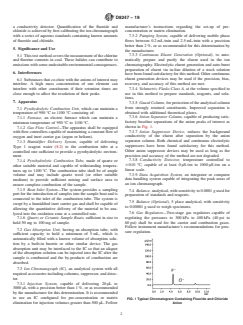
shown in Fig. 1.
7.1.2 Gas Flow Control—The apparatus shall be equipped
7.3.7 Anion Suppressor Device, reduces the background
with flow controllers capable of maintaining a constant flow of
conductivity of the eluent after separation by the anion
oxygen and inert carrier gas (argon or helium).
separator column. Both chemical and continuous electrolytic
7.1.3 Humidifier Delivery System, capable of delivering
suppressors have been found satisfactory for this method.
Type 1 reagent water (8.2) to the combustion tube at a
Other anion suppressor devices may be used as long as the
controlled rate sufficient to provide a pyrohydrolytic environ-
precision and accuracy of the method are not degraded.
ment.
7.3.8 Conductivity Detector, temperature controlled to
7.1.4 Pyrohydrolytic Combustion Tube, made of quartz or
60.01 °C, capable of at least 0 µS⁄cm to 1000 µS⁄cm on a
other suitable material and capable of withstanding tempera-
linear scale.
tures up to 1100 °C. The combustion tube shall be of ample
7.3.9 Data Acquisition System, an integrator or computer
volume and may include quartz wool (or other suitable
data handling system capable of integrating the peak areas of
medium) to provide sufficient mixing and surface area to
an ion chromatograph.
ensure complete combustion of the sample.
7.1.5 Boat Inlet System—The system provides a sampling
7.4 Balance, analytical, with sensitivity to 0.0001 g used for
port for the introduction of samples into the sample boat and is
preparation of standards and reagents.
connected to the inlet of the combustion tube. The system is
7.5 Balance (Optional), 5 place analytical, with sensitivity
swept by a humidified inert carrier gas and shall be capable of
to 0.00001 g used to weigh specimens.
allowing the quantitative delivery of the material to be ana-
7.6 Gas Regulators—Two-stage gas regulators capable of
lyzed into the oxidation zone at a controlled rate.
regulating the pressures to 300 kPa to 400 kPa (40 psi to
7.1.6 Quartz or Ceramic Sample Boats, sufficient in size to
60 psi) shall be used for the carrier and combustion gases.
hold 50 mg to 100 mg of sample.
Follow instrument manufacturer’s recommendations for pres-
7.2 Gas Absorption Unit, having an absorption tube, with
sure regulation.
sufficient capacity to hold a minimum of 5 mL, which is
automatically filled with a known volume of absorption solu-
tion by a built-in burette or other similar device. The gas
absorption unit may be interfaced to the IC so that an aliquot
of the absorption solution can be injected into the IC after the
sample is combusted and the by-products of combustion are
absorbed.
7.3 Ion Chromatograph (IC), an analytical system with all
required accessories including columns, suppressor, and detec-
tor.
7.3.1 Injection System, capable of delivering 20 µL to
3000 µL with a precision better than 1 %, or as recommended
by the manufacturer for this determination. It is recommended
to use an IC configured for pre-concentration or matrix
FIG. 1 Typical Chromatogram Containing Fluoride and Chloride
elimination for injection volumes greater than 500 µL. Follow Anion
D8247 − 19
7.7 Purification Scrubbers or Filters—Molecular sieve for 8.9 Eluent Solution—Follow the specific guidelines for the
moisture and activated charcoal (or equivalent) for hydrocar- preparation and use of the eluent solution from the manufac-
bons are recommended to ensure the removal of contaminants. turer of the columns used.
8.10 Optional Phosphate Stock Solution (1000 mg⁄L)—
8. Reagents and Materials
Dissolve 1.433 g of potassium dihydrogen phosphate
8.1 Purity of Reagents—Reagent grade or higher purity
(KH PO ) in water and dilute to 1 L with water in a Class A
2 4
chemicals shall be used for the preparation of all samples, volumetric flask and mix well.
standards, eluent, and regenerator solutions. Unless otherwise
8.11 Optional Phosphate Absorbing Solution—Dilute the
indicated, it is intended that all reagents shall conform to the
phosphate stock solution with water (1+399) in a Class A
specification of the Committee on Analytical Reagents of the
volumetric flask to a final mass concentration of 2.50 mg⁄L.
American Chemical Society, where such specifications are
Themassconcentrationofphosphateintheabsorbingsolutions
available. Othergradesmaybeused,providedthatthereagent
is used as an internal standard by the ion chromatograph.
is of sufficiently high purity to permit its use without lessening
8.12 Optional Hydrogen Peroxide Absorbing Solution—
the accuracy of the determination.
Typically,Type I water is used as absorber solution for fluoride
8.2 Purity of Water—Unless otherwise indicated, references
and chloride analysis. If desired, a solution of 500 mg⁄L
to water shall be understood to meanType I having a minimum
hydrogen peroxide may be used to improve recovery in
value of 18 MΩ·cm resistance and conforming to Specification
bromide and sulfate determinations. Hydrogen peroxide is not
D1193 Type I reagent water. Comply with all ion chromato-
required if the measurement of bromide and sulfur is not being
graph instrument and column vendor requirements for eluent
determined.
preparation and handling (for example, filtering and degas-
8.13 Suppressor (Chemical and Electrolytic):
sing). The quality of the reagent water is critical to the
8.13.1 Chemical Suppressor Regenerant Solution—Follow
performance, repeatability, reproducibility, and accuracy of the
thespecificmanufacturerguidelinesforthepreparationanduse
method. A chart of critical specification parameters for Type I
of the suppressor solution. The manufacturer’s recommended
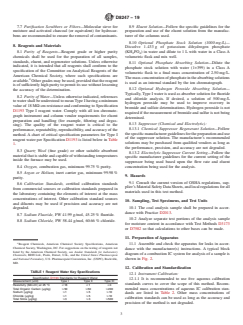
reagent water per Specification D1193 is listed below in Table
solutions may be purchased from qualified vendors as long as
1.
the performance, precision, and accuracy are not degraded.
8.3 Quartz Wool (fine grade) or other suitable absorbent
8.13.2 Electrolytic Suppressor Current Setting—Follow the
materialthatisstableandcapableofwithstandingtemperatures
specific manufacturer guidelines for the current setting of the
inside the furnace may be used.
suppressor being used based upon the flow rate and eluent
8.4 Oxygen, combustion gas, minimum 99.75 % purity.
concentration being used for the analysis.
8.5 Argon or Helium, inert carrier gas, minimum 99.98 %
9. Hazards
purity.
9.1 Consult the current version of OSHA regulations, sup-
8.6 Calibration Standards, certified calibration standards
plier’sMaterialSafetyDataSheets,andlocalregulationsforall
from commercial sources or calibration standards prepared in
materials used in this test method.
the laboratory containing the elements of interest at the mass
concentrations of interest. Other calibration standard sources
10. Sampling, Test Specimens, and Test Units
and diluents may be used if precision and accuracy are not
10.1 The coal analysis sample shall be prepared in accor-
degraded.
dance with Practice D2013.
8.7 Sodium Fluoride, FW 41.99 g⁄mol, 45.25 % fluoride.
10.2 Analyze separate test portions of the analysis sample
8.8 Sodium Chloride, FW 58.44 g/mol, 60.66 % chloride.
for moisture content in accordance with Test Methods D3173
or D7582 so that calculations to other bases can be made.
11. Preparation of Apparatus
Reagent Chemicals, American Chemical Society Specifications, American 11.1 Assemble and check the apparatus for leaks in accor-
Chemical Society, Washington, DC. For suggestions on the testing of rea
...