

ASTM B361-16
(Specification)Standard Specification for Factory-Made Wrought Aluminum and Aluminum-Alloy Welding Fittings
General Information
- Abstract
ABSTRACT
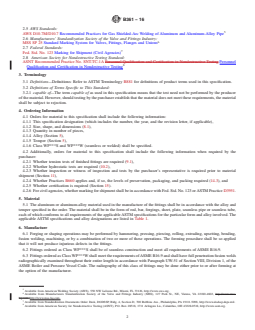
This specification covers only factory-made wrought aluminum and aluminum-alloy welding fittings in contrast to field-made fittings. The aluminum or aluminum-alloy material used in the manufacture of the fittings shall be in accordance with the alloy and temper specified. The material shall be in the form of rod, bar, forgings, sheet, plate, seamless pipe or seamless tube, each of which conforms to all requirements. Forging or shaping operations may be performed by hammering, pressing, piercing, rolling, extruding, upsetting, bending, or fusion welding, or by a combination of two or more of these operations. Tension tests and hydrostatic tests shall be made to conform to the specified requirements.
SCOPE
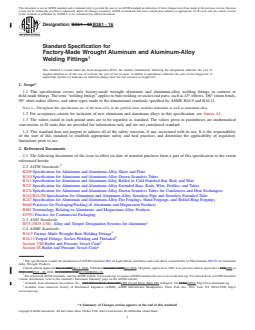
1.1 This specification covers only factory-made wrought aluminum and aluminum-alloy welding fittings in contrast to field-made fittings. The term “welding fittings” applies to butt-welding or socket-end parts, such as 45° elbows, 180° return bends, 90° short radius elbows, and other types made to the dimensional standards specified by ASME B16.9 and B16.11.
Note 1: Throughout this specification use of the term alloy in the general sense includes aluminum as well as aluminum-alloy.
1.2 For acceptance criteria for inclusion of new aluminum and aluminum alloys in this specification, see Annex A1.
1.3 The values stated in inch-pound units are to be regarded as standard. The values given in parentheses are mathematical conversions to SI units that are provided for information only and are not considered standard.
1.4 This standard does not purport to address all of the safety concerns, if any, associated with its use. It is the responsibility of the user of this standard to establish appropriate safety and heal practices and determine the applicability of regulatory limitations prior to use.
- Status
- Published
- Publication Date
- 30-Apr-2016
- Technical Committee
- B07 - Light Metals and Alloys
- Drafting Committee
- B07.03 - Aluminum Alloy Wrought Products
Buy Documents
ASTM B361-16 - Standard Specification for Factory-Made Wrought Aluminum and Aluminum-Alloy Welding Fittings
REDLINE ASTM B361-16 - Standard Specification for Factory-Made Wrought Aluminum and Aluminum-Alloy Welding Fittings
Overview
ASTM B361-16: Standard Specification for Factory-Made Wrought Aluminum and Aluminum-Alloy Welding Fittings is a key international standard governed by ASTM International. This specification focuses on the requirements for factory-made, wrought aluminum and aluminum-alloy welding fittings, primarily used in piping systems. The scope of ASTM B361-16 exclusively covers fittings manufactured in a controlled factory setting, distinguishing them from field-fabricated fittings. These fittings are essential in applications demanding reliable, consistent, and code-compliant connections, especially in industries such as chemical processing, energy, and water treatment.
Key Topics
- Scope of Application: Includes butt-welding and socket-welding parts such as 45° elbows, 180° return bends, 90° short radius elbows, and other dimensional forms conforming to ASME B16.9 and B16.11 standards.
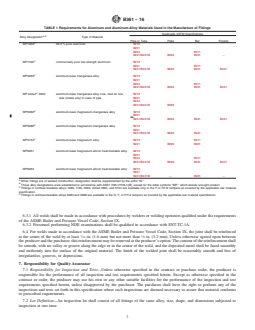
- Material Specifications: Fittings are crafted from specific aluminum or aluminum alloys, such as 1060, 1100, 3003, 5083, 5086, 5154, 6061, and 6063, in forms like rod, bar, plate, forgings, seamless pipe, or tube. Alloy and temper must be as specified in the order, conforming to referenced ASTM standards.
- Manufacturing Processes: Forming operations may involve hammering, pressing, piercing, rolling, extruding, upsetting, bending, fusion welding, and machining. Welded fittings must pass radiographic examination, meet ASME Boiler and Pressure Vessel Code requirements, and be crafted by qualified personnel.
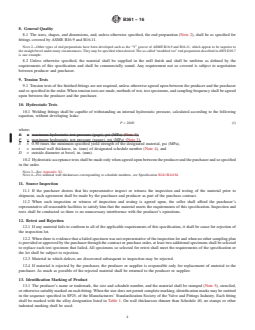
- Testing Requirements: Fittings may be subject to tension and hydrostatic tests upon purchaser request. All fittings must be capable of withstanding specified hydrostatic pressure without leakage.
- Quality Assurance: Inspection, lot definition, rejection, retest procedures, and certification processes ensure product quality and traceability.
- Identification and Packaging: Markings and packaging must satisfy buyer requirements for identification, shipment, and regulatory compliance.
Applications
Factory-made wrought aluminum and aluminum-alloy welding fittings manufactured under ASTM B361-16 are widely used in:
- Piping Systems: For transporting fluids or gases where corrosion resistance, lightweight construction, and code compliance are vital.
- Chemical and Petrochemical Industries: Offering high corrosion resistance in aggressive environments.
- Water and Wastewater Treatment: For reliable, long-lasting pipeline fittings.
- Energy and Power Generation: Used in systems where aluminum's thermal properties are advantageous.
- Boiler and Pressure Vessel Construction: All welding and inspection procedures align with ASME codes for safety and reliability.
By ensuring fittings meet stringent material, manufacturing, and quality criteria, this standard helps minimize risk, facilitates procurement, and assures long-term service life in demanding applications.
Related Standards
ASTM B361-16 references and aligns with several other standards for materials, manufacturing, and testing, including:
- ASTM B209 - Aluminum and Aluminum-Alloy Sheet and Plate
- ASTM B210 - Aluminum and Aluminum-Alloy Drawn Seamless Tubes
- ASTM B211 - Aluminum and Aluminum-Alloy Bar, Rod, and Wire
- ASTM B221 - Extruded Aluminum and Aluminum-Alloy Products
- ASTM B241/B241M - Seamless Pipe and Extruded Tube
- ASTM B247 - Aluminum-Alloy Forgings
- ASME B16.9, B16.11 - Fittings Dimensional Standards
- ASME Boiler and Pressure Vessel Code (Section VIII, IX) – Welding and pressure testing
- AWS D10.7 - Welding practices for aluminum pipe
- ANSI H35.1 - Alloy and temper designation
- MSS SP 25 - Marking systems
Adhering to ASTM B361-16 ensures compatibility with these key industrial standards, optimizing performance and regulatory compliance for wrought aluminum welding fittings.
Keywords: ASTM B361-16, aluminum welding fittings, aluminum-alloy fittings, factory-made fittings, piping systems, ASME B16.9, ASME B16.11, aluminum standards, fitting specification, hydrostatic testing, quality assurance
Relations
- Effective Date
- 01-Nov-2023
- Effective Date
- 01-Oct-2023
- Effective Date
- 01-May-2020
- Effective Date
- 01-May-2018
- Effective Date
- 01-Nov-2017
- Effective Date
- 01-Oct-2017
- Effective Date
- 01-Dec-2015
- Effective Date
- 01-Oct-2015
- Effective Date
- 01-Apr-2013
- Effective Date
- 15-Nov-2012
- Effective Date
- 01-Nov-2012
- Effective Date
- 01-Nov-2012
- Effective Date
- 15-May-2012
- Effective Date
- 15-Jan-2012
- Effective Date
- 15-Jan-2012
Buy Documents
ASTM B361-16 - Standard Specification for Factory-Made Wrought Aluminum and Aluminum-Alloy Welding Fittings
REDLINE ASTM B361-16 - Standard Specification for Factory-Made Wrought Aluminum and Aluminum-Alloy Welding Fittings
Get Certified
Connect with accredited certification bodies for this standard

Institut za varilstvo d.o.o. (Welding Institute)
Slovenia's leading welding institute since 1952. ISO 3834, EN 1090, pressure equipment certification, NDT personnel, welder qualification. Only IIW Au
Sponsored listings
Frequently Asked Questions
ASTM B361-16 is a technical specification published by ASTM International. Its full title is "Standard Specification for Factory-Made Wrought Aluminum and Aluminum-Alloy Welding Fittings". This standard covers: ABSTRACT This specification covers only factory-made wrought aluminum and aluminum-alloy welding fittings in contrast to field-made fittings. The aluminum or aluminum-alloy material used in the manufacture of the fittings shall be in accordance with the alloy and temper specified. The material shall be in the form of rod, bar, forgings, sheet, plate, seamless pipe or seamless tube, each of which conforms to all requirements. Forging or shaping operations may be performed by hammering, pressing, piercing, rolling, extruding, upsetting, bending, or fusion welding, or by a combination of two or more of these operations. Tension tests and hydrostatic tests shall be made to conform to the specified requirements. SCOPE 1.1 This specification covers only factory-made wrought aluminum and aluminum-alloy welding fittings in contrast to field-made fittings. The term “welding fittings” applies to butt-welding or socket-end parts, such as 45° elbows, 180° return bends, 90° short radius elbows, and other types made to the dimensional standards specified by ASME B16.9 and B16.11. Note 1: Throughout this specification use of the term alloy in the general sense includes aluminum as well as aluminum-alloy. 1.2 For acceptance criteria for inclusion of new aluminum and aluminum alloys in this specification, see Annex A1. 1.3 The values stated in inch-pound units are to be regarded as standard. The values given in parentheses are mathematical conversions to SI units that are provided for information only and are not considered standard. 1.4 This standard does not purport to address all of the safety concerns, if any, associated with its use. It is the responsibility of the user of this standard to establish appropriate safety and heal practices and determine the applicability of regulatory limitations prior to use.
ABSTRACT This specification covers only factory-made wrought aluminum and aluminum-alloy welding fittings in contrast to field-made fittings. The aluminum or aluminum-alloy material used in the manufacture of the fittings shall be in accordance with the alloy and temper specified. The material shall be in the form of rod, bar, forgings, sheet, plate, seamless pipe or seamless tube, each of which conforms to all requirements. Forging or shaping operations may be performed by hammering, pressing, piercing, rolling, extruding, upsetting, bending, or fusion welding, or by a combination of two or more of these operations. Tension tests and hydrostatic tests shall be made to conform to the specified requirements. SCOPE 1.1 This specification covers only factory-made wrought aluminum and aluminum-alloy welding fittings in contrast to field-made fittings. The term “welding fittings” applies to butt-welding or socket-end parts, such as 45° elbows, 180° return bends, 90° short radius elbows, and other types made to the dimensional standards specified by ASME B16.9 and B16.11. Note 1: Throughout this specification use of the term alloy in the general sense includes aluminum as well as aluminum-alloy. 1.2 For acceptance criteria for inclusion of new aluminum and aluminum alloys in this specification, see Annex A1. 1.3 The values stated in inch-pound units are to be regarded as standard. The values given in parentheses are mathematical conversions to SI units that are provided for information only and are not considered standard. 1.4 This standard does not purport to address all of the safety concerns, if any, associated with its use. It is the responsibility of the user of this standard to establish appropriate safety and heal practices and determine the applicability of regulatory limitations prior to use.
ASTM B361-16 is classified under the following ICS (International Classification for Standards) categories: 23.040.40 - Metal fittings. The ICS classification helps identify the subject area and facilitates finding related standards.
ASTM B361-16 has the following relationships with other standards: It is inter standard links to ASTM B660-23, ASTM D3951-18(2023), ASTM B247-20, ASTM D3951-18, ASTM B881-17, ASTM B234-17, ASTM D3951-15, ASTM B247-15, ASTM B221-13, ASTM B221-12a, ASTM B241/B241M-12e1, ASTM B241/B241M-12, ASTM B210-12, ASTM B211-12e1, ASTM B211-12. Understanding these relationships helps ensure you are using the most current and applicable version of the standard.
ASTM B361-16 is available in PDF format for immediate download after purchase. The document can be added to your cart and obtained through the secure checkout process. Digital delivery ensures instant access to the complete standard document.
Standards Content (Sample)
This international standard was developed in accordance with internationally recognized principles on standardization established in the Decision on Principles for the
Development of International Standards, Guides and Recommendations issued by the World Trade Organization Technical Barriers to Trade (TBT) Committee.
Designation: B361 − 16
Standard Specification for
Factory-Made Wrought Aluminum and Aluminum-Alloy
Welding Fittings
This standard is issued under the fixed designation B361; the number immediately following the designation indicates the year of
original adoption or, in the case of revision, the year of last revision. A number in parentheses indicates the year of last reapproval. A
superscript epsilon (´) indicates an editorial change since the last revision or reapproval.
1. Scope* B211 Specification for Aluminum and Aluminum-Alloy
Rolled or Cold-Finished Bar, Rod, and Wire (Metric)
1.1 This specification covers only factory-made wrought
B0211_B0211M
aluminum and aluminum-alloy welding fittings in contrast to
B221 Specification for Aluminum and Aluminum-Alloy Ex-
field-made fittings. The term “welding fittings” applies to
truded Bars, Rods, Wire, Profiles, and Tubes
butt-welding or socket-end parts, such as 45° elbows, 180°
B234 Specification for Aluminum and Aluminum-Alloy
return bends, 90° short radius elbows, and other types made to
Drawn Seamless Tubes for Surface Condensers,
the dimensional standards specified by ASME B16.9 and
Evaporators, and Heat Exchangers
B16.11.
B241/B241M Specification for Aluminum and Aluminum-
NOTE 1—Throughout this specification use of the term alloy in the
Alloy Seamless Pipe and Seamless Extruded Tube
general sense includes aluminum as well as aluminum-alloy.
B247 Specification for Aluminum and Aluminum-Alloy Die
1.2 For acceptance criteria for inclusion of new aluminum
Forgings, Hand Forgings, and Rolled Ring Forgings
and aluminum alloys in this specification, see Annex A1.
B660 Practices for Packaging/Packing of Aluminum and
Magnesium Products
1.3 The values stated in inch-pound units are to be regarded
B881 Terminology Relating to Aluminum- and Magnesium-
as standard. The values given in parentheses are mathematical
Alloy Products
conversions to SI units that are provided for information only
D3951 Practice for Commercial Packaging
and are not considered standard.
2.3 ANSI Standards:
1.4 This standard does not purport to address all of the
H35.1/H35.1(M) Alloy and Temper Designation Systems
safety concerns, if any, associated with its use. It is the
for Aluminum
responsibility of the user of this standard to establish appro-
2.4 ASME Standards:
priate safety, health, and environmental practices and deter-
B16.9 Factory-Made Wrought Butt-Welding Fittings
mine the applicability of regulatory limitations prior to use.
B16.11 Forged Fittings, Socket-Welding and Threaded
Section VIII Boiler and Pressure Vessel Code
2. Referenced Documents
Section IX Boiler and Pressure Vessel Code
2.1 The following documents of the issue in effect on date
2.5 AWS Standards:
of material purchase form a part of this specification to the
AWS D10.7M/D10.7 Recommended Practices for Gas
extent referenced herein:
Shielded-Arc Welding of Aluminum and Aluminum-Alloy
2.2 ASTM Standards:
Pipe
B209 Specification for Aluminum and Aluminum-Alloy
2.6 Manufacturers’ Standardization Society of the Valve and
Sheet and Plate (Metric) B0209_B0209M
Fittings Industry:
B210 Specification for Aluminum and Aluminum-Alloy
MSS SP 25 Standard Marking System for Valves, Fittings,
Drawn Seamless Tubes (Metric) B0210_B0210M
Flanges and Unions
1 3
This specification is under the jurisdiction of ASTM Committee B07 on Light Available from Aluminum Association, Inc., 1400 Crystal Drive Suite 430,
Metals and Alloys and is the direct responsibility of Subcommittee B07.03 on Arlington, VA 22202, http://www.aluminum.org.
Aluminum Alloy Wrought Products. Available from American Society of Mechanical Engineers (ASME), ASME
Current edition approved May 1, 2016. Published May 2016. Originally International Headquarters, Three Park Ave., New York, NY 10016-5990, http://
approved in 1960. Last previous edition approved in 2008 as B361 – 08. DOI: www.asme.org.
10.1520/B0361-16. Available from American Welding Society (AWS), 550 NW LeJeune Rd.,
For referenced ASTM standards, visit the ASTM website, www.astm.org, or Miami, FL 33126, http://www.aws.org.
contact ASTM Customer Service at service@astm.org. For Annual Book of ASTM Available from Manufacturers Standardization Society of the Valve and Fittings
Standards volume information, refer to the standard’s Document Summary page on Industry (MSS), 127 Park St., NE, Vienna, VA 22180-4602, http://www.mss-
the ASTM website. hq.com.
*A Summary of Changes section appears at the end of this standard
Copyright © ASTM International, 100 Barr Harbor Drive, PO Box C700, West Conshohocken, PA 19428-2959. United States
B361 − 16
2.7 Federal Standards: 6. Manufacture
Fed. Std. No. 123 Marking for Shipment (Civil Agencies)
6.1 Forging or shaping operations may be performed by
2.8 American Society for Nondestructive Testing Standard:
hammering, pressing, piercing, rolling, extruding, upsetting,
ASNT Recommended Practice No. SNT-TC-1A Personnel
bending, fusion welding, machining, or by a combination of
Qualification and Certification in Nondestructive Testing
two or more of these operations. The forming procedure shall
be so applied that it will not produce injurious defects in the
3. Terminology
fittings.
3.1 Definitions—Definitions: Refer to ASTM Terminology
6.2 Fittings ordered as Class WP***S shall be of seamless
B881 for definitions of product terms used in this specification.
construction and meet all requirements of ASME B16.9.
3.2 Definitions of Terms Specific to This Standard:
6.3 Fittings ordered as Class WP***W shall meet the
3.2.1 capable of—The term capable of as used in this
requirements of ASME B16.9 and shall have full penetration
specification means that the test need not be performed by the
fusion welds radiographically examined throughout their entire
producer of the material. However, should testing by the
length in accordance with Paragraph UW-51 of Section VIII,
purchaser establish that the material does not meet these
Division 1, of the ASME Boiler and Pressure Vessel Code. The
requirements, the material shall be subject to rejection.
radiography of this class of fittings may be done either prior to
or after forming at the option of the manufacturer.
4. Ordering Information
6.3.1 All welds shall be made in accordance with proce-
4.1 Orders for material to this specification shall include the
dures by welders or welding operators qualified under the
following information:
requirements of the ASME Boiler and Pressure Vessel Code,
4.1.1 This specification designation (which includes the
Section IX.
number, the year, and the revision letter, if applicable),
6.3.2 Personnel performing NDE examinations shall be
4.1.2 Size, shape, and dimensions (8.1),
qualified in accordance with SNT-TC-1A.
4.1.3 Quantity in number of pieces,
6.4 For welds made in accordance with the ASME Boiler
4.1.4 Alloy (Section 5),
and Pressure Vessel Code, Section IX, the joint shall be
4.1.5 Temper (Section 5),
reinforced at the center of the weld by at least ⁄16 in. (1.6 mm)
4.1.6 Class WP***S and WP***W (seamless or welded)
but not more than ⁄8 in. (3.2 mm). Unless otherwise agreed
shall be specified.
upon between the producer and the purchaser, this reinforce-
4.2 Additionally, orders for material to this specification
ment may be removed at the producer’s option. The contour of
shall include the following information when required by the
the reinforcement shall be smooth, with no valley or groove
purchaser:
along the edge or in the center of the weld, and the deposited
4.2.1 Whether tension tests of finished fittings are required
metal shall be fused smoothly and uniformly into the surface of
(9.1),
the original material. The finish of the welded joint shall be
4.2.2 Whether hydrostatic tests are required (10.2),
reasonably smooth and free of irregularities, grooves, or
4.2.3 Whether inspection or witness of inspection and tests
depressions.
by the purchaser’s representative is required prior to material
shipment (Section 11),
7. Responsibility for Quality Assurance
4.2.4 Whether Practices B660 applies and, if so, the levels
7.1 Responsibility for Inspection and Tests—Unless other-
of preservation, packaging, and packing required (14.3), and
wise specified in the contract or purchase order, the producer is
4.2.5 Whether certification is required (Section 15).
responsible for the performance of all inspection and test
4.2.6 For civil agencies, whether marking for shipment shall
requirements specified herein. Except as otherwise specified in
be in accordance with Fed. Std. No. 123 or ASTM Practice
the contract or order, the producer may use his own or any
D3951.
other suitable facilities for the performance of the inspection
and test requirements specified herein, unless disapproved by
5. Material
the purchaser. The purchaser shall have the right to perform
5.1 The aluminum or aluminum-alloy material used in the
any of the inspections and tests set forth in this specification
manufacture of the fittings shall be in accordance with the alloy
where such inspections are deemed necessary to assure that
and temper specified in the order. The material shall be in the
material conforms to prescribed requirements.
form of rod, bar, forgings, sheet, plate, seamless pipe or
7.2 Lot Definition—An inspection lot shall consist of all
seamless tube, each of which conforms to all requirements of
fittings of the same alloy, size, shape, and dimensions subjected
the applicable ASTM specifications for the particular form and
to inspection at one time.
alloy involved. The applicable ASTM specifications and alloy
designations are listed in Table 1.
8. General Quality
7 8.1 The sizes, shapes, and dimensions, and, unless other-
Available from Standardization Documents Order Desk, DODSSP, Bldg. 4,
wise specified, the end preparation (Note 2), shall be as
Section D, 700 Robbins Ave., Philadelphia, PA 19111-5098, http://
www.dodssp.daps.mil.
specified for fittings covered by ASME B16.9 and B16.11.
Available from American Society for Nondestructive Testing (ASNT), P.O. Box
28518, 1711 Arlingate Ln., Columbus, OH 43228-0518, http://www.asnt.org. NOTE 2—Other types of end preparations have been developed such as
B361 − 16
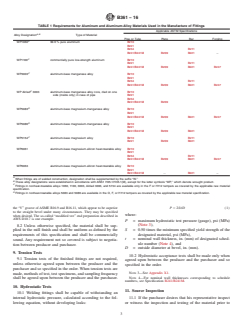
TABLE 1 Requirements for Aluminum and Aluminum-Alloy Materials Used in the Manufacture of Fittings
Applicable ASTM Specifications
A,B
Alloy Designation Type of Material
Pipe or Tube Plate Bar Forging
C
WP1060 99.6 % pure aluminum B210
B221
B234 B211
B241/B241M B209 B221 .
C
WP1100 commercially pure low-strength aluminum B210
B221 B211
B241/B241M B209 B221 B247
C
WP3003 aluminum-base manganese alloy B210
B221
B234 B211
B241/B241M B209 B221 B247
C
WP Alclad 3003 aluminum-base manganese alloy core, clad on one B210
side (inside only) in case of pipe B221
B234
B241/B241M B209
D
WP5083 aluminum-base magnesium-manganese alloy B210
B221
B241/B241M B209 B221 B247
D
WP5086 aluminum-base magnesium-manganese alloy B210
B221
B241/B
...
This document is not an ASTM standard and is intended only to provide the user of an ASTM standard an indication of what changes have been made to the previous version. Because
it may not be technically possible to adequately depict all changes accurately, ASTM recommends that users consult prior editions as appropriate. In all cases only the current version
of the standard as published by ASTM is to be considered the official document.
Designation: B361 − 08 B361 − 16
Standard Specification for
Factory-Made Wrought Aluminum and Aluminum-Alloy
Welding Fittings
This standard is issued under the fixed designation B361; the number immediately following the designation indicates the year of
original adoption or, in the case of revision, the year of last revision. A number in parentheses indicates the year of last reapproval. A
superscript epsilon (´) indicates an editorial change since the last revision or reapproval.
1. Scope*
1.1 This specification covers only factory-made wrought aluminum and aluminum-alloy welding fittings in contrast to
field-made fittings. The term “welding fittings” applies to butt-welding or socket-end parts, such as 45° elbows, 180° return bends,
90° short radius elbows, and other types made to the dimensional standards specified by ASME B16.9 and B16.11.
NOTE 1—Throughout this specification use of the term alloy in the general sense includes aluminum as well as aluminum-alloy.
1.2 For acceptance criteria for inclusion of new aluminum and aluminum alloys in this specification, see Annex A1.
1.3 The values stated in inch-pound units are to be regarded as standard. The values given in parentheses are mathematical
conversions to SI units that are provided for information only and are not considered standard.
1.4 This standard does not purport to address all of the safety concerns, if any, associated with its use. It is the responsibility
of the user of this standard to establish appropriate safety and heal practices and determine the applicability of regulatory
limitations prior to use.
2. Referenced Documents
2.1 The following documents of the issue in effect on date of material purchase form a part of this specification to the extent
referenced herein:
2.2 ASTM Standards:
B209 Specification for Aluminum and Aluminum-Alloy Sheet and Plate
B210 Specification for Aluminum and Aluminum-Alloy Drawn Seamless Tubes
B211 Specification for Aluminum and Aluminum-Alloy Rolled or Cold Finished Bar, Rod, and Wire
B221 Specification for Aluminum and Aluminum-Alloy Extruded Bars, Rods, Wire, Profiles, and Tubes
B234 Specification for Aluminum and Aluminum-Alloy Drawn Seamless Tubes for Condensers and Heat Exchangers
B241/B241M Specification for Aluminum and Aluminum-Alloy Seamless Pipe and Seamless Extruded Tube
B247 Specification for Aluminum and Aluminum-Alloy Die Forgings, Hand Forgings, and Rolled Ring Forgings
B660 Practices for Packaging/Packing of Aluminum and Magnesium Products
B881 Terminology Relating to Aluminum- and Magnesium-Alloy Products
D3951 Practice for Commercial Packaging
2.3 ANSI Standards:
H35.1/H35.1(M) Alloy and Temper Designation Systems for Aluminum
2.4 ASME Standards:
B16.9 Factory-Made Wrought Butt-Welding Fittings
B16.11 Forged Fittings, Socket-Welding and Threaded
Section VIII Boiler and Pressure Vessel Code
Section IX Boiler and Pressure Vessel Code
This specification is under the jurisdiction of ASTM Committee B07 on Light Metals and Alloys and is the direct responsibility of Subcommittee B07.03 on Aluminum
Alloy Wrought Products.
Current edition approved Nov. 1, 2008May 1, 2016. Published December 2008May 2016. Originally approved in 1960. Last previous edition approved in 20022008 as
B361 – 02.B361 – 08. DOI: 10.1520/B0361-08.10.1520/B0361-16.
For referenced ASTM standards, visit the ASTM website, www.astm.org, or contact ASTM Customer Service at service@astm.org. For Annual Book of ASTM Standards
volume information, refer to the standard’s Document Summary page on the ASTM website.
Available from Aluminum Association, Inc., 1525 Wilson Blvd., Suite 600,1400 Crystal Drive Suite 430, Arlington, VA 22209,22202, http://www.aluminum.org.
Available from American Society of Mechanical Engineers (ASME), ASME International Headquarters, Three Park Ave., New York, NY 10016-5990, http://
www.asme.org.
*A Summary of Changes section appears at the end of this standard
Copyright © ASTM International, 100 Barr Harbor Drive, PO Box C700, West Conshohocken, PA 19428-2959. United States
B361 − 16
2.5 AWS Standards:
AWS D10.7M/D10.7 Recommended Practices for Gas Shielded-Arc Welding of Aluminum and Aluminum-Alloy Pipe
2.6 Manufacturers’ Standardization Society of the Valve and Fittings Industry:
MSS SP 25 Standard Marking System for Valves, Fittings, Flanges and Unions
2.7 Federal Standards:
Fed. Std. No. 123 Marking for Shipment (Civil Agencies)
2.8 American Society for Nondestructive Testing Standard:
ASNT Recommended Practice No. SNT-TC-1A Personnel Qualification and Certification in Nondestructive Testing Personnel
Qualification and Certification in Nondestructive Testing
3. Terminology
3.1 Definitions—Definitions: Refer to ASTM Terminology B881 for definitions of product terms used in this specification.
3.2 Definitions of Terms Specific to This Standard:
3.2.1 capable of—The term capable of as used in this specification means that the test need not be performed by the producer
of the material. However, should testing by the purchaser establish that the material does not meet these requirements, the material
shall be subject to rejection.
4. Ordering Information
4.1 Orders for material to this specification shall include the following information:
4.1.1 This specification designation (which includes the number, the year, and the revision letter, if applicable),
4.1.2 Size, shape, and dimensions (8.1),
4.1.3 Quantity in number of pieces,
4.1.4 Alloy (Section 5),
4.1.5 Temper (Section 5),
4.1.6 Class WP***S and WP***W (seamless or welded) shall be specified.
4.2 Additionally, orders for material to this specification shall include the following information when required by the
purchaser:
4.2.1 Whether tension tests of finished fittings are required (9.1),
4.2.2 Whether hydrostatic tests are required (10.2),
4.2.3 Whether inspection or witness of inspection and tests by the purchaser’s representative is required prior to material
shipment (Section 11),
4.2.4 Whether Practices B660 applies and, if so, the levels of preservation, packaging, and packing required (14.3), and
4.2.5 Whether certification is required (Section 15).
4.2.6 For civil agencies, whether marking for shipment shall be in accordance with Fed. Std. No. 123 or ASTM Practice D3951.
5. Material
5.1 The aluminum or aluminum-alloy material used in the manufacture of the fittings shall be in accordance with the alloy and
temper specified in the order. The material shall be in the form of rod, bar, forgings, sheet, plate, seamless pipe or seamless tube,
each of which conforms to all requirements of the applicable ASTM specifications for the particular form and alloy involved. The
applicable ASTM specifications and alloy designations are listed in Table 1.
6. Manufacture
6.1 Forging or shaping operations may be performed by hammering, pressing, piercing, rolling, extruding, upsetting, bending,
fusion welding, machining, or by a combination of two or more of these operations. The forming procedure shall be so applied
that it will not produce injurious defects in the fittings.
6.2 Fittings ordered as Class WP***S shall be of seamless construction and meet all requirements of ASME B16.9.
6.3 Fittings ordered as Class WP***W shall meet the requirements of ASME B16.9 and shall have full penetration fusion welds
radiographically examined throughout their entire length in accordance with Paragraph UW-51 of Section VIII, Division 1, of the
ASME Boiler and Pressure Vessel Code. The radiography of this class of fittings may be done either prior to or after forming at
the option of the manufacturer.
Available from American Welding Society (AWS), 550 NW LeJeune Rd., Miami, FL 33126, http://www.aws.org.
Available from Manufacturers Standardization Society of the Valve and Fittings Industry (MSS), 127 Park St., NE, Vienna, VA 22180-4602, http://www.mss-
hq.com.http://www.mss-hq.com.
Available from Standardization Documents Order Desk, DODSSP, Bldg. 4, Section D, 700 Robbins Ave., Philadelphia, PA 19111-5098, http://www.dodssp.daps.mil.
Available from American Society for Nondestructive Testing (ASNT), P.O. Box 28518, 1711 Arlingate Ln., Columbus, OH 43228-0518, http://www.asnt.org.
B361 − 16
TABLE 1 Requirements for Aluminum and Aluminum-Alloy Materials Used in the Manufacture of Fittings
Applicable ASTM Specifications
A,B
Alloy Designation Type of Material
Pipe or Tube Plate Bar Forging
C
WP1060 99.6 % pure aluminum B210
B221
B234 B211
B241/B241M B209 B221 .
C
WP1100 commercially pure low-strength aluminum B210
B221 B211
B241/B241M B209 B221 B247
C
WP3003 aluminum-base manganese alloy B210
B221
B234 B211
B241/B241M B209 B221 B247
C
WP Alclad 3003 aluminum-base manganese alloy core, clad on one B210
side (inside only) in case of pipe B221
B234
B241/B241M B209
D
WP5083 aluminum-base magnesium-manganese alloy B210
B221
B241/B241M B209 B221 B247
D
WP5086 aluminum-base magnesium-manganese alloy B210
B221
B241/B241M B209 B221
C
WP5154 aluminum-base magnesium alloy B210 B211
B221 B209 B221
WP6061 aluminum-base magnesium-silicon heat-treatable alloy B210
B221
B234 B211
B241/B241M B209 B221 B247
WP6063 aluminum-base magnesium-silicon heat-treatable alloy B210
B221
B241/B241M . B221 .
A
When fittings are of welded construction, designation shall be supplemented by the suffix “W.’’
B
These alloy designations were established in accordance with ANS1 H35.1/H35.1(M), except for the letter symbols “WP,’’ which denote wrought product.
C
Fittings in nonheat-treatable alloys 1060, 1100, 3003, Alclad 3003, and 5154 are available only in the F or H112 tempers as covered by the applicable raw material
specification.
D
Fittings in nonheat-treatable alloys 5083 and 5086 are available in the O, F, or H112 tempers as covered by the applicable raw material specification.
6.3.1 All welds shall be made in accordance with procedures by welders or welding operators qualified under the requirements
of the ASME Boiler and Pressure Vessel Code, Section IX.
6.3.2 Personnel performing NDE examinations shall be qualified in accordance with SNT-TC-1A.
6.4 For welds made in accordance with the ASME Boiler and Pressure Vessel Code, Section IX, the joint shall be reinforced
1 1
at the center of the weld by at least ⁄16 in. (1.6 mm) but not more than ⁄8 in. (3.2 mm). Unless otherwise agreed upon between
the producer and the purchaser, this reinforcement may be removed at the producer’s option. The contour of the reinforcement shall
be smooth, with no valley or groove along the edge or in the center of the weld, and the deposited metal shall be fused smoothly
and uniformly into the surface of the original material. The finish of the welded joint shall be reasonably smooth and free of
irregularities, grooves, or depressions.
7. Responsibility for Quality Assurance
7.1 Responsibility for Inspection and Tests—Unless otherwise specified in the contract or purchase order, the producer is
responsible for the performance of all inspection and test requirements specified herein. Except as otherwise specified in the
contrac
...