


ASTM D6546-23
(Test Method)Standard Test Methods for and Suggested Limits for Determining Compatibility of Elastomer Seals for Industrial Hydraulic Fluid Applications
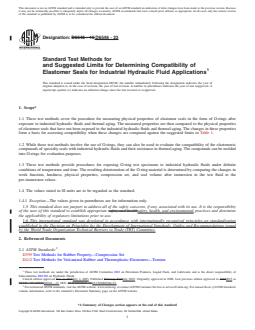
Standard Test Methods for and Suggested Limits for Determining Compatibility of Elastomer Seals for Industrial Hydraulic Fluid Applications
SIGNIFICANCE AND USE
4.1 When more than one elastomer seal material is tested, the test methods yield comparative data on which to base judgements as to expected service quality. Suggested in-service property change limits are provided. Property changes beyond these limits will indicate limited service life of the elastomer seal.
4.2 These test methods attempt to simulate service conditions through controlled aging and evaluation of property changes but may not give any direct correlations with actual part performance since actual service conditions vary widely. These test methods yield comparative data and indications of property changes of the elastomeric seal material under ideal service conditions. These test methods can be used for quality control purposes, for engineering assessments, for service evaluation, and for manufacturing control. The information from these test methods can be used to anticipate expected service quality.
SCOPE
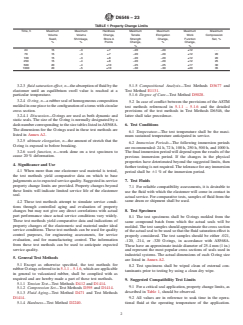
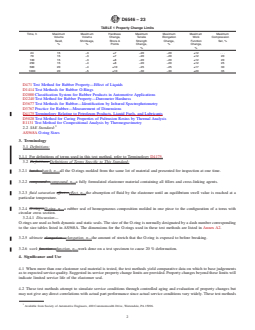
1.1 These test methods cover the procedure for measuring physical properties of elastomer seals in the form of O-rings after exposure to industrial hydraulic fluids and thermal aging. The measured properties are then compared to the physical properties of elastomer seals that have not been exposed to the industrial hydraulic fluids and thermal aging. The changes in these properties form a basis for assessing compatibility when these changes are compared against the suggested limits in Table 1.
1.2 While these test methods involve the use of O-rings, they can also be used to evaluate the compatibility of the elastomeric compounds of specialty seals with industrial hydraulic fluids and their resistance to thermal aging. The compounds can be molded into O-rings for evaluation purposes.
1.3 These test methods provide procedures for exposing O-ring test specimens to industrial hydraulic fluids under definite conditions of temperature and time. The resulting deterioration of the O-ring material is determined by comparing the changes in work function, hardness, physical properties, compression set, and seal volume after immersion in the test fluid to the pre-immersion values.
1.4 The values stated in SI units are to be regarded as the standard.
1.4.1 Exception—The values given in parentheses are for information only.
1.5 This standard does not purport to address all of the safety concerns, if any, associated with its use. It is the responsibility of the user of this standard to establish appropriate safety, health, and environmental practices and determine the applicability of regulatory limitations prior to use.
1.6 This international standard was developed in accordance with internationally recognized principles on standardization established in the Decision on Principles for the Development of International Standards, Guides and Recommendations issued by the World Trade Organization Technical Barriers to Trade (TBT) Committee.
General Information
- Status
- Published
- Publication Date
- 30-Jun-2023
- Technical Committee
- D02 - Petroleum Products, Liquid Fuels, and Lubricants
- Drafting Committee
- D02.N0 - Hydraulic Fluids
Relations
- Refers
ASTM D4175-23a - Standard Terminology Relating to Petroleum Products, Liquid Fuels, and Lubricants - Effective Date
- 15-Dec-2023
- Refers
ASTM D4175-23e1 - Standard Terminology Relating to Petroleum Products, Liquid Fuels, and Lubricants - Effective Date
- 01-Jul-2023
- Effective Date
- 15-Mar-2020
- Refers
ASTM D5028-17 - Standard Test Method for Curing Properties of Pultrusion Resins by Thermal Analysis - Effective Date
- 15-Jul-2017
- Refers
ASTM D5028-09 - Standard Test Method for Curing Properties of Pultrusion Resins by Thermal Analysis - Effective Date
- 01-Sep-2009
- Effective Date
- 01-Sep-2008
- Effective Date
- 01-Nov-2003
- Effective Date
- 01-Nov-2003
- Effective Date
- 10-Mar-2003
- Effective Date
- 10-Jun-1998
- Refers
ASTM D5028-96 - Standard Test Method for Curing Properties of Pultrusion Resins by Thermal Analysis - Effective Date
- 01-Jan-1996
Overview
ASTM D6546-23: Standard Test Methods and Suggested Limits for Determining Compatibility of Elastomer Seals for Industrial Hydraulic Fluid Applications provides comprehensive procedures for evaluating the compatibility of elastomer O-rings and other seal materials when exposed to industrial hydraulic fluids and subjected to thermal aging. Developed by ASTM International, this standard offers comparative data to assess changes in critical physical properties of elastomer seals, establishing suggested property change limits that serve as guidance for anticipated service life and quality.
By simulating idealized hydraulic service conditions, ASTM D6546-23 supports engineers, manufacturers, and quality control professionals in making informed judgments about elastomer material selection and expected performance in hydraulic fluid systems.
Key Topics
- Compatibility Testing of Elastomer Seals: Procedures for exposing elastomer O-rings to specific hydraulic fluids and temperatures, followed by detailed measurement of physical properties.
- Comparative Analysis: Evaluating property changes-such as tensile strength, hardness, compression set, elongation, work function, and volume change-against suggested in-service limits.
- Quality Control and Engineering Assessment: Utilizing standardized test methods to inform quality control processes, manufacturing control, equipment design decisions, and ongoing service evaluation.
- Controlled Aging Simulation: Test conditions are designed to replicate idealized service environments rather than all possible real-world scenarios, providing consistent benchmarks for material evaluation.
- Traceability and Compound Confirmation: Procedures for verifying consistency and quality of elastomer compounds, including requirements for FTIR spectra, TGA, and DSC analysis.
Applications
ASTM D6546-23 is widely used in industrial and manufacturing sectors that rely on hydraulic equipment where elastomer seals are critical to maintaining system integrity. Typical applications include:
- Hydraulic System Design and Maintenance: Ensuring seal material compatibility with specific hydraulic fluids to minimize premature failure, prevent leaks, and maximize service life.
- Seal and O-ring Manufacturing: Verifying material consistency and durability before large-scale production or procurement begins.
- Quality Assurance Programs: Routine qualification testing of elastomer batches to ensure they meet performance expectations for compression set, hardness, volume swell/shrinkage, and resistance to fluid aging.
- Engineering Decision-Making: Assisting mechanical and reliability engineers in material selection during new hydraulic equipment development or upgrades.
- Field Service Evaluation: Investigating root causes of seal failure by comparing in-service seals with ASTM D6546-23 benchmarks.
Related Standards
ASTM D6546-23 references and complements several other international standards relevant to rubber and elastomer seals:
- ASTM D395 – Compression Set Testing for Rubber
- ASTM D412 – Tension Testing of Vulcanized Rubber and Thermoplastic Elastomers
- ASTM D471 – Effect of Liquids on Rubber Property
- ASTM D1414 – Test Methods for Rubber O-Rings
- ASTM D2240 – Durometer Hardness Testing of Rubber
- ASTM D3677 – Identification by Infrared Spectrophotometry
- ASTM D3767 – Measurement of Dimensions for Rubber
- SAE AS568A – Standard Sizes for O-rings
Conclusion
ASTM D6546-23 serves as a crucial standard for evaluating the performance and compatibility of elastomer seals within industrial hydraulic fluid applications. By providing clear test methods and property change limits, the standard enables consistent quality assessments, material selection, and long-term system reliability. Incorporating ASTM D6546-23 into hydraulic equipment manufacturing and maintenance practices ensures optimized seal performance and supports compliance with global quality standards.
Keywords: elastomer seal compatibility, hydraulic fluid, O-ring testing, thermal aging, industrial seal standards, ASTM D6546-23, seal property limits, quality control, rubber testing, industrial hydraulics.
Buy Documents
ASTM D6546-23 - Standard Test Methods for and Suggested Limits for Determining Compatibility of Elastomer Seals for Industrial Hydraulic Fluid Applications
REDLINE ASTM D6546-23 - Standard Test Methods for and Suggested Limits for Determining Compatibility of Elastomer Seals for Industrial Hydraulic Fluid Applications
Get Certified
Connect with accredited certification bodies for this standard

Smithers Quality Assessments
US management systems and product certification.

DIN CERTCO
DIN Group product certification.
Sponsored listings
Frequently Asked Questions
ASTM D6546-23 is a standard published by ASTM International. Its full title is "Standard Test Methods for and Suggested Limits for Determining Compatibility of Elastomer Seals for Industrial Hydraulic Fluid Applications". This standard covers: SIGNIFICANCE AND USE 4.1 When more than one elastomer seal material is tested, the test methods yield comparative data on which to base judgements as to expected service quality. Suggested in-service property change limits are provided. Property changes beyond these limits will indicate limited service life of the elastomer seal. 4.2 These test methods attempt to simulate service conditions through controlled aging and evaluation of property changes but may not give any direct correlations with actual part performance since actual service conditions vary widely. These test methods yield comparative data and indications of property changes of the elastomeric seal material under ideal service conditions. These test methods can be used for quality control purposes, for engineering assessments, for service evaluation, and for manufacturing control. The information from these test methods can be used to anticipate expected service quality. SCOPE 1.1 These test methods cover the procedure for measuring physical properties of elastomer seals in the form of O-rings after exposure to industrial hydraulic fluids and thermal aging. The measured properties are then compared to the physical properties of elastomer seals that have not been exposed to the industrial hydraulic fluids and thermal aging. The changes in these properties form a basis for assessing compatibility when these changes are compared against the suggested limits in Table 1. 1.2 While these test methods involve the use of O-rings, they can also be used to evaluate the compatibility of the elastomeric compounds of specialty seals with industrial hydraulic fluids and their resistance to thermal aging. The compounds can be molded into O-rings for evaluation purposes. 1.3 These test methods provide procedures for exposing O-ring test specimens to industrial hydraulic fluids under definite conditions of temperature and time. The resulting deterioration of the O-ring material is determined by comparing the changes in work function, hardness, physical properties, compression set, and seal volume after immersion in the test fluid to the pre-immersion values. 1.4 The values stated in SI units are to be regarded as the standard. 1.4.1 Exception—The values given in parentheses are for information only. 1.5 This standard does not purport to address all of the safety concerns, if any, associated with its use. It is the responsibility of the user of this standard to establish appropriate safety, health, and environmental practices and determine the applicability of regulatory limitations prior to use. 1.6 This international standard was developed in accordance with internationally recognized principles on standardization established in the Decision on Principles for the Development of International Standards, Guides and Recommendations issued by the World Trade Organization Technical Barriers to Trade (TBT) Committee.
SIGNIFICANCE AND USE 4.1 When more than one elastomer seal material is tested, the test methods yield comparative data on which to base judgements as to expected service quality. Suggested in-service property change limits are provided. Property changes beyond these limits will indicate limited service life of the elastomer seal. 4.2 These test methods attempt to simulate service conditions through controlled aging and evaluation of property changes but may not give any direct correlations with actual part performance since actual service conditions vary widely. These test methods yield comparative data and indications of property changes of the elastomeric seal material under ideal service conditions. These test methods can be used for quality control purposes, for engineering assessments, for service evaluation, and for manufacturing control. The information from these test methods can be used to anticipate expected service quality. SCOPE 1.1 These test methods cover the procedure for measuring physical properties of elastomer seals in the form of O-rings after exposure to industrial hydraulic fluids and thermal aging. The measured properties are then compared to the physical properties of elastomer seals that have not been exposed to the industrial hydraulic fluids and thermal aging. The changes in these properties form a basis for assessing compatibility when these changes are compared against the suggested limits in Table 1. 1.2 While these test methods involve the use of O-rings, they can also be used to evaluate the compatibility of the elastomeric compounds of specialty seals with industrial hydraulic fluids and their resistance to thermal aging. The compounds can be molded into O-rings for evaluation purposes. 1.3 These test methods provide procedures for exposing O-ring test specimens to industrial hydraulic fluids under definite conditions of temperature and time. The resulting deterioration of the O-ring material is determined by comparing the changes in work function, hardness, physical properties, compression set, and seal volume after immersion in the test fluid to the pre-immersion values. 1.4 The values stated in SI units are to be regarded as the standard. 1.4.1 Exception—The values given in parentheses are for information only. 1.5 This standard does not purport to address all of the safety concerns, if any, associated with its use. It is the responsibility of the user of this standard to establish appropriate safety, health, and environmental practices and determine the applicability of regulatory limitations prior to use. 1.6 This international standard was developed in accordance with internationally recognized principles on standardization established in the Decision on Principles for the Development of International Standards, Guides and Recommendations issued by the World Trade Organization Technical Barriers to Trade (TBT) Committee.
ASTM D6546-23 is classified under the following ICS (International Classification for Standards) categories: 83.140.50 - Seals. The ICS classification helps identify the subject area and facilitates finding related standards.
ASTM D6546-23 has the following relationships with other standards: It is inter standard links to ASTM D4175-23a, ASTM D4175-23e1, ASTM E1131-20, ASTM D5028-17, ASTM D5028-09, ASTM E1131-08, ASTM D5028-96(2003), ASTM D5028-96(2003)e1, ASTM E1131-03, ASTM E1131-98, ASTM D5028-96. Understanding these relationships helps ensure you are using the most current and applicable version of the standard.
ASTM D6546-23 is available in PDF format for immediate download after purchase. The document can be added to your cart and obtained through the secure checkout process. Digital delivery ensures instant access to the complete standard document.
Standards Content (Sample)
This international standard was developed in accordance with internationally recognized principles on standardization established in the Decision on Principles for the
Development of International Standards, Guides and Recommendations issued by the World Trade Organization Technical Barriers to Trade (TBT) Committee.
Designation: D6546 − 23
Standard Test Methods for
and Suggested Limits for Determining Compatibility of
Elastomer Seals for Industrial Hydraulic Fluid Applications
This standard is issued under the fixed designation D6546; the number immediately following the designation indicates the year of
original adoption or, in the case of revision, the year of last revision. A number in parentheses indicates the year of last reapproval. A
superscript epsilon (´) indicates an editorial change since the last revision or reapproval.
1. Scope* Development of International Standards, Guides and Recom-
mendations issued by the World Trade Organization Technical
1.1 These test methods cover the procedure for measuring
Barriers to Trade (TBT) Committee.
physical properties of elastomer seals in the form of O-rings
after exposure to industrial hydraulic fluids and thermal aging.
2. Referenced Documents
The measured properties are then compared to the physical
2.1 ASTM Standards:
properties of elastomer seals that have not been exposed to the
D395 Test Methods for Rubber Property—Compression Set
industrial hydraulic fluids and thermal aging. The changes in
D412 Test Methods for Vulcanized Rubber and Thermoplas-
these properties form a basis for assessing compatibility when
tic Elastomers—Tension
these changes are compared against the suggested limits in
D471 Test Method for Rubber Property—Effect of Liquids
Table 1.
D1414 Test Methods for Rubber O-Rings
1.2 While these test methods involve the use of O-rings,
D2000 Classification System for Rubber Products in Auto-
they can also be used to evaluate the compatibility of the
motive Applications
elastomeric compounds of specialty seals with industrial hy-
D2240 Test Method for Rubber Property—Durometer Hard-
draulic fluids and their resistance to thermal aging. The
ness
compounds can be molded into O-rings for evaluation pur-
D3677 Test Methods for Rubber—Identification by Infrared
poses.
Spectrophotometry
1.3 These test methods provide procedures for exposing D3767 Practice for Rubber—Measurement of Dimensions
O-ring test specimens to industrial hydraulic fluids under
D4175 Terminology Relating to Petroleum Products, Liquid
definite conditions of temperature and time. The resulting Fuels, and Lubricants
deterioration of the O-ring material is determined by compar-
D5028 Test Method for Curing Properties of Pultrusion
ing the changes in work function, hardness, physical
Resins by Thermal Analysis
properties, compression set, and seal volume after immersion
E1131 Test Method for Compositional Analysis by Thermo-
in the test fluid to the pre-immersion values.
gravimetry
2.2 SAE Standard:
1.4 The values stated in SI units are to be regarded as the
AS568A O-ring Sizes
standard.
1.4.1 Exception—The values given in parentheses are for
3. Terminology
information only.
3.1 Definitions:
1.5 This standard does not purport to address all of the
3.1.1 For definitions of terms used in this test method, refer
safety concerns, if any, associated with its use. It is the
to Terminology D4175.
responsibility of the user of this standard to establish appro-
3.2 Definitions of Terms Specific to This Standard:
priate safety, health, and environmental practices and deter-
3.2.1 batch, n—all the O-rings molded from the same lot of
mine the applicability of regulatory limitations prior to use.
material and presented for inspection at one time.
1.6 This international standard was developed in accor-
3.2.2 compound, n—a fully formulated elastomer material
dance with internationally recognized principles on standard-
containing all fillers and cross-linking agents.
ization established in the Decision on Principles for the
1 2
These test methods are under the jurisdiction of ASTM Committee D02 on For referenced ASTM standards, visit the ASTM website, www.astm.org, or
Petroleum Products, Liquid Fuels, and Lubricants and is the direct responsibility of contact ASTM Customer Service at service@astm.org. For Annual Book of ASTM
Subcommittee D02.N0 on Hydraulic Fluids. Standards volume information, refer to the standard’s Document Summary page on
Current edition approved July 1, 2023. Published July 2023. Originally approved the ASTM website.
in 2000. Last previous edition approved in 2015 as D6546 – 15. DOI: 10.1520/ Available from Society of Automotive Engineers, 400 Commonwealth Drive,
D6546-23. Warrendale, PA 15096.
*A Summary of Changes section appears at the end of this standard
Copyright © ASTM International, 100 Barr Harbor Drive, PO Box C700, West Conshohocken, PA 19428-2959. United States
D6546 − 23
TABLE 1 Property Change Limits
Time, h Maximum Maximum Hardness Maximum Maximum Maximum Maximum
Volume Volume Change, Tensile Elongation Work Compression
Swell, Shrinkage, Shore A Strength Change, Function Set, %
% % Points Change, % Change,
% %
24 15 −3 ±7 −20 −20 ±12 . . .
70 15 −3 ±7 −20 −20 ±12 20
100 15 −3 ±8 −20 −20 ±12 20
250 15 −4 ±8 −20 −20 ±12 25
500 20 −4 ±10 −25 −25 ±17 30
1000 20 −5 ±10 −30 −30 ±20 35
3.2.3 fluid saturation effect, n—the absorption of fluid by the 5.1.5 Compositional Analysis—Test Methods D3677 and
elastomer until an equilibrium swell value is reached at a Test Method E1131.
particular temperature. 5.1.6 Degree of Cure—Test Method D5028.
3.2.4 O-ring, n—a rubber seal of homogeneous composition
5.2 In case of conflict between the provisions of the ASTM
molded in one piece to the configuration of a torus with circular
test methods referenced in 5.1.1 – 5.1.6 and the detailed
cross section.
provisions of the test methods in Test Methods D6546, the
3.2.4.1 Discussion—O-rings are used as both dynamic and
latter shall take precedence.
static seals. The size of the O-ring is normally designated by a
dash number corresponding to the size tables listed in AS568A. 6. Test Conditions
The dimensions for the O-rings used in these test methods are
6.1 Temperature—The test temperature shall be the maxi-
listed in Annex A2.
mum sustained temperature anticipated in service.
3.2.5 ultimate elongation, n—the amount of stretch that the
6.2 Immersion Periods—The following immersion periods
O-ring is exposed to before breaking.
are recommended: 24 h, 72 h, 100 h, 250 h, 500 h, and 1000 h.
3.2.6 work function, n—work done on a test specimen to
The final immersion period will depend upon the results of the
cause 20 % deformation.
previous immersion period. If the changes in the physical
properties have deteriorated beyond the suggested limits, then
4. Significance and Use
further testing is not required. The tolerance for any immersion
4.1 When more than one elastomer seal material is tested, period shall be 61 % of the immersion period.
the test methods yield comparative data on which to base
judgements as to expected service quality. Suggested in-service 7. Test Fluids
property change limits are provided. Property changes beyond
7.1 For reliable compatibility assessments, it is desirable to
these limits will indicate limited service life of the elastomer
use the fluid with which the elastomer will come in contact in
seal.
actual service. For comparative tests, samples of fluid from the
same drum or shipment shall be used.
4.2 These test methods attempt to simulate service condi-
tions through controlled aging and evaluation of property
8. Test Specimen
changes but may not give any direct correlations with actual
part performance since actual service conditions vary widely.
8.1 The test specimens shall be O-rings molded from the
These test methods yield comparative data and indications of
same compound batch from which the actual seals will be
property changes of the elastomeric seal material under ideal
molded. The test samples should approximate the cross section
service conditions. These test methods can be used for quality
of the actual seal to be used so that the fluid saturation effect is
control purposes, for engineering assessments, for service
properly considered. The test samples should be either -021,
evaluation, and for manufacturing control. The information
-120, -214, or -320 O-rings, in accordance with AS568A.
from these test methods can be used to anticipate expected
These have an approximate inside diameter of 25.4 mm (1 in.)
service quality.
and represent the most popular cross sections of seals used in
industrial systems. The actual dimensions of each O-ring size
5. General Test Methods
are listed in Annex A2.
5.1 Except as otherwise specified, the test methods for
8.2 Test specimens shall be wiped clean of external con-
rubber O-rings referred to in 5.1.1 – 5.1.6, which are applicable
taminants prior to testing by using a clean dry wipe.
in general to vulcanized rubber, shall be complied with as
required and are hereby made a part of these test methods.
9. Suggested Compatibility Test Limits
5.1.1 Tension Test—Test Methods D412 and D1414.
9.1 For a critical seal application, property change limits, as
5.1.2 Compression Set—Test Methods D395 and D1414.
described in Table 1, should be observed.
5.1.3 Fluid Aging—Test Method D471 and Test Methods
D1414. 9.2 All values are in reference to soak time in the opera-
5.1.4 Hardness—Test Method D2240. tional fluid at the operating temperature of the application.
D6546 − 23
Values reflect changes from the determined pre-immersion drip off the surface of the specimen. Then proceed with the
original physical property values of the test specimens. acetone wipe and weighing process described in 10.2.5. Report
when this alternate method of specimen cooling is used.
9.3 If the changes are within these limits, the elastomer
10.2.7 The change in volume is calculated as follows:
should be considered compatible. Once a seal material is found
to be compatible, all seals for that system should be ordered by
~M 2 M ! 2 ~M 2 M !
3 4 1 2
ΔV, % 5 × 100 (1)
specific compound or specification and not by Classification M 2 M
~ !
1 2
D2000 call out number or generic polymer designation.
where:
M = initial mass of specimen in air, g,
10. Procedure for Change in Volume
M = initial mass of specimen in water, g,
10.1 Apparatus:
M = mass of specimen in air after immersion, g, and
10.1.1 Test Container, a Mason jar (quart size) fitted with a
M = mass of specimen in water after immersion, g.
lid to prevent liquid and vapor from escaping. The lid shall not
10.3 Volume Shrinkage-Simulated Dry Out (Optional Test
contaminate the test liquid. Cover the lid with aluminum foil.
Method)—Test three specimens.
10.1.2 Heating Device, a forced air oven, aluminum block
10.3.1 In some situations when long downtimes are
heater, or oil bath heater. Maintain the temperature within
expected, the O-ring should not shrink beyond 5 % of its
61 °C (1.8 °F).
previous volume change value since this can affect its ability to
10.1.3 Test Specimen—The test specimen shall consist of an
be an effective seal when the system is restarted. In those cases
entire O-ring. The same specimen may be used for all tests with
in which a positive volume change was obtained in 10.2 and
hardness and volume determinations made prior to stress-strain
long system down times are anticipated, it is recommended that
tests. Place the test specimen in the test liquid so that it is not
volume shrinkage be determined. To perform this optional test
distorted or in contact with the sides of the test container or
method, additional O-rings will have to be tested in accordance
with the other test specimens. Test a minimum of three test
with 10.2 and then tested in accordance with 10.3 since the
specimens at one time. It is also important that only O-rings of
normal test for volume change is immediately followed by the
one size and one material compound be placed in the test
destructive tensile test.
container.
10.3.2 The test specimen shall consist on an entire O-ring.
10.1.4 Analytical Balance, an analytical balance capable of
The specimen must first be submitted for the volume swell test.
allowing a test specimen to be weighed whether in air or while
This specimen is only to be used for this test sequence and not
submerged in water.
for any other testing.
10.2 Volume Change—Test three specimens.
10.3.3 Place the test specimen from the volume swell test in
10.2.1 Weigh each test specimen in air, M , to the nearest
a forced-air oven that allows air circulation around the test
1 mg, and then weigh each specimen immersed in water, M , at
specimen, and maintain the oven at a test temperature of
room temperature. It is important that all air bubbles clinging
23 °C 6 1 °C (73.4 °F 6 1.8 °F) for 22 h 6 0.25 h. At the end
to the test specimen be removed before reading the weight in
of the required period, remove the specimen from the oven and
water. Blot the specimen dry.
allow it to air cool.
10.2.2 Suspend the specimens in the glass jar by the use of
10.3.4 Weigh each test specimen in air, M , and then weigh
corrosion-resistant wire. Separate the specimens by bending
each specimen immersed in water, M .
small loops in the wire or by locating them in different
10.3.5 The change in volume or shrinkage is calculated as
locations so that they do not contact each other.
follows:
10.2.3 Suspend the specimen vertically so that 25.4 mm
(1 in.) of test fluid is between the lower extremity of the M 2 M 2 M 2 M
~ ! ~ !
5 6 3 4
ΔV, % 5 × 100 (2)
specimen and the bottom of the apparatus. Add enough test
~M 2 M !
3 4
fluid to cover the specimen to a depth of 25.4 mm (1 in.) over
where:
the upper extremity of the specimen.
M = initial mass of volume swell specimen in air after
10.2.4 Place the test apparatus in the heating device adjusted
immersion, g,
to maintain the sample at the test temperature for the required
M = initial mass of volume swell specimen in water after
length of time. At the end of the required immersion period,
immersion, g,
remove the specimen from the apparatus. Cool the specimen to
M = mass of volume swell specimen in air after dry out, g,
room temperature by immersing it in a cool, fresh amount of
and
the test fluid for 45 min.
M = mass of volume swell specimen in water after dry out,
10.2.5 At the end of the cooling period, remove the speci-
g.
men from the fluid, wipe with a cloth dipped in acetone, and
blot dry. Weigh each test specimen in air, M , and then weigh
11. Changes in Tensile Strength, Work Function,
each specimen immersed in water, M .
Elongation, and Hardness
10.2.6 Some oils can be very viscous and may be difficult to
remove with an acetone wipe. Since these oils do not readily 11.1 Original Properties—The original tensile strength,
volatize, specimens exposed to these oils can be cooled by work function, ultimate elongation, and hardness shall be
suspending them for 45 min in air at room temperature determined using a duplicate set of specimens of O-rings of the
shielded from draft. This will allow the majority of the oil to same cross section as those that are to be immersed in the test
D6546 − 23
fluid. The O-rings shall be from the same batch as those that are the grips to remove any slack in the specimen. Exercise care
to be immersed in the test fluid. that no load is placed on the specimen. Pull the specimen at a
rate of 50.8 cm ⁄min (20 in. ⁄min). Record the breaking force
11.2 Properties After Exposure to the Test Fluid, for deter-
value, F, at the time of rupture.
mining the tensile strength, work function, ultimate elongation,
11.4.4 Calculations:
and hardness of specimens after immersion in the test fluid at
11.4.4.1 Tensile strength is calculated as follows:
the test temperature. At the end of the required immersion time,
remove the specimens, and if necessary, cool them to room T 5 F/A (4)
temperature in a fresh sample of the same fluid for 45 min. At
where:
the end of the cooling period, remove the specimen from the
T = tensile strength, MPa (psi),
fluid, wipe it with a cloth dipped in acetone, and blot dry.
F = breaking force, N (lb), and
Immediately determine the hardness, tensile strength, work
A = twice the cross-sectional area calculated from axial
function, and ultimate elongation in accordance with the
thickness, W, as follows:
following test methods, using the original cross-sectional area
2 2 2 2
A 5 π W /2 5 1.57 W mm in. (5)
~ !
of the untreated specimens.
11.2.1 Three specimens shall be tested. The test specimen
11.4.4.2 Tensile strength change is calculated as follows:
shall consist of the entire O-ring. These specimens must first be
T 2 T
2 1
submitted to the volume swell test and cannot be used for any ΔT 5 × 100 (6)
T
other testing since physical property tests are destructive.
where:
11.3 Hardness Change—Measure the hardness in accor-
ΔT = tensile strength change (%),
dance with Test Methods D1414, Section 16, using a micro-
T = tensile strength after immersion, and
hardness tester. Select the mean value from the multiple
T = tensile strength prior to immersion.
readings taken on each O-ring, and then select the mean value
for all the O-rings. (The mean value for hardness measure- 11.5 Elongation Change:
ments is the numerical mean value; thus if five readings are 1
...
This document is not an ASTM standard and is intended only to provide the user of an ASTM standard an indication of what changes have been made to the previous version. Because
it may not be technically possible to adequately depict all changes accurately, ASTM recommends that users consult prior editions as appropriate. In all cases only the current version
of the standard as published by ASTM is to be considered the official document.
Designation: D6546 − 15 D6546 − 23
Standard Test Methods for
and Suggested Limits for Determining Compatibility of
Elastomer Seals for Industrial Hydraulic Fluid Applications
This standard is issued under the fixed designation D6546; the number immediately following the designation indicates the year of
original adoption or, in the case of revision, the year of last revision. A number in parentheses indicates the year of last reapproval. A
superscript epsilon (´) indicates an editorial change since the last revision or reapproval.
1. Scope*
1.1 These test methods cover the procedure for measuring physical properties of elastomer seals in the form of O-rings after
exposure to industrial hydraulic fluids and thermal aging. The measured properties are then compared to the physical properties
of elastomer seals that have not been exposed to the industrial hydraulic fluids and thermal aging. The changes in these properties
form a basis for assessing compatibility when these changes are compared against the suggested limits in Table 1.
1.2 While these test methods involve the use of O-rings, they can also be used to evaluate the compatibility of the elastomeric
compounds of specialty seals with industrial hydraulic fluids and their resistance to thermal aging. The compounds can be molded
into O-rings for evaluation purposes.
1.3 These test methods provide procedures for exposing O-ring test specimens to industrial hydraulic fluids under definite
conditions of temperature and time. The resulting deterioration of the O-ring material is determined by comparing the changes in
work function, hardness, physical properties, compression set, and seal volume after immersion in the test fluid to the
pre-immersion values.
1.4 The values stated in SI units are to be regarded as the standard.
1.4.1 Exception—The values given in parentheses are for information only.
1.5 This standard does not purport to address all of the safety concerns, if any, associated with its use. It is the responsibility
of the user of this standard to establish appropriate safety and healthsafety, health, and environmental practices and determine
the applicability of regulatory limitations prior to use.
1.6 This international standard was developed in accordance with internationally recognized principles on standardization
established in the Decision on Principles for the Development of International Standards, Guides and Recommendations issued
by the World Trade Organization Technical Barriers to Trade (TBT) Committee.
2. Referenced Documents
2.1 ASTM Standards:
D395 Test Methods for Rubber Property—Compression Set
D412 Test Methods for Vulcanized Rubber and Thermoplastic Elastomers—Tension
These test methods are under the jurisdiction of ASTM Committee D02 on Petroleum Products, Liquid Fuels, and Lubricants and is the direct responsibility of
Subcommittee D02.N0 on Hydraulic Fluids.
Current edition approved Dec. 1, 2015July 1, 2023. Published February 2016July 2023. Originally approved in 2000. Last previous edition approved in 20102015 as
D6546 – 00 (2010).D6546 – 15. DOI: 10.1520/D6546-15.10.1520/D6546-23.
For referenced ASTM standards, visit the ASTM website, www.astm.org, or contact ASTM Customer Service at service@astm.org. For Annual Book of ASTM Standards
volume information, refer to the standard’s Document Summary page on the ASTM website.
*A Summary of Changes section appears at the end of this standard
Copyright © ASTM International, 100 Barr Harbor Drive, PO Box C700, West Conshohocken, PA 19428-2959. United States
D6546 − 23
TABLE 1 Property Change Limits
Time, h Maximum Maximum Hardness Maximum Maximum Maximum Maximum
Volume Volume Change, Tensile Elongation Work Compression
Swell, Shrinkage, Shore A Strength Change, Function Set, %
% % Points Change, % Change,
% %
24 15 −3 ±7 −20 −20 ±12 . . .
70 15 −3 ±7 −20 −20 ±12 20
100 15 −3 ±8 −20 −20 ±12 20
250 15 −4 ±8 −20 −20 ±12 25
500 20 −4 ±10 −25 −25 ±17 30
1000 20 −5 ±10 −30 −30 ±20 35
D471 Test Method for Rubber Property—Effect of Liquids
D1414 Test Methods for Rubber O-Rings
D2000 Classification System for Rubber Products in Automotive Applications
D2240 Test Method for Rubber Property—Durometer Hardness
D3677 Test Methods for Rubber—Identification by Infrared Spectrophotometry
D3767 Practice for Rubber—Measurement of Dimensions
D4175 Terminology Relating to Petroleum Products, Liquid Fuels, and Lubricants
D5028 Test Method for Curing Properties of Pultrusion Resins by Thermal Analysis
E1131 Test Method for Compositional Analysis by Thermogravimetry
2.2 SAE Standard:
AS568A O-ring Sizes
3. Terminology
3.1 Definitions:
3.1.1 For definitions of terms used in this test method, refer to Terminology D4175.
3.2 Definitions:Definitions of Terms Specific to This Standard:
3.2.1 batch—batch, n—all the O-rings molded from the same lot of material and presented for inspection at one time.
3.2.2 compound—compound, n—a fully formulated elastomer material containing all fillers and cross-linking agents.
3.2.3 fluid saturation effect—effect, n—the absorption of fluid by the elastomer until an equilibrium swell value is reached at a
particular temperature.
3.2.4 O-ring—O-ring, n—a rubber seal of homogeneous composition molded in one piece to the configuration of a torus with
circular cross section.
3.2.4.1 Discussion—
O-rings are used as both dynamic and static seals. The size of the O-ring is normally designated by a dash number corresponding
to the size tables listed in AS568A. The dimensions for the O-rings used in these test methods are listed in Annex A2.
3.2.5 ultimate elongation—elongation, n—the amount of stretch that the O-ring is exposed to before breaking.
3.2.6 work function—function, n—work done on a test specimen to cause 20 % deformation.
4. Significance and Use
4.1 When more than one elastomer seal material is tested, the test methods yield comparative data on which to base judgements
as to expected service quality. Suggested in-service property change limits are provided. Property changes beyond these limits will
indicate limited service life of the elastomer seal.
4.2 These test methods attempt to simulate service conditions through controlled aging and evaluation of property changes but
may not give any direct correlations with actual part performance since actual service conditions vary widely. These test methods
Available from Society of Automotive Engineers, 400 Commonwealth Drive, Warrendale, PA 15096.
D6546 − 23
yield comparative data and indications of property changes of the elastomeric seal material under ideal service conditions. These
test methods can be used for quality control purposes, for engineering assessments, for service evaluation, and for manufacturing
control. The information from these test methods can be used to anticipate expected service quality.
5. General Test Methods
5.1 Except as otherwise specified, the test methods for rubber O-rings referred to in 5.1.1 – 5.1.6, which are applicable in general
to vulcanized rubber, shall be complied with as required and are hereby made a part of these test methods.
5.1.1 Tension Test—Test Methods D412 and D1414.
5.1.2 Compression Set—Test Methods D395 and D1414.
5.1.3 Fluid Aging—Test Method D471 and Test Methods D1414.
5.1.4 Hardness—Test Method D2240.
5.1.5 Compositional Analysis—Test Methods D3677 and Test Method E1131.
5.1.6 Degree of Cure—Test Method D5028.
5.2 In case of conflict between the provisions of the ASTM test methods referenced in 5.1.1 – 5.1.6 and the detailed provisions
of the test methods in Test Methods D6546, the latter shall take precedence.
6. Test Conditions
6.1 Temperature—The test temperature shall be the maximum sustained temperature anticipated in service.
6.2 Immersion Periods—The following immersion periods are recommended: 24 h, 72 h, 100 h, 250 h, 500 h, and 1000 h. The
final immersion period will depend upon the results of the previous immersion period. If the changes in the physical properties
have deteriorated beyond the suggested limits, then further testing is not required. The tolerance for any immersion period shall
be 61 % of the immersion period.
7. Test Fluids
7.1 For reliable compatibility assessments, it is desirable to use the fluid with which the elastomer will come in contact in actual
service. For comparative tests, samples of fluid from the same drum or shipment shall be used.
8. Test Specimen
8.1 The test specimens shall be O-rings molded from the same compound batch from which the actual seals will be molded. The
test samples should approximate the cross section of the actual seal to be used so that the fluid saturation effect is properly
considered. The test samples should be either -021, -120, -214, or -320 O-rings, in accordance with AS568A. These have an
approximate inside diameter of 25.4 mm (1 in.) and represent the most popular cross sections of seals used in industrial systems.
The actual dimensions of each O-ring size are listed in Annex A2.
8.2 Test specimens shall be wiped clean of external contaminants prior to testing by using a clean dry wipe.
9. Suggested Compatibility Test Limits
9.1 For a critical seal application, property change limits, as described in Table 1, should be observed.
9.2 All values are in reference to soak time in the operational fluid at the operating temperature of the application. Values reflect
changes from the determined pre-immersion original physical property values of the test specimens.
D6546 − 23
9.3 If the changes are within these limits, the elastomer should be considered compatible. Once a seal material is found to be
compatible, all seals for that system should be ordered by specific compound or specification and not by Classification D2000 call
out number or generic polymer designation.
10. Procedure for Change in Volume
10.1 Apparatus:
10.1.1 Test Container, a Mason jar (quart size) fitted with a lid to prevent liquid and vapor from escaping. The lid shall not
contaminate the test liquid. Cover the lid with aluminum foil.
10.1.2 Heating Device, a forced air oven, aluminum block heater, or oil bath heater. Maintain the temperature within 61 °C
(1.8 °F).
10.1.3 Test Specimen—The test specimen shall consist of an entire O-ring. The same specimen may be used for all tests with
hardness and volume determinations made prior to stress-strain tests. Place the test specimen in the test liquid so that it is not
distorted or in contact with the sides of the test container or with the other test specimens. Test a minimum of three test specimens
at one time. It is also important that only O-rings of one size and one material compound be placed in the test container.
10.1.4 Analytical Balance, an analytical balance capable of allowing a test specimen to be weighed whether in air or while
submerged in water.
10.2 Volume Change—Test three specimens.
10.2.1 Weigh each test specimen in air, M , to the nearest 1 mg, and then weigh each specimen immersed in water, M , at room
1 2
temperature. It is important that all air bubbles clinging to the test specimen be removed before reading the weight in water. Blot
the specimen dry.
10.2.2 Suspend the specimens in the glass jar by the use of corrosion-resistant wire. Separate the specimens by bending small
loops in the wire or by locating them in different locations so that they do not contact each other.
10.2.3 Suspend the specimen vertically so that 25.4 mm (1 in.) of test fluid is between the lower extremity of the specimen and
the bottom of the apparatus. Add enough test fluid to cover the specimen to a depth of 25.4 mm (1 in.) over the upper extremity
of the specimen.
10.2.4 Place the test apparatus in the heating device adjusted to maintain the sample at the test temperature for the required length
of time. At the end of the required immersion period, remove the specimen from the apparatus. Cool the specimen to room
temperature by immersing it in a cool, fresh amount of the test fluid for 45 min.
10.2.5 At the end of the cooling period, remove the specimen from the fluid, wipe with a cloth dipped in acetone, and blot dry.
Weigh each test specimen in air, M , and then weigh each specimen immersed in water, M .
3 4
10.2.6 Some oils can be very viscous and may be difficult to remove with an acetone wipe. Since these oils do not readily volatize,
specimens exposed to these oils can be cooled by suspending them for 45 min in air at room temperature shielded from draft. This
will allow the majority of the oil to drip off the surface of the specimen. Then proceed with the acetone wipe and weighing process
described in 10.2.5. Report when this alternate method of specimen cooling is used.
10.2.7 The change in volume is calculated as follows:
~M 2 M !2 ~M 2 M !
3 4 1 2
ΔV, %5 ×100 (1)
M 2 M
~ !
1 2
where:
M = initial mass of specimen in air, g,
M = initial mass of specimen in water, g,
M = mass of specimen in air after immersion, g, and
M = mass of specimen in water after immersion, g.
D6546 − 23
10.3 Volume Shrinkage-Simulated Dry Out (Optional Test Method)—Test three specimens.
10.3.1 In some situations when long downtimes are expected, the O-ring should not shrink beyond 5 % of its previous volume
change value since this can affect its ability to be an effective seal when the system is restarted. In those cases in which a positive
volume change was obtained in 10.2 and long system down times are anticipated, it is recommended that volume shrinkage be
determined. To perform this optional test method, additional O-rings will have to be tested in accordance with 10.2 and then tested
in accordance with 10.3 since the normal test for volume change is immediately followed by the destructive tensile test.
10.3.2 The test specimen shall consist on an entire O-ring. The specimen must first be submitted for the volume swell test. This
specimen is only to be used for this test sequence and not for any other testing.
10.3.3 Place the test specimen from the volume swell test in a forced-air oven that allows air circulation around the test specimen,
and maintain the oven at a test temperature of 23 °C 6 1 °C (73.4 °F 6 1.8 °F) for 22 h 6 0.25 h. At the end of the required period,
remove the specimen from the oven and allow it to air cool.
10.3.4 Weigh each test specimen in air, M , and then weigh each specimen immersed in water, M .
5 6
10.3.5 The change in volume or shrinkage is calculated as follows:
M 2 M 2 M 2 M
~ ! ~ !
5 6 3 4
ΔV, %5 ×100 (2)
~M 2 M !
3 4
where:
M = initial mass of volume swell specimen in air after immersion, g,
M = initial mass of volume swell specimen in water after immersion, g,
M = mass of volume swell specimen in air after dry out, g, and
M = mass of volume swell specimen in water after dry out, g.
11. Changes in Tensile Strength, Work Function, Elongation, and Hardness
11.1 Original Properties—The original tensile strength, work function, ultimate elongation, and hardness shall be determined
using a duplicate set of specimens of O-rings of the same cross section as those that are to be immersed in the test fluid. The O-rings
shall be from the same batch as those that are to be immersed in the test fluid.
11.2 Properties After Exposure to the Test Fluid, for determining the tensile strength, work function, ultimate elongation, and
hardness of specimens after immersion in the test fluid at the test temperature. At the end of the required immersion time, remove
the specimens, and if necessary, cool them to room temperature in a fresh sample of the same fluid for 45 min. At the end of the
cooling period, remove the specimen from the fluid, wipe it with a cloth dipped in acetone, and blot dry. Immediately determine
the hardness, tensile strength, work function, and ultimate elongation in accordance with the following test methods, using the
original cross-sectional area of the untreated specimens.
11.2.1 Three specimens shall be tested. The test specimen shall consist of the entire O-ring. These specimens must first be
submitted to the volume swell test and cannot be used for any other testing since physical property tests are destructive.
11.3 Hardness Change—Measure the hardness in accordance with Test Methods D1414, Section 16, using a microhardness tester.
Select the mean value from the multiple readings taken on each O-ring, and then select the mean value for all the O-rings. (The
mean value for hardness measurements is the numerical mean value; thus if five readings are obtained, for example, 70A, 69A,
69A, 72A, and 71A, the numerical mean would be 70.2 or 70A since Shore hardness is always reported in whole numbers.) The
mean value for all O-rings shall be recorded. Measurements are to be taken before and after exposure to fluid.
11.3.1 The hardness change is calculated as follows:
ΔH 5 H 2 H (3)
2 1
where:
ΔH = hardness change,
D6546 − 23
H = hardness before fluid exposure, and
H = hardness after fluid exposure.
The units are given as Shore A points and a plus or minus sign should be included. A negative sign would indicate that the O-ring
is softening after exposure and its hardness value would be less than the hardness value before exposure. A positive sign would
indicate that the O-ring is hardening after exposure and its hardness value would be greater than the hardness value before
expos
...
Questions, Comments and Discussion
Ask us and Technical Secretary will try to provide an answer. You can facilitate discussion about the standard in here.
Loading comments...