


ASTM E2977-15(2023)
(Practice)Standard Practice for Measuring and Reporting Performance of Fourier-Transform Nuclear Magnetic Resonance (FT-NMR) Spectrometers for Liquid Samples
Standard Practice for Measuring and Reporting Performance of Fourier-Transform Nuclear Magnetic Resonance (FT-NMR) Spectrometers for Liquid Samples
SIGNIFICANCE AND USE
4.1 This practice permits an analyst to compare the performance of an NMR spectrometer for a particular test on any given day with the instrument's prior performance for that test. The practice can also provide sufficient quantitative performance information for problem diagnosis and solving. If complete information about how a test is carried out is supplied and sufficient replicates are collected to substantiate statistical relevance, the tests in this practice can be used to establish the setting and meeting of relevant performance specifications. This practice is not necessarily meant for the comparison of different instruments with each other, even if the instruments are of the same type and model. This practice is not meant for the comparison of the performance of different instruments operated under conditions differing from those specified for a particular test.
SCOPE
1.1 This practice covers procedures for measuring and reporting the performance of Fourier-transform nuclear magnetic resonance spectrometers (FT-NMRs) using liquid samples.
1.2 This practice is not directly applicable to FT-NMR spectrometers outfitted to measure gaseous, anisotropically structured liquid, semi-solid, or solid samples; those set up to work with flowing sample streams; or those used to make hyperpolarization measurements.
1.3 This practice was expressly developed for FT-NMR spectrometers operating with proton resonance frequencies between 200 MHz and 1200 MHz.
1.4 This practice is not directly applicable to continuous wave (scanning) NMR spectrometers.
1.5 This practice is not directly applicable to instruments using single-sideband detection.
1.6 Units—The values stated in SI units are to be regarded as the standard. No other units of measurement are included in this standard.
1.7 This standard does not purport to address all of the safety concerns, if any, associated with its use. It is the responsibility of the user of this standard to establish appropriate safety, health, and environmental practices and determine the applicability of regulatory limitations prior to use.
1.8 This international standard was developed in accordance with internationally recognized principles on standardization established in the Decision on Principles for the Development of International Standards, Guides and Recommendations issued by the World Trade Organization Technical Barriers to Trade (TBT) Committee.
General Information
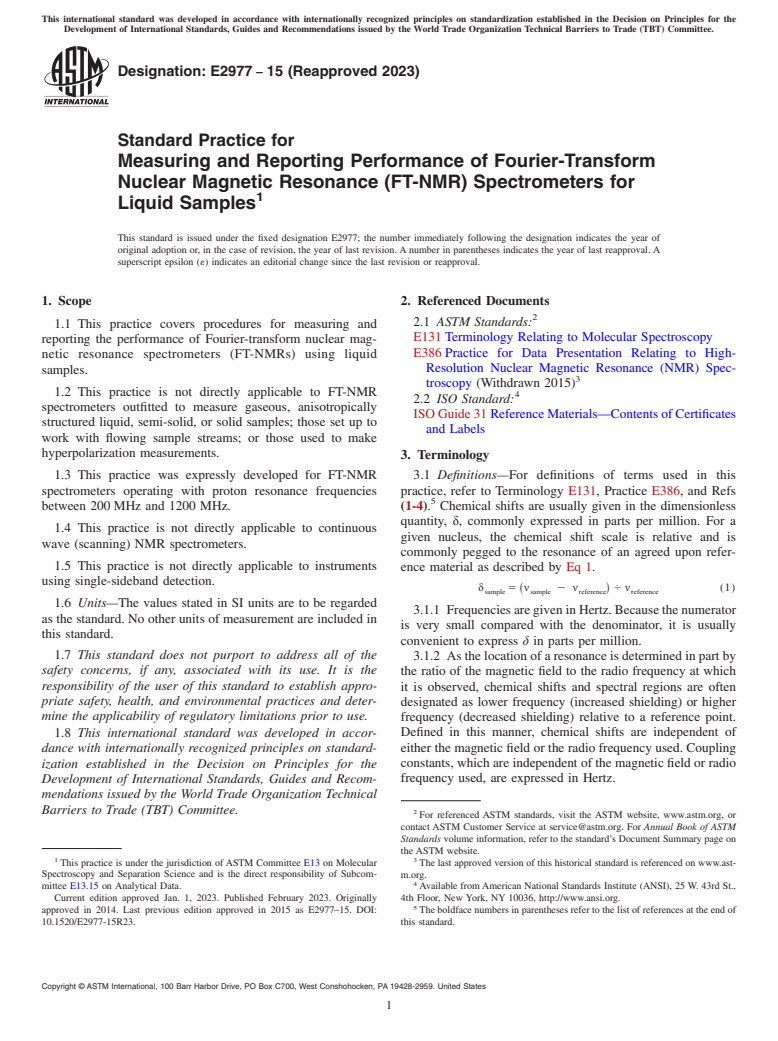
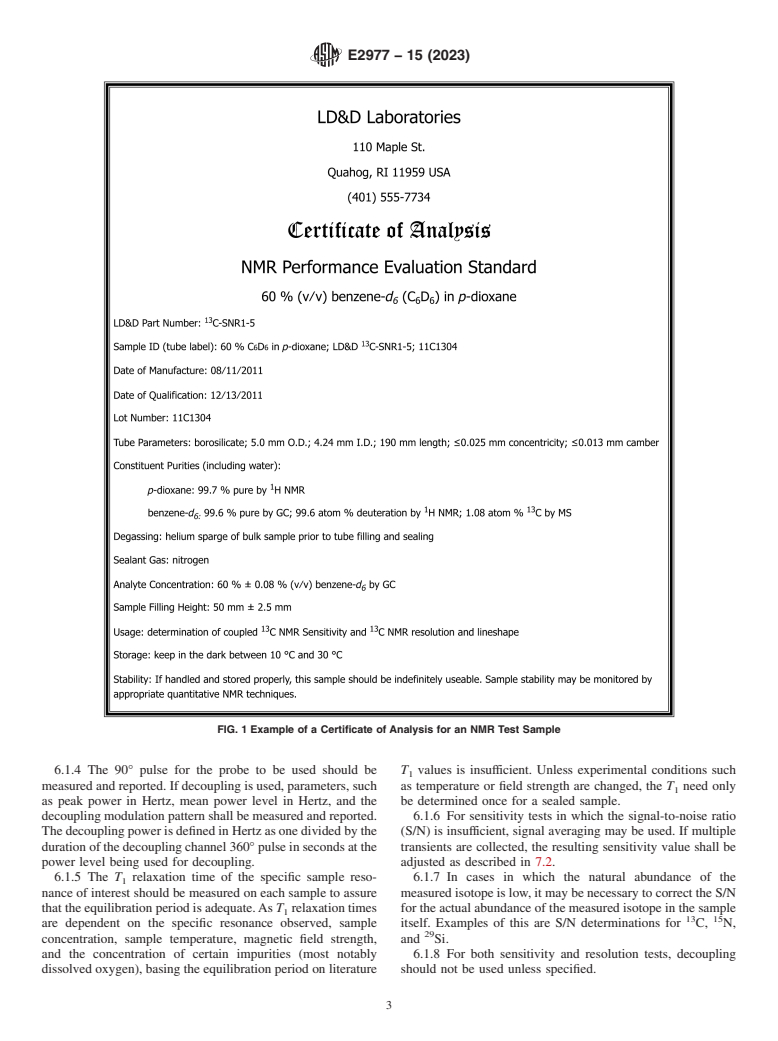
Standards Content (Sample)
This international standard was developed in accordance with internationally recognized principles on standardization established in the Decision on Principles for the
Development of International Standards, Guides and Recommendations issued by the World Trade Organization Technical Barriers to Trade (TBT) Committee.
Designation: E2977 − 15 (Reapproved 2023)
Standard Practice for
Measuring and Reporting Performance of Fourier-Transform
Nuclear Magnetic Resonance (FT-NMR) Spectrometers for
1
Liquid Samples
This standard is issued under the fixed designation E2977; the number immediately following the designation indicates the year of
original adoption or, in the case of revision, the year of last revision. A number in parentheses indicates the year of last reapproval. A
superscript epsilon (´) indicates an editorial change since the last revision or reapproval.
1. Scope 2. Referenced Documents
2
2.1 ASTM Standards:
1.1 This practice covers procedures for measuring and
E131 Terminology Relating to Molecular Spectroscopy
reporting the performance of Fourier-transform nuclear mag-
E386 Practice for Data Presentation Relating to High-
netic resonance spectrometers (FT-NMRs) using liquid
Resolution Nuclear Magnetic Resonance (NMR) Spec-
samples.
3
troscopy (Withdrawn 2015)
1.2 This practice is not directly applicable to FT-NMR
4
2.2 ISO Standard:
spectrometers outfitted to measure gaseous, anisotropically
ISO Guide 31 Reference Materials—Contents of Certificates
structured liquid, semi-solid, or solid samples; those set up to
and Labels
work with flowing sample streams; or those used to make
hyperpolarization measurements.
3. Terminology
1.3 This practice was expressly developed for FT-NMR
3.1 Definitions—For definitions of terms used in this
spectrometers operating with proton resonance frequencies practice, refer to Terminology E131, Practice E386, and Refs
5
between 200 MHz and 1200 MHz.
(1-4). Chemical shifts are usually given in the dimensionless
quantity, δ, commonly expressed in parts per million. For a
1.4 This practice is not directly applicable to continuous
given nucleus, the chemical shift scale is relative and is
wave (scanning) NMR spectrometers.
commonly pegged to the resonance of an agreed upon refer-
1.5 This practice is not directly applicable to instruments
ence material as described by Eq 1.
using single-sideband detection.
δ 5 ~ν 2 ν ! ÷ ν (1)
sample sample reference reference
1.6 Units—The values stated in SI units are to be regarded
3.1.1 Frequencies are given in Hertz. Because the numerator
as the standard. No other units of measurement are included in
is very small compared with the denominator, it is usually
this standard.
convenient to express δ in parts per million.
1.7 This standard does not purport to address all of the
3.1.2 As the location of a resonance is determined in part by
safety concerns, if any, associated with its use. It is the
the ratio of the magnetic field to the radio frequency at which
responsibility of the user of this standard to establish appro-
it is observed, chemical shifts and spectral regions are often
priate safety, health, and environmental practices and deter- designated as lower frequency (increased shielding) or higher
mine the applicability of regulatory limitations prior to use.
frequency (decreased shielding) relative to a reference point.
Defined in this manner, chemical shifts are independent of
1.8 This international standard was developed in accor-
dance with internationally recognized principles on standard- either the magnetic field or the radio frequency used. Coupling
constants, which are independent of the magnetic field or radio
ization established in the Decision on Principles for the
Development of International Standards, Guides and Recom- frequency used, are expressed in Hertz.
mendations issued by the World Trade Organization Technical
Barriers to Trade (TBT) Committee.
2
For referenced ASTM standards, visit the ASTM website, www.astm.org, or
contact ASTM Customer Service at service@astm.org. For Annual Book of ASTM
Standards volume information, refer to the standard’s Document Summary page on
the ASTM website.
1 3
This practice is under the jurisdiction of ASTM Committee E13 on Molecular The last approved version of this historical standard is referenced on www.ast-
Spectroscopy and Separation Science and is the direct responsibility of Subcom- m.org.
4
mittee E13.15 on Analytical Data. Available from American National Standards Institute (ANSI), 25 W. 43rd St.,
Current edition approved Jan. 1, 2023. Published February 2023. Originally 4th Floor, New York, NY 10036, http://www.ansi.org.
5
approved in 2014. Last previous edition approved in 2015 as E2977–15. DOI: The boldface numbers in parentheses refer to the list of references at the end of
10.1520/E2977-15R23. this standard.
Copyright © ASTM International, 100 Barr Harbor Drive, PO Box C700, West Conshohocken, PA 19428-2959. United States
1
---------------------- Page: 1 -----------------
...
Questions, Comments and Discussion
Ask us and Technical Secretary will try to provide an answer. You can facilitate discussion about the standard in here.