


ASTM F1875-98(2014)
(Practice)Standard Practice for Fretting Corrosion Testing of Modular Implant Interfaces: Hip Femoral Head-Bore and Cone Taper Interface
Standard Practice for Fretting Corrosion Testing of Modular Implant Interfaces: Hip Femoral Head-Bore and Cone Taper Interface
SIGNIFICANCE AND USE
5.1 The modular interfaces of total joint prostheses are subjected to micromotion that could result in fretting and corrosion. The release of corrosion products and particulate debris could stimulate adverse biological reactions, as well as lead to accelerated wear at the articulation interface. Methods to assess the stability and corrosion resistance of the modular interfaces, therefore, are an essential component of device testing.
5.2 Long-term in-vitro testing is essential to produce damage and debris from fretting of a modular interface (4,5). The use of proteinaceous solutions is recommended to best simulate the in-vivo environment.
5.3 Short-term tests often can be useful in evaluations of differences in design during device development (1-4). The electrochemical methods provide semiquantitative measures of fretting corrosion rates. The relative contributions of mechanical and electrochemical processes to the total corrosion and particulate release phenomena, however, have not been established; therefore, these tests should not be utilized to compare the effects of changes in material combinations, but rather be utilized to evaluate design changes of bore (head) and cone (stem) components.
5.4 These tests are recommended for evaluating the fretting wear and corrosion of modular interfaces of hip femoral head and stem components. Similar methods may be applied to other modular interfaces where fretting corrosion is of concern.
5.5 These methods are recommended for comparative evaluation of the fretting wear and corrosion of new materials, coatings, or designs, or a combination thereof, under consideration for hip femoral head and neck modular interfaces. Components for testing may be those of a manufactured modular hip device (finished product) or sample coupons, which are designed and manufactured for simulation of the head, taper, and neck region of a modular hip device.
SCOPE
1.1 This practice describes the testing, analytical, and characterization methods for evaluating the mechanical stability of the bore and cone interface of the head and stem junction of modular hip implants subjected to cyclic loading by measurements of fretting corrosion (1-5).2 Two test methods described are as follows:
1.1.1 Method I—The primary purpose of this method is to provide a uniform set of guidelines for long-term testing to determine the amount of damage by measurement of the production of corrosion products and particulate debris from fretting and fretting corrosion. Damage is also assessed by characterization of the damage to the bore and cone surfaces (4, 5).
1.1.2 Methods II—This method provides for short-term electrochemical evaluation of the fretting corrosion of the modular interface. It is not the intent of this method to produce damage nor particulate debris but rather to provide a rapid method for qualitative assessment of design changes which do not include material changes (1-4).
1.2 This practice does not provide for judgment or prediction of in-vivo implant performance, but rather provides for a uniform set of guidelines for evaluating relative differences in performance between differing implant designs, constructs, or materials with performance defined in the context of the amount of fretting and fretting corrosion. Also, this practice should permit direct comparison of fretting corrosion data between independent research groups, and thus provide for building of a data base on modular implant performance.
1.3 This practice provides for comparative testing of manufactured hip femoral heads and stems and for coupon type specimen testing where the male taper portion of the modular junction does not include the entire hip implant, with the taper portion of the coupon identical in design, manufacturing, and materials to the taper of the final hip implant (4,5).
1.4 Method I of this practice permits simultaneous evaluation of the fatigue strength of a femoral h...
General Information
Buy Standard
Standards Content (Sample)
NOTICE: This standard has either been superseded and replaced by a new version or withdrawn.
Contact ASTM International (www.astm.org) for the latest information
Designation: F1875 − 98 (Reapproved 2014)
Standard Practice for
Fretting Corrosion Testing of Modular Implant Interfaces:
Hip Femoral Head-Bore and Cone Taper Interface
This standard is issued under the fixed designation F1875; the number immediately following the designation indicates the year of
original adoption or, in the case of revision, the year of last revision. A number in parentheses indicates the year of last reapproval. A
superscript epsilon (´) indicates an editorial change since the last revision or reapproval.
1. Scope portion of the coupon identical in design, manufacturing, and
materials to the taper of the final hip implant (4,5).
1.1 This practice describes the testing, analytical, and char-
acterization methods for evaluating the mechanical stability of
1.4 Method I of this practice permits simultaneous evalua-
the bore and cone interface of the head and stem junction of
tionofthefatiguestrengthofafemoralhipstem(inaccordance
modular hip implants subjected to cyclic loading by measure-
with Practice F1440) and the mechanical stability and debris
ments of fretting corrosion (1-5). Two test methods described
generated by fretting and fretting corrosion of the modular
are as follows:
interface.
1.1.1 Method I—The primary purpose of this method is to
1.5 The general concepts and methodologies described in
provide a uniform set of guidelines for long-term testing to
this practice could be applied to the study of other modular
determine the amount of damage by measurement of the
interfaces in total joint prostheses.
production of corrosion products and particulate debris from
fretting and fretting corrosion. Damage is also assessed by 1.6 The values stated in SI units are to be regarded as
characterization of the damage to the bore and cone surfaces standard. No other units of measurement are included in this
(4, 5). standard.
1.1.2 Methods II—This method provides for short-term
1.7 This standard may involve hazardous materials,
electrochemical evaluation of the fretting corrosion of the
operations, and equipment. This standard does not purport to
modular interface. It is not the intent of this method to produce
address all of the safety concerns, if any, associated with its
damage nor particulate debris but rather to provide a rapid
use. It is the responsibility of the user of this standard to
method for qualitative assessment of design changes which do
establish appropriate safety and health practices and deter-
not include material changes (1-4).
mine the applicability of regulatory limitations prior to use.
1.2 This practice does not provide for judgment or predic-
tion of in-vivo implant performance, but rather provides for a
2. Referenced Documents
uniform set of guidelines for evaluating relative differences in
2.1 ASTM Standards:
performance between differing implant designs, constructs, or
E4 Practices for Force Verification of Testing Machines
materials with performance defined in the context of the
E466 Practice for Conducting Force Controlled Constant
amount of fretting and fretting corrosion. Also, this practice
Amplitude Axial Fatigue Tests of Metallic Materials
should permit direct comparison of fretting corrosion data
E467 Practice for Verification of Constant Amplitude Dy-
between independent research groups, and thus provide for
namic Forces in an Axial Fatigue Testing System
building of a data base on modular implant performance.
F561 Practice for Retrieval and Analysis of Medical
1.3 This practice provides for comparative testing of manu-
Devices, and Associated Tissues and Fluids
factured hip femoral heads and stems and for coupon type
F746 Test Method for Pitting or Crevice Corrosion of
specimen testing where the male taper portion of the modular
Metallic Surgical Implant Materials
junction does not include the entire hip implant, with the taper
F897 Test Method for Measuring Fretting Corrosion of
Osteosynthesis Plates and Screws
F1440 Practice for Cyclic Fatigue Testing of Metallic
Stemmed HipArthroplasty Femoral Components Without
ThispracticeisunderthejurisdictionofASTMCommitteeF04onMedicaland
Surgical Materials and Devices and is the direct responsibility of Subcommittee
F04.22 on Arthroplasty
Current edition approved Oct. 1, 2014. Published November 2014. Originally
approved in 1998. Last previous edition approved in 2009 as F1875 – 98(2009). For referenced ASTM standards, visit the ASTM website, www.astm.org, or
DOI: 10.1520/F1875-98R14. contact ASTM Customer Service at service@astm.org. For Annual Book of ASTM
The bold face numbers in parentheses refers to the list of references at the end Standards volume information, refer to the standard’s Document Summary page on
of this standard. the ASTM website.
Copyright © ASTM International, 100 Barr Harbor Drive, PO Box C700, West Conshohocken, PA 19428-2959. United States
F1875 − 98 (2014)
Torsion (Withdrawn 2012) therefore, total elemental level refers to all matter and corro-
F1636 SpecificationforBoresandConesforModularFemo- sion products released by fretting wear and corrosion.
ral Heads (Withdrawn 2001)
3.1.10 wear, n—damage to a solid surface, generally involv-
G3 Practice for Conventions Applicable to Electrochemical
ingprogressivelossofmaterial,duetorelativemotionbetween
Measurements in Corrosion Testing
that surface and a contacting substance or substances.
G5 Reference Test Method for Making Potentiodynamic
Anodic Polarization Measurements
4. Summary of Test Method
G15 Terminology Relating to Corrosion and CorrosionTest-
4 4.1 Method I—The femoral stem and head components, or
ing (Withdrawn 2010)
coupons to simulate head-taper-neck geometry, are loaded
G40 Terminology Relating to Wear and Erosion
cyclically in a manner similar to that described in Practice
G61 Test Method for Conducting Cyclic Potentiodynamic
F1440. The head neck junction is exposed to a saline or
Polarization Measurements for Localized Corrosion Sus-
proteinaceous solution, either by immersion of the entire
ceptibility of Iron-, Nickel-, or Cobalt-Based Alloys
device, or with a fluid containing envelope. The cyclic load is
G102 Practice for Calculation of Corrosion Rates and Re-
applied for a minimum of 10 million cycles.At the conclusion
lated Information from Electrochemical Measurements
of testing, the isolated fluid is withdrawn for chemical analysis
2.2 ISO Standards:
for total elemental level, and characterization of particulate
ISO 7206-7 Endurance Performance of Stemmed Femoral
debris. The taper interface is subsequently disengaged and the
Components Without Application of Torsion
surfaces inspected for fretting wear and corrosion using optical
microscopy and scanning electron microscopy. The output of
3. Terminology
thesemethodsisaquantitativemeasureoftotalelementallevel
3.1 Definitions:
andaqualitativeevaluationofdamageofthemodularinterface
3.1.1 corrosive wear, n—wear in which chemical or electro-
caused by fretting wear and corrosion.
chemical reaction with the environment is significant.
4.2 Method II—A coupon similar to that used in Method I,
3.1.2 coverage, n—the length, parallel to the taper surface,
or an entire femoral stem and head construct, may be mounted
that the bore and cone interfaces are in contact.
in an inverted position in a test chamber. The chamber is filled
3.1.3 crevice corrosion, n—localized corrosion of a metal
withanelectrolytesolutiontoalevelsufficienttosubmergethe
surface at, or immediately adjacent to, an area that is shielded
bore and cone interface and a small portion of the exposed
from full exposure to the environment because of close
neck. The area of contact and articulation between the ball and
proximity between the metal and the surface of another
the test apparatus is isolated from the electrolyte, either by
material.
being above the fill level, or with an elastomeric seal used to
isolate the bottom of the test chamber.
3.1.4 external circuit, n—the wires, connectors, measuring
4.2.1 Procedure A—A saturated calomel electrode with a
devices, current sources, and so forth that are used to bring
luggin probe is used as a reference electrode to measure
about or measure the desired electrical conditions within the
changes in the corrosion potential with an electrometer. A
test cell.
counter electrode also may be employed and the polarization
3.1.5 femoral head neck extension, n—a distance parallel to
characteristics measured with a potentiostat.
the taper axis, from the nominal neck offset length (k)as
4.2.2 Procedure B—Alargesurfaceareacounterelectrodeis
defined in Specification F1636, and the center of the head.
immersed in the solution to simulate the area of the stem. A
Such variants from the nominal length are used to adjust for
zero-resistance ammeter is connected between the test device
resection level, leg length, and so forth. A positive neck
and the counter electrode. The difference in current, thus
extension equates to the center of the head being located
measured prior to and during cyclic loading, represents the
further away from the stem.
fretting corrosion current flowing between the modular inter-
3.1.6 fretting, n—small amplitude oscillatory motion, usu-
face (anode) and the metal sheet (cathode).
ally tangential, between two solid surfaces in contact.
3.1.7 fretting corrosion, n—the deterioration at the interface
5. Significance and Use
between contacting surfaces as the result of corrosion and
5.1 The modular interfaces of total joint prostheses are
slight oscillatory slip between the two surfaces.
subjected to micromotion that could result in fretting and
3.1.8 fretting wear, n—wear arising as a result of fretting.
corrosion. The release of corrosion products and particulate
debris could stimulate adverse biological reactions, as well as
3.1.9 total elemental level, n—the total weight of particulate
matter and corrosion ions generated by fretting wear and lead to accelerated wear at the articulation interface. Methods
to assess the stability and corrosion resistance of the modular
fretting corrosion. Most analytical techniques are unable to
accurately differentiate between ions and particulates, and interfaces, therefore, are an essential component of device
testing.
5.2 Long-term in-vitro testing is essential to produce dam-
The last approved version of this historical standard is referenced on
age and debris from fretting of a modular interface (4,5). The
www.astm.org.
useofproteinaceoussolutionsisrecommendedtobestsimulate
Available fromAmerican National Standards Institute (ANSI), 25 W. 43rd St.,
4th Floor, New York, NY 10036. the in-vivo environment.
F1875 − 98 (2014)
5.3 Short-term tests often can be useful in evaluations of 6.3 Specimen Mounting Devices, Method II—Modular hip
differences in design during device development (1-4). The and stem components shall be set-up in an inverted position, as
electrochemical methods provide semiquantitative measures of shown in Fig. 2. Coupon samples may be set up as shown in
fretting corrosion rates. The relative contributions of mechani- Fig. 1, or in an inverted orientation.
cal and electrochemical processes to the total corrosion and
6.4 Environmental Containment, Method I—The prosthesis
particulate release phenomena, however, have not been estab-
may be placed in an environmental chamber, which is filled
lished; therefore, these tests should not be utilized to compare
with the appropriate fluid. Care should be taken to ensure that
the effects of changes in material combinations, but rather be
the contact area between the head and the low friction thrust
utilized to evaluate design changes of bore (head) and cone
bearing is not exposed to the electrolyte solution. The modular
(stem) components.
interface of the prostheses or coupon samples also may be
5.4 These tests are recommended for evaluating the fretting enclosed in an elastomeric sleeve, which contains the electro-
wear and corrosion of modular interfaces of hip femoral head lyte. The materials used for such isolation must be nonreactive
andstemcomponents.Similarmethodsmaybeappliedtoother and capable of retaining the fluid environment, (that is, prevent
modular interfaces where fretting corrosion is of concern. leakage), throughout the course of testing. The volume of the
chamber shall be between 5 and 100 mL.
5.5 These methods are recommended for comparative
evaluation of the fretting wear and corrosion of new materials,
NOTE 1—The use of small fluid volumes with the sleeve containment
method may not produce as much fretting corrosion as full prosthesis
coatings, or designs, or a combination thereof, under consid-
exposure, due to the reduced surface area of the cathodic metal exposed.
eration for hip femoral head and neck modular interfaces.
Components for testing may be those of a manufactured 6.5 Environmental Chamber, Method II—The chamber shall
modular hip device (finished product) or sample coupons, be filled with electrolyte so as to submerge the modular
which are designed and manufactured for simulation of the interface.An elastomeric seal is used to isolate the contact area
head, taper, and neck region of a modular hip device. between the head and the load application surface. Similar
seals should be employed for coupon sample testing. For
6. Apparatus
couponsorientedasshowninFig.1,thechamberfilllevelshall
bekeptbelowthearticulationbetweentheheadandtheloading
6.1 Testing Machines—The action of the machine should be
apparatus.
analyzedthereaftertoensurethatthedesiredformandperiodic
force amplitude is maintained for the duration of the test (see
6.6 Counter and Reference Electrodes, Method II—Acoun-
Practice E467). The test machine should have a load monitor-
ter electrode is included in the external circuit of Method II to
ing system, such as the transducer mounted in line with the
act as a cathode for measurement of corrosion currents. A
specimen. The loads should be monitored continuously in the
reference electrode is employed for measurement of the
early stages of the test and periodically thereafter to ensure the
corrosion potential of the specimen.
desired load cycle is maintained. The varying load as deter-
6.6.1 Method II, Procedure A—The counter electrode and
minedbysuitabledynamicverificationshouldbemaintainedat
saturated calomel electrode (SCE) shall be employed in accor-
all times to within 62 % of the maximum force being used in
dance with Test Methods G5 and G61.
accordance with Practices E4 and E466.
6.2 Specimen Mounting Devices, Method I—Modular hip
and stem components shall be set up as described in Practices
F1440. Coupon samples shall be set up as shown in Fig. 1.The
set up must provide for identical loading geometry as that in
Practice F1440.
NOTE 1—For Method I, the fluid is con
...
This document is not an ASTM standard and is intended only to provide the user of an ASTM standard an indication of what changes have been made to the previous version. Because
it may not be technically possible to adequately depict all changes accurately, ASTM recommends that users consult prior editions as appropriate. In all cases only the current version
of the standard as published by ASTM is to be considered the official document.
Designation: F1875 − 98 (Reapproved 2009) F1875 − 98 (Reapproved 2014)
Standard Practice for
Fretting Corrosion Testing of Modular Implant Interfaces:
Hip Femoral Head-Bore and Cone Taper Interface
This standard is issued under the fixed designation F1875; the number immediately following the designation indicates the year of
original adoption or, in the case of revision, the year of last revision. A number in parentheses indicates the year of last reapproval. A
superscript epsilon (´) indicates an editorial change since the last revision or reapproval.
1. Scope
1.1 This practice describes the testing, analytical, and characterization methods for evaluating the mechanical stability of the
bore and cone interface of the head and stem junction of modular hip implants subjected to cyclic loading by measurements of
fretting corrosion (1-5). Two test methods described are as follows:
1.1.1 Method I—The primary purpose of this method is to provide a uniform set of guidelines for long-term testing to determine
the amount of damage by measurement of the production of corrosion products and particulate debris from fretting and fretting
corrosion. Damage is also assessed by characterization of the damage to the bore and cone surfaces (4, 5).
1.1.2 Methods II—This method provides for short-term electrochemical evaluation of the fretting corrosion of the modular
interface. It is not the intent of this method to produce damage nor particulate debris but rather to provide a rapid method for
qualitative assessment of design changes which do not include material changes (1-4).
1.2 This practice does not provide for judgment or prediction of in-vivo implant performance, but rather provides for a uniform
set of guidelines for evaluating relative differences in performance between differing implant designs, constructs, or materials with
performance defined in the context of the amount of fretting and fretting corrosion. Also, this practice should permit direct
comparison of fretting corrosion data between independent research groups, and thus provide for building of a data base on
modular implant performance.
1.3 This practice provides for comparative testing of manufactured hip femoral heads and stems and for coupon type specimen
testing where the male taper portion of the modular junction does not include the entire hip implant, with the taper portion of the
coupon identical in design, manufacturing, and materials to the taper of the final hip implant (4,5).
1.4 Method I of this practice permits simultaneous evaluation of the fatigue strength of a femoral hip stem (in accordance with
Practice F1440) and the mechanical stability and debris generated by fretting and fretting corrosion of the modular interface.
1.5 The general concepts and methodologies described in this practice could be applied to the study of other modular interfaces
in total joint prostheses.
1.6 The values stated in SI units are to be regarded as standard. No other units of measurement are included in this standard.
1.7 This standard may involve hazardous materials, operations, and equipment. This standard does not purport to address all
of the safety concerns, if any, associated with its use. It is the responsibility of the user of this standard to establish appropriate
safety and health practices and determine the applicability of regulatory limitations prior to use.
2. Referenced Documents
2.1 ASTM Standards:
E4 Practices for Force Verification of Testing Machines
E466 Practice for Conducting Force Controlled Constant Amplitude Axial Fatigue Tests of Metallic Materials
E467 Practice for Verification of Constant Amplitude Dynamic Forces in an Axial Fatigue Testing System
F561 Practice for Retrieval and Analysis of Medical Devices, and Associated Tissues and Fluids
F746 Test Method for Pitting or Crevice Corrosion of Metallic Surgical Implant Materials
This practice is under the jurisdiction of ASTM Committee F04 on Medical and Surgical Materials and Devices and is the direct responsibility of Subcommittee F04.15
on Material Test Methods
Current edition approved Dec. 1, 2009Oct. 1, 2014. Published December 2009November 2014. Originally approved in 1998. Last previous edition approved in 20042009
as F1875 – 98(2004).(2009). DOI: 10.1520/F1875-98R09.10.1520/F1875-98R14.
The bold face numbers in parentheses refers to the list of references at the end of this standard.
For referenced ASTM standards, visit the ASTM website, www.astm.org, or contact ASTM Customer Service at service@astm.org. For Annual Book of ASTM Standards
volume information, refer to the standard’s Document Summary page on the ASTM website.
Copyright © ASTM International, 100 Barr Harbor Drive, PO Box C700, West Conshohocken, PA 19428-2959. United States
F1875 − 98 (2014)
F897 Test Method for Measuring Fretting Corrosion of Osteosynthesis Plates and Screws
F1440 Practice for Cyclic Fatigue Testing of Metallic Stemmed Hip Arthroplasty Femoral Components Without Torsion
(Withdrawn 2012)
F1636 Specification for Bores and Cones for Modular Femoral Heads (Withdrawn 2001)
G3 Practice for Conventions Applicable to Electrochemical Measurements in Corrosion Testing
G5 Reference Test Method for Making Potentiodynamic Anodic Polarization Measurements
G15 Terminology Relating to Corrosion and Corrosion Testing (Withdrawn 2010)
G40 Terminology Relating to Wear and Erosion
G61 Test Method for Conducting Cyclic Potentiodynamic Polarization Measurements for Localized Corrosion Susceptibility of
Iron-, Nickel-, or Cobalt-Based Alloys
G102 Practice for Calculation of Corrosion Rates and Related Information from Electrochemical Measurements
2.2 ISO Standards:
ISO 7206-7 Endurance Performance of Stemmed Femoral Components Without Application of Torsion
3. Terminology
3.1 Definitions:
3.1.1 corrosive wear, n—wear in which chemical or electrochemical reaction with the environment is significant.
3.1.2 coverage, n—the length, parallel to the taper surface, that the bore and cone interfaces are in contact.
3.1.3 crevice corrosion, n—localized corrosion of a metal surface at, or immediately adjacent to, an area that is shielded from
full exposure to the environment because of close proximity between the metal and the surface of another material.
3.1.4 external circuit, n—the wires, connectors, measuring devices, current sources, and so forth that are used to bring about
or measure the desired electrical conditions within the test cell.
3.1.5 femoral head neck extension, n—a distance parallel to the taper axis, from the nominal neck offset length (k) as defined
in Specification F1636, and the center of the head. Such variants from the nominal length are used to adjust for resection level,
leg length, and so forth. A positive neck extension equates to the center of the head being located further away from the stem.
3.1.6 fretting, n—small amplitude oscillatory motion, usually tangential, between two solid surfaces in contact.
3.1.7 fretting corrosion, n—the deterioration at the interface between contacting surfaces as the result of corrosion and slight
oscillatory slip between the two surfaces.
3.1.8 fretting wear, n—wear arising as a result of fretting.
3.1.9 total elemental level, n—the total weight of particulate matter and corrosion ions generated by fretting wear and fretting
corrosion. Most analytical techniques are unable to accurately differentiate between ions and particulates, and therefore, total
elemental level refers to all matter and corrosion products released by fretting wear and corrosion.
3.1.10 wear, n—damage to a solid surface, generally involving progressive loss of material, due to relative motion between that
surface and a contacting substance or substances.
4. Summary of Test Method
4.1 Method I—The femoral stem and head components, or coupons to simulate head-taper-neck geometry, are loaded cyclically
in a manner similar to that described in Practice F1440. The head neck junction is exposed to a saline or proteinaceous solution,
either by immersion of the entire device, or with a fluid containing envelope. The cyclic load is applied for a minimum of 10
million cycles. At the conclusion of testing, the isolated fluid is withdrawn for chemical analysis for total elemental level, and
characterization of particulate debris. The taper interface is subsequently disengaged and the surfaces inspected for fretting wear
and corrosion using optical microscopy and scanning electron microscopy. The output of these methods is a quantitative measure
of total elemental level and a qualitative evaluation of damage of the modular interface caused by fretting wear and corrosion.
4.2 Method II—A coupon similar to that used in Method I, or an entire femoral stem and head construct, may be mounted in
an inverted position in a test chamber. The chamber is filled with an electrolyte solution to a level sufficient to submerge the bore
and cone interface and a small portion of the exposed neck. The area of contact and articulation between the ball and the test
apparatus is isolated from the electrolyte, either by being above the fill level, or with an elastomeric seal used to isolate the bottom
of the test chamber.
4.2.1 Procedure A—A saturated calomel electrode with a luggin probe is used as a reference electrode to measure changes in
the corrosion potential with an electrometer. A counter electrode also may be employed and the polarization characteristics
measured with a potentiostat.
The last approved version of this historical standard is referenced on www.astm.org.
Available from American National Standards Institute (ANSI), 25 W. 43rd St., 4th Floor, New York, NY 10036.
F1875 − 98 (2014)
4.2.2 Procedure B—A large surface area counter electrode is immersed in the solution to simulate the area of the stem. A
zero-resistance ammeter is connected between the test device and the counter electrode. The difference in current, thus measured
prior to and during cyclic loading, represents the fretting corrosion current flowing between the modular interface (anode) and the
metal sheet (cathode).
5. Significance and Use
5.1 The modular interfaces of total joint prostheses are subjected to micromotion that could result in fretting and corrosion. The
release of corrosion products and particulate debris could stimulate adverse biological reactions, as well as lead to accelerated wear
at the articulation interface. Methods to assess the stability and corrosion resistance of the modular interfaces, therefore, are an
essential component of device testing.
5.2 Long-term in-vitro testing is essential to produce damage and debris from fretting of a modular interface (4,5). The use of
proteinaceous solutions is recommended to best simulate the in-vivo environment.
5.3 Short-term tests often can be useful in evaluations of differences in design during device development (1-4). The
electrochemical methods provide semiquantitative measures of fretting corrosion rates. The relative contributions of mechanical
and electrochemical processes to the total corrosion and particulate release phenomena, however, have not been established;
therefore, these tests should not be utilized to compare the effects of changes in material combinations, but rather be utilized to
evaluate design changes of bore (head) and cone (stem) components.
5.4 These tests are recommended for evaluating the fretting wear and corrosion of modular interfaces of hip femoral head and
stem components. Similar methods may be applied to other modular interfaces where fretting corrosion is of concern.
5.5 These methods are recommended for comparative evaluation of the fretting wear and corrosion of new materials, coatings,
or designs, or a combination thereof, under consideration for hip femoral head and neck modular interfaces. Components for testing
may be those of a manufactured modular hip device (finished product) or sample coupons, which are designed and manufactured
for simulation of the head, taper, and neck region of a modular hip device.
6. Apparatus
6.1 Testing Machines—The action of the machine should be analyzed thereafter to ensure that the desired form and periodic
force amplitude is maintained for the duration of the test (see Practice E467). The test machine should have a load monitoring
system, such as the transducer mounted in line with the specimen. The loads should be monitored continuously in the early stages
of the test and periodically thereafter to ensure the desired load cycle is maintained. The varying load as determined by suitable
dynamic verification should be maintained at all times to within 62 % of the maximum force being used in accordance with
Practices E4 and E466.
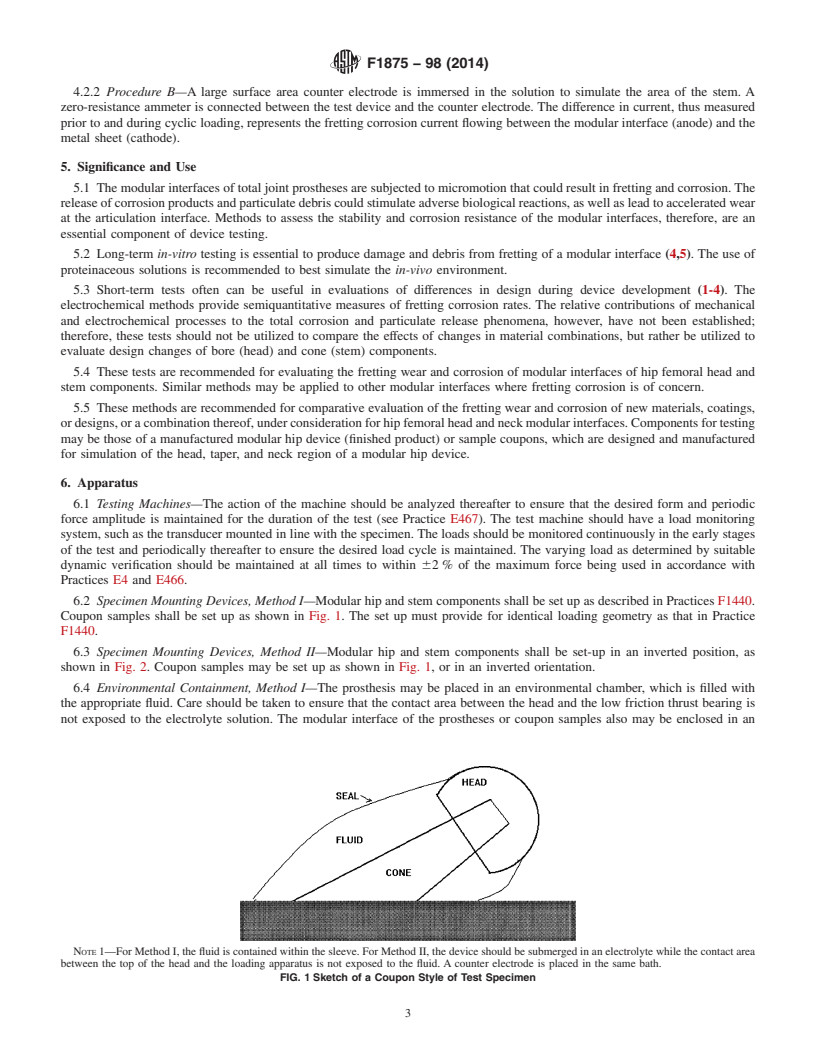
6.2 Specimen Mounting Devices, Method I—Modular hip and stem components shall be set up as described in Practices F1440.
Coupon samples shall be set up as shown in Fig. 1. The set up must provide for identical loading geometry as that in Practice
F1440.
6.3 Specimen Mounting Devices, Method II—Modular hip and stem components shall be set-up in an inverted position, as
shown in Fig. 2. Coupon samples may be set up as shown in Fig. 1, or in an inverted orientation.
6.4 Environmental Containment, Method I—The prosthesis may be placed in an environmental chamber, which is filled with
the appropriate fluid. Care should be taken to ensure that the contact area between the head and the low friction thrust bearing is
not exposed to the electrolyte solution. The modular interface of the prostheses or coupon samples also may be enclosed in an
NOTE 1—For Method I, the fluid is contained within the sleeve. For Method II, the device should be submerged in an electrolyte while the contact area
between the top of the head and the loading apparatus is not exposed to the fluid. A counter electrode is placed in the same bath.
FIG. 1 Sketch of a Coupon Style of Test Specimen
F1875 − 98 (2014)
NOTE 1—The cathode sheet surrounds, but does not make contact with the device being tested. For Procedure A, the counter electrode is not utilized,
and is substituted with a luggin probe and calomel electrode.
FIG. 2 Suggested Set-Up for Method II Procedure B, Measurements of Fretting Corrosion Currents of a Complete THR
elastomeric sleeve, which contains the electrolyte. The materials used for such isolation must be nonreactive and capable of
retaining the fluid environment, (that is, prevent leakage),
...
Questions, Comments and Discussion
Ask us and Technical Secretary will try to provide an answer. You can facilitate discussion about the standard in here.