

ASTM F2949-18
(Specification)Standard Specification for Pole Vault Box Collars
General Information
- Abstract
ABSTRACT
This specification covers minimum requirements of size, physical characteristics of materials, standard testing procedures, labeling and identification of pole vault box collars. With the required minimum dimensions, maximum thickness, maximum dimensions of box collar cutout, minimum dimensions of box collar cutout a pole vault box collars shall be tested under ambient conditions that match those of intended use. The pole vault box collar shall be tested using the impact testing procedures for Installed Surface Performance Test (Field Test) of ASTM F1292.
SCOPE
1.1 This specification covers minimum requirements of size, physical characteristics of materials, standard testing procedures, labeling and identification of pole vault box collars.2
1.2 Units—The values stated in SI units are to be regarded as the standard. The values given in parentheses are for information only.
1.3 This standard does not purport to address all of the safety concerns, if any, associated with its use. It is the responsibility of the user of this standard to establish appropriate safety, health, and environmental practices and determine the applicability of regulatory limitations prior to use.
1.4 This international standard was developed in accordance with internationally recognized principles on standardization established in the Decision on Principles for the Development of International Standards, Guides and Recommendations issued by the World Trade Organization Technical Barriers to Trade (TBT) Committee.
- Status
- Published
- Publication Date
- 31-Mar-2018
- Technical Committee
- F08 - Sports Equipment, Playing Surfaces, and Facilities
- Drafting Committee
- F08.67 - Pole Vault
Overview
ASTM F2949-18: Standard Specification for Pole Vault Box Collars establishes the minimum requirements for the design, materials, dimensions, testing, and labeling of pole vault box collars. Developed by ASTM International, this standard aims to enhance the safety and performance of pole vault landing systems by specifying the physical and functional characteristics of box collars used in athletics. The specification applies globally and is intended for manufacturers, facility managers, and testing agencies involved in track and field equipment procurement, installation, and maintenance.
Key Topics
- Dimensional Requirements: The standard details the minimum and maximum dimensions for pole vault box collars and their components, such as arms, wings, and cutouts, to ensure compatibility with pole vault boxes and vaulting poles.
- Material Characteristics: Physical properties of the materials used in the manufacture of box collars are specified to promote safety and durability during use.
- Performance Testing: Pole vault box collars are required to undergo impact testing using procedures adapted from ASTM F1292 to assess cushioning properties and reduce injury risks during vaulting activities.
- Labeling and Identification: The standard mandates clear manufacturer identification, model designation, installation instructions, and warning labels to help users correctly install and maintain the equipment.
- Testing Procedures: The specification outlines the procedures for field and laboratory testing, including the use of standardized impact test systems, documentation of environmental conditions, and recording of test outcomes.
Applications
ASTM F2949-18 serves a critical role in several practical contexts:
- Track and Field Safety: By providing consistent specifications, the standard helps minimize the risk of injury for pole vaulters by ensuring proper cushioning and fit of pole vault box collars around the vaulting box.
- Equipment Procurement: Athletics organizations, schools, and sports facility managers use this standard to select compliant pole vault box collars and to verify that equipment meets safety and performance criteria.
- Product Development and Manufacturing: Manufacturers rely on ASTM F2949-18 to design and construct pole vault box collars that meet both regulatory and end-user requirements.
- Compliance Assessment: Testing laboratories and certifying bodies refer to this standard when conducting field or laboratory evaluations, ensuring equipment is both effective and safe.
Related Standards
- ASTM F1292 – Specification for Impact Attenuation of Surfacing Materials Within the Use Zone of Playground Equipment: Referenced for the impact testing procedures used for pole vault box collars.
- ASTM Standards for Track and Field Equipment: This standard complements other ASTM specifications related to sports surfaces and facility safety.
- International Safety Guidelines: ASTM F2949-18 is developed in accordance with World Trade Organization (WTO) standardization principles, ensuring international applicability.
Keywords: ASTM F2949-18, pole vault box collars, athletic equipment standards, impact testing, track and field safety, box collar dimensions, ASTM F1292, pole vaulting, sports facility equipment, international standard.
Relations
- Effective Date
- 01-Apr-2018
- Effective Date
- 01-Dec-2018
- Effective Date
- 01-Oct-2017
- Effective Date
- 01-May-2017
- Effective Date
- 01-Nov-2013
- Effective Date
- 01-Dec-2009
- Effective Date
- 01-Jan-2004
- Effective Date
- 10-Aug-1999
Frequently Asked Questions
ASTM F2949-18 is a technical specification published by ASTM International. Its full title is "Standard Specification for Pole Vault Box Collars". This standard covers: ABSTRACT This specification covers minimum requirements of size, physical characteristics of materials, standard testing procedures, labeling and identification of pole vault box collars. With the required minimum dimensions, maximum thickness, maximum dimensions of box collar cutout, minimum dimensions of box collar cutout a pole vault box collars shall be tested under ambient conditions that match those of intended use. The pole vault box collar shall be tested using the impact testing procedures for Installed Surface Performance Test (Field Test) of ASTM F1292. SCOPE 1.1 This specification covers minimum requirements of size, physical characteristics of materials, standard testing procedures, labeling and identification of pole vault box collars.2 1.2 Units—The values stated in SI units are to be regarded as the standard. The values given in parentheses are for information only. 1.3 This standard does not purport to address all of the safety concerns, if any, associated with its use. It is the responsibility of the user of this standard to establish appropriate safety, health, and environmental practices and determine the applicability of regulatory limitations prior to use. 1.4 This international standard was developed in accordance with internationally recognized principles on standardization established in the Decision on Principles for the Development of International Standards, Guides and Recommendations issued by the World Trade Organization Technical Barriers to Trade (TBT) Committee.
ABSTRACT This specification covers minimum requirements of size, physical characteristics of materials, standard testing procedures, labeling and identification of pole vault box collars. With the required minimum dimensions, maximum thickness, maximum dimensions of box collar cutout, minimum dimensions of box collar cutout a pole vault box collars shall be tested under ambient conditions that match those of intended use. The pole vault box collar shall be tested using the impact testing procedures for Installed Surface Performance Test (Field Test) of ASTM F1292. SCOPE 1.1 This specification covers minimum requirements of size, physical characteristics of materials, standard testing procedures, labeling and identification of pole vault box collars.2 1.2 Units—The values stated in SI units are to be regarded as the standard. The values given in parentheses are for information only. 1.3 This standard does not purport to address all of the safety concerns, if any, associated with its use. It is the responsibility of the user of this standard to establish appropriate safety, health, and environmental practices and determine the applicability of regulatory limitations prior to use. 1.4 This international standard was developed in accordance with internationally recognized principles on standardization established in the Decision on Principles for the Development of International Standards, Guides and Recommendations issued by the World Trade Organization Technical Barriers to Trade (TBT) Committee.
ASTM F2949-18 is classified under the following ICS (International Classification for Standards) categories: 97.220.10 - Sports facilities. The ICS classification helps identify the subject area and facilitates finding related standards.
ASTM F2949-18 has the following relationships with other standards: It is inter standard links to ASTM F2949-12e2, ASTM F1292-18, ASTM F1292-17a, ASTM F1292-17, ASTM F1292-13, ASTM F1292-09, ASTM F1292-04, ASTM F1292-99. Understanding these relationships helps ensure you are using the most current and applicable version of the standard.
ASTM F2949-18 is available in PDF format for immediate download after purchase. The document can be added to your cart and obtained through the secure checkout process. Digital delivery ensures instant access to the complete standard document.
Standards Content (Sample)
This international standard was developed in accordance with internationally recognized principles on standardization established in the Decision on Principles for the
Development of International Standards, Guides and Recommendations issued by the World Trade Organization Technical Barriers to Trade (TBT) Committee.
Designation: F2949 −18 An American National Standard
Standard Specification for
Pole Vault Box Collars
This standard is issued under the fixed designation F2949; the number immediately following the designation indicates the year of
original adoption or, in the case of revision, the year of last revision. A number in parentheses indicates the year of last reapproval. A
superscript epsilon (´) indicates an editorial change since the last revision or reapproval.
1. Scope 3.1.1 box collar arms, n—thetwopartsofthepolevaultbox
collar to the left and right of the pole vault box. If the box
1.1 This specification covers minimum requirements of
collar has box collar wings, the wings are part of the box collar
size, physical characteristics of materials, standard testing
arms.
procedures, labeling and identification of pole vault box
3.1.2 box collar body, n—the part of the pole vault box
collars.
collar that pads the horizontal surfaces around the rim of the
1.2 Units—The values stated in SI units are to be regarded
pole vault box and under the front buns.
as the standard. The values given in parentheses are for
3.1.3 box collar cutout, n—the opening in the pole vault box
information only.
collar above the pole vault box.
1.3 This standard does not purport to address all of the
3.1.4 box collar wing, n—the part of the box collar arm that
safety concerns, if any, associated with its use. It is the
extends down the inner sidewall of the pole vault box.The box
responsibility of the user of this standard to establish appro-
collar wings provide protection and help to hold the box collar
priate safety, health, and environmental practices and deter-
in place.
mine the applicability of regulatory limitations prior to use.
1.4 This international standard was developed in accor- 3.1.5 front buns, n—the parts of the pole vault landing
dance with internationally recognized principles on standard- system that pad the areas between the standard bases and
ization established in the Decision on Principles for the around the pole vault box.
Development of International Standards, Guides and Recom-
3.1.6 front opening, n—the opening at the front of the pole
mendations issued by the World Trade Organization Technical
vault box nearest the approach runway.
Barriers to Trade (TBT) Committee.
3.1.7 pole bend cavity, n—the rearmost portion of the pole
vault box and box collar cutout in front of the strike plate
2. Referenced Documents
where the pole bends and rotates. The cavity is formed by the
2.1 ASTM Standards:
sidewalls and strike plate of the pole vault box, the rearmost
F1292 Specification for Impact Attenuation of Surfacing
part of the pole slide, and inside edges of the box collar cutout
Materials Within the Use Zone of Playground Equipment
over the deepest part of the box where the pole slide meets the
strike plate.
3. Terminology
3.1.8 pole slide, n—thefloorofthepolevaultboxthatslants
3.1 Definitions:
downward from its front boundary with the runway to its rear
boundary with the back of the box. The tip of the vaulting pole
slides on the pole slide to the strike plate.
This specification is under the jurisdiction ofASTM Committee F08 on Sports 3.1.9 pole slide opening, n—the space between the ends of
Equipment, Playing Surfaces, and Facilities and is the direct responsibility of
the box collar arms at the front of the pole vault box collar and
Subcommittee F08.67 on Pole Vault.
above the intersection of the runway with the pole slide.
Current edition approved April 1, 2018. Published May 2018. Originally
ε2
approved in 2012. Last previous edition approved in 2012 as F2949 – 12 . DOI:
3.1.10 pole vault box, n—the trough at the end of the pole
10.1520/F2949-18.
vault runway. It has four sides: a downward sloping floor or
The user’s attention is called to the possibility that compliance with this
pole slide, two sidewalls, and a strike plate. A vaulter directs
standard may require use of an invention covered by patent rights.
By publication of this standard, no position is taken with respect to the validity
the lower end of the vaulting pole into the pole vault box. The
of any such claim(s) or of any patent rights in connection therewith. If a patent
backwallofpolevaultboxstopstheforwardmotionoftheend
holder has filed a statement of willingness to grant a license under these rights on
ofthepolewhileallowingthepoletorotateaboutitsendasthe
reasonable and nondiscriminatory terms and conditions to applicants desiring to
vaulter leaves the ground and completes a vault.
obtain such a license, then details may be obtained from the standards developer.
For referenced ASTM standards, visit the ASTM website, www.astm.org, or
3.1.11 pole vault box collar, n—a device used to offer
contact ASTM Customer Service at service@astm.org. For Annual Book of ASTM
impact protection to pole vaulters in and around a pole vault
Standards volume information, refer to the standard’s Document Summary page on
the ASTM website. box.
Copyright © ASTM International, 100 Barr Harbor Drive, PO Box C700, West Conshohocken, PA 19428-2959. United States
F2949 − 18
3.1.12 sidewalls, n—the left and right walls of the pole vault through the front edge of the pole slide, the horizontal distance
box. from left to right across the box collar cutout shall be no less
than 56 cm (22 in.). At and above the horizontal plane of the
3.1.13 strike plate, n—the back wall of the pole vault box;
runway,thehorizontaldistancefromlefttorightacrosstherear
the stopboard.
of the box collar cutout at the front of the bend cavity shall be
4. Performance Requirements
no less than 23 cm (9 in.).The width across the base of the rear
openingoftheboxcollarcutoutshallbenolessthan41cm(16
4.1 The average peak acceleration calculated from the last
in). The width across the base of the front opening of the box
two of a series of three impact tests for each impact test
collar cutout shall be no less than 58 cm (23 in.). The front
location on the pole vault box collar shall not exceed 200 g
edge of the box collar that borders the strike plate shall not
when impact tested in accordance with Section 9.
extend forward past the upward extended plane of the strike
4.2 The average HIC score calculated from the last two of a
plate.Theboxcollararmsshallnotextendovertheboxbeyond
series of three impact tests for each impact test location on the
the upward extended plane of the adjacent sidewall of the pole
pole vault box collar shall not exceed 1150 when impact tested
vault box for a distance of at least 15 cm (6 in.) forward from
in accordance with Section 9.
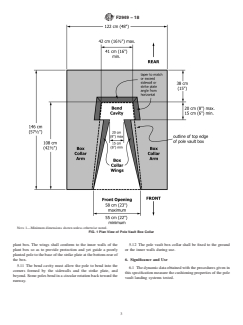
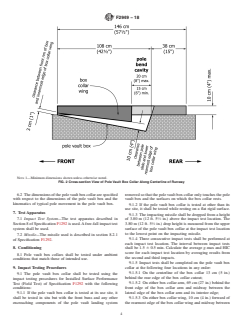
the top edge of the strike plate. (See Figs. 1 and 2.)
5. Dimensions 5.5 To allow the pole to bend undisturbed, the front face of
the box collar edge that borders the strike plate shall be tapered
5.1 Minimum Dimensions—A pole vault box collar shall be
away from the box at an angle between 116 and 140° from
at least 122 cm (48 in.) wide and 146 cm (57 ⁄2 in.) long. The
horizontal to match or exceed the angle of the strike plate.
distance from the rear edge of the box collar at its base to the
rear edge of the box collar cutout shall be at least 38 cm (15 5.6 To allow the pole to bend undisturbed, the inner faces of
the box collar arms that border the sidewalls shall be tapered
in.). At its uppermost surface, the box collar shall cover the
away from the box at an angle between 124 and 140° from
upper edges of each sidewall of the box from the front of the
box where the pole slide meets the runway to a point on the top horizontal to match or exceed the angle of the sidewalls. This
taper shall extend forward along the side of the pole bend
edge of the sidewall no less than 20 cm (8 in.) forward of the
topofthestrikeplate.Theboxcollararmsshallextendforward cavity the full length of the pole bend cavity. (See Figs. 1 and
2.)
at least 108 cm (42 ⁄2 in.) from the base of the rear edge of the
4,5
box collar cutout. (See Figs. 1 and 2.)
5.7 The body of the box collar shall extend rearward at least
30 cm (12 in.) under the front buns of the pole vault landing
5.2 Maximum Thickness—A pole vault box collar shall be
system.
no more than 10 cm (4 in.) thick.
5.8 The body of the box collar shall extend laterally at least
5.3 Maximum Dimensions of Box Collar Cutout—At the
15 cm (6 in.) under the front buns of the pole vault landing
box collar’s uppermost surface in the vertical plane passing
system.
through the front edge of the pole slide, the horizontal distance
from left to right across the box collar cutout shall be no more
5.9 Theboxcollarwingsshallbenomorethan10cm(4in.)
than 58 cm (23 in.).At the horizontal plane of the runway, the
thick on the upper sidewalls of the box. The box collar wings
horizontal distance from left to right across the rear of the box
shall extend no closer towards rear of the box than 15 cm (6
collar cutout at the front of the bend cavity shall be no more
in.) from the strike plate. The horizontal distance between the
than 29 cm (11 ⁄2 in.). The width across the base of the rear
wings of the box collar arms shall be no less than 15 cm (6 in.)
opening of the box collar cutout shall be no more than 42 cm
when measured at the front edge of the bend cavity. The
(16 ⁄2in.).Thewidthacrossthebaseofthefrontopeningofthe
minimum horizontal distance between the wings of the box
box collar cutout shall be no more than 60 cm (24 in.).The box
collar arms shall increase linearly from this point forward to
collar arms shall extend over the box beyond the upward
the fro
...
This document is not an ASTM standard and is intended only to provide the user of an ASTM standard an indication of what changes have been made to the previous version. Because
it may not be technically possible to adequately depict all changes accurately, ASTM recommends that users consult prior editions as appropriate. In all cases only the current version
of the standard as published by ASTM is to be considered the official document.
´2
Designation: F2949 − 12 F2949 − 18 An American National Standard
Standard Specification for
Pole Vault Box Collars
This standard is issued under the fixed designation F2949; the number immediately following the designation indicates the year of
original adoption or, in the case of revision, the year of last revision. A number in parentheses indicates the year of last reapproval. A
superscript epsilon (´) indicates an editorial change since the last revision or reapproval.
ε NOTE—Editorially added footnotes regarding patent rights in August 2013.
ε NOTE—Editorially corrected 9.1.3 in April 2014.
1. Scope
1.1 This specification covers minimum requirements of size, physical characteristics of materials, standard testing procedures,
labeling and identification of pole vault box collars.
1.2 Units—The values stated in SI units are to be regarded as the standard. The values given in parentheses are for information
only.
1.3 This standard does not purport to address all of the safety concerns, if any, associated with its use. It is the responsibility
of the user of this standard to establish appropriate safety safety, health, and healthenvironmental practices and determine the
applicability of regulatory limitations prior to use.
1.4 This international standard was developed in accordance with internationally recognized principles on standardization
established in the Decision on Principles for the Development of International Standards, Guides and Recommendations issued
by the World Trade Organization Technical Barriers to Trade (TBT) Committee.
2. Referenced Documents
2.1 ASTM Standards:
F1292 Specification for Impact Attenuation of Surfacing Materials Within the Use Zone of Playground Equipment
3. Terminology
3.1 Definitions:
3.1.1 box collar arms, n—the two parts of the pole vault box collar to the left and right of the pole vault box. If the box collar
has box collar wings, the wings are part of the box collar arms.
3.1.2 box collar body, n—the part of the pole vault box collar that pads the horizontal surfaces around the rim of the pole vault
box and under the front buns.
3.1.3 box collar cutout, n—the opening in the pole vault box collar above the pole vault box.
3.1.4 box collar wing, n—the part of the box collar arm that extends down the inner sidewall of the pole vault box. The box
collar wings provide protection and help to hold the box collar in place.
3.1.5 front buns, n—the parts of the pole vault landing system that pad the areas between the standard bases and around the pole
vault box.
3.1.6 front opening, n—the opening at the front of the pole vault box nearest the approach runway.
3.1.7 pole bend cavity, n—the rearmost portion of the pole vault box and box collar cutout in front of the strike plate where the
pole bends and rotates. The cavity is formed by the sidewalls and strike plate of the pole vault box, the rearmost part of the pole
slide, and inside edges of the box collar cutout over the deepest part of the box where the pole slide meets the strike plate.
This specification is under the jurisdiction of ASTM Committee F08 on Sports Equipment, Playing Surfaces, and Facilities and is the direct responsibility of
Subcommittee F08.67 on Pole Vault.
Current edition approved Sept. 1, 2012April 1, 2018. Published October 2012May 2018. Originally approved in 2012. Last previous edition approved in 2012 as
ε2
F2949 – 12 . DOI: 10.1520/F2949-12E02.10.1520/F2949-18.
The user’s attention is called to the possibility that compliance with this standard may require use of an invention covered by patent rights.
By publication of this standard, no position is taken with respect to the validity of any such claim(s) or of any patent rights in connection therewith. If a patent holder
has filed a statement of willingness to grant a license under these rights on reasonable and nondiscriminatory terms and conditions to applicants desiring to obtain such a
license, then details may be obtained from the standards developer.
For referenced ASTM standards, visit the ASTM website, www.astm.org, or contact ASTM Customer Service at service@astm.org. For Annual Book of ASTM Standards
volume information, refer to the standard’s Document Summary page on the ASTM website.
Copyright © ASTM International, 100 Barr Harbor Drive, PO Box C700, West Conshohocken, PA 19428-2959. United States
F2949 − 18
3.1.8 pole slide, n—the floor of the pole vault box that slants downward from its front boundary with the runway to its rear
boundary with the back of the box. The tip of the vaulting pole slides on the pole slide to the strike plate.
3.1.9 pole slide opening, n—the space between the ends of the box collar arms at the front of the pole vault box collar and above
the intersection of the runway with the pole slide.
3.1.10 pole vault box, n—the trough at the end of the pole vault runway. It has four sides: a downward sloping floor or pole slide,
two sidewalls, and a strike plate. A vaulter directs the lower end of the vaulting pole into the pole vault box. The back wall of pole
vault box stops the forward motion of the end of the pole while allowing the pole to rotate about its end as the vaulter leaves the
ground and completes a vault.
3.1.11 pole vault box collar, n—a device used to offer impact protection to pole vaulters in and around a pole vault box.
3.1.12 sidewalls, n—the left and right walls of the pole vault box.
3.1.13 strike plate, n—the back wall of the pole vault box; the stopboard.
4. Performance Requirements
4.1 The average peak acceleration calculated from the last two of a series of three impact tests for each impact test location on
the pole vault box collar shall not exceed 200 g when impact tested in accordance with Section 9.
4.2 The average HIC score calculated from the last two of a series of three impact tests for each impact test location on the pole
vault box collar shall not exceed 1150 when impact tested in accordance with Section 9.
5. Dimensions
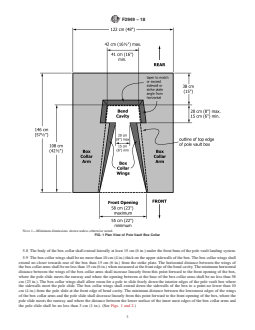
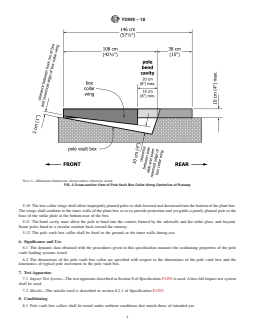
5.1 Minimum Dimensions—A pole vault box collar shall be at least 122 cm (48 in.) wide and 146 cm (57 ⁄2 in.) long. The
distance from the rear edge of the box collar at its base to the rear edge of the box collar cutout shall be at least 38 cm (15 in.).
At its uppermost surface, the box collar shall cover the upper edges of each sidewall of the box from the front of the box where
the pole slide meets the runway to a point on the top edge of the sidewall no less than 20 cm (8 in.) forward of the top of the strike
plate. The box collar arms shall extend forward at least 108 cm (42 ⁄2 in.) from the base of the rear edge of the box collar cutout.
4,5
(See Figs. 1 and 2.)
5.2 Maximum Thickness—A pole vault box collar shall be no more than 10 cm (4 in.) thick.
5.3 Maximum Dimensions of Box Collar Cutout—At the box collar’s uppermost surface in the vertical plane passing through
the front edge of the pole slide, the horizontal distance from left to right across the box collar cutout shall be no more than 58 cm
(23 in.). At the horizontal plane of the runway, the horizontal distance from left to right across the rear of the box collar cutout
at the front of the bend cavity shall be no more than 29 cm (11 ⁄2 in.). The width across the base of the rear opening of the box
collar cutout shall be no more than 42 cm (16 ⁄2 in.). The width across the base of the front opening of the box collar cutout shall
be no more than 60 cm (24 in.). The box collar arms shall extend over the box beyond the upward extended plane of the adjacent
sidewall of the pole vault box from a point no more than 20 cm (8 in.) forward from the top edge of the strike plate to the front
of the box where the pole slide meets the runway. (See Figs. 1 and 2.)
5.4 Minimum Dimensions of Box Collar Cutout—At the box collar’s upper most surface in the vertical plane passing through
the front edge of the pole slide, the horizontal distance from left to right across the box collar cutout shall be no less than 56 cm
(22 in.). At and above the horizontal plane of the runway, the horizontal distance from left to right across the rear of the box collar
cutout at the front of the bend cavity shall be no less than 23 cm (9 in.). The width across the base of the rear opening of the box
collar cutout shall be no less than 41 cm (16 in). The width across the base of the front opening of the box collar cutout shall be
no less than 58 cm (23 in.). The front edge of the box collar that borders the strike plate shall not extend forward past the upward
extended plane of the strike plate. The box collar arms shall not extend over the box beyond the upward extended plane of the
adjacent sidewall of the pole vault box for a distance of at least 15 cm (6 in.) forward from the top edge of the strike plate. (See
Figs. 1 and 2.)
5.5 To allow the pole to bend undisturbed, the front face of the box collar edge that borders the strike plate shall be tapered away
from the box at an angle between 105116 and 120 degrees 140° from horizontal to match or exceed the angle of the strike plate.
5.6 To allow the pole to bend undisturbed, the inner faces of the box collar arms that border the sidewalls shall be tapered away
from the box at an angle between 105124 and 120 degrees 140° from horizontal to match or exceed the angle of the sidewalls.
This taper shall extend forward along the side of the pole bend cavity the full length of the pole bend cavity. (See Figs. 1 and 2.)
5.7 The body of the box collar shall extend rearward at least 30 cm (12 in.) under the front buns of the pole vault landing system.
ASTM has been informed that a pole vault box collar manufactured to the specifications listed in Fig. 1 may be
...