


ASTM D3763-23
(Test Method)Standard Test Method for High Speed Puncture Properties of Plastics Using Load and Displacement Sensors
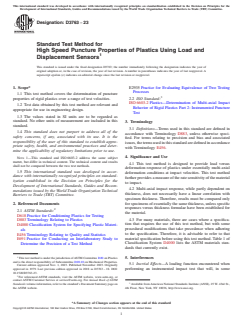
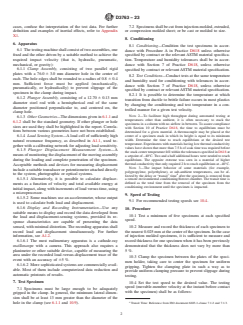
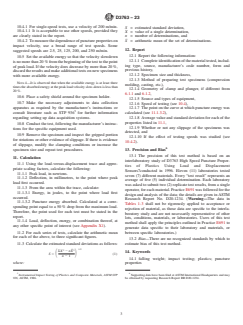
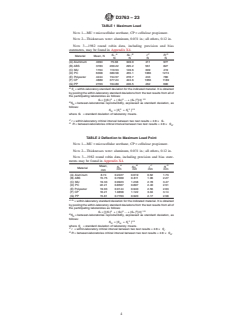
Standard Test Method for High Speed Puncture Properties of Plastics Using Load and Displacement Sensors
SIGNIFICANCE AND USE
4.1 This test method is designed to provide load versus deformation response of plastics under essentially multi-axial deformation conditions at impact velocities. This test method further provides a measure of the rate sensitivity of the material to impact.
4.2 Multi-axial impact response, while partly dependent on thickness, does not necessarily have a linear correlation with specimen thickness. Therefore, results must be compared only for specimens of essentially the same thickness, unless specific responses versus thickness formulae have been established for the material.
4.3 For many materials, there are cases where a specification that requires the use of this test method, but with some procedural modifications that take precedence when adhering to the specification. Therefore, it is advisable to refer to that material specification before using this test method. Table 1 of Classification System D4000 lists the ASTM materials standards that currently exist.
SCOPE
1.1 This test method covers the determination of puncture properties of rigid plastics over a range of test velocities.
1.2 Test data obtained by this test method are relevant and appropriate for use in engineering design.
1.3 The values stated in SI units are to be regarded as standard. No other units of measurement are included in this standard.
1.4 This standard does not purport to address all of the safety concerns, if any, associated with its use. It is the responsibility of the user of this standard to establish appropriate safety, health, and environmental practices and determine the applicability of regulatory limitations prior to use.
Note 1: This standard and ISO 6603-2 address the same subject matter, but differ in technical content. The technical content and results shall not be compared between the two test methods.
1.5 This international standard was developed in accordance with internationally recognized principles on standardization established in the Decision on Principles for the Development of International Standards, Guides and Recommendations issued by the World Trade Organization Technical Barriers to Trade (TBT) Committee.
General Information
- Status
- Published
- Publication Date
- 31-Oct-2023
- Technical Committee
- D20 - Plastics
- Drafting Committee
- D20.10 - Mechanical Properties
Relations
- Effective Date
- 01-Nov-2023
- Effective Date
- 01-Feb-2024
- Effective Date
- 01-Nov-2023
- Effective Date
- 01-Nov-2022
- Effective Date
- 01-Apr-2022
- Effective Date
- 01-Apr-2022
- Effective Date
- 01-Nov-2023
- Effective Date
- 01-Nov-2023
- Effective Date
- 01-Nov-2023
- Effective Date
- 01-Nov-2023
- Effective Date
- 01-Nov-2023
- Effective Date
- 01-Nov-2023
- Effective Date
- 01-Nov-2023
- Effective Date
- 01-Nov-2023
- Effective Date
- 01-Nov-2023
Overview
ASTM D3763-23 is the Standard Test Method for High Speed Puncture Properties of Plastics Using Load and Displacement Sensors, developed by ASTM International. This test method is designed for evaluating the puncture resistance and mechanical performance of rigid plastics subjected to high-speed, multi-axial impact. Using instrumented load and displacement sensors, this method quantifies how plastics respond to impact forces, providing critical data on load, deformation, and energy absorption. ASTM D3763-23 is internationally recognized and aligns with World Trade Organization (WTO) guidelines for standardization.
Key Topics
- Multi-Axial Deformation at Impact Velocities: The method subjects plastic specimens to impact causing deformation from multiple directions to simulate real-use scenarios.
- Load vs. Displacement Curve: The test records force and displacement during puncture, delivering a detailed load-displacement profile for the material.
- Rate Sensitivity: Evaluates how the impact speed affects the puncture resistance of plastics, which is vital for applications subject to varying impact speeds.
- Specimen Thickness Dependency: Results are closely linked to specimen thickness; comparisons should only be made between samples of similar thickness unless specific thickness-response correlations are established.
- Test Conditions: Conditioning of samples and testing environment (temperature, humidity) follow established ASTM practices to ensure reproducibility of results.
Applications
ASTM D3763-23 is widely applicable across industries where plastics must endure high-speed impacts or penetration, including:
- Automotive Components: Used for evaluating interior panels, bumpers, and structural plastics subject to crash or impact forces.
- Packaging: Ensures plastic containers, films, and protective covers can withstand puncture risks during transportation and handling.
- Electronics and Appliances: Assesses the impact resistance of casings and housing materials that must protect sensitive components.
- Construction Materials: Supports the selection and quality evaluation of plastic sheets and laminates used in architecture and civil engineering.
- Material Development and Quality Control: Useful for research and development of new polymers, as well as quality assurance processes in manufacturing.
The test produces data relevant to engineering design and material selection, including peak puncture load, displacement at maximum load, and absorbed energy. These are essential for engineers and designers seeking to optimize product durability and safety.
Related Standards
Using ASTM D3763-23 alongside other internationally and industry-recognized standards ensures comprehensive material assessment:
- ISO 6603-2: Determination of multi-axial impact behavior of rigid plastics (note: technical content differs from ASTM D3763-23; results are not directly comparable).
- ASTM D618: Practice for Conditioning Plastics for Testing.
- ASTM D4000: Classification System for Specifying Plastic Materials.
- ASTM D883: Terminology Relating to Plastics.
- ASTM E691: Practice for Conducting an Interlaboratory Study to Determine the Precision of a Test Method.
Summary
ASTM D3763-23 provides a standardized, scientifically-valid approach for measuring the high-speed puncture properties of rigid plastics. The method’s data on load, displacement, and energy absorption under dynamic, real-world conditions are indispensable for material selection, quality control, and engineering design across diverse sectors including automotive, packaging, construction, and consumer products. By adopting this standard, organizations can ensure consistency, reliability, and international compliance in their plastic material testing programs.
Buy Documents
ASTM D3763-23 - Standard Test Method for High Speed Puncture Properties of Plastics Using Load and Displacement Sensors
REDLINE ASTM D3763-23 - Standard Test Method for High Speed Puncture Properties of Plastics Using Load and Displacement Sensors
Get Certified
Connect with accredited certification bodies for this standard

Smithers Quality Assessments
US management systems and product certification.

DIN CERTCO
DIN Group product certification.
Sponsored listings
Frequently Asked Questions
ASTM D3763-23 is a standard published by ASTM International. Its full title is "Standard Test Method for High Speed Puncture Properties of Plastics Using Load and Displacement Sensors". This standard covers: SIGNIFICANCE AND USE 4.1 This test method is designed to provide load versus deformation response of plastics under essentially multi-axial deformation conditions at impact velocities. This test method further provides a measure of the rate sensitivity of the material to impact. 4.2 Multi-axial impact response, while partly dependent on thickness, does not necessarily have a linear correlation with specimen thickness. Therefore, results must be compared only for specimens of essentially the same thickness, unless specific responses versus thickness formulae have been established for the material. 4.3 For many materials, there are cases where a specification that requires the use of this test method, but with some procedural modifications that take precedence when adhering to the specification. Therefore, it is advisable to refer to that material specification before using this test method. Table 1 of Classification System D4000 lists the ASTM materials standards that currently exist. SCOPE 1.1 This test method covers the determination of puncture properties of rigid plastics over a range of test velocities. 1.2 Test data obtained by this test method are relevant and appropriate for use in engineering design. 1.3 The values stated in SI units are to be regarded as standard. No other units of measurement are included in this standard. 1.4 This standard does not purport to address all of the safety concerns, if any, associated with its use. It is the responsibility of the user of this standard to establish appropriate safety, health, and environmental practices and determine the applicability of regulatory limitations prior to use. Note 1: This standard and ISO 6603-2 address the same subject matter, but differ in technical content. The technical content and results shall not be compared between the two test methods. 1.5 This international standard was developed in accordance with internationally recognized principles on standardization established in the Decision on Principles for the Development of International Standards, Guides and Recommendations issued by the World Trade Organization Technical Barriers to Trade (TBT) Committee.
SIGNIFICANCE AND USE 4.1 This test method is designed to provide load versus deformation response of plastics under essentially multi-axial deformation conditions at impact velocities. This test method further provides a measure of the rate sensitivity of the material to impact. 4.2 Multi-axial impact response, while partly dependent on thickness, does not necessarily have a linear correlation with specimen thickness. Therefore, results must be compared only for specimens of essentially the same thickness, unless specific responses versus thickness formulae have been established for the material. 4.3 For many materials, there are cases where a specification that requires the use of this test method, but with some procedural modifications that take precedence when adhering to the specification. Therefore, it is advisable to refer to that material specification before using this test method. Table 1 of Classification System D4000 lists the ASTM materials standards that currently exist. SCOPE 1.1 This test method covers the determination of puncture properties of rigid plastics over a range of test velocities. 1.2 Test data obtained by this test method are relevant and appropriate for use in engineering design. 1.3 The values stated in SI units are to be regarded as standard. No other units of measurement are included in this standard. 1.4 This standard does not purport to address all of the safety concerns, if any, associated with its use. It is the responsibility of the user of this standard to establish appropriate safety, health, and environmental practices and determine the applicability of regulatory limitations prior to use. Note 1: This standard and ISO 6603-2 address the same subject matter, but differ in technical content. The technical content and results shall not be compared between the two test methods. 1.5 This international standard was developed in accordance with internationally recognized principles on standardization established in the Decision on Principles for the Development of International Standards, Guides and Recommendations issued by the World Trade Organization Technical Barriers to Trade (TBT) Committee.
ASTM D3763-23 is classified under the following ICS (International Classification for Standards) categories: 83.080.01 - Plastics in general. The ICS classification helps identify the subject area and facilitates finding related standards.
ASTM D3763-23 has the following relationships with other standards: It is inter standard links to ASTM D3763-18, ASTM D883-24, ASTM D883-23, ASTM D883-22, ASTM E456-13a(2022), ASTM E456-13a(2022)e1, ASTM D5420-21, ASTM D7436-17, ASTM C1484-10(2018), ASTM D7192-20, ASTM D7136/D7136M-20, ASTM C1349-17, ASTM D5857-17, ASTM D4101-17e1, ASTM D5628-18. Understanding these relationships helps ensure you are using the most current and applicable version of the standard.
ASTM D3763-23 is available in PDF format for immediate download after purchase. The document can be added to your cart and obtained through the secure checkout process. Digital delivery ensures instant access to the complete standard document.
Standards Content (Sample)
This international standard was developed in accordance with internationally recognized principles on standardization established in the Decision on Principles for the
Development of International Standards, Guides and Recommendations issued by the World Trade Organization Technical Barriers to Trade (TBT) Committee.
Designation: D3763 − 23
Standard Test Method for
High Speed Puncture Properties of Plastics Using Load and
Displacement Sensors
This standard is issued under the fixed designation D3763; the number immediately following the designation indicates the year of
original adoption or, in the case of revision, the year of last revision. A number in parentheses indicates the year of last reapproval. A
superscript epsilon (´) indicates an editorial change since the last revision or reapproval.
1. Scope* E2935 Practice for Evaluating Equivalence of Two Testing
Processes
1.1 This test method covers the determination of puncture
2.2 ISO Standard:
properties of rigid plastics over a range of test velocities.
ISO 6603-2 Plastics—Determination of Multi-axial Impact
1.2 Test data obtained by this test method are relevant and
Behavior of Rigid Plastics Part 2: Instrumented Puncture
appropriate for use in engineering design.
Test
1.3 The values stated in SI units are to be regarded as
standard. No other units of measurement are included in this
3. Terminology
standard.
3.1 Definitions—Terms used in this standard are defined in
1.4 This standard does not purport to address all of the
accordance with Terminology D883, unless otherwise speci-
safety concerns, if any, associated with its use. It is the
fied. For terms relating to precision and bias and associated
responsibility of the user of this standard to establish appro-
issues, the terms used in this standard are defined in accordance
priate safety, health, and environmental practices and deter-
with Terminology E456.
mine the applicability of regulatory limitations prior to use.
4. Significance and Use
NOTE 1—This standard and ISO 6603-2 address the same subject
matter, but differ in technical content. The technical content and results
4.1 This test method is designed to provide load versus
shall not be compared between the two test methods.
deformation response of plastics under essentially multi-axial
1.5 This international standard was developed in accor-
deformation conditions at impact velocities. This test method
dance with internationally recognized principles on standard-
further provides a measure of the rate sensitivity of the material
ization established in the Decision on Principles for the
to impact.
Development of International Standards, Guides and Recom-
4.2 Multi-axial impact response, while partly dependent on
mendations issued by the World Trade Organization Technical
thickness, does not necessarily have a linear correlation with
Barriers to Trade (TBT) Committee.
specimen thickness. Therefore, results must be compared only
for specimens of essentially the same thickness, unless specific
2. Referenced Documents
responses versus thickness formulae have been established for
2.1 ASTM Standards:
the material.
D618 Practice for Conditioning Plastics for Testing
4.3 For many materials, there are cases where a specifica-
D883 Terminology Relating to Plastics
tion that requires the use of this test method, but with some
D4000 Classification System for Specifying Plastic Materi-
procedural modifications that take precedence when adhering
als
to the specification. Therefore, it is advisable to refer to that
E456 Terminology Relating to Quality and Statistics
material specification before using this test method. Table 1 of
E691 Practice for Conducting an Interlaboratory Study to
Classification System D4000 lists the ASTM materials stan-
Determine the Precision of a Test Method
dards that currently exist.
5. Interferences
This test method is under the jurisdiction of ASTM Committee D20 on Plastics
and is the direct responsibility of Subcommittee D20.10 on Mechanical Properties.
5.1 Inertial Effects—A loading function encountered when
Current edition approved Nov. 1, 2023. Published November 2023. Originally
performing an instrumented impact test that will, in some
approved in 1979. Last previous edition approved in 2018 as D3763 – 18. DOI:
10.1520/D3763-23.
For referenced ASTM standards, visit the ASTM website, www.astm.org, or
contact ASTM Customer Service at service@astm.org. For Annual Book of ASTM
Standards volume information, refer to the standard’s Document Summary page on Available from American National Standards Institute (ANSI), 25 W. 43rd St.,
the ASTM website. 4th Floor, New York, NY 10036, http://www.ansi.org.
*A Summary of Changes section appears at the end of this standard
Copyright © ASTM International, 100 Barr Harbor Drive, PO Box C700, West Conshohocken, PA 19428-2959. United States
D3763 − 23
cases, confuse the interpretation of the test data. For further 7.2 Specimens shall be cut from injection-molded, extruded,
definition and examples of inertial effects, refer to Appendix or compression molded sheet; or be cast or molded to size.
X1.
8. Conditioning
6. Apparatus
8.1 Conditioning—Condition the test specimens in accor-
6.1 The testing machine shall consist of two assemblies, one
dance with Procedure A in Practice D618 unless otherwise
fixed and the other driven by a suitable method to achieve the
specified by contract or the relevant ASTM material specifica-
required impact velocity (that is, hydraulic, pneumatic,
tion. Temperature and humidity tolerances shall be in accor-
mechanical, or gravity):
dance with Section 7 of Practice D618, unless otherwise
6.1.1 Clamp Assembly, consisting of two parallel rigid
specified by contract or relevant ASTM material specification.
plates with a 76.0 6 3.0 mm diameter hole in the center of
8.2 Test Conditions—Conduct tests at the same temperature
each. The hole edges shall be rounded to a radius of 0.8 6 0.4
and humidity used for conditioning with tolerances in accor-
mm. Sufficient force must be applied (mechanically,
dance with Section 7 of Practice D618, unless otherwise
pneumatically, or hydraulically) to prevent slippage of the
specified by contract or relevant ASTM material specification.
specimen in the clamp during impact.
8.2.1 It is possible to determine the temperature at which
6.1.2 Plunger Assembly, consisting of a 12.70 6 0.13 mm
transition from ductile to brittle failure occurs in most plastics
diameter steel rod with a hemispherical end of the same
by changing the conditioning and test temperature in a con-
diameter positioned perpendicular to, and centered on, the
trolled manner for a given test velocity.
clamp hole.
NOTE 2—To facilitate high throughput during automated testing at
6.1.3 Other Geometries—The dimensions given in 6.1.1 and
temperatures other than ambient, it is often necessary to stack the
6.1.2 shall be the standard geometry. If other plunger or hole
specimens in a column with no airflow in between. To assure compliance
sizes are used they shall be highlighted in the report. Correla-
with Section 10 of Practice D618, the time to equilibrium must be
tions between various geometries have not been established.
determined for a given material. A thermocouple may be placed at the
6.1.4 Load Sensing System—A load cell of sufficiently high center of a specimen stack in which its height is equal to its minimum
width. Determine the time to reach equilibrium at the desired test
natural resonance frequency, as described in A1.1, used to-
temperature. Experiments with materials having low thermal conductivity
gether with a calibrating network for adjusting load sensitivity.
values have shown that more than 7.5 h of soak time was required before
6.1.5 Plunger Displacement Measurement System—A
the stack center temperature fell within the tolerances specified in D618 at
means of monitoring the displacement of the moving assembly
a setpoint of –40°C. Two and a half additional hours were needed to reach
equilibrium. The opposite extreme was seen in a material of higher
during the loading and complete penetration of the specimen.
thermal conductivity that only required 2 h to reach equilibrium at –40°C.
Acceptable methods and devices for measuring displacement
NOTE 3—The impact behavior of some materials (for example,
include a suitable transducer or potentiometer attached directly
polypropylene, polyethylene), at sub-ambient temperatures, can be af-
to the system, photographic or optical systems. 4
fected by the delay or “transit” time after the specimen is removed from
6.1.5.1 Alternatively, it is possible to calculate displace-
a remote environmental conditioning/freezer chamber. The transit time is
defined as the total time from the removal of the specimen from the
ments as a function of velocity and total available energy at
conditioning environment until the specimen is impacted.
initial impact, along with increments of load versus time, using
a microprocessor.
9. Speed of Testing
6.1.5.2 Some machines use an accelerometer, whose output
9.1 For recommended testing speeds see 10.4.
is used to calculate both load and displacement.
6.1.6 Display and Recording Instrumentation—Use any
10. Procedure
suitable means to display and record the data developed from
10.1 Test a minimum of five specimens at each specified
the load and displacement-sensing systems, provided its re-
speed.
sponse characteristics are capable of presenting the data
sensed, with minimal distortion. The recording apparatus shall 10.2 Measure and record the thickness of each specimen to
record load and displacement simultaneously. For further the nearest 0.025 mm at the center of the specimen. In the case
information, see A1.2. of injection molded specimens, it is sufficient to measure and
6.1.6.1 The most rudimentary apparatus is a cathode-ray record thickness for one specimen when it has been previously
oscilloscope with a camera. This approach also requires a demonstrated that the thickness does not vary by more than
planimeter or other suitable device, capable of measuring the 5 %.
area under the recorded load-versus-displacement trace of the
10.3 Clamp the specimen between the plates of the speci-
event with an accuracy of 65 %.
men holder, taking care to center the specimen for uniform
6.1.6.2 More sophisticated systems are commercially avail-
gripping. Tighten the clamping plate in such a way as to
able. Most of them include computerized data reduction and
provide uniform clamping pressure to prevent slippage during
automatic printouts of results.
testing.
7. Test Specimen
10.4 Set the test speed to the desired value. The testing
speed (movable-member velocity at the instant before contact
7.1 Specimens must be large enough to be adequately
with the specimen) shall be as follows:
gripped in the clamp. In general, the minimum lateral dimen-
sion shall be at least 13 mm greater than the diameter of the
hole in the clamp (see 6.1.1 and 10.9). Transit Time: Reference from ISO document 6603-1-clause 7.1.2 and 7.1.3.
D3763 − 23
10.4.1 For single-speed tests, use a velocity of 200 m/min.
S = estimated standard deviation,
10.4.1.1 It is acceptable to use other speeds, provided they
X = value of a single determination,
are clearly stated in the report.
n = number of determinations, and
¯
10.4.2 To measure the dependence of puncture properties on = arithmetic mean of the set of determinations.
X
impact velocity, use a broad range of test speeds. Some
12. Report
suggested speeds are 2.5, 25, 125, 200, and 250 m/min.
12.1 Report the following information:
10.5 Set the available energy so that the velocity slowdown
12.1.1 Complete identification of the material tested, includ-
is no more than 20 % from the beginning of the test to the point
ing type, source, manufacturer’s code number, form and
of peak load. If the velocity does decrease by more than 20 %,
previous history,
discard the results and make additional tests on new specimens
12.1.2 Specimen size and thickness,
with more available energy.
12.1.3 Method of preparing test specimens (compression
NOTE 4—It is observed that when the available energy is at least three
molding, casting, etc.),
times the absorbed energy at the peak load velocity slow-down is less than
12.1.4 Geometry of clamp and plunger, if different from
20 %.
6.1.1 and 6.1.2,
10.6 Place a safety shield around the specimen holder.
12.1.5 Source and types of equipment,
10.7 Make the necessary adjustments to data collection
12.1.6 Speed of testing (see 10.4),
apparatus as required by the manufacturer’s instructions or
12.1.7 The point on the curve at which puncture energy was
consult literature such as STP 936 for further information
calculated (see 11.1.3.2),
regarding setting up data acquisition systems.
12.1.8 Average value and standard deviation for each of the
properties listed in 11.1,
10.8 Conduct the test, following the manufacturer’s instruc-
12.1.9 Whether or not any slippage of the specimens was
tions for the specific equipment used.
detected, and
10.9 Remove the specimen and inspect the gripped portion
12.1.10 If the effect of testing speeds was studied (see
for striations or other evidence of slippage. If there is evidence
10.4.2).
of slippage, modify the clamping conditions or increase the
specimen size and repeat test procedures.
13. Precision and Bias
13.1 The precision of this test method is based on an
11. Calculation
interlaboratory study of D3763 High Speed Puncture Proper-
11.1 Using the load-versus-displacement trace and appro-
ties of Plastics Using Load and Displacement
priate scaling factors, calculate the following:
Sensors7conducted in 1996. Eleven (11) laboratories tested
11.1.1 Peak load, in newtons.
seven (7) different materials. Every “test result” represents an
11.1.2 Deflection, in millimetres, to the point where peak
average of five (5) individual determination. Each laboratory
load first occurred.
was asked to submit two (2) replicate test results, from a single
11.1.3 From the area within the trace, calculate:
operator, for each material. Practice E691 was followed for the
11.1.3.1 Energy, in joules, to the point where load first
design and analysis of the data; the details are given in ASTM
occurred.
Research Report No. D20-1234. (Warning—The data in
11.1.3.2 Puncture energy absorbed. Calculated at a corre-
Tables 1-3 shall not be rigorously applied to acceptance or
sponding point equal to a 50 % drop from the maximum load.
rejection of material, as those data are specific to the interla-
Therefore, the point used for each test must be stated in the
boratory study and are not necessarily representative of other
report.
lots, conditions, materials, or laboratories. Users of this test
11.1.4 Load, deflection, energy, or combination thereof, at
method shall apply the principles outlined in Practice E691 to
any other specific point of interest (see Appendix X1).
generate data specific to their laboratory and materials, or
11.2 For each series of tests, calculate the arithmetic mean
between specific laboratories.)
for each of the above, to three significant figures.
13.2 Bias—There are no recognized standards by which to
11.3 Calculate the estimated standard deviations as follows:
estimate bias of this test method.
1/2
2 ¯ 2
ΣX 2 nX
14. Keywords
S 5S D (1)
n 2 1
14.1 falling weight; impact testing; plastics; puncture
where: properties
5 6
Instrumented Impact Testing of Plastics and Composite Materials, ASTM STP Supporting data have been filed at ASTM International Headquarters and may
936, ASTM, 1986. be obtained by requesting Research Report RR:D20-1234.
D3763 − 23
TABLE 1 Maximum Load
NOTE 1—MU = microcellular urethane, CP = cellulose propionate.
NOTE 2—Thicknesses were: aluminum, 0.031 in.; all others, 0.12 in.
NOTE 3—1982 round robin data, including precision and bias
statements, may be found in Appendix X4.
A B C D
S , S , r, R,
r R
Material Mean, N
N N N N
(A) Aluminum 4094 75.38 349.0 211 977
(B) ABS 3783 200.22 295.2 561 827
(C) MU 1704 110.53 149.6 309 419
(D) PC 6368 380.58 455.1 1066 1274
(E) Polyester 4244 154.57 278.7 433 780
(F) CP 4889 377.24 424.6 1056 1189
(G) PP 2703 164.89 246.5 462 690
A
S = within-laboratory standard deviation for the indicated material. It is obtained
r
by pooling the within-laboratory standard deviations from the test results from all of
the participating laboratories as follows:
2 2 2 1/2
S = [[(S ) + ( S ) . + (S ) ]/n]
r 1 2 n
B
S = between-laboratories reproducibility, expressed as standard deviation, as
R
follows:
2 2 1/2
S = [S + S ]
R r L
where S = standard deviation of laboratory means.
L
C
r = within-laboratory critical interval between two test results = 2.8 × S .
r
D
R = between-laboratories critical interval between two test results = 2.8 × S .
R
TABLE 2 Deflection to Maximum Load Point
NOTE 1—MU = microcellular urethane, CP = cellulose propionate.
NOTE 2—Thicknesses were: aluminum, 0.031 in.; all others, 0.12 in.
NOTE 3—1982 round robin data, including precision and bias state-
ments may be found in Appendix X4.
A B C D
Mean, S , S , r, R,
r R
Material
mm mm mm mm
mm
(A) Aluminum 8.74 0.2227 0.619 0.62 1.73
(B) ABS 15.75 0.7009 0.811 1.96 2.27
(C) MU 19.33 0.9923 1.238 2.78 3.47
(D) PC 22.21 0.8567 0.897 2.40 2.51
(E) Polyester 19.03 0.9144 0.940 2.56 2.63
(F) CP 16.21 1.0858 1.122 3.04 3.14
(G) PP 15.81 0.7763 0.920 2.17 2.58
A S
r
= within-laboratory standard deviation for the indicated material. It is obtained
by pooling the within-laboratory standard deviations from the test results from all of
the participating laboratories as follows:
2 2 2 1/2
S = [[(S ) + ( S ) . + (S ) ]/n]
r 1 2 n
B
S = between-laboratories reproducibility, expressed as standard deviation, as
R
follows:
2 1/2
S = [S + S ]
R r2 L
where S = standard deviation of laboratory means.
L
C
r = within-laboratory critical interval between two test results = 2.8 × S .
r
D
R = between-laboratories critical interval between two test results = 2.8 × S .
R
D3763 − 23
TABLE 3 Energy to Maximum Load Point
NOTE 1—MU = microcellular urethane, CP = cellulose propionate.
NOTE 2—Thicknesses were: aluminum, 0.031 in.; all others, 0.12 in.
NOTE 3—1982 round robin data, including precision and bias
statements, may be found in Appendix X4.
A B C D
Material Mean, J S , J S , J r, J R, J
r R
(A) Aluminum 14.78 0.506 2.03 1.42 5.67
(B) ABS 30.05 2.083 2.93 5.83 8.21
(C) MU 14.69 1.212 1.71 3.39 4.78
(D) PC 71.23 2.324 3.77 6.51 10.56
(E) Polyester 43.16 1.642 3.12 4.60 8.75
(F) CP 35.31 3.359 3.75 9.41 10.49
(G) PP 21.21 1.357 2.86 3.80 8.01
A
S = within-laboratory standard deviation for the indicated material. It is obtained
r
by pooling the within-laboratory standard deviations from the test results from all of
the participating laboratories as follows:
2 2 2 1/2
S = [[(S ) + ( S ) . + (S ) ]/n]
r 1 2 n
B
S = between-laboratories reproducibility, expressed as standard deviation, as
R
follows:
2 2 1/2
S = [S + S ]
R r L
where S = standard deviation of laboratory means.
L
C
r = within-laboratory critical interval between two test results = 2.8 × S .
r
D
R = between-laboratories critical interval between two test results = 2.8 × S .
R
ANNEX
(Mandatory Information)
A1. MINIMUM INSTRUMENTATION REQUIREMENTS
A1.1 Force Measurement—Any transducer that meets the A1.1.3 Transducer Location—The transducer shall be lo-
performance requirements for dynamic force measurement cated as close as possible to the impact point of the transducer/
may be used. This includes, but is not limited to, strain gage striker assembly to minimize the mass effect as described in
force transducers, piezo-electric force transducers and acceler- A1.1.2. For testing involving extremely tough materials, it may
ometers. be necessary to locate the transducer further from the impact
point to prevent damage. Generally, this class of materials will
A1.1.1 Performance Requirements—The natural frequency
produce a high loading impact event with a long t . Under these
f
(f ) of the transducer plus striker shall be sufficient to avoid
dev
conditions, a transducer/striker assembly with a f lower than
dev
distortion of the force-time or acceleration-time data. The time
6 kHz will not adversely affect the test data. This is due to the
failure (t ), in seconds, of a given test specimen regulates the
f
damping effect of the test specimen itself as well as the large
minimum natural frequency for a transducer/striker assembly
magnitude of the loading event in comparison to the initial
by the following relationship:
oscillation produced by the transducer assembly.
A1.2 Recording Apparatus—Any recording device that
t 5 3/f (A1.1)
f dev
meets the performance requirements of dynamic data acquisi-
Since time to failure is generally greater than 0.5 msec for
plastics, a transducer assembly with a natural frequency tion may be used. This includes, but is not limited to,
greater than 6 kHz is recommended (0.0005 >= 3 ⁄6000). In
oscilloscopes, data loggers, and computer based data acquisi-
addition, the transducer must have the durability to survive
tion systems.
repeated impact tests without change in output from its ini-
A1.2.1 Performance
...
This document is not an ASTM standard and is intended only to provide the user of an ASTM standard an indication of what changes have been made to the previous version. Because
it may not be technically possible to adequately depict all changes accurately, ASTM recommends that users consult prior editions as appropriate. In all cases only the current version
of the standard as published by ASTM is to be considered the official document.
Designation: D3763 − 18 D3763 − 23
Standard Test Method for
High Speed Puncture Properties of Plastics Using Load and
Displacement Sensors
This standard is issued under the fixed designation D3763; the number immediately following the designation indicates the year of
original adoption or, in the case of revision, the year of last revision. A number in parentheses indicates the year of last reapproval. A
superscript epsilon (´) indicates an editorial change since the last revision or reapproval.
1. Scope*
1.1 This test method covers the determination of puncture properties of rigid plastics over a range of test velocities.
1.2 Test data obtained by this test method are relevant and appropriate for use in engineering design.
1.3 The values stated in SI units are to be regarded as standard. No other units of measurement are included in this standard.
1.4 This standard does not purport to address all of the safety concerns, if any, associated with its use. It is the responsibility
of the user of this standard to establish appropriate safety, health, and environmental practices and determine the applicability of
regulatory limitations prior to use.
NOTE 1—This standard and ISO 6603-2 address the same subject matter, but differ in technical content. The technical content and results shall not be
compared between the two test methods.
1.5 This international standard was developed in accordance with internationally recognized principles on standardization
established in the Decision on Principles for the Development of International Standards, Guides and Recommendations issued
by the World Trade Organization Technical Barriers to Trade (TBT) Committee.
2. Referenced Documents
2.1 ASTM Standards:
D618 Practice for Conditioning Plastics for Testing
D883 Terminology Relating to Plastics
D1600 Terminology for Abbreviated Terms Relating to Plastics
D4000 Classification System for Specifying Plastic Materials
E456 Terminology Relating to Quality and Statistics
E691 Practice for Conducting an Interlaboratory Study to Determine the Precision of a Test Method
E2935 Practice for Evaluating Equivalence of Two Testing Processes
2.2 ISO Standard:
ISO 6603-2 Plastics—Determination of Multi-axial Impact Behavior of Rigid Plastics Part 2: Instrumented Puncture Test
This test method is under the jurisdiction of ASTM Committee D20 on Plastics and is the direct responsibility of Subcommittee D20.10 on Mechanical Properties.
Current edition approved Nov. 1, 2018Nov. 1, 2023. Published November 2018November 2023. Originally approved in 1979. Last previous edition approved in 20152018
as D3763 – 15.D3763 – 18. DOI: 10.1520/D3763-18.10.1520/D3763-23.
For referenced ASTM standards, visit the ASTM website, www.astm.org, or contact ASTM Customer Service at service@astm.org. For Annual Book of ASTM Standards
volume information, refer to the standard’s Document Summary page on the ASTM website.
Available from American National Standards Institute (ANSI), 25 W. 43rd St., 4th Floor, New York, NY 10036, http://www.ansi.org.
*A Summary of Changes section appears at the end of this standard
Copyright © ASTM International, 100 Barr Harbor Drive, PO Box C700, West Conshohocken, PA 19428-2959. United States
D3763 − 23
3. Terminology
3.1 Definitions—For definitions see Terms used in this standard are defined in accordance with Terminology D883 and for
abbreviations see , unless otherwise specified. For terms relating to precision and bias and associated issues, the terms used in this
standard are defined in accordance with Terminology D1600E456.
4. Significance and Use
4.1 This test method is designed to provide load versus deformation response of plastics under essentially multi-axial deformation
conditions at impact velocities. This test method further provides a measure of the rate sensitivity of the material to impact.
4.2 Multi-axial impact response, while partly dependent on thickness, does not necessarily have a linear correlation with specimen
thickness. Therefore, results shouldmust be compared only for specimens of essentially the same thickness, unless specific
responses versus thickness formulae have been established for the material.
4.3 For many materials, there may be are cases where a specification that requires the use of this test method, but with some
procedural modifications that take precedence when adhering to the specification. Therefore, it is advisable to refer to that material
specification before using this test method. Table 1 of Classification System D4000 lists the ASTM materials standards that
currently exist.
5. Interferences
5.1 Inertial Effects—A loading function encountered when performing an instrumented impact test that may,will, in some cases,
confuse the interpretation of the test data. For further definition and examples of inertial effects, refer to Appendix X1.
6. Apparatus
6.1 The testing machine shall consist of two assemblies, one fixed and the other driven by a suitable method to achieve the
required impact velocity (that is, hydraulic, pneumatic, mechanical, or gravity):
6.1.1 Clamp Assembly, consisting of two parallel rigid plates with a 76.0 6 3.0 mm diameter hole in the center of each. The hole
edges shall be rounded to a radius of 0.8 6 0.4 mm. Sufficient force must be applied (mechanically, pneumatically, or
hydraulically) to prevent slippage of the specimen in the clamp during impact.
6.1.2 Plunger Assembly, consisting of a 12.70 6 0.13 mm diameter steel rod with a hemispherical end of the same diameter
positioned perpendicular to, and centered on, the clamp hole.
6.1.3 Other Geometries—The dimensions given in 6.1.1 and 6.1.2 shall be the standard geometry. If other plunger or hole sizes
are used they shall be highlighted in the report. Correlations between various geometries have not been established.
6.1.4 Load Sensing System—A load cell of sufficiently high natural resonance frequency, as described in A1.1, used together with
a calibrating network for adjusting load sensitivity.
6.1.5 Plunger Displacement Measurement System—A means of monitoring the displacement of the moving assembly during the
loading and complete penetration of the specimen. This can be accomplished through the use ofAcceptable methods and devices
for measuring displacement include a suitable transducer or potentiometer attached directly to the system. Photographic or optical
systems can also be utilized for measuring displacement. system, photographic or optical systems.
6.1.5.1 Alternatively, displacement may be calculated it is possible to calculate displacements as a function of velocity and total
available energy at initial impact, along with increments of load versus time, using a microprocessor.
6.1.5.2 Some machines use an accelerometer, whose output is used to calculate both load and displacement.
6.1.6 Display and Recording Instrumentation—Use any suitable means to display and record the data developed from the load and
displacement-sensing systems, provided its response characteristics are capable of presenting the data sensed, with minimal
distortion. The recording apparatus shall record load and displacement simultaneously. For further information, see A1.2.
D3763 − 23
6.1.6.1 The most rudimentary apparatus is a cathode-ray oscilloscope with a camera. This approach also requires a planimeter or
other suitable device, capable of measuring the area under the recorded load-versus-displacement trace of the event with an
accuracy of 65 %.
6.1.6.2 More sophisticated systems are commercially available. Most of them include computerized data reduction and automatic
printouts of results.
7. Test Specimen
7.1 Specimens must be large enough to be adequately gripped in the clamp. In general, the minimum lateral dimension shouldshall
be at least 13 mm greater than the diameter of the hole in the clamp (see 6.1.1 and 10.9).
7.2 Specimens mayshall be cut from injection-molded, extruded, or compression molded sheet; or they may be cast or molded to
size.
8. Conditioning
8.1 Conditioning—Condition the test specimens in accordance with Procedure A in Practice D618 unless otherwise specified by
contract or the relevant ASTM material specification. Temperature and humidity tolerances shall be in accordance with Section 7
of Practice D618, unless otherwise specified by contract or relevant ASTM material specification.
8.2 Test Conditions—Conduct tests at the same temperature and humidity used for conditioning with tolerances in accordance with
Section 7 of Practice D618, unless otherwise specified by contract or relevant ASTM material specification.
8.2.1 By changing the conditioning and test temperature in a controlled manner for a given test velocity, It is possible to determine
the temperature at which transition from ductile to brittle failure occurs can be determined for most plastics.in most plastics by
changing the conditioning and test temperature in a controlled manner for a given test velocity.
NOTE 2—To facilitate high throughput during automated testing at temperatures other than ambient, it is often necessary to stack the specimens in a
column with no airflow in between. To assure compliance with Section 10 of Practice D618, the time to equilibrium must be determined for a given
material. A thermocouple may be placed at the center of a specimen stack in which its height is equal to its minimum width. Determine the time to reach
equilibrium at the desired test temperature. Experiments with materials having low thermal conductivity values have shown that more than 7.5 h of soak
time was required before the stack center temperature fell within the tolerances specified in D618 at a setpoint of -40°C.–40°C. Two and a half additional
hours were needed to reach equilibrium. The opposite extreme was seen in a material of higher thermal conductivity that only required 2 h to reach
equilibrium at -40°C.–40°C.
NOTE 3—The impact behavior of some materials (for example, polypropylene, polyethylene), at sub-ambient temperatures, can be affected by the delay
or “transit” time after the specimen is removed from a remote environmental conditioning/freezer chamber. The transit time is defined as the total time
from the removal of the specimen from the conditioning environment until the specimen is impacted.
9. Speed of Testing
9.1 For recommended testing speeds see 10.4.
10. Procedure
10.1 Test a minimum of five specimens at each specified speed.
10.2 Measure and record the thickness of each specimen to the nearest 0.025 mm at the center of the specimen. In the case of
injection molded specimens, it is sufficient to measure and record thickness for one specimen when it has been previously
demonstrated that the thickness does not vary by more than 5 %.
10.3 Clamp the specimen between the plates of the specimen holder, taking care to center the specimen for uniform gripping.
Tighten the clamping plate in such a way as to provide uniform clamping pressure to prevent slippage during testing.
Transit Time: Reference from ISO document 6603-1-clause 7.1.2 and 7.1.3.
D3763 − 23
10.4 Set the test speed to the desired value. The testing speed (movable-member velocity at the instant before contact with the
specimen) shall be as follows:
10.4.1 For single-speed tests, use a velocity of 200 m/min.
10.4.1.1 Other speeds may be used, It is acceptable to use other speeds, provided they are clearly stated in the report.
10.4.2 To measure the dependence of puncture properties on impact velocity, use a broad range of test speeds. Some suggested
speeds are 2.5, 25, 125, 200, and 250 m/min.
10.5 Set the available energy so that the velocity slowdown is no more than 20 % from the beginning of the test to the point of
peak load. If the velocity shoulddoes decrease by more than 20 %, discard the results and make additional tests on new specimens
with more available energy.
NOTE 4—It is observed that when the available energy is at least three times the absorbed energy at the peak load velocity slow-down is less than 20 %.
10.6 Place a safety shield around the specimen holder.
10.7 Make the necessary adjustments to data collection apparatus as required by the manufacturer’s instructions or consult
literature such as STP 936 for further information regarding setting up data acquisition systems.
10.8 Conduct the test, following the manufacturer’s instructions for the specific equipment used.
10.9 Remove the specimen and inspect the gripped portion for striations or other evidence of slippage. If there is evidence of
slippage, modify the clamping conditions or increase the specimen size and repeat test procedures.
11. Calculation
11.1 Using the load-versus-displacement trace and appropriate scaling factors, calculate the following:
11.1.1 Peak load, in newtons.
11.1.2 Deflection, in millimetres, to the point where peak load first occurred.
11.1.3 From the area within the trace, calculate:
11.1.3.1 Energy, in joules, to the point where load first occurred.
11.1.3.2 Puncture energy absorbed. Calculated at a corresponding point equal to a 50 % drop from the maximum load. Therefore,
the point used for each test must be stated in the report.
11.1.4 Load, deflection, energy, or combination thereof, at any other specific point of interest (see Appendix X1).
11.2 For each series of tests, calculate the arithmetic mean for each of the above, to three significant figures.
11.3 Calculate the estimated standard deviations as follows:
1/2
2 2
¯
ΣX 2 nX
S 5S D (1)
n 2 1
where:
S = estimated standard deviation,
Instrumented Impact Testing of Plastics and Composite Materials, ASTM STP 936, ASTM, 1986.
D3763 − 23
X = value of a single determination,
n = number of determinations, and
¯
= arithmetic mean of the set of determinations.
X
12. Report
12.1 Report the following information:
12.1.1 Complete identification of the material tested, including type, source, manufacturer’s code number, form and previous
history,
12.1.2 Specimen size and thickness,
12.1.3 Method of preparing test specimens (compression molding, casting, etc.),
12.1.4 Geometry of clamp and plunger, if different from 6.1.1 and 6.1.2,
12.1.5 Source and types of equipment,
12.1.6 Speed of testing (see 10.4),
12.1.7 The point on the curve at which puncture energy was calculated (see 11.1.3.2),
12.1.8 Average value and standard deviation for each of the properties listed in 11.1,
12.1.9 Whether or not any slippage of the specimens was detected, and
12.1.10 If the effect of testing speeds was studied (see 10.4.2).
13. Precision and Bias
13.1 Tables 1-3 are based on a round robin conducted inThe precision of this test method is based on an interlaboratory study of
TABLE 1 Maximum Load
NOTE 1—MU = microcellular urethane, CP = cellulose propionate.
NOTE 2—Thicknesses were: aluminum, 0.031 in.; all others, 0.12 in.
NOTE 3—1982 round robin data, including precision and bias
statements, may be found in Appendix X4.
A B C D
S , S , r, R,
r R
Material Mean, N
N N N N
(A) Aluminum 4094 75.38 349.0 211 977
(B) ABS 3783 200.22 295.2 561 827
(C) MU 1704 110.53 149.6 309 419
(D) PC 6368 380.58 455.1 1066 1274
(E) Polyester 4244 154.57 278.7 433 780
(F) CP 4889 377.24 424.6 1056 1189
(G) PP 2703 164.89 246.5 462 690
A
S = within-laboratory standard deviation for the indicated material. It is obtained
r
by pooling the within-laboratory standard deviations from the test results from all of
the participating laboratories as follows:
2 2 2 1/2
S = [[(S ) + ( S ) . + (S ) ]/n]
r 1 2 n
B
S = between-laboratories reproducibility, expressed as standard deviation, as
R
follows:
2 2 1/2
S = [S + S ]
R r L
whereS = standard deviation of laboratory means.
L
C
r = within-laboratory critical interval between two test results = 2.8 × S .
r
D
R = between-laboratories critical interval between two test results = 2.8 × S .
R
Supporting data have been filed at ASTM International Headquarters and may be obtained by requesting Research Report RR:D20-1234.
D3763 − 23
D3763 1996 in accordance with PracticeHigh Speed Puncture Properties of E691, involving 7 materials tested by 11 laboratories.
For each material, all of the specimens were prepared at the laboratory of the company volunteering that material Plastics Using
Load and Displacement Sensors7conducted in 1996. Eleven (11) laboratories tested seven (7) different materials. Every “test
result” represents an average of five (5) individual determination. Each laboratory was asked to submit two (2) replicate test results,
from a single operator, for each material. Practice E691for the round robin. Ten specimens from each material were sent to each
participating laboratory. Each test result was the average of 5 individual determinations. Each laboratory obtained 2 test results for
each material. was followed for the design and analysis of the data; the details are given in ASTM Research Report No. D20-1234.
(Warning—The explanations of r and R (13.2 – 13.2.3) are only intended to present a meaningful way of considering the
approximate precision of this test method. The data in Tables 1-3 shouldshall not be rigorously applied to acceptance or rejection
of materials, as these data only apply to the materials tested in the round robin and are unlikely to be rigorously material, as those
data are specific to the interlaboratory study and are not necessarily representative of other lots, conditions, materials, or
laboratories. Users of this test method shouldshall apply the principles outlined in Practice E691 to generate data specific to their
materials and laboratory (or between specific laboratories). The principles of laboratory and materials, or between specific
laboratories.13.2 – 13.2.3 would then be valid for such data.)
13.2 Concept of r and R in Tables 1-3—If S and S have been calculated from a large enough body of data, and for test results
r R
that were averages from testing 5 specimens for each test result, then the following applies:
13.2.1 Repeatability—Two test results obtained within one laboratory shall be judged not equivalent if they differ by more than
the r value for that material. r is the interval representing the critical difference between two test results for the same material,
obtained by the same operator using the same equipment on the same day in the same laboratory.
13.2.2 Reproducibility—Two test results obtained by different laboratories shall be judged not equivalent if they differ more than
the R value for that material. R is the interval representing the critical difference between two test results for the same material,
obtained by different operators using different equipment in different laboratories.
13.2.3 Any judgment in accordance with 13.2.1 and 13.2.2 would have an approximate 95 % (0.95) probability of being correct.
13.2 Bias—There are no recognized standards by which to estimate bias of this test method.
14. Keywords
14.1 falling weight; impact testing; plastics; puncture properties
TABLE 2 Deflection to Maximum Load Point
NOTE 1—MU = microcellular urethane, CP = cellulose propionate.
NOTE 2—Thicknesses were: aluminum, 0.031 in.; all others, 0.12 in.
NOTE 3—1982 round robin data, including precision and bias state-
ments may be found in Appendix X4.
A B C D
Mean,
S , S , r, R,
r R
Material
mm mm mm mm
mm
(A) Aluminum 8.74 0.2227 0.619 0.62 1.73
(B) ABS 15.75 0.7009 0.811 1.96 2.27
(C) MU 19.33 0.9923 1.238 2.78 3.47
(D) PC 22.21 0.8567 0.897 2.40 2.51
(E) Polyester 19.03 0.9144 0.940 2.56 2.63
(F) CP 16.21 1.0858 1.122 3.04 3.14
(G) PP 15.81 0.7763 0.920 2.17 2.58
A Sr
= within-laboratory standard deviation for the indicated material. It is obtained
by pooling the within-laboratory standard deviations from the test results from all of
the participating laboratories as follows:
2 2 2 1/2
S = [[(S ) + ( S ) . + (S ) ]/n]
r 1 2 n
B
S = between-laboratories reproducibility, expressed as standard deviation, as
R
follows:
2 1/2
S = [S + S ]
R r2 L
whereS = standard deviation of laboratory means.
L
C
r = within-laboratory critical interval between two test results = 2.8 × S .
r
D
R = between-laboratories critical interval between two test results = 2.8 × S .
R
D3763 − 23
TABLE 3 Energy to Maximum Load Point
NOTE 1—MU = microcellular urethane, CP = cellulose propionate.
NOTE 2—Thicknesses were: aluminum, 0.031 in.; all others, 0.12 in.
NOTE 3—1982 round robin data, including precision and bias
statements, may be found in Appendix X4.
A B C D
Material Mean, J S , J S , J r, J R, J
r R
(A) Aluminum 14.78 0.506 2.03 1.42 5.67
(B) ABS 30.05 2.083 2.93 5.83 8.21
(C) MU 14.69 1.212 1.71 3.39 4.78
(D) PC 71.23 2.324 3.77 6.51 10.56
(E) Polyester 43.16 1.642 3.12 4.60 8.75
(F) CP 35.31 3.359 3.75 9.41 10.49
(G) PP 21.21 1.357 2.86 3.80 8.01
A
S = within-laboratory standard deviation for the indicated material. It is obtained
r
by pooling the within-laboratory standard deviations from the test results from all of
the participating laboratories as follows:
2 2 2 1/2
S = [[(S ) + ( S ) . + (S ) ]/n]
r 1 2 n
B
S = between-laboratories reproducibility, expressed as standard deviation, as
R
follows:
2 2 1/2
S = [S + S ]
R r L
whereS = standard deviation of laboratory means.
L
C
r = within-laboratory critical interval between two test results = 2.8 × S .
r
D
R = between-laboratories critical interval between two test results = 2.8 × S .
R
ANNEX
(Mandatory Information)
A1. MINIMUM INSTRUMENTATION REQUIREMENTS
A1.1 Force Measurement—Any transducer that meets the performance requirements for dynamic force measurement may be used.
This includes, but is not limited to, strain gage force transducers, piezo-electric force transducers and accelerometers.
A1.1.1 Performance Requirements—The natural frequency (f ) of the transducer plus striker shall be sufficient to avoid distortion
dev
of the force-time or acceleration-time data. The time failure (t ), in seconds, of a given test specimen regulates the minimum
f
natural frequency for a transducer/striker assembly by the following relationship:
t 5 3/f (A1.1)
f dev
Since time to failure is generally greater than 0.5 msec for plastics, a transducer assembly with a natural
...
Questions, Comments and Discussion
Ask us and Technical Secretary will try to provide an answer. You can facilitate discussion about the standard in here.
Loading comments...