

ASTM D4944-18
(Test Method)Standard Test Method for Field Determination of Water (Moisture) Content of Soil by the Calcium Carbide Gas Pressure Tester
General Information
- Abstract
SIGNIFICANCE AND USE
5.1 The water content of soil is used throughout geotechnical engineering practice, both in the laboratory and in the field. Results are sometimes needed within a short time period and in locations where it is not practical to install an oven or to transport samples to an oven. This test method is used for these occasions.
5.2 The results of this test have been used for field control of compacted embankments or other earth structures such as in the determination of water content for control of soil moisture and dry density within a specified range.
5.3 This test method requires specimens consisting of soil having all particles smaller than the 4.75 mm (No. 4) sieve size.
5.4 This test method may not be as accurate as other accepted methods such as Test Method D2216. Inaccuracies may result because specimens are too small to properly represent the total soil, from clumps of soil not breaking up to expose all the available water to the reagent and from other inherent procedural, equipment or process inaccuracies. Therefore, other methods may be more appropriate when highly accurate results are required, or when the use of test results is sensitive to minor variations in the values obtained.
Note 1: The quality of the result produced by this standard is dependent on the competence of the personnel performing it, and the suitability of the equipment and facilities used. Agencies that meet the criteria of Practice D3740 are generally considered capable of competent and objective testing/sampling/inspection. Users of this standard are cautioned that compliance with Practice D3740 does not in itself ensure reliable results. Reliable results depend on many factors; Practice D3740 provides a means of evaluating some of those factors.
SCOPE
1.1 This test method outlines procedures for determining the water (moisture) content of soil by chemical reaction using calcium carbide as a reagent to react with the available water in the soil producing a gas. A measurement is made of the gas pressure produced when a specified mass of wet or moist soil is placed in a testing device with an appropriate volume of reagent and mixed.
1.2 This test method is not intended as a replacement for Test Method D2216; but as a supplement when rapid results are required, when testing is done in field locations, or where an oven is not practical for use. Test Method D2216 is to be used as the test method to compare for accuracy checks and correction.
1.3 This test method is applicable for most soils. Calcium carbide, used as a reagent, reacts with water as it is mixed with the soil by shaking and agitating with the aid of steel balls in the apparatus. To produce accurate results, the reagent must react with all the water which is not chemically hydrated with soil minerals or compounds in the soil. Some highly plastic clay soils or other soils not friable enough to break up may not produce representative results because some of the water may be trapped inside soil clods or clumps which cannot come in contact with the reagent. There may be some soils containing certain compounds or chemicals that will react unpredictably with the reagent and give erroneous results. Any such problem will become evident as calibration or check tests with Test Method D2216 are made. Some soils containing compounds or minerals that dehydrate with heat (such as gypsum) which are to have special temperature control with Test Method D2216 may not be affected (dehydrated) in this test method.
1.4 This test method is limited to using calcium carbide moisture test equipment made for 20 g, or larger, soil specimens and to testing soil which contains particles no larger than the 4.75 mm (No. 4) Standard sieve size.
1.5 The values stated in SI units are to be regarded as standard. The inch-pound units given in parentheses are mathematical conversions, which are provided for information purposes only and are not considered standard.
...
- Status
- Published
- Publication Date
- 14-Feb-2018
- Technical Committee
- D18 - Soil and Rock
- Drafting Committee
- D18.08 - Special and Construction Control Tests
Buy Documents
ASTM D4944-18 - Standard Test Method for Field Determination of Water (Moisture) Content of Soil by the Calcium Carbide Gas Pressure Tester
REDLINE ASTM D4944-18 - Standard Test Method for Field Determination of Water (Moisture) Content of Soil by the Calcium Carbide Gas Pressure Tester
Overview
ASTM D4944-18: Standard Test Method for Field Determination of Water (Moisture) Content of Soil by the Calcium Carbide Gas Pressure Tester provides a reliable, quick procedure for determining the water (moisture) content of soil in field conditions. This test method is valuable in geotechnical engineering, particularly when immediate moisture content results are required and laboratory facilities-such as ovens for oven-drying-are unavailable or impractical.
The method utilizes the reaction between calcium carbide and the free water in a soil sample to generate acetylene gas, which corresponds to the moisture content and is measured using a pressure tester. Results can be available within minutes, supporting efficient field operations while adhering to ASTM International's globally recognized standards.
Key Topics
- Purpose: Enables rapid determination of soil water (moisture) content where field testing is necessary and immediate results are critical.
- Applicability: Suited for most soils with particles no larger than 4.75 mm (No. 4 sieve size), excluding highly plastic and non-friable clays or soils with reactive chemicals that might interfere with calcium carbide.
- Equipment: Uses a calibrated calcium carbide gas pressure tester, manual or electronic balances, steel balls for agitation, and appropriate safety equipment.
- Procedure:
- Mix a measured mass of soil (passing the No. 4 sieve) with calcium carbide reagent and steel balls in a sealed chamber.
- Vigorously agitate to ensure full reaction, producing acetylene gas.
- Measure gas pressure to determine water content using a calibration curve specific to the soil and instrument.
- Limitations:
- Less precise than laboratory oven-drying (ASTM D2216), especially for soils difficult to pulverize or with water not accessible to the reagent.
- Calibration and accuracy checks against D2216 are recommended for quality assurance.
- Safety: Calcium carbide produces flammable acetylene gas upon reaction with water. Testing must be conducted safely, away from heat, flame, or sparks, and proper personal protective equipment should be worn.
Applications
- Quality Control on Construction Sites: Frequently used for field control of compacted embankments, earthworks, and other soil-structure projects, where water content directly influences compaction and stability.
- Geotechnical Investigations: Supports site assessments for roads, dams, and foundation engineering by facilitating rapid soil moisture evaluation.
- Remote Operations: Ideal for environments where transport of soil samples to centralized laboratories is impractical or where setting up oven-drying is not feasible.
- Calibration and Comparative Testing: Used as a supplement or preliminary check before more precise laboratory gravimetric tests, enabling quick decisions in field applications.
Related Standards
- ASTM D2216: Standard Test Methods for Laboratory Determination of Water (Moisture) Content of Soil and Rock by Mass. Serves as the reference method for comparison and calibration.
- ASTM D653: Terminology Relating to Soil, Rock, and Contained Fluids. Provides key definitions used in this and related standards.
- ASTM D3740: Practice for Minimum Requirements for Agencies Engaged in Testing and/or Inspection of Soil and Rock in Engineering.
- ASTM E11: Specification for Woven Wire Test Sieve Cloth and Test Sieves, detailing the requirements for sieving soil samples.
- ASTM D4753: Guide for Evaluating, Selecting, and Specifying Balances and Standard Masses for Use in Soil, Rock, and Construction Materials Testing.
Practical Value
ASTM D4944-18 is indispensable for construction managers, geotechnical engineers, and field technicians who need quick, reliable soil moisture measurements to make timely decisions or ensure quality control in earthworks. By allowing in-situ moisture content determinations, it helps maintain project momentum, ensure compaction targets, and avoid costly delays or corrective work due to improper soil moisture control.
Keywords: calcium carbide, moisture content, soil water content, field test, gas pressure tester, soil moisture determination, rapid soil testing, geotechnical field control.
Relations
- Effective Date
- 15-Feb-2018
- Effective Date
- 01-Feb-2024
- Effective Date
- 01-Nov-2023
- Effective Date
- 01-Oct-2019
- Effective Date
- 01-May-2015
- Effective Date
- 01-Aug-2014
- Effective Date
- 01-May-2014
- Effective Date
- 01-Oct-2013
- Effective Date
- 01-May-2013
- Effective Date
- 01-May-2013
- Effective Date
- 01-May-2012
- Effective Date
- 01-Mar-2012
- Effective Date
- 01-Nov-2011
- Effective Date
- 01-Sep-2011
- Effective Date
- 01-Sep-2011
Buy Documents
ASTM D4944-18 - Standard Test Method for Field Determination of Water (Moisture) Content of Soil by the Calcium Carbide Gas Pressure Tester
REDLINE ASTM D4944-18 - Standard Test Method for Field Determination of Water (Moisture) Content of Soil by the Calcium Carbide Gas Pressure Tester
Get Certified
Connect with accredited certification bodies for this standard

CIS Institut d.o.o.
Personal Protective Equipment (PPE) certification body. Notified Body NB-2890 for EU Regulation 2016/425 PPE.

Kiwa BDA Testing
Building and construction product certification.
Kmetijski inštitut Slovenije
Agricultural Institute of Slovenia. Soil testing, plant health, agricultural product analysis.
Sponsored listings
Frequently Asked Questions
ASTM D4944-18 is a standard published by ASTM International. Its full title is "Standard Test Method for Field Determination of Water (Moisture) Content of Soil by the Calcium Carbide Gas Pressure Tester". This standard covers: SIGNIFICANCE AND USE 5.1 The water content of soil is used throughout geotechnical engineering practice, both in the laboratory and in the field. Results are sometimes needed within a short time period and in locations where it is not practical to install an oven or to transport samples to an oven. This test method is used for these occasions. 5.2 The results of this test have been used for field control of compacted embankments or other earth structures such as in the determination of water content for control of soil moisture and dry density within a specified range. 5.3 This test method requires specimens consisting of soil having all particles smaller than the 4.75 mm (No. 4) sieve size. 5.4 This test method may not be as accurate as other accepted methods such as Test Method D2216. Inaccuracies may result because specimens are too small to properly represent the total soil, from clumps of soil not breaking up to expose all the available water to the reagent and from other inherent procedural, equipment or process inaccuracies. Therefore, other methods may be more appropriate when highly accurate results are required, or when the use of test results is sensitive to minor variations in the values obtained. Note 1: The quality of the result produced by this standard is dependent on the competence of the personnel performing it, and the suitability of the equipment and facilities used. Agencies that meet the criteria of Practice D3740 are generally considered capable of competent and objective testing/sampling/inspection. Users of this standard are cautioned that compliance with Practice D3740 does not in itself ensure reliable results. Reliable results depend on many factors; Practice D3740 provides a means of evaluating some of those factors. SCOPE 1.1 This test method outlines procedures for determining the water (moisture) content of soil by chemical reaction using calcium carbide as a reagent to react with the available water in the soil producing a gas. A measurement is made of the gas pressure produced when a specified mass of wet or moist soil is placed in a testing device with an appropriate volume of reagent and mixed. 1.2 This test method is not intended as a replacement for Test Method D2216; but as a supplement when rapid results are required, when testing is done in field locations, or where an oven is not practical for use. Test Method D2216 is to be used as the test method to compare for accuracy checks and correction. 1.3 This test method is applicable for most soils. Calcium carbide, used as a reagent, reacts with water as it is mixed with the soil by shaking and agitating with the aid of steel balls in the apparatus. To produce accurate results, the reagent must react with all the water which is not chemically hydrated with soil minerals or compounds in the soil. Some highly plastic clay soils or other soils not friable enough to break up may not produce representative results because some of the water may be trapped inside soil clods or clumps which cannot come in contact with the reagent. There may be some soils containing certain compounds or chemicals that will react unpredictably with the reagent and give erroneous results. Any such problem will become evident as calibration or check tests with Test Method D2216 are made. Some soils containing compounds or minerals that dehydrate with heat (such as gypsum) which are to have special temperature control with Test Method D2216 may not be affected (dehydrated) in this test method. 1.4 This test method is limited to using calcium carbide moisture test equipment made for 20 g, or larger, soil specimens and to testing soil which contains particles no larger than the 4.75 mm (No. 4) Standard sieve size. 1.5 The values stated in SI units are to be regarded as standard. The inch-pound units given in parentheses are mathematical conversions, which are provided for information purposes only and are not considered standard. ...
SIGNIFICANCE AND USE 5.1 The water content of soil is used throughout geotechnical engineering practice, both in the laboratory and in the field. Results are sometimes needed within a short time period and in locations where it is not practical to install an oven or to transport samples to an oven. This test method is used for these occasions. 5.2 The results of this test have been used for field control of compacted embankments or other earth structures such as in the determination of water content for control of soil moisture and dry density within a specified range. 5.3 This test method requires specimens consisting of soil having all particles smaller than the 4.75 mm (No. 4) sieve size. 5.4 This test method may not be as accurate as other accepted methods such as Test Method D2216. Inaccuracies may result because specimens are too small to properly represent the total soil, from clumps of soil not breaking up to expose all the available water to the reagent and from other inherent procedural, equipment or process inaccuracies. Therefore, other methods may be more appropriate when highly accurate results are required, or when the use of test results is sensitive to minor variations in the values obtained. Note 1: The quality of the result produced by this standard is dependent on the competence of the personnel performing it, and the suitability of the equipment and facilities used. Agencies that meet the criteria of Practice D3740 are generally considered capable of competent and objective testing/sampling/inspection. Users of this standard are cautioned that compliance with Practice D3740 does not in itself ensure reliable results. Reliable results depend on many factors; Practice D3740 provides a means of evaluating some of those factors. SCOPE 1.1 This test method outlines procedures for determining the water (moisture) content of soil by chemical reaction using calcium carbide as a reagent to react with the available water in the soil producing a gas. A measurement is made of the gas pressure produced when a specified mass of wet or moist soil is placed in a testing device with an appropriate volume of reagent and mixed. 1.2 This test method is not intended as a replacement for Test Method D2216; but as a supplement when rapid results are required, when testing is done in field locations, or where an oven is not practical for use. Test Method D2216 is to be used as the test method to compare for accuracy checks and correction. 1.3 This test method is applicable for most soils. Calcium carbide, used as a reagent, reacts with water as it is mixed with the soil by shaking and agitating with the aid of steel balls in the apparatus. To produce accurate results, the reagent must react with all the water which is not chemically hydrated with soil minerals or compounds in the soil. Some highly plastic clay soils or other soils not friable enough to break up may not produce representative results because some of the water may be trapped inside soil clods or clumps which cannot come in contact with the reagent. There may be some soils containing certain compounds or chemicals that will react unpredictably with the reagent and give erroneous results. Any such problem will become evident as calibration or check tests with Test Method D2216 are made. Some soils containing compounds or minerals that dehydrate with heat (such as gypsum) which are to have special temperature control with Test Method D2216 may not be affected (dehydrated) in this test method. 1.4 This test method is limited to using calcium carbide moisture test equipment made for 20 g, or larger, soil specimens and to testing soil which contains particles no larger than the 4.75 mm (No. 4) Standard sieve size. 1.5 The values stated in SI units are to be regarded as standard. The inch-pound units given in parentheses are mathematical conversions, which are provided for information purposes only and are not considered standard. ...
ASTM D4944-18 is classified under the following ICS (International Classification for Standards) categories: 13.080.40 - Hydrological properties of soils. The ICS classification helps identify the subject area and facilitates finding related standards.
ASTM D4944-18 has the following relationships with other standards: It is inter standard links to ASTM D4944-11, ASTM D4753-24, ASTM D3740-23, ASTM D3740-19, ASTM D4753-15, ASTM D653-14, ASTM E177-14, ASTM E11-13, ASTM E691-13, ASTM E177-13, ASTM D3740-12a, ASTM D3740-12, ASTM E691-11, ASTM D653-11, ASTM D3740-11. Understanding these relationships helps ensure you are using the most current and applicable version of the standard.
ASTM D4944-18 is available in PDF format for immediate download after purchase. The document can be added to your cart and obtained through the secure checkout process. Digital delivery ensures instant access to the complete standard document.
Standards Content (Sample)
This international standard was developed in accordance with internationally recognized principles on standardization established in the Decision on Principles for the
Development of International Standards, Guides and Recommendations issued by the World Trade Organization Technical Barriers to Trade (TBT) Committee.
Designation: D4944 − 18
Standard Test Method for
Field Determination of Water (Moisture) Content of Soil by
the Calcium Carbide Gas Pressure Tester
This standard is issued under the fixed designation D4944; the number immediately following the designation indicates the year of
original adoption or, in the case of revision, the year of last revision. A number in parentheses indicates the year of last reapproval. A
superscript epsilon (´) indicates an editorial change since the last revision or reapproval.
1. Scope* 1.5 The values stated in SI units are to be regarded as
standard. The inch-pound units given in parentheses are
1.1 Thistestmethodoutlinesproceduresfordeterminingthe
mathematical conversions, which are provided for information
water (moisture) content of soil by chemical reaction using
purposes only and are not considered standard.
calcium carbide as a reagent to react with the available water
1.5.1 Cited sieve sizes are the standard sieve sizes given in
in the soil producing a gas. A measurement is made of the gas
Table 1 of Specification E11.
pressure produced when a specified mass of wet or moist soil
is placed in a testing device with an appropriate volume of 1.6 All observed and calculated values shall conform to the
reagent and mixed. guidelines for significant digits and rounding established in
Practice D6026 unless superseded by this standard.
1.2 This test method is not intended as a replacement for
1.6.1 Theproceduresusedtospecifyhowdataarecollected,
TestMethodD2216;butasasupplementwhenrapidresultsare
recorded or calculated in this standard are regarded as the
required, when testing is done in field locations, or where an
industry standard. In addition they are representative of the
oven is not practical for use. Test Method D2216 is to be used
significant digits that generally should be retained. The proce-
as the test method to compare for accuracy checks and
dures used do not consider material variation, purpose for
correction.
obtaining the data, special purpose studies, or any consider-
1.3 This test method is applicable for most soils. Calcium
ations for the user’s objectives; it is common practice to
carbide, used as a reagent, reacts with water as it is mixed with
increase or reduce significant digits of reported data to be
the soil by shaking and agitating with the aid of steel balls in
commensuratewiththeseconsiderations.Itisbeyondthescope
the apparatus. To produce accurate results, the reagent must
of this standard to consider significant digits used in analytical
react with all the water which is not chemically hydrated with
methods for engineering design.
soil minerals or compounds in the soil. Some highly plastic
1.7 This standard does not purport to address all of the
clay soils or other soils not friable enough to break up may not
safety concerns, if any, associated with its use. It is the
produce representative results because some of the water may
responsibility of the user of this standard to establish appro-
be trapped inside soil clods or clumps which cannot come in
priate safety, health, and environmental practices and deter-
contact with the reagent. There may be some soils containing
mine the applicability of regulatory limitations prior to use.
certain compounds or chemicals that will react unpredictably
For specific hazards statements, see Section 7.
with the reagent and give erroneous results.Any such problem
1.8 This international standard was developed in accor-
will become evident as calibration or check tests with Test
dance with internationally recognized principles on standard-
Method D2216 are made. Some soils containing compounds or
ization established in the Decision on Principles for the
minerals that dehydrate with heat (such as gypsum) which are
Development of International Standards, Guides and Recom-
to have special temperature control with Test Method D2216
mendations issued by the World Trade Organization Technical
may not be affected (dehydrated) in this test method.
Barriers to Trade (TBT) Committee.
1.4 This test method is limited to using calcium carbide
moisture test equipment made for 20 g, or larger, soil speci-
2. Referenced Documents
mens and to testing soil which contains particles no larger than 2
2.1 ASTM Standards:
the 4.75 mm (No. 4) Standard sieve size.
D653 Terminology Relating to Soil, Rock, and Contained
Fluids
Thistestmethodisunder the jurisdiction ofASTM CommitteeD18onSoiland
Rock and is the direct responsibility of Subcommittee D18.08 on Special and
Construction Control Tests. For referenced ASTM standards, visit the ASTM website, www.astm.org, or
Current edition approved Feb. 15, 2018. Published February 2018. Originally contact ASTM Customer Service at service@astm.org. For Annual Book of ASTM
approved in 1989. Last previous edition approved in 2011 as D4944 – 11. DOI: Standards volume information, refer to the standard’s Document Summary page on
10.1520/D4944-18. theASTM website.
*A Summary of Changes section appears at the end of this standard
Copyright © ASTM International, 100 Barr Harbor Drive, PO Box C700, West Conshohocken, PA 19428-2959. United States
D4944 − 18
D2216 Test Methods for Laboratory Determination of Water 5.4 This test method may not be as accurate as other
(Moisture) Content of Soil and Rock by Mass accepted methods such as Test Method D2216. Inaccuracies
D3740 Practice for Minimum Requirements for Agencies may result because specimens are too small to properly
Engaged in Testing and/or Inspection of Soil and Rock as represent the total soil, from clumps of soil not breaking up to
Used in Engineering Design and Construction expose all the available water to the reagent and from other
D4753 Guide for Evaluating, Selecting, and Specifying Bal- inherent procedural, equipment or process inaccuracies.
ances and Standard Masses for Use in Soil, Rock, and Therefore, other methods may be more appropriate when
Construction Materials Testing highly accurate results are required, or when the use of test
D6026 Practice for Using Significant Digits in Geotechnical results is sensitive to minor variations in the values obtained.
Data
NOTE 1—The quality of the result produced by this standard is
E11 Specification for Woven Wire Test Sieve Cloth and Test
dependent on the competence of the personnel performing it, and the
Sieves
suitability of the equipment and facilities used. Agencies that meet the
criteria of Practice D3740 are generally considered capable of competent
E177 Practice for Use of the Terms Precision and Bias in
and objective testing/sampling/inspection. Users of this standard are
ASTM Test Methods
cautioned that compliance with Practice D3740 does not in itself ensure
E691 Practice for Conducting an Interlaboratory Study to
reliable results. Reliable results depend on many factors; Practice D3740
Determine the Precision of a Test Method
provides a means of evaluating some of those factors.
3. Terminology 6. Apparatus
3.1 Definitions: 6.1 Calcium Carbide Pressure Tester Set Including:
6.1.1 Testing chamber with attached pressure gauge.
3.1.1 Definitions of terms used in this test method can be
found in Terminology D653.
NOTE 2—The testing chamber with pressure gauge and the balances are
calibrated as a set (see Section 8).
4. Summary of Test Method
6.1.2 A set of tared manual balances or portable electronic
balance meeting the requirements of a GP2 of Specification
4.1 Ameasuredvolumeofcalciumcarbide,inexcessofthat
D4753.
neededtoreactwiththewater,isplacedinthetestingapparatus
6.1.3 Carrying case.
along with two steel balls and a representative specimen of soil
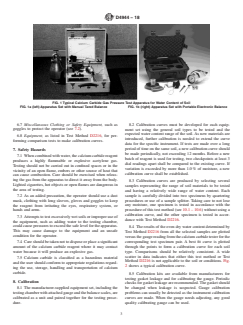
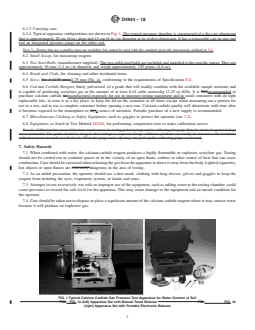
6.1.4 Typical apparatus configurations are shown in Fig. 1.
having all particles smaller than the 4.75 mm (No. 4) sieve size
The typical pressure chamber is constructed of a die-cast
and having a mass equal to that specified by the manufacturer
aluminum that is approximately 20 cm (8 in.) deep and 15 cm
of the instrument or equipment. The apparatus is shaken
(6 in.) in diameter at its widest dimension. It has a removable
vigorously in a rotating motion so the calcium carbide reagent
cap on one end and an integrated pressure gauge on the other
can contact all the available water in the soil.Acetylene gas is
end.
produced proportionally to the amount of available water
present. The apparent water content is read from a pressure
NOTE 3—Testers that use a smaller mass are available, but cannot be
gauge on the apparatus calibrated to read in percent water
used with this standard given the inaccuracies outlined in 5.4.
content for the mass of soil specified.
6.2 Small Scoop, for measuring reagent.
4.2 Acalibrationcurveisdevelopedforeachinstrumentand
6.3 Two Steel Balls, (manufacturer supplied). The two solid
each soil type by plotting the pressure gauge reading and the
steelballsareincludedandmatchedtothespecificgauge.They
water content determined from Test Method D2216 using
are approximately 30 mm (1.2 in.) in diameter and weigh
representative specimens of the soil. The calibration curve is
approximately 130 grams (4.6 oz).
used to determine a corrected water content value for subse-
6.4 Brush and Cloth, for cleaning and other incidental
quent tests on the same type of soil.
items.
6.5 Sieve, 4.75 mm (No. 4), conforming to the requirements
5. Significance and Use
of Specification E11.
5.1 The water content of soil is used throughout geotechni-
6.6 Calcium Carbide Reagent, finely pulverized, of a grade
cal engineering practice, both in the laboratory and in the field.
that will readily combine with the available sample moisture
Results are sometimes needed within a short time period and in
and is capable of producing acetylene gas in the amount of at
locations where it is not practical to install an oven or to
least 0.14 cubic meters/kg (2.25 cu ft/lb). It is recommended to
transport samples to an oven.This test method is used for these
purchase calcium carbide manufactured expressly for use in
occasions.
moisture testing equipment and in small containers with air
5.2 The results of this test have been used for field control
tight replaceable lids, to store it in a dry place, to keep the lid
of compacted embankments or other earth structures such as in
on the container at all times except when measuring out a
the determination of water content for control of soil moisture
portion for use in a test, and to use a complete container before
and dry density within a specified range.
opening a new one. Calcium carbide quality will deteriorate
5.3 This test method requires specimens consisting of soil with time after it becomes exposed to the atmosphere or a
having all particles smaller than the 4.75 mm (No. 4) sieve source of moisture. Periodic purchase of a new supply is
size. recommended.
D4944 − 18
FIG. 1 Typical Calcium Carbide Gas Pressure Test Apparatus for Water Content of Soil
FIG. 1a (left) Apparatus Set with Manual Tared Balance FIG. 1b (right) Apparatus Set with Portable Electronic Balance
6.7 Miscellaneous Clothing or Safety Equipment, such as 8.2 Calibration curves must be developed for each equip-
goggles to protect the operator (see 7.2). ment set using the general soil types to be tested and the
expected water content range of the soil.As new materials are
6.8 Equipment, as listed in Test Method D2216, for per-
introduced, further calibration is needed to extend the curve
forming comparison tests to make calibration curves.
data for the specific instrument. If tests are made over a long
period of time on the same soil, a new calibration curve should
7. Safety Hazards
be made periodically, not exceeding 12 months. Before a new
7.1 When combined with water, the calcium carbide reagent
batch of reagent is used for testing, two checkpoints at least 3
produces a highly flammable or explosive acetylene gas.
dial readings apart shall be compared to the existing curve. If
Testing should not be carried out in confined spaces or in the
variation is exceeded by more than 1.0 % of moisture, a new
vicinity of an open flame, embers or other source of heat that
calibration curve shall be established.
can cause combustion. Care should be exercised when releas-
ing the gas from the apparatus to direct it away from the body.
8.3 Calibration curves are produced by selecting several
Lighted cigarettes, hot objects or open flames are dangerous in
samples representing the range of soil materials to be tested
the area of testing.
and having a relatively wide range of water content. Each
sample is carefully divided into two specimens by quarterin
...
This document is not an ASTM standard and is intended only to provide the user of an ASTM standard an indication of what changes have been made to the previous version. Because
it may not be technically possible to adequately depict all changes accurately, ASTM recommends that users consult prior editions as appropriate. In all cases only the current version
of the standard as published by ASTM is to be considered the official document.
Designation: D4944 − 11 D4944 − 18
Standard Test Method for
Field Determination of Water (Moisture) Content of Soil by
the Calcium Carbide Gas Pressure Tester
This standard is issued under the fixed designation D4944; the number immediately following the designation indicates the year of
original adoption or, in the case of revision, the year of last revision. A number in parentheses indicates the year of last reapproval. A
superscript epsilon (´) indicates an editorial change since the last revision or reapproval.
1. Scope*
1.1 This test method outlines procedures for determining the water (moisture) content of soil by chemical reaction using calcium
carbide as a reagent to react with the available water in the soil producing a gas. A measurement is made of the gas pressure
produced when a specified mass of wet or moist soil is placed in a testing device with an appropriate volume of reagent and mixed.
1.2 This test method is not intended as a replacement for Test Method D2216; but as a supplement when rapid results are
required, when testing is done in field locations, or where an oven is not practical for use. Test Method D2216 is to be used as
the test method to compare for accuracy checks and correction.
1.3 This test method is applicable for most soils. Calcium carbide, used as a reagent, reacts with water as it is mixed with the
soil by shaking and agitating with the aid of steel balls in the apparatus. To produce accurate results, the reagent must react with
all the water which is not chemically hydrated with soil minerals or compounds in the soil. Some highly plastic clay soils or other
soils not friable enough to break up may not produce representative results because some of the water may be trapped inside soil
clods or clumps which cannot come in contact with the reagent. There may be some soils containing certain compounds or
chemicals that will react unpredictably with the reagent and give erroneous results. Any such problem will become evident as
calibration or check tests with Test Method D2216 are made. Some soils containing compounds or minerals that dehydrate with
heat (such as gypsum) which are to have special temperature control with Test Method D2216 may not be affected (dehydrated)
in this test method.
1.4 This test method is limited to using calcium carbide moisture test equipment made for 20 g, or larger, soil specimens and
to testing soil which contains particles no larger than the No. 4 4.75 mm (No. 4) Standard sieve size.
1.5 The values stated in SI units are to be regarded as standard. No other units of measurement are included in this The
inch-pound units given in parentheses are mathematical conversions, which are provided for information purposes only and are
not considered standard.
1.5.1 Cited sieve sizes are the standard sieve sizes given in Table 1 of Specification E11.
1.6 All observed and calculated values shall conform to the guidelines for significant digits and rounding established in Practice
D6026 unless superseded by this standard.
1.6.1 The procedures used to specify how data are collected, recorded or calculated in this standard are regarded as the industry
standard. In addition they are representative of the significant digits that generally should be retained. The procedures used do not
consider material variation, purpose for obtaining the data, special purpose studies, or any considerations for the user’s objectives;
it is common practice to increase or reduce significant digits of reported data to be commensurate with these considerations. It is
beyond the scope of this standard to consider significant digits used in analytical methods for engineering design.
1.7 This standard does not purport to address all of the safety concerns, if any, associated with its use. It is the responsibility
of the user of this standard to establish appropriate safety safety, health, and healthenvironmental practices and determine the
applicability of regulatory limitations prior to use. For specific hazards statements, see Section 7.
1.8 This international standard was developed in accordance with internationally recognized principles on standardization
established in the Decision on Principles for the Development of International Standards, Guides and Recommendations issued
by the World Trade Organization Technical Barriers to Trade (TBT) Committee.
This test method is under the jurisdiction of ASTM Committee D18 on Soil and Rock and is the direct responsibility of Subcommittee D18.08 on Special and Construction
Control Tests.
Current edition approved Nov. 1, 2011Feb. 15, 2018. Published December 2011February 2018. Originally approved in 1989. Last previous edition approved in 20042011
as D4944 – 04.11. DOI: 10.1520/D4944-11.10.1520/D4944-18.
*A Summary of Changes section appears at the end of this standard
Copyright © ASTM International, 100 Barr Harbor Drive, PO Box C700, West Conshohocken, PA 19428-2959. United States
D4944 − 18
2. Referenced Documents
2.1 ASTM Standards:
D653 Terminology Relating to Soil, Rock, and Contained Fluids
D2216 Test Methods for Laboratory Determination of Water (Moisture) Content of Soil and Rock by Mass
D3740 Practice for Minimum Requirements for Agencies Engaged in Testing and/or Inspection of Soil and Rock as Used in
Engineering Design and Construction
D4753 Guide for Evaluating, Selecting, and Specifying Balances and Standard Masses for Use in Soil, Rock, and Construction
Materials Testing
D6026 Practice for Using Significant Digits in Geotechnical Data
E11 Specification for Woven Wire Test Sieve Cloth and Test Sieves
E177 Practice for Use of the Terms Precision and Bias in ASTM Test Methods
E691 Practice for Conducting an Interlaboratory Study to Determine the Precision of a Test Method
3. Terminology
3.1 Definitions—Definitions:
3.1.1 Definitions of terms used in this test method can be found in Terminology D653.
4. Summary of Test Method
4.1 A measured volume of calcium carbide, in excess of that needed to react with the water, is placed in the testing apparatus
along with two steel balls and a representative specimen of soil having all particles smaller than the No. 4 4.75 mm (No. 4) sieve
size and having a mass equal to that specified by the manufacturer of the instrument or equipment. The apparatus is shaken
vigorously in a rotating motion so the calcium carbide reagent can contact all the available water in the soil. Acetylene gas is
produced proportionally to the amount of available water present. The apparent water content is read from a pressure gauge on
the apparatus calibrated to read in percent water content for the mass of soil specified.
4.2 A calibration curve is developed for each instrument and each soil type by plotting the pressure gauge reading and the water
content determined from Test Method D2216 using representative specimens of the soil. The calibration curve is used to determine
a corrected water content value for subsequent tests on the same type of soil.
5. Significance and Use
5.1 The water content of soil is used throughout geotechnical engineering practice, both in the laboratory and in the field.
Results are sometimes needed within a short time period and in locations where it is not practical to install an oven or to transport
samples to an oven. This test method is used for these occasions.
5.2 The results of this test have been used for field control of compacted embankments or other earth structures such as in the
determination of water content for control of soil moisture and dry density within a specified range.
5.3 This test method requires specimens consisting of soil having all particles smaller than the No. 4 4.75 mm (No. 4) sieve
size.
5.4 This test method may not be as accurate as other accepted methods such as Test Method D2216. Inaccuracies may result
because specimens are too small to properly represent the total soil, from clumps of soil not breaking up to expose all the available
water to the reagent and from other inherent procedural, equipment or process inaccuracies. Therefore, other methods may be more
appropriate when highly accurate results are required, or when the use of test results is sensitive to minor variations in the values
obtained.
NOTE 1—The quality of the result produced by this standard is dependent on the competence of the personnel performing it, and the suitability of the
equipment and facilities used. Agencies that meet the criteria of Practice D3740 are generally considered capable of competent and objective
testing/sampling/inspection. Users of this standard are cautioned that compliance with Practice D3740 does not in itself ensure reliable results. Reliable
results depend on many factors; Practice D3740 provides a means of evaluating some of those factors.
6. Apparatus
6.1 Calcium Carbide Pressure Tester Set Including:
6.1.1 Testing chamber with attached pressure gauge.
NOTE 2—The testing chamber with pressure gauge and the balances are calibrated as a set (see Section 8).
6.1.2 A set of tared manual balances or portable electronic balance meeting the requirements of a GP2 of Specification D4753.
NOTE 2—Testers that use a smaller mass are available, but are considered too inaccurate for this standard. The testing chamber with pressure gauge
and the balances are calibrated as a set (see Section 8). A typical apparatus is shown in Fig. 1.
For referenced ASTM standards, visit the ASTM website, www.astm.org, or contact ASTM Customer Service at service@astm.org. For Annual Book of ASTM Standards
volume information, refer to the standard’s Document Summary page on the ASTM website.
D4944 − 18
6.1.3 Carrying case.
6.1.4 Typical apparatus configurations are shown in Fig. 1. The typical pressure chamber is constructed of a die-cast aluminum
that is approximately 20 cm (8 in.) deep and 15 cm (6 in.) in diameter at its widest dimension. It has a removable cap on one end
and an integrated pressure gauge on the other end.
NOTE 3—Testers that use a smaller mass are available, but cannot be used with this standard given the inaccuracies outlined in 5.4.
6.2 Small Scoop, for measuring reagent.
6.3 Two Steel Balls, (manufacturer supplied). The two solid steel balls are included and matched to the specific gauge. They are
approximately 30 mm (1.2 in.) in diameter and weigh approximately 130 grams (4.6 oz).
6.4 Brush and Cloth, for cleaning and other incidental items.
6.5 Sieve, No. 4 (4.75 mm),4.75 mm (No. 4), conforming to the requirements of Specification E11.
6.6 Calcium Carbide Reagent, finely pulverized, of a grade that will readily combine with the available sample moisture and
is capable of producing acetylene gas in the amount of at least 0.14 cubic meters/kg (2.25 cu ft/lb). It is bestrecommended to
purchase calcium carbide in manufactured expressly for use in moisture testing equipment and in small containers with air tight
replaceable lids, to store it in a dry place, to keep the lid on the container at all times except when measuring out a portion for
use in a test, and to use a complete container before opening a new one. Calcium carbide quality will deteriorate with time after
it becomes exposed to the atmosphere or anya source of moisture. Periodic purchase of a new supply is recommended.
6.7 Miscellaneous Clothing or Safety Equipment, such as goggles to protect the operator (see 7.2).
6.8 Equipment, as listed in Test Method D2216, for performing comparison tests to make calibration curves.
NOTE 3—Calibration kits are available from manufacturers for testing gasket leakage and for calibrating the gauge. Periodic checks for gasket leakage
are recommended. The gasket should be changed when leakage is suspected. Gauge calibration problems can usually be detected as the instrument
calibration curves are made (see Section 8). When the gauge needs adjusting, any good quality calibrating gauge can be used.
7. Safety Hazards
7.1 When combined with water, the calcium carbide reagent produces a highly flammable or explosive acetylene gas. Testing
should not be carried out in confined spaces or in the vicinity of an open flame, embers or other source of heat that can cause
combustion. Care should be exercised when releasing the gas from the apparatus to direct it away from the body. Lighted cigarettes,
hot objects or open flames are extremely dangerous in the area of testing.
7.2 As an added precaution, the operator should use a dust mask, clothing with long sleeves, gloves and goggles to keep the
reagent from irritating the eyes, respiratory system, or hands and arms.
7.3 Attempts to test excessively wet soils or improper use of the equipment, such as adding water to the testing chamber, could
cause pressures to exceed the safe level for the apparatus. This may cause damage to the equipment and an unsafe condition for
the operator.
7.4 Care should be taken not to dispose or place a significant amount of the calcium carbide reagent where it may contact water
because it will produce an explosive gas.
FIG. 1 Typical Calcium Carbide Gas Pressure Test Apparatus for Water Content of Soil
FIG. FIG. 1a (left) Apparatus Set with Manual Tared Balance FIG. FIG. 1b
(right) Apparatus Set with Portable Electronic Balance
D4944 − 18
7.5 Calcium carbide is classified as a hazardous material and t
...