

ASTM D3326-07(2024)
(Practice)Standard Practice for Preparation of Samples for Identification of Waterborne Oils
General Information
- Abstract
SIGNIFICANCE AND USE
4.1 Identification of a recovered oil is determined by comparison with known oils selected because of their possible relationship to the particular recovered oil, for example, suspected or questioned sources. Thus, samples of such known oils must be collected and submitted along with the unknown for analysis. It is unlikely that identification of the sources of an unknown oil by itself can be made without direct matching, that is, solely with a library of analyses.
SCOPE
1.1 This practice covers the preparation for analysis of waterborne oils recovered from water. The identification is based upon the comparison of physical and chemical characteristics of the waterborne oils with oils from suspect sources. These oils may be of petroleum or vegetable/animal origin, or both. Seven procedures are given as follows:
Sections
Procedure A (for samples of more than 50 mL volume containing significant quantities of hydrocarbons with boiling points above 280 °C)
8 to 12
Procedure B (for samples containing significant quantities of hydrocarbons with boiling points above 280 °C)
13 to 17
Procedure C (for waterborne oils containing significant amounts of components boiling below 280 °C and to mixtures of these and higher boiling components)
18 to 22
Procedure D (for samples containing both petroleum and vegetable/animal derived oils)
23 to 27
Procedure E (for samples of light crudes and medium distillate fuels)
28 to 34
Procedure F (for thin films of oil-on-water)
35 to 39
Procedure G (for oil-soaked samples)
40 to 44
1.2 Procedures for the analytical examination of the waterborne oil samples are described in Practice D3415 and Test Methods D3328, D3414, and D3650. Refer to the individual oil identification test methods for the sample preparation method of choice. The deasphalting effects of the sample preparation method should be considered in selecting the best methods.
1.3 The values stated in SI units are to be regarded as standard. No other units of measurement are included in this standard.
1.4 This standard does not purport to address all of the safety concerns, if any, associated with its use. It is the responsibility of the user of this standard to establish appropriate safety, health, and environmental practices and determine the applicability of regulatory limitations prior to use. Specific caution statements are given in Sections 6 and 32.
1.5 This international standard was developed in accordance with internationally recognized principles on standardization established in the Decision on Principles for the Development of International Standards, Guides and Recommendations issued by the World Trade Organization Technical Barriers to Trade (TBT) Committee.
- Status
- Published
- Publication Date
- 31-Mar-2024
- Technical Committee
- D19 - Water
- Drafting Committee
- D19.06 - Methods for Analysis for Organic Substances in Water
Overview
ASTM D3326-07(2024) – Standard Practice for Preparation of Samples for Identification of Waterborne Oils provides a comprehensive framework for the preparation of samples from waterborne oils prior to analytical identification. Developed by ASTM International, this standard outlines best practices for ensuring that oil samples collected from water environments are handled, preserved, and processed in a manner that allows reliable comparison to suspected source oils. The standard supports the identification of both petroleum-based and animal/vegetable-derived oils, emphasizing accurate matching through direct analysis rather than reliance solely on analytical libraries.
This standard is essential for laboratories, response teams, and regulatory agencies involved in oil spill response, environmental monitoring, and forensic oil identification, supporting traceability, evidence integrity, and consistency across investigations.
Key Topics
- Sample Collection & Preservation: Guidelines for collecting representative waterborne oil samples and suspected source oils, with detailed preservation procedures to prevent degradation.
- Sample Preparation Techniques: Seven distinct procedures (A–G) tailored for various sample types, including:
- Large volume samples with high-boiling hydrocarbons
- Limited volume samples, thin films, or oil-soaked materials
- Oils containing both petroleum and animal/vegetable components
- Light crudes and medium distillates
- Weathering Simulation: Methods to mimic environmental weathering, ensuring that sample conditions are comparable for analytical comparisons.
- Separation & Extraction Methods: Procedures for separating oil from water, removing sediments/debris, and extracting oils using solvents.
- Health & Safety Precautions: Emphasis on laboratory safety, including handling of volatile and potentially hazardous solvents.
- Reference Standards & Terminology: Use of SI units, defined terminology to ensure clarity, and references to complementary ASTM standards for analytical methods.
Applications
The ASTM D3326-07(2024) standard is widely applied in situations where accurate identification of waterborne oil is critical, such as:
- Oil Spill Response and Forensics: Preparing samples for comparative analysis to determine the source of an oil spill, aiding in liability determination and environmental impact assessments.
- Regulatory Compliance and Environmental Monitoring: Supporting agencies and organizations in conforming to national and international requirements for oil pollution investigations.
- Legal Evidence Preparation: Ensuring that samples used in legal proceedings are handled and prepared according to recognized standards, enhancing the credibility of analytical results in court.
- Research and Development: Providing a consistent methodology for preparing samples in research studies focused on the behavior, fate, and ecological impacts of waterborne oils.
The standard’s procedures support the extraction and preparation of oil samples regardless of origin (petroleum, animal, or vegetable), sample volume, or environmental condition, making it versatile for diverse field and laboratory scenarios.
Related Standards
For the complete analysis and identification of waterborne oils, ASTM D3326-07(2024) is commonly used alongside the following ASTM standards:
- ASTM D3415 – Practice for Identification of Waterborne Oils
- ASTM D3328 – Test Methods for Comparison of Waterborne Petroleum Oils by Gas Chromatography
- ASTM D3414 – Test Method for Comparison of Waterborne Petroleum Oils by Infrared Spectroscopy (withdrawn 2018)
- ASTM D3650 – Test Method for Comparison of Waterborne Petroleum Oils By Fluorescence Analysis (withdrawn 2018)
- ASTM D4489 – Practices for Sampling of Waterborne Oils
- ASTM D1193 – Specification for Reagent Water
These standards provide complementary guidance for analytical examination, ensuring a holistic and standardized approach to waterborne oil identification.
Keywords: ASTM D3326, waterborne oil identification, oil spill sample preparation, petroleum oil analysis, forensic oil comparison, environmental monitoring, sample extraction, oil spill response, laboratory best practices, oil sample preservation.
Relations
- Effective Date
- 01-Apr-2024
- Effective Date
- 01-Apr-2024
- Effective Date
- 15-Dec-2017
- Effective Date
- 15-Dec-2017
- Effective Date
- 01-Apr-2024
- Effective Date
- 01-Apr-2024
- Effective Date
- 01-Apr-2024
- Effective Date
- 01-Apr-2024
- Effective Date
- 01-Apr-2024
- Effective Date
- 01-Apr-2024
- Effective Date
- 01-Apr-2024
- Effective Date
- 01-Apr-2024
Get Certified
Connect with accredited certification bodies for this standard

Element Materials Technology
Materials testing and product certification.

ABS Group Brazil
ABS Group certification services in Brazil.

ABS Quality Evaluations Inc.
American Bureau of Shipping quality certification.
Sponsored listings
Frequently Asked Questions
ASTM D3326-07(2024) is a standard published by ASTM International. Its full title is "Standard Practice for Preparation of Samples for Identification of Waterborne Oils". This standard covers: SIGNIFICANCE AND USE 4.1 Identification of a recovered oil is determined by comparison with known oils selected because of their possible relationship to the particular recovered oil, for example, suspected or questioned sources. Thus, samples of such known oils must be collected and submitted along with the unknown for analysis. It is unlikely that identification of the sources of an unknown oil by itself can be made without direct matching, that is, solely with a library of analyses. SCOPE 1.1 This practice covers the preparation for analysis of waterborne oils recovered from water. The identification is based upon the comparison of physical and chemical characteristics of the waterborne oils with oils from suspect sources. These oils may be of petroleum or vegetable/animal origin, or both. Seven procedures are given as follows: Sections Procedure A (for samples of more than 50 mL volume containing significant quantities of hydrocarbons with boiling points above 280 °C) 8 to 12 Procedure B (for samples containing significant quantities of hydrocarbons with boiling points above 280 °C) 13 to 17 Procedure C (for waterborne oils containing significant amounts of components boiling below 280 °C and to mixtures of these and higher boiling components) 18 to 22 Procedure D (for samples containing both petroleum and vegetable/animal derived oils) 23 to 27 Procedure E (for samples of light crudes and medium distillate fuels) 28 to 34 Procedure F (for thin films of oil-on-water) 35 to 39 Procedure G (for oil-soaked samples) 40 to 44 1.2 Procedures for the analytical examination of the waterborne oil samples are described in Practice D3415 and Test Methods D3328, D3414, and D3650. Refer to the individual oil identification test methods for the sample preparation method of choice. The deasphalting effects of the sample preparation method should be considered in selecting the best methods. 1.3 The values stated in SI units are to be regarded as standard. No other units of measurement are included in this standard. 1.4 This standard does not purport to address all of the safety concerns, if any, associated with its use. It is the responsibility of the user of this standard to establish appropriate safety, health, and environmental practices and determine the applicability of regulatory limitations prior to use. Specific caution statements are given in Sections 6 and 32. 1.5 This international standard was developed in accordance with internationally recognized principles on standardization established in the Decision on Principles for the Development of International Standards, Guides and Recommendations issued by the World Trade Organization Technical Barriers to Trade (TBT) Committee.
SIGNIFICANCE AND USE 4.1 Identification of a recovered oil is determined by comparison with known oils selected because of their possible relationship to the particular recovered oil, for example, suspected or questioned sources. Thus, samples of such known oils must be collected and submitted along with the unknown for analysis. It is unlikely that identification of the sources of an unknown oil by itself can be made without direct matching, that is, solely with a library of analyses. SCOPE 1.1 This practice covers the preparation for analysis of waterborne oils recovered from water. The identification is based upon the comparison of physical and chemical characteristics of the waterborne oils with oils from suspect sources. These oils may be of petroleum or vegetable/animal origin, or both. Seven procedures are given as follows: Sections Procedure A (for samples of more than 50 mL volume containing significant quantities of hydrocarbons with boiling points above 280 °C) 8 to 12 Procedure B (for samples containing significant quantities of hydrocarbons with boiling points above 280 °C) 13 to 17 Procedure C (for waterborne oils containing significant amounts of components boiling below 280 °C and to mixtures of these and higher boiling components) 18 to 22 Procedure D (for samples containing both petroleum and vegetable/animal derived oils) 23 to 27 Procedure E (for samples of light crudes and medium distillate fuels) 28 to 34 Procedure F (for thin films of oil-on-water) 35 to 39 Procedure G (for oil-soaked samples) 40 to 44 1.2 Procedures for the analytical examination of the waterborne oil samples are described in Practice D3415 and Test Methods D3328, D3414, and D3650. Refer to the individual oil identification test methods for the sample preparation method of choice. The deasphalting effects of the sample preparation method should be considered in selecting the best methods. 1.3 The values stated in SI units are to be regarded as standard. No other units of measurement are included in this standard. 1.4 This standard does not purport to address all of the safety concerns, if any, associated with its use. It is the responsibility of the user of this standard to establish appropriate safety, health, and environmental practices and determine the applicability of regulatory limitations prior to use. Specific caution statements are given in Sections 6 and 32. 1.5 This international standard was developed in accordance with internationally recognized principles on standardization established in the Decision on Principles for the Development of International Standards, Guides and Recommendations issued by the World Trade Organization Technical Barriers to Trade (TBT) Committee.
ASTM D3326-07(2024) is classified under the following ICS (International Classification for Standards) categories: 75.080 - Petroleum products in general. The ICS classification helps identify the subject area and facilitates finding related standards.
ASTM D3326-07(2024) has the following relationships with other standards: It is inter standard links to ASTM D3326-07(2017), ASTM D4489-95(2024), ASTM D3415-98(2017), ASTM D4489-95(2017), ASTM D6469-20, ASTM D8112-24, ASTM D8506-23, ASTM D5739-06(2020), ASTM D3328-06(2020), ASTM D3415-98(2024), ASTM D3325-90(2020), ASTM D5412-93(2017)e1. Understanding these relationships helps ensure you are using the most current and applicable version of the standard.
ASTM D3326-07(2024) is available in PDF format for immediate download after purchase. The document can be added to your cart and obtained through the secure checkout process. Digital delivery ensures instant access to the complete standard document.
Standards Content (Sample)
This international standard was developed in accordance with internationally recognized principles on standardization established in the Decision on Principles for the
Development of International Standards, Guides and Recommendations issued by the World Trade Organization Technical Barriers to Trade (TBT) Committee.
Designation: D3326 − 07 (Reapproved 2024)
Standard Practice for
Preparation of Samples for Identification of Waterborne
Oils
This standard is issued under the fixed designation D3326; the number immediately following the designation indicates the year of
original adoption or, in the case of revision, the year of last revision. A number in parentheses indicates the year of last reapproval. A
superscript epsilon (´) indicates an editorial change since the last revision or reapproval.
1. Scope ization established in the Decision on Principles for the
Development of International Standards, Guides and Recom-
1.1 This practice covers the preparation for analysis of
mendations issued by the World Trade Organization Technical
waterborne oils recovered from water. The identification is
Barriers to Trade (TBT) Committee.
based upon the comparison of physical and chemical charac-
teristics of the waterborne oils with oils from suspect sources.
2. Referenced Documents
These oils may be of petroleum or vegetable/animal origin, or
2.1 ASTM Standards:
both. Seven procedures are given as follows:
D95 Test Method for Water in Petroleum Products and
Sections
Bituminous Materials by Distillation
Procedure A (for samples of more than 50 mL volume
containing significant quantities of hydrocarbons with boiling
D1129 Terminology Relating to Water
points above 280 °C) 8 to 12
D1193 Specification for Reagent Water
Procedure B (for samples containing significant quantities of
hydrocarbons with boiling points above 280 °C) 13 to 17 D3325 Practice for Preservation of Waterborne Oil Samples
Procedure C (for waterborne oils containing significant
D3328 Test Methods for Comparison of Waterborne Petro-
amounts of components boiling below 280 °C and to
leum Oils by Gas Chromatography
mixtures of these and higher boiling components) 18 to 22
Procedure D (for samples containing both petroleum and D3414 Test Method for Comparison of Waterborne Petro-
vegetable/animal derived oils) 23 to 27 3
leum Oils by Infrared Spectroscopy (Withdrawn 2018)
Procedure E (for samples of light crudes and medium distillate
D3415 Practice for Identification of Waterborne Oils
fuels) 28 to 34
Procedure F (for thin films of oil-on-water) 35 to 39
D3650 Test Method for Comparison of Waterborne Petro-
Procedure G (for oil-soaked samples) 40 to 44
leum Oils By Fluorescence Analysis (Withdrawn 2018)
1.2 Procedures for the analytical examination of the water-
D4489 Practices for Sampling of Waterborne Oils
borne oil samples are described in Practice D3415 and Test
E1 Specification for ASTM Liquid-in-Glass Thermometers
Methods D3328, D3414, and D3650. Refer to the individual oil
E133 Specification for Distillation Equipment
identification test methods for the sample preparation method
of choice. The deasphalting effects of the sample preparation 3. Terminology
method should be considered in selecting the best methods.
3.1 Definitions:
1.3 The values stated in SI units are to be regarded as 3.1.1 For definitions of terms used in this standard, refer to
standard. No other units of measurement are included in this Terminology D1129.
standard.
3.2 Definitions of Terms Specific to This Standard:
1.4 This standard does not purport to address all of the
3.2.1 animal/vegetable-derived oils, n—a mixture made of
safety concerns, if any, associated with its use. It is the
mono-, di-, and triglyceride esters of fatty acids and other
responsibility of the user of this standard to establish appro-
substances of animal or vegetable origin, or both.
priate safety, health, and environmental practices and deter-
3.2.2 simulated weathering of waterborne oils by
mine the applicability of regulatory limitations prior to use.
distillation, n—considers only the effect of evaporation, which
Specific caution statements are given in Sections 6 and 32.
likely is the most significant short-term weathering effect in the
1.5 This international standard was developed in accor-
environment.
dance with internationally recognized principles on standard-
1 2
This practice is under the jurisdiction of ASTM Committee D19 on Water and For referenced ASTM standards, visit the ASTM website, www.astm.org, or
is the direct responsibility of Subcommittee D19.06 on Methods for Analysis for contact ASTM Customer Service at service@astm.org. For Annual Book of ASTM
Organic Substances in Water. Standards volume information, refer to the standard’s Document Summary page on
Current edition approved April 1, 2024. Published April 2024. Originally the ASTM website.
approved in 1974. Last previous edition approved in 2017 as D3326 – 07 (2017). The last approved version of this historical standard is referenced on
DOI: 10.1520/D3326-07R24. www.astm.org.
Copyright © ASTM International, 100 Barr Harbor Drive, PO Box C700, West Conshohocken, PA 19428-2959. United States
D3326 − 07 (2024)
3.2.3 simulated weathering of waterborne oils by PROCEDURE A—LARGE SAMPLES
evaporation, n—under ultraviolet light simulates the loss of
8. Scope
light components on weathering, as well as some oxidative
weathering.
8.1 This procedure covers the preparation for analysis of
samples in which the volumes of waterborne oil in the
4. Significance and Use
environmental and suspect source samples equal or exceed
4.1 Identification of a recovered oil is determined by com-
50 mL and in which the oil portion contains significant
parison with known oils selected because of their possible amounts of hydrocarbons with boiling points above 280 °C.
relationship to the particular recovered oil, for example,
NOTE 1—The boiling point may be ascertained by injecting the neat
suspected or questioned sources. Thus, samples of such known
samples into the gas chromatograph and checking the elution times above
oils must be collected and submitted along with the unknown
that of pentadecane on a nonpolar column.
for analysis. It is unlikely that identification of the sources of
8.2 The preparation of samples containing mostly hydrocar-
an unknown oil by itself can be made without direct matching,
bons of boiling points below 280 °C, such as petroleum
that is, solely with a library of analyses.
distillate fuels, is beyond the scope of this procedure (see
Procedure C or E).
5. Reagents and Materials
5.1 Purity of Reagents—Reagent grade chemicals shall be
9. Summary of Procedure
used in all tests. Unless otherwise indicated, it is intended that
9.1 A neat portion of the waterborne oil is retained. If not
all reagents shall conform to the specifications of the Commit-
possible to obtain a neat portion, then retain a portion of the
tee on Analytical Reagents of the American Chemical Society.
waterborne oil as received. This is to be used in those analyses
Special ancillary procedures such as fluorescence may require
performed on samples containing significant quantities of
higher purity grades of solvents. Other grades may be used
hydrocarbons with boiling points below 280 °C. Preparation of
provided it is first ascertained that the reagent is of sufficiently
these samples is beyond the scope of this procedure, but are
high purity to permit its use without lessening the accuracy of
covered in Procedure C.
the determination.
NOTE 2—Waterborne oil samples containing significant quantities of
5.2 Purity of Water—Unless otherwise indicated, references
hydrocarbons with boiling points below 280 °C (see Note 1), such as
to water shall be understood to mean reagent water that meets
gasoline and kerosene, can usually be obtained as neat samples without
the purity specifications of Type I or Type II water, as specified any sample preparation.
in Specification D1193.
9.2 The waterborne oil sample is dissolved in an equal
volume of chloroform or dichloromethane and centrifuged to
6. Caution
remove the free water, solids, and debris. The water layer, if
6.1 Solvents used in this practice are volatile, flammable, or
present, is separated from the organic layer. Other debris, if
may cause the harm to the health of the user. Specifically,
present, is removed by filtration through glass wool.
benzene is a known carcinogen, while chloroform and carbon
NOTE 3—The use of spectrograde cyclohexane is required for the
tetrachloride are suspected carcinogens. Consequently, it is
extraction of samples to be analyzed by fluorescence spectrometry by Test
important that extractions and separations utilizing these sub-
Method D3650. Separation of water may be accomplished by centrifuga-
stances must be carried out in a laboratory hood with a
tion or dying, or both, with anhydrous sodium sulfate.
minimum linear face velocity of 38 m ⁄min to 45 m ⁄min
9.3 When centrifugation will not separate the water from the
(125 ft ⁄min to 150 ft ⁄min) located in a regulated area posted
chloroform solution of the sample, it is refluxed with an
with signs bearing the legends: NO SMOKING or (if appro-
aromatic or petroleum distillate solvent in accordance with Test
priate) DANGER — CHEMICAL CARCINOGEN-
Method D95.
AUTHORIZED PERSONNEL ONLY, or both.
NOTE 4—Pressure filtration has also been found useful for breaking
emulsions.
7. Sampling
9.4 A portion of the solvent/sample solution is retained. The
7.1 Collect representative samples in accordance with Prac-
solvent may be removed by evaporation. This portion of the
tices D4489.
sample may be used in the preliminary gas chromatographic
7.2 Preserve the waterborne oil samples in accordance with
analysis, Test Methods D3328 (Test Method A), and other
Practice D3325.
analyses in which the results are unaffected by weathering.
7.3 The portion of the sample used must be representative of
9.5 The remainder of the solvent/sample solution is distilled
the total sample. If the material is liquid, thoroughly stir the
using nitrogen purge to a liquid temperature of 280 °C to
sample as received, warming if necessary to ensure uniformity.
remove the solvent and simulate weathering conditions as
nearly as possible. The distillate may be discarded or saved for
characterization by gas chromatography (Test Methods
ACS Reagent Chemicals, Specifications and Procedures for Reagents and
Standard-Grade Reference Materials, American Chemical Society, Washington,
D3328). This simulated weathering treatment is necessary to
DC. For suggestions on the testing of reagents not listed by the American Chemical
bring the unweathered suspect samples and the waterborne oil
Society, see Analar Standards for Laboratory Chemicals, BDH Ltd., Poole, Dorset,
sample to as nearly comparable physical condition for subse-
U.K., and the United States Pharmacopeia and National Formulary, U.S. Pharma-
copeial Convention, Inc. (USPC), Rockville, MD. quent analysis as possible. Analyses requiring the use of this
D3326 − 07 (2024)
treated residue include elemental analysis; gas chromato- 10.7 Flowmeter, to regulate flow of nitrogen to distillation
graphic analysis (Test Methods D3328, Test Methods A and B); flask. It should be calibrated and graduated for the range
an infrared procedure (Test Method D3414); a fluorescence test 10 mL ⁄min to 15 mL ⁄min.
method (Test Method D3650); and any applicable test method
11. Reagents and Materials
or practice described in Practice D3415.
11.1 Filter Paper, medium retention, medium fast speed,
NOTE 5—The distillate might yield useful information but is discarded
in this practice. prewashed with solvent used.
11.2 Glass Wool, prewashed with solvent used.
10. Apparatus
11.3 Solvent—Chloroform (stabilized with ethanol) or di-
10.1 Centrifuge, capable of whirling two or more filled
chloromethane is used for dissolution of the waterborne oil
100 mL centrifuge tubes at a speed that is controlled to give a
samples. If water is to be removed by distillation, an aromatic,
relative centrifugal force (rcf) between 500 and 800 at the tip
petroleum distillate, or volatile spirits solvent is required as
of the tubes.
specified in Test Method D95. The safety precautions associ-
ated with the use of the solvent selected should be considered
10.2 Centrifuge Tubes, cone shaped, 100 mL.
before it is used (see Note 3).
10.3 Distillation Apparatus for Water Determination, as
specified in Test Method D95.
12. Procedure
10.4 Distillation Apparatus for Simulated Weathering, as
12.1 Retention of Neat Samples:
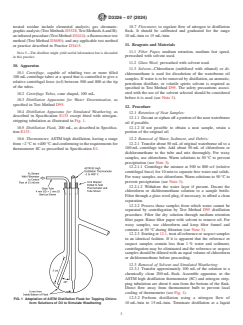
described in Specification E133 except fitted with nitrogen-
12.1.1 Decant or siphon off a portion of the neat waterborne
stripping tubulation as illustrated in Fig. 1.
oil if possible.
10.5 Distillation Flask, 200 mL, as described in Specifica- 12.1.2 If not possible to obtain a neat sample, retain a
portion of the original oil.
tion E133.
10.6 Thermometer, ASTM high distillation, having a range 12.2 Removal of Water, Sediment, and Debris:
12.2.1 Transfer about 50 mL of original waterborne oil to a
from −2 °C to +400 °C and conforming to the requirements for
thermometer 8C as prescribed in Specification E1. 100 mL centrifuge tube. Add about 50 mL of chloroform or
dichloromethane to the tube and mix thoroughly. For waxy
samples, use chloroform. Warm solutions to 50 °C to prevent
precipitation (see Note 3).
12.2.1.1 Centrifuge the mixture at 500 to 800 rcf (relative
centrifugal force) for 10 min to separate free water and solids.
For waxy samples, use chloroform. Warm solutions to 50 °C to
prevent precipitation (see Note 3).
12.2.1.2 Withdraw the water layer if present. Decant the
chloroform or dichloromethane solution to a sample bottle.
Filter through a glass wool plug, if necessary, to afford a clean
separation.
12.2.2 Process those samples from which water cannot be
separated by centrifugation by Test Method D95 distillation
procedure. Filter the dry solution through medium retention
filter paper. Rinse filter paper with solvent to remove oil. For
waxy samples, use chloroform and keep filter funnel and
contents at 50 °C during filtration (see Note 3).
12.2.3 Starting at 12.1, treat all reference or suspect samples
in an identical fashion. If it is apparent that the reference or
suspect samples contain less than 1 % water and sediment,
centrifugation may be eliminated and the reference or suspect
samples should be diluted with an equal volume of chloroform
or dichloromethane before proceeding.
12.3 Removal of Solvent and Simulated Weathering:
12.3.1 Transfer approximately 100 mL of the solution to a
chemically clean 200 mL flask. Assemble apparatus so the
ASTM high distillation thermometer (8C) and nitrogen strip-
ping tubulation are about 6 mm from the bottom of the flask.
Direct flow away from thermometer bulb to prevent local
cooling of thermometer (see Fig. 1).
12.3.2 Perform distillation using a nitrogen flow of
FIG. 1 Adaptation of ASTM Distillation Flask for Topping Chloro-
form Solutions of Oil to Simulate Weathering 10 mL ⁄min to 15 mL ⁄min. Terminate distillation at a liquid
D3326 − 07 (2024)
temperature of 280 °C. Shut off the nitrogen flow when the 17.4 Decant supernatant liquid into a 250 mL beaker and
temperature of the liquid in the distillation flask cools below evaporate the solvent and volatiles initially at 25 °C to 35 °C
175 °C. Pour the hot residue into a suitable container. and then at 40 °C to 50 °C for 2 h in the presence of a stream
12.3.3 Treat all reference and suspect oils in the same of nitrogen. Transfer the sample to a sample vial when there is
manner as the waterborne oil samples. Repeat 12.2.1 – 12.3.2. approximately 4 mL sample remaining and continue the sol-
vent removal. The samples can then be used for analysis in
PROCEDURE B—LIMITED SAMPLE VOLUMES OF
accordance with Practice D3415.
HEAVY OILS
NOTE 6—This treatment with 70 mg of oil, evaporated at 40 °C for
15 min in the presence of an airstream, yielded gas chromatograms
13. Scope
resembling those of the distillation test method in 12.3.
13.1 This procedure covers the preparation for analysis of
PROCEDURE C—OILS BOILING BELOW 280 °C
waterborne oil samples of petroleum derived origin in which
the volumes equal or are less than 1 mL. An aliquot of larger
18. Scope
oil samples may also be used.
18.1 This procedure covers the preparation for analysis of
13.2 The procedure is applicable to oils containing signifi-
waterborne oil samples containing significant amounts of
cant amounts of hydrocarbons boiling above 280 °C.
components boiling below 280 °C.
13.3 The preparation of samples containing lower boiling
18.2 The procedure is applicable to samples of distillate fuel
hydrocarbon is beyond the scope of this procedure, but is
oils, light and heavy naphthas, and other petroleum solvents.
covered by Procedures C and E.
19. Summary of Procedure
14. Summary of Procedure
19.1 The oil and water phases are separated by
14.1 The sample is dissolved in pentane or hexane, and the
centrifugation, and the oil phase is dried with anhydrous
water and insolubles are removed by centrifugation. The
magnesium sulfate.
organic solvent phase is dried with anhydrous magnesium
sulfate, filtered, and the volatile components
...