

ASTM D4145-10(2022)
(Test Method)Standard Test Method for Coating Flexibility of Prepainted Sheet
General Information
- Abstract
SIGNIFICANCE AND USE
4.1 Organic coatings on precoated sheet are subjected to stresses when fabricated into products by roll forming, brake bending, or other deformation processes. These stresses can exceed the flexibility or adhesive strength of the coating, resulting in fracture of the coating which exposes the substrate, or in the loss of adhesion of the coating to the substrate. This test is a means of evaluating the ability of a coating system to withstand the stresses of fabrication.
4.2 The bend direction, whether the axis of bend is transverse to or along the rolling direction of the metal, and the temperature of the specimen when it is bent can affect the results of this test and should be agreed upon between the supplier and the user.
SCOPE
1.1 This test method describes a procedure for determining the flexibility and adhesion of organic coatings (paints) on metallic substrates that are deformed by bending when the sheet is fabricated into building panels or other products.
1.2 The metal substrate must be capable of passing this test without fracturing and with no excessive grain development.
1.3 The values stated in inch-pound units are to be regarded as standard. The values given in parentheses are mathematical conversions to SI units that are provided for information only and are not considered standard.
1.4 This standard does not purport to address all of the safety concerns, if any, associated with its use. It is the responsibility of the user of this standard to establish appropriate safety, health, and environmental practices and determine the applicability of regulatory limitations prior to use.
1.5 This international standard was developed in accordance with internationally recognized principles on standardization established in the Decision on Principles for the Development of International Standards, Guides and Recommendations issued by the World Trade Organization Technical Barriers to Trade (TBT) Committee.
- Status
- Published
- Publication Date
- 30-Nov-2022
- Technical Committee
- D01 - Paint and Related Coatings, Materials, and Applications
- Drafting Committee
- D01.53 - Coil Coated Metal

Overview
ASTM D4145-10(2022): Standard Test Method for Coating Flexibility of Prepainted Sheet is an internationally recognized method developed by ASTM International. This standard specifies procedures for evaluating the flexibility and adhesion of organic coatings on metal sheets that are subjected to deformation during fabrication. Common deformation processes include roll forming, brake bending, and similar mechanical operations. The ability of a prepainted coating to withstand these stresses without fracturing or losing adhesion is vital for ensuring the long-term durability and aesthetic value of finished metal products, particularly in industries like construction and manufacturing.
Key Topics
- Coating Flexibility Assessment: The standard outlines methods to determine how well an organic coating can bend without cracking or losing adhesion during fabrication.
- T-Bend Test: Central to the procedure is the T-bend test, which quantifies the coating’s flexibility by bending the prepainted sheet around itself or a die and observing for cracks or pickoff.
- Adhesion Testing: The method includes a tape pull-off test to verify whether the coating remains adhered to the substrate after bending.
- Test Variables: Important aspects affecting results, such as bend direction (longitudinal or transverse), temperature during testing, and specification of testing conditions between supplier and user.
- Reporting Requirements: The standard details the essential information to record, including substrate identification, coating system, test temperatures, bend direction, and observation method.
Applications
ASTM D4145-10(2022) serves critical quality assurance purposes in various sectors where prepainted metal products are fabricated or installed. Its practical applications include:
- Building Panels: Ensuring organic coatings on metal sheets can withstand bending and forming processes during assembly, preventing premature failure or substrate exposure.
- Coil-Coated Metals: Used by manufacturers and suppliers to validate the performance of coil-coated steel and aluminum before shipment and installation.
- Automotive and Appliance Industries: Verifies robust paint adhesion and flexibility in metal parts that require forming and finishing.
- Supplier-Buyer Agreements: Provides a common reference that suppliers and users can agree upon for assessing coating systems under agreed-upon conditions.
Employing this standard helps minimize costly coating failures and ensures that products meet both regulatory and customer requirements for durability, adhesion, and visual quality.
Related Standards
For organizations seeking a broader view of coating performance or related test methods, the following standards are relevant:
- ASTM D3359: Standard Test Methods for Measuring Adhesion by Tape Test
- ASTM D522: Standard Test Methods for Mandrel Bend Test of Attached Organic Coatings
- ASTM D2794: Standard Test Method for Resistance of Organic Coatings to the Effects of Rapid Deformation (Impact)
- ISO 1519: Paints and varnishes - Bend test (mandrel)
Practical Value
The adoption of ASTM D4145 enables manufacturers, fabricators, and quality control personnel to consistently assess and document the performance of prepainted coatings. By following standardized procedures, companies reduce the risk of coating failures due to cracking or poor adhesion during forming, ensuring compliance with international trade and technical regulations. This test method supports high product quality, customer satisfaction, and regulatory alignment within the global supply chain for prepainted metals.
Keywords: ASTM D4145, prepainted sheet, coating flexibility, T-bend test, coating adhesion, organic coatings, quality assurance, fabrication, prepainted metal, standard test method.
Frequently Asked Questions
ASTM D4145-10(2022) is a standard published by ASTM International. Its full title is "Standard Test Method for Coating Flexibility of Prepainted Sheet". This standard covers: SIGNIFICANCE AND USE 4.1 Organic coatings on precoated sheet are subjected to stresses when fabricated into products by roll forming, brake bending, or other deformation processes. These stresses can exceed the flexibility or adhesive strength of the coating, resulting in fracture of the coating which exposes the substrate, or in the loss of adhesion of the coating to the substrate. This test is a means of evaluating the ability of a coating system to withstand the stresses of fabrication. 4.2 The bend direction, whether the axis of bend is transverse to or along the rolling direction of the metal, and the temperature of the specimen when it is bent can affect the results of this test and should be agreed upon between the supplier and the user. SCOPE 1.1 This test method describes a procedure for determining the flexibility and adhesion of organic coatings (paints) on metallic substrates that are deformed by bending when the sheet is fabricated into building panels or other products. 1.2 The metal substrate must be capable of passing this test without fracturing and with no excessive grain development. 1.3 The values stated in inch-pound units are to be regarded as standard. The values given in parentheses are mathematical conversions to SI units that are provided for information only and are not considered standard. 1.4 This standard does not purport to address all of the safety concerns, if any, associated with its use. It is the responsibility of the user of this standard to establish appropriate safety, health, and environmental practices and determine the applicability of regulatory limitations prior to use. 1.5 This international standard was developed in accordance with internationally recognized principles on standardization established in the Decision on Principles for the Development of International Standards, Guides and Recommendations issued by the World Trade Organization Technical Barriers to Trade (TBT) Committee.
SIGNIFICANCE AND USE 4.1 Organic coatings on precoated sheet are subjected to stresses when fabricated into products by roll forming, brake bending, or other deformation processes. These stresses can exceed the flexibility or adhesive strength of the coating, resulting in fracture of the coating which exposes the substrate, or in the loss of adhesion of the coating to the substrate. This test is a means of evaluating the ability of a coating system to withstand the stresses of fabrication. 4.2 The bend direction, whether the axis of bend is transverse to or along the rolling direction of the metal, and the temperature of the specimen when it is bent can affect the results of this test and should be agreed upon between the supplier and the user. SCOPE 1.1 This test method describes a procedure for determining the flexibility and adhesion of organic coatings (paints) on metallic substrates that are deformed by bending when the sheet is fabricated into building panels or other products. 1.2 The metal substrate must be capable of passing this test without fracturing and with no excessive grain development. 1.3 The values stated in inch-pound units are to be regarded as standard. The values given in parentheses are mathematical conversions to SI units that are provided for information only and are not considered standard. 1.4 This standard does not purport to address all of the safety concerns, if any, associated with its use. It is the responsibility of the user of this standard to establish appropriate safety, health, and environmental practices and determine the applicability of regulatory limitations prior to use. 1.5 This international standard was developed in accordance with internationally recognized principles on standardization established in the Decision on Principles for the Development of International Standards, Guides and Recommendations issued by the World Trade Organization Technical Barriers to Trade (TBT) Committee.
ASTM D4145-10(2022) is classified under the following ICS (International Classification for Standards) categories: 87.040 - Paints and varnishes. The ICS classification helps identify the subject area and facilitates finding related standards.
ASTM D4145-10(2022) is available in PDF format for immediate download after purchase. The document can be added to your cart and obtained through the secure checkout process. Digital delivery ensures instant access to the complete standard document.
Standards Content (Sample)
This international standard was developed in accordance with internationally recognized principles on standardization established in the Decision on Principles for the
Development of International Standards, Guides and Recommendations issued by the World Trade Organization Technical Barriers to Trade (TBT) Committee.
Designation: D4145 − 10 (Reapproved 2022)
Standard Test Method for
Coating Flexibility of Prepainted Sheet
This standard is issued under the fixed designation D4145; the number immediately following the designation indicates the year of
original adoption or, in the case of revision, the year of last revision.Anumber in parentheses indicates the year of last reapproval.A
superscript epsilon (´) indicates an editorial change since the last revision or reapproval.
1. Scope being when failures no longer occur. The panels may be
examined with or without low magnification (5 to 10×) after
1.1 This test method describes a procedure for determining
each bend in order to determine if the coating fractured
the flexibility and adhesion of organic coatings (paints) on
(cracked). If loss of adhesion or pickoff is to be determined,
metallic substrates that are deformed by bending when the
this examination shall occur after performing a tape pull-off
sheet is fabricated into building panels or other products.
test.
1.2 The metal substrate must be capable of passing this test
without fracturing and with no excessive grain development.
4. Significance and Use
1.3 The values stated in inch-pound units are to be regarded
4.1 Organic coatings on precoated sheet are subjected to
as standard. The values given in parentheses are mathematical
stresses when fabricated into products by roll forming, brake
conversions to SI units that are provided for information only
bending, or other deformation processes. These stresses can
and are not considered standard.
exceed the flexibility or adhesive strength of the coating,
1.4 This standard does not purport to address all of the
resultinginfractureofthecoatingwhichexposesthesubstrate,
safety concerns, if any, associated with its use. It is the
or in the loss of adhesion of the coating to the substrate. This
responsibility of the user of this standard to establish appro-
test is a means of evaluating the ability of a coating system to
priate safety, health, and environmental practices and deter-
withstand the stresses of fabrication.
mine the applicability of regulatory limitations prior to use.
4.2 The bend direction, whether the axis of bend is trans-
1.5 This international standard was developed in accor-
verse to or along the rolling direction of the metal, and the
dance with internationally recognized principles on standard-
temperature of the specimen when it is bent can affect the
ization established in the Decision on Principles for the
results of this test and should be agreed upon between the
Development of International Standards, Guides and Recom-
supplier and the user.
mendations issued by the World Trade Organization Technical
Barriers to Trade (TBT) Committee.
5. Apparatus
2. Terminology
5.1 A means of holding one end of the specimen rigidly
whilemakingthebendisneeded.Damagetothecoatingwhile
2.1 Definitions of Terms Specific to This Standard:
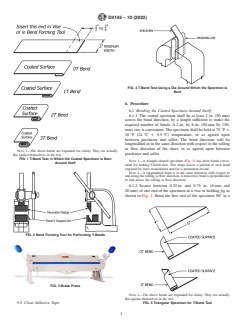
making the bend must be avoided. Various bending tools such
2.1.1 T-bend, n—a description of the severity of a bend in
as a vise with smooth jaws or with smooth inserts, a bend
terms of the gauge or thickness (t) of the sheet to which the
formingtool(Fig.2),abrakepress(Fig.3)oracombinationof
coating has been applied; as used in this test method, the
tools have been found to be satisfactory.
T-bend rating is the minimum number of thicknesses of metal
aroundwhichthecoatedsheetisbent(Fig.1),orifbentaround
5.2 IfthemetalisnotbentarounditselfasinFig.1,aseries
a die, the number of thicknesses of metal equivalent to the
of bending dies with smoothly rounded ends may be used as
diameter of the die to achieve no fracture or removal of the
guides around which the specimen is bent (Fig. 4).
coating.
5.3 Bend Forming Tool.
3. Summary of Test Method
5.3.1 A manual or automated operation forming tool ca-
pableoffacilitatingtheT-bendingofasamplemaybeused.An
3.1 Prepainted panels are bent 180° around progressively
arbor press with an appropriate fixed V-shaped die and move-
morethicknessesofmetalorlargerdiameterdies,theendpoint
able wedge has been found to be satisfactory for this purpose.
5.4 Magnifier.
This test method is under the jurisdiction of ASTM Committee D01 on Paint
and Related Coatings, Materials, andApplications and is the direct responsibility of
5.4.1 A magnifier capable of 5 to 10× magnification for
Subcommittee D01.53 on Coil Coated Metal.
examining the specimen for coating fracture and pickoff after
Current edition approved Dec. 1, 2022. Published December 2022. Originally
testing. A stereomicroscope has been found useful for this
approved in 1983. Last previous edition approved in 2018 as D4145–10 (2018).
DOI: 10.1520/D4145-10R22. purpose.
Copyright © ASTM International, 100 Barr Harbor Drive, PO Box C700, West Conshohocken, PA 19428-2959. United States
D4145 − 10 (2022)
FIG. 4 T-Bend Test Using a Die Around Which the Specimen is
Bent
6. Procedure
6.1 Bending the Coated Specimen Around Itself:
6.1.1 The coated specimen shall be at least 2 in. (50 mm)
across the bend direction, by a length sufficient to make the
required number of bends. A2-in. by 6-in. (50-mm by 150-
mm)sizeisconvenient.Thespecimenshallbeheldat75°F 6
10°F (24°C 6 5.5°C) temperature, or as agreed upon
between purchaser and seller. The bend direction will be
longitudinal or in the same direction with respect to the rolling
or flow direction of the sheet, or as agreed upon between
NOTE 1—The above bends are expanded for clarity. They are actually
purchaser and seller.
flat against themselves in the test.
FIG. 1 T-Bend Test in Which the Coated Specimen is Bent
NOTE 1—A triangle-shaped specimen (Fig. 5) has been found conve-
Around Itself
nient for making T-bend tests. This shape leaves a portion of each bend
exposed for later examination and for a permanent record.
NOTE 2—A longitudinal bend is in the same direction with respect to
and along the rolling or flow direction.Atransverse bend is perpendicular
to and across the rolling or flow direction.
6.1.2 Secure between 0.25in. and 0.75 in. (6mm and
20mm) of one end of the specimen in a vise or holding jig as
shown in Fig. 1. Bend the free end of the specimen 90° in a
FIG. 2 Bend Forming Tool for Performing T-Bends
FIG. 3 Brake Press
NOTE 1—The above bends are expanded for clarity. They are actually
flat against themselves in the test.
5.5 Clear Adhesive Tape. FIG. 5 Triangular Specimen for T-Bend Test
D4145 − 10 (2022)
smoothanduniformmannersothatthecoatingtobeexamined 6.3.3 InsertthebentendbetweenthefixedV-shapeddieand
is on the outside of the specimen after bending. moveablewedgeoftheformingtool.Depressthespecimen,as
inavisein6.1.3,tocompletethe180°bend,whichiscalledan
6.1.3 Continue to bend the specimen until t
...