

ASTM B124/B124M-20
(Specification)Standard Specification for Copper and Copper Alloy Forging Rod, Bar, and Shapes
General Information
- Abstract
ABSTRACT
This specification establishes the requirements for copper (UNS Nos. C11000, C14500, and C14700) and copper alloy (UNS Nos. C36500, C37000, C37700, C46400, C48200, C48500, C61900, C62300, C63000, C63200, C64200, C64210, C65500, C67500, C67600, C69300, C70620, C71520, and C77400) forging rods, bars, and shapes. The material for manufacture shall be a cast rod, bar, or billet of such purity and soundness as to be suitable for processing by hot working, cold working, and annealing to produce a uniform wrought structure in the finished product. Products shall be produced in tempers H50 (extruded and drawn), M20 (as hot rolled), and M30 (as hot extruded). Products shall be tested and shall adhere to dimensional (diameter, thickness, width, length, shape, and straightness), mechanical, and chemical composition requirements.
SCOPE
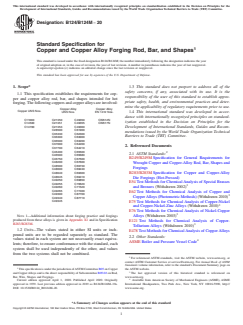
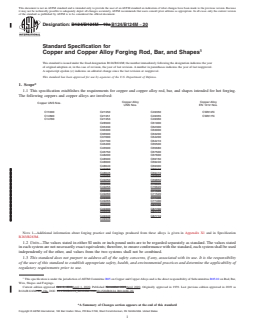
1.1 This specification establishes the requirements for copper and copper alloy rod, bar, and shapes intended for hot forging. The following coppers and copper alloys are involved:
Copper UNS Nos.
Copper Alloy
UNS Nos.
Copper Alloy
EN 1412 Nos.
C11000
C27450
C49350
CW612N
C14500
C27451
C49355
CW617N
C14700
C27453
C49360
C28500
C61900
C35330
C62300
C36300
C63000
C36500
C63200
C37000
C64200
C37700
C64210
C46400
C65500
C46500
C65680
C46750
C67500
C48200
C67600
C48500
C69150
C48600
C69240
C48640
C69300
C48645
C69410
C49250
C69850
C49255
C70620
C49260
C71520
C49265
C77400
C49300
C87700
C49340
C87710
C49345
Note 1: Additional information about forging practice and forgings produced from these alloys is given in Appendix X1 and in Specification B283/B283M.
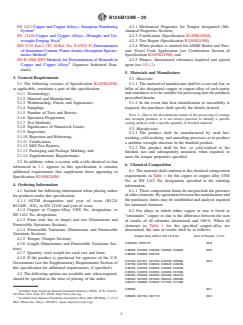
1.2 Units—The values stated in either SI units or inch-pound units are to be regarded separately as standard. The values stated in each system are not necessarily exact equivalents; therefore, to ensure conformance with the standard, each system shall be used independently of the other, and values from the two systems shall not be combined.
1.3 This standard does not purport to address all of the safety concerns, if any, associated with its use. It is the responsibility of the user of this standard to establish appropriate safety, health, and environmental practices and determine the applicability of regulatory requirements prior to use.
1.4 This international standard was developed in accordance with internationally recognized principles on standardization established in the Decision on Principles for the Development of International Standards, Guides and Recommendations issued by the World Trade Organization Technical Barriers to Trade (TBT) Committee.
- Status
- Published
- Publication Date
- 31-Mar-2020
- Technical Committee
- B05 - Copper and Copper Alloys
- Drafting Committee
- B05.02 - Rod, Bar, Wire, Shapes and Forgings
Buy Documents
ASTM B124/B124M-20 - Standard Specification for Copper and Copper Alloy Forging Rod, Bar, and Shapes
REDLINE ASTM B124/B124M-20 - Standard Specification for Copper and Copper Alloy Forging Rod, Bar, and Shapes
Overview
ASTM B124/B124M-20 is the international standard specification developed by ASTM for copper and copper alloy forging rod, bar, and shapes, essential for hot forging applications. This standard covers a broad range of copper (such as UNS C11000, C14500, C14700) and copper alloy grades (including various brasses, bronzes, and nickel silvers) that are commonly used in the manufacture of industrial components by forging. The specification ensures products meet stringent criteria for dimensional accuracy, mechanical integrity, and chemical composition, supporting consistent quality and performance across global manufacturing environments.
Key Topics
- Material Scope: This standard applies to both copper and a wide selection of copper alloys, identified by UNS and EN numbers, making it relevant for diverse industrial needs such as C11000 pure copper, C37700 forging brass, and many other alloys designed for high forgeability, strength, and resistance to corrosion.
- Product Forms: Encompasses forged rods, bars, and various shapes intended for hot forging processes.
- Manufacturing Requirements:
- Products must be manufactured from cast rod, bar, or billet with suitable purity and soundness.
- Required to be processed by hot-working, cold-working, and annealing to ensure a uniform wrought structure in the finished product.
- Tempers: Specifies various tempers, including H50 (extruded and drawn), M20 (as hot-rolled), and M30 (as hot-extruded), to suit application-specific requirements.
- Testing & Quality Control: Requires compliance with strict dimensional, mechanical, and chemical composition requirements as well as test methods to verify conformance.
- Dimensions and Tolerances: Specifies tolerances for diameter, width, thickness, length, shape, and straightness-crucial for component interchangeability and performance.
- Traceability: Offers options for identification marking, certification, and test reports, supporting quality assurance in regulated industries.
Applications
ASTM B124/B124M-20 is widely used across industries requiring reliable copper and copper alloy forgings, including:
- Automotive: Manufacture of precision-forged components such as connectors, fittings, and engine parts due to their high electrical and thermal conductivity.
- Aerospace: Production of critical hardware and fasteners, where mechanical strength and corrosion resistance are vital.
- Plumbing and Fluid Handling: Forged valve bodies, couplings, and fittings made from brass or bronze for water and gas systems.
- Industrial Machinery: Components like bushings, gears, and bearings, benefitting from the excellent forgeability and machinability of covered alloys.
- Marine: Use of naval brass and copper-nickel alloys in applications demanding resistance to seawater corrosion.
These versatile copper and copper alloy forgings are chosen for applications where durability, conductivity, and machinability are essential.
Related Standards
To ensure comprehensive quality and compatibility, ASTM B124/B124M-20 references and aligns with several other important standards, including:
- ASTM B249/B249M - General requirements for wrought copper and copper-alloy rod, bar, shapes, and forgings, providing additional manufacturing and testing criteria.
- ASTM B283/B283M - Specification for copper and copper-alloy die forgings (hot-pressed), relevant for final forged product properties.
- EN 1412 & EN 12165 - European standards governing copper and copper alloys, facilitating international harmonization.
- ASME Boiler and Pressure Vessel Code - For applications in pressurized environments, ensures compliance with critical safety requirements.
- ISO and JIS Standards - International and Japanese standards for chemical analysis and determination of alloy composition.
Compliance with ASTM B124/B124M-20 helps manufacturers and users achieve reliable, high-quality copper and alloy forgings, essential for safety, performance, and regulatory conformity in demanding industrial sectors.
Keywords: ASTM B124, copper forging rod, copper alloy bar, hot forging stock, brass forging, bronze forging, ASTM copper alloys, EN 1412, industrial copper standards.
Relations
- Effective Date
- 01-Apr-2020
- Effective Date
- 01-Oct-2023
- Refers
ASTM B283/B283M-19a - Standard Specification for Copper and Copper-Alloy Die Forgings (Hot-Pressed) - Effective Date
- 01-Oct-2019
- Effective Date
- 01-Oct-2019
- Refers
ASTM B283/B283M-19 - Standard Specification for Copper and Copper-Alloy Die Forgings (Hot-Pressed) - Effective Date
- 01-Apr-2019
- Effective Date
- 01-Apr-2019
- Refers
ASTM B283/B283M-18a - Standard Specification for Copper and Copper-Alloy Die Forgings (Hot-Pressed) - Effective Date
- 01-Oct-2018
- Effective Date
- 01-Oct-2018
- Effective Date
- 01-Mar-2018
- Refers
ASTM B283/B283M-18 - Standard Specification for Copper and Copper-Alloy Die Forgings (Hot-Pressed) - Effective Date
- 01-Mar-2018
- Refers
ASTM B283/B283M-17a - Standard Specification for Copper and Copper-Alloy Die Forgings (Hot-Pressed) - Effective Date
- 01-Oct-2017
- Refers
ASTM B283/B283M-17 - Standard Specification for Copper and Copper-Alloy Die Forgings (Hot-Pressed) - Effective Date
- 01-Apr-2017
- Effective Date
- 01-Apr-2017
- Effective Date
- 01-Oct-2016
- Refers
ASTM B283/B283M-16a - Standard Specification for Copper and Copper-Alloy Die Forgings (Hot-Pressed) - Effective Date
- 01-Oct-2016
Buy Documents
ASTM B124/B124M-20 - Standard Specification for Copper and Copper Alloy Forging Rod, Bar, and Shapes
REDLINE ASTM B124/B124M-20 - Standard Specification for Copper and Copper Alloy Forging Rod, Bar, and Shapes
Get Certified
Connect with accredited certification bodies for this standard

Element Materials Technology
Materials testing and product certification.

Inštitut za kovinske materiale in tehnologije
Institute of Metals and Technology. Materials testing, metallurgical analysis, NDT.
Sponsored listings
Frequently Asked Questions
ASTM B124/B124M-20 is a technical specification published by ASTM International. Its full title is "Standard Specification for Copper and Copper Alloy Forging Rod, Bar, and Shapes". This standard covers: ABSTRACT This specification establishes the requirements for copper (UNS Nos. C11000, C14500, and C14700) and copper alloy (UNS Nos. C36500, C37000, C37700, C46400, C48200, C48500, C61900, C62300, C63000, C63200, C64200, C64210, C65500, C67500, C67600, C69300, C70620, C71520, and C77400) forging rods, bars, and shapes. The material for manufacture shall be a cast rod, bar, or billet of such purity and soundness as to be suitable for processing by hot working, cold working, and annealing to produce a uniform wrought structure in the finished product. Products shall be produced in tempers H50 (extruded and drawn), M20 (as hot rolled), and M30 (as hot extruded). Products shall be tested and shall adhere to dimensional (diameter, thickness, width, length, shape, and straightness), mechanical, and chemical composition requirements. SCOPE 1.1 This specification establishes the requirements for copper and copper alloy rod, bar, and shapes intended for hot forging. The following coppers and copper alloys are involved: Copper UNS Nos. Copper Alloy UNS Nos. Copper Alloy EN 1412 Nos. C11000 C27450 C49350 CW612N C14500 C27451 C49355 CW617N C14700 C27453 C49360 C28500 C61900 C35330 C62300 C36300 C63000 C36500 C63200 C37000 C64200 C37700 C64210 C46400 C65500 C46500 C65680 C46750 C67500 C48200 C67600 C48500 C69150 C48600 C69240 C48640 C69300 C48645 C69410 C49250 C69850 C49255 C70620 C49260 C71520 C49265 C77400 C49300 C87700 C49340 C87710 C49345 Note 1: Additional information about forging practice and forgings produced from these alloys is given in Appendix X1 and in Specification B283/B283M. 1.2 Units—The values stated in either SI units or inch-pound units are to be regarded separately as standard. The values stated in each system are not necessarily exact equivalents; therefore, to ensure conformance with the standard, each system shall be used independently of the other, and values from the two systems shall not be combined. 1.3 This standard does not purport to address all of the safety concerns, if any, associated with its use. It is the responsibility of the user of this standard to establish appropriate safety, health, and environmental practices and determine the applicability of regulatory requirements prior to use. 1.4 This international standard was developed in accordance with internationally recognized principles on standardization established in the Decision on Principles for the Development of International Standards, Guides and Recommendations issued by the World Trade Organization Technical Barriers to Trade (TBT) Committee.
ABSTRACT This specification establishes the requirements for copper (UNS Nos. C11000, C14500, and C14700) and copper alloy (UNS Nos. C36500, C37000, C37700, C46400, C48200, C48500, C61900, C62300, C63000, C63200, C64200, C64210, C65500, C67500, C67600, C69300, C70620, C71520, and C77400) forging rods, bars, and shapes. The material for manufacture shall be a cast rod, bar, or billet of such purity and soundness as to be suitable for processing by hot working, cold working, and annealing to produce a uniform wrought structure in the finished product. Products shall be produced in tempers H50 (extruded and drawn), M20 (as hot rolled), and M30 (as hot extruded). Products shall be tested and shall adhere to dimensional (diameter, thickness, width, length, shape, and straightness), mechanical, and chemical composition requirements. SCOPE 1.1 This specification establishes the requirements for copper and copper alloy rod, bar, and shapes intended for hot forging. The following coppers and copper alloys are involved: Copper UNS Nos. Copper Alloy UNS Nos. Copper Alloy EN 1412 Nos. C11000 C27450 C49350 CW612N C14500 C27451 C49355 CW617N C14700 C27453 C49360 C28500 C61900 C35330 C62300 C36300 C63000 C36500 C63200 C37000 C64200 C37700 C64210 C46400 C65500 C46500 C65680 C46750 C67500 C48200 C67600 C48500 C69150 C48600 C69240 C48640 C69300 C48645 C69410 C49250 C69850 C49255 C70620 C49260 C71520 C49265 C77400 C49300 C87700 C49340 C87710 C49345 Note 1: Additional information about forging practice and forgings produced from these alloys is given in Appendix X1 and in Specification B283/B283M. 1.2 Units—The values stated in either SI units or inch-pound units are to be regarded separately as standard. The values stated in each system are not necessarily exact equivalents; therefore, to ensure conformance with the standard, each system shall be used independently of the other, and values from the two systems shall not be combined. 1.3 This standard does not purport to address all of the safety concerns, if any, associated with its use. It is the responsibility of the user of this standard to establish appropriate safety, health, and environmental practices and determine the applicability of regulatory requirements prior to use. 1.4 This international standard was developed in accordance with internationally recognized principles on standardization established in the Decision on Principles for the Development of International Standards, Guides and Recommendations issued by the World Trade Organization Technical Barriers to Trade (TBT) Committee.
ASTM B124/B124M-20 is classified under the following ICS (International Classification for Standards) categories: 77.150.30 - Copper products. The ICS classification helps identify the subject area and facilitates finding related standards.
ASTM B124/B124M-20 has the following relationships with other standards: It is inter standard links to ASTM B124/B124M-19a, ASTM B249/B249M-23, ASTM B283/B283M-19a, ASTM B249/B249M-19a, ASTM B283/B283M-19, ASTM B249/B249M-19, ASTM B283/B283M-18a, ASTM B249/B249M-18a, ASTM B249/B249M-18, ASTM B283/B283M-18, ASTM B283/B283M-17a, ASTM B283/B283M-17, ASTM B249/B249M-17, ASTM B249/B249M-16, ASTM B283/B283M-16a. Understanding these relationships helps ensure you are using the most current and applicable version of the standard.
ASTM B124/B124M-20 is available in PDF format for immediate download after purchase. The document can be added to your cart and obtained through the secure checkout process. Digital delivery ensures instant access to the complete standard document.
Standards Content (Sample)
This international standard was developed in accordance with internationally recognized principles on standardization established in the Decision on Principles for the
Development of International Standards, Guides and Recommendations issued by the World Trade Organization Technical Barriers to Trade (TBT) Committee.
Designation:B124/B124M −20
Standard Specification for
Copper and Copper Alloy Forging Rod, Bar, and Shapes
This standard is issued under the fixed designation B124/B124M; the number immediately following the designation indicates the year
of original adoption or, in the case of revision, the year of last revision. A number in parentheses indicates the year of last reapproval.
A superscript epsilon (´) indicates an editorial change since the last revision or reapproval.
This standard has been approved for use by agencies of the U.S. Department of Defense.
1. Scope* 1.3 This standard does not purport to address all of the
safety concerns, if any, associated with its use. It is the
1.1 This specification establishes the requirements for cop-
responsibility of the user of this standard to establish appro-
per and copper alloy rod, bar, and shapes intended for hot
priate safety, health, and environmental practices and deter-
forging.The following coppers and copper alloys are involved:
mine the applicability of regulatory requirements prior to use.
Copper Alloy Copper Alloy
Copper UNS Nos.
UNS Nos. EN 1412 Nos. 1.4 This international standard was developed in accor-
dance with internationally recognized principles on standard-
C11000 C27450 C49350 CW612N
ization established in the Decision on Principles for the
C14500 C27451 C49355 CW617N
C14700 C27453 C49360 Development of International Standards, Guides and Recom-
C28500 C61900
mendations issued by the World Trade Organization Technical
C35330 C62300
Barriers to Trade (TBT) Committee.
C36300 C63000
C36500 C63200
C37000 C64200
2. Referenced Documents
C37700 C64210
C46400 C65500 2
2.1 ASTM Standards:
C46500 C65680
B249/B249M Specification for General Requirements for
C46750 C67500
C48200 C67600
Wrought Copper and Copper-Alloy Rod, Bar, Shapes and
C48500 C69150
Forgings
C48600 C69240
C48640 C69300 B283/B283M Specification for Copper and Copper-Alloy
C48645 C69410
Die Forgings (Hot-Pressed)
C49250 C69850
E54 Test Methods for ChemicalAnalysis of Special Brasses
C49255 C70620
C49260 C71520 and Bronzes (Withdrawn 2002)
C49265 C77400
E62 Test Methods for Chemical Analysis of Copper and
C49300 C87700
CopperAlloys (Photometric Methods)(Withdrawn 2010)
C49340 C87710
C49345
E75 Test Methods for Chemical Analysis of Copper-Nickel
and Copper-Nickel-Zinc Alloys (Withdrawn 2010)
E76 Test Methods for Chemical Analysis of Nickel-Copper
NOTE 1—Additional information about forging practice and forgings
Alloys (Withdrawn 2003)
produced from these alloys is given in Appendix X1 and in Specification
E121 Test Methods for Chemical Analysis of Copper-
B283/B283M.
Tellurium Alloys (Withdrawn 2010)
1.2 Units—The values stated in either SI units or inch-
E478 Test Methods for ChemicalAnalysis of CopperAlloys
pound units are to be regarded separately as standard. The
2.2 Other Standards:
values stated in each system are not necessarily exact equiva-
ASME Boiler and Pressure Vessel Code
lents; therefore, to ensure conformance with the standard, each
system shall be used independently of the other, and values
from the two systems shall not be combined.
For referenced ASTM standards, visit the ASTM website, www.astm.org, or
contact ASTM Customer Service at service@astm.org. For Annual Book of ASTM
Standards volume information, refer to the standard’s Document Summary page on
ThisspecificationisunderthejurisdictionofASTMCommitteeB05onCopper the ASTM website.
and CopperAlloys and is the direct responsibility of Subcommittee B05.02 on Rod, The last approved version of this historical standard is referenced on
Bar, Wire, Shapes and Forgings. www.astm.org.
Current edition approved April 1, 2020. Published April 2020. Originally Available from American Society of Mechanical Engineers (ASME), ASME
approved in 1939. Last previous edition approved in 2019 as B124/B124M–19a. International Headquarters, Two Park Ave., New York, NY 10016-5990, http://
DOI: 10.1520/B0124_B0124M–20. www.asme.org.
*A Summary of Changes section appears at the end of this standard
Copyright © ASTM International, 100 Barr Harbor Drive, PO Box C700, West Conshohocken, PA 19428-2959. United States
B124/B124M−20
EN 1412 Copper and CopperAlloys—European Numbering 4.2.1 Mechanical Properties for Temper designated (Me-
System chanical Properties Section),
EN 12165 Copper and Copper Alloys—Wrought and Un- 4.2.2 Certification (Specification B249/B249M),
wrought Forging Stock 4.2.3 Test Report (Specification B249/B249M),
ISO 3110, Part 2 (TC 26 Ref. No. N 670 E⁄F) Determination 4.2.4 When product is ordered for ASME Boiler and Pres-
ofAluminum Content: FlameAtomicAbsorption Spectro- sure Vessel Code Application (see Certification Section of
metric Method Specification B249/B249M), and
JIS H 1068:2005 Methods for Determination of Bismuth in 4.2.5 Shapes; dimensional tolerances required and agreed
Copper and Copper Alloys (Japanese Industrial Stan- upon (see 10.1.3).
dards)
5. Materials and Manufacture
3. General Requirements
5.1 Materials:
5.1.1 Thematerialofmanufactureshallbeacastrod,bar,or
3.1 The following sections of Specification B249/B249M,
billet of the designated copper or copper-alloy of such purity
as applicable, constitute a part of this specification:
andsoundnessastobesuitableforprocessingintotheproducts
3.1.1 Terminology;
prescribed herein.
3.1.2 Material and Manufacture;
5.1.2 In the event that heat identification or traceability is
3.1.3 Workmanship, Finish, and Appearance;
required, the purchaser shall specify the details desired.
3.1.4 Sampling;
3.1.5 Number of Tests and Retests;
NOTE 2—Due to the discontinuous nature of the processing of castings
3.1.6 Specimen Preparation;
into wrought products, it is not always practical to identify a specific
3.1.7 Test Methods; casting analysis with a specific quantity of finished material.
3.1.8 Significance of Numerical Limits;
5.2 Manufacture:
3.1.9 Inspection;
5.2.1 The product shall be manufactured by such hot-
3.1.10 Rejection and Rehearing;
working, cold-working, and annealing processes as to produce
3.1.11 Certification;
a uniform wrought structure in the finished product.
3.1.12 Mill Test Reports;
5.2.2 The product shall be hot- or cold-worked to the
3.1.13 Packaging and Package Marking; and
finished size and subsequently annealed, when required, to
3.1.14 Supplementary Requirements.
meet the temper properties specified.
3.2 In addition, when a section with a title identical to that
6. Chemical Composition
referenced in 3.1, appears in this specification, it contains
6.1 The material shall conform to the chemical composition
additional requirements that supplement those appearing in
requirements in Table 1 for the copper or copper alloy UNS
Specification B249/B249M.
No. or EN 1412 No. designation specified in the ordering
4. Ordering Information
information.
6.1.1 These composition limits do not preclude the presence
4.1 Include the following information when placing orders
ofotherelements.Byagreementbetweenthemanufacturerand
for products under this specification:
the purchaser, limits may be established and analysis required
4.1.1 ASTM designation and year of issue (B124/
for unnamed elements.
B124M – XX), or EN 12165 and year of issue;
4.1.2 Copper or Copper-Alloy UNS No. designation, or
6.2 For alloys in which either copper or zinc is listed as
EN 1412 No. designation;
“remainder,” copper or zinc is the difference between the sum
4.1.3 Form (rod, bar, or shape) and size (Dimensions and
of results of all elements determined and 100 %. When all
Permissible Variations Section);
elements in Table 1 for the specified copper-alloy are
4.1.4 Permissible Variations (Dimensions and Permissible
determined, the sum of results shall be as follows:
Variations Section);
Copper Alloy UNS or EN 1412 No. Sum of Results, % min
4.1.5 Temper (Temper Section);
CW612N, CW617N 99.8
4.1.6 Length (Dimensions and Permissible Variations Sec-
tion);
C36500, C37000, C46400, C46500, C48200, 99.6
4.1.7 Quantity: total weight for each size and form;
C48500, C48600, C69150
4.1.8 If the product is purchased for agencies of the U.S.
C27450, C27451, C27453, C35330, C36300, 99.5
Government (see the Supplementary Requirements Section of
C37700, C46750, C48640, C48645, C49250,
this specification for additional requirements, if specified.). C49255, C49260, C49265, C49300, C49340,
C49345, C49350, C49355, C49360, C61900,
4.2 The following options are available and, when required,
C62300, C63000, C63200, C64200, C64210,
C65500, C67500, C67600, C69240, C69300,
should be specified at the time of placing of the order:
C69410, C69850, C70620, C71520, C77400
C28500 99.1
Available fromAmerican National Standards Institute (ANSI), 25 W. 43rd St.,
4th Floor, New York, NY 10036, http://www.ansi.org.
C65680, C87700, C87710 99.2
Available from Japanese StandardsAssociation (JSA), Mita MTBldg., 3-13-12
Mita, Minato-ku, Tokyo, 108-0073, Japan, http://www.jsa.or.jp.
B124/B124M−20
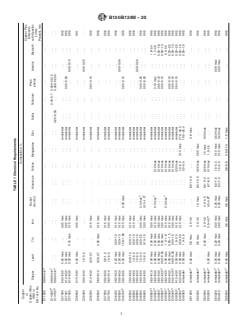
TABLE 1 Chemical Requirements
Composition, %
Copper
Copper Plus
or
Elements
Copper Alloy
Nickel Phos-
Copper Lead Tin Iron Aluminum Silicon Manganese Zinc Sulfur Tellurium Arsenic Bismuth with Specific
UNS or
(incl Co) phorus
Limits
EN 1412 No.
Present, min
A
C11000 99.90 min . . . . . . . . . . . . . .
B C
C14500 99.90 min . . . . . . . . . . . . . . . . . . . . . . . . . . . 0.40–0.7 0.004–0.012 . . . . . . . . .
B D
C14700 99.90 min . . . . . . . . . . . . . . . . . . . . . . . . 0.20–0.50 . . . 0.002–0.005 . . . . . . . . .
C27450 60.0–65.0 0.25 max . . . 0.35 max . . . . . . . . . . . . remainder . . . . . . . . . . . . . . . 99.5
C27451 61.0–65.0 0.25 max . . . 0.35 max . . . . . . . . . . . . remainder . . . . . . 0.05–0.20 . . . . . . 99.5
C27453 61.5–63.5 0.25 max 0.15 max 0.15 max . . . . . . . . . . . . remainder . . . . . . . . . 0.02–0.15 . . . 99.5
C28500 57.0–59.0 0.25 max . . . 0.35 max . . . . . . . . . . . . remainder . . . . . . . . . . . . . . . 99.1
C35330 59.5–64.0 1.5–3.5 . . . . . . . . . . . . . . . . . . remainder . . . . . . . . . 0.02–0.25 . . . . . .
C36300 61.0–63.0 0.25–0.7 . . . 0.15 max . . . . . . . . . . . . remainder . . . . . . 0.04–0.15 . . . . . . 99.5
C36500 58.0–61.0 0.25–0.7 0.25 max 0.15 max . . . . . . . . . . . . remainder . . . . . . . . . . . . . . . 99.6
C37000 59.0–62.0 0.8–1.5 0.15 max . . . . . . . . . . . . remainder . . . . . . . . . . . . . . . 99.6
C37700 58.0–61.0 1.5–2.5 . . . 0.30 max . . . . . . . . . . . . remainder . . . . . . . . . . . . . . . 99.5
C46400 59.0–62.0 0.20 max 0.50–1.0 0.10 max . . . . . . . . . . . . remainder . . . . . . . . . . . . . . . 99.6
C46500 59.0–62.0 0.20 max 0.50–1.0 0.10 max . . . . . . . . . . . . remainder . . . . . . . . . 0.02–0.06 . . . . . .
E
C46750 59.2–62.5 0.25 max 1.00–1.80 0.10 max 0.50 max . . . . . . . . . remainder . . . . . . 0.05–0.15 . . . . . . 99.5
C48200 59.0–62.0 0.40–1.0 0.50–1.0 0.10 max . . . . . . . . . . . . remainder . . . . . . . . . . . . . . . 99.6
C48500 59.0–62.0 1.3–2.2 0.50–1.0 0.10 max . . . . . . . . . . . . remainder . . . . . . . . . . . . . . . 99.6
C48600 59.0–62.0 1.0–2.5 0.30–1.5 . . . . . . . . . . . . . . . remainder . . . . . . . . . 0.02–0.25 . . . . . .
F
C48640 59.0–62.0 1.5–3.0 0.50–2.0 0.40 max 0.3 max . . . . . . . . . remainder . . . . . . 0.05–0.25 . . . . . . 99.5
F
C48645 60.0–63.0 1.0–2.5 0.10–1.5 0.30 max 0.10–1.0 . . . . . . . . . remainder . . . . . . 0.02–0.25 . . . . . . 99.5
G
C49250 58.0–61.0 0.09 max 0.30 max 0.50 max . . . . . . . . . . . . remainder . . . . . . . . . . . . 1.8–2.4 99.5
H F
C49255 58.0–60.0 0.09 max 0.50 max 0.10 max 0.3 max . . . 0.10 max . . . remainder . . . . . . 0.10 max . . . 1.7–2.9 99.5
I
C49260 58.0–63.0 0.09 max 0.50 max 0.50 max . . . . . . 0.10 max . . . remainder . . . . . . 0.05–0.15 . . . 0.50–1.8 99.5
G A
C49265 58.0–62.0 0.09–0.25 0.50 max 0.30 max . . . . . . 0.10 max . . . remainder . . . . . . 0.05–0.12 . . . 0.50–1.3 99.5
J F
C49300 58.0–62.0 0.09 max 1.0–1.8 0.10 max 0.3 max . . . 0.10 max . . . remainder . . . . . . . . . . . . 0.5–2.5 99.5
K
C49340 60.0–63.0 0.09 max 0.50– 1.5 0.12 max . . . . . . 0.10 max . . . remainder . . . . . . 0.05–0.15 . . . 0.50–2.2 99.5
G A
C49345 60.0–64.0 0.09–0.25 0.50–1.5 0.30 max . . . . . . 0.10 max . . . remainder . . . . . . 0.05–0.12 . . . 0.50–1.3 99.5
L
C49350 61.0–63.0 0.09 max 1.5–3.0 0.12 max . . . . . . 0.30 max . . . remainder . . . . . . 0.04–0.15 . . . 0.50–2.5 99.5
M
C49355 63.0–69.0 0.09 max 0.50–2.0 0.10 max . . . . . . 1.0–2.0 0.10 max 27.0–35.0 . . . . . . . . . . . . 0.50–1.5 99.5
C49360 remainder 0.09 max 1.0–2.0 . . . . . . . . . 2.0–3.5 . . . 19.0–22.0 . . . . . . . . . . . . 0.50–1.5 99.5
A
C61900 remainder 0.02 max 0.6 max 3.0–4.5 . . . 8.5–10.0 . . . . . . 0.8 max . . . . . . . . . . . . . . . 99.5
A
C62300 remainder . . . 0.6 max 2.0–4.0 1.0 max 8.5–10.0 0.25 max 0.50 max . . . . . . . . . . . . . . . . . . 99.5
A
C63000 remainder . . . 0.20 max 2.0–4.0 4.0–5.5 9.0–11.0 0.25 max 1.5 max 0.30 max . . . . . . . . . . . . . . . 99.5
A N N
C63200 remainder 0.02 max . . . 3.5–4.3 4.0–4.8 8.7–9.5 0.10 max 1.2–2.0 . . . . . . . . . . . . . . . . . . 99.5
A
C64200 remainder 0.05 max 0.20 max 0.30 max 0.25 max 6.3–7.6 1.5–2.2 0.10 max 0.50 max . . . . . . . . . 0.09 max . . . 99.5
A
C64210 remainder 0.05 max 0.20 max 0.30 max 0.25 max 6.3–7.0 1.5–2.0 0.10 max 0.50 max . . . . . . . . . 0.09 max . . . 99.5
A
C65500 remainder 0.05 max . . . 0.8 max 0.6 max . . . 2.8–3.8 0.50–1.3 1.5 max . . . . . . . . . . . . . . . 99.5
B124/B124M−20
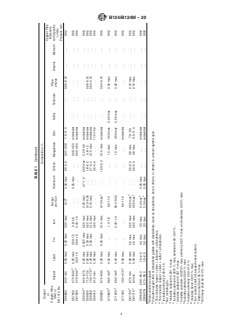
TABLE 1 Continued
Composition, %
Copper
Copper Plus
or
Elements
Copper Alloy
Nickel Phos-
Copper Lead Tin Iron Aluminum Silicon Manganese Zinc Sulfur Tellurium Arsenic Bismuth with Specific
UNS or
(incl Co) phorus
Limits
EN 1412 No.
Present, min
F
C65680 84.0 min 0.09 max 0.30 max 0.30 max 0.10 0.30 max 2.5–4.5 0.01–0.09 7.0–11.0 . . . . . . 0.05–0.15 . . . . . . 99.2
A
C67500 57.0–60.0 0.20 max 0.50–1.5 0.8–2.0 . . . 0.25 max . . . 0.05–0.50 remainder . . . . . . . . . . . . . . . 99.5
A
C67600 57.0–60.0 0.50–1.0 0.50–1.5 0.40–1.3 . . . . . . . . . 0.05–0.50 remainder . . . . . . . . . . . . . . . 99.5
A
C69150 82.5–87.5 0.05 max 0.025 max 0.25 max 0.20 max 0.7–1.3 0.02 max 0.25–0.6 remainder . . . . . . . . . . . . . . . 99.6
C69240 71.0–72.5 0.25 max 0.30 max 0.20 max 0.10–0.50 . . . 1.8–2.2 0.6–1.2 remainder . . . . . . 0.06–0.12 . . . . . . 99.5
A
C69300 73.0–77.0 0.09 max 0.20 max 0.10 max 0.10 max . . . 2.7–3.4 0.10 max remainder . . . . . . 0.04–0.15 . . . . . . 99.5
C69410 81.0 min 0.09 max . . . 0.20 max . . . . . . 3.5–4.5 . . . 11.0–15.0 . . . . . . . . . . . . . . . 99.5
F
C69850 67.5–69.0 0.09 max 0.20 max 0.10 max 0.10 max . . . 1.53–2.0 0.10 max remainder . . . . . . 0.04–0.15 . . . . . . 99.5
O A
C70620 86.5 min 0.02 max . . . 1.0–1.8 9.0–11.0 . . . . . . 1.0 max 0.50 max 0.02 max . . . 0.02 max . . . . . . 99.5
O A
C71520 65.0 min 0.02 max . . . 0.40–1.0 29.0–33.0
...
This document is not an ASTM standard and is intended only to provide the user of an ASTM standard an indication of what changes have been made to the previous version. Because
it may not be technically possible to adequately depict all changes accurately, ASTM recommends that users consult prior editions as appropriate. In all cases only the current version
of the standard as published by ASTM is to be considered the official document.
Designation: B124/B124M − 19a B124/B124M − 20
Standard Specification for
Copper and Copper Alloy Forging Rod, Bar, and Shapes
This standard is issued under the fixed designation B124/B124M; the number immediately following the designation indicates the year
of original adoption or, in the case of revision, the year of last revision. A number in parentheses indicates the year of last reapproval.
A superscript epsilon (´) indicates an editorial change since the last revision or reapproval.
This standard has been approved for use by agencies of the U.S. Department of Defense.
1. Scope*
1.1 This specification establishes the requirements for copper and copper alloy rod, bar, and shapes intended for hot forging.
The following coppers and copper alloys are involved:
Copper Alloy Copper Alloy
Copper UNS Nos.
UNS Nos. EN 1412 Nos.
C11000 C27450 C49350 CW612N
C14500 C27451 C49355 CW617N
C14700 C27453 C49360
C28500 C61900
C35330 C62300
C36300 C63000
C36500 C63200
C37000 C64200
C37700 C64210
C46400 C65500
C46500 C65680
C46750 C67500
C48200 C67600
C48500 C69150
C48600 C69240
C48640 C69300
C49250 C69410
C48645 C69410
C49255 C69850
C49250 C69850
C49260 C70620
C49255 C70620
C49265 C71520
C49260 C71520
C49300 C77400
C49265 C77400
C49340 C87700
C49300 C87700
C49345 C87710
C49340 C87710
C49345
NOTE 1—Additional information about forging practice and forgings produced from these alloys is given in Appendix X1 and in Specification
B283/B283M.
1.2 Units—The values stated in either SI units or inch-pound units are to be regarded separately as standard. The values stated
in each system are not necessarily exact equivalents; therefore, to ensure conformance with the standard, each system shall be used
independently of the other, and values from the two systems shall not be combined.
1.3 This standard does not purport to address all of the safety concerns, if any, associated with its use. It is the responsibility
of the user of this standard to establish appropriate safety, health, and environmental practices and determine the applicability of
regulatory requirements prior to use.
This specification is under the jurisdiction of ASTM Committee B05 on Copper and Copper Alloys and is the direct responsibility of Subcommittee B05.02 on Rod, Bar,
Wire, Shapes and Forgings.
Current edition approved Oct. 1, 2019April 1, 2020. Published November 2019April 2020. Originally approved in 1939. Last previous edition approved in 2019 as
B124/B124M–19.–19a. DOI: 10.1520/B0124_B0124M–19A.10.1520/B0124_B0124M–20.
*A Summary of Changes section appears at the end of this standard
Copyright © ASTM International, 100 Barr Harbor Drive, PO Box C700, West Conshohocken, PA 19428-2959. United States
B124/B124M − 20
1.4 This international standard was developed in accordance with internationally recognized principles on standardization
established in the Decision on Principles for the Development of International Standards, Guides and Recommendations issued
by the World Trade Organization Technical Barriers to Trade (TBT) Committee.
2. Referenced Documents
2.1 ASTM Standards:
B249/B249M Specification for General Requirements for Wrought Copper and Copper-Alloy Rod, Bar, Shapes and Forgings
B283/B283M Specification for Copper and Copper-Alloy Die Forgings (Hot-Pressed)
E54 Test Methods for Chemical Analysis of Special Brasses and Bronzes (Withdrawn 2002)
E62 Test Methods for Chemical Analysis of Copper and Copper Alloys (Photometric Methods) (Withdrawn 2010)
E75 Test Methods for Chemical Analysis of Copper-Nickel and Copper-Nickel-Zinc Alloys (Withdrawn 2010)
E76 Test Methods for Chemical Analysis of Nickel-Copper Alloys (Withdrawn 2003)
E121 Test Methods for Chemical Analysis of Copper-Tellurium Alloys (Withdrawn 2010)
E478 Test Methods for Chemical Analysis of Copper Alloys
2.2 Other Standards:
ASME Boiler and Pressure Vessel Code
EN 1412 Copper and Copper Alloys—European Numbering System
EN 12165 Copper and Copper Alloys—Wrought and Unwrought Forging Stock
ISO 3110, Part 2 (TC 26 Ref. No. N 670 E ⁄F) Determination of Aluminum Content: Flame Atomic Absorption Spectrometric
Method
JIS H 1068:2005 Methods for Determination of Bismuth in Copper and Copper Alloys (Japanese Industrial Standards)
3. General Requirements
3.1 The following sections of Specification B249/B249M, as applicable, constitute a part of this specification:
3.1.1 Terminology;
3.1.2 Material and Manufacture;
3.1.3 Workmanship, Finish, and Appearance,Appearance;
3.1.4 Sampling;
3.1.5 Number of Tests and Retests;
3.1.6 Specimen Preparation;
3.1.7 Test Methods;
3.1.8 Significance of Numerical Limits;
3.1.9 Inspection;
3.1.10 Rejection and Rehearing;
3.1.11 Certification;
3.1.12 Mill Test Reports;
3.1.13 Packaging and Package Marking; and
3.1.14 Supplementary Requirements.
3.2 In addition, when a section with a title identical to that referenced in 3.1, appears in this specification, it contains additional
requirements that supplement those appearing in Specification B249/B249M.
4. Ordering Information
4.1 Include the following information when placing orders for products under this specification:
4.1.1 ASTM designation and year of issue (B124/B124M – XX), or EN 12165 and year of issue;
4.1.2 Copper or Copper-Alloy UNS No. designation, or EN 1412 No. designation;
4.1.3 Form (rod, bar, or shape) and size (Dimensions and Permissible Variations Section);
4.1.4 Permissible Variations (Dimensions and Permissible Variations Section);
4.1.5 Temper (Temper Section);
4.1.6 Length (Dimensions and Permissible Variations Section);
4.1.7 Quantity: total weight for each size and form;
For referenced ASTM standards, visit the ASTM website, www.astm.org, or contact ASTM Customer Service at service@astm.org. For Annual Book of ASTM Standards
volume information, refer to the standard’s Document Summary page on the ASTM website.
The last approved version of this historical standard is referenced on www.astm.org.
Available from American Society of Mechanical Engineers (ASME), ASME International Headquarters, Two Park Ave., New York, NY 10016-5990, http://
www.asme.org.
Available from American National Standards Institute (ANSI), 25 W. 43rd St., 4th Floor, New York, NY 10036, http://www.ansi.org.
Available from Japanese Standards Association (JSA), Mita MT Bldg., 3-13-12 Mita, Minato-ku, Tokyo, 108-0073, Japan, http://www.jsa.or.jp.
B124/B124M − 20
4.1.8 If the product is purchased for agencies of the U.S. Government (see the Supplementary Requirements Section of this
specification for additional requirements, if specified.).
4.2 The following options are available and, when required, should be specified at the time of placing of the order:
4.2.1 Mechanical Properties for Temper designated (Mechanical Properties Section),
4.2.2 Certification (Specification B249/B249M),
4.2.3 Test Report (Specification B249/B249M),
4.2.4 When product is ordered for ASME Boiler and Pressure Vessel Code Application (see Certification Section of
Specification B249/B249M), and
4.2.5 Shapes; dimensional tolerances required and agreed upon (see 10.1.3).
5. Materials and Manufacture
5.1 Materials:
5.1.1 The material of manufacture shall be a cast rod, bar, or billet of the designated copper or copper-alloy of such purity and
soundness as to be suitable for processing into the products prescribed herein.
5.1.2 In the event that heat identification or traceability is required, the purchaser shall specify the details desired.
NOTE 2—Due to the discontinuous nature of the processing of castings into wrought products, it is not always practical to identify a specific casting
analysis with a specific quantity of finished material.
5.2 Manufacture:
5.2.1 The product shall be manufactured by such hot-working, cold-working, and annealing processes as to produce a uniform
wrought structure in the finished product.
5.2.2 The product shall be hot- or cold-worked to the finished size and subsequently annealed, when required, to meet the
temper properties specified.
6. Chemical Composition
6.1 The material shall conform to the chemical composition requirements in Table 1 for the copper or copper alloy UNS No.
or EN 1412 No. designation specified in the ordering information.
6.1.1 These composition limits do not preclude the presence of other elements. By agreement between the manufacturer and the
purchaser, limits may be established and analysis required for unnamed elements.
6.2 For alloys in which either copper or zinc is listed as “remainder,” copper or zinc is the difference between the sum of results
of all elements determined and 100 %. When all elements in Table 1 for the specified copper-alloy are determined, the sum of
results shall be as follows:
Copper Alloy UNS or EN 1412 No. Sum of Results, % min
CW612N, CW617N 99.8
C36500, C37000, C46400, C46500, C48200, 99.6
C48500, C48600, C69150
C27450, C27451, C27453, C35330, C36300, 99.5
C37700, C46750, C48640, C48645, C49250,
C49255, C49260, C49265, C49300, C49340,
C49345, C49350, C49355, C49360, C61900,
C62300, C63000, C63200, C64200, C64210,
C65500, C67500, C67600, C69240, C69300,
C69410, C69850, C70620, C71520, C77400
C28500 99.1
C65680, C87700, C87710 99.2
B124/B124M − 20
TABLE 1 Chemical Requirements
Composition, %
Copper
Copper Plus
or
Elements
Copper Alloy
Nickel Phos-
Copper Lead Tin Iron Aluminum Silicon Manganese Zinc Sulfur Tellurium Arsenic Bismuth with Specific
UNS or
(incl Co) phorus
Limits
EN 1412 No.
Present, min
A
C11000 99.90 min . . . . . . . . . . . . . . . . . . . . . . . . . . . . . . . . . . . . . . . . . .
B C
C14500 99.90 min . . . . . . . . . . . . . . . . . . . . . . . . . . . 0.40–0.7 0.004–0.012 . . . . . . . . .
B D
C14700 99.90 min . . . . . . . . . . . . . . . . . . . . . . . . 0.20–0.50 . . . 0.002–0.005 . . . . . . . . .
C27450 60.0–65.0 0.25 max . . . 0.35 max . . . . . . . . . . . . remainder . . . . . . . . . . . . . . . 99.5
C27451 61.0–65.0 0.25 max . . . 0.35 max . . . . . . . . . . . . remainder . . . . . . 0.05–0.20 . . . . . . 99.5
C27453 61.5–63.5 0.25 max 0.15 max 0.15 max . . . . . . . . . . . . remainder . . . . . . . . . 0.02–0.15 . . . 99.5
C28500 57.0–59.0 0.25 max . . . 0.35 max . . . . . . . . . . . . remainder . . . . . . . . . . . . . . . 99.1
C35330 59.5–64.0 1.5–3.5 . . . . . . . . . . . . . . . . . . remainder . . . . . . . . . 0.02–0.25 . . . . . .
C36300 61.0–63.0 0.25–0.7 . . . 0.15 max . . . . . . . . . . . . remainder . . . . . . 0.04–0.15 . . . . . . 99.5
C36500 58.0–61.0 0.25–0.7 0.25 max 0.15 max . . . . . . . . . . . . remainder . . . . . . . . . . . . . . . 99.6
C37000 59.0–62.0 0.8–1.5 0.15 max . . . . . . . . . . . . remainder . . . . . . . . . . . . . . . 99.6
C37700 58.0–61.0 1.5–2.5 . . . 0.30 max . . . . . . . . . . . . remainder . . . . . . . . . . . . . . . 99.5
C46400 59.0–62.0 0.20 max 0.50–1.0 0.10 max . . . . . . . . . . . . remainder . . . . . . . . . . . . . . . 99.6
C46500 59.0–62.0 0.20 max 0.50–1.0 0.10 max . . . . . . . . . . . . remainder . . . . . . . . . 0.02–0.06 . . . . . .
E
C46750 59.2–62.5 0.25 max 1.00–1.80 0.10 max 0.50 max . . . . . . . . . remainder . . . . . . 0.05–0.15 . . . . . . 99.5
C48200 59.0–62.0 0.40–1.0 0.50–1.0 0.10 max . . . . . . . . . . . . remainder . . . . . . . . . . . . . . . 99.6
C48500 59.0–62.0 1.3–2.2 0.50–1.0 0.10 max . . . . . . . . . . . . remainder . . . . . . . . . . . . . . . 99.6
C48600 59.0–62.0 1.0–2.5 0.30–1.5 . . . . . . . . . . . . . . . remainder . . . . . . . . . 0.02–0.25 . . . . . .
F
C48640 59.0–62.0 1.5–3.0 0.50–2.0 0.40 max 0.3 max . . . . . . . . . remainder . . . . . . 0.05–0.25 . . . . . . 99.5
F
C48645 60.0–63.0 1.0–2.5 0.10–1.5 0.30 max 0.10–1.0 . . . . . . . . . remainder . . . . . . 0.02–0.25 . . . . . . 99.5
G
C49250 58.0–61.0 0.09 max 0.30 max 0.50 max . . . . . . . . . . . . remainder . . . . . . . . . . . . 1.8–2.4 99.5
H F
C49255 58.0–60.0 0.09 max 0.50 max 0.10 max 0.3 max . . . 0.10 max . . . remainder . . . . . . 0.10 max . . . 1.7–2.9 99.5
I
C49260 58.0–63.0 0.09 max 0.50 max 0.50 max . . . . . . 0.10 max . . . remainder . . . . . . 0.05–0.15 . . . 0.50–1.8 99.5
G A
C49265 58.0–62.0 0.09–0.25 0.50 max 0.30 max . . . . . . 0.10 max . . . remainder . . . . . . 0.05–0.12 . . . 0.50–1.3 99.5
J F
C49300 58.0–62.0 0.09 max 1.0–1.8 0.10 max 0.3 max . . . 0.10 max . . . remainder . . . . . . . . . . . . 0.5–2.5 99.5
K
C49340 60.0–63.0 0.09 max 0.50– 1.5 0.12 max . . . . . . 0.10 max . . . remainder . . . . . . 0.05–0.15 . . . 0.50–2.2 99.5
G A
C49345 60.0–64.0 0.09–0.25 0.50–1.5 0.30 max . . . . . . 0.10 max . . . remainder . . . . . . 0.05–0.12 . . . 0.50–1.3 99.5
L
C49350 61.0–63.0 0.09 max 1.5–3.0 0.12 max . . . . . . 0.30 max . . . remainder . . . . . . 0.04–0.15 . . . 0.50–2.5 99.5
M
C49355 63.0–69.0 0.09 max 0.50–2.0 0.10 max . . . . . . 1.0–2.0 0.10 max 27.0–35.0 . . . . . . . . . . . . 0.50–1.5 99.5
C49360 remainder 0.09 max 1.0–2.0 . . . . . . . . . 2.0–3.5 . . . 19.0–22.0 . . . . . . . . . . . . 0.50–1.5 99.5
A
C61900 remainder 0.02 max 0.6 max 3.0–4.5 . . . 8.5–10.0 . . . . . . 0.8 max . . . . . . . . . . . . . . . 99.5
A
C62300 remainder . . . 0.6 max 2.0–4.0 1.0 max 8.5–10.0 0.25 max 0.50 max . . . . . . . . . . . . . . . . . . 99.5
A
C63000 remainder . . . 0.20 max 2.0–4.0 4.0–5.5 9.0–11.0 0.25 max 1.5 max 0.30 max . . . . . . . . . . . . . . . 99.5
A N N
C63200 remainder 0.02 max . . . 3.5–4.3 4.0–4.8 8.7–9.5 0.10 max 1.2–2.0 . . . . . . . . . . . . . . . . . . 99.5
A
C64200 remainder 0.05 max 0.20 max 0.30 max 0.25 max 6.3–7.6 1.5–2.2 0.10 max 0.50 max . . . . . . . . . 0.09 max . . . 99.5
A
C64210 remainder 0.05 max 0.20 max 0.30 max 0.25 max 6.3–7.0 1.5–2.0 0.10 max 0.50 max . . . . . . . . . 0.09 max . . . 99.5
A
C65500 remainder 0.05 max . . . 0.8 max 0.6 max . . . 2.8–3.8 0.50–1.3 1.5 max . . . . . . . . . . . . . . . 99.5
B124/B124M − 20
TABLE 1 Continued
Composition, %
Copper
Copper Plus
or
Elements
Copper Alloy
Nickel Phos-
Copper Lead Tin Iron Aluminum Silicon Manganese Zinc Sulfur Tellurium Arsenic Bismuth with Specific
UNS or
(incl Co) phorus
Limits
EN 1412 No.
Present, min
F
C65680 84.0 min 0.09 max 0.30 max 0.30 max 0.10 0.30 max 2.5–4.5 0.01–0.09 7.0–11.0 . . . . . . 0.05–0.15 . . . . . . 99.2
A
C67500 57.0–60.0 0.20 max 0.50–1.5 0.8–2.0 . . . 0.25 max . . . 0.05–0.50 remainder . . . . . . . . . . . . . . . 99.5
A
C67600 57.0–60.0 0.50–1.0 0.50–1.5 0.40–1.3 . . . . . . . . . 0.05–0.50 remainder . . . . . . . . . . . . . . . 99.5
A
C69150 82.5–87.5 0.05 max 0.025 max 0.25 max 0.20 max 0.7–1.3 0.02 max 0.25–0.6 remainder . . . . . . . . . . . . . . . 99.6
C69240 71.0–72.5 0.25 max 0.30 max 0.20 max 0.10–0.50 . . . 1.8–2.2 0.6–1.2 remainder . . . . . . 0.06–0.12 . . . . . . 99.5
A
C69300 73.0–77.0 0.09 max 0.20 max 0.10 max 0.10 max . . . 2.7–3.4 0.10 max remainder . . . . . . 0.04–0.15 . . . . . . 99.5
C69410 81.0 min 0.09 max . . . 0.20 max . . . . . . 3.5–4.5 . . . 11.0–15.0 . . . . . . . . . . . . . . . 99.5
F
C69850 67.5–69.0 0.09 max 0.20 max 0.10 max 0.10 max . . . 1.53–2.0 0.10 max remainder . . . . . . 0.04–0.15 . . . . . . 99.5
O A
C70620 86.5 min 0.02 max . . . 1.0–1.8 9.0–11.0 . . . . . . 1.0 max 0.50 max 0.02 max . . . 0.02 max . . . . . . 99.5
O A
C71520 65.0 min 0.02 max . . . 0.40–1.0 29.0–33.0 . . . . . . 1.0 max 0.50 max 0.02 max . . . 0.02 max . . . . . . 99.5
A
C77400 43.0–47.0 0.09 max . . . . . . 9.0–11.0 . . . . . . . . . remainder . . . . .
...