

ASTM F1194-18
(Guide)Standard Guide for Documenting the Results of Chemical Permeation Testing of Materials Used in Protective Clothing
General Information
- Abstract
SIGNIFICANCE AND USE
3.1 This guide is intended to encourage thorough and consistent documentation of permeation testing and its results.
3.2 Uniform information and performance data increase the likelihood of selecting proper chemical protective clothing material (CPC) by permitting direct comparisons of one product with another.
3.3 A standard format for test information and data also encourages computer storage of test results for easy retrieval, comparison, and correlations.
SCOPE
1.1 This guide provides a format for documenting information and performance data from a permeation test.
1.2 Documented information and data are grouped into five major categories that define important aspects of each test:
1.2.1 Protective clothing material,
1.2.2 Test method,
1.2.3 Challenge chemical,
1.2.4 Test results, and
1.2.5 Source of the data.
1.3 Use of this guide is facilitated by adherence to the procedures outlined in a standard test method.
1.4 This international standard was developed in accordance with internationally recognized principles on standardization established in the Decision on Principles for the Development of International Standards, Guides and Recommendations issued by the World Trade Organization Technical Barriers to Trade (TBT) Committee.
- Status
- Published
- Publication Date
- 31-May-2018
- Technical Committee
- F23 - Personal Protective Clothing and Equipment
- Drafting Committee
- F23.30 - Chemicals
Buy Documents
ASTM F1194-18 - Standard Guide for Documenting the Results of Chemical Permeation Testing of Materials Used in Protective Clothing
REDLINE ASTM F1194-18 - Standard Guide for Documenting the Results of Chemical Permeation Testing of Materials Used in Protective Clothing
Overview
ASTM F1194-18: Standard Guide for Documenting the Results of Chemical Permeation Testing of Materials Used in Protective Clothing is an internationally recognized standard developed by ASTM International. This guide supports the consistent and thorough documentation of chemical permeation testing for materials used in chemical protective clothing (CPC). By establishing a standardized reporting format, the guide enhances the reliability, comparability, and utility of permeation test data for organizations that select, evaluate, and use protective clothing to safeguard personnel from hazardous chemicals.
Uniform documentation is critical for making informed comparisons between products, facilitating data storage and retrieval, and supporting regulatory compliance. This standard aligns with the globally recognized principles for the development of international standards, underscoring its relevance in cross-border applications.
Key Topics
- Standardized Documentation: Provides a comprehensive reporting format for recording critical test details and results, ensuring completeness and clarity across the industry.
- Data Categories: Organizes documented information into five major fields:
- Protective clothing material
- Test method
- Challenge chemical
- Test results
- Data source
- Consistent Information: Encourages the reporting of essential details, such as material description, test conditions, chemical identification (including CAS numbers), and observed results.
- Facilitates Electronic Data Management: Supports the use of databases for the storage, retrieval, and comparison of chemical permeation test data.
- Emphasis on Comparability: Highlights the importance of uniform information for comparing the performance of different protective clothing materials.
Applications
ASTM F1194-18 is instrumental in a wide range of settings where chemical protective clothing is specified or evaluated:
- Selection of Protective Clothing: Enables safety professionals and procurement teams to compare permeation resistance data objectively and select appropriate materials for specific chemical hazards.
- Testing Laboratories: Offers a clear format for reporting results from chemical permeation tests, supporting transparency and reproducibility in laboratory practices.
- Manufacturers and Suppliers: Facilitates communication of product performance to customers by standardizing the way test results are documented and shared.
- Regulatory Compliance: Assists organizations in meeting documentation and safety recordkeeping requirements mandated by local and international regulations.
- Database Development: Streamlines the integration of permeation test data into electronic storage systems for efficient long-term access, retrieval, and analysis.
Common sectors that benefit from ASTM F1194-18 include chemical processing, pharmaceuticals, emergency response, laboratory research, and manufacturing environments where chemical exposures are a risk.
Related Standards
- ASTM F739 - Test Method for Permeation of Liquids and Gases through Protective Clothing Materials under Conditions of Continuous Contact: Often referenced for conducting permeation testing of protective clothing materials.
- Industry-specific regulations: May reference or require adherence to ASTM standards for chemical protective clothing selection, testing, and documentation.
By adhering to ASTM F1194-18, organizations enhance safety, ensure compliance, and create a robust record-keeping system for chemical permeation testing-a critical aspect of occupational health and safety in chemically hazardous environments.
Keywords: chemical permeation testing, chemical protective clothing, permeation test results, protective clothing documentation, ASTM F1194-18, standard reporting format, protective clothing data management, chemical safety.
Relations
- Effective Date
- 01-Jun-2018
- Effective Date
- 01-Sep-2012
- Effective Date
- 01-Jul-2007
- Effective Date
- 10-Jun-1999
- Effective Date
- 01-Jun-2018
- Effective Date
- 01-Jun-2018
- Effective Date
- 01-Jun-2018
- Effective Date
- 01-Jun-2018
Buy Documents
ASTM F1194-18 - Standard Guide for Documenting the Results of Chemical Permeation Testing of Materials Used in Protective Clothing
REDLINE ASTM F1194-18 - Standard Guide for Documenting the Results of Chemical Permeation Testing of Materials Used in Protective Clothing
Get Certified
Connect with accredited certification bodies for this standard

CIS Institut d.o.o.
Personal Protective Equipment (PPE) certification body. Notified Body NB-2890 for EU Regulation 2016/425 PPE.

Kiwa BDA Testing
Building and construction product certification.
Kmetijski inštitut Slovenije
Agricultural Institute of Slovenia. Soil testing, plant health, agricultural product analysis.
Sponsored listings
Frequently Asked Questions
ASTM F1194-18 is a guide published by ASTM International. Its full title is "Standard Guide for Documenting the Results of Chemical Permeation Testing of Materials Used in Protective Clothing". This standard covers: SIGNIFICANCE AND USE 3.1 This guide is intended to encourage thorough and consistent documentation of permeation testing and its results. 3.2 Uniform information and performance data increase the likelihood of selecting proper chemical protective clothing material (CPC) by permitting direct comparisons of one product with another. 3.3 A standard format for test information and data also encourages computer storage of test results for easy retrieval, comparison, and correlations. SCOPE 1.1 This guide provides a format for documenting information and performance data from a permeation test. 1.2 Documented information and data are grouped into five major categories that define important aspects of each test: 1.2.1 Protective clothing material, 1.2.2 Test method, 1.2.3 Challenge chemical, 1.2.4 Test results, and 1.2.5 Source of the data. 1.3 Use of this guide is facilitated by adherence to the procedures outlined in a standard test method. 1.4 This international standard was developed in accordance with internationally recognized principles on standardization established in the Decision on Principles for the Development of International Standards, Guides and Recommendations issued by the World Trade Organization Technical Barriers to Trade (TBT) Committee.
SIGNIFICANCE AND USE 3.1 This guide is intended to encourage thorough and consistent documentation of permeation testing and its results. 3.2 Uniform information and performance data increase the likelihood of selecting proper chemical protective clothing material (CPC) by permitting direct comparisons of one product with another. 3.3 A standard format for test information and data also encourages computer storage of test results for easy retrieval, comparison, and correlations. SCOPE 1.1 This guide provides a format for documenting information and performance data from a permeation test. 1.2 Documented information and data are grouped into five major categories that define important aspects of each test: 1.2.1 Protective clothing material, 1.2.2 Test method, 1.2.3 Challenge chemical, 1.2.4 Test results, and 1.2.5 Source of the data. 1.3 Use of this guide is facilitated by adherence to the procedures outlined in a standard test method. 1.4 This international standard was developed in accordance with internationally recognized principles on standardization established in the Decision on Principles for the Development of International Standards, Guides and Recommendations issued by the World Trade Organization Technical Barriers to Trade (TBT) Committee.
ASTM F1194-18 is classified under the following ICS (International Classification for Standards) categories: 13.340.10 - Protective clothing. The ICS classification helps identify the subject area and facilitates finding related standards.
ASTM F1194-18 has the following relationships with other standards: It is inter standard links to ASTM F1194-99(2010), ASTM F739-12, ASTM F739-07, ASTM F739-99a, ASTM F1383-20, ASTM F1296-08(2023), ASTM F739-20, ASTM F1461-17. Understanding these relationships helps ensure you are using the most current and applicable version of the standard.
ASTM F1194-18 is available in PDF format for immediate download after purchase. The document can be added to your cart and obtained through the secure checkout process. Digital delivery ensures instant access to the complete standard document.
Standards Content (Sample)
This international standard was developed in accordance with internationally recognized principles on standardization established in the Decision on Principles for the
Development of International Standards, Guides and Recommendations issued by the World Trade Organization Technical Barriers to Trade (TBT) Committee.
Designation: F1194 − 18
Standard Guide for
Documenting the Results of Chemical Permeation Testing of
Materials Used in Protective Clothing
This standard is issued under the fixed designation F1194; the number immediately following the designation indicates the year of
original adoption or, in the case of revision, the year of last revision. A number in parentheses indicates the year of last reapproval. A
superscript epsilon (´) indicates an editorial change since the last revision or reapproval.
INTRODUCTION
Promulgation of standard test methods for measuring the resistance of protective clothing materials
to permeation by liquid or gaseous chemicals has fostered the generation of increasing volumes of
material performance data. Not all data have been, nor will be, generated using Test Method F739.
To be useful, such data should be combined with information that specifies detailed characteristics
ofeachtest.Thesecharacteristicsincludeinformationonthematerialspecimens,challengechemicals,
test apparatus, analytical method used, and test conditions (for example, temperature). The sensitivity
or detection limit of the test system is of particular importance in comparing the data from different
sources during the protective clothing selection process.
Todate,mostreportsonpermeationtestinghavenotincludedsuchspecificity.Thisguide,therefore,
presents a standard format for recording all required information and data. The standard format is
intended to facilitate the use of electronic databases to store, retrieve, and apply test results.
1. Scope 2. Referenced Documents
2.1 ASTM Standards:
1.1 This guide provides a format for documenting informa-
F739 Test Method for Permeation of Liquids and Gases
tion and performance data from a permeation test.
throughProtectiveClothingMaterialsunderConditionsof
1.2 Documented information and data are grouped into five
Continuous Contact
major categories that define important aspects of each test:
3. Significance and Use
1.2.1 Protective clothing material,
3.1 This guide is intended to encourage thorough and
1.2.2 Test method,
consistent documentation of permeation testing and its results.
1.2.3 Challenge chemical,
3.2 Uniform information and performance data increase the
1.2.4 Test results, and
likelihood of selecting proper chemical protective clothing
1.2.5 Source of the data.
material (CPC) by permitting direct comparisons of one
1.3 Use of this guide is facilitated by adherence to the product with another.
procedures outlined in a standard test method.
3.3 A standard format for test information and data also
encourages computer storage of test results for easy retrieval,
1.4 This international standard was developed in accor-
comparison, and correlations.
dance with internationally recognized principles on standard-
ization established in the Decision on Principles for the
4. Data Fields
Development of International Standards, Guides and Recom-
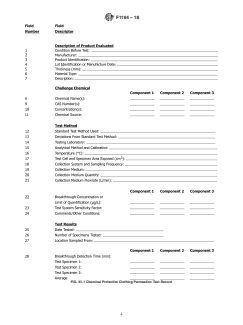
4.1 Asuggested reporting format is shown in Appendix X1,
mendations issued by the World Trade Organization Technical
Fig. X1.1.
Barriers to Trade (TBT) Committee.
4.2 If a particular data field is not applicable to the testing
performed, insert “not applicable” in the field. If a particular
This guide is under the jurisdiction of ASTM Committee F23 on Personal
Protective Clothing and Equipment and is the direct responsibility of Subcommittee
F23.30 on Chemicals. For referenced ASTM standards, visit the ASTM website, www.astm.org, or
Current edition approved June 1, 2018. Published June 2018. Originally contact ASTM Customer Service at service@astm.org. For Annual Book of ASTM
approved in 1989. Last previous edition approved in 2010 as F1194 – 99 (2010). Standards volume information, refer to the standard’s Document Summary page on
DOI: 10.1520/F1194-18. the ASTM website.
Copyright © ASTM International, 100 Barr Harbor Drive, PO Box C700, West Conshohocken, PA 19428-2959. United States
F1194 − 18
piece of data has not been obtained, insert “no data” or 4.5.1 Standard Test Method Used (Field 12)—Reference the
“unknown” in the field. specific standard test method and edition used (for example,
ɛ1
Test Method F739–12 ). If no standard test method was used,
4.3 A description of each field of information follows.
list “none.”
4.3.1 Description of Product Evaluated—A positive identi-
4.5.2 Deviations from Standard Test Method (Field 13)—
fication of the specific CPC product material evaluated.
Include any differences from the referenced standards, such as
4.3.1.1 Condition Before Test (Field 1)—Notes the prior
an alternative permeation test cell or deviations from specific
conditioning or treatment of the material specimen before
test conditions.
testing. Examples are “new,” “laundered,” and “following
4.5.3 Testing Laboratory (Field 14)—Include the name,
flexing and abrasion.” Specify test methods or procedures that
address, and telephone number of the testing laboratory.
are used for conditioning or treating the material prior to
4.5.4 Analytical Method and Calibration (Field 15)—A
testing. Also, specify the temperature, humidity, and duration
general description of the method used to analyze for the
of the environmental preconditioning of the specimens imme-
challenge chemical (an example is “GC/FID”) and the method
diately prior to testing.
of calibrating the analytical method.
4.3.1.2 Manufacturer (Field 2)—The name, address, and
4.5.5 Temperature (Field 16)—The temperature, in degrees
telephone of the product producer. If unknown, then enter the
Celsius (°C), at which the testing was carried out.
source or supplier of the product.
4.5.6 Test Cell and Specimen Area Exposed (Field 17)—The
4.3.1.3 Product Identification (Field 3)—The manufactur- 2
surface area, in square centimetres (cm ), of the test specimen
er’s code or catalog number, or “brand name” which uniquely
exposed on the challenge side of the test cell and an image or
describes the product tested.
description of the test cell used. Include any special methods
4.3.1.4 Lot Identification or Manufacture Date (Field 4)—
used to mount the sample in the cell.
The production lot/batch identification or date which uniquely
4.5.7 Collection System and Sampling Frequency (Field
identifies the product that was evaluated.
18)—Willnormallybe“openloop”(singlepass),“closedloop”
4.3.1.5 Thickness (Field 5)—(mm). The nominal thickness
(recirculating), “closed loop/aliquot replacement” (recirculat-
of the barrier material. Where polymers are coated on
ing with aliquot replacement), or “cumulative.” Include infor-
substrates, obtain the coating thickness from the manufacturer.
mation on the sampling frequency, for example, “one sample
every 5 min.” Include information on the sample volume, for
4.3.1.6 Material Type (Field 6)—A generic description of
example, “continuous analysis,” or “aliquot sample volume of
the type of chemical resistant material that was tested. Ex-
0.001 L.” Include information on any additional steps required
amples are “neoprene,” “natural rubber,” and “nitrile rubber.”
for sample analysis.
4.3.1.7 Description (Field 7)—Includes items such as type
4.5.8 Collection Medium (Field 19)—The sorbent in which
ofsupportfabric,supportingorsubstratematerialbasisweight,
thechemicaliscollectedforanalysis.Examplesare“nitrogen,”
weight of material or substrate, and treatments such as surface
“air,” “saline solution,” “5 % methanol⁄95 % water,” and
chlorination.
“gauze.”
4.4 Challenge Chemical—The pure chemical or chemical
4.5.9 Collection Medi
...
This document is not an ASTM standard and is intended only to provide the user of an ASTM standard an indication of what changes have been made to the previous version. Because
it may not be technically possible to adequately depict all changes accurately, ASTM recommends that users consult prior editions as appropriate. In all cases only the current version
of the standard as published by ASTM is to be considered the official document.
Designation: F1194 − 99 (Reapproved 2010) F1194 − 18
Standard Guide for
Documenting the Results of Chemical Permeation Testing of
Materials Used in Protective Clothing
This standard is issued under the fixed designation F1194; the number immediately following the designation indicates the year of
original adoption or, in the case of revision, the year of last revision. A number in parentheses indicates the year of last reapproval. A
superscript epsilon (´) indicates an editorial change since the last revision or reapproval.
INTRODUCTION
Promulgation of standard test methods for measuring the resistance of protective clothing materials
to permeation by liquid or gaseous chemicals has fostered the generation of increasing volumes of
material performance data. Not all data have been, nor will be, generated using Test Method F739.
To be useful, such data should be combined with information that specifies detailed characteristics
of each test. These characteristics include information on the material specimens, challenge chemicals,
test apparatus, analytical method used, and test conditions (for example, temperature). The sensitivity
or detection limit of the test system is of particular importance in comparing the data from different
sources during the protective clothing selection process.
To date, most reports on permeation testing have not included such specificity. This guide, therefore,
presents a standard format for recording all required information and data. The standard format is
intended to facilitate the use of electronic databases to store, retrieve, and apply test results.
1. Scope
1.1 This guide provides a format for documenting information and performance data from a permeation test.
1.2 Documented information and data are grouped into five major categories that define important aspects of each test:
1.2.1 Protective Clothing Material,clothing material,
1.2.2 Test Method,method,
1.2.3 Challenge Chemical,chemical,
1.2.4 Test Results,results, and
1.2.5 Source of the Data.data.
1.3 Use of this guide is facilitated by adherence to the procedures outlined in a standard test method.
1.4 This international standard was developed in accordance with internationally recognized principles on standardization
established in the Decision on Principles for the Development of International Standards, Guides and Recommendations issued
by the World Trade Organization Technical Barriers to Trade (TBT) Committee.
2. Referenced Documents
2.1 ASTM Standards:
F739 Test Method for Permeation of Liquids and Gases through Protective Clothing Materials under Conditions of Continuous
Contact
3. Significance and Use
3.1 This guide is intended to encourage thorough and consistent documentation of permeation testing and its results.
This guide is under the jurisdiction of ASTM Committee F23 on Personal Protective Clothing and Equipment and is the direct responsibility of Subcommittee F23.30
on Chemicals.
Current edition approved Jan. 1, 2010June 1, 2018. Published January 2010June 2018. Originally approved in 1989. Last previous edition approved in 20052010 as
F1194 - 99F1194 – 99 (2010).(2005). DOI: 10.1520/F1194-99R10.10.1520/F1194-18.
For referenced ASTM standards, visit the ASTM website, www.astm.org, or contact ASTM Customer Service at service@astm.org. For Annual Book of ASTM Standards
volume information, refer to the standard’s Document Summary page on the ASTM website.
Copyright © ASTM International, 100 Barr Harbor Drive, PO Box C700, West Conshohocken, PA 19428-2959. United States
F1194 − 18
3.2 Uniform information and performance data increase the likelihood of selecting proper chemical protective clothing material
(CPC) by permitting direct comparisons of one product with another.
3.3 A standard format for test information and data also encourages computer storage of test results for easy retrieval,
comparison, and correlations.
4. Data Fields
4.1 The A suggested reporting format is shown in Annex A1Appendix X1, Fig. A1.1X1.1.
4.2 If a particular data field is not applicable to the testing performed, insert “not applicable” in the field. If a particular piece
of data has not been obtained, insert “no data” or “unknown” in the field.
4.3 A description of each field of information follows.
4.3.1 Description of Product Evaluated—A positive identification of the specific CPC product material evaluated.
4.3.1.1 Condition Before Test (field(Field 1)—Notes the prior conditioning or treatment of the material specimen before testing.
Examples are “new,” “laundered,” after two weeks production usage,” and “after decontamination.” Any laundering or
decontaminating procedures should be briefly described or referenced.and “following flexing and abrasion.” Specify test methods
or procedures that are used for conditioning or treating the material prior to testing. Also, specify the temperature, humidity, and
duration of the environmental preconditioning of the specimens immediately prior to testing.
4.3.1.2 Manufacturer (Field 2)—Manufacturer (field 2)—The name, addressThe name, address, and telephone of the product
producer. If unknown, then enter the source or supplier of the product.
4.3.1.3 Product Identification (field(Field 3)—The manufacturer’s code or catalog number, or “brand name” which uniquely
describes the product tested.
4.3.1.4 Lot Identification or Manufacture Date (field(Field 4)—The production lot/batch identification or date which uniquely
identifies the product which was evaluated. If this information cannot be found, enter the earliest date that the specific test product
(sample) was known to exist, for example, the purchase date, supplier’s stocking date, and so forth.that was evaluated.
4.3.1.5 Thickness (field (Field 5)—(mm). The nominal thickness of the barrier material. Where polymers are coated on
substrates, a obtain the coating thickness may be available from the manufacturer.
4.3.1.6 Material Type (field(Field 6)—A generic description of the type of chemical resistant material that was tested. Examples
are “neoprene,” “natural rubber,” and “nitrile rubber.”
4.3.1.7 Description (field(Field 7)—Includes items such as type of support fabric, supporting or substrate material basis weight,
weight of material or substrate, and treatments such as surface chlorination.
4.4 Challenge Chemical—The pure chemical or chemical (mixture) to which the material specimen was exposed. The exact
identity of the chemicalsuggested reporting format in Appendix X1 is essential for the user to determine if the data will be
applicable to his situation. Provision is made for three component mixtures. More components can be enteredprovides for up to
three components in a mixture. Enter more components if necessary.
NOTE 1—The exact identity of the chemical is essential for the user to determine if the data will be applicable to their situation.
4.4.1 Chemical Name(s) (field(Field 8)—The name(s) of the component(s) (of interest) of the challenge chemical(s).
4.4.2 CAS Number(s) (field(Field 9)—The unique registry number(s) assigned by the Chemical Abstracts Service of the
American Chemical Society for each chemical component of the challenge chemical.
4.4.3 Concentrations (field(Field 10)—The concentration of the components of the challenge chemical. If the challenge
chemical is a mixture, the concentration of each component is reported. For examplereported, for example, as volume % for liquids
or gases, mg/L for dissolved solids, and weight % for solids.
4.4.4 Chemical Source (field(Field 11)—The manufacturer or supplier, catalog number, and the lot of the challenge chemical.
4.5 Test Method—A description of the test method and testing parameters used to generate the test results.
4.5.1 Standard Test Method Used (field(Field 12)—Reference the specific standard test method and edition used (for example,
ɛ1
Test Method F739–12 ). If no standard test method was used, list “none.”
4.5.2 Deviation FromDeviations from Standard Test Method (field(Field 13)—Some testing conditions such as low volatile,
insoluble, or very toxic chemicals, may require modifications to the standard test method. The differences could include description
of an alternate permeation test cell.Include any differences from the referenced standards, such as an alternative permeation test
cell or deviations from specific test conditions.
4.5.3 Testing Laboratory (field(Field 14)—Include the name, address, and telephone number of the testing laboratory.
4.5.4 Analytical Method and Calibration (field(Field 15)—A general, not specific general description of the method used to
analyze for the challenge chemical. An example is “GC/FID.”chemical (an example is “GC/FID”) and the method of calibrating
the analytical method.
4.5.5 Temperature (field(Field 16)—The temperature, in degrees Celsius (°C), at which the testing was carried out.
4.5.6 Test Cell
...