

ASTM A252/A252M-19
(Specification)Standard Specification for Welded and Seamless Steel Pipe Piles
General Information
- Abstract
ABSTRACT
This specification covers nominal wall cylindrical steel pipe piles in which the steel cylinder acts as a permanent load-carrying member or as a shell to form cast-in-place concrete piles. Each welded pile shall be made by seamless, electric resistance welding, flash welding or fusion welding with longitudinal, helical-butt, or helical-lap seams. This specification also deals with material tensile requirements, minimum elongation values and common size and weights per unit length values.
SCOPE
1.1 This specification covers nominal (average) wall steel pipe piles of cylindrical shape and applies to pipe piles in which the steel cylinder acts as a permanent load-carrying member, or as a shell to form cast-in-place concrete piles. Pipe piles are produced as both welded and seamless products.
1.2 This specification is expressed in both inch-pound units and SI units; however, unless the purchase order or contract specifies the applicable M specification designation (SI units), the inch-pound units shall apply. The values stated in either inch-pound or SI units are to be regarded separately as standard. Within the text, the SI units are shown in brackets. The values stated in each system may not be exact equivalents; therefore, each system shall be used independently of the other. Combining values from two systems may result in nonconformance with the standard.
1.3 The text of this specification contains notes and footnotes that provide explanatory material. Such notes and footnotes, excluding those in tables and figures, do not contain any mandatory requirements.
1.4 The following precautionary caveat pertains only to the test method portion, Section 16 of this specification. This standard does not purport to address all of the safety problems, if any, associated with its use. It is the responsibility of the user of this standard to establish appropriate safety, health, and environmental practices and determine the applicability of regulatory limitations prior to use.
1.5 This international standard was developed in accordance with internationally recognized principles on standardization established in the Decision on Principles for the Development of International Standards, Guides and Recommendations issued by the World Trade Organization Technical Barriers to Trade (TBT) Committee.
- Status
- Published
- Publication Date
- 30-Jun-2019
- Technical Committee
- A01 - Steel, Stainless Steel and Related Alloys
- Drafting Committee
- A01.09 - Carbon Steel Tubular Products
Buy Documents
ASTM A252/A252M-19 - Standard Specification for Welded and Seamless Steel Pipe Piles
REDLINE ASTM A252/A252M-19 - Standard Specification for Welded and Seamless Steel Pipe Piles
Overview
ASTM A252/A252M-19: Standard Specification for Welded and Seamless Steel Pipe Piles is an internationally recognized standard developed by ASTM International. It specifies requirements for nominal wall, cylindrical steel pipe piles-used either as permanent load-bearing members or as shells for forming cast-in-place concrete piles. The standard is vital for ensuring consistency, safety, and performance in civil engineering and construction projects utilizing steel pipe piles. This dual-units specification is applicable to products manufactured in both inch-pound and SI units, supporting a global marketplace.
Key Topics
- Product Scope: Covers both welded and seamless steel pipe piles of cylindrical shape.
- Manufacturing Methods:
- Seamless
- Electric resistance welded
- Flash welded
- Fusion welded (longitudinal, helical-butt, or helical-lap seams)
- Material Requirements: Specifies properties such as chemical composition with a phosphorus maximum of 0.050%.
- Mechanical Properties: Details minimum tensile strength, yield strength, and elongation percentages based on grade.
- Ordering Information: Clearly outlines the data required for orders, including grade, method of manufacture, size, and weight.
- Dimensional Tolerances: Establishes permissible variations in outside diameter, wall thickness, and unit weight.
- Inspection and Testing: Defines the frequency and methods for tension tests, inspection, and criteria for acceptance or rejection.
- Marking and Certification: Specifies requirements for product identification, bar coding, and manufacturer certification.
Applications
Steel pipe piles manufactured to ASTM A252/A252M-19 are widely utilized in numerous construction and infrastructure projects, where reliable deep foundations are required:
- Civil Engineering: Supports buildings, bridges, and marine structures.
- Foundations: Used as both permanent load-carrying elements and as forms for cast-in-place concrete piles.
- Transport Infrastructure: Used in highway overpasses, railways, and docks.
- Marine and Offshore Structures: Provides foundational support in corrosive or aquatic environments.
- Industrial Projects: Suited for heavy machinery bases and plant infrastructure.
These piles offer advantages such as high strength, load-bearing capacity, options for various lengths (single, double random, or uniform), and suitability for different soil conditions. The specification ensures that pipe piles meet specified physical and chemical requirements, contributing to safety and durability in the field.
Related Standards
When working with ASTM A252/A252M-19, the following ASTM and industry standards may also be relevant:
- ASTM A370: Test Methods and Definitions for Mechanical Testing of Steel Products
- ASTM A751: Test Methods, Practices, and Terminology for Chemical Analysis of Steel Products
- ASTM A941: Terminology Relating to Steel, Stainless Steel, Related Alloys, and Ferroalloys
- ASTM E29: Practice for Using Significant Digits in Test Data to Determine Conformance with Specifications
These related documents provide guidance on terminology, mechanical testing, chemical analysis, and data reporting practices, ensuring a consistent approach when specifying or evaluating steel pipe piles for critical construction purposes.
Keywords: ASTM A252, steel pipe piles, welded pipe piles, seamless pipe piles, specification, foundation construction, civil engineering, steel standards, construction materials.
Relations
- Effective Date
- 01-Mar-2024
- Effective Date
- 01-Mar-2024
- Effective Date
- 01-Jul-2019
- Refers
ASTM A370-17a - Standard Test Methods and Definitions for Mechanical Testing of Steel Products - Effective Date
- 15-Nov-2017
- Effective Date
- 01-Sep-2017
- Effective Date
- 01-Jan-2017
- Effective Date
- 01-Nov-2015
- Effective Date
- 01-Nov-2015
- Effective Date
- 15-May-2014
- Effective Date
- 01-Mar-2014
- Effective Date
- 15-Nov-2013
- Effective Date
- 01-Jun-2013
- Effective Date
- 01-May-2013
- Effective Date
- 01-Apr-2013
- Refers
ASTM A370-12a - Standard Test Methods and Definitions for Mechanical Testing of Steel Products - Effective Date
- 15-Oct-2012
Buy Documents
ASTM A252/A252M-19 - Standard Specification for Welded and Seamless Steel Pipe Piles
REDLINE ASTM A252/A252M-19 - Standard Specification for Welded and Seamless Steel Pipe Piles
Get Certified
Connect with accredited certification bodies for this standard

Institut za varilstvo d.o.o. (Welding Institute)
Slovenia's leading welding institute since 1952. ISO 3834, EN 1090, pressure equipment certification, NDT personnel, welder qualification. Only IIW Au
Sponsored listings
Frequently Asked Questions
ASTM A252/A252M-19 is a technical specification published by ASTM International. Its full title is "Standard Specification for Welded and Seamless Steel Pipe Piles". This standard covers: ABSTRACT This specification covers nominal wall cylindrical steel pipe piles in which the steel cylinder acts as a permanent load-carrying member or as a shell to form cast-in-place concrete piles. Each welded pile shall be made by seamless, electric resistance welding, flash welding or fusion welding with longitudinal, helical-butt, or helical-lap seams. This specification also deals with material tensile requirements, minimum elongation values and common size and weights per unit length values. SCOPE 1.1 This specification covers nominal (average) wall steel pipe piles of cylindrical shape and applies to pipe piles in which the steel cylinder acts as a permanent load-carrying member, or as a shell to form cast-in-place concrete piles. Pipe piles are produced as both welded and seamless products. 1.2 This specification is expressed in both inch-pound units and SI units; however, unless the purchase order or contract specifies the applicable M specification designation (SI units), the inch-pound units shall apply. The values stated in either inch-pound or SI units are to be regarded separately as standard. Within the text, the SI units are shown in brackets. The values stated in each system may not be exact equivalents; therefore, each system shall be used independently of the other. Combining values from two systems may result in nonconformance with the standard. 1.3 The text of this specification contains notes and footnotes that provide explanatory material. Such notes and footnotes, excluding those in tables and figures, do not contain any mandatory requirements. 1.4 The following precautionary caveat pertains only to the test method portion, Section 16 of this specification. This standard does not purport to address all of the safety problems, if any, associated with its use. It is the responsibility of the user of this standard to establish appropriate safety, health, and environmental practices and determine the applicability of regulatory limitations prior to use. 1.5 This international standard was developed in accordance with internationally recognized principles on standardization established in the Decision on Principles for the Development of International Standards, Guides and Recommendations issued by the World Trade Organization Technical Barriers to Trade (TBT) Committee.
ABSTRACT This specification covers nominal wall cylindrical steel pipe piles in which the steel cylinder acts as a permanent load-carrying member or as a shell to form cast-in-place concrete piles. Each welded pile shall be made by seamless, electric resistance welding, flash welding or fusion welding with longitudinal, helical-butt, or helical-lap seams. This specification also deals with material tensile requirements, minimum elongation values and common size and weights per unit length values. SCOPE 1.1 This specification covers nominal (average) wall steel pipe piles of cylindrical shape and applies to pipe piles in which the steel cylinder acts as a permanent load-carrying member, or as a shell to form cast-in-place concrete piles. Pipe piles are produced as both welded and seamless products. 1.2 This specification is expressed in both inch-pound units and SI units; however, unless the purchase order or contract specifies the applicable M specification designation (SI units), the inch-pound units shall apply. The values stated in either inch-pound or SI units are to be regarded separately as standard. Within the text, the SI units are shown in brackets. The values stated in each system may not be exact equivalents; therefore, each system shall be used independently of the other. Combining values from two systems may result in nonconformance with the standard. 1.3 The text of this specification contains notes and footnotes that provide explanatory material. Such notes and footnotes, excluding those in tables and figures, do not contain any mandatory requirements. 1.4 The following precautionary caveat pertains only to the test method portion, Section 16 of this specification. This standard does not purport to address all of the safety problems, if any, associated with its use. It is the responsibility of the user of this standard to establish appropriate safety, health, and environmental practices and determine the applicability of regulatory limitations prior to use. 1.5 This international standard was developed in accordance with internationally recognized principles on standardization established in the Decision on Principles for the Development of International Standards, Guides and Recommendations issued by the World Trade Organization Technical Barriers to Trade (TBT) Committee.
ASTM A252/A252M-19 is classified under the following ICS (International Classification for Standards) categories: 23.040.10 - Iron and steel pipes. The ICS classification helps identify the subject area and facilitates finding related standards.
ASTM A252/A252M-19 has the following relationships with other standards: It is inter standard links to ASTM A941-24, ASTM A370-24, ASTM A370-19, ASTM A370-17a, ASTM A941-17, ASTM A370-17, ASTM A370-15, ASTM A941-15, ASTM A370-14, ASTM A751-14, ASTM A370-13, ASTM A941-13b, ASTM A941-13a, ASTM A941-13, ASTM A370-12a. Understanding these relationships helps ensure you are using the most current and applicable version of the standard.
ASTM A252/A252M-19 is available in PDF format for immediate download after purchase. The document can be added to your cart and obtained through the secure checkout process. Digital delivery ensures instant access to the complete standard document.
Standards Content (Sample)
This international standard was developed in accordance with internationally recognized principles on standardization established in the Decision on Principles for the
Development of International Standards, Guides and Recommendations issued by the World Trade Organization Technical Barriers to Trade (TBT) Committee.
Designation:A252/A252M −19
Standard Specification for
Welded and Seamless Steel Pipe Piles
This standard is issued under the fixed designationA252/A252M; the number immediately following the designation indicates the year
of original adoption or, in the case of revision, the year of last revision.Anumber in parentheses indicates the year of last reapproval.
A superscript epsilon (´) indicates an editorial change since the last revision or reapproval.
1. Scope* 2. Referenced Documents
2.1 ASTM Standards:
1.1 This specification covers nominal (average) wall steel
A370Test Methods and Definitions for Mechanical Testing
pipe piles of cylindrical shape and applies to pipe piles in
of Steel Products
which the steel cylinder acts as a permanent load-carrying
A751Test Methods, Practices, and Terminology for Chemi-
member, or as a shell to form cast-in-place concrete piles. Pipe
cal Analysis of Steel Products
piles are produced as both welded and seamless products.
A941TerminologyRelatingtoSteel,StainlessSteel,Related
1.2 This specification is expressed in both inch-pound units
Alloys, and Ferroalloys
and SI units; however, unless the purchase order or contract
E29Practice for Using Significant Digits in Test Data to
specifies the applicable M specification designation (SI units),
Determine Conformance with Specifications
the inch-pound units shall apply. The values stated in either
inch-pound or SI units are to be regarded separately as
3. Terminology
standard. Within the text, the SI units are shown in brackets.
3.1 Definitions:
Thevaluesstatedineachsystemmaynotbeexactequivalents;
3.1.1 Definitions of terms used in this specification shall be
therefore,eachsystemshallbeusedindependentlyoftheother.
in accordance with Terminology A941.
Combining values from two systems may result in nonconfor-
3.1.2 defect—animperfectionofsufficientsizeormagnitude
mance with the standard.
to be cause for rejection.
1.3 The text of this specification contains notes and foot-
3.1.3 heat lot—a group of pipe piles of the same outside
notes that provide explanatory material. Such notes and
diameter, nominal wall thickness, and steel heat.
footnotes, excluding those in tables and figures, do not contain
3.1.4 imperfection—any discontinuity or irregularity found
any mandatory requirements.
in the pipe.
1.4 The following precautionary caveat pertains only to the
test method portion, Section 16 of this specification. This
4. Ordering Information
standard does not purport to address all of the safety problems,
4.1 Ordersformaterialunderthisspecificationshallcontain
if any, associated with its use. It is the responsibility of the user
information concerning as many of the following items as are
of this standard to establish appropriate safety, health, and
required to describe the desired material adequately:
environmental practices and determine the applicability of
4.1.1 Quantity (feet or number of lengths),
regulatory limitations prior to use.
4.1.2 Name of material (steel pipe piles),
1.5 This international standard was developed in accor-
4.1.3 Method of manufacture (seamless or welded),
dance with internationally recognized principles on standard-
4.1.4 Grade (Tables 1 and 2),
ization established in the Decision on Principles for the
4.1.5 Product analysis (specify if product analysis is
Development of International Standards, Guides and Recom-
required, if not ladle analysis will be used) (see Section 9),
mendations issued by the World Trade Organization Technical
4.1.6 Size (outside diameter and nominal wall thickness),
Barriers to Trade (TBT) Committee.
4.1.7 Weight (specify if each piece must be weighed) (see
12.1),
This specification is under the jurisdiction ofASTM Committee A01 on Steel,
Stainless Steel and RelatedAlloys and is the direct responsibility of Subcommittee
A01.09 on Carbon Steel Tubular Products. For referenced ASTM standards, visit the ASTM website, www.astm.org, or
CurrenteditionapprovedJuly1,2019.PublishedJuly2019.Originallyapproved contact ASTM Customer Service at service@astm.org. For Annual Book of ASTM
in 1944. Last previous edition approved in 2018 as A252–10 (2018). DOI: Standards volume information, refer to the standard’s Document Summary page on
10.1520/A0252_A0252M-19. the ASTM website.
*A Summary of Changes section appears at the end of this standard
Copyright © ASTM International, 100 Barr Harbor Drive, PO Box C700, West Conshohocken, PA 19428-2959. United States
A252/A252M−19
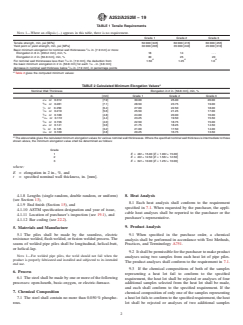
TABLE 1 Tensile Requirements
NOTE 1—Where an ellipsis (.) appears in this table, there is no requirement.
Grade 1 Grade 2 Grade 3
Tensile strength, min, psi [MPa] 50 000 [345] 60 000 [415] 66 000 [455]
Yield point or yield strength, min, psi [MPa] 30 000 [205] 35 000 [240] 45 000 [310]
Basic minimum elongation for nominal wall thicknesses ⁄16 in. [7.9 mm] or more:
Elongation in 8 in. [203.2 mm], min, % 18 14 . . .
Elongation in 2 in. [50.8 mm], min, % 30 25 20
A A A
For nominal wall thicknesses less than ⁄16 in. [7.9 mm], the deduction from 1.50 1.25 1.0
the basic minimum elongation in 2 in. [50.8 mm] for each ⁄32 - in. [0.8 mm]
decrease in nominal wall thickness below ⁄16 in. [7.9 mm], in percentage points
A
Table 2 gives the computed minimum values:
A
TABLE 2 Calculated Minimum Elongation Values
Nominal Wall Thickness Elongation in 2 in. [50.8 mm], min, %
in. [mm] Grade 1 Grade 2 Grade 3
⁄16 or 0.312 [7.9] 30.00 25.00 20.00
⁄32 or 0.281 [7.1] 28.50 23.75 19.00
⁄4 or 0.250 [6.4] 27.00 22.50 18.00
⁄32 or 0.219 [5.6] 25.50 21.25 17.00
⁄16 or 0.188 [4.8] 24.00 20.00 16.00
⁄64 or 0.172 [4.4] 23.25 19.50 15.50
⁄32 or 0.156 [4.0] 22.50 18.75 15.00
⁄64 or 0.141 [3.6] 21.75 18.25 14.50
⁄8 or 0.125 [3.2] 21.00 17.50 14.00
⁄64 or 0.109 [2.8] 20.25 16.75 13.50
A
Theabovetablegivesthecalculatedminimumelongationvaluesforvariousnominalwallthicknesses.Wherethespecifiednominalwallthicknessisintermediatetothose
shown above, the minimum elongation value shall be determined as follows:
Grade
1 E =48t + 15.00 [E = 1.90t + 15.00]
2 E =40t + 12.50 [E = 1.56t + 12.50]
3 E =32t + 10.00 [E = 1.25t + 10.00]
where:
E = elongation in 2 in., %, and
t = specified nominal wall thickness, in. [mm].
4.1.8 Lengths (single random, double random, or uniform) 8. Heat Analysis
(see Section 13),
8.1 Each heat analysis shall conform to the requirement
4.1.9 End finish (Section 15), and
specified in 7.1. When requested by the purchaser, the appli-
4.1.10 ASTM specification designation and year of issue,
cable heat analyses shall be reported to the purchaser or the
4.1.11 Location of purchaser’s inspection (see 19.1), and
purchaser’s representative.
4.1.12 Bar coding (see 22.2).
9. Product Analysis
5. Materials and Manufacture
5.1 The piles shall be made by the seamless, electric
9.1 When specified in the purchase order, a chemical
resistance welded, flash welded, or fusion welded process.The analysis shall be performed in accordance with Test Methods,
seams of welded pipe piles shall be longitudinal, helical-butt,
Practices, and Terminology A751.
or helical-lap.
9.2 Itshallbepermissibleforthepurchasertomakeproduct
NOTE 1—For welded pipe piles, the weld should not fail when the
analyses using two samples from each heat lot of pipe piles.
product is properly fabricated and installed and subjected to its intended
The product analyses shall conform to the requirement in 7.1.
end use.
9.3 If the chemical compositions of both of the samples
6. Process
representing a heat lot fail to conform to the specified
6.1 The steel shall be made by one or more of the following
requirement, the heat lot shall be rejected or analyses of four
processes: open-hearth, basic-oxygen, or electric-furnace.
additional samples selected from the heat lot shall be made,
and each shall conform to the specified requirement. If the
7. Chemical Composition
chemical composition of only one of the samples representing
aheatlotfailstoconformtothespecifiedrequirement,theheat
7.1 The steel shall contain no more than 0.050% phospho-
rous. lot shall be rejected or analyses of two additional samples
A252/A252M−19
selected from the heat lot shall be made, and each shall
Single random lengths 16 to 25 ft [4.88 to 7.62 m], incl
Double random lengths over 25 ft [7.62 m] with a minimum average
conform to the specified requirement.
of 35 ft [10.67 m]
9.4 Whenaproductanalysisisnotrequestedinthepurchase Uniform lengths length as specified with a permissible
variation of ±1 in.
order, the manufacturer shall provide the ladle analysis for the
13.2 Lengths that have been spliced at the mill by welding
respective heat lot. This ladle analysis shall conform to the
requirements in 7.1. shall be acceptable as the equivalent of unspliced lengths
provided tension test specimens cut from sample splices
10. Tensile Requirements
conform to the tensile strength requirements prescribed in
10.1 The material shall conform to the requirements as to
Tables1and2.Theweldingbeadshallnotberemovedforthis
tensile properties prescribed in Tables 1 and 2.
test. Such specimens shall be made in accordance with the
provisions specified in Sections16–18.
10.2 The yield point shall be determined by the drop of the
beam,bythehaltinthegageofthetestingmachine,bytheuse
14. Workmanship, Finish, and Appearance
of dividers, or by other approved methods. When a definite
14.1 The finished pipe piles shall be reasonably straight and
yieldpointisnotexhibited,theyieldstrengthcorrespondingto
shall not contain imperfections in such number or of such
apermanentoffsetof0.2%ofthegagelengthofthespecimen,
character as to render the pipe unsuitable for pipe piles.
or to a total extension of 0.5% of the gage length under load
shall be determined.
14.2 Surface imperfections having a depth not in excess of
12.5% of the specified nominal wall thickness shall be
11. Weights Per Unit Length
acceptable.Itshallbepermissibletoestablishthedepthofsuch
11.1 The weights per unit length for various sizes of pipe
imperfections by grinding or filing.
piles are listed in Table 3.
14.3 Surface imperfections having a depth in excess of
11.2 For pipe pile sizes not listed in Table 3, the weight per
12.5% of the specified nominal wall thickness shall be
unit length shall be calculated as follows:
considered to be defects. It shall be permissible for defects not
W 5 10.69 D 2 t t 1
~ !
deeper than 33 ⁄3% of the specified nominal wall thickness to
W 5 .0246615 D 2 t t (1) be repaired by welding, provided that the defect is completely
@ ~ ! #
removed prior to welding.
where:
W = weight per unit length, lb/ft [kg/m], 15. Ends
D = specified outside diameter, in. [mm], and
15.1 Pipe piles shall be furnished with plain ends. Unless
t = specified nominal wall thickness, in. [mm].
otherwise specified, pipe piles shall have either flame–cut or
12. Permissible Variations in Weights and Dimensions machine–cut ends, with the burrs at the ends removed. Where
ends are specified to be beveled, they shall be beveled to an
12.1 Weight—When specified on the purchase order, each
angleof30+5,−0°,measuredfromalinedrawnperpendicular
length of pipe pile shall be weighed separately and its weight
to the axis of the pipe pile.
shallnotvarymorethan15%overor5%underitstheoretical
weight, calculated using its length and its weight per unit
16. Number of Tests
length (see Section 11). When not specified on the purchase
16.1 One tension test shall be made on one length or
order, the manufacturer shall ensure the pipe conforms to
fractionthereofofeachsize,oronepieceofskelprepresenting
Section 11 by other methods.
each heat lot.
12.2 Outside Diameter—The outside diameter of pipe piles
16.2 A retest shall be allowed if the percentage of elonga-
shall not vary more than 61% from the specified outside
tion of any test tension specimen is less than that prescribed in
diameter.
Tables 1 and 2 and any part of the fracture is more than ⁄4 in.
12.3 Wall Thickness—The wall thickness at any point shall
[19 mm] from the center of the gage length for test specimens
not be more than 12.5% under the specified nominal wall
havinga2–in.[50mm]gagelength,orisoutsideofthemiddle
thickness.Thefollowingcalculationshallbeusedtodetermine
thirdofthegagelengthfortestspecimenshavingan8–in.[200
the minimum wall thickness:
mm] gage length, as indicated by scribe scratches marked on
t 30.875 5 t (2)
n m
the specimen before testing. A retest shall also be allowed if
any part of the fracture is in an inside or outside surface
where:
imperfection.
t = nominal wall thickness, and
n
t = minimum permissible wall thickness. 16.3 Itshallbepermissibletodiscardanytestspecimenthat
m
shows defective machining or develops imperfections and
Thewallthicknessisexpressedtothreedecimalplaces,with
substitute another test specimen.
rounding being in accordance with Practice E29.
17. Retests
13. Lengths
13.1 Pipe piles shall be furnished in single random lengths, 17.1 If the results of the tension test representing any heat
double random lengths, or in uniform lengths as specified in lot fail to conform to the applicable requirements prescribed in
the purchase or
...
This document is not an ASTM standard and is intended only to provide the user of an ASTM standard an indication of what changes have been made to the previous version. Because
it may not be technically possible to adequately depict all changes accurately, ASTM recommends that users consult prior editions as appropriate. In all cases only the current version
of the standard as published by ASTM is to be considered the official document.
Designation: A252 − 10 (Reapproved 2018) A252/A252M − 19
Standard Specification for
Welded and Seamless Steel Pipe Piles
This standard is issued under the fixed designation A252;A252/A252M; the number immediately following the designation indicates the
year of original adoption or, in the case of revision, the year of last revision. A number in parentheses indicates the year of last
reapproval. A superscript epsilon (´) indicates an editorial change since the last revision or reapproval.
1. Scope Scope*
1.1 This specification covers nominal (average) wall steel pipe piles of cylindrical shape and applies to pipe piles in which the
steel cylinder acts as a permanent load-carrying member, or as a shell to form cast-in-place concrete piles. Pipe piles are produced
as both welded and seamless products.
1.2 This specification is expressed in both inch-pound units and SI units; however, unless the purchase order or contract
specifies the applicable M specification designation (SI units), the inch-pound units shall apply. The values stated in either
inch-pound or SI units are to be regarded as standard. The values given in parentheses are mathematical conversions to SI units
that are provided for information only and are not considered separately as standard. Within the text, the SI units are shown in
brackets. The values stated in each system may not be exact equivalents; therefore, each system shall be used independently of
the other. Combining values from two systems may result in nonconformance with the standard.
1.3 The text of this specification contains notes and footnotes that provide explanatory material. Such notes and footnotes,
excluding those in tables and figures, do not contain any mandatory requirements.
1.4 The following precautionary caveat pertains only to the test method portion, Section 16 of this specification. This standard
does not purport to address all of the safety problems, if any, associated with its use. It is the responsibility of the user of this
standard to establish appropriate safety, health, and environmental practices and determine the applicability of regulatory
limitations prior to use.
1.5 This international standard was developed in accordance with internationally recognized principles on standardization
established in the Decision on Principles for the Development of International Standards, Guides and Recommendations issued
by the World Trade Organization Technical Barriers to Trade (TBT) Committee.
2. Referenced Documents
2.1 ASTM Standards:
A370 Test Methods and Definitions for Mechanical Testing of Steel Products
A751 Test Methods, Practices, and Terminology for Chemical Analysis of Steel Products
A941 Terminology Relating to Steel, Stainless Steel, Related Alloys, and Ferroalloys
E29 Practice for Using Significant Digits in Test Data to Determine Conformance with Specifications
3. Terminology
3.1 Definitions:
3.1.1 Definitions of terms used in this specification shall be in accordance with Terminology A941.
3.1.2 defect—an imperfection of sufficient size or magnitude to be cause for rejection.
3.1.3 heat lot—a group of pipe piles of the same outside diameter, nominal wall thickness, and steel heat.
3.1.4 imperfection—any discontinuity or irregularity found in the pipe.
4. Ordering Information
4.1 Orders for material under this specification shall contain information concerning as many of the following items as are
required to describe the desired material adequately:
This specification is under the jurisdiction of ASTM Committee A01 on Steel, Stainless Steel and Related Alloys and is the direct responsibility of Subcommittee A01.09
on Carbon Steel Tubular Products.
Current edition approved Sept. 1, 2018July 1, 2019. Published October 2018July 2019. Originally approved in 1944. Last previous edition approved in 20102018 as
A252 – 10.A252 – 10 (2018). DOI: 10.1520/A0252-10R18.10.1520/A0252_A0252M-19.
For referenced ASTM standards, visit the ASTM website, www.astm.org, or contact ASTM Customer Service at service@astm.org. For Annual Book of ASTM Standards
volume information, refer to the standard’s Document Summary page on the ASTM website.
*A Summary of Changes section appears at the end of this standard
Copyright © ASTM International, 100 Barr Harbor Drive, PO Box C700, West Conshohocken, PA 19428-2959. United States
A252/A252M − 19
4.1.1 Quantity (feet or number of lengths),
4.1.2 Name of material (steel pipe piles),
4.1.3 Method of manufacture (seamless or welded),
4.1.4 Grade (Tables 1 and 2),
4.1.5 Product analysis (specify if product analysis is required, if not ladle analysis will be used) (see Section 9),
4.1.6 Size (outside diameter and nominal wall thickness),
4.1.7 Weight (specify if each piece must be weighed) (see 12.1),
4.1.8 Lengths (single random, double random, or uniform) (see Section 13),
4.1.9 End finish (Section 15), and
4.1.10 ASTM specification designation and year of issue,
4.1.11 Location of purchaser’s inspection (see 19.1), and
4.1.12 Bar coding (see 22.2).
5. Materials and Manufacture
5.1 The piles shall be made by the seamless, electric resistance welded, flash welded, or fusion welded process. The seams of
welded pipe piles shall be longitudinal, helical-butt, or helical-lap.
NOTE 1—For welded pipe piles, the weld should not fail when the product is properly fabricated and installed and subjected to its intended end use.
6. Process
6.1 The steel shall be made by one or more of the following processes: open-hearth, basic-oxygen, or electric-furnace.
7. Chemical Composition
7.1 The steel shall contain no more than 0.050 % phosphorous.
8. Heat Analysis
8.1 Each heat analysis shall conform to the requirement specified in 7.1. When requested by the purchaser, the applicable heat
analyses shall be reported to the purchaser or the purchaser’s representative.
9. Product Analysis
9.1 Chemical When specified in the purchase order, a chemical analysis shall be performed in accordance with Test Methods,
Practices, and Terminology A751.
9.2 It shall be permissible for the purchaser to make product analyses using two samples from lots each heat lot of pipe piles
as follows:piles. The product
TABLE 1 Tensile Requirements
NOTE 1—Where an ellipsis (.) appears in this table, there is no requirement.
Grade 1 Grade 2 Grade 3
Tensile strength, min, psi (MPa) 50 000 (345) 60 000 (415) 66 000 (455)
Yield point or yield strength, min, psi (MPa) 30 000 (205) 35 000 (240) 45 000 (310)
Basic minimum elongation for nominal wall thicknesses ⁄16 in. (7.9 mm) or more:
Elongation in 8 in. (203.2 mm), min, % 18 14 . . .
Elongation in 2 in. (50.8 mm), min, % 30 25 20
A A A
For nominal wall thicknesses less than ⁄16 in. (7.9 mm), the deduction from 1.50 1.25 1.0
the basic minimum elongation in 2 in. (50.08 mm) for each ⁄32 - in. (0.8 mm)
decrease in nominal wall thickness below ⁄16 in. (7.9 mm), in percentage points
TABLE 1 Tensile Requirements
NOTE 1—Where an ellipsis (.) appears in this table, there is no requirement.
Grade 1 Grade 2 Grade 3
Tensile strength, min, psi [MPa] 50 000 [345] 60 000 [415] 66 000 [455]
Yield point or yield strength, min, psi [MPa] 30 000 [205] 35 000 [240] 45 000 [310]
Basic minimum elongation for nominal wall thicknesses ⁄16 in. [7.9 mm] or more:
Elongation in 8 in. [203.2 mm], min, % 18 14 . . .
Elongation in 2 in. [50.8 mm], min, % 30 25 20
A A A
For nominal wall thicknesses less than ⁄16 in. [7.9 mm], the deduction from 1.50 1.25 1.0
the basic minimum elongation in 2 in. [50.8 mm] for each ⁄32 - in. [0.8 mm]
decrease in nominal wall thickness below ⁄16 in. [7.9 mm], in percentage points
A
Table 2 gives the computed minimum values:
A252/A252M − 19
A
TABLE 2 Calculated Minimum Elongation Values
Nominal Wall Thickness Elongation in 2 in. (50.8 mm), min, %
in. mm Grade 1 Grade 2 Grade 3
⁄16 or 0.312 7.9 30.00 25.00 20.00
⁄32 or 0.281 7.1 28.50 23.75 19.00
⁄4 or 0.250 6.4 27.00 22.50 18.00
⁄32 or 0.219 5.6 25.50 21.25 17.00
⁄16 or 0.188 4.8 24.00 20.00 16.00
⁄64 or 0.172 4.4 23.25 19.50 15.50
⁄32 or 0.156 4.0 22.50 18.75 15.00
⁄64 or 0.141 3.6 21.75 18.25 14.50
⁄8 or 0.125 3.2 21.00 17.50 14.00
⁄64 or 0.109 2.8 20.25 16.75 13.50
A
TABLE 2 Calculated Minimum Elongation Values
Nominal Wall Thickness Elongation in 2 in. [50.8 mm], min, %
in. [mm] Grade 1 Grade 2 Grade 3
⁄16 or 0.312 [7.9] 30.00 25.00 20.00
⁄32 or 0.281 [7.1] 28.50 23.75 19.00
⁄4 or 0.250 [6.4] 27.00 22.50 18.00
⁄32 or 0.219 [5.6] 25.50 21.25 17.00
⁄16 or 0.188 [4.8] 24.00 20.00 16.00
⁄64 or 0.172 [4.4] 23.25 19.50 15.50
⁄32 or 0.156 [4.0] 22.50 18.75 15.00
⁄64 or 0.141 [3.6] 21.75 18.25 14.50
⁄8 or 0.125 [3.2] 21.00 17.50 14.00
⁄64 or 0.109 [2.8] 20.25 16.75 13.50
A
The above table gives the calculated minimum elongation values for various nominal wall thicknesses. Where the specified nominal wall thickness is intermediate to those
shown above, the minimum elongation value shall be determined as follows:
Grade
1 E = 48t + 15.00 [E = 1.90t + 15.00]
2 E = 40t + 12.50 [E = 1.56t + 12.50]
3 E = 32t + 10.00 [E = 1.25t + 10.00]
where:
E = elongation in 2 in., %, and
t = specified nominal wall thickness, in. [mm].
Pipe Size Outside Number of Samples and Size of Lot
Diameter, in. (mm)
Under 14 (355.6) 2 from 200 pipe or fraction thereof
14 to 36, incl (355.6 to 914) 2 from 100 pipe or fraction thereof
Over 36 (914) 2 from 3000 ft (914 m) or fraction thereof
analyses shall conform to the requirement in 7.1.
The product analyses shall conform to the requirement in 7.1.
9.3 If the chemical compositions of both of the samples representing a heat lot fail to conform to the specified requirement,
the heat lot shall be rejected or analyses of four additional samples selected from the heat lot shall be made, and each shall conform
to the specified requirement. If the chemical composition of only one of the samples representing a heat lot fails to conform to the
specified requirement, the heat lot shall be rejected or analyses of two additional samples selected from the heat lot shall be made,
and each shall conform to the specified requirement.
9.4 When a product analysis is not requested in the purchase order, the manufacturer shall provide the ladle analysis for the
respective heat lot. This ladle analysis shall conform to the requirements in 7.1.
10. Tensile Requirements
10.1 The material shall conform to the requirements as to tensile properties prescribed in Tables 1 and 2.
10.2 The yield point shall be determined by the drop of the beam, by the halt in the gage of the testing machine, by the use of
dividers, or by other approved methods. When a definite yield point is not exhibited, the yield strength corresponding to a
permanent offset of 0.2 % of the gage length of the specimen, or to a total extension of 0.5 % of the gage length under load shall
be determined.
A252/A252M − 19
11. Weights Per Unit Length
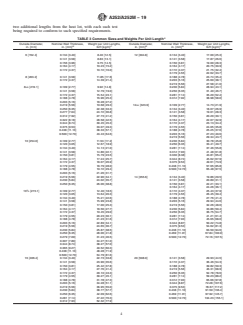
11.1 The weights per unit length for various sizes of pipe piles are listed in Table 3.
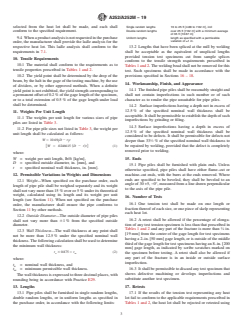
11.2 For pipe pile sizes not listed in Table 3, the weight per unit length shall be calculated as follows:
W 5 10.69~D 2 t!t (1)
W 5 10.69 D 2 t t
~ !
W 5 .0246615 D 2 t t (1)
@ ~ ! #
where:
W = weight per unit length, lb/ft,
D = specified outside diameter, in., and
t = specified nominal wall thickness, in.
W = weight per unit length, lb/ft [kg/m],
D = specified outside diameter, in. [mm], and
t = specified nominal wall thickness, in. [mm].
12. Permissible Variations in Weights and Dimensions
12.1 Weight—Each When specified on the purchase order, each length of pipe pile shall be weighed separately and its weight
shall not vary more than 15 % over or 5 % under its theoretical weight, calculated using its length and its weight per unit length
(see Section 11). When not specified on the purchase order, the manufacturer shall ensure the pipe conforms to Section 11 by other
methods.
12.2 Outside Diameter—The outside diameter of pipe piles shall not vary more than 61 % from the specified outside diameter.
12.3 Wall Thickness—The wall thickness at any point shall not be more than 12.5 % under the specified nominal wall thickness.
The following calculation shall be used to determine the minimum wall thickness:
t 30.875 5 t (2)
n m
where:
t = nominal wall thickness, and
n
t = minimum permissible wall thickness.
m
NOTE 2—The minimum permissible wall thickness on inspection is shown in Table X1.1 (see Appendix) for various nominal wall thicknesses.
The wall thickness is expressed to three decimal places, with rounding being in accordance with Practice E29.
13. Lengths
13.1 Pipe piles shall be furnished in single random lengths, double random lengths, or in uniform lengths as specified in the
purchase order, in accordance with the following limits:
Single random lengths 16 to 25 ft (4.88 to 7.62 mm), incl
Single random lengths 16 to 25 ft [4.88 to 7.62 m], incl
Double random lengths over 25 ft (7.62 m) with a minimum average
of 35 ft (10.67 m)
Double random lengths over 25 ft [7.62 m] with a minimum average
of 35 ft [10.67 m]
Uniform lengths length as specified with a permissible
variation of ±1 in.
13.2 Lengths that have been spliced at the mill by welding shall be acceptable as the equivalent of unspliced lengths provided
tension test specimens cut from sample splices conform to the tensile strength requirements prescribed in Tables 1 and 2. The
welding bead shall not be removed for this test. Such specimens shall be made in accordance with the provisions specified in
Sections 16 – 18.
14. Workmanship, Finish, and Appearance
14.1 The finished pipe piles shall be reasonably straight and shall not contain imperfections in such number or of such character
as to render the pipe unsuitable for pipe piles.
14.2 Surface imperfections having a depth not in excess of 25 %12.5 % of the specified nominal wall thickness shall be
acceptable. It shall be permissible to establish the depth of such imperfections by grinding or filing.
14.3 Surface imperfections having a depth in excess of 25 %12.5 % of the specified nominal wall thickness shall be considered
to be defects. It shall be permissible for defects not deeper than 33 ⁄3 % of the specified nominal wall thickness to be repaired by
welding, provided that the defect is completely removed prior to welding.
A252/A252M − 19
15. Ends
15.1 Pipe piles shall be furnished with plain ends. Unless otherwise specified, pipe piles shall have either flame–cut or
machine–cut ends, with the burrs at the ends removed. Where ends are specified to be beveled, they shall be beveled to an angle
of 30 +5, −0°, measured from a line drawn perpendicular to the axis of the pipe pile.
16. Number of Tests
16.1 One tension test shall be made on one length or fraction thereof of each size, or one piece of skelp representing each lot
of 200 lengths or fraction thereof of each size. heat lot.
16.2 A retest shall be allowed if the percentage of elongation of any test tension specimen is less than that prescribed in Tables
1 and 2 and any part of the fracture is more than ⁄4 in. (19 mm)[19 mm] from the center of the gage length for test specimens
having a 2–in. (50 mm)[50 mm] gage length, or is outside of the middle third of the gage length for test specimens having an 8–in.
(200 mm)[200 mm] gage length, as indicated by scribe scratches marked on the specimen before testing. A retest shall also be
allowed if any part of the fracture is in an inside or outside surface imperfection.
16.3 It shall be permissible to discard any test specimen that shows defective machining or develops imperfections and
substitute another test specimen.
17. Retests
17.1 If the results of the tension test representing any heat lot fail to conform to the applicable requirements prescribed in Tables
1 and 2, the heat lot shall be rejected or retested using two additional lengths from the heat lot, with each such test being required
to conform to such specified requirements.
A252/A252M − 19
A
TABLE 3 Common Sizes and Weights Per Unit Length
Outside Diameter, Nominal Wall Thickness, Weight per Unit Lengths, Outside Diameter, Nominal Wall Thickness, Weight per Unit Lengths,
B C B B C
in. in. lb/ft in. in. lb/ft
6 0.134 8.40 12 0.134 17.00
0.141 8.83 0.141 17.87
0.156 9.75 0.150 19.00
0.164 10.23 0.164 20.75
0.172 10.72 0.172 21.75
0.179 22.62
8 0.141 11.85 0.188 23.74
0.172 14.39 0.203 25.60
0.219 27.58
8 ⁄8 0.109 9.92 0.230 28.94
0.141 12.79 0.250 31.40
0.172 15.54 0.281 35.20
0.188 16.96 0.312 38.98
0.203 18.28
0.219 19.68 12 ⁄4 0.109 14.73
0.250 22.38 0.134 18.07
0.277 24.72 0.141 19.01
0.312 27.73 0.150 20.20
0.322 28.58 0.164 22.07
0.344 30.45 0.172 23.13
0.375 33.07 0.179 24.05
0.438 38.33 0.188 25.25
0.500 43.43 0.203 27.23
0.219 29.34
10 0.109 11.53 0.230 30.78
0.120 12.67 0.250 33.41
0.134 14.13 0.281 37.46
0.141 14.86 0.312 41.48
0.150 15.79 0.330 43.81
0.164 17.24 0.344 45.62
0.172 18.07 0.375 49.61
0.179 18.79 0.438 57.65
0.188 19.72 0.500 65.48
0.203 21.26
0.219 22.90 14 0.134 19.86
0.230 24.02 0.141 20.89
0.250 26.06 0.150 22.21
0.164 24.26
10 ⁄4 0.109
...