

ASTM C559-16(2020)
(Test Method)Standard Test Method for Bulk Density by Physical Measurements of Manufactured Carbon and Graphite Articles
General Information
- Abstract
SIGNIFICANCE AND USE
4.1 Bulk density as determined by this test method is a basic material property of importance in manufacturing and application of carbon and graphite.
4.2 This test method can be used for quality and process control, material characterization and description, and other purposes.
SCOPE
1.1 This test method covers the determination of the bulk density of manufactured articles of carbon and graphite of at least 500 mm3 volume. The bulk density is calculated to an accuracy of 0.25 %, using measurements of mass and dimensions in air at 25 °C ± 5 °C.
1.2 The values stated in SI units are to be regarded as standard. No other units of measurement are included in this standard.
1.3 This standard does not purport to address all of the safety concerns, if any, associated with its use. It is the responsibility of the user of this standard to establish appropriate safety, health, and environmental practices and determine the applicability of regulatory limitations prior to use.
1.4 This international standard was developed in accordance with internationally recognized principles on standardization established in the Decision on Principles for the Development of International Standards, Guides and Recommendations issued by the World Trade Organization Technical Barriers to Trade (TBT) Committee.
- Status
- Published
- Publication Date
- 30-Apr-2020
- Technical Committee
- D02 - Petroleum Products, Liquid Fuels, and Lubricants
- Drafting Committee
- D02.F0 - Manufactured Carbon and Graphite Products


Overview
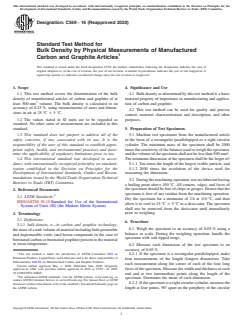
ASTM C559-16(2020) is the Standard Test Method for Bulk Density by Physical Measurements of Manufactured Carbon and Graphite Articles, developed by ASTM International. This standard outlines a precise method for determining the bulk density of manufactured articles made from carbon and graphite with a minimum volume of 500 mm³. The procedure assesses the mass and dimensions of specimens in air at a controlled temperature, enabling calculations accurate to within 0.25%. This test method is crucial for manufacturers, quality assurance teams, and researchers focused on the characterization and quality control of carbon and graphite materials.
Key Topics
- Bulk Density Definition: Describes the mass per unit volume, including both permeable and impermeable voids within the carbon or graphite structure.
- Measurement Accuracy: Provides requirements for measurement precision (accurate to 0.25%) using SI units only, ensuring global consistency.
- Sample Preparation: Specifies specimen geometry, minimum size, and preparation steps, including drying and handling to avoid contamination or deformation.
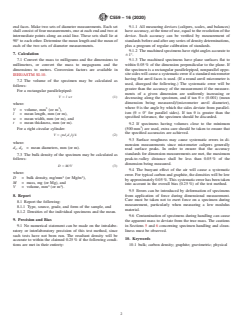
- Calculation Methods: Details how to determine volume and bulk density for different specimen shapes (rectangular parallelepiped or right circular cylinder).
- Quality and Process Control: Emphasizes the method’s use in quality control, process verification, and material characterization.
- Precision and Bias: Outlines measures to maintain accuracy, such as equipment calibration, sample integrity, and error mitigation (surface roughness, buoyancy effects, contamination).
Applications
The ASTM C559-16(2020) standard is widely used in multiple sectors that manufacture or utilize carbon and graphite components:
- Manufacturing Quality Control: Enables consistent evaluation of bulk density to ensure products meet required specifications, supporting process standardization and batch comparison.
- Material Characterization: Bulk density measurements are essential for describing the physical properties of carbon and graphite articles, especially when used in demanding applications.
- Research and Development: Facilitates comparative analysis of new carbon and graphite formulations or processing methods.
- Supplier Evaluation: Buyers and stakeholders can use bulk density data produced in accordance with ASTM C559-16(2020) to compare material grades and select trusted suppliers.
- End-Use Industries: Relevant for producers of electrodes, refractories, mechanical carbon parts, and other sectors where the performance and reliability of carbon or graphite articles are affected by bulk density.
Related Standards
- IEEE/ASTM SI-10: Standard for Use of the International System of Units (SI), referenced for measurement consistency.
- Other ASTM Carbon and Graphite Standards: Additional test methods and material standards developed by ASTM Committee D02 and Subcommittee D02.F0, targeting manufactured carbon and graphite products.
- International Standardization: Developed in accordance with the World Trade Organization (WTO) TBT Committee's internationally recognized principles, supporting global harmonization in measurement and reporting.
Conclusion
ASTM C559-16(2020) provides a rigorously defined approach for the measurement of bulk density in manufactured carbon and graphite articles. Adherence to this standard ensures accuracy, repeatability, and international comparability, making it a vital resource for quality control, research, and materials engineering in the carbon and graphite industry.
Keywords: ASTM C559-16, bulk density, carbon, graphite, physical measurement, quality control, materials characterization, SI units, manufacturing, ASTM standard.
Relations
- Effective Date
- 01-May-2020
- Referred By
ASTM D7219-19 - Standard Specification for Isotropic and Near-isotropic Nuclear Graphites - Effective Date
- 01-May-2020
- Effective Date
- 01-May-2020
- Effective Date
- 01-May-2020
- Referred By
ASTM C838-16 - Standard Test Method for Bulk Density of As-Manufactured Carbon and Graphite Shapes - Effective Date
- 01-May-2020
- Effective Date
- 01-May-2020
- Effective Date
- 01-May-2020
- Effective Date
- 01-May-2020
- Effective Date
- 01-May-2020
- Effective Date
- 01-May-2020
- Effective Date
- 01-May-2020
- Effective Date
- 01-May-2020
- Effective Date
- 01-May-2020
- Referred By
ASTM D7542-21 - Standard Test Method for Air Oxidation of Carbon and Graphite in the Kinetic Regime - Effective Date
- 01-May-2020
- Effective Date
- 01-May-2020
Get Certified
Connect with accredited certification bodies for this standard

ECOCERT
Organic and sustainability certification.

Eurofins Food Testing Global
Global leader in food, environment, and pharmaceutical product testing.

Intertek Bangladesh
Intertek certification and testing services in Bangladesh.
Sponsored listings
Frequently Asked Questions
ASTM C559-16(2020) is a standard published by ASTM International. Its full title is "Standard Test Method for Bulk Density by Physical Measurements of Manufactured Carbon and Graphite Articles". This standard covers: SIGNIFICANCE AND USE 4.1 Bulk density as determined by this test method is a basic material property of importance in manufacturing and application of carbon and graphite. 4.2 This test method can be used for quality and process control, material characterization and description, and other purposes. SCOPE 1.1 This test method covers the determination of the bulk density of manufactured articles of carbon and graphite of at least 500 mm3 volume. The bulk density is calculated to an accuracy of 0.25 %, using measurements of mass and dimensions in air at 25 °C ± 5 °C. 1.2 The values stated in SI units are to be regarded as standard. No other units of measurement are included in this standard. 1.3 This standard does not purport to address all of the safety concerns, if any, associated with its use. It is the responsibility of the user of this standard to establish appropriate safety, health, and environmental practices and determine the applicability of regulatory limitations prior to use. 1.4 This international standard was developed in accordance with internationally recognized principles on standardization established in the Decision on Principles for the Development of International Standards, Guides and Recommendations issued by the World Trade Organization Technical Barriers to Trade (TBT) Committee.
SIGNIFICANCE AND USE 4.1 Bulk density as determined by this test method is a basic material property of importance in manufacturing and application of carbon and graphite. 4.2 This test method can be used for quality and process control, material characterization and description, and other purposes. SCOPE 1.1 This test method covers the determination of the bulk density of manufactured articles of carbon and graphite of at least 500 mm3 volume. The bulk density is calculated to an accuracy of 0.25 %, using measurements of mass and dimensions in air at 25 °C ± 5 °C. 1.2 The values stated in SI units are to be regarded as standard. No other units of measurement are included in this standard. 1.3 This standard does not purport to address all of the safety concerns, if any, associated with its use. It is the responsibility of the user of this standard to establish appropriate safety, health, and environmental practices and determine the applicability of regulatory limitations prior to use. 1.4 This international standard was developed in accordance with internationally recognized principles on standardization established in the Decision on Principles for the Development of International Standards, Guides and Recommendations issued by the World Trade Organization Technical Barriers to Trade (TBT) Committee.
ASTM C559-16(2020) is classified under the following ICS (International Classification for Standards) categories: 71.100.99 - Other products of the chemical industry. The ICS classification helps identify the subject area and facilitates finding related standards.
ASTM C559-16(2020) has the following relationships with other standards: It is inter standard links to ASTM C559-16, ASTM D7219-19, ASTM D5502-21, ASTM D8356-20, ASTM C838-16, ASTM D7972-14(2020), ASTM C747-16, ASTM C783-85(2020), ASTM D6354-23, ASTM C769-15(2020)e1, ASTM C1066-09(2022), ASTM C1836-16(2023), ASTM C785-08(2022), ASTM D7542-21, ASTM F2168-13(2019). Understanding these relationships helps ensure you are using the most current and applicable version of the standard.
ASTM C559-16(2020) is available in PDF format for immediate download after purchase. The document can be added to your cart and obtained through the secure checkout process. Digital delivery ensures instant access to the complete standard document.
Standards Content (Sample)
This international standard was developed in accordance with internationally recognized principles on standardization established in the Decision on Principles for the
Development of International Standards, Guides and Recommendations issued by the World Trade Organization Technical Barriers to Trade (TBT) Committee.
Designation: C559 − 16 (Reapproved 2020)
Standard Test Method for
Bulk Density by Physical Measurements of Manufactured
Carbon and Graphite Articles
This standard is issued under the fixed designation C559; the number immediately following the designation indicates the year of
original adoption or, in the case of revision, the year of last revision. A number in parentheses indicates the year of last reapproval. A
superscript epsilon (´) indicates an editorial change since the last revision or reapproval.
1. Scope 4. Significance and Use
1.1 This test method covers the determination of the bulk 4.1 Bulk density as determined by this test method is a basic
density of manufactured articles of carbon and graphite of at material property of importance in manufacturing and applica-
least 500 mm volume. The bulk density is calculated to an tion of carbon and graphite.
accuracy of 0.25 %, using measurements of mass and dimen-
4.2 This test method can be used for quality and process
sions in air at 25 °C 6 5 °C.
control, material characterization and description, and other
1.2 The values stated in SI units are to be regarded as purposes.
standard. No other units of measurement are included in this
5. Preparation of Test Specimens
standard.
1.3 This standard does not purport to address all of the 5.1 Machine test specimens from the manufactured article
safety concerns, if any, associated with its use. It is the in the form of a rectangular parallelepiped or a right circular
responsibility of the user of this standard to establish appro- cylinder. The minimum mass of the specimen shall be 2000
priate safety, health, and environmental practices and deter- timesthesensitivityofthebalanceusedtoweighthespecimen,
mine the applicability of regulatory limitations prior to use. andthevolumeofthespecimenshallnotbelessthan500 mm .
1.4 This international standard was developed in accor- Theminimumdimensionofthespecimenshallbethelargerof:
dance with internationally recognized principles on standard- 5.1.1 Ten times the length of the largest visible particle, and
ization established in the Decision on Principles for the 5.1.2 2000 times the resolution of the device used for
Development of International Standards, Guides and Recom- measuring the dimension.
mendations issued by the World Trade Organization Technical
5.2 Duringthemachiningoperation,usenolubricanthaving
Barriers to Trade (TBT) Committee.
a boiling point above 100 °C. All corners, edges, and faces of
the specimen should be free of chips or gouges. Ensure that the
2. Referenced Documents
specimen is free of any residue from the machining operation.
2.1 ASTM Standards:
Dry the specimen for a minimum of 2 h at 110 °C, and then
IEEE/ASTM SI-10 Standard for Use of the International
allow it to cool to 25 °C 6 5 °C in a desiccator. The specimen
System of Units (SI) (the Modern Metric System)
shall not be removed from the desiccator until immediately
prior to weighing.
3. Terminology
3.1 Definitions:
6. Procedure
3.1.1 bulk density, n—in carbon and graphite technology,
6.1 Weigh the specimen to an accuracy of 0.05 % using a
themassofaunitvolumeofmaterialincludingbothpermeable
balance or scale. During the weighing operation, handle the
and impermeable voids (and boron compounds in the case of
specimen with soft-tipped tongs.
boronated carbon or boronated graphite) present in the material
at room temperature.
6.2 Measure each dimension of the test specimen to an
accuracy of 0.05 %.
This test method is under the jurisdiction of ASTM Committee D02 on
6.2.1 If the specimen is a rectangular parallelepiped, make
Petroleum Products, Liquid Fuels, and Lubricants and is the direct responsibility of
four measurements of the length (longest dimension). Take
Subcommittee D02.F0 on Manufactured Carbon and Graphite Products.
each measurement along the center of each of the four long
Current edition approved May 1, 2020. Published June 2020. Originally
faces of the specimen. Measure the width and thickness at each
approved in 1968. Last previous edition approved in 2016 as C559 – 16. DOI:
10.1520/C0559-16R20.
end and at two intermediate points along the length of the
For referenced ASTM standards, visit the ASTM website, www.astm.org, or
specimen. Determine the mean of each dimension.
contact ASTM Customer Service at service@astm.org. For Annual Book of ASTM
6.2.2 Ifthespecimenisarightcircularcylinder,measurethe
Standards volume information, refer to the standard’s Document Summary page on
the ASTM website. length at four points, 90° apart on the periphery of the circular
Copyright © ASTM International, 100 Barr Harbor Drive, PO Box C700, West Conshohocken, PA 19428-2959. United States
C559 − 16 (2020)
end faces. Make two sets of diameter measurements. Each set 9.1.1 All measuring devices (calipers, scales, and balances)
shall consist of four measurements, one at each end and two a
...