

ASTM C747-23
(Test Method)Standard Test Method for Moduli of Elasticity and Fundamental Frequencies of Carbon and Graphite Materials by Sonic Resonance
General Information
- Abstract
SIGNIFICANCE AND USE
5.1 This test method may be used for material development, characterization, design data generation, and quality control purposes.
5.2 This test method is primarily concerned with the room temperature determination of the dynamic moduli of elasticity and rigidity of slender rods or bars composed of homogeneously distributed carbon or graphite particles.
5.3 This test method can be adapted for other materials that are elastic in their initial stress-strain behavior, as defined in Test Method E111.
5.4 This basic test method can be modified to determine elastic moduli behavior at temperatures from –75 °C to +2500 °C. Thin graphite rods may be used to project the specimen extremities into ambient temperature conditions to provide resonant frequency detection by the use of transducers as described in 7.1.
SCOPE
1.1 This test method covers determination of the dynamic elastic properties of isotropic and near isotropic carbon and graphite materials at ambient temperatures. Specimens of these materials possess specific mechanical resonant frequencies that are determined by the elastic modulus, mass, and geometry of the test specimen. The dynamic elastic properties of a material can therefore be computed if the geometry, mass, and mechanical resonant frequencies of a suitable (rectangular or cylindrical) test specimen of that material can be measured. Dynamic Young's modulus is determined using the resonant frequency in the flexural or longitudinal mode of vibration. The dynamic shear modulus, or modulus of rigidity, is found using torsional resonant vibrations. Dynamic Young's modulus and dynamic shear modulus are used to compute Poisson's ratio.
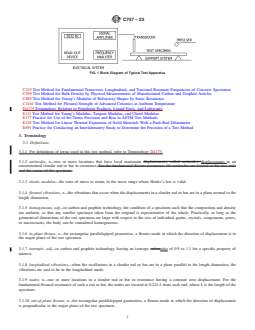
1.2 This test method determines elastic properties by measuring the fundamental resonant frequency of test specimens of suitable geometry by exciting them mechanically by a singular elastic strike with an impulse tool. Specimen supports, impulse locations, and signal pick-up points are selected to induce and measure specific modes of the transient vibrations. A transducer (for example, contact accelerometer or non-contacting microphone) senses the resulting mechanical vibrations of the specimen and transforms them into electric signals. (See Fig. 1.) The transient signals are analyzed, and the fundamental resonant frequency is isolated and measured by the signal analyzer, which provides a numerical reading that is (or is proportional to) either the frequency or the period of the specimen vibration. The appropriate fundamental resonant frequencies, dimensions, and mass of the specimen are used to calculate dynamic Young's modulus, dynamic shear modulus, and Poisson's ratio. Annex A1 contains an alternative approach using continuous excitation.
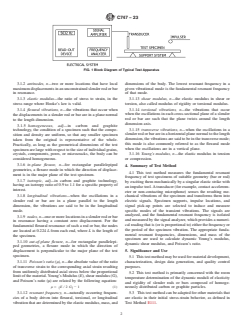
FIG. 1 Block Diagram of Typical Test Apparatus
1.3 The values stated in SI units are to be regarded as standard. No other units of measurement are included in this standard.
1.4 This standard does not purport to address all of the safety concerns, if any, associated with its use. It is the responsibility of the user of this standard to establish appropriate safety, health, and environmental practices and determine the applicability of regulatory limitations prior to use.
1.5 This international standard was developed in accordance with internationally recognized principles on standardization established in the Decision on Principles for the Development of International Standards, Guides and Recommendations issued by the World Trade Organization Technical Barriers to Trade (TBT) Committee.
- Status
- Published
- Publication Date
- 30-Sep-2023
- Technical Committee
- D02 - Petroleum Products, Liquid Fuels, and Lubricants
- Drafting Committee
- D02.F0 - Manufactured Carbon and Graphite Products
Buy Documents
ASTM C747-23 - Standard Test Method for Moduli of Elasticity and Fundamental Frequencies of Carbon and Graphite Materials by Sonic Resonance
REDLINE ASTM C747-23 - Standard Test Method for Moduli of Elasticity and Fundamental Frequencies of Carbon and Graphite Materials by Sonic Resonance
Overview
ASTM C747-23 is the Standard Test Method for Moduli of Elasticity and Fundamental Frequencies of Carbon and Graphite Materials by Sonic Resonance. This internationally recognized ASTM standard specifies procedures for determining the dynamic elastic properties-such as Young’s modulus, shear modulus, and Poisson’s ratio-of isotropic and near-isotropic carbon and graphite materials. The primary method involves measuring the fundamental resonant frequency of test specimens in various vibrational modes at ambient temperature. These dynamic measurements are critical for material characterization, design data generation, material development, and quality control in industries utilizing advanced carbon and graphite products.
Key Topics
- Dynamic Elastic Modulus Measurement: The standard outlines how to determine Young’s modulus and shear modulus by assessing the fundamental resonant frequencies in flexural, longitudinal, and torsional vibration modes.
- Test Specimen Geometries: Guidance is provided for preparing specimens of rectangular or cylindrical cross-section, with specific requirements on dimension tolerances and ratios to ensure accurate results.
- Resonant Frequency Testing: Measurement involves mechanically exciting the specimen with an impulse tool and capturing resulting vibrations via transducers (such as accelerometers or microphones).
- Calculation Procedures: The test method details the use of the measured frequencies, specimen mass, and geometry to calculate dynamic elastic properties through established equations.
- Application to Other Materials: While primarily focused on carbon and graphite, the procedure can be adapted for other materials showing elastic behavior as described in ASTM E111.
- Repeatability and Reproducibility: The standard discusses precision, repeatability, and reproducibility of results and highlights techniques to ensure reliable data collection.
- Temperature Range Adaptation: Although the standard focuses on room temperature determinations, methods are mentioned for extending measurements from –75 °C up to 2500 °C.
Applications
The ASTM C747-23 test method offers significant practical value across several areas:
- Material Development and Research: Provides accurate data on the dynamic elastic properties of new or modified carbon and graphite materials, aiding in the development of advanced products for engineering applications.
- Quality Control: Offers a non-destructive, reliable means to ensure uniformity and specification compliance for batches of carbon and graphite components.
- Design Data Generation: Supplies essential elastic modulus values needed for mechanical design calculations, ensuring safety and performance in critical applications such as aerospace, electronics, and energy sectors.
- Characterization of Mechanical Behavior: Enables comprehensive understanding of how carbon and graphite materials respond to dynamic stresses, essential for predicting lifecycle and durability.
- Adaptability: With modifications detailed in the standard, the method can also evaluate other elastic materials and can be extended to testing at various temperatures, including high-temperature applications.
Related Standards
ASTM C747-23 references several related ASTM standards, including:
- ASTM C215: Test Method for Fundamental Transverse, Longitudinal, and Torsional Resonant Frequencies of Concrete Specimens
- ASTM C559: Test Method for Bulk Density by Physical Measurements of Manufactured Carbon and Graphite Articles
- ASTM C885: Test Method for Young’s Modulus of Refractory Shapes by Sonic Resonance
- ASTM C1161: Test Method for Flexural Strength of Advanced Ceramics at Ambient Temperature
- ASTM E111: Test Method for Young’s Modulus, Tangent Modulus, and Chord Modulus
- ASTM E228: Test Method for Linear Thermal Expansion of Solid Materials with a Push-Rod Dilatometer
These referenced methods ensure seamless integration for laboratories and engineers already utilizing ASTM procedures for related measurements.
By following ASTM C747-23, engineers and researchers can ensure accurate, repeatable, and standardized determination of elastic properties in carbon and graphite, facilitating high-performance applications and reliable material quality control. For the most current information and in-depth procedural details, users should consult the official ASTM standard.
Relations
- Effective Date
- 01-Oct-2023
- Refers
ASTM D4175-23a - Standard Terminology Relating to Petroleum Products, Liquid Fuels, and Lubricants - Effective Date
- 15-Dec-2023
- Refers
ASTM D4175-23 - Standard Terminology Relating to Petroleum Products, Liquid Fuels, and Lubricants - Effective Date
- 01-Jul-2023
- Refers
ASTM D4175-23e1 - Standard Terminology Relating to Petroleum Products, Liquid Fuels, and Lubricants - Effective Date
- 01-Jul-2023
- Effective Date
- 01-Oct-2023
- Effective Date
- 01-Oct-2023
- Effective Date
- 01-Oct-2023
- Effective Date
- 01-Oct-2023
- Effective Date
- 01-Oct-2023
- Effective Date
- 01-Oct-2023
- Referred By
ASTM D8255-19 - Standard Guide for Work of Fracture Measurements on Small Nuclear Graphite Specimens - Effective Date
- 01-Oct-2023
- Effective Date
- 01-Oct-2023
- Effective Date
- 01-Oct-2023
- Effective Date
- 01-Oct-2023
- Effective Date
- 01-Oct-2023
Buy Documents
ASTM C747-23 - Standard Test Method for Moduli of Elasticity and Fundamental Frequencies of Carbon and Graphite Materials by Sonic Resonance
REDLINE ASTM C747-23 - Standard Test Method for Moduli of Elasticity and Fundamental Frequencies of Carbon and Graphite Materials by Sonic Resonance
Get Certified
Connect with accredited certification bodies for this standard

ECOCERT
Organic and sustainability certification.

Eurofins Food Testing Global
Global leader in food, environment, and pharmaceutical product testing.

Intertek Bangladesh
Intertek certification and testing services in Bangladesh.
Sponsored listings
Frequently Asked Questions
ASTM C747-23 is a standard published by ASTM International. Its full title is "Standard Test Method for Moduli of Elasticity and Fundamental Frequencies of Carbon and Graphite Materials by Sonic Resonance". This standard covers: SIGNIFICANCE AND USE 5.1 This test method may be used for material development, characterization, design data generation, and quality control purposes. 5.2 This test method is primarily concerned with the room temperature determination of the dynamic moduli of elasticity and rigidity of slender rods or bars composed of homogeneously distributed carbon or graphite particles. 5.3 This test method can be adapted for other materials that are elastic in their initial stress-strain behavior, as defined in Test Method E111. 5.4 This basic test method can be modified to determine elastic moduli behavior at temperatures from –75 °C to +2500 °C. Thin graphite rods may be used to project the specimen extremities into ambient temperature conditions to provide resonant frequency detection by the use of transducers as described in 7.1. SCOPE 1.1 This test method covers determination of the dynamic elastic properties of isotropic and near isotropic carbon and graphite materials at ambient temperatures. Specimens of these materials possess specific mechanical resonant frequencies that are determined by the elastic modulus, mass, and geometry of the test specimen. The dynamic elastic properties of a material can therefore be computed if the geometry, mass, and mechanical resonant frequencies of a suitable (rectangular or cylindrical) test specimen of that material can be measured. Dynamic Young's modulus is determined using the resonant frequency in the flexural or longitudinal mode of vibration. The dynamic shear modulus, or modulus of rigidity, is found using torsional resonant vibrations. Dynamic Young's modulus and dynamic shear modulus are used to compute Poisson's ratio. 1.2 This test method determines elastic properties by measuring the fundamental resonant frequency of test specimens of suitable geometry by exciting them mechanically by a singular elastic strike with an impulse tool. Specimen supports, impulse locations, and signal pick-up points are selected to induce and measure specific modes of the transient vibrations. A transducer (for example, contact accelerometer or non-contacting microphone) senses the resulting mechanical vibrations of the specimen and transforms them into electric signals. (See Fig. 1.) The transient signals are analyzed, and the fundamental resonant frequency is isolated and measured by the signal analyzer, which provides a numerical reading that is (or is proportional to) either the frequency or the period of the specimen vibration. The appropriate fundamental resonant frequencies, dimensions, and mass of the specimen are used to calculate dynamic Young's modulus, dynamic shear modulus, and Poisson's ratio. Annex A1 contains an alternative approach using continuous excitation. FIG. 1 Block Diagram of Typical Test Apparatus 1.3 The values stated in SI units are to be regarded as standard. No other units of measurement are included in this standard. 1.4 This standard does not purport to address all of the safety concerns, if any, associated with its use. It is the responsibility of the user of this standard to establish appropriate safety, health, and environmental practices and determine the applicability of regulatory limitations prior to use. 1.5 This international standard was developed in accordance with internationally recognized principles on standardization established in the Decision on Principles for the Development of International Standards, Guides and Recommendations issued by the World Trade Organization Technical Barriers to Trade (TBT) Committee.
SIGNIFICANCE AND USE 5.1 This test method may be used for material development, characterization, design data generation, and quality control purposes. 5.2 This test method is primarily concerned with the room temperature determination of the dynamic moduli of elasticity and rigidity of slender rods or bars composed of homogeneously distributed carbon or graphite particles. 5.3 This test method can be adapted for other materials that are elastic in their initial stress-strain behavior, as defined in Test Method E111. 5.4 This basic test method can be modified to determine elastic moduli behavior at temperatures from –75 °C to +2500 °C. Thin graphite rods may be used to project the specimen extremities into ambient temperature conditions to provide resonant frequency detection by the use of transducers as described in 7.1. SCOPE 1.1 This test method covers determination of the dynamic elastic properties of isotropic and near isotropic carbon and graphite materials at ambient temperatures. Specimens of these materials possess specific mechanical resonant frequencies that are determined by the elastic modulus, mass, and geometry of the test specimen. The dynamic elastic properties of a material can therefore be computed if the geometry, mass, and mechanical resonant frequencies of a suitable (rectangular or cylindrical) test specimen of that material can be measured. Dynamic Young's modulus is determined using the resonant frequency in the flexural or longitudinal mode of vibration. The dynamic shear modulus, or modulus of rigidity, is found using torsional resonant vibrations. Dynamic Young's modulus and dynamic shear modulus are used to compute Poisson's ratio. 1.2 This test method determines elastic properties by measuring the fundamental resonant frequency of test specimens of suitable geometry by exciting them mechanically by a singular elastic strike with an impulse tool. Specimen supports, impulse locations, and signal pick-up points are selected to induce and measure specific modes of the transient vibrations. A transducer (for example, contact accelerometer or non-contacting microphone) senses the resulting mechanical vibrations of the specimen and transforms them into electric signals. (See Fig. 1.) The transient signals are analyzed, and the fundamental resonant frequency is isolated and measured by the signal analyzer, which provides a numerical reading that is (or is proportional to) either the frequency or the period of the specimen vibration. The appropriate fundamental resonant frequencies, dimensions, and mass of the specimen are used to calculate dynamic Young's modulus, dynamic shear modulus, and Poisson's ratio. Annex A1 contains an alternative approach using continuous excitation. FIG. 1 Block Diagram of Typical Test Apparatus 1.3 The values stated in SI units are to be regarded as standard. No other units of measurement are included in this standard. 1.4 This standard does not purport to address all of the safety concerns, if any, associated with its use. It is the responsibility of the user of this standard to establish appropriate safety, health, and environmental practices and determine the applicability of regulatory limitations prior to use. 1.5 This international standard was developed in accordance with internationally recognized principles on standardization established in the Decision on Principles for the Development of International Standards, Guides and Recommendations issued by the World Trade Organization Technical Barriers to Trade (TBT) Committee.
ASTM C747-23 is classified under the following ICS (International Classification for Standards) categories: 71.060.10 - Chemical elements. The ICS classification helps identify the subject area and facilitates finding related standards.
ASTM C747-23 has the following relationships with other standards: It is inter standard links to ASTM C747-16, ASTM D4175-23a, ASTM D4175-23, ASTM D4175-23e1, ASTM E1875-20a, ASTM C1259-21, ASTM C885-87(2020), ASTM C781-20, ASTM C769-15(2020)e1, ASTM C783-85(2020), ASTM D8255-19, ASTM D7775-21, ASTM D8356-20, ASTM C1198-20, ASTM D6354-23. Understanding these relationships helps ensure you are using the most current and applicable version of the standard.
ASTM C747-23 is available in PDF format for immediate download after purchase. The document can be added to your cart and obtained through the secure checkout process. Digital delivery ensures instant access to the complete standard document.
Standards Content (Sample)
This international standard was developed in accordance with internationally recognized principles on standardization established in the Decision on Principles for the
Development of International Standards, Guides and Recommendations issued by the World Trade Organization Technical Barriers to Trade (TBT) Committee.
Designation: C747 − 23
Standard Test Method for
Moduli of Elasticity and Fundamental Frequencies of
Carbon and Graphite Materials by Sonic Resonance
This standard is issued under the fixed designation C747; the number immediately following the designation indicates the year of
original adoption or, in the case of revision, the year of last revision. A number in parentheses indicates the year of last reapproval. A
superscript epsilon (´) indicates an editorial change since the last revision or reapproval.
1. Scope* 1.4 This standard does not purport to address all of the
safety concerns, if any, associated with its use. It is the
1.1 This test method covers determination of the dynamic
responsibility of the user of this standard to establish appro-
elastic properties of isotropic and near isotropic carbon and
priate safety, health, and environmental practices and deter-
graphite materials at ambient temperatures. Specimens of these
mine the applicability of regulatory limitations prior to use.
materials possess specific mechanical resonant frequencies that
1.5 This international standard was developed in accor-
are determined by the elastic modulus, mass, and geometry of
dance with internationally recognized principles on standard-
the test specimen. The dynamic elastic properties of a material
ization established in the Decision on Principles for the
can therefore be computed if the geometry, mass, and mechani-
Development of International Standards, Guides and Recom-
cal resonant frequencies of a suitable (rectangular or cylindri-
mendations issued by the World Trade Organization Technical
cal) test specimen of that material can be measured. Dynamic
Barriers to Trade (TBT) Committee.
Young’s modulus is determined using the resonant frequency
in the flexural or longitudinal mode of vibration. The dynamic
2. Referenced Documents
shear modulus, or modulus of rigidity, is found using torsional
2.1 ASTM Standards:
resonant vibrations. Dynamic Young’s modulus and dynamic
C215 Test Method for Fundamental Transverse,
shear modulus are used to compute Poisson’s ratio.
Longitudinal, and Torsional Resonant Frequencies of
1.2 This test method determines elastic properties by mea-
Concrete Specimens
suring the fundamental resonant frequency of test specimens of
C559 Test Method for Bulk Density by Physical Measure-
suitable geometry by exciting them mechanically by a singular
ments of Manufactured Carbon and Graphite Articles
elastic strike with an impulse tool. Specimen supports, impulse
C885 Test Method for Young’s Modulus of Refractory
locations, and signal pick-up points are selected to induce and
Shapes by Sonic Resonance
measure specific modes of the transient vibrations. A trans-
C1161 Test Method for Flexural Strength of Advanced
ducer (for example, contact accelerometer or non-contacting
Ceramics at Ambient Temperature
microphone) senses the resulting mechanical vibrations of the
D4175 Terminology Relating to Petroleum Products, Liquid
specimen and transforms them into electric signals. (See Fig.
Fuels, and Lubricants
1.) The transient signals are analyzed, and the fundamental
E111 Test Method for Young’s Modulus, Tangent Modulus,
resonant frequency is isolated and measured by the signal
and Chord Modulus
analyzer, which provides a numerical reading that is (or is
E177 Practice for Use of the Terms Precision and Bias in
proportional to) either the frequency or the period of the
ASTM Test Methods
specimen vibration. The appropriate fundamental resonant
E228 Test Method for Linear Thermal Expansion of Solid
frequencies, dimensions, and mass of the specimen are used to
Materials With a Push-Rod Dilatometer
calculate dynamic Young’s modulus, dynamic shear modulus,
E691 Practice for Conducting an Interlaboratory Study to
and Poisson’s ratio. Annex A1 contains an alternative approach
Determine the Precision of a Test Method
using continuous excitation.
3. Terminology
1.3 The values stated in SI units are to be regarded as
standard. No other units of measurement are included in this
3.1 Definitions:
standard.
3.1.1 For definitions of terms used in this test method, refer
to Terminology D4175.
This test method is under the jurisdiction of ASTM Committee D02 on
Petroleum Products, Liquid Fuels, and Lubricants and is the direct responsibility of
Subcommittee D02.F0 on Manufactured Carbon and Graphite Products. For referenced ASTM standards, visit the ASTM website, www.astm.org, or
Current edition approved Oct. 1, 2023. Published November 2023. Originally contact ASTM Customer Service at service@astm.org. For Annual Book of ASTM
approved in 1974. Last previous edition approved in 2016 as C747 – 16. DOI: Standards volume information, refer to the standard’s Document Summary page on
10.1520/C0747-23. the ASTM website.
*A Summary of Changes section appears at the end of this standard
Copyright © ASTM International, 100 Barr Harbor Drive, PO Box C700, West Conshohocken, PA 19428-2959. United States
C747 − 23
FIG. 1 Block Diagram of Typical Test Apparatus
3.1.2 antinodes, n—two or more locations that have local dimensions of the body. The lowest resonant frequency in a
maximum displacements in an unconstrained slender rod or bar given vibrational mode is the fundamental resonant frequency
in resonance. of that mode.
3.1.13 shear modulus, n—the elastic modulus in shear or
3.1.3 elastic modulus—the ratio of stress to strain, in the
stress range where Hooke’s law is valid. torsion, also called modulus of rigidity or torsional modulus.
3.1.14 torsional vibrations, n—the vibrations that occur
3.1.4 flexural vibrations, n—the vibrations that occur when
when the oscillations in each cross-sectional plane of a slender
the displacements in a slender rod or bar are in a plane normal
rod or bar are such that the plane twists around the length
to the length dimension.
dimension axis.
3.1.5 homogeneous, adj—in carbon and graphite
3.1.15 transverse vibrations, n—when the oscillations in a
technology, the condition of a specimen such that the compo-
slender rod or bar are in a horizontal plane normal to the length
sition and density are uniform, so that any smaller specimen
dimension, the vibrations are said to be in the transverse mode;
taken from the original is representative of the whole.
this mode is also commonly referred to as the flexural mode
Practically, as long as the geometrical dimensions of the test
when the oscillations are in a vertical plane.
specimen are large with respect to the size of individual grains,
crystals, components, pores, or microcracks, the body can be 3.1.16 Young’s modulus, n—the elastic modulus in tension
considered homogeneous. or compression.
3.1.6 in-plane flexure, n—for rectangular parallelepiped
4. Summary of Test Method
geometries, a flexure mode in which the direction of displace-
4.1 This test method measures the fundamental resonant
ment is in the major plane of the test specimen.
frequency of test specimens of suitable geometry (bar or rod)
3.1.7 isotropic, adj—in carbon and graphite technology,
by exciting them mechanically by a singular elastic strike with
having an isotropy ratio of 0.9 to 1.1 for a specific property of
an impulse tool. A transducer (for example, contact accelerom-
interest.
eter or non-contacting microphone) senses the resulting me-
3.1.8 longitudinal vibrations—when the oscillations in a chanical vibrations of the specimen and transforms them into
slender rod or bar are in a plane parallel to the length
electric signals. Specimen supports, impulse locations, and
dimension, the vibrations are said to be in the longitudinal signal pick-up points are selected to induce and measure
mode.
specific modes of the transient vibrations. The signals are
analyzed, and the fundamental resonant frequency is isolated
3.1.9 nodes, n—one or more locations in a slender rod or bar
and measured by the signal analyzer, which provides a numeri-
in resonance having a constant zero displacement. For the
cal reading that is (or is proportional to) either the frequency or
fundamental flexural resonance of such a rod or bar, the nodes
the period of the specimen vibration. The appropriate funda-
are located at 0.224 L from each end, where L is the length of
mental resonant frequencies, dimensions, and mass of the
the specimen.
specimen are used to calculate dynamic Young’s modulus,
3.1.10 out-of-plane flexure, n—for rectangular parallelepi-
dynamic shear modulus, and Poisson’s ratio.
ped geometries, a flexure mode in which the direction of
displacement is perpendicular to the major plane of the test 5. Significance and Use
specimen.
5.1 This test method may be used for material development,
3.1.11 Poisson’s ratio (μ), n—the absolute value of the ratio characterization, design data generation, and quality control
of transverse strain to the corresponding axial strain resulting purposes.
from uniformly distributed axial stress below the proportional
5.2 This test method is primarily concerned with the room
limit of the material. Young’s Modulus (E), shear modulus (G),
temperature determination of the dynamic moduli of elasticity
and Poisson’s ratio (μ) are related by the following equation:
and rigidity of slender rods or bars composed of homoge-
μ 5 E ⁄ 2 G 2 1 (1) neously distributed carbon or graphite particles.
~ !
3.1.12 resonant frequency, n—naturally occurring frequen- 5.3 This test method can be adapted for other materials that
cies of a body driven into flexural, torsional, or longitudinal are elastic in their initial stress-strain behavior, as defined in
vibration that are determined by the elastic modulus, mass, and Test Method E111.
C747 − 23
5.4 This basic test method can be modified to determine 6.3 The test method assumes that the specimen is vibrating
elastic moduli behavior at temperatures from –75 °C to freely, with no significant restraint or impediment. Specimen
+2500 °C. Thin graphite rods may be used to project the supports should be designed and located properly in accor-
specimen extremities into ambient temperature conditions to dance with 9.3.1, 9.4.1, and 9.5.1 so the specimen can vibrate
provide resonant frequency detection by the use of transducers freely in the desired mode. In using direct contact transducers,
as described in 7.1. the transducer should be positioned away from antinodes and
with minimal force to avoid interference with free vibration.
6. Interferences With non-contacting transducers, the maximum sensitivity is
accomplished by placing the transducer at an antinode.
6.1 The relationships between resonant frequency and dy-
namic modulus presented herein are specifically applicable to 6.4 Proper location of the impulse point and transducer is
important in introducing and measuring the desired vibration
homogeneous, elastic, isotropic materials.
6.1.1 This method of determining the moduli is applicable mode. The locations of the impulse point and transducer should
not be changed in multiple readings; changes in position may
to inhomogeneous materials only with careful consideration of
the effect of inhomogeneities and anisotropy. The character develop and detect alternative vibration modes. In the same
manner, the force used in impacting should be consistent in
(volume fraction, size, morphology, distribution, orientation,
elastic properties, and interfacial bonding) of inhomogeneities multiple readings.
in the specimens will have a direct effect on the elastic
6.5 If the frequency readings are not repeatable for a
properties of the specimen as a whole. These effects must be
specific set of impulse and transducer locations on a specimen,
considered in interpreting the test results for composites and
it may be because several different modes of vibration are
inhomogeneous materials.
being developed and detected in the test. The geometry of the
6.1.2 The procedure involves measuring transient elastic
test bar and desired vibration mode should be evaluated and
vibrations. Materials with very high damping capacity may be
used to identify the nodes and antinodes of the desired
difficult to measure with this technique if the vibration damps
vibrations. More consistent measurements may be obtained if
out before the frequency counter can measure the signal
the impulse point and transducer locations are shifted to induce
(commonly within three to five vibration cycles).
and measure the single desired mode of vibration.
6.1.3 If specific surface treatments (coatings, machining,
grinding, etching, etc.) change the elastic properties of the
7. Apparatus
near-surface material, there may be accentuated effects on the
7.1 Apparatus suitable for accurately detecting, analyzing,
properties measured by this flexural method, as compared to
and measuring the fundamental resonant frequency or period of
static bulk measurements by tensile or compression testing.
a vibrating free beam is used. The test apparatus is shown in
6.1.4 The test method is not satisfactory for specimens that
Fig. 1. It consists of an impulser, a suitable pickup transducer
have major discontinuities, such as large cracks (internal or
to convert the mechanical vibration into an electrical signal, an
surface) or voids.
electronic system (consisting of a signal conditioner/amplifier,
6.2 This test method for determining moduli is limited to
a signal analyzer, and a frequency readout device), and a
specimens with regular geometries (rectangular parallelepiped
support system. Commercial instrumentation is available that
and cylinders) for which analytical equations are available to
measures the frequency or period of the vibrating specimen.
relate geometry, mass, and modulus to the resonant vibration
7.2 Impulser—The exciting impulse is imparted by lightly
frequencies. The test method is not appropriate for determining
striking the specimen with a suitable implement. This imple-
the elastic properties of materials that cannot be fabricated into
ment should have most of its mass concentrated at the point of
such geometries.
impact and have mass sufficient to induce a measurable
6.2.1 The analytical equations assume parallel and concen-
mechanical vibration, but not so large as to displace or damage
tric dimensions for the regular geometries of the specimen.
the specimen physically. In practice, the size and geometry of
Deviations from the specified tolerances for the dimensions of
the impulser depends on the size and mass and elastic
the specimens will change the resonant frequencies and intro-
properties of the specimen and the force needed to produce
duce error into the calculations.
vibration. For commonly tested geometries (small bars, rods,
6.2.2 Edge treatments such as chamfers or radii are not
and discs) in advanced ceramics, an example of such an
considered in the analytical equations. Edge chamfers on
impulser would be a steel sphere 6 mm in diameter glued to the
flexure bars prepared according to Test Method C1161 will
end of a flexible 10 cm long polymer rod. (See Fig. 2.) An
change the resonant frequency of the test bars and introduce
alternative impulser would be a solid metal, ceramic, or
error into the calculations of the dynamic modulus. It is
polymer sphere (2 mm to 20 mm in diameter) dropped on the
recommended that specimens for this test method not have
specimen through a guide tube to ensure proper impulse
chamfered or rounded edges.
position.
6.2.3 For specimens with as-fabricated and rough or uneven
surfaces, variations in dimensions can have a significant effect 7.3 Signal Pickup—Signal detection can be via transducers
in the calculations. For example, in the calculation of dynamic in direct contact with the specimen or by non-contact trans-
modulus, the modulus value is inversely proportional to the ducers. Contact transducers are commonly accelerometers
cube of the thickness. Uniform specimen dimensions and using piezoelectric or strain gage methods to measure the
precise measurements are essential for accurate results. vibration. Non-contact transducers are commonly acoustic
C747 − 23
shear modulus. Although the equations for computing shear
modulus with a cylindrical specimen are both simpler and more
accurate than those used with a rectangular bar, experimental
difficulties in obtaining torsional resonant frequencies for a
cylindrical specimen usually preclude its use for determining
shear modulus.
8.2 Resonant frequencies for a given specimen are func-
tions of the specimen dimensions as well as its mass and
moduli. Dimensions should therefore be selected with this
relationship in mind. The selection of size shall be made so
that, for an estimated modulus, the resonant frequencies
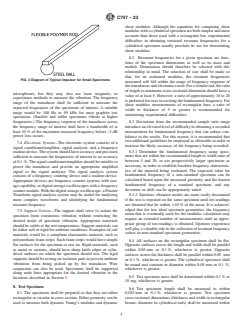
FIG. 2 Diagram of Typical Impulser for Small Specimens
measured will fall within the range of frequency response of
the transducers and electronics used. For a slender rod, the ratio
of length to minimum cross-sectional dimension should have a
microphones, but they may also use laser, magnetic, or
value of at least 5. However, a ratio of approximately 10 to 20
capacitance methods to measure the vibration. The frequency
is preferred for ease in exciting the fundamental frequency. For
range of the transducer shall be sufficient to measure the
shear modulus measurements of rectangular bars, a ratio of
expected frequencies of the specimens of interest. A suitable
width to thickness of 5 or greater is recommended for
range would be 100 Hz to 50 kHz for most graphite test
minimizing experimental difficulties.
specimens. (Smaller and stiffer specimens vibrate at higher
frequencies.) The frequency response of the transducer across 8.3 Deviations from the recommended sample ratio range
the frequency range of interest shall have a bandwidth of at introduce an elevated level of difficulty in obtaining a recorded
least 10 % of the maximum measured frequency before –3 dB measurement for fundamental frequency that can reduce con-
power loss occurs. fidence in the results. For this reason, it is recommended that
two additional guidelines be employed as allowable in order to
7.4 Electronic System—The electronic system consists of a
increase the likely accuracy of the frequency being recorded:
signal conditioner/amplifier, signal analyzer, and a frequency
8.3.1 Determine the fundamental frequency using speci-
readout device. The system should have accuracy and precision
mens that are within the recommended length to width ratio of
sufficient to measure the frequencies of interest to an accuracy
between 5 and 20, or use progressively larger specimens as
of 0.1 %. The signal conditioner/amplifier should be suitable to
necessary, in order to establish baseline frequency characteris-
power the transducer and provide an appropriate amplified
tics of the material being evaluated. The expected value for
signal to the signal analyzer. The signal analysis system
fundamental frequency of a non-standard specimen can be
consists of a frequency counting device and a readout device.
calculated based upon the measured geometry and the known
Appropriate devices are frequency counter systems with stor-
fundamental frequency of a standard specimen, and any
age capability or digital storage oscilloscopes with a frequency
deviation or shift can be appropriately noted.
counter module. With the digital storage oscilloscope, a Fourier
Transform signal analysis system may be useful for analyzing 8.3.2 Spurious vibration modes are more easily discounted
more complex waveforms and identifying the fundamental if the test is repeated on the same specimen until ten readings
resonant frequency. are obtained that lie within 610 % of the mean. It is acknowl-
edged that for less ideal specimen geometries, the frequency
7.5 Support System—The support shall serve to isolate the
mean that is eventually used for the modulus calculation may
specimen from extraneous vibration without restricting the
require an extended number of measurements until an appro-
desired mode of specimen vibration. Appropriate materials
priate group of ten readings is obtained. Operator experience
should be stable at the test temperatures. Support materials can
will play a valuable role in the collection of resonant frequency
be either soft or rigid for ambient conditions. Examples of soft
values in non-standard specimen geometries.
materials would be a compliant elastomeric material, such as
polyurethane foam strips. Such foam strips would have simple
8.4 All surfaces on the rectangular specimen shall be flat.
flat surfaces for the specimen to rest on. Rigid materials, such
Opposite surfaces across the length and width shall be parallel
as metal or ceramic, should have sharp knife edges or cylin-
within 0.05 mm or 0.1 %, whichever is greater. Opposite
drical surfaces on which the specimen should rest. The rigid
surfaces across the thickness shall be parallel within 0.05 mm
supports should be resting on isolation pads to prevent ambient
or 0.1 %, whichever is greater. The cylindrical specimen shall
vibrations from being picked up by the transducer. Wire
be round and constant in diameter within 0.05 mm or 0.1 %,
suspension can also be used. Specimens shall be supported
whichever is greater.
along node lines appropriate for the desired vibration in the
8.5 Test specimen mass shall be determined within 0.1 % or
locations described in Section 9.
10 mg, whichever is greater.
8. Test Specimen
8.6 Test specimen length shall be measured to within
8.1 The specimens shall be prepared so that they are either 0.025 mm or 0.1 %, whichever is greater. Test specimen
rectangular or circular in cross-section. Either geometry can be cross-sectional dimensions (thickness and width in rectangular
used to measure both dynamic Young’s modulus and dynamic beams; diameter in cylindrical rods) shall be measured within
C747 − 23
0.1 % or 0.025 mm, whichever is greater, at three equally 9.3.2 Determine the direction of maximum sensitivity for
spaced locations along the length and an average value the transducer. Orient the transducer so that it will detect the
determined. desired vibration.
9.3.2.1 Direct Contact Transducers—Place the transducer in
8.7 Porous materials and those susceptible to hydration
contact with the test specimen to pick up the desired vibration.
should be dried in air at 120 °C in a drying oven until the mass
If the transducer is placed at an antinode (location of maximum
is constant (less than 0.1 % or 10 mg difference in measured
displacement), it may mass load the specimen and modify the
mass with 30 min of additional drying).
natural vibration. The transducer should preferably be placed
8.8 It is recommended that the laboratory obtain and
only as far from the nodal points as necessary to obtain a
maintain an internal reference specimen with known and
reading (see Fig. 3). This location will minimize the damping
recorded fundamental resonant frequencies in flexure and
effect from the contacting transducer. The transducer contact
torsion. The reference specimen should be used to check and
force should be consistent, with good response and minimal
confirm the operation of the test system on a regular basis. It
interference with the free vibration of the specimen.
can also be used to train operators in the proper test setup and
9.3.2.2 Non-Contact Transducers—Place the non-contact
test procedure. The reference specimen can be a standard
transducer over an antinode point and close enough to the test
ceramic material (alumina, silicon carbide, zirconia, etc.) or it
specimen to pick up the desired vibration, but not so close as
may be of a similar size, composition, and microstructure to the
to interfere with the free vibration (see Fig. 3).
types of specimens commonly tested at the laboratory. The
9.3.3 Strike the specimen lightly and elastically, either at the
reference specimen must meet the size, dimensional tolerances,
center of the specimen or at the opposite end of the specimen
and surface finish requirements of Section 8.
from the detecting transducer (see Fig. 3).
9.3.4 Record the resultant reading, and repeat the test until
9. Procedure
a recommended ten readings are obtained that lie within 10 %
9.1 Activate all electrical equipment and allow it to stabilize
of the mean. The round-robin interlaboratory study (12.2)
according to the manufacturer’s recommendations.
showed that data points significantly (>10 %) out of range were
measurements of spurious vibration modes or secondary har-
9.2 Use a test specimen established as a verification/
monics. If ten readings cannot be taken, a minimum of five
calibration standard to verify the equipment response and
readings that lie within 10 % of the mean shall be required for
accuracy.
estimating the mean. Use the mean of these readings to
9.3 Fundamental Flexural Resonance Frequency (Out-of-
determine the fundamental resonant frequency in flexure.
Plane Flexure):
9.4 Fundamental Flexural Resonance Frequency (In-Plane
9.3.1 Place the specimen on the supports located at the
Flexure):
fundamental nodal points (0.224 L from each end; see Fig. 3).
9.4.1 This procedure is the same as that above (9.3), except
that the direction of vibration is in the major plane of the
specimen. Rotate the test bar 90° around its long axis and
reposition it on the specimen supports (see Fig. 3). Transpose
the width and thickness dimensions in the calculations. For
homogeneous, isotropic materials, the calculated moduli
should be the same as the moduli calculated from the out-of-
plane frequency. The comparison of in-plane and out-of-plane
frequency measurements can thus be used as a cross check of
experimental methods and calculations.
9.5 Fundamental Torsional Resonance Frequency:
9.5.1 Support the specimen at the midpoint of its length and
width (the torsional nodal planes) (see Fig. 4).
9.5.2 Locate the transducer at one quadrant of the
specimen, preferably at approximately 0.224 L from one end
and toward the edge. This location is a nodal point of flexural
vibration and will minimize the possibility of detecting a
spurious flexural mode (see Fig. 4).
9.5.3 Strike the specimen on the quadrant diagonally
opposite the transducer, again at 0.224 L from the end and near
the edge. Striking at a flexural nodal point will minimize the
possibility of exciting a flexural mode of vibration (see Fig. 4).
9.5.4 Record the resultant reading, and repeat the test until
a recommended ten readings are obtained that lie within 10 %
of the mean. The round-robin interlaboratory study (12.2)
showed that data points significantly (> 10 %) out of range
FIG. 3 Rectangular Specimens Tested for In-plane and Out-of-
plane Flexure were measurements of spurious vibration modes or secondary
C747 − 23
FIG. 4 Rectangular Specimen Tested for Torsional Vibration
harmonics. If ten readings cannot be taken, a minimum of five
t = thickness of the bar, mm (see Note 1 and Note 2),
readings that lie within 10 % of the mean shall be required for
μ = Poisson’s Ratio,
estimating the mean. Use the mean of these readings to f = fundamental resonant frequency of bar in flexure, Hz,
f
determine the fundamental resonant frequency in torsion.
and
T = correction factor for fundamental flexural mode to
9.6 Longitudinal Fundamental Resonance Frequency—This
account for finite thickness of bar, Poisson’s ratio, and
procedure is the same as that above (9.3), except that the
other factors.
direction of vibration is longitudinal along the long axis of the
2 4
specimen. However, the specimen should be supported at t t
T 5 116.585 1 1 0.0752 μ 1 0.8109 μ 20.868
~ !S D S D
locations other than their nodal points, as this will encourage L L
the specimen to vibrate in the flexural mode in addition to the
t
8.340~1 1 0.2023 μ 1 2.173 μ !
S D
longitudinal mode. Place either a contacting or non-contacting
L
2 (3)
transducer at one end of the specimen and strike the opposite
t
3 2 4
1.00016.338~1 1 0.1408 μ 1 1.536 μ !
S D
end to induce a vibration parallel to the specimen length. For
L
homogeneous, isotropic materials, the calculated moduli
NOTE 1—The width (b) and thickness (t) values used in the modulus
calculations (Eq 2 and Eq 3) for the rectangular specimens will depend on
should be the same as the moduli calculated from the in-plane
the type of vibration (out-of-plane or in-plane) induced in the specimen.
and out-of-plane frequency. A comparison to the in-plane and
The cross-sectional dimension t will always be parallel to the vibrational
out-of-plane modulus can thus be used as a cross check of
motion. The dimension b will always be perpendicular to the vibrational
experimental methods and calculations.
motion. In effect, the two different flexural modes will give two different
fundamental resonant frequencies, but the calculations for the two modes
10. Calculation
should give the same modulus value, because the values for b and t are
3,4
exchanged in the calculations for the two different flexure modes.
10.1 Dynamic Young’s Modulus :
NOTE 2—In the modulus equations, the mass and length terms are given
10.1.1 For the fundamental flexure frequency of a rectan-
in units of grams and millimeters. However, the defined equations can also
gular bar,
be used with mass and length terms in units of kilograms and meters with
no changes in terms or exponents.
2 3 3
E 5 0.9464~mf ⁄ b!~L ⁄ t !T (2)
f 1
10.1.1.1 If L / t ≥ 10, T can be simplified to the following:
where:
T 5 1.0001 6.585 t ⁄ L (4)
~ !
E = Young’s modulus, Pa,
m = mass of the bar, g (see Note 2),
and E can be calculated directly.
b = width of the bar, mm (see Note 1 and Note 2),
10.1.1.2 If L/t < 10 and Poisson’s ratio is known, then T ,
L = length of the bar, mm, (see Note 2),
can be calculated directly from Eq 3 and then used to calculate
E.
10.1.1.3 If L/t < 10 and Poisson’s ratio is not known, then
Spinner, S., Reichard, T. W., and Tefft, W. E., "A Comparison of Experimental
an initial Poisson’s ratio must be assumed to begin the
and Theoretical Relations Between Young’s Modulus and the Flexural and Longi-
computations. An iterative process is then used to determine a
tudinal Resonance Frequencies of Uniform Bars," Journal of Research of the
National Bureau of Standards-A. Physics and Chemistry, Vol 64A, No. 2, March-
value of Poisson’s ratio, based on experimental Young’s
April, 1960.
modulus and shear modulus. The iterative process is illustrated
Spinner, S., and Tefft, W. E., "A Method for Determining Mechanical
by the flowchart in Fig. 5 and described in (1) through (5)
Resonance Frequencies and for Calculating Elastic Moduli from These
Frequencies," Proceedings, ASTM, 1961, pp. 1221–1238. below.
C747 − 23
FIG. 5 Process Flowchart for Iterative Determination of Poisson’s Ratio
(1) Determine the fundamental flexural and torsional reso- 10.1.2.1 If L/D ≥ 10, then T ' can be simplified to the
nant frequency of the rectangular test specimen, as described in following:
Section 9. Using Eq 9 and Eq 10, calculate the dynamic shear
T ' 5 1.00014.939~D ⁄ L! (7)
modulus of the test specimen for the fundamental torsional
10.1.2.2 If L/ D < 10 and Poisson’s ratio is known, then T '
resonant frequency. 1
can be calculated directly from Eq 6 and then used to calculate
(2) Using Eq 2 and Eq 3, calculate the dynamic Young’s
E.
modulus of the rectangular test specimen from the fundamental
10.1.2.3 If L/ D < 10 and Poisson’ a ratio is not known, then
flexural resonant frequency, dimensions and mass of the
an initial Poisson’s ratio must be assumed to start the compu-
specimen, and initial/iterative Poisson’s ratio. Care shall be
tations. Final values for Poisson’s ratio, dynamic Young’s
exercised in using consistent units for all of the parameters
modulus, and dynamic shear modulus are determined, using
throughout the computations.
the same method shown in Fig. 5 and described in (1) through
(3) Substitute the dynamic shear modulus and Young’s
(5) in 10.1.1.3, but using the modulus equations for circular
modulus values calculated in steps (1) and (2) into Eq 12 for
bars (Eq 5, Eq 6, and Eq 7).
Poisson’s ratio satisfying isotropic conditions. Calculate a new
10.1.3 For the fundamental longitudinal frequency of a
value for Poisson’s ratio for another iteration beginning at Step
rectangular or circular bar:
(2).
2 2
(4) Repeat Steps (2) and (3) until no significant difference
E 5 4.000f L ρ (8)
l
(2 % or less) is observed between the last iterative value and
where:
the final computed value of the Poisson’s ratio.
f = fundamental resonant frequency of bar vibrating
(5) Self-consistent values for the moduli are thus obtained.
l
longitudinally, Hz, and
10.1.2 For the fun
...
This document is not an ASTM standard and is intended only to provide the user of an ASTM standard an indication of what changes have been made to the previous version. Because
it may not be technically possible to adequately depict all changes accurately, ASTM recommends that users consult prior editions as appropriate. In all cases only the current version
of the standard as published by ASTM is to be considered the official document.
Designation: C747 − 16 C747 − 23
Standard Test Method for
Moduli of Elasticity and Fundamental Frequencies of
Carbon and Graphite Materials by Sonic Resonance
This standard is issued under the fixed designation C747; the number immediately following the designation indicates the year of
original adoption or, in the case of revision, the year of last revision. A number in parentheses indicates the year of last reapproval. A
superscript epsilon (´) indicates an editorial change since the last revision or reapproval.
1. Scope*
1.1 This test method covers determination of the dynamic elastic properties of isotropic and near isotropic carbon and graphite
materials at ambient temperatures. Specimens of these materials possess specific mechanical resonant frequencies that are
determined by the elastic modulus, mass, and geometry of the test specimen. The dynamic elastic properties of a material can
therefore be computed if the geometry, mass, and mechanical resonant frequencies of a suitable (rectangular or cylindrical) test
specimen of that material can be measured. Dynamic Young’s modulus is determined using the resonant frequency in the flexural
or longitudinal mode of vibration. The dynamic shear modulus, or modulus of rigidity, is found using torsional resonant vibrations.
Dynamic Young’s modulus and dynamic shear modulus are used to compute Poisson’s ratio.
1.2 This test method determines elastic properties by measuring the fundamental resonant frequency of test specimens of suitable
geometry by exciting them mechanically by a singular elastic strike with an impulse tool. Specimen supports, impulse locations,
and signal pick-up points are selected to induce and measure specific modes of the transient vibrations. A transducer (for example,
contact accelerometer or non-contacting microphone) senses the resulting mechanical vibrations of the specimen and transforms
them into electric signals. (See Fig. 1.) The transient signals are analyzed, and the fundamental resonant frequency is isolated and
measured by the signal analyzer, which provides a numerical reading that is (or is proportional to) either the frequency or the period
of the specimen vibration. The appropriate fundamental resonant frequencies, dimensions, and mass of the specimen are used to
calculate dynamic Young’s modulus, dynamic shear modulus, and Poisson’s ratio. Annex A1 contains an alternative approach
using continuous excitation.
1.3 The values stated in SI units are to be regarded as standard. No other units of measurement are included in this standard.
1.4 This standard does not purport to address all of the safety concerns, if any, associated with its use. It is the responsibility
of the user of this standard to establish appropriate safety and healthsafety, health, and environmental practices and determine
the applicability of regulatory limitations prior to use.
1.5 This international standard was developed in accordance with internationally recognized principles on standardization
established in the Decision on Principles for the Development of International Standards, Guides and Recommendations issued
by the World Trade Organization Technical Barriers to Trade (TBT) Committee.
2. Referenced Documents
2.1 ASTM Standards:
This test method is under the jurisdiction of ASTM Committee D02 on Petroleum Products, Liquid Fuels, and Lubricants and is the direct responsibility of Subcommittee
D02.F0 on Manufactured Carbon and Graphite Products.
Current edition approved Oct. 1, 2016Oct. 1, 2023. Published January 2017November 2023. Originally approved in 1974. Last previous edition approved in 20102016
ɛ1
as C747 – 93 (2010)C747 – 16. . DOI: 10.1520/C0747-16.10.1520/C0747-23.
For referenced ASTM standards, visit the ASTM website, www.astm.org, or contact ASTM Customer Service at service@astm.org. For Annual Book of ASTM Standards
volume information, refer to the standard’s Document Summary page on the ASTM website.
*A Summary of Changes section appears at the end of this standard
Copyright © ASTM International, 100 Barr Harbor Drive, PO Box C700, West Conshohocken, PA 19428-2959. United States
C747 − 23
FIG. 1 Block Diagram of Typical Test Apparatus
C215 Test Method for Fundamental Transverse, Longitudinal, and Torsional Resonant Frequencies of Concrete Specimens
C559 Test Method for Bulk Density by Physical Measurements of Manufactured Carbon and Graphite Articles
C885 Test Method for Young’s Modulus of Refractory Shapes by Sonic Resonance
C1161 Test Method for Flexural Strength of Advanced Ceramics at Ambient Temperature
D4175 Terminology Relating to Petroleum Products, Liquid Fuels, and Lubricants
E111 Test Method for Young’s Modulus, Tangent Modulus, and Chord Modulus
E177 Practice for Use of the Terms Precision and Bias in ASTM Test Methods
E228 Test Method for Linear Thermal Expansion of Solid Materials With a Push-Rod Dilatometer
E691 Practice for Conducting an Interlaboratory Study to Determine the Precision of a Test Method
3. Terminology
3.1 Definitions:
3.1.1 For definitions of terms used in this test method, refer to Terminology D4175.
3.1.2 antinodes, n—two or more locations that have local maximum displacements, called antinodes, displacements in an
unconstrained slender rod or bar in resonance. For the fundamental flexure resonance, the antinodes are located at the two ends
and the center of the specimen.
3.1.3 elastic modulus—the ratio of stress to strain, in the stress range where Hooke’s law is valid.
3.1.4 flexural vibrations, n—the vibrations that occur when the displacements in a slender rod or bar are in a plane normal to the
length dimension.
3.1.5 homogeneous, adj—in carbon and graphite technology, the condition of a specimen such that the composition and density
are uniform, so that any smaller specimen taken from the original is representative of the whole. Practically, as long as the
geometrical dimensions of the test specimen are large with respect to the size of individual grains, crystals, components, pores,
or microcracks, the body can be considered homogeneous.
3.1.6 in-plane flexure, n—for rectangular parallelepiped geometries, a flexure mode in which the direction of displacement is in
the major plane of the test specimen.
3.1.7 isotropic, adj—in carbon and graphite technology, having an isotropy rationratio of 0.9 to 1.1 for a specific property of
interest.
3.1.8 longitudinal vibrations—when the oscillations in a slender rod or bar are in a plane parallel to the length dimension, the
vibrations are said to be in the longitudinal mode.
3.1.9 nodes, n—one or more locations in a slender rod or bar in resonance having a constant zero displacement. For the
fundamental flexural resonance of such a rod or bar, the nodes are located at 0.224 L from each end, where L is the length of the
specimen.
3.1.10 out-of-plane flexure, n—for rectangular parallelepiped geometries, a flexure mode in which the direction of displacement
is perpendicular to the major plane of the test specimen.
C747 − 23
3.1.11 Poisson’s rationratio (μ), n—the absolute value of the ratio of transverse strain to the corresponding axial strain resulting
from uniformly distributed axial stress below the proportional limit of the material. Young’s Modulus (E), shear modulus (G), and
Poisson’s ratio (μ) are related by the following equation:
μ 5 E ⁄ 2 G 2 1 (1)
~ !
3.1.12 resonant frequency, n—naturally occurring frequencies of a body driven into flexural, torsional, or longitudinal vibration
that are determined by the elastic modulus, mass, and dimensions of the body. The lowest resonant frequency in a given vibrational
mode is the fundamental resonant frequency of that mode.
3.1.13 shear modulus, n—the elastic modulus in shear or torsion. Alsotorsion, also called modulus of rigidity or torsional modulus.
3.1.14 torsional vibrations, n—the vibrations that occur when the oscillations in each cross-sectional plane of a slender rod or bar
are such that the plane twists around the length dimension axis.
3.1.15 transverse vibrations, n—when the oscillations in a slender rod or bar are in a horizontal plane normal to the length
dimension, the vibrations are said to be in the transverse mode. Thismode; this mode is also commonly referred to as the flexural
mode when the oscillations are in a vertical plane.
3.1.16 Young’s modulus, n—the elastic modulus in tension or compression.
4. Summary of Test Method
4.1 This test method measures the fundamental resonant frequency of test specimens of suitable geometry (bar or rod) by exciting
them mechanically by a singular elastic strike with an impulse tool. A transducer (for example, contact accelerometer or
non-contacting microphone) senses the resulting mechanical vibrations of the specimen and transforms them into electric signals.
Specimen supports, impulse locations, and signal pick-up points are selected to induce and measure specific modes of the transient
vibrations. The signals are analyzed, and the fundamental resonant frequency is isolated and measured by the signal analyzer,
which provides a numerical reading that is (or is proportional to) either the frequency or the period of the specimen vibration. The
appropriate fundamental resonant frequencies, dimensions, and mass of the specimen are used to calculate dynamic Young’s
modulus, dynamic shear modulus, and Poisson’s ratio.
5. Significance and Use
5.1 This test method may be used for material development, characterization, design data generation, and quality control purposes.
5.2 This test method is primarily concerned with the room temperature determination of the dynamic moduli of elasticity and
rigidity of slender rods or bars composed of homogeneously distributed carbon or graphite particles.
5.3 This test method can be adapted for other materials that are elastic in their initial stress-strain behavior, as defined in Test
Method E111.
5.4 This basic test method can be modified to determine elastic moduli behavior at temperatures from –75 °C to +2500 °C. –75 °C
to +2500 °C. Thin graphite rods may be used to project the specimen extremities into ambient temperature conditions to provide
resonant frequency detection by the use of transducers as described in 7.1.
6. Interferences
6.1 The relationships between resonant frequency and dynamic modulus presented herein are specifically applicable to
homogeneous, elastic, isotropic materials.
6.1.1 This method of determining the moduli is applicable to inhomogeneous materials only with careful consideration of the
effect of inhomogeneities and anisotropy. The character (volume fraction, size, morphology, distribution, orientation, elastic
properties, and interfacial bonding) of inhomogeneities in the specimens will have a direct effect on the elastic properties of the
specimen as a whole. These effects must be considered in interpreting the test results for composites and inhomogeneous materials.
C747 − 23
6.1.2 The procedure involves measuring transient elastic vibrations. Materials with very high damping capacity may be difficult
to measure with this technique if the vibration damps out before the frequency counter can measure the signal (commonly within
three to five vibration cycles).
6.1.3 If specific surface treatments (coatings, machining,’machining, grinding, etching, etc.) change the elastic properties of the
near-surface material, there may be accentuated effects on the properties measured by this flexural method, as compared to static
bulk measurements by tensile or compression testing.
6.1.4 The test method is not satisfactory for specimens that have major discontinuities, such as large cracks (internal or surface)
or voids.
6.2 This test method for determining moduli is limited to specimens with regular geometries (rectangular parallelepiped and
cylinders) for which analytical equations are available to relate geometry, mass, and modulus to the resonant vibration frequencies.
The test method is not appropriate for determining the elastic properties of materials that cannot be fabricated into such geometries.
6.2.1 The analytical equations assume parallel and concentric dimensions for the regular geometries of the specimen. Deviations
from the specified tolerances for the dimensions of the specimens will change the resonant frequencies and introduce error into
the calculations.
6.2.2 Edge treatments such as chamfers or radii are not considered in the analytical equations. Edge chamfers on flexure bars
prepared according to Test Method C1161 will change the resonant frequency of the test bars and introduce error into the
calculations of the dynamic modulus. It is recommended that specimens for this test method not have chamfered or rounded edges.
6.2.3 For specimens with as-fabricated and rough or uneven surfaces, variations in dimensions can have a significant effect in the
calculations. For example, in the calculation of dynamic modulus, the modulus value is inversely proportional to the cube of the
thickness. Uniform specimen dimensions and precise measurements are essential for accurate results.
6.3 The test method assumes that the specimen is vibrating freely, with no significant restraint or impediment. Specimen supports
should be designed and located properly in accordance with 9.3.1, 9.4.1, and 9.5.1 so the specimen can vibrate freely in the desired
mode. In using direct contact transducers, the transducer should be positioned away from antinodes and with minimal force to
avoid interference with free vibration. With non-contacting transducers, the maximum sensitivity is accomplished by placing the
transducer at an antinode.
6.4 Proper location of the impulse point and transducer is important in introducing and measuring the desired vibration mode. The
locations of the impulse point and transducer should not be changed in multiple readings; changes in position may develop and
detect alternative vibration modes. In the same manner, the force used in impacting should be consistent in multiple readings.
6.5 If the frequency readings are not repeatable for a specific set of impulse and transducer locations on a specimen, it may be
because several different modes of vibration are being developed and detected in the test. The geometry of the test bar and desired
vibration mode should be evaluated and used to identify the nodes and antinodes of the desired vibrations. More consistent
measurements may be obtained if the impulse point and transducer locations are shifted to induce and measure the single desired
mode of vibration.
7. Apparatus
7.1 Apparatus suitable for accurately detecting, analyzing, and measuring the fundamental resonant frequency or period of a
vibrating free beam is used. The test apparatus is shown in Fig. 1. It consists of an impulser, a suitable pickup transducer to convert
the mechanical vibration into an electrical signal, an electronic system (consisting of a signal conditioner/amplifier, a signal
analyzer, and a frequency readout device), and a support system. Commercial instrumentation is available that measures the
frequency or period of the vibrating specimen.
7.2 Impulser—The exciting impulse is imparted by lightly striking the specimen with a suitable implement. This implement should
have most of its mass concentrated at the point of impact and have mass sufficient to induce a measurable mechanical vibration,
but not so large as to displace or damage the specimen physically. In practice, the size and geometry of the impulser depends on
the size and weightand mass and elastic properties of the specimen and the force needed to produce vibration. For commonly tested
geometries (small bars, rods, and discs) in advanced ceramics, an example of such an impulser would be a steel sphere 6 mm in
C747 − 23
diameter glued to the end of a flexible 10 cm long polymer rod. (See Fig. 2.) An alternative impulser would be a solid metal,
ceramic, or polymer sphere (2 mm to 20 mm in diameter) dropped on the specimen through a guide tube to ensure proper impulse
position.
7.3 Signal Pickup—Signal detection can be via transducers in direct contact with the specimen or by non-contact transducers.
Contact transducers are commonly accelerometers using piezoelectric or strain gage methods to measure the vibration. Non-contact
transducers are commonly acoustic microphones, but they may also use laser, magnetic, or capacitance methods to measure the
vibration. The frequency range of the transducer shall be sufficient to measure the expected frequencies of the specimens of
interest. A suitable range would be 100 Hz to 50 kHz for most graphite test specimens. (Smaller and stiffer specimens vibrate at
higher frequencies.) The frequency response of the transducer across the frequency range of interest shall have a bandwidth of at
least 10 % of the maximum measured frequency before –3 dB power loss occurs.
7.4 Electronic System—The electronic system consists of a signal conditioner/amplifier, signal analyzer, and a frequency readout
device. The system should have accuracy and precision sufficient to measure the frequencies of interest to an accuracy of 0.1 %.
The signal conditioner/amplifier should be suitable to power the transducer and provide andan appropriate amplified signal to the
signal analyzer. The signal analysis system consists of a frequency counting device and a readout device. Appropriate devices are
frequency counter systems with storage capability or digital storage oscilloscopes with a frequency counter module. With the
digital storage oscilloscope, a Fast Fourier Transform signal analysis system may be useful for analyzing more complex waveforms
and identifying the fundamental resonant frequency.
7.5 Support System—The support shall serve to isolate the specimen from extraneous vibration without restricting the desired
mode of specimen vibration. Appropriate materials should be stable at the test temperatures. Support materials can be either soft
or rigid for ambient conditions. Examples of soft materials would be a compliant elastomeric material, such as polyurethane foam
strips. Such foam strips would have simple flat surfaces for the specimen to rest on. Rigid materials, such as metal or ceramic,
should have sharp knife edges or cylindrical surfaces on which the specimen should rest. The rigid supports should be resting on
isolation pads to prevent ambient vibrations from being picked up by the transducer. Wire suspension can also be used. Specimens
shall be supported along node lines appropriate for the desired vibration in the locations described in Section 9.
8. Test Specimen
8.1 The specimens shall be prepared so that they are either rectangular or circular in cross-section. Either geometry can be used
to measure both dynamic Young’s modulus and dynamic shear modulus. Although the equations for computing shear modulus with
a cylindrical specimen are both simpler and more accurate than those used with a rectangular bar, experimental difficulties in
obtaining torsional resonant frequencies for a cylindrical specimen usually preclude its use for determining shear modulus.
8.2 Resonant frequencies for a given specimen are functions of the specimen dimensions as well as its mass and moduli.
Dimensions should therefore be selected with this relationship in mind. The selection of size shall be made so that, for an estimated
modulus, the resonant frequencies measured will fall within the range of frequency response of the transducers and electronics
used. For a slender rod, the ratio of length to minimum cross-sectional dimension should have a value of at least 5. However, a
ratio of approximately 10 to 20 is preferred for ease in exciting the fundamental frequency. For shear modulus measurements of
rectangular bars, a ratio of width to thickness of 5 or greater is recommended for minimizing experimental difficulties.
8.3 Deviations from the recommended sample ratio range introduce an elevated level of difficulty in obtaining a recorded
FIG. 2 Diagram of Typical Impulser for Small Specimens
C747 − 23
measurement for fundamental frequency that the operator can have confidence in. can reduce confidence in the results. For this
reason, it is recommended that two additional guidelines be employed as allowable in order to increase the likely accuracy of the
frequency being recorded:
8.3.1 Determine the fundamental frequency using specimens that are within the recommended length to width ratio of between
5 and 20, or use progressively larger specimens as necessary, in order to establish baseline frequency characteristics of the material
being evaluated. The expected value for fundamental frequency of a non-standard specimen can be calculated based upon the
measured geometry and the known fundamental frequency of a standard specimen, and any deviation or shift can be appropriately
noted.
8.3.2 Spurious vibration modes are more easily discounted if the test is repeated on the same specimen until ten readings are
obtained that lie within 610 % of the mean. It is acknowledged that for less ideal specimen geometries, the frequency mean that
is eventually used for the modulus calculation may require an extended number of measurements until an appropriate group of ten
readings is obtained. Operator experience will play a valuable role in the collection of resonant frequency values in non-standard
specimen geometries.
8.4 All surfaces on the rectangular specimen shall be flat. Opposite surfaces across the length and width shall be parallel within
0.05 mm or 0.1 %, whichever is greater. Opposite surfaces across the thickness shall be parallel within 0.05 mm or 0.1 %,
whichever is greater. The cylindrical specimen shall be round and constant in diameter within 0.05 mm or 0.1 %, whichever is
greater.
8.5 Test specimen mass shall be determined within 0.1 % or 10 mg, whichever is greater.
8.6 Test specimen length shall be measured to within 0.025 mm or 0.1 %, 0.1 %, whichever is greater. Test specimen
cross-sectional dimensions (thickness and width in rectangular beams; diameter in cylindrical rods) shall be measured within
0.1%0.1 % or 0.025 mm, whichever is greater, at three equally spaced locations along the length and an average value determined.
8.7 Porous materials and those susceptible to hydration should be dried in air at 120 °C in a drying oven until the mass is constant
(less than 0.1 % or 10 mg difference in measured mass with 30 min of additional drying).
8.8 It is recommended that the laboratory obtain and maintain an internal reference specimen with known and recorded
fundamental resonant frequencies in flexure and torsion. The reference specimen should be used to check and confirm the operation
of the test system on a regular basis. It can also be used to train operators in the proper test setup and test procedure. The reference
specimen can be a standard ceramic material (alumina, silicon carbide, zirconia, etc.) or it may be of a similar size, composition,
and microstructure to the types of specimens commonly tested at the laboratory. The reference specimen must meet the size,
dimensional tolerances, and surface finish requirements of Section 8.
9. Procedure
9.1 Activate all electrical equipment and allow it to stabilize according to the manufacturer’s recommendations.
9.2 Use a test specimen established as a verification/calibration standard to verify the equipment response and accuracy.
9.3 Fundamental Flexural Resonance Frequency (Out-of-Plane Flexure):
9.3.1 Place the specimen on the supports located at the fundamental nodal points (0.224 L from each end; see Fig. 3).
9.3.2 Determine the direction of maximum sensitivity for the transducer. Orient the transducer so that it will detect the desired
vibration.
9.3.2.1 Direct Contact Transducers—Place the transducer in contact with the test specimen to pick up the desired vibration. If the
transducer is placed at an antinode (location of maximum displacement), it may mass load the specimen and modify the natural
vibration. The transducer should preferably be placed only as far from the nodal points as necessary to obtain a reading (see Fig.
3). This location will minimize the damping effect from the contacting transducer. The transducer contact force should be
consistent, with good response and minimal interference with the free vibration of the specimen.
C747 − 23
FIG. 3 Rectangular Specimens Tested for In-plane and Out-of-plane Flexure
9.3.2.2 Non-Contact Transducers—Place the non-contact transducer over an antinode point and close enough to the test specimen
to pick up the desired vibration, but not so close as to interfere with the free vibration (see Fig. 3).
9.3.3 Strike the specimen lightly and elastically, either at the center of the specimen or at the opposite end of the specimen from
the detecting transducer (see Fig. 3).
9.3.4 Record the resultant reading, and repeat the test until a recommended ten readings are obtained that lie within 10 % of the
mean. The round-robin interlaboratory study (12.2) showed that data points significantly (>10 %) out of range were measurements
of spurious vibration modes or secondary harmonics. If ten readings cannot be taken, a minimum of five readings that lie within
10 % of the mean shall be required for estimating the mean. Use the mean of these readings to determine the fundamental resonant
frequency in flexure.
9.4 Fundamental Flexural Resonance Frequency (In-Plane Flexure):
9.4.1 This procedure is the same as that above (9.3), except that the direction of vibration is in the major plane of the specimen.
Rotate the test bar 90° around its long axis and reposition it on the specimen supports (see Fig. 3). Transpose the width and
thickness dimensions in the calculations. For homogeneous, isotropic materials, the calculated moduli should be the same as the
moduli calculated from the out-of-plane frequency. The comparison of in-plane and out-of-plane frequency measurements can thus
be used as a cross check of experimental methods and calculations.
9.5 Fundamental Torsional Resonance Frequency:
9.5.1 Support the specimen at the midpoint of its length and width (the torsional nodal planes) (see Fig. 4).
9.5.2 Locate the transducer at one quadrant of the specimen, preferably at approximately 0.224 L from one end and toward the
edge. This location is a nodal point of flexural vibration and will minimize the possibility of detecting a spurious flexural mode
(see Fig. 4).
9.5.3 Strike the specimen on the quadrant diagonally opposite the transducer, again at 0.224 L from the end and near the edge.
Striking at a flexural nodal point will minimize the possibility of exciting a flexural mode of vibration (see Fig. 4).
C747 − 23
FIG. 4 Rectangular Specimen Tested for Torsional Vibration
9.5.4 Record the resultant reading, and repeat the test until a recommended ten readings are obtained that lie within 10 % of the
mean. The round-robin interlaboratory study (12.2) showed that data points significantly (> 10 %) out of range were measurements
of spurious vibration modes or secondary harmonics. If ten readings cannot be taken, a minimum of five readings that lie within
10 % of the mean shall be required for estimating the mean. Use the mean of these readings to determine the fundamental resonant
frequency in torsion.
9.6 Longitudinal Fundamental Resonance Frequency—This procedure is the same as that above (9.3), except that the direction of
vibration is longitudinal along the long axis of the specimen. However, the specimen should be supported at locations other than
their nodal points, as this will encourage the specimen to vibrate in the flexural mode in addition to the longitudinal mode. Place
either a contacting or non-contacting transducer at one end of the specimen and strike the opposite end to induce a vibration parallel
to the specimen length. For homogeneous, isotropic materials, the calculated moduli should be the same as the moduli calculated
from the in-plane and out-of-plane frequency. A comparison to the in-plane and out-ofplaneout-of-plane modulus can thus be used
as a cross check of experimental methods and calculations.
10. Calculation
3,4
10.1 Dynamic Young’s Modulus :
10.1.1 For the fundamental flexure frequency of a rectangular bar,
2 3 3
E 5 0.9464 mf ⁄ b L ⁄ t T (2)
~ !~ !
f 1
where:
E = Young’s modulus, Pa,
m = mass of the bar, g (see Note 2),
b = width of the bar, mm (see Note 1 and Note 2),
L = length of the bar, mm, (see Note 2),
t = thickness of the bar, mm (see Note 1 and Note 2),
μ = Poisson’s Ratio,
f = fundamental resonant frequency of bar in flexure, Hz, and
f
T = correction factor for fundamental flexural mode to account for finite thickness of bar, Poisson’s ratio, and so forth.
T = correction factor for fundamental flexural mode to account for finite thickness of bar, Poisson’s ratio, and other factors.
t
8.340~1 1 0.2023 μ 1 2.173 μ !
S D
2 4
t t L
T 5 116.585~1 1 0.0752 μ 1 0.8109 μ ! 20.868 2 (3)
S D S D 2
L L t
3 4
1.00016.338 1 1 0.1408 μ 1 1.536 μ
~ !S D
L
Spinner, S., Reichard, T. W., and Tefft, W. E., "A Comparison of Experimental and Theoretical Relations Between Young’s Modulus and the Flexural and Longitudinal
Resonance Frequencies of Uniform Bars," Journal of Research of the National Bureau of Standards-A. Physics and Chemistry, Vol 64A, No. 2, March-April, 1960.
Spinner, S., and Tefft, W. E., "A Method for Determining Mechanical Resonance Frequencies and for Calculating Elastic Moduli from These Frequencies," Proceedings,
ASTM, 1961, pp. 1221–1238–1238.
C747 − 23
NOTE 1—The width (b) and thickness (t) values used in the modulus calculations (Eq 2 and Eq 3) for the rectangular specimens will depend on the type
of vibration (out-of-plane or in-plane) induced in the specimen. The cross-sectional dimension t will always be parallel to the vibrational motion. The
dimension b will always be perpendicular to the vibrational motion. In effect, the two different flexural modes will give two different fundamental resonant
frequencies, but the calculations for the two modes should give the same modulus value, because the values for b and t are exchanged in the calculations
for the two different flexure modes.
NOTE 2—In the modulus equations, the mass and length terms are given in units of grams and millimeters. However, the defined equations can also be
used with mass and length terms in units of kilograms and meters with no changes in terms or exponents.
10.1.1.1 If L / t ≥ 10, T can be simplified to the following:
T 5 1.00016.585 t ⁄ L (4)
~ !
and E can be calculated directly.
10.1.1.2 If L/t < 10 and Poisson’s ratio is known, then T , can be calculated directly from Eq 3 and then used to calculate E.
10.1.1.3 If L/t < 10 and Poisson’s ratio is not known, then an initial Poisson’s ratio must be assumed to begin the computations.
An iterative process is then used to determine a value of Poisson’s ratio, based on experimental Young’s modulus and shear
modulus. The iterative process is flowcharted illustrated by the flowchart in Fig. 5 and described in (1) through (5) below.
(1) Determine the fundamental flexural and torsional resonant frequency of the rectangular test specimen, as described in
Section 9. Using Eq 9 and Eq 10, calculate the dynamic shear modulus of the test specimen for the fundamental torsional resonant
frequency.
(2) Using Eq 2 and Eq 3, calculate the dynamic Young’s modulus of the rectangular test specimen from the fundamental
flexural resonant frequency, dimensions and mass of the specimen, and initial/iterative Poisson’s ratio. Care shall be exercised in
using consistent units for all of the parameters throughout the computations.
(3) Substitute the dynamic shear modulus and Young’s modulus values calculated in steps (1) and (2) into Eq 12 for Poisson’s
ratio satisfying isotropic conditions. Calculate a new value for Poisson’s ratio for another iteration beginning at Step (2).
(4) Repeat Steps (2) and (3) until no significant difference (2 % or less) is observed between the last iterative value and the
final computed value of the Poisson’s ratio.
(5) Self-consistent values for the moduli are thus obtained.
10.1.2 For the fundamental flexural frequency of a rod of circular cross-section :
L
2 '
E 5 1.6067 mf T (5)
S D~ !
f 1
D
L
E 5 1.6067 ~mf !T ' (5)
S D
4 f 1
D
FIG. 5 Process Flowchart for Iterative Determination of Poisson’s Ratio
C747 − 23
where:
D = diameter of rod, mm (see Note 2), and
T ' = correction factor for fundamental flexural mode to account for finite diameter of bar, Poisson’s ratio, and so forth.
D
4.691 1 1 0.2023 μ 1 2.173 μ
S S DD
2 4
D D L
' 2
T 5 114.939 1 1 0.0752 μ 1 0.8109 μ 2 0.4883 2 (6)
~ !S D S D
L L D
3 2 4
1.00014.754 1 1 0.1408 μ 1 1.536 μ
S S DD
L
D
4.691 1 1 0.2023 μ 1 2.173 μ
~ !S D
2 4
D D L
T '5 114.939~1 1 0.0752 μ 1 0.8109 μ ! 2 0.4883 2 (6)
S D S D
1 2
L L D
3 4
1.00014.754 1 1 0.1408 μ 1 1.536 μ
~ !
S D
L
10.1.2.1 If L/D ≥ 10, then T ' can be simplified to the following:
' 2
T 5 1.00014.939 D ⁄ L (7)
~ !
T '5 1.00014.939~D ⁄ L! (7)
10.1.2.2 If L/ D < 10 and Poisson’s ratio is known, then T ' can be calculated directly from Eq 6 and then used to calculate E.
10.1.2.3 If L/ D < 10 and Poisson’ a ratio is not known, then an initial Poisson’s ratio must be assumed to start the computations.
Final values for Poisson’s ratio, dynamic Young’s modulus, and dynamic shear modulus are determined, using the same method
shown in Fig. 5 and described in (1) through (5) in 10.1.1.3, but using the modulus equations for circular bars (Eq 5, Eq 6, and
Eq 7).
10.1.3 For the fundamental longitudinal frequency of a rectangular or circular bar:
2 2
E 5 4.000f L ρ (8)
l
where:
f = fundamental resonant frequency of bar vibrating longitudinally, Hz, and
l
ρ = density of the bar (g/mm ) (Test Method C559).
4,5
10.2 Dynamic Shear Modulus :
10.2.1 For the fundamental torsional frequency of a rectangular bar. :
4Lmf
t
G 5 R (9)
bt
4Lmf R
t
G 5 (9)
bt
where:
G = dynamic shear modulus, Pa, and
f = fundamental resonant frequency of bar in torsion, Hz.
t
b
S D
2 2
t 0.00851b b 2 b
R 5 1 1 2 0.060 2 1 (10)
S D S D S D
t 1.991 L L t
3 4
42 2.521 1 2
b
S D
π
b
e t11
b
S D
2 2
t 0.00851b b 2 b
R 5 1 1 2 0.060 2 1 (10)
S 2 D S D S D
t 1.991 L L t
3 4
42 2.521 1 2
S D
πb⁄t
b e 11
Pickett, G., "Equations for Computing Elastic Constants from Flexural and Torsional Resonant Frequencies of Vibration of Prisms and Cylinders," Proceedings, ASTM,
Vol 45, 1945, pp. 846–865.
C747 − 23
Eq 10 should be accurate to within ~0.2 % for b/L ≤0.3 and b/t ≤10 in the fundamental mode of torsional vibration, otherwise
the errors are estimated to be ≤1 %.
10.2.2 For the fundamental torsion frequency of a cylindrical rod :
2 2
G5 16mf ⁄ L ⁄ π D (11)
~ !
t
10.3 Poisson’s Ratio:
μ 5 ~E ⁄ 2 G!2 1 (12)
where:
μ = Poisson’s ratio,
E = Young’s modulus, and
G = shear modulus.
10.4 If measurements are made at elevated or cryogenic temperatures, the calculated moduli must be corrected for thermal
expansion effects using Eq 13.
f 1
T
M 5 M (13)
S D F G
T O
f ~1 1 α ∆ T!
O
where:
M = modulus at temperature T (either Young’s modulus E or shear modulus G),
T
M = modulus at room temperature (either Young’s modulus E or shear modulus G),
O
f = resonant frequency in furnace or cryogenic chamber at temperature T,
T
f = resonant frequency at room temperature in furnace or cryogenic chamber,
O
-1
α = average linear thermal expansion (°C ) from room temperature to test temperature (Test Method E228 is recommended),
and
ΔT = temperature differential in °C between test temperature T and room temperature.
11. Report
11.1 Report the following information:
11.1.1 Identification of specific tests performed, a detailed description of apparatus used (impulser, transducer, electrical system,
and support system), and an explanation of any deviations from the described test method.
11.1.2 Description of instrument calibration and functional validation method (refer to 8.8).
11.1.3 Complete identification of the material being tested, including manufacturer, grade number, lot number, grain orientation,
and original material size.
11.1.4 Number of specimens tested in each orientation, along with a specimen sampling plan layout.
11.1.5 Specimen dimensions and weight.mass.
11.1.6 Average dynamic modulus for each vibrational mode group.
11.1.7 Standard deviation for each group of specimens.
11.1.8 Environmental conditions of test including temperature, humidity, and special atmosphere (if used).
11.1.9 Date of test and name of the person performing the test.
12. Precision and Bias
12.1 Precision—The precision of this test method is based on an interlaboratory study of C747, conducted in 2014. Two materials
were analyzed by five participating laboratories. laboratories, as there were no more laboratories using this technique on graphite
C747 − 23
and carbon materials at the time of the study. The number of available laboratories had not increased by the time of the first review
of the standard and it is not expected to, due to the specialized application of this test method. Every test result represents an
individual determination, and all labs were asked to report five replicate results. Except for the use of only five laboratories,
Practice E691 was followed for the design and analysis of the data; the details are given in the applicable ASTM Research Report.
12.1.1 Repeatability (r)—The difference between repetitive results obtained by the same operator in a given laboratory applying
the same test method with the same apparatus under constant operating conditions on identical test material within short intervals
of time would in the long run, in the normal and correct operation of the test method, exceed the following values only in one case
in 20.
12.1.1.1 Repeatability can be interpreted as maximum difference between two results, obtained under repeatability conditions that
are accepted as plausible due to random causes under normal and correct operation of the test method
12.1.1.2 Repeatability limits The repeatability varies depending on the graphite and the specimen geometry. The repeatability
standard deviation and the 95 % repeatability limit for each case are listed in Tables 1-7.
12.1.2 Reproducibility (R)—The difference between two single and independent results obtained by different operators applying
the same test method in different laboratories using different apparatus on identical test material would, in the long run, in the
normal and correct operation of the test method, exceed the following values only in one case in 20.
12.1.2.1 Reproducibility can be interpreted as maximum difference between two results, obtained under reproducibility conditions
that are accepted as plausible due to random causes under normal and correct operation of the test method
12.1.2.2 Reproducibility limits The reproducibility varies depending on the graphite and the specimen geometry. The
reproducibility standard deviation and the 95 % reproducibility limit for each case are listed in Tables 1-7.
12.1.3 The above terms (repeatability limit and reproducibility limit) are used as specified in Practice E177.
12.1.4 Any judgment in accordance with 12.1.1 and 12.1.2 would normally have an approximate 95 % probability of being
correct, however the precision statistics obtained in this ILS must not be treated as exact mathematical quantities which are
applicable to all circumstances and uses. The limited number of materials tested and laboratories reporting results guarantees that
there will be times when differences greater than predicted by the ILS results will arise, sometimes with considerably greater or
smaller frequency than the 95 % probability limit would imply. The repeatability limit and the reproducibility limit should be
considered as general guides, and the associated probability of 95 % as only a rough indicator of what can be expected.
12.2 Bias—No reference materials were included in this ILS, thereforeinformation can be presented on the bias of the procedure
in Test Method C747 no statement on bias is being made.for measuring carbon and graphite because no reference material having
an accepted reference value is available.
12.3 The precision statement was determined through statistical examination of all usable data, from five laboratories per analysis,
on two different materials, described in Table 8. To judge the equivalency of any two test results, it is recommended to choose the
listed material closest in characteristics to the test material.
13. Keywords
13.1 bar; beam; cylindrical rod; disc; dynamic; elastic modulus; elastic properties; flexure; graphite; impulse; Poisson’s ratio;
resonance; resonant beam; shear modulus; torsion; Young’s modulus
TABLE 1 Precision Statistics in Units of GPa for Dynamic Young’s Modulus Calculated for a Rectangular Bar L/t $ 10 Vibrating in the
Flexural Mode (see 10.1.1.1)
Material Average Repeatability Standard Reproducibility Standard Repeatability Limit Reproducibility Limit
x Deviation Deviation r R
S S
r R
Graphite A 9.36 0.08 0.10 0.22 0.27
Graphite B 12.27 0.09 0.09 0.24 0.24
Supporting data have been filed at ASTM International Headquarters and may be obtained by requesting Research Report RR:D02-1847. Contact ASTM Customer
Service at service@astm.org.
C747 − 23
TABLE 2 Precision Statistics in Units of GPa for Dynamic Young’s Modulus Calculated for a Rectangular Bar L/t $ 10 Vibrating <
10Vibrating in the Flexural Mode (see 10.1.1.3)
Material Average Repeatability Standard Reproducibility Standard Repeatability Limit Reproducibility Limit
x Deviation Deviation r R
S S
r R
Graphite A 9.52 0.20 0.36 0.57 1.00
Graphite B 12.41 0.07 0.13 0.20 0.36
TABLE 3 Precision Statistics in Units of GPa for Dynamic Young’s Modulus Calculated for a Circular Rod with L/D $ 10 Vibrating in the
Flexural Mode (see 10.1.2.1)
Material Average Repeatability Standard Reproducibility Standard Repeatability Limit Reproducibility Limit
x Deviation Deviation r R
S S
r R
Graphite A 8.98 0.30 0.31 0.84 0.86
Graphite B 12.10 0.08 0.09 0.23 0.26
TABLE 4 Precision Statistics in Units of GPa for Dynamic Young’s Modulus Calculated for a Circular Rod with L/D < 10 Vibrating in the
Flexural Mode (see 10.1.2.2)
Material Average Repeatability Standard Reproducibility Standard Repeatability Limit Reproducibility Limit
x Deviation Deviation r R
S S
r R
Graphite A 8.70 0.04 0.10 0.11 0.29
Graphite B 12.24 0.17 0.17 0.46 0.46
TABLE 5 Precision Statistics in Units of GPa for Dynamic Young’s Modulus Calculated for a Rectangular Bar Vibrating in the
Longitudinal Mode (see 10.1.3)
Material Average Repeatability Standard Reproducibility Standard Repeatability Limit Reproducibility Limit
x Deviation Deviation r R
S S
r R
Graphite A 9.11 0.17 0.17 0.47 0.47
Graphite B 12.09 0.05 0.06 0.15 0.18
TABLE 6 Precision Statistics in Units of GPa for Dynamic Young’s Modulus Calculated for a Circular Rod Vibrating in the Longitudinal
Mode (see 10.1.3)
Material Average Repeatability Standard Reproducibility Standard Repeatability Limit Reproducibility Limit
x Deviation Deviation r R
S S
r R
Graphite A 8.74 0.04 0.07 0.10 0.20
Graphite B 12.33 0.14 0.14 0.38 0.38
TABLE 7 Precision Statistics in Units of GPa for Shear Modulus Calculated for a Rectangular Bar Vibrating in the Torsional Mode (see
10.2.1)
Material Average Repeatability Standard Reproducibility Standard Repeatability Limit Reproducibility Limit
x Deviation Deviation r R
S S
r R
Graphite A 3.84 0.17 0.17 0.48 0.48
Graphite B 4.87 0.04 0.19 0.11 0.53
TABLE 8 Parameters and Characteristics of the Two Graphite Grades Used in this ILS
Grade Forming Method Source Coke Grain Size (μm) Ash Content (wppm) Density (g/cm )
Graphite A iso-static molded petroleum 20 <10 1.77
Graphite B vibration molded coal 300 <10 1.85
C747 − 23
ANNEX
(Mandatory Info
...