

ASTM D7196-23
(Test Method)Standard Test Method for Raveling Test of Cold-Mixed Emulsified Asphalt Samples
General Information
- Abstract
SIGNIFICANCE AND USE
4.1 This test is useful for classifying the curing and formulation of cold-mixed emulsified asphalt samples through ravel testing of compacted specimens. This performance test should be used to rank the mix conditions and approximate curing time for return to traffic and resistance to weather damage.
Note 1: The quality of the results produced by this standard are dependent on the competence of the personnel performing the procedure and the capability, calibration, and maintenance of the equipment used. Agencies that meet the criteria of Specification D3666 are generally considered capable of competent and objective testing, sampling, inspection, etc. Users of this standard are cautioned that compliance with Specification D3666 alone does not completely ensure reliable results. Reliable results depend on many factors; following the suggestions of Specification D3666 or some similar acceptable guideline provides a means of evaluating and controlling some of those factors.
SCOPE
1.1 This test method measures the resistance to raveling characteristics of emulsified asphalt and field aggregates or recycled asphalt pavement (RAP) mixtures by simulating an abrasion similar to early return to traffic.
1.2 A precision and bias statement for this standard has not been developed at this time. Therefore, this standard should not be used for acceptance or rejection of a material for purchasing purposes.
1.3 The values stated in SI units are to be regarded as standard. No other units of measurement are included in this standard.
1.4 The text of this standard references notes and footnotes which provide explanatory material. These notes and footnotes (excluding those in tables and figures) shall not be considered as requirements of the standard.
1.5 This standard does not purport to address all of the safety concerns, if any, associated with its use. It is the responsibility of the user of this standard to establish appropriate safety, health, and environmental practices and determine the applicability of regulatory limitations prior to use.
1.6 This international standard was developed in accordance with internationally recognized principles on standardization established in the Decision on Principles for the Development of International Standards, Guides and Recommendations issued by the World Trade Organization Technical Barriers to Trade (TBT) Committee.
- Status
- Published
- Publication Date
- 31-May-2023
- Technical Committee
- D04 - Road and Paving Materials
- Drafting Committee
- D04.27 - Cold Mix Asphalts
Buy Documents


ASTM D7196-23 - Standard Test Method for Raveling Test of Cold-Mixed Emulsified Asphalt Samples
REDLINE ASTM D7196-23 - Standard Test Method for Raveling Test of Cold-Mixed Emulsified Asphalt Samples
Overview
ASTM D7196-23, Standard Test Method for Raveling Test of Cold-Mixed Emulsified Asphalt Samples, establishes a laboratory procedure for evaluating the resistance to raveling of compacted specimens made with emulsified asphalt and aggregates, including recycled asphalt pavement (RAP). This method simulates abrasion conditions similar to those encountered when traffic is allowed on cold mix asphalt shortly after it has been laid, providing valuable insights into the curing behavior and formulation quality of cold-mixed emulsified asphalt materials.
Key Topics
- Emulsified Asphalt & Aggregates: The test is applicable to mixes using field-sourced aggregates, RAP, or combinations, blended with emulsified asphalt according to project requirements.
- Simulation of Early Traffic Abrasion: This standard measures how well mixtures resist surface raveling when subjected to abrasion, which simulates early return-to-traffic scenarios.
- Curing and Mix Classification: Results from the raveling test can be used to rank mixtures based on their curing performance and resistance to weather-induced distress.
- Laboratory Procedure:
- Specimens are compacted using a gyratory compactor.
- A rotating abrasion head with a rubber hose is used to abrade the cured specimen.
- The percent mass loss from the specimen after abrasion is calculated as a measure of raveling resistance.
- Sample Types:
- Method A: Field-blended cold bituminous paving mixtures.
- Method B: Laboratory-blended mixtures using project aggregates or RAP.
- Test Limitations: The standard is intended for research and informational purposes only. It is not suitable for material acceptance or rejection in purchasing due to the absence of a precision and bias statement.
Applications
- Material Development and Mix Design: Engineers and researchers use ASTM D7196-23 to compare different cold-mix emulsified asphalt formulations, identify the best compositions, and optimize curing times for project-specific requirements.
- Quality Control and Performance Ranking: By ranking raveling resistance, practitioners can judge the relative durability of various mix designs and select solutions with enhanced resistance to abrasion and early traffic loads.
- Assessment of RAP Mixtures: The method provides a means for evaluating the effectiveness of recycled asphalt pavement in new cold-mix applications.
- Weather Resistance Evaluation: The test helps estimate a mixture’s ability to withstand weather-related distress, contributing to pavement longevity and maintenance planning.
Related Standards
This test method references several related ASTM and ISSA standards critical to road and paving material evaluation:
- ASTM D75/D75M: Practice for Sampling Aggregates
- ASTM D977: Specification for Emulsified Asphalt
- ASTM D979/D979M: Practice for Sampling Asphalt Mixtures
- ASTM D2397/D2397M: Specification for Cationic Emulsified Asphalt
- ASTM D3666: Specification for Agencies Testing and Inspecting Road and Paving Materials
- ASTM D3910: Practices for Design, Testing, and Construction of Slurry Seal
- ASTM D4753: Guide for Balances and Masses in Construction Material Testing
- ASTM D6372: Practice for Design, Testing, and Construction of Microsurfacing
- ASTM D6925: Test Method for Preparation and Determination of Relative Density of Asphalt Mix Specimens
- ISSA TB-100: Test Method for Wet Track Abrasion of Slurry Surfaces
Practical Value
Utilizing ASTM D7196-23 in the evaluation of cold-mixed emulsified asphalt provides a scientifically based approach to ranking mix durability, optimizing curing times, and minimizing risks associated with premature traffic exposure. This delivers practical benefits for pavement performance, resource utilization (especially with RAP), and maintenance planning, all essential for modern infrastructure projects adopting sustainable and resilient construction practices.
Relations
- Effective Date
- 01-Feb-2024
- Effective Date
- 01-Dec-2023
- Effective Date
- 01-Nov-2019
- Effective Date
- 01-Nov-2019
- Effective Date
- 01-Nov-2019
- Effective Date
- 01-Nov-2019
- Effective Date
- 01-May-2019
- Effective Date
- 01-May-2019
- Effective Date
- 01-Jun-2017
- Effective Date
- 01-Jun-2017
- Effective Date
- 01-Oct-2016
- Effective Date
- 01-May-2015
- Effective Date
- 01-Jan-2015
- Effective Date
- 15-Dec-2013
- Effective Date
- 01-Dec-2013
Buy Documents
ASTM D7196-23 - Standard Test Method for Raveling Test of Cold-Mixed Emulsified Asphalt Samples
REDLINE ASTM D7196-23 - Standard Test Method for Raveling Test of Cold-Mixed Emulsified Asphalt Samples
Get Certified
Connect with accredited certification bodies for this standard

Zavod za gradbeništvo Slovenije (ZAG) - Inšpekcija
ZAG inspection body for construction products, structures, and materials.
Sponsored listings
Frequently Asked Questions
ASTM D7196-23 is a standard published by ASTM International. Its full title is "Standard Test Method for Raveling Test of Cold-Mixed Emulsified Asphalt Samples". This standard covers: SIGNIFICANCE AND USE 4.1 This test is useful for classifying the curing and formulation of cold-mixed emulsified asphalt samples through ravel testing of compacted specimens. This performance test should be used to rank the mix conditions and approximate curing time for return to traffic and resistance to weather damage. Note 1: The quality of the results produced by this standard are dependent on the competence of the personnel performing the procedure and the capability, calibration, and maintenance of the equipment used. Agencies that meet the criteria of Specification D3666 are generally considered capable of competent and objective testing, sampling, inspection, etc. Users of this standard are cautioned that compliance with Specification D3666 alone does not completely ensure reliable results. Reliable results depend on many factors; following the suggestions of Specification D3666 or some similar acceptable guideline provides a means of evaluating and controlling some of those factors. SCOPE 1.1 This test method measures the resistance to raveling characteristics of emulsified asphalt and field aggregates or recycled asphalt pavement (RAP) mixtures by simulating an abrasion similar to early return to traffic. 1.2 A precision and bias statement for this standard has not been developed at this time. Therefore, this standard should not be used for acceptance or rejection of a material for purchasing purposes. 1.3 The values stated in SI units are to be regarded as standard. No other units of measurement are included in this standard. 1.4 The text of this standard references notes and footnotes which provide explanatory material. These notes and footnotes (excluding those in tables and figures) shall not be considered as requirements of the standard. 1.5 This standard does not purport to address all of the safety concerns, if any, associated with its use. It is the responsibility of the user of this standard to establish appropriate safety, health, and environmental practices and determine the applicability of regulatory limitations prior to use. 1.6 This international standard was developed in accordance with internationally recognized principles on standardization established in the Decision on Principles for the Development of International Standards, Guides and Recommendations issued by the World Trade Organization Technical Barriers to Trade (TBT) Committee.
SIGNIFICANCE AND USE 4.1 This test is useful for classifying the curing and formulation of cold-mixed emulsified asphalt samples through ravel testing of compacted specimens. This performance test should be used to rank the mix conditions and approximate curing time for return to traffic and resistance to weather damage. Note 1: The quality of the results produced by this standard are dependent on the competence of the personnel performing the procedure and the capability, calibration, and maintenance of the equipment used. Agencies that meet the criteria of Specification D3666 are generally considered capable of competent and objective testing, sampling, inspection, etc. Users of this standard are cautioned that compliance with Specification D3666 alone does not completely ensure reliable results. Reliable results depend on many factors; following the suggestions of Specification D3666 or some similar acceptable guideline provides a means of evaluating and controlling some of those factors. SCOPE 1.1 This test method measures the resistance to raveling characteristics of emulsified asphalt and field aggregates or recycled asphalt pavement (RAP) mixtures by simulating an abrasion similar to early return to traffic. 1.2 A precision and bias statement for this standard has not been developed at this time. Therefore, this standard should not be used for acceptance or rejection of a material for purchasing purposes. 1.3 The values stated in SI units are to be regarded as standard. No other units of measurement are included in this standard. 1.4 The text of this standard references notes and footnotes which provide explanatory material. These notes and footnotes (excluding those in tables and figures) shall not be considered as requirements of the standard. 1.5 This standard does not purport to address all of the safety concerns, if any, associated with its use. It is the responsibility of the user of this standard to establish appropriate safety, health, and environmental practices and determine the applicability of regulatory limitations prior to use. 1.6 This international standard was developed in accordance with internationally recognized principles on standardization established in the Decision on Principles for the Development of International Standards, Guides and Recommendations issued by the World Trade Organization Technical Barriers to Trade (TBT) Committee.
ASTM D7196-23 is classified under the following ICS (International Classification for Standards) categories: 93.080.20 - Road construction materials. The ICS classification helps identify the subject area and facilitates finding related standards.
ASTM D7196-23 has the following relationships with other standards: It is inter standard links to ASTM D4753-24, ASTM D6925-23, ASTM D977-19ae1, ASTM D75/D75M-19, ASTM D977-19a, ASTM D2397/D2397M-19a, ASTM D2397/D2397M-19, ASTM D977-19, ASTM D2397/D2397M-17, ASTM D977-17, ASTM D3666-16, ASTM D4753-15, ASTM D6925-15, ASTM D75/D75M-13, ASTM D2397/D2397M-13. Understanding these relationships helps ensure you are using the most current and applicable version of the standard.
ASTM D7196-23 is available in PDF format for immediate download after purchase. The document can be added to your cart and obtained through the secure checkout process. Digital delivery ensures instant access to the complete standard document.
Standards Content (Sample)
This international standard was developed in accordance with internationally recognized principles on standardization established in the Decision on Principles for the
Development of International Standards, Guides and Recommendations issued by the World Trade Organization Technical Barriers to Trade (TBT) Committee.
Designation: D7196 − 23
Standard Test Method for
Raveling Test of Cold-Mixed Emulsified Asphalt Samples
This standard is issued under the fixed designation D7196; the number immediately following the designation indicates the year of
original adoption or, in the case of revision, the year of last revision. A number in parentheses indicates the year of last reapproval. A
superscript epsilon (´) indicates an editorial change since the last revision or reapproval.
1. Scope D2397/D2397M Specification for Cationic Emulsified As-
phalt
1.1 This test method measures the resistance to raveling
D3666 Specification for Minimum Requirements for Agen-
characteristics of emulsified asphalt and field aggregates or
cies Testing and Inspecting Road and Paving Materials
recycled asphalt pavement (RAP) mixtures by simulating an
D3910 Practices for Design, Testing, and Construction of
abrasion similar to early return to traffic.
Slurry Seal
1.2 A precision and bias statement for this standard has not
D4753 Guide for Evaluating, Selecting, and Specifying Bal-
been developed at this time. Therefore, this standard should not
ances and Standard Masses for Use in Soil, Rock, and
be used for acceptance or rejection of a material for purchasing
Construction Materials Testing
purposes.
D6372 Practice for Design, Testing, and Construction of
1.3 The values stated in SI units are to be regarded as Microsurfacing
D6925 Test Method for Preparation and Determination of
standard. No other units of measurement are included in this
standard. the Relative Density of Asphalt Mix Specimens by Means
of the Superpave Gyratory Compactor
1.4 The text of this standard references notes and footnotes
2.2 ISSA Document:
which provide explanatory material. These notes and footnotes
ISSA Technical Bulletin No. 100 Test Method for Wet Track
(excluding those in tables and figures) shall not be considered
Abrasion of Slurry Surfaces
as requirements of the standard.
1.5 This standard does not purport to address all of the
3. Summary of Test Method
safety concerns, if any, associated with its use. It is the
3.1 An aggregate or RAP, or both, is mixed together with a
responsibility of the user of this standard to establish appro-
preset amount of additives (if shown to be necessary), water (if
priate safety, health, and environmental practices and deter-
necessary), and emulsified asphalt. This may be a field-blended
mine the applicability of regulatory limitations prior to use.
mixture (Method A) or a laboratory-blended mixture (Method
1.6 This international standard was developed in accor-
B). The mixture is compacted in a gyratory compactor and
dance with internationally recognized principles on standard-
cured at the specified conditions for a designated period of
ization established in the Decision on Principles for the
time. After the assigned curing time, a rotating rubber hose
Development of International Standards, Guides and Recom-
exerts an abrasion force on the specimen for a preset time
mendations issued by the World Trade Organization Technical
period and the abraded loss of material is calculated.
Barriers to Trade (TBT) Committee.
4. Significance and Use
2. Referenced Documents
2 4.1 This test is useful for classifying the curing and formu-
2.1 ASTM Standards:
lation of cold-mixed emulsified asphalt samples through ravel
D75/D75M Practice for Sampling Aggregates
testing of compacted specimens. This performance test should
D977 Specification for Emulsified Asphalt
be used to rank the mix conditions and approximate curing
D979/D979M Practice for Sampling Asphalt Mixtures
time for return to traffic and resistance to weather damage.
NOTE 1—The quality of the results produced by this standard are
This test method is under the jurisdiction of ASTM Committee D04 on Road
dependent on the competence of the personnel performing the procedure
and Paving Materials and is the direct responsibility of Subcommittee D04.27 on
and the capability, calibration, and maintenance of the equipment used.
Cold Mix Asphalts.
Agencies that meet the criteria of Specification D3666 are generally
Current edition approved June 1, 2023. Published June 2023. Originally
considered capable of competent and objective testing, sampling,
approved in 2006. Last previous edition approved in 2018 as D7196 – 18. DOI:
inspection, etc. Users of this standard are cautioned that compliance with
10.1520/D7196-23.
Specification D3666 alone does not completely ensure reliable results.
For referenced ASTM standards, visit the ASTM website, www.astm.org, or
Reliable results depend on many factors; following the suggestions of
contact ASTM Customer Service at service@astm.org. For Annual Book of ASTM
Standards volume information, refer to the standard’s Document Summary page on Specification D3666 or some similar acceptable guideline provides a
the ASTM website. means of evaluating and controlling some of those factors.
Copyright © ASTM International, 100 Barr Harbor Drive, PO Box C700, West Conshohocken, PA 19428-2959. United States
D7196 − 23
5. Apparatus 5.6 Gyratory Compactor—A gyratory compactor meeting
the requirements of Test Method D6925.
5.1 Hobart Mixer—The ⁄3 H.P. Fixed Speed Motor, model
A 120 will be used to abrade the sample. 5.7 Mechanical Mixer—A mixer capable of mixing up to
3000 g of the cold emulsified asphalt mixture.
5.2 Raveling Test Adapter Base—This base must fit the
Hobart mixer in 5.1 and be an adequate and level support for 5.8 100 to 150 mm Fine Bristle Paint Brush—A fine bristled
clamping the test specimen in place. The test specimen should paint brush capable of sweeping loose material from abraded
not move during abrasion. A picture of the base can be seen in sample without damaging surface.
Fig. 1.
6. Materials
5.3 Raveling Test Abrasion Head with Hose—The abrasion
6.1 Emulsified Asphalt—The emulsified asphalt should meet
head should be free floating over the sample and have a mass
all applicable specifications for the required project. The
of 600 6 15 g. This mass shall include the rubber hose. The
emulsion specifications shall be provided by the agency or
rubber hose shall be a Parker 7094 Hose (7094-75304) or
requirements such as those given in Practice D977 or Specifi-
equivalent. The hose shall be 19 mm ID by 6.25 mm wall
cation D2397/D2397M. The emulsified asphalt shall be
thickness and cut to 127 mm in length. The rubber hose shall
brought to equilibrium to the specified temperature, if other
be easily removed so that it may be rotated or changed prior to
than laboratory ambient, for a minimum of 1 h prior to mixing
testing to ensure a clean surface for abrasion.
with the aggregates or RAP.
5.4 Oven or Environmental Chamber—If required for other
6.2 Aggregates/RAP—The job aggregates or RAP, or both,
than ambient laboratory curing conditions, the oven shall be a
for Method B should be sampled and split according to Practice
constant temperature forced draft oven. The shelves in the oven
D75/D75M.
shall be placed at least 150 mm apart and 100 mm away from
the top an
...
This document is not an ASTM standard and is intended only to provide the user of an ASTM standard an indication of what changes have been made to the previous version. Because
it may not be technically possible to adequately depict all changes accurately, ASTM recommends that users consult prior editions as appropriate. In all cases only the current version
of the standard as published by ASTM is to be considered the official document.
Designation: D7196 − 18 D7196 − 23
Standard Test Method for
Raveling Test of Cold-Mixed Emulsified Asphalt Samples
This standard is issued under the fixed designation D7196; the number immediately following the designation indicates the year of
original adoption or, in the case of revision, the year of last revision. A number in parentheses indicates the year of last reapproval. A
superscript epsilon (´) indicates an editorial change since the last revision or reapproval.
1. Scope
1.1 This test method measures the resistance to raveling characteristics of emulsified asphalt and field aggregates or recycled
asphalt pavement (RAP) mixtures by simulating an abrasion similar to early return to traffic.
1.2 A precision and bias statement for this standard has not been developed at this time. Therefore, this standard should not be
used for acceptance or rejection of a material for purchasing purposes.
1.3 The values stated in SI units are to be regarded as standard. No other units of measurement are included in this standard.
1.4 The text of this standard references notes and footnotes which provide explanatory material. These notes and footnotes
(excluding those in tables and figures) shall not be considered as requirements of the standard.
1.5 This standard does not purport to address all of the safety concerns, if any, associated with its use. It is the responsibility
of the user of this standard to establish appropriate safety, health, and environmental practices and determine the applicability of
regulatory limitations prior to use.
1.6 This international standard was developed in accordance with internationally recognized principles on standardization
established in the Decision on Principles for the Development of International Standards, Guides and Recommendations issued
by the World Trade Organization Technical Barriers to Trade (TBT) Committee.
2. Referenced Documents
2.1 ASTM Standards:
D75/D75M Practice for Sampling Aggregates
D977 Specification for Emulsified Asphalt
D979/D979M Practice for Sampling Asphalt Mixtures
D2397/D2397M Specification for Cationic Emulsified Asphalt
D3666 Specification for Minimum Requirements for Agencies Testing and Inspecting Road and Paving Materials
D3910 Practices for Design, Testing, and Construction of Slurry Seal
D4753 Guide for Evaluating, Selecting, and Specifying Balances and Standard Masses for Use in Soil, Rock, and Construction
Materials Testing
D6372 Practice for Design, Testing, and Construction of Microsurfacing
This test method is under the jurisdiction of ASTM Committee D04 on Road and Paving Materials and is the direct responsibility of Subcommittee D04.27 on Cold Mix
Asphalts.
Current edition approved Dec. 15, 2018June 1, 2023. Published January 2019June 2023. Originally approved in 2006. Last previous edition approved in 20162018 as
D7196 – 16.D7196 – 18. DOI: 10.1520/D7196-18.10.1520/D7196-23.
For referenced ASTM standards, visit the ASTM website, www.astm.org, or contact ASTM Customer Service at service@astm.org. For Annual Book of ASTM Standards
volume information, refer to the standard’s Document Summary page on the ASTM website.
Copyright © ASTM International, 100 Barr Harbor Drive, PO Box C700, West Conshohocken, PA 19428-2959. United States
D7196 − 23
D6925 Test Method for Preparation and Determination of the Relative Density of Asphalt Mix Specimens by Means of the
Superpave Gyratory Compactor
2.2 ISSA Document:
ISSA Technical Bulletin No. 100 Test Method for Wet Track Abrasion of Slurry Surfaces
3. Summary of Test Method
3.1 An aggregate or RAP, or both, is mixed together with a preset amount of additives (if shown to be necessary), water (if
necessary), and emulsified asphalt. This may be a field-blended mixture (Method A) or a laboratory-blended mixture (Method B).
The mixture is compacted in a gyratory compactor and cured at the specified conditions for a designated period of time. After the
assigned curing time, a rotating rubber hose exerts an abrasion force on the specimen for a preset time period and the abraded loss
of material is calculated.
4. Significance and Use
4.1 This test is useful for classifying the curing and formulation of cold-mixed emulsified asphalt samples through ravel testing
of compacted specimens. This performance test should be used to rank the mix conditions and approximate curing time for return
to traffic and resistance to weather damage.
NOTE 1—The quality of the results produced by this standard are dependent on the competence of the personnel performing the procedure and the
capability, calibration, and maintenance of the equipment used. Agencies that meet the criteria of Specification D3666 are generally considered capable
of competent and objective testing, sampling, inspection, etc. Users of this standard are cautioned that compliance with Specification D3666 alone does
not completely ensure reliable results. Reliable results depend on many factors; following the suggestions of Specification D3666 or some similar
acceptable guideline provides a means of evaluating and controlling some of those factors.
5. Apparatus
5.1 Hobart Mixer—The ⁄3 H.P. Fixed Speed Motor, model A 120 will be used to abrade the sample.
5.2 Raveling Test Adapter Base—This base must fit the Hobart mixer in 5.1 and be an adequate and level support for clamping
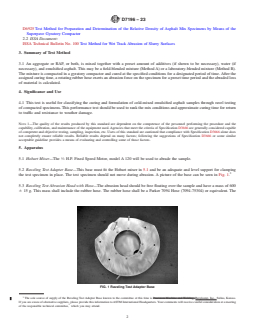
the test specimen in place. The test specimen should not move during abrasion. A picture of the base can be seen in Fig. 1.
5.3 Raveling Test Abrasion Head with Hose—The abrasion head should be free floating over the sample and have a mass of 600
6 15 g. This mass shall include the rubber hose. The rubber hose shall be a Parker 7094 Hose (7094-75304) or equivalent. The
FIG. 1 Raveling Test Adapter Base
The sole source of supply of the Raveling Test Adapter Base known to the committee at this time is Precision Machine and Welding, Bergkamp, Inc., Salina, Kansas.
If you are aware of alternative suppliers, please provide this information to ASTM International Headquarters. Your comments will receive careful consideration at a meeting
of the responsible technical committee, which you may attend.
D7196 − 23
hose shall be 19 mm ID by 6.25 mm wall thickness and cut to 127 mm in length. The rubber hose shall be easily removed so that
it may be rotated or changed prior to testing to ensure a clean surface for abrasion.
5.4 Oven or Environmental Chamber—If required for other than ambient laboratory curing conditions, the oven shall be a constant
temperature forced draft oven. The shelves in the oven shall be placed at least 150 mm apart and 100 mm away from the top and
floor.
5.5 Balance—A balance capable of weighing 3000 g or more to within 60.1 g and conforming to the requirements of Guide
D4753, Class GP2. A minimum platform length and width of 200 mm is required.
5.6 Gyratory Compactor—A gyratory compactor meeting the requirements of Test Method D6925.
5.7 Mechanical Mixer—A mixer capable of mixing up to 3000 g of the cold emulsified asphalt mixture.
5.8 100 to 150 mm Fine Bristle Paint Brush
...