


ASTM D5768-02(2018)
(Test Method)Standard Test Method for Determination of Iodine Value of Tall Oil Fatty Acids
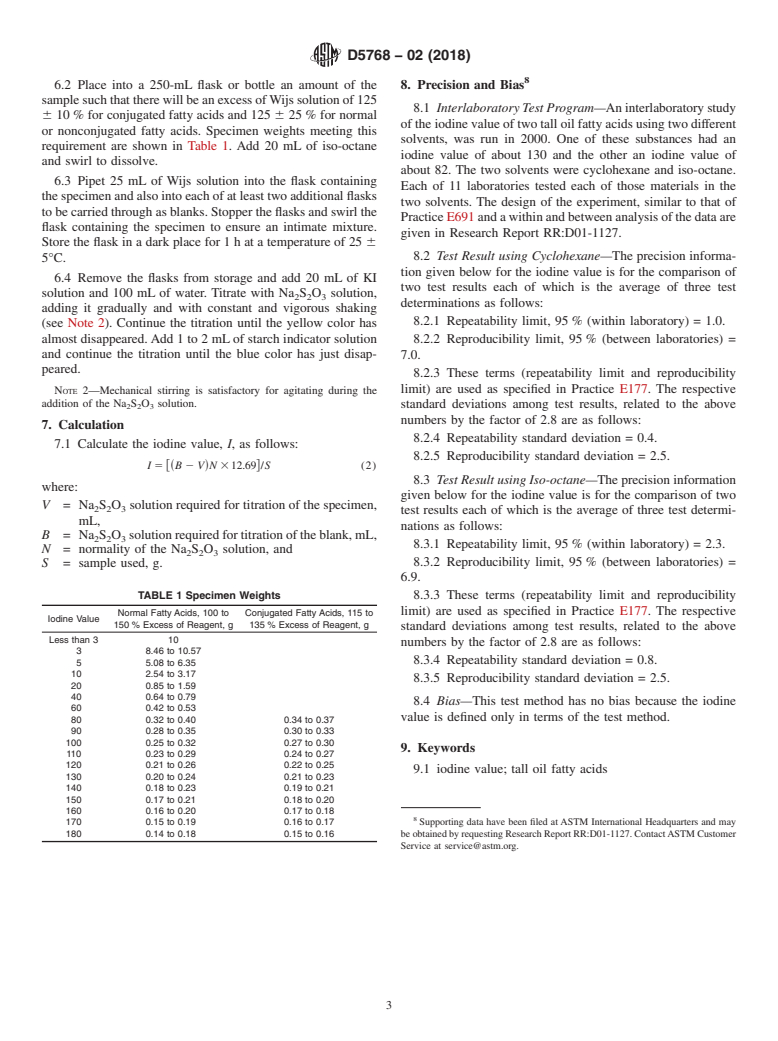
Standard Test Method for Determination of Iodine Value of Tall Oil Fatty Acids
SIGNIFICANCE AND USE
3.1 The iodine value of a fatty acid product is a measure of the unsaturated fatty acid content of that product and consequently a measure of the ease of oxidation or drying capacity of that fatty acid product.
3.2 This test method measures the unsaturation as iodine value by addition of an iodine/chlorine reagent. The amount of reagent absorbed is determined by back titrating the excess reagent and comparing it to a blank determination.
3.3 In samples containing conjugated double bonds, the iodine value obtained is empirical since the reagent does not react stoichiometrically with conjugated unsaturation. Where no conjugation is present, the iodine value obtained is a measure of the total unsaturation. By using proper specimen weights, the empirical values obtained are useful for comparative purposes.
3.4 This test method was developed in order to replace the hazardous solvent, carbon tetrachloride, used in Test Method D1959 with the less hazardous and more available solvents, iso-octane and cyclohexane. As data on the satisfactory use of other solvents becomes available, this test method will be amended to include those solvents.
3.5 This test method should have applicability to fatty acids and oils other than tall oil fatty acid but that possibility has not been investigated.
SCOPE
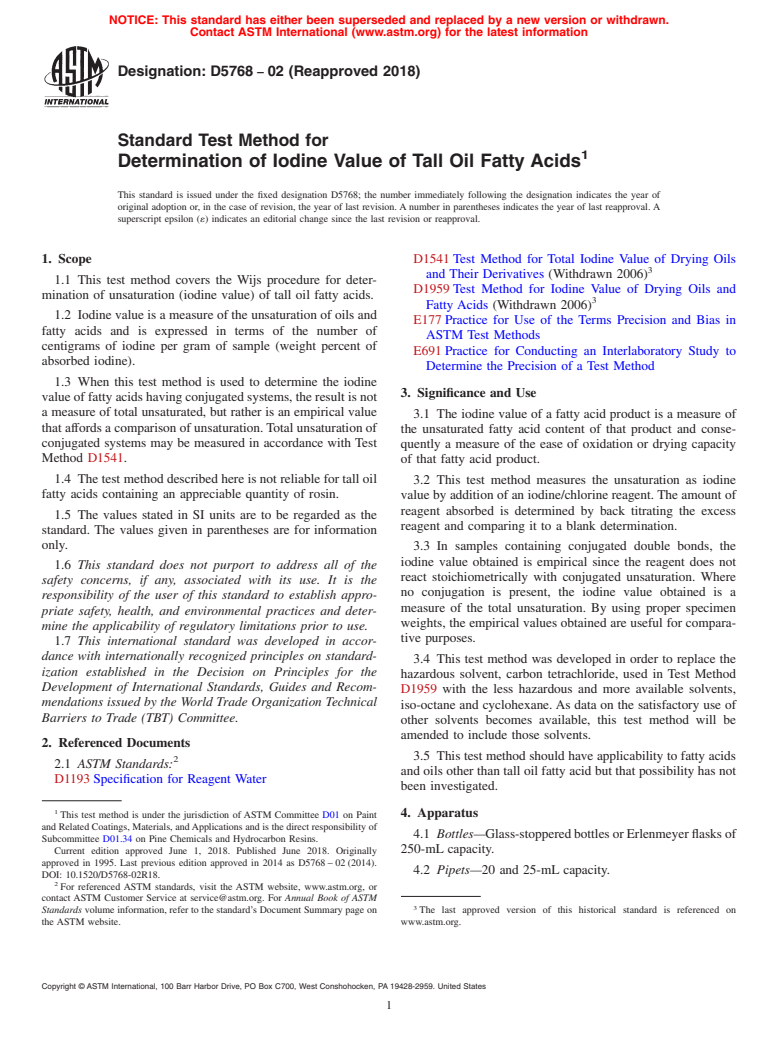
1.1 This test method covers the Wijs procedure for determination of unsaturation (iodine value) of tall oil fatty acids.
1.2 Iodine value is a measure of the unsaturation of oils and fatty acids and is expressed in terms of the number of centigrams of iodine per gram of sample (weight percent of absorbed iodine).
1.3 When this test method is used to determine the iodine value of fatty acids having conjugated systems, the result is not a measure of total unsaturated, but rather is an empirical value that affords a comparison of unsaturation. Total unsaturation of conjugated systems may be measured in accordance with Test Method D1541.
1.4 The test method described here is not reliable for tall oil fatty acids containing an appreciable quantity of rosin.
1.5 The values stated in SI units are to be regarded as the standard. The values given in parentheses are for information only.
1.6 This standard does not purport to address all of the safety concerns, if any, associated with its use. It is the responsibility of the user of this standard to establish appropriate safety, health, and environmental practices and determine the applicability of regulatory limitations prior to use.
1.7 This international standard was developed in accordance with internationally recognized principles on standardization established in the Decision on Principles for the Development of International Standards, Guides and Recommendations issued by the World Trade Organization Technical Barriers to Trade (TBT) Committee.
General Information
Buy Standard
Standards Content (Sample)
NOTICE: This standard has either been superseded and replaced by a new version or withdrawn.
Contact ASTM International (www.astm.org) for the latest information
Designation: D5768 − 02 (Reapproved 2018)
Standard Test Method for
Determination of Iodine Value of Tall Oil Fatty Acids
This standard is issued under the fixed designation D5768; the number immediately following the designation indicates the year of
original adoption or, in the case of revision, the year of last revision. A number in parentheses indicates the year of last reapproval. A
superscript epsilon (´) indicates an editorial change since the last revision or reapproval.
1. Scope D1541 Test Method for Total Iodine Value of Drying Oils
and Their Derivatives (Withdrawn 2006)
1.1 This test method covers the Wijs procedure for deter-
D1959 Test Method for Iodine Value of Drying Oils and
mination of unsaturation (iodine value) of tall oil fatty acids.
Fatty Acids (Withdrawn 2006)
1.2 Iodine value is a measure of the unsaturation of oils and
E177 Practice for Use of the Terms Precision and Bias in
fatty acids and is expressed in terms of the number of
ASTM Test Methods
centigrams of iodine per gram of sample (weight percent of
E691 Practice for Conducting an Interlaboratory Study to
absorbed iodine).
Determine the Precision of a Test Method
1.3 When this test method is used to determine the iodine
3. Significance and Use
value of fatty acids having conjugated systems, the result is not
a measure of total unsaturated, but rather is an empirical value
3.1 The iodine value of a fatty acid product is a measure of
that affords a comparison of unsaturation.Total unsaturation of
the unsaturated fatty acid content of that product and conse-
conjugated systems may be measured in accordance with Test
quently a measure of the ease of oxidation or drying capacity
Method D1541.
of that fatty acid product.
1.4 The test method described here is not reliable for tall oil
3.2 This test method measures the unsaturation as iodine
fatty acids containing an appreciable quantity of rosin. value by addition of an iodine/chlorine reagent. The amount of
reagent absorbed is determined by back titrating the excess
1.5 The values stated in SI units are to be regarded as the
reagent and comparing it to a blank determination.
standard. The values given in parentheses are for information
only.
3.3 In samples containing conjugated double bonds, the
iodine value obtained is empirical since the reagent does not
1.6 This standard does not purport to address all of the
react stoichiometrically with conjugated unsaturation. Where
safety concerns, if any, associated with its use. It is the
no conjugation is present, the iodine value obtained is a
responsibility of the user of this standard to establish appro-
measure of the total unsaturation. By using proper specimen
priate safety, health, and environmental practices and deter-
weights, the empirical values obtained are useful for compara-
mine the applicability of regulatory limitations prior to use.
tive purposes.
1.7 This international standard was developed in accor-
dance with internationally recognized principles on standard-
3.4 This test method was developed in order to replace the
ization established in the Decision on Principles for the
hazardous solvent, carbon tetrachloride, used in Test Method
Development of International Standards, Guides and Recom-
D1959 with the less hazardous and more available solvents,
mendations issued by the World Trade Organization Technical
iso-octane and cyclohexane. As data on the satisfactory use of
Barriers to Trade (TBT) Committee.
other solvents becomes available, this test method will be
amended to include those solvents.
2. Referenced Documents
3.5 This test method should have applicability to fatty acids
2.1 ASTM Standards:
and oils other than tall oil fatty acid but that possibility has not
D1193 Specification for Reagent Water
been investigated.
This test method is under the jurisdiction of ASTM Committee D01 on Paint 4. Apparatus
and Related Coatings, Materials, andApplications and is the direct responsibility of
4.1 Bottles—Glass-stopperedbottlesorErlenmeyerflasksof
Subcommittee D01.34 on Pine Chemicals and Hydrocarbon Resins.
Current edition approved June 1, 2018. Published June 2018. Originally 250-mL capacity.
approved in 1995. Last previous edition approved in 2014 as D5768 – 02 (2014).
4.2 Pipets—20 and 25-mL capacity.
DOI: 10.1520/D5768-02R18.
For referenced ASTM standards, visit the ASTM website, www.astm.org, or
contact ASTM Customer Service at service@astm.org. For Annual Book of ASTM
Standards volume information, refer to the standard’s Document Summary page on The last approved version of this historical standard is referenced on
the ASTM website. www.astm.org.
Copyright © ASTM International, 100 Barr Harbor Drive, PO Box C700, West Conshohocken, PA 19428-2959. United States
D5768 − 02 (2018)
4.3 Analytical balance constantly, until the yellow color has almost disappeared. Add
1to2mLofstarchindicatorsolutionandcontinuethetitration,
5. Reagents
adding the Na S O solution slowly until the blue color has
2 2 3
just disappeared. Calculate the normality, N, of the Na S O as
5.1 Purity of Reagents—Reagent grade chemicals shall be 2 2 3
follows:
used in all tests unless otherwise specified. Unless otherwise
indicated, it is intended that all reagents shall conform to the
N 5 A 320.39 /C (1)
~ !
Specifications of the Committee onAnalytical Reagents of the
where:
American Chemical Society, where such specifications are
A =K Cr O used, g, and
2 2 7
available. Other grades may be used provided it is first
C =Na S O solution required for titration of the K Cr O ,
2 2 3 2 2 7
ascertained that the reagent is of sufficiently high purity to
mL.
permit its use without lessening the accuracy of the determi-
nation.
5.8 Starch Indicator Solution:
5.8.1 Use soluble starch that will pass the following test for
5.2 Purity of Water—Unless otherwise indicated, references
sensitivity: Make a paste with1gof starch and a small amount
to water shall be understood to mean reagent water conforming
of cold water. Add, while stirring, 200 mL of boiling water.
to Type I of Specification D1193.
Dilute5mLofthissolutionwith100mLofwaterandadd0.05
5.3 Acetic Acid (Glacial) 17.4 M—Verify the absence of
mL of 0.1 N iodine solution. The deep blue color produced
substances reducing permanganate as follows: Dilute 2 mL of
must be discharged by 0.05 mL of 0.1 N Na S O solution.
2 2 3
the acid with 10 mL of water and add 0.1 mL of 0.1 N
5.8.2 Make a homogeneous paste of 10 g of soluble starch
potassium permanganate (KMnO ) solution. The pink color
in cold water.Add to this 1 Lof boiling water. Stir rapidly and
should not be entirely discharged at the end of 2 h.
cool. Salicylic acid (1.25 g/L) may be added to preserve the
5.4 Iso-octane or cyclohexane.
indicator. If long storage is required, keep the solution in a
refrigerator at 4 to 10°C (40 to 50°F). Prepare fresh indicator
5.5 Chlorine (99.8 % Cl)—(Warning—Extremely hazard-
when the end point of the titration from blue to colorless fails
ous. For specific hazard information and guidance, see suppli-
to be sharp.
er’s Material Safety Data sheets.) Commercial grades of
chlorineavailableincylindersmaybeused,providedthegasis
5.9 Wijs Solution—(Warning—Extremely hazardous. For
dried by passing through concentrated sulfuric acid (H SO ,sp
specific hazard information and guidance, see supplier’s Safety
2 4
gr1.84)beforepassingitintotheiodinesolution.Alternatively,
Data sheets.) Dissolve 13.0 g of iodine in 1 L of acetic acid.
the chlorine may be prepared by allowing concentrated hydro-
Gentle heat may be necessary to promote solution. Cool and
chloric acid (HCl, sp gr 1.19) to drop onto potassium perman-
removeasmallquantity(100to200mL)andsetasideinacool
ganate (KMnO ) or onto a mixture of KMnO and manganese
place for future use. Pass dry chlorine gas into the iodine
4 4
dioxide (MnO ). Dry the gas thus generated by passing it
2 solution until the original titration is not quite doubled. A
through concentrated H SO .
characteristic color change takes place in the Wijs solution
2 4
when the desired amount of chlorine has been added; this may
5.6 Potassium Iodide Solution (150 g/L)—Dissolve 150 g of
be used to assist in judging the
...
This document is not an ASTM standard and is intended only to provide the user of an ASTM standard an indication of what changes have been made to the previous version. Because
it may not be technically possible to adequately depict all changes accurately, ASTM recommends that users consult prior editions as appropriate. In all cases only the current version
of the standard as published by ASTM is to be considered the official document.
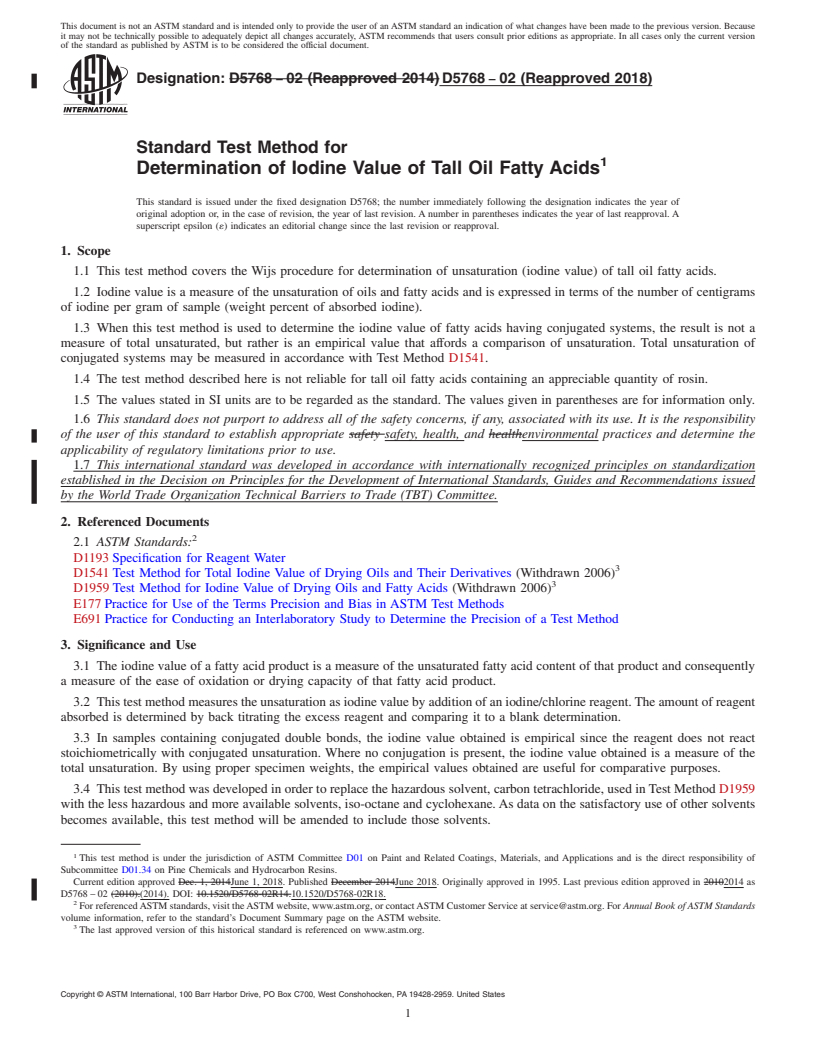
Designation: D5768 − 02 (Reapproved 2014) D5768 − 02 (Reapproved 2018)
Standard Test Method for
Determination of Iodine Value of Tall Oil Fatty Acids
This standard is issued under the fixed designation D5768; the number immediately following the designation indicates the year of
original adoption or, in the case of revision, the year of last revision. A number in parentheses indicates the year of last reapproval. A
superscript epsilon (´) indicates an editorial change since the last revision or reapproval.
1. Scope
1.1 This test method covers the Wijs procedure for determination of unsaturation (iodine value) of tall oil fatty acids.
1.2 Iodine value is a measure of the unsaturation of oils and fatty acids and is expressed in terms of the number of centigrams
of iodine per gram of sample (weight percent of absorbed iodine).
1.3 When this test method is used to determine the iodine value of fatty acids having conjugated systems, the result is not a
measure of total unsaturated, but rather is an empirical value that affords a comparison of unsaturation. Total unsaturation of
conjugated systems may be measured in accordance with Test Method D1541.
1.4 The test method described here is not reliable for tall oil fatty acids containing an appreciable quantity of rosin.
1.5 The values stated in SI units are to be regarded as the standard. The values given in parentheses are for information only.
1.6 This standard does not purport to address all of the safety concerns, if any, associated with its use. It is the responsibility
of the user of this standard to establish appropriate safety safety, health, and healthenvironmental practices and determine the
applicability of regulatory limitations prior to use.
1.7 This international standard was developed in accordance with internationally recognized principles on standardization
established in the Decision on Principles for the Development of International Standards, Guides and Recommendations issued
by the World Trade Organization Technical Barriers to Trade (TBT) Committee.
2. Referenced Documents
2.1 ASTM Standards:
D1193 Specification for Reagent Water
D1541 Test Method for Total Iodine Value of Drying Oils and Their Derivatives (Withdrawn 2006)
D1959 Test Method for Iodine Value of Drying Oils and Fatty Acids (Withdrawn 2006)
E177 Practice for Use of the Terms Precision and Bias in ASTM Test Methods
E691 Practice for Conducting an Interlaboratory Study to Determine the Precision of a Test Method
3. Significance and Use
3.1 The iodine value of a fatty acid product is a measure of the unsaturated fatty acid content of that product and consequently
a measure of the ease of oxidation or drying capacity of that fatty acid product.
3.2 This test method measures the unsaturation as iodine value by addition of an iodine/chlorine reagent. The amount of reagent
absorbed is determined by back titrating the excess reagent and comparing it to a blank determination.
3.3 In samples containing conjugated double bonds, the iodine value obtained is empirical since the reagent does not react
stoichiometrically with conjugated unsaturation. Where no conjugation is present, the iodine value obtained is a measure of the
total unsaturation. By using proper specimen weights, the empirical values obtained are useful for comparative purposes.
3.4 This test method was developed in order to replace the hazardous solvent, carbon tetrachloride, used in Test Method D1959
with the less hazardous and more available solvents, iso-octane and cyclohexane. As data on the satisfactory use of other solvents
becomes available, this test method will be amended to include those solvents.
This test method is under the jurisdiction of ASTM Committee D01 on Paint and Related Coatings, Materials, and Applications and is the direct responsibility of
Subcommittee D01.34 on Pine Chemicals and Hydrocarbon Resins.
Current edition approved Dec. 1, 2014June 1, 2018. Published December 2014June 2018. Originally approved in 1995. Last previous edition approved in 20102014 as
D5768 – 02 (2010).(2014). DOI: 10.1520/D5768-02R14.10.1520/D5768-02R18.
For referenced ASTM standards, visit the ASTM website, www.astm.org, or contact ASTM Customer Service at service@astm.org. For Annual Book of ASTM Standards
volume information, refer to the standard’s Document Summary page on the ASTM website.
The last approved version of this historical standard is referenced on www.astm.org.
Copyright © ASTM International, 100 Barr Harbor Drive, PO Box C700, West Conshohocken, PA 19428-2959. United States
D5768 − 02 (2018)
3.5 This test method should have applicability to fatty acids and oils other than tall oil fatty acid but that possibility has not been
investigated.
4. Apparatus
4.1 Bottles—Glass-stoppered bottles or Erlenmeyer flasks of 250-mL capacity.
4.2 Pipets—20 and 25-mL capacity.
4.3 Analytical balance
5. Reagents
5.1 Purity of Reagents—Reagent grade chemicals shall be used in all tests unless otherwise specified. Unless otherwise
indicated, it is intended that all reagents shall conform to the Specifications of the Committee on Analytical Reagents of the
American Chemical Society, where such specifications are available. Other grades may be used provided it is first ascertained that
the reagent is of sufficiently high purity to permit its use without lessening the accuracy of the determination.
5.2 Purity of Water—Unless otherwise indicated, references to water shall be understood to mean reagent water conforming to
Type I of Specification D1193.
5.3 Acetic Acid (Glacial) 17.4 M—Verify the absence of substances reducing permanganate as follows: Dilute 2 mL of the acid
with 10 mL of water and add 0.1 mL of 0.1 N potassium permanganate (KMnO ) solution. The pink color should not be entirely
discharged at the end of 2 h.
5.4 Iso-octane or cyclohexane.
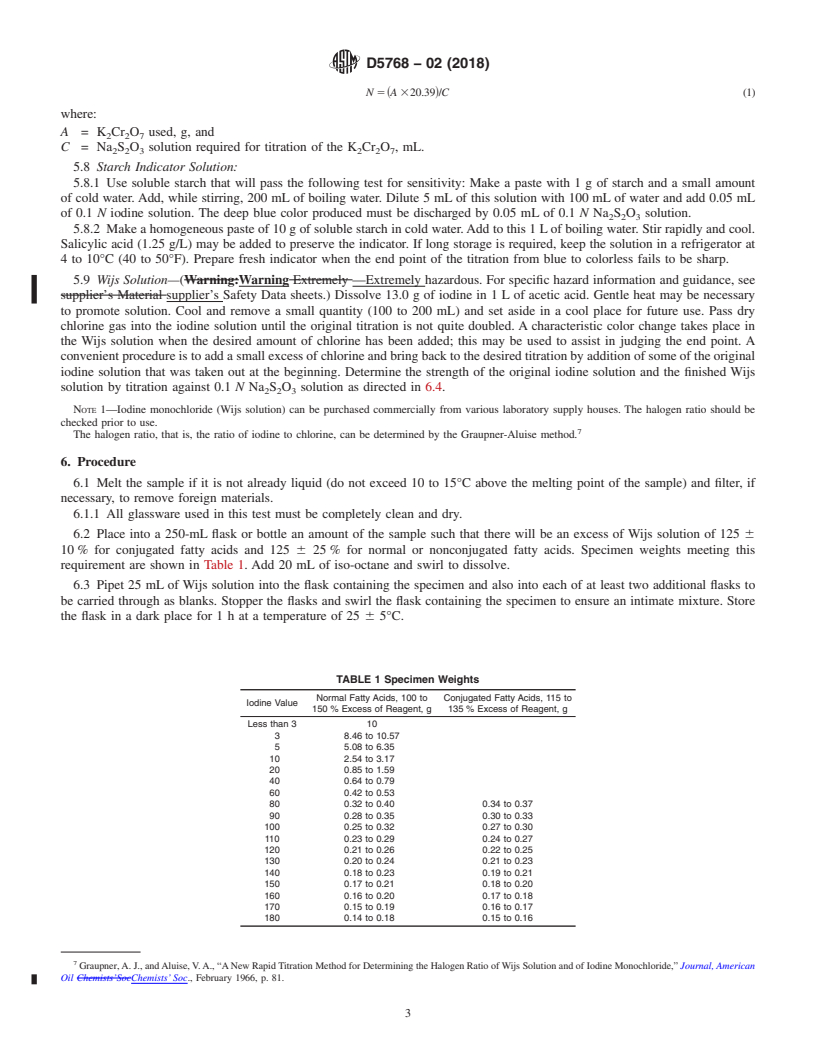
5.5 Chlorine (99.8 % Cl)—(Warning:Warning Extremely —Extremely hazardous. For specific hazard information and
guidance, see supplier’s Material Safety Data sheets.) Commercial grades of chlorine available in cylinders may be used, provided
the gas is dried by passing through concentrated sulfuric acid (H SO , sp gr 1.84) before passing it into the iodine solution.
2 4
Alternatively, the chlorine may be prepared by allowing concentrated hydrochloric acid (HCl, sp gr 1.19) to drop onto potassium
permanganate (KMnO ) or onto a mixture of KMnO and manganese dioxide (MnO ). Dry the gas thus generated by passing it
4 4 2
through concentrated H SO .
2 4
5.6 Potassium Iodide Solution (150 g/L)—Dissolve 150 g of potassium iodide (KI) in water and dilute to 1 L.
5.7 Sodium Thiosulfate, Standard Solution (0.1 N)—Dissolve 24.8 g of sodium thiosulfate (Na S O ·5H O) in water and dilute
2 2 3 2
to 1 L. Standardize against potassium dichromate (K Cr O ) as follows: Weigh to 0.1 mg, by difference from a weighing bottle,
2 2 7
0.16 to 0.22 g of K Cr O that has been finely ground and then dried to constant weight at 105 to 110°C prior to use. Place the
2 2 7
K Cr O in a 500-mL flask or bottle and dissolve in 25 mL of water. Add 5 mL of concentrated hydrochloric acid (11.6 M) and
2 2 7
20 mL of KI solution, and rotate to mix. Allow to stand for 5 min and then add 100 mL of water. Titrate with the Na S O solution,
2 2 3
while shaking constantly, until the yellow color has almost disappeared. Add 1 to 2 mL of starch indicator solution and continue
the titration, adding the Na S O solution slowly until the blue color has just disappeared. Calculate the normality, N, of the
2 2 3
Na S O as follows:
2 2 3
Reagent Chemicals, American Chemical Society Specifications, American Chemical Society, Washington, DC. For suggestions on the testing of reagents not listed by
the American Chemical Society, see Analar Standards for Laboratory Chemicals, BDH Ltd., Poole, Dorset, U.K., and the United States Pharmacopeia and National
Formulary, U.S. Pharmacopeial Convention, Inc. (USPC), Rockville, MD.
“Analytical Reagents, ACS Specifications,” American Chemical Society, Washington, DC, 1960.
National Institute of Standards and Technology Standard Reference Material No. 136 of potassium dichromate is recommended for this purpose and should be trea
...
Questions, Comments and Discussion
Ask us and Technical Secretary will try to provide an answer. You can facilitate discussion about the standard in here.