

ASTM D5389-93(2019)
(Test Method)Standard Test Method for Open-Channel Flow Measurement by Acoustic Velocity Meter Systems
General Information
- Abstract
SIGNIFICANCE AND USE
5.1 This test method is used where high accuracy of velocity or continuous discharge measurement over a long period of time is required and other test methods of measurement are not feasible due to low velocities in the channel, variable stage-discharge relations, complex stage-discharge relations, or the presence of marine traffic. It has the additional advantages of requiring no moving parts, introducing no head loss, and providing virtually instantaneous readings (1 to 100 readings per second).
5.2 The test method may require a relatively large amount of site work and survey effort and is therefore most suitable for permanent or semi-permanent installations.
SCOPE
1.1 This test method covers the measurement of flow rate of water in open channels, streams, and closed conduits with a free water surface.
1.2 The test method covers the use of acoustic transmissions to measure the average water velocity along a line between one or more opposing sets of transducers—by the time difference or frequency difference techniques.
1.3 The values stated in SI units are to be regarded as the standard.
1.4 This standard does not purport to address all of the safety concerns, if any, associated with its use. It is the responsibility of the user of this standard to establish appropriate safety, health, and environmental practices and determine the applicability of regulatory limitations prior to use. Specific precautionary statements are given in Section 6.
1.5 This international standard was developed in accordance with internationally recognized principles on standardization established in the Decision on Principles for the Development of International Standards, Guides and Recommendations issued by the World Trade Organization Technical Barriers to Trade (TBT) Committee.
- Status
- Published
- Publication Date
- 31-Oct-2019
- Technical Committee
- D19 - Water
- Drafting Committee
- D19.07 - Sediments, Geomorphology, and Open-Channel Flow
Overview
The ASTM D5389-93(2019) standard, published by ASTM International, specifies the Standard Test Method for Open-Channel Flow Measurement by Acoustic Velocity Meter (AVM) Systems. This internationally recognized test method covers the measurement of water flow rates in open channels, streams, and closed conduits with a free water surface using acoustic (ultrasonic) technology. The test method is particularly significant for achieving high accuracy in velocity or continuous discharge measurement where conventional methods may not be feasible-such as in low-velocity channels, waterways with variable or complex stage-discharge relations, or locations affected by marine traffic.
AVM systems offer several operational advantages:
- No moving parts, reducing maintenance needs and mechanical failures.
- No head loss is introduced to the water system.
- Virtually instantaneous readings, with response rates between 1 and 100 readings per second. Due to the site survey and installation requirements, this method is best suited for permanent or semi-permanent monitoring installations.
Key Topics
Measurement Principle
- AVM systems rely on acoustic transmissions between sets of transducers placed across the channel. Measurements utilize either the time difference or frequency difference of acoustic signals to determine average water velocity along defined paths.
- Flow rate calculations are based on integrating these velocities with water stage and cross-sectional area data.
System Components and Site Requirements
- AVM systems include transducers, acoustic and electronic processing units, display/recorders, stage measuring devices, and robust cabling.
- Site selection is critical and should consider channel geometry, stability, absence of obstructions, minimal air entrainment, and manageable sediment or weed growth.
- Proper mounting, alignment, and calibration of transducers are essential for achieving valid, repeatable measurements.
Sources of Error and Limitations
- Measurement accuracy can be impacted by signal attenuation due to suspended solids or air bubbles, reflection or refraction from density or temperature gradients, and electromagnetic interference.
- Errors may also result from improper installation, inadequate calibration, unstable cross-sections, or path alignment inaccuracies.
- The standard stresses the need for regular data review, calibration, and error-checking during operation.
Applications
Practical Uses
- Hydrology and Water Resource Management: Monitoring river discharge, irrigation channels, and reservoir inflow/outflow.
- Flood Control: Real-time flow data for flood prediction and response.
- Environmental Monitoring: Assessment of streamflow for ecological studies and compliance with regulatory requirements.
- Maritime and Navigation: Flow measurement in navigable waterways where traffic and low-flow conditions complicate conventional methods.
Suitable Scenarios
- Locations requiring high-accuracy, continuous flow records over extended periods.
- Installations where the flow regime is too complex or variable for traditional velocity-area methods.
- Channels with low velocities, tidal influences, or those subject to saline/brackish water intrusion.
Related Standards
- ASTM D1129: Terminology Relating to Water
- ASTM D3858: Test Method for Open-Channel Flow Measurement of Water by Velocity–Area Method
- ISO 6416: Liquid Flow Measurement in Open Channels-Measurement of Discharge by the Ultrasonic (Acoustic) Method
- ASTM D2777: Practice for Determination of Precision and Bias of Applicable Test Methods of Committee D19 on Water
Summary
ASTM D5389-93(2019) provides a robust and accurate methodology for measuring open-channel water flow using acoustic velocity meter systems. Its practical value is evident in permanent hydrological monitoring, flood management, and settings where other flow measurement approaches are impractical. Adhering to this standard ensures reliable data collection that supports water management decisions, regulatory compliance, and scientific research. For best results, careful consideration of site conditions, regular calibration, and adherence to related standards are essential.
Relations
- Effective Date
- 01-Nov-2019
- Effective Date
- 01-May-2020
- Effective Date
- 01-Mar-2019
- Effective Date
- 15-Jun-2012
- Effective Date
- 01-Jan-2012
- Effective Date
- 01-Mar-2010
- Effective Date
- 01-Oct-2008
- Effective Date
- 15-Jan-2008
- Effective Date
- 01-Sep-2006
- Effective Date
- 01-Sep-2006
- Effective Date
- 15-Aug-2006
- Effective Date
- 01-Apr-2006
- Effective Date
- 15-Feb-2006
- Effective Date
- 01-Mar-2004
- Effective Date
- 01-Mar-2004
Get Certified
Connect with accredited certification bodies for this standard

BSMI (Bureau of Standards, Metrology and Inspection)
Taiwan's standards and inspection authority.
Sponsored listings
Frequently Asked Questions
ASTM D5389-93(2019) is a standard published by ASTM International. Its full title is "Standard Test Method for Open-Channel Flow Measurement by Acoustic Velocity Meter Systems". This standard covers: SIGNIFICANCE AND USE 5.1 This test method is used where high accuracy of velocity or continuous discharge measurement over a long period of time is required and other test methods of measurement are not feasible due to low velocities in the channel, variable stage-discharge relations, complex stage-discharge relations, or the presence of marine traffic. It has the additional advantages of requiring no moving parts, introducing no head loss, and providing virtually instantaneous readings (1 to 100 readings per second). 5.2 The test method may require a relatively large amount of site work and survey effort and is therefore most suitable for permanent or semi-permanent installations. SCOPE 1.1 This test method covers the measurement of flow rate of water in open channels, streams, and closed conduits with a free water surface. 1.2 The test method covers the use of acoustic transmissions to measure the average water velocity along a line between one or more opposing sets of transducers—by the time difference or frequency difference techniques. 1.3 The values stated in SI units are to be regarded as the standard. 1.4 This standard does not purport to address all of the safety concerns, if any, associated with its use. It is the responsibility of the user of this standard to establish appropriate safety, health, and environmental practices and determine the applicability of regulatory limitations prior to use. Specific precautionary statements are given in Section 6. 1.5 This international standard was developed in accordance with internationally recognized principles on standardization established in the Decision on Principles for the Development of International Standards, Guides and Recommendations issued by the World Trade Organization Technical Barriers to Trade (TBT) Committee.
SIGNIFICANCE AND USE 5.1 This test method is used where high accuracy of velocity or continuous discharge measurement over a long period of time is required and other test methods of measurement are not feasible due to low velocities in the channel, variable stage-discharge relations, complex stage-discharge relations, or the presence of marine traffic. It has the additional advantages of requiring no moving parts, introducing no head loss, and providing virtually instantaneous readings (1 to 100 readings per second). 5.2 The test method may require a relatively large amount of site work and survey effort and is therefore most suitable for permanent or semi-permanent installations. SCOPE 1.1 This test method covers the measurement of flow rate of water in open channels, streams, and closed conduits with a free water surface. 1.2 The test method covers the use of acoustic transmissions to measure the average water velocity along a line between one or more opposing sets of transducers—by the time difference or frequency difference techniques. 1.3 The values stated in SI units are to be regarded as the standard. 1.4 This standard does not purport to address all of the safety concerns, if any, associated with its use. It is the responsibility of the user of this standard to establish appropriate safety, health, and environmental practices and determine the applicability of regulatory limitations prior to use. Specific precautionary statements are given in Section 6. 1.5 This international standard was developed in accordance with internationally recognized principles on standardization established in the Decision on Principles for the Development of International Standards, Guides and Recommendations issued by the World Trade Organization Technical Barriers to Trade (TBT) Committee.
ASTM D5389-93(2019) is classified under the following ICS (International Classification for Standards) categories: 17.120.20 - Flow in open channels. The ICS classification helps identify the subject area and facilitates finding related standards.
ASTM D5389-93(2019) has the following relationships with other standards: It is inter standard links to ASTM D5389-93(2013), ASTM D1129-13(2020)e2, ASTM D3850-19, ASTM D2777-12, ASTM D3850-12, ASTM D1129-10, ASTM D3858-95(2008), ASTM D2777-08, ASTM D1129-06a, ASTM D1129-06ae1, ASTM D2777-06, ASTM D3850-94(2006), ASTM D1129-06, ASTM D1129-04, ASTM D1129-04e1. Understanding these relationships helps ensure you are using the most current and applicable version of the standard.
ASTM D5389-93(2019) is available in PDF format for immediate download after purchase. The document can be added to your cart and obtained through the secure checkout process. Digital delivery ensures instant access to the complete standard document.
Standards Content (Sample)
This international standard was developed in accordance with internationally recognized principles on standardization established in the Decision on Principles for the
Development of International Standards, Guides and Recommendations issued by the World Trade Organization Technical Barriers to Trade (TBT) Committee.
Designation: D5389 − 93 (Reapproved 2019)
Standard Test Method for
Open-Channel Flow Measurement by Acoustic Velocity
Meter Systems
This standard is issued under the fixed designation D5389; the number immediately following the designation indicates the year of
original adoption or, in the case of revision, the year of last revision. A number in parentheses indicates the year of last reapproval. A
superscript epsilon (´) indicates an editorial change since the last revision or reapproval.
1. Scope D3858 Test Method for Open-Channel Flow Measurement
of Water by Velocity-Area Method
1.1 This test method covers the measurement of flow rate of
water in open channels, streams, and closed conduits with a 2.2 ISO Standard:
free water surface. ISO 6416 Liquid Flow Measurements in Open Channels—
Measurement of Discharge by the Ultrasonic (Acoustic)
1.2 Thetestmethodcoverstheuseofacoustictransmissions
Method
tomeasuretheaveragewatervelocityalongalinebetweenone
or more opposing sets of transducers—by the time difference
3. Terminology
or frequency difference techniques.
3.1 Definitions:
1.3 The values stated in SI units are to be regarded as the
3.1.1 For definitions of terms used in this standard, refer to
standard.
Terminology D1129.
1.4 This standard does not purport to address all of the
3.2 Definitions of Terms Specific to This Standard:
safety concerns, if any, associated with its use. It is the
3.2.1 acoustic path, n—the straight line between the centers
responsibility of the user of this standard to establish appro-
of two acoustic transducers.
priate safety, health, and environmental practices and deter-
mine the applicability of regulatory limitations prior to use.
3.2.2 acoustic path length, n—the face-to-face distance
Specific precautionary statements are given in Section 6.
between transducers on an acoustic path.
1.5 This international standard was developed in accor-
3.2.3 acoustic transducer, n—a device that is used to gen-
dance with internationally recognized principles on standard-
erate acoustic signals when driven by an electric voltage, and
ization established in the Decision on Principles for the
conversely, a device that is used to generate an electric voltage
Development of International Standards, Guides and Recom-
when excited by an acoustic signal.
mendations issued by the World Trade Organization Technical
3.2.4 acoustic travel time, n—the time required for an
Barriers to Trade (TBT) Committee.
acoustic signal to propagate along an acoustic path, either
upstream or downstream.
2. Referenced Documents
3.2.5 discharge, n—the rate of flow expressed in units of
2.1 ASTM Standards:
volume of water per unit of time. The discharge includes any
D1129 Terminology Relating to Water
sediment or other materials that may be dissolved or mixed
D2777 Practice for Determination of Precision and Bias of
with it.
Applicable Test Methods of Committee D19 on Water
D3850 Test Method for RapidThermal Degradation of Solid
3.2.6 line velocity, n—the downstream component of water
Electrical Insulating Materials By Thermogravimetric
velocity averaged over an acoustic path.
Method (TGA)
3.2.7 measurement plane, n—the plane formed by two or
more parallel acoustic paths of different elevations.
3.2.8 path velocity, n—the water velocity averaged over the
This test method is under the jurisdiction of ASTM Committee D19 on Water
acoustic path.
and is the direct responsibility of Subcommittee D19.07 on Sediments,
Geomorphology, and Open-Channel Flow.
3.2.9 stage, n—the height of a water surface above an
Current edition approved Nov. 1, 2019. Published January 2020. Originally
established (or arbitrary) datum plane; also gage height.
approved in 1993. Last previous edition approved in 2013 as D5389 – 93 (2013).
DOI: 10.1520/D5389-93R19.
For referenced ASTM standards, visit the ASTM website, www.astm.org, or
contact ASTM Customer Service at service@astm.org. For Annual Book of ASTM
Standards volume information, refer to the standard’s Document Summary page on Available fromAmerican National Standards Institute (ANSI), 25 W. 43rd St.,
the ASTM website. 4th Floor, New York, NY 10036, http://www.ansi.org.
Copyright © ASTM International, 100 Barr Harbor Drive, PO Box C700, West Conshohocken, PA 19428-2959. United States
D5389 − 93 (2019)
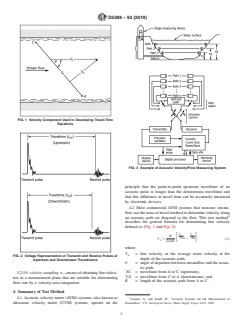
FIG. 1 Velocity Component Used in Developing Travel-Time
Equations
FIG. 3 Example of Acoustic Velocity/Flow Measuring System
principle that the point-to-point upstream traveltime of an
acoustic pulse is longer than the downstream traveltime and
that this difference in travel time can be accurately measured
by electronic devices.
4.2 Most commercial AVM systems that measure stream-
flow use the time-of-travel method to determine velocity along
an acoustic path set diagonal to the flow. This test method
describes the general formula for determining line velocity
defined as (Fig. 1 and Fig. 2):
1 1
B
t t
F G
CA AC
V 5 2 (1)
L
2cosθ
where:
V = line velocity, or the average water velocity at the
L
FIG. 2 Voltage Representation of Transmit and Receive Pulses at
depth of the acoustic path,
Upstream and Downstream Transducers
θ = angle of departure between streamflow and the acous-
tic path,
t
AC = traveltime from A to C (upstream),
3.2.10 velocity sampling, n—meansofobtaininglineveloci-
t
CA = traveltime from C to A (downstream), and
ties in a measurement plane that are suitable for determining
B = length of the acoustic path from A to C.
flow rate by a velocity-area integration.
4. Summary of Test Method
4.1 Acoustic velocity meter (AVM) systems, also known as
Laenen, A., and Smith, W., “Acoustic Systems for the Measurement of
ultrasonic velocity meter (UVM) systems, operate on the Streamflow,” U.S. Geological Survey Water Supply Paper 2213, 1983.
D5389 − 93 (2019)
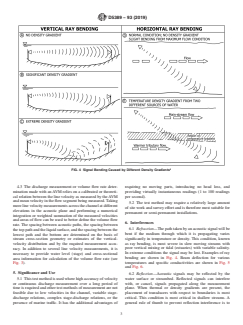
FIG. 4 Signal Bending Caused by Different Density Gradients
4.3 The discharge measurement or volume flow rate deter- requiring no moving parts, introducing no head loss, and
mination made with anAVM relies on a calibrated or theoreti- providing virtually instantaneous readings (1 to 100 readings
cal relation between the line velocity as measured by theAVM per second).
and mean velocity in the flow segment being measured.Taking
5.2 The test method may require a relatively large amount
morelinevelocitymeasurementsacrossthechannelatdifferent
of site work and survey effort and is therefore most suitable for
elevations in the acoustic plane and performing a numerical
permanent or semi-permanent installations.
integration or weighted summation of the measured velocities
and areas of flow can be used to better define the volume flow
6. Interferences
rate. The spacing between acoustic paths, the spacing between
6.1 Refraction—Thepathtakenbyanacousticsignalwillbe
thetoppathandtheliquidsurface,andthespacingbetweenthe
bent if the medium through which it is propagating varies
lowest path and the bottom are determined on the basis of
significantly in temperature or density. This condition, known
stream cross-section geometry or estimates of the vertical-
as ray bending, is most severe in slow moving streams with
velocity distribution and by the required measurement accu-
poor vertical mixing or tidal (estuaries) with variable salinity.
racy. In addition to several line velocity measurements, it is
In extreme conditions the signal may be lost. Examples of ray
necessary to provide water level (stage) and cross-sectional
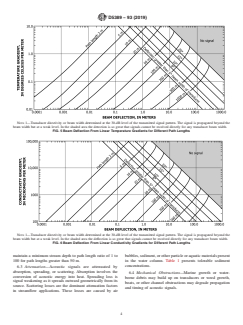
bending are shown in Fig. 4. Beam deflection for various
area information for calculation of the volume flow rate (see
temperatures and specific conductivities are shown in Fig. 5
Fig. 3).
and Fig. 6.
5. Significance and Use
6.2 Reflection—Acoustic signals may be reflected by the
5.1 Thistestmethodisusedwherehighaccuracyofvelocity water surface or streambed. Reflected signals can interfere
or continuous discharge measurement over a long period of with, or cancel, signals propagated along the measurement
time is required and other test methods of measurement are not plane. When thermal or density gradients are present, the
feasible due to low velocities in the channel, variable stage- placement of transducers with respect to boundaries is most
discharge relations, complex stage-discharge relations, or the critical. This condition is most critical in shallow streams. A
presence of marine traffic. It has the additional advantages of general rule of thumb to prevent reflection interference is to
D5389 − 93 (2019)
NOTE 1—Transducer directivity or beam width determined at the 30-dB level of the transmitted signal pattern. The signal is propagated beyond the
beam width but at a weak level. In the shaded area the detection is so great that signals cannot be received directly for any transducer beam width.
FIG. 5 Beam Deflection From Linear Temperature Gradients for Different Path Lengths
NOTE 1—Transducer directivity or beam width determined at the 30-dB level of the transmitted signal pattern. The signal is propagated beyond the
beam width but at a weak level. In the shaded area the deflection is so great that signals cannot be received directly for any transducer beam width.
FIG. 6 Beam Deflection From Linear Conductivity Gradients for Different Path Lengths
maintain a minimum stream depth to path length ratio of 1 to bubbles,sediment,orotherparticleoraquaticmaterialspresent
100 for path lengths greater than 50 m.
in the water column. Table 1 presents tolerable sediment
concentrations.
6.3 Attenuation—Acoustic signals are attenuated by
absorption, spreading, or scattering. Absorption involves the
6.4 Mechanical Obstructions—Marine growth or water-
conversion of acoustic energy into heat. Spreading loss is
borne debris may build up on transducers or weed growth,
signal weakening as it spreads outward geometrically from its
boats, or other channel obstructions may degrade propagation
source. Scattering losses are the dominant attenuation factors
and timing of acoustic signals.
in streamflow applications. These losses are caused by air
D5389 − 93 (2019)
TABLE 1 Estimates of Tolerable Sediment Concentrations for
7.1.5 Display/Recorder—Generally, the output of the sys-
AVM System Operation Based on Attenuation From Spherical
tem is a display or a recorder, or both. The recorder normally
Spreading and From Scattering From the Most Critical Particle
includes calendar data, time, flow rate, stage, and any other
Size
information deemed desirable, such as error messages. Equip-
NOTE 1—Sediment concentrations in milligrams per litre.
ment of this type is often connected to other output devices,
Selected Path distance (m)
such as telemetry equipment.
Trans-
ducer 7.2 Acoustic Transducers—Transducers may be active (con-
Fre-
taining Transmitter and first stage of amplification) or passive
quency 5 20 50 100 200 300 500 1000
(no amplification) depending on path length and presence of
(kHz)
electromagnetic interference EMI. Acoustic transducers must
1000 6300 1200 400 — — — — —
500 — 3500 1200 530 230 — — —
be rigidly mounted in the channel wall or bottom. Means must
300 — 7900 2800 1300 560 350 — —
be provided for precise determination of acoustic path
200 — 11 000 4000 1800 830 520 280 —
elevation, length, and angle to flow. The transducers and
100 — — 10 000 4600 2200 1400 770 350
30 — — — — 8800 5700 3200 1500
cabling must be sufficiently rugged to withstand the handling
and operational environment into which they will be placed.
Additionally, provision shall be made for simple replacement
of transducer or cable, or both, in the event of failure or
damage.
6.5 Electrical Obstructions—Nearby radio transmitters,
electrical machinery, faulty electrical insulators, or other
7.3 StageMeasuringDevice—Thereareseveralmethodsfor
sources of electromagnetic interference (EMI) can cause fail-
measuring stage and inputting this information to the system.
ure or sporadic operation of AVMs.
The actual method used depends on the particular installation
requirements. Some examples include visual measurement/
7. Apparatus
manual keyboard entry, float/counterweight or bubbler systems
with servo manometers connected to analog conversion equip-
7.1 The instrumentation used to measure open-channel flow
ment or digital encoders, upward looking acoustic transducers,
by acoustic means consists of a complex and integrated
or other electronic pressure sensors.
electronic system known as an acoustic velocity meter (AVM).
Three or four companies presently market AVM systems
7.4 Power Supply—Several venders currently offer battery-
suitable for measurement of open-channel flow. System con-
powdered AVMs as well as systems operating on 110 V ac
figurations range from simple single-path to complex-multi-
standard commercial electric power. Availability of electricity
path systems. Internal computation, transmission, and record-
should be considered during site evaluation prior to equipment
ing systems vary depending on local requirements. MostAVM
selection.
systemsmustincludethecapabilitytocomputeanacousticline
7.5 Cabling—All interconnected cabling to and from trans-
velocity from one or more path velocities together with stage
ducers shall be armored or protected, or both, to minimize
(waterlevel)andotherinformationrelatedtochannelgeometry
damage during installation and operation.
necessarytocalculateaflowrateperunitoftime,usuallycubic
3 3
7.6 Responders—A responder is an electronic device that
millimetres per second (m /s) or cubic feet per second (ft /s).
receives an acoustic signal and then retransmits it back across
7.1.1 Electronics Equipment—There are several methods
the stream after a predetermined time interval. A responder is
that are currently being used to implement the electro-acoustic
used where direct wire connection is impractical. A typical
functions and mathematical manipulations required to obtain a
responder system is shown in Fig. 7.
line-velocity measurement. Whatever method is used must
includeinternalautomaticmeansforcontinuouslycheckingthe
8. Sampling
accuracy. In addition, provision must be included to prevent
8.1 Sampling, as defined in Terminology D1129,isnot
erroneous readings during acoustic interruptions caused by
rivertraffic,aquaticlife,orgradualdegradationofcomponents. applicable to this test method.
7.1.2 Flow Readout Equipment—This equipment is func-
9. Preparation of Apparatus
tionally separated into three subsystems. These subsystems
may or may not be physically separable but are discussed 9.1 Site Selections:
separately for clarity. 9.1.1 Channel Geometry—The gaged site should be in a
7.1.3 Acoustic Tranceiver—This system generates, receives, section of channel that is straight for three to ten channel
and measures the traveltimes of acoustic signals. The acoustic widths upstream and one to two channel widths downstream.
signals travel between the various pairs of acoustic transducers Thebanksshouldbeparallelandnotsubjecttooverflow.There
and form the acoustic paths from which line velocities are should be minimal change in cross-section area between the
determined. upstream and downstream transducer locations. Calibrating
7.1.4 Processor—The processor performs the mathematical discharge measurements must be made along the acoustic path
operations required to calculate acoustic line velocities, makes where large differences exist in cross-sectional area between
decisions about which acoustic paths should be used on the the upstream and downstream transducers. AVMs are not
basis of stage, performs error checking, calculates total volume usually suitable for wide shallow channels, except by using
flow rate, and totalizes volume flow. multiple horizontal paths.
D5389 − 93 (2019)
sediment concentration is highly dependent on path length and
transducer frequency, as shown in Table 1. At locations where
concentrations greater than 1000 mg/Lmay be experienced for
significant periods, or where reliable measurements is particu-
larly important under such conditions, the ultrasonic technique
may not be suitable.
9.1.6 Weed Growth—The gage cross section should be free
of weed growth, that seriously attenuates the acoustic signal.
Different types of weed may have different properties, because
it is the air included within the plant structure that produces the
unwanted effect.
9.1.7 EntrainedAir—Thepresenceofsignificantamountsof
entrained air bubbles in the water may cause problems due to
reflection and scattering of the propagated acoustic wave.
Locations that are downstream of dams, weirs, waterfalls, or
millorpowerplanttail-racesmaysufferfromthisproblem.Air
entrainment from these hydraulic structures may persist for
several kilometers downstream or 5 to 10 min from the source.
9.1.8 Remotely-Generated Hydraulic Effects—Hydraulic
uniformity of a gage site is an important attribute. Velocity
profiles that depart significantly from the ideal may be engen-
dered by bed, bank, or tributary confluence conditions at
locations remote from the gage location itself, but may persist
to have an effect at the gage.They may be present during some
river-flow states, but not during others. Locations close to
tributary streams having hydrological regimes different from
those of the main stream should be avoided.
9.1.9 Tributary Effects—The ultrasonic technique works
FIG. 7 Responder System
most reliably where the physical properties of the water in the
channel reach to be gaged are as nearly homogeneous as
possible. In situations where an upstream tributary is injecting
9.1.2 Channel Stability—The cross sections should not be
water of a significantly different physical character, difficulties
subject to frequent shifting and the relationship between stage
may result. Usually these differences will be in the water
and cross-section area must be stable or frequently measured.
temperature or suspended sediment load. Full mixing of the
Siteswithunstableverticalvelocityprofilesshouldbeavoided,
two bodies of water to a homogeneous state may not be
or additional acoustic paths added within the vertical to obtain
achieved for a considerable distance downstream of the con-
improved velocity averaging.
fluence.
9.1.3 Water Temperature Gradients—Refraction of the
9.1.10 Ambient Electrical Noise—The effective functioning
acoustic signal is caused by temperature gradients in the water,
of ultrasonic technique depends upon the reliability and sensi-
and signal loss and resulting loss of accuracy may result.
tivity of electronic technology. Some instrumentation designs
Channel reaches that maintain deep water during low-flow
may suffer significantly from the effects of ambient electrical
periods(withconsequen
...