

ASTM A713-24
(Specification)Standard Specification for Steel Wire, High-Carbon Spring, for Heat-Treated Components
General Information
- Abstract
ABSTRACT
This specification deals with the general requirements for round carbon spring steel wire coils intended for the manufacture of mechanical springs and wire forms that are heat treated after fabrication. Heat treatment processes include austenitizing, quenching and tempering. The steel shall be made by the open-hearth, basic-oxygen, or electric-furnace process and the wire shall be thermally treated, or thermally treated and drawn. Product analysis, wrap testing, and chemical analysis shall be performed and materials shall conform to the requirements for chemical composition, metallurgical structure and mechanical properties such as tensile strength. Packaging of the coils of wire shall be by agreement between the manufacturer and the purchaser wherein the agreement shall include coil dimensions and weights, while marking and bar coding for identification shall be by tag securely attached to each coil of wire.
SCOPE
1.1 This specification covers round carbon spring steel wire in coils intended for the manufacture of mechanical springs and wire forms that are heat treated (austenitized, quenched, and tempered) after fabrication.
1.2 The values stated in inch-pound units are to be regarded as the standard.
1.3 This international standard was developed in accordance with internationally recognized principles on standardization established in the Decision on Principles for the Development of International Standards, Guides and Recommendations issued by the World Trade Organization Technical Barriers to Trade (TBT) Committee.
- Status
- Published
- Publication Date
- 29-Feb-2024
- Technical Committee
- A01 - Steel, Stainless Steel and Related Alloys
- Drafting Committee
- A01.03 - Steel Rod and Wire
Buy Documents

ASTM A713-24 - Standard Specification for Steel Wire, High-Carbon Spring, for Heat-Treated Components
REDLINE ASTM A713-24 - Standard Specification for Steel Wire, High-Carbon Spring, for Heat-Treated Components
Overview
ASTM A713-24 is the recognized international standard specification for high-carbon steel wire in round coils, intended for the manufacture of mechanical springs and wire forms that are heat-treated after fabrication. This specification, published by ASTM International, details requirements for materials, manufacturing processes, chemical composition, mechanical properties, dimensions, and testing. Compliance with ASTM A713 provides manufacturers and purchasers with assurance in terms of product quality, consistency, and fit-for-purpose performance in demanding spring and formed wire applications.
Key Topics
Scope & Coverage
ASTM A713-24 applies specifically to round high-carbon spring steel wire supplied in coils. The primary use is in components that undergo austenitizing, quenching, and tempering after forming.Material Production
The steel must be produced by open-hearth, basic-oxygen, electric-furnace, or other established steelmaking processes. Prior to fabrication, wire may be thermally treated or thermally treated and drawn, depending on design and user needs.Chemical Composition
The standard specifies carbon and alloy compositions suitable for spring properties, with allowable grades and ranges guiding material selection. Substitutions or custom chemistries may be allowed by agreement.Mechanical Properties & Testing
While tensile strength is not a default requirement, values can be agreed upon as needed. The wrap test is a key evaluation to ensure flexibility and absence of brittleness, verifying the wire’s suitability for forming operations.Dimensional Accuracy
Permissible variations in wire diameter and roundness are strictly defined. This ensures consistency of fit and function in automated or precision spring production.Workmanship & Surface Quality
Wire must be substantially free of rust and surface flaws. Guidelines also address unwound coil characteristics, welded areas, and coil continuity.Packaging and Identification
Coils are to be packaged, marked, and barcoded per purchaser and manufacturer agreement. Accurate tagging, including ASTM designation and batch identification, is required for traceability.
Applications
ASTM A713-24 is critical wherever high-performance heat-treated steel springs or precision wire forms are essential. Typical industries and uses include:
- Automotive: Springs for door closers, suspension, and clutch mechanisms
- Industrial machinery: Mechanical springs in actuators, fasteners, levers, and controls
- Consumer products: Wire forms and springs for appliances, electronics, and tools
- Aerospace and transportation: Components requiring predictable mechanical properties after heat treatment
By adhering to ASTM A713, manufacturers ensure wire products demonstrate reliable toughness, high fatigue resistance, and predictable performance after fabrication and thermal processing.
Related Standards
ASTM A713-24 references several related industry standards to promote uniformity and compatibility across manufacturing and testing environments. Key referenced documents include:
- ASTM A370: Mechanical Testing of Steel Products
- ASTM A510/A510M: General Requirements for Carbon Steel Wire Rods and Coarse Round Wire
- ASTM A700: Guide for Packaging, Marking, and Loading Steel Products
- ASTM A751: Chemical Analysis of Steel Products
- ASTM E112: Determining Average Grain Size
- ASTM E527 / SAE J1086: Numbering system for metals and alloys
Adherence to these foundational ASTM and SAE standards ensures that supply chains and quality controls are well aligned with best practices in the steel wire and mechanical spring industry.
Practical Value
Following ASTM A713-24 provides multiple practical benefits:
- Assured mechanical properties and durability for spring applications
- Clear requirements for chemical composition and dimensional tolerances
- Consistent surface quality and traceability through proper marking
- Confidence in material compatibility with heat treatment processes
- Supports efficient procurement and global trade by meeting internationally recognized standards
ASTM A713-24 is the essential specification for any organization designing, making, or sourcing high-carbon steel wire for heat-treated mechanical spring and formed wire components.
Relations
- Effective Date
- 01-Mar-2024
- Effective Date
- 01-Mar-2024
- Effective Date
- 01-Mar-2024
- Effective Date
- 15-Sep-2023
- Effective Date
- 01-May-2023
Buy Documents
ASTM A713-24 - Standard Specification for Steel Wire, High-Carbon Spring, for Heat-Treated Components
REDLINE ASTM A713-24 - Standard Specification for Steel Wire, High-Carbon Spring, for Heat-Treated Components
Get Certified
Connect with accredited certification bodies for this standard

Element Materials Technology
Materials testing and product certification.

Inštitut za kovinske materiale in tehnologije
Institute of Metals and Technology. Materials testing, metallurgical analysis, NDT.
Sponsored listings
Frequently Asked Questions
ASTM A713-24 is a technical specification published by ASTM International. Its full title is "Standard Specification for Steel Wire, High-Carbon Spring, for Heat-Treated Components". This standard covers: ABSTRACT This specification deals with the general requirements for round carbon spring steel wire coils intended for the manufacture of mechanical springs and wire forms that are heat treated after fabrication. Heat treatment processes include austenitizing, quenching and tempering. The steel shall be made by the open-hearth, basic-oxygen, or electric-furnace process and the wire shall be thermally treated, or thermally treated and drawn. Product analysis, wrap testing, and chemical analysis shall be performed and materials shall conform to the requirements for chemical composition, metallurgical structure and mechanical properties such as tensile strength. Packaging of the coils of wire shall be by agreement between the manufacturer and the purchaser wherein the agreement shall include coil dimensions and weights, while marking and bar coding for identification shall be by tag securely attached to each coil of wire. SCOPE 1.1 This specification covers round carbon spring steel wire in coils intended for the manufacture of mechanical springs and wire forms that are heat treated (austenitized, quenched, and tempered) after fabrication. 1.2 The values stated in inch-pound units are to be regarded as the standard. 1.3 This international standard was developed in accordance with internationally recognized principles on standardization established in the Decision on Principles for the Development of International Standards, Guides and Recommendations issued by the World Trade Organization Technical Barriers to Trade (TBT) Committee.
ABSTRACT This specification deals with the general requirements for round carbon spring steel wire coils intended for the manufacture of mechanical springs and wire forms that are heat treated after fabrication. Heat treatment processes include austenitizing, quenching and tempering. The steel shall be made by the open-hearth, basic-oxygen, or electric-furnace process and the wire shall be thermally treated, or thermally treated and drawn. Product analysis, wrap testing, and chemical analysis shall be performed and materials shall conform to the requirements for chemical composition, metallurgical structure and mechanical properties such as tensile strength. Packaging of the coils of wire shall be by agreement between the manufacturer and the purchaser wherein the agreement shall include coil dimensions and weights, while marking and bar coding for identification shall be by tag securely attached to each coil of wire. SCOPE 1.1 This specification covers round carbon spring steel wire in coils intended for the manufacture of mechanical springs and wire forms that are heat treated (austenitized, quenched, and tempered) after fabrication. 1.2 The values stated in inch-pound units are to be regarded as the standard. 1.3 This international standard was developed in accordance with internationally recognized principles on standardization established in the Decision on Principles for the Development of International Standards, Guides and Recommendations issued by the World Trade Organization Technical Barriers to Trade (TBT) Committee.
ASTM A713-24 is classified under the following ICS (International Classification for Standards) categories: 77.140.25 - Spring steels. The ICS classification helps identify the subject area and facilitates finding related standards.
ASTM A713-24 has the following relationships with other standards: It is inter standard links to ASTM A713-04(2017), ASTM A941-24, ASTM A370-24, ASTM A370-23, ASTM A941-23. Understanding these relationships helps ensure you are using the most current and applicable version of the standard.
ASTM A713-24 is available in PDF format for immediate download after purchase. The document can be added to your cart and obtained through the secure checkout process. Digital delivery ensures instant access to the complete standard document.
Standards Content (Sample)
This international standard was developed in accordance with internationally recognized principles on standardization established in the Decision on Principles for the
Development of International Standards, Guides and Recommendations issued by the World Trade Organization Technical Barriers to Trade (TBT) Committee.
Designation: A713 − 24
Standard Specification for
Steel Wire, High-Carbon Spring, for Heat-Treated
Components
This standard is issued under the fixed designation A713; the number immediately following the designation indicates the year of
original adoption or, in the case of revision, the year of last revision. A number in parentheses indicates the year of last reapproval. A
superscript epsilon (´) indicates an editorial change since the last revision or reapproval.
1. Scope* 2.2 Society of Automotive Engineers Standard:
J 1086 Numbering Metals and Alloys
1.1 This specification covers round carbon spring steel wire
2.3 AIAG Standard:
in coils intended for the manufacture of mechanical springs and
AIAGB-10 02.00 Trading Partner Labels Implementation
wire forms that are heat treated (austenitized, quenched, and
Guideline
tempered) after fabrication.
3. Terminology
1.2 The values stated in inch-pound units are to be regarded
as the standard.
3.1 Definitions:
3.1.1 Refer to Terminology A941 for definitions of terms
1.3 This international standard was developed in accor-
not in 3.2.
dance with internationally recognized principles on standard-
3.2 Definitions of Terms Specific to This Standard:
ization established in the Decision on Principles for the
3.2.1 heat-treated components, n—mechanical springs or
Development of International Standards, Guides and Recom-
wire forms that are austenitized, quenched, and tempered after
mendations issued by the World Trade Organization Technical
fabrication.
Barriers to Trade (TBT) Committee.
3.2.2 out-of-round, n—the difference between the maximum
2. Referenced Documents
diameter and the minimum diameter on the same cross section.
2.1 ASTM Standards:
4. Ordering Information
A370 Test Methods and Definitions for Mechanical Testing
4.1 It shall be the responsibility of the purchaser to specify
of Steel Products
all requirements that are necessary for material under this
A510/A510M Specification for General Requirements for
specification. Such requirements include, but are not limited to,
Wire Rods and Coarse Round Wire, Carbon Steel, and
the following:
Alloy Steel
4.1.1 Quantity (weight),
A700 Guide for Packaging, Marking, and Loading Methods
4.1.2 Name of material (Sections 1 and 7),
for Steel Products for Shipment
4.1.3 Diameter (Section 10),
A751 Test Methods and Practices for Chemical Analysis of
4.1.4 Packaging, marking, and loading (Section 15),
Steel Products
4.1.5 ASTM designation and date of issue,
A941 Terminology Relating to Steel, Stainless Steel, Related
4.1.6 Special requirements (Sections 8 and 9), and
Alloys, and Ferroalloys
4.1.7 End use.
E29 Practice for Using Significant Digits in Test Data to
NOTE 1—A typical ordering description is as follows: Steel Wire, High
Determine Conformance with Specifications
Carbon Spring, for Heat-Treated Components, Grade 1070, to ASTM
E527 Practice for Numbering Metals and Alloys in the
A713 dated ________, for Door Closer Springs, 30 000 lb, Size 0.250 in.
Unified Numbering System (UNS)
in 500-lb Catch Weight Coils.
5. General Requirements for Delivery
5.1 Material furnished under this specification shall con-
This specification is under the jurisdiction of ASTM Committee A01 on Steel,
Stainless Steel and Related Alloys and is the direct responsibility of Subcommittee
form to the applicable requirements of the latest edition of
A01.03 on Steel Rod and Wire.
Specification A510/A510M unless otherwise specified herein.
Current edition approved March 1, 2024. Published March 2024. Originally
approved in 1975. Last previous edition approved in 2017 as A713 – 04 (2017).
DOI: 10.1520/A0713-24. Available from American Society of Mechanical Engineers (ASME), ASME
For referenced ASTM standards, visit the ASTM website, www.astm.org, or International Headquarters, Three Park Ave., New York, NY 10016-5990, http://
contact ASTM Customer Service at service@astm.org. For Annual Book of ASTM www.asme.org.
Standards volume information, refer to the standard’s Document Summary page on Available from Automotive Industry Action Group (AIAG), 4400 Town Center,
the ASTM website. Southfield, MI, 48075. http://www.aiag.org.
*A Summary of Changes section appears at the end of this standard
Copyright © ASTM International, 100 Barr Harbor Drive, PO Box C700, West Conshohocken, PA 19428-2959. United States
A713 − 24
6. Materials and Manufacture 9. Mechanical Properties
6.1 The steel shall be made by any commercially accepted 9.1 Tensile strength is not normally a requirement. Mini-
steelmaking process. mum or maximum values for tensile strength may be agreed
upon between the purchaser and manufacturer and are depen-
6.2 The wire, prior to fabrication, shall be thermally treated
dent on the chemical composition, thermal treatment, and
or thermally treated and drawn.
diameter of wire specified.
6.3 The condition or wire (metallurgical and mechanical
9.2 Wrap Test:
properties) to be used is at the discretion of the purchaser and
9.2.1 Requirements—Wire shall wind without fracture on a
is generally dependent on the severity of the component part to
cylindrical mandrel of a diameter specified in Table 2. The
be formed.
7. Chemical Composition
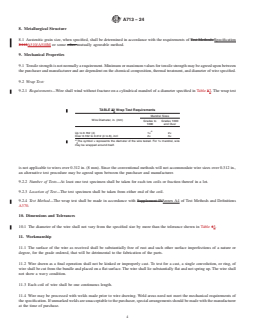
TABLE 2 Wrap Test Requirements
Mandrel Sizes
7.1 The steel shall conform to the requirements for chemical
Wire Diameter, in. (mm)
composition prescribed in Table 1 for the grade ordered. Grades to Grades 1090
1090 and Over
A
TABLE 1 Chemical Composition
Up to 0.162 (4) 1× 2×
Over 0.162 to 0.312 (4 to 8), incl 2× 3×
NOTE 1— The following ranges of silicon are commonly specified for
A
The symbol × represents the diameter of the wire tested. For 1× mandrel, wire
high-carbon steels: 0.10 % to 0.20 %; 0.15 % to 0.30 %; 0.20 % to
may be wrapped around itself.
0.40 %; or 0.30 % to 0.60 %.
Composition, %
UNS
Carbon Manga- Phos- Sulfur,
Designa- Grade
A nese phorus, max wrap test is not applicable to wires over 0.312 in. (8 mm).
tion
max
Since the conventional methods will not accommodate wire
G 10550 1055 0.50–0.60 0.60–0.90 0.040 0.050
sizes over 0.312 in., an alternative test procedure may be
G 10590 1059 0.55–0.65 0.50–0.80 0.040 0.050
agreed upon between the purchaser and manufacturer.
G 10600 1060 0.55–0.65 0.60–0.90 0.040 0.050
G 10640 1064 0.60–0.70 0.50–0.80 0.040 0.050 9.2.2 Number of Tests—At least one test specimen shall be
G 10650 1065 0.60–0.70 0.60–0.90 0.040 0.050
taken for each ten coils or fraction thereof in a lot.
G 10690 1069 0.65–0.75 0.40–0.70 0.040 0.050
9.2.3 Location of Test—The test specimen shall be taken
G 10700 1070 0.65–0.75 0.60–0.90 0.040 0.050
G 10740 1074 0.70–0.80 0.50–0.80 0.040 0.050 from either end of the coil.
G 10750 1075 0.70–0.80 0.40–0.70 0.040 0.050
9.2.4 Test Method—The wrap test shall be made in accor-
G 10780 1078 0.72–0.85 0.30–0.60 0.040 0.050
dance with Annex A4 of Test Methods and Definitions A370.
G 10800 1080 0.75–0.88 0.60–0.90 0.040 0.050
G 10840 1084 0.80–0.93 0.60–0.90 0.040 0.050
G 10860 1086 0.80–0.93 0.30–0.50 0.040 0.050 10. Dimensions and Tolerances
G 10900 1090 0.85–0.98 0.60–0.90 0.040 0.050
10.1 The diameter of the wire shall not vary from
...
This document is not an ASTM standard and is intended only to provide the user of an ASTM standard an indication of what changes have been made to the previous version. Because
it may not be technically possible to adequately depict all changes accurately, ASTM recommends that users consult prior editions as appropriate. In all cases only the current version
of the standard as published by ASTM is to be considered the official document.
Designation: A713 − 04 (Reapproved 2017) A713 − 24
Standard Specification for
Steel Wire, High-Carbon Spring, for Heat-Treated
Components
This standard is issued under the fixed designation A713; the number immediately following the designation indicates the year of
original adoption or, in the case of revision, the year of last revision. A number in parentheses indicates the year of last reapproval. A
superscript epsilon (´) indicates an editorial change since the last revision or reapproval.
1. Scope Scope*
1.1 This specification covers round carbon spring steel wire in coils intended for the manufacture of mechanical springs and wire
forms that are heat treated (austenitized, quenched, and tempered) after fabrication.
1.2 The values stated in inch-pound units are to be regarded as the standard.
1.3 This international standard was developed in accordance with internationally recognized principles on standardization
established in the Decision on Principles for the Development of International Standards, Guides and Recommendations issued
by the World Trade Organization Technical Barriers to Trade (TBT) Committee.
2. Referenced Documents
2.1 ASTM Standards:
A370 Test Methods and Definitions for Mechanical Testing of Steel Products
A510A510/A510M Specification for General Requirements for Wire Rods and Coarse Round Wire, Carbon Steel (Metric)
A0510_A0510M Steel, and Alloy Steel
A700 Guide for Packaging, Marking, and Loading Methods for Steel Products for Shipment
A751 Test Methods and Practices for Chemical Analysis of Steel Products
A941 Terminology Relating to Steel, Stainless Steel, Related Alloys, and Ferroalloys
E29 Practice for Using Significant Digits in Test Data to Determine Conformance with Specifications
E30 Test Methods for Chemical Analysis of Steel, Cast Iron, Open-Hearth Iron, and Wrought Iron (Withdrawn 1995)
E112 Test Methods for Determining Average Grain Size
E350 Test Methods for Chemical Analysis of Carbon Steel, Low-Alloy Steel, Silicon Electrical Steel, Ingot Iron, and Wrought
Iron
E527 Practice for Numbering Metals and Alloys in the Unified Numbering System (UNS)
2.2 Society of Automotive Engineers Standard:
J 1086 Numbering Metals and Alloys
This specification is under the jurisdiction of ASTM Committee A01 on Steel, Stainless Steel and Related Alloys and is the direct responsibility of Subcommittee A01.03
on Steel Rod and Wire.
Current edition approved March 15, 2017March 1, 2024. Published March 2017March 2024. Originally approved in 1975. Last previous edition approved in 20102017
as A713 – 04 (2010).(2017). DOI: 10.1520/A0713-04R17.10.1520/A0713-24.
For referenced ASTM standards, visit the ASTM website, www.astm.org, or contact ASTM Customer Service at service@astm.org. For Annual Book of ASTM Standards
volume information, refer to the standard’s Document Summary page on the ASTM website.
Available from American Society of Mechanical Engineers (ASME), ASME International Headquarters, Three Park Ave., New York, NY 10016-5990, http://
www.asme.org.
*A Summary of Changes section appears at the end of this standard
Copyright © ASTM International, 100 Barr Harbor Drive, PO Box C700, West Conshohocken, PA 19428-2959. United States
A713 − 24
2.3 AIAG Standard:
AIAGB-5AIAGB-10 02.00 Primary Metals Identification Tag Application StandardTrading Partner Labels Implementation
Guideline
3. Terminology
3.1 Definitions:
3.1.1 Refer to Terminology A941 for definitions of terms not in 3.2.
3.2 Definitions:Definitions of Terms Specific to This Standard:
3.2.1 heat-treated components—components, n—mechanical springs or wire forms that are austenitized, quenched, and tempered
after fabrication.
3.2.2 out-of-round, n—the difference between the maximum diameter and the minimum diameter on the same cross section.
3.2 Refer to Terminology A941 for a more detailed description of heat-treating terms.
4. Ordering Information
4.1 It shall be the responsibility of the purchaser to specify all requirements that are necessary for material under this specification.
Such requirements include, but are not limited to, the following:
4.1.1 Quantity (weight),
4.1.2 Name of material (Sections 1 and 7),
4.1.3 Diameter ((SectionTable 1 10),
4.1.4 Packaging, marking, and loading (Section 1215),
4.1.5 ASTM designation and date of issue,
4.1.6 Special requirements (Sections 8 and 9), and
4.1.7 End use.
NOTE 1—A typical ordering description is as follows: Steel Wire, High Carbon Spring, for Heat-Treated Components, Grade 1070, to ASTM A713 dated
________, for Door Closer Springs, 30 00030 000 lb, Size 0.250 in. in 500-lb Catch Weight Coils.
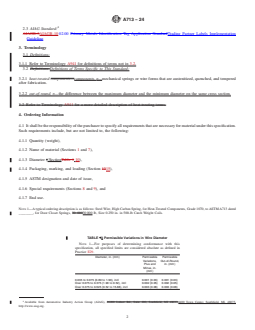
TABLE 13 Permissible Variations in Wire Diameter
NOTE 1—For purposes of determining conformance with this
specification, all specified limits are considered absolute as defined in
Practice E29.
Diameter, in. (mm) Permissible Permissible
Variations, Out-of-Round,
Plus and in. (mm)
Minus, in.
(mm)
0.035 to 0.075 (0.89 to 1.90), incl 0.001 (0.03) 0.001 (0.03)
Over 0.075 to 0.375 (1.90 to 9.52), incl 0.002 (0.05) 0.002 (0.05)
Over 0.375 to 0.625 (9.52 to 15.88), incl 0.003 (0.08) 0.003 (0.08)
Available from Automotive Industry Action Group (AIAG), 26200 Lahser Rd., Suite 200, Southfield, MI 48033,4400 Town Center, Southfield, MI, 48075.
http://www.aiag.org.
A713 − 24
5. General Requirements for Delivery
5.1 Material furnished under this specification shall conform to the applicable requirements of the latest edition of Specification
A510A510/A510M unless otherwise specified herein.
6. Materials and Manufacture
6.1 The steel shall be made by the open-hearth, basic-oxygen, or electric-furnace any commercially accepted steelmaking process.
6.2 The wire, prior to fabrication, shall be thermally treated or thermally treated and drawn.
6.3 The condition or wire (metallurgical and mechanical properties) to be used is at the discretion of the purchaser and is generally
dependent on the severity of the component part to be formed.
7. Chemical Composition
7.1 The steel shall conform to the requirements for chemical composition prescribed in Table 21 for the grade ordered.
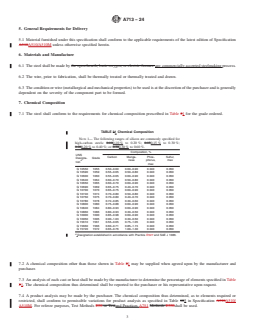
TABLE 21 Chemical Composition
NOTE 1— The following ranges of silicon are commonly specified for
high-carbon steels: 0.100.10 % to 0.20 %; 0.150.15 % to 0.30 %;
0.200.20 % to 0.40 %; or 0.300.30 % to 0.60 %.
Composition, %
UNS
Carbon Manga- Phos- Sulfur,
Designa- Grade
A nese phorus, max
tion
max
G 10550 1055 0.50–0.60 0.60–0.90 0.040 0.050
G 10590 1059 0.55–0.65 0.50–0.80 0.040 0.050
G 10600 1060 0.55–0.65 0.60–0.90 0.040 0.050
G 10640 1064 0.60–0.70 0.50–0.80 0.040 0.050
G 10650 1065 0.60–0.70 0.60–0.90 0.040 0.050
G 10690 1069 0.65–0.75 0.40–0.70 0.040 0.050
G 10700 1070 0.65–0.75 0.60–0.90 0.040 0.050
G 10740 1074 0.70–0.80 0.50–0.80 0.040 0.050
G 10750 1075 0.70–0.80 0.40–0.70 0.040 0.050
G 10780 1078 0.72–0.85 0.30–0.60 0.040 0.050
G 10800 1080 0.75–0.88 0.60–0.90 0.040 0.050
G 10840 1084 0.80–0.93 0.60–0.90 0.040 0.050
G 10860 1086 0.80–0.93 0.30–0.50 0.040 0.050
G 10900 1090 0.85–0.98 0.60–0.90 0.040 0.050
G 10950 1095 0.90–1.03 0.30–0.50 0.040 0.050
G 15610 1561 0.55–0.65 0.75–1.05 0.040 0.050
G 15660 1566 0.60–0.71 0.85–1.15 0.040 0.050
G 15720 1572 0.65–0.76 1.00–1.30 0.040 0.050
A
Designation established in accordance with Practice E527 and SAE J 1086.
7.2 A chemical composition other than those shown in Table 21 may be supplied when agreed upon by the manufacturer and
purchaser.
7.3 An analysis of each cast or heat shall be made by the manufacturer to determine
...