

ASTM D7830/D7830M-14(2021)e1
(Test Method)Standard Test Method for In-Place Density (Unit Weight) and Water Content of Soil Using an Electromagnetic Soil Density Gauge
General Information
- Abstract
SIGNIFICANCE AND USE
5.1 The method described determines wet density and gravimetric water content by correlating complex impedance measurement data to an empirically developed model. The empirical model is generated by comparing the electrical properties of typical soils encountered in civil construction projects to their wet densities and gravimetric water contents determined by other accepted methods.
5.2 The test method described is useful as a rapid, non-destructive technique for determining the in-place total density and gravimetric water content of soil and soil-aggregate mixtures and the determination of dry density.
5.3 This method may be used for quality control and acceptance of compacted soil and soil-aggregate mixtures as used in construction and also for research and development. The non-destructive nature allows for repetitive measurements at a single test location and statistical analysis of the results.
Note 2: The quality of the result produced by this standard test method is dependent on the competence of the personnel performing it, and the suitability of the equipment and facilities used. Agencies that meet the requirements of Practice D3740 are generally considered capable of competent and objective sampling/testing/inspection, and the like. Users of this standard are cautioned that compliance with Practice D3740 does not in itself assure reliable results. Reliable results depend on many factors; Practice D3740 provides a means of evaluation some of those factors.
SCOPE
1.1 This test method covers the procedures for determining in-place properties of non-frozen, unbound soil and soil aggregate mixtures such as total density, gravimetric water content and relative compaction by measuring the intrinsic impedance of the compacted soil.
1.1.1 The method and device described in this test method are intended for in-process quality control of earthwork projects. Site or material characterization is not an intended result.
1.2 Units—The values stated in either SI units or inch-pound units are to be regarded separately as standard. The values stated in each system may not be exact equivalents; therefore, each system shall be used independently of the other. Combining values from the two systems may result in nonconformance with the standard.
1.2.1 The gravitational system of inch-pound units is used when dealing with inch-pound units. In this system, the pound (lbf) represents a unit of force (weight) while the unit for mass is slugs. The rationalized slug unit is not given in this standard.
1.2.2 In the engineering profession, it is customary practice to use, interchangeably, units representing both mass and force, unless dynamic calculations are involved. This implicitly combines two separate systems of units, that is, the absolute system and the gravimetric system. It is undesirable to combine the use of two separate systems within a single standard. The use of balances or scales recording pounds of mass (lbm), or the recording of density in lbm/ft3 should not be regarded as nonconformance with this standard.
1.3 All observed and calculated values shall conform to the Guide for Significant Digits and Rounding established in Practice D6026.
1.3.1 The procedures used to specify how data is collected, recorded, and calculated in this standard are regarded as industry standard. In addition, they are representative of the significant digits that should generally be retained. The procedures used do not consider material variation, purpose for obtaining the data, special purpose studies, or any considerations for the user’s objectives; and it is common practice to increase or decrease the number of significant digits of reported data commensurate with these considerations. It is beyond the scope of this standard to consider significant digits used in the analysis methods for engineering design.
1.4 This standard does not purport to address all of the safety concerns, if any,...
- Status
- Published
- Publication Date
- 14-Jul-2021
- Technical Committee
- D18 - Soil and Rock
- Drafting Committee
- D18.08 - Special and Construction Control Tests
Overview
ASTM D7830/D7830M-14(2021)e1 is a standard test method developed by ASTM International for determining the in-place density (unit weight) and water content of soil using an electromagnetic soil density gauge. This method provides a rapid and non-destructive approach to measure wet density, gravimetric water content, and related compaction properties of non-frozen, unbound soils and soil-aggregate mixtures, relying on electromagnetic impedance measurements correlated to empirical data.
The method is especially valuable for in-process quality control and acceptance testing during construction projects, enabling repetitive, reliable, and efficient assessment of soil compaction and moisture without disturbing the test location.
Key Topics
- In-place Soil Density and Water Content: Measures the total (wet) density, dry density, and gravimetric water content of soils in their natural state.
- Electromagnetic Soil Density Gauge: Utilizes impedance spectroscopy, which detects variations in electromagnetic properties of soil at different frequencies, to infer density and water content.
- Empirical Calibration: The instrument's measurements are linked to established empirical models built by comparing electrical soil properties to densities and water contents determined via traditional methods.
- Non-Destructive Testing: The process allows for repeated measurements at a single location, supporting robust statistical analysis and minimizing disruption to tested materials.
- Unit Flexibility: Can be applied using both SI and inch-pound units. Results should not mix units within a dataset.
- Quality Control: Supports real-time assessment during earthworks and facilitates immediate corrective actions if required compaction standards are not met.
- User and Equipment Considerations: Accurate results depend on suitable equipment, operator competence, and adherence to procedural guidance.
Applications
- Construction Quality Control: Ensures compacted soils and soil-aggregate mixtures meet project specifications for density and moisture, critical for roads, foundations, embankments, and other civil engineering structures.
- Compaction Acceptance Testing: Provides a rapid alternative to traditional sand-cone, rubber balloon, or nuclear gauge methods for confirming soil compaction in the field.
- Research and Development: Useful in laboratory and field studies focusing on new soil stabilization techniques or comparative evaluations of compaction equipment.
- Environmental and Safety Advantages: As a non-nuclear technology, electromagnetic density gauges offer a safer alternative to nuclear-based density measurement tools, eliminating radiological hazards and regulatory compliance burdens.
- Efficiency: Saves time through quick measurement cycles and enables productivity gains for earthwork contractors and material testing labs.
Related Standards
The use and reference of ASTM D7830/D7830M often occur alongside other recognized ASTM soil testing standards. Key related documents include:
- ASTM D698, D1557: Laboratory tests for soil compaction characteristics using standard and modified efforts.
- ASTM D1556/D1556M, D2167, D2937: Field methods for determining soil density by sand-cone, rubber balloon, and drive-cylinder techniques.
- ASTM D2216: Laboratory determination of water (moisture) content in soil and rock by mass.
- ASTM D4253, D4254: Tests for maximum and minimum index density and unit weight procedures for soils.
- ASTM D6938: Methods for in-place density and water content determination using nuclear techniques.
- ASTM D6026: Guide for using significant digits in geotechnical data.
- ASTM D4718/D4718M: Correction procedures for soils containing oversized particles.
Understanding and referencing these related standards is important for laboratories, engineers, and field technicians to ensure consistent, standardized soil testing and reporting methods across varied project requirements.
Keywords: ASTM D7830, electromagnetic soil density gauge, in-place soil density, soil water content measurement, construction quality control, non-destructive soil testing, soil compaction acceptance, soil-aggregate mixtures, earthwork testing, geotechnical standards.
Relations
- Refers
ASTM D4959-24 - Standard Test Method for Determination of Water Content of Soil By Direct Heating - Effective Date
- 01-Feb-2024
- Effective Date
- 01-Nov-2023
- Effective Date
- 01-Jul-2020
- Effective Date
- 01-Oct-2019
- Effective Date
- 01-Mar-2019
- Effective Date
- 15-Feb-2018
- Refers
ASTM D4318-17 - Standard Test Methods for Liquid Limit, Plastic Limit, and Plasticity Index of Soils - Effective Date
- 01-Jun-2017
- Effective Date
- 01-Jun-2017
- Effective Date
- 01-Mar-2017
- Refers
ASTM D2937-17 - Standard Test Method for Density of Soil in Place by the Drive-Cylinder Method - Effective Date
- 01-Feb-2017
- Effective Date
- 01-Feb-2017
- Refers
ASTM D2937-17e2 - Standard Test Method for Density of Soil in Place by the Drive-Cylinder Method - Effective Date
- 01-Feb-2017
- Refers
ASTM D2937-17e1 - Standard Test Method for Density of Soil in Place by the Drive-Cylinder Method - Effective Date
- 01-Feb-2017
- Effective Date
- 01-Mar-2016
- Effective Date
- 01-Mar-2016
Get Certified
Connect with accredited certification bodies for this standard

CIS Institut d.o.o.
Personal Protective Equipment (PPE) certification body. Notified Body NB-2890 for EU Regulation 2016/425 PPE.

Kiwa BDA Testing
Building and construction product certification.
Kmetijski inštitut Slovenije
Agricultural Institute of Slovenia. Soil testing, plant health, agricultural product analysis.
Sponsored listings
Frequently Asked Questions
ASTM D7830/D7830M-14(2021)e1 is a standard published by ASTM International. Its full title is "Standard Test Method for In-Place Density (Unit Weight) and Water Content of Soil Using an Electromagnetic Soil Density Gauge". This standard covers: SIGNIFICANCE AND USE 5.1 The method described determines wet density and gravimetric water content by correlating complex impedance measurement data to an empirically developed model. The empirical model is generated by comparing the electrical properties of typical soils encountered in civil construction projects to their wet densities and gravimetric water contents determined by other accepted methods. 5.2 The test method described is useful as a rapid, non-destructive technique for determining the in-place total density and gravimetric water content of soil and soil-aggregate mixtures and the determination of dry density. 5.3 This method may be used for quality control and acceptance of compacted soil and soil-aggregate mixtures as used in construction and also for research and development. The non-destructive nature allows for repetitive measurements at a single test location and statistical analysis of the results. Note 2: The quality of the result produced by this standard test method is dependent on the competence of the personnel performing it, and the suitability of the equipment and facilities used. Agencies that meet the requirements of Practice D3740 are generally considered capable of competent and objective sampling/testing/inspection, and the like. Users of this standard are cautioned that compliance with Practice D3740 does not in itself assure reliable results. Reliable results depend on many factors; Practice D3740 provides a means of evaluation some of those factors. SCOPE 1.1 This test method covers the procedures for determining in-place properties of non-frozen, unbound soil and soil aggregate mixtures such as total density, gravimetric water content and relative compaction by measuring the intrinsic impedance of the compacted soil. 1.1.1 The method and device described in this test method are intended for in-process quality control of earthwork projects. Site or material characterization is not an intended result. 1.2 Units—The values stated in either SI units or inch-pound units are to be regarded separately as standard. The values stated in each system may not be exact equivalents; therefore, each system shall be used independently of the other. Combining values from the two systems may result in nonconformance with the standard. 1.2.1 The gravitational system of inch-pound units is used when dealing with inch-pound units. In this system, the pound (lbf) represents a unit of force (weight) while the unit for mass is slugs. The rationalized slug unit is not given in this standard. 1.2.2 In the engineering profession, it is customary practice to use, interchangeably, units representing both mass and force, unless dynamic calculations are involved. This implicitly combines two separate systems of units, that is, the absolute system and the gravimetric system. It is undesirable to combine the use of two separate systems within a single standard. The use of balances or scales recording pounds of mass (lbm), or the recording of density in lbm/ft3 should not be regarded as nonconformance with this standard. 1.3 All observed and calculated values shall conform to the Guide for Significant Digits and Rounding established in Practice D6026. 1.3.1 The procedures used to specify how data is collected, recorded, and calculated in this standard are regarded as industry standard. In addition, they are representative of the significant digits that should generally be retained. The procedures used do not consider material variation, purpose for obtaining the data, special purpose studies, or any considerations for the user’s objectives; and it is common practice to increase or decrease the number of significant digits of reported data commensurate with these considerations. It is beyond the scope of this standard to consider significant digits used in the analysis methods for engineering design. 1.4 This standard does not purport to address all of the safety concerns, if any,...
SIGNIFICANCE AND USE 5.1 The method described determines wet density and gravimetric water content by correlating complex impedance measurement data to an empirically developed model. The empirical model is generated by comparing the electrical properties of typical soils encountered in civil construction projects to their wet densities and gravimetric water contents determined by other accepted methods. 5.2 The test method described is useful as a rapid, non-destructive technique for determining the in-place total density and gravimetric water content of soil and soil-aggregate mixtures and the determination of dry density. 5.3 This method may be used for quality control and acceptance of compacted soil and soil-aggregate mixtures as used in construction and also for research and development. The non-destructive nature allows for repetitive measurements at a single test location and statistical analysis of the results. Note 2: The quality of the result produced by this standard test method is dependent on the competence of the personnel performing it, and the suitability of the equipment and facilities used. Agencies that meet the requirements of Practice D3740 are generally considered capable of competent and objective sampling/testing/inspection, and the like. Users of this standard are cautioned that compliance with Practice D3740 does not in itself assure reliable results. Reliable results depend on many factors; Practice D3740 provides a means of evaluation some of those factors. SCOPE 1.1 This test method covers the procedures for determining in-place properties of non-frozen, unbound soil and soil aggregate mixtures such as total density, gravimetric water content and relative compaction by measuring the intrinsic impedance of the compacted soil. 1.1.1 The method and device described in this test method are intended for in-process quality control of earthwork projects. Site or material characterization is not an intended result. 1.2 Units—The values stated in either SI units or inch-pound units are to be regarded separately as standard. The values stated in each system may not be exact equivalents; therefore, each system shall be used independently of the other. Combining values from the two systems may result in nonconformance with the standard. 1.2.1 The gravitational system of inch-pound units is used when dealing with inch-pound units. In this system, the pound (lbf) represents a unit of force (weight) while the unit for mass is slugs. The rationalized slug unit is not given in this standard. 1.2.2 In the engineering profession, it is customary practice to use, interchangeably, units representing both mass and force, unless dynamic calculations are involved. This implicitly combines two separate systems of units, that is, the absolute system and the gravimetric system. It is undesirable to combine the use of two separate systems within a single standard. The use of balances or scales recording pounds of mass (lbm), or the recording of density in lbm/ft3 should not be regarded as nonconformance with this standard. 1.3 All observed and calculated values shall conform to the Guide for Significant Digits and Rounding established in Practice D6026. 1.3.1 The procedures used to specify how data is collected, recorded, and calculated in this standard are regarded as industry standard. In addition, they are representative of the significant digits that should generally be retained. The procedures used do not consider material variation, purpose for obtaining the data, special purpose studies, or any considerations for the user’s objectives; and it is common practice to increase or decrease the number of significant digits of reported data commensurate with these considerations. It is beyond the scope of this standard to consider significant digits used in the analysis methods for engineering design. 1.4 This standard does not purport to address all of the safety concerns, if any,...
ASTM D7830/D7830M-14(2021)e1 is classified under the following ICS (International Classification for Standards) categories: 13.080.20 - Physical properties of soils. The ICS classification helps identify the subject area and facilitates finding related standards.
ASTM D7830/D7830M-14(2021)e1 has the following relationships with other standards: It is inter standard links to ASTM D4959-24, ASTM D3740-23, ASTM D7382-20, ASTM D3740-19, ASTM D2216-19, ASTM D4944-18, ASTM D4318-17, ASTM D4318-17e1, ASTM D6938-17, ASTM D2937-17, ASTM D4643-17, ASTM D2937-17e2, ASTM D2937-17e1, ASTM D4253-16e1, ASTM D4253-16. Understanding these relationships helps ensure you are using the most current and applicable version of the standard.
ASTM D7830/D7830M-14(2021)e1 is available in PDF format for immediate download after purchase. The document can be added to your cart and obtained through the secure checkout process. Digital delivery ensures instant access to the complete standard document.
Standards Content (Sample)
This international standard was developed in accordance with internationally recognized principles on standardization established in the Decision on Principles for the
Development of International Standards, Guides and Recommendations issued by the World Trade Organization Technical Barriers to Trade (TBT) Committee.
´1
Designation: D7830/D7830M − 14 (Reapproved 2021)
Standard Test Method for
In-Place Density (Unit Weight) and Water Content of Soil
Using an Electromagnetic Soil Density Gauge
This standard is issued under the fixed designation D7830/D7830M; the number immediately following the designation indicates the
year of original adoption or, in the case of revision, the year of last revision. A number in parentheses indicates the year of last
reapproval. A superscript epsilon (´) indicates an editorial change since the last revision or reapproval.
ε NOTE—Referenced Documents section was updated editorially in July 2021.
1. Scope industry standard. In addition, they are representative of the
significant digits that should generally be retained. The proce-
1.1 This test method covers the procedures for determining
dures used do not consider material variation, purpose for
in-place properties of non-frozen, unbound soil and soil aggre-
obtaining the data, special purpose studies, or any consider-
gate mixtures such as total density, gravimetric water content
ations for the user’s objectives; and it is common practice to
and relative compaction by measuring the intrinsic impedance
increaseordecreasethenumberofsignificantdigitsofreported
of the compacted soil.
data commensurate with these considerations. It is beyond the
1.1.1 The method and device described in this test method
scope of this standard to consider significant digits used in the
are intended for in-process quality control of earthwork proj-
analysis methods for engineering design.
ects. Site or material characterization is not an intended result.
1.4 This standard does not purport to address all of the
1.2 Units—The values stated in either SI units or inch-
safety concerns, if any, associated with its use. It is the
pound units are to be regarded separately as standard. The
responsibility of the user of this standard to establish appro-
values stated in each system may not be exact equivalents;
priate safety, health, and environmental practices and deter-
therefore,eachsystemshallbeusedindependentlyoftheother.
mine the applicability of regulatory limitations prior to use.
Combining values from the two systems may result in noncon-
formance with the standard. NOTE 1—ASTM International takes no position respecting the validity
ofanypatentrightsassertedinconnectionwithanyitemmentionedinthis
1.2.1 The gravitational system of inch-pound units is used
standard. Users of this standard are expressly advised that determination
when dealing with inch-pound units. In this system, the pound
of the validity of any such patent rights, and the risk of infringement of
(lbf) represents a unit of force (weight) while the unit for mass
such rights, are entirely their own responsibility.
is slugs.The rationalized slug unit is not given in this standard.
1.5 This international standard was developed in accor-
1.2.2 In the engineering profession, it is customary practice
dance with internationally recognized principles on standard-
touse,interchangeably,unitsrepresentingbothmassandforce,
ization established in the Decision on Principles for the
unless dynamic calculations are involved. This implicitly
Development of International Standards, Guides and Recom-
combines two separate systems of units, that is, the absolute
mendations issued by the World Trade Organization Technical
systemandthegravimetricsystem.Itisundesirabletocombine
Barriers to Trade (TBT) Committee.
the use of two separate systems within a single standard. The
use of balances or scales recording pounds of mass (lbm), or
2. Referenced Documents
the recording of density in lbm/ft should not be regarded as
2.1 ASTM Standards:
nonconformance with this standard.
D653 Terminology Relating to Soil, Rock, and Contained
1.3 All observed and calculated values shall conform to the
Fluids
Guide for Significant Digits and Rounding established in
D698 Test Methods for Laboratory Compaction Character-
Practice D6026.
istics of Soil Using Standard Effort (12,400 ft-lbf/ft (600
1.3.1 The procedures used to specify how data is collected,
kN-m/m ))
recorded, and calculated in this standard are regarded as
D1556/D1556M Test Method for Density and Unit Weight
of Soil in Place by Sand-Cone Method
ThistestmethodisunderthejurisdictionofASTMCommitteeD18onSoiland
Rock and is the direct responsibility of Subcommittee D18.08 on Special and
Construction Control Tests. For referenced ASTM standards, visit the ASTM website, www.astm.org, or
Current edition approved July 15, 2021. Published July 2021. Originally contact ASTM Customer Service at service@astm.org. For Annual Book of ASTM
approved in 2013. Last previous edition approved in 2014 as D7830 – 14. Standards volume information, refer to the standard’s Document Summary page on
DOI:10.1520/D7830_D7830M–14R21E01. the ASTM website.
Copyright © ASTM International, 100 Barr Harbor Drive, PO Box C700, West Conshohocken, PA 19428-2959. United States
´1
D7830/D7830M − 14 (2021)
D1557 Test Methods for Laboratory Compaction Character- an electromagnetic impedance spectroscopy device. Electro-
istics of Soil Using Modified Effort (56,000 ft-lbf/ft magnetic properties of the soil are determined at specific
(2,700 kN-m/m )) frequencies by measuring the changes in the electromagnetic
D2167 Test Method for Density and Unit Weight of Soil in field. A function is generated that describes the relationship
Place by the Rubber Balloon Method between electrical properties over a range of frequencies. That
D2216 Test Methods for Laboratory Determination of Water function is compared to an empirical model and other calibra-
(Moisture) Content of Soil and Rock by Mass tion checks to determine water content and density.
D2937 Test Method for Density of Soil in Place by the
4.2 This method employs electromagnetic impedance spec-
Drive-Cylinder Method
troscopy to determine the volumetric water content and wet
D3740 Practice for Minimum Requirements for Agencies
density. The measurement spectrum is made up of frequencies
Engaged in Testing and/or Inspection of Soil and Rock as
ranging from 30 kHz to 50 MHz.
Used in Engineering Design and Construction
4.3 Propertiessuchasdrydensity,gravimetricwatercontent
D4253 Test Methods for Maximum Index Density and Unit
and relative compaction are calculated from the total density
Weight of Soils Using a Vibratory Table
and the volumetric water content.
D4254 Test Methods for Minimum Index Density and Unit
Weight of Soils and Calculation of Relative Density
5. Significance and Use
D4318 Test Methods for Liquid Limit, Plastic Limit, and
Plasticity Index of Soils
5.1 The method described determines wet density and
D4643 Test Method for Determination of Water Content of
gravimetric water content by correlating complex impedance
Soil and Rock by Microwave Oven Heating
measurement data to an empirically developed model. The
D4718/D4718M Practice for Correction of Unit Weight and
empirical model is generated by comparing the electrical
Water Content for Soils Containing Oversize Particles
properties of typical soils encountered in civil construction
D4944 TestMethodforFieldDeterminationofWater(Mois-
projects to their wet densities and gravimetric water contents
ture)ContentofSoilbytheCalciumCarbideGasPressure
determined by other accepted methods.
Tester
5.2 The test method described is useful as a rapid, non-
D4959 Test Method for Determination of Water Content of
destructive technique for determining the in-place total density
Soil By Direct Heating
and gravimetric water content of soil and soil-aggregate
D6026 Practice for Using Significant Digits and Data Re-
mixtures and the determination of dry density.
cords in Geotechnical Data
D6913/D6913M Test Methods for Particle-Size Distribution
5.3 This method may be used for quality control and
(Gradation) of Soils Using Sieve Analysis
acceptance of compacted soil and soil-aggregate mixtures as
D6938 TestMethodsforIn-PlaceDensityandWaterContent
used in construction and also for research and development.
of Soil and Soil-Aggregate by Nuclear Methods (Shallow
The non-destructive nature allows for repetitive measurements
Depth)
at a single test location and statistical analysis of the results.
D7382 Test Methods for Determination of Maximum Dry
NOTE2—Thequalityoftheresultproducedbythisstandardtestmethod
Unit Weight of Granular Soils Using a Vibrating Hammer
is dependent on the competence of the personnel performing it, and the
E691 Practice for Conducting an Interlaboratory Study to
suitability of the equipment and facilities used. Agencies that meet the
requirements of Practice D3740 are generally considered capable of
Determine the Precision of a Test Method
competent and objective sampling/testing/inspection, and the like. Users
2.2 Other Referenced Documents:
of this standard are cautioned that compliance with Practice D3740 does
“Development of a Non-Nuclear Soil Density Gauge to
not in itself assure reliable results. Reliable results depend on many
Eliminate the Need for Nuclear Density Gauges”
factors; Practice D3740 provides a means of evaluation some of those
factors.
3. Terminology
3.1 Definitions:
6. Interferences
3.1.1 See Terminology D653 for general definitions.
6.1 Anomalies in the test material with electrical impedance
3.2 Definitions of Terms Specific to This Standard:
properties significantly different from construction soils and
3.2.1 impedance, n—a measure of opposition to alternating
aggregate evaluated during soil model development, such as
current (AC).
metal objects or organic material, may affect the accuracy of
3.2.2 impedance spectroscopy, n—a method that measures the test method.
the electromagnetic properties of a medium as a function of
6.2 Chemical and mineralogical composition may affect the
frequency.
results of a test. Examples of materials that may impact the
results include but are not limited to, quarried materials
4. Summary of Test Method
containing higher concentrations of iron, volcanic rock, and
4.1 The total or wet density and gravimetric water content
materials that have significant fractions of cemented particles,
of soil and soil-aggregate are correlated to empirical data using
organic soils, recycled materials or materials containing
asphalt, portland cement, lime, fly ash, or other stabilizing
Prepared for The Department of Homeland Security under contract No.
modifiers. In most cases the effect may be satisfactorily
HSHQDC-07-C-00080. Dated October 31, 2008. Available from the U.S. Depart-
ment of Homeland Security, Washington, D.C. 20528, http://www.dhs.gov. addressed by following the Calibration Procedure in Section 7.
´1
D7830/D7830M − 14 (2021)
6.3 A significant increase in the conductivity of the pore 6.8 Attempts to measure unknown in-place soils with a soil
water such as from ground water that may contain significant model that was generated from a limited range of density or
water content values, or both, may result in density and water
salt deposits or contaminants. In most cases the effect may be
satisfactorilyaddressedbyfollowingtheCalibrationProcedure content errors.
in Section 7.
6.9 Strongelectromagneticfieldssuchasthosegeneratedby
high tension power lines may interfere with the device opera-
6.4 This test method applies only to non-frozen soil. The
tion.
electrical properties of soil change with temperature.
Generally, testing should be limited to soil temperatures above
6.10 For a circular sensor 280 mm [11 in.] in diameter, the
10°C [50°F] and below 40°C [104°F]. Effects of temperature typical maximum measured volume is approximately 0.0034
3 3
on electrical properties of soils also depend on soil type.
m [0.12ft ].Theactualmeasuredvolumeisindeterminateand
Clayey soils are more temperature sensitive than sandy soils. varies with the plate diameter, sensor configuration, and
Accuracy of measurements improves when the temperature of material being tested. Results are typically influenced more by
soil is close to the temperature used in the model calibration. the density and water content of the material near the surface.
Calibration for temperature effects should be done when soil
4,5
7. Apparatus
temperatures differ by more than 10°C [18°F] from model
7.1 Electromagnetic Soil Density Gauge—Adevice capable
calibration temperatures. Calibration Procedures are given in
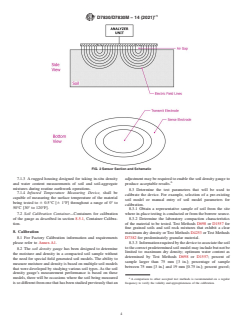
of generating an electromagnetic field and measuring the
Section 7.
differential voltage change between two electrodes. An ex-
6.5 The accuracy of the results obtained by this test method
ample of the device is shown in Fig. 1 and a sensor schematic
maybeinfluencedbypoororincorrectplacementofthedevice
section and approximate electrical fields that sense the soil is
on the soil being tested. Non-homogeneous soils, non-uniform
shown in Fig. 2. While the exact details of construction of the
surface texture, large air voids that may be present may
apparatus may vary, the system shall consist of:
decrease the precision of the results. Correct placement of the
7.1.1 Electronic circuitry to provide power and signal con-
soil gauge is important to the quality of the electrical measure-
ditioning to the sensor and to provide the data acquisition and
ments collected by the device.
display functions. The circuitry shall be designed to perform a
calibration of the unit over a range of conditions and materials
6.6 Oversized particles in the measurement volume may
expected in the field.
cause an error in water content and/or density results. Where
7.1.2 Internal circuitry suitable for displaying individual
lack of uniformity in the soil is suspected due to layering,
measurements to allow operators to record the results.
aggregates, or voids, the test site should be excavated and
visually examined to determine if the material is representative
The sole source of supply of the TransTech Soil Density Gauge (SDG)
of the in-situ material in general and if an oversize correction
apparatusknowntothecommitteeatthistimeisTransTechSystems,Inc.1594State
is required in accordance with Practice D4718/D4718M.
Street, Schenectady, NY. If you are aware of alternative suppliers, please provide
this information to ASTM International Headquarters. Your comments will receive
6.7 Variation from actual values may increase for soil
careful consideration at a meeting of the responsible technical committee, which
materialthatissignificantlydrierorwetterthanoptimumwater
you may attend.
The Electromagnetic Soil Density Gauge is covered by a patent (patent no.: US
content as determined using Test Methods D698 or D1557.
7,219,024 B2). Interested parties are invited to submit information regarding the
Variation from actual values may increase for soil material that
identification of an alternative(s) to this patented item to the ASTM International
is compacted to less than 80 % of the maximum dry density as
Headquarters.Your comments will receive careful consideration at a meeting of the
determined using Test Methods D698 or D1557. responsible technical committee, which you may attend.
FIG. 1 Electromagnetic Soil Density Gauge
´1
D7830/D7830M − 14 (2021)
FIG. 2 Sensor Section and Schematic
7.1.3 A rugged housing designed for taking in-situ density adjustment may be required to enable the soil density gauge to
and water content measurements of soil and soil-aggregate produce acceptable results.
mixtures during routine earthwork operations.
8.3 Determine the test parameters that will be used to
7.1.4 Infrared Temperature Measuring Device, shall be
calibrate the device. For example, selection of a pre-existing
capable of measuring the surface temperature of the material
soil model or manual entry of soil model parameters for
being tested to 6 0.5°C [6 1°F] throughout a range of 0° to
calibration.
50°C [30° to 120°F].
8.3.1 Obtain a representative sample of soil from the site
7.2 Soil Calibration Container—Containers for calibration where in-place testing is conducted or from the borrow source.
of the gauge as described in section 8.5.1, Container Calibra- 8.3.2 Determine the laboratory compaction characteristics
tion. of the material to be tested. Test Methods D698 or D1557 for
fine grained soils and soil rock mixtures that exhibit a clear
8. Calibration
maximum dry density orTest Methods D4253 orTest Methods
D7382 for predominately granular material.
8.1 For Factory Calibration information and requirements
please refer to Annex A1. 8.3.3 Informationrequiredbythedevicetoassociatethesoil
to the correct predetermined soil model may include but not be
8.2 The soil density gauge has been designed to determine
limited to: maximum dry density; optimum water content as
the moisture and density in a compacted soil sample without
determined by Test Methods D698 or D1557; percent of
the need for special field generated soil models. The ability to
sample larger than 75 mm [3 in.]; percentage of sample
measure moisture and density is based on multiple soil models
between 75 mm [3 in.] and 19 mm [0.75 in.]; percent gravel;
that were developed by studying various soil types.As the soil
density gauge’s measurement performance is based on these
models, there will be occasions where the soil being measured
A comparison to other accepted test methods is recommended on a regular
issodifferentfromonethathasbeenstudiedpreviouslythatan frequency to verify the validity and appropriateness of the calibration.
´1
D7830/D7830M − 14 (2021)
percent sand; percent fines; coefficient of uniformity; and 8.5.3.1 The water content correction can be applied
coefficient of curvature in accordance with Test Method manually, or can be entered into the device if the device is
D6913/D6913M, Plastic Limit, and Test Methods D4318, equipped with an offset or correction feature.
Liquid Limit. 8.5.4 The mean value of the difference between the wet
density as determined in 8.5.2 and the values measured with
8.4 Prior to using the gauge derived water content on any
the gauge shall be used as a correction to those measurements
new material, the value for water content should be verified by
made in the field.
comparison to another accepted test method such as Test
8.5.4.1 The wet density correction can be applied manually,
Methods D2216, D4643, D4944,or D4959. Prior to using the
or can be entered into the device if the device is equipped with
gaugederiveddensityonanynewmaterial,thevalueshouldbe
an offset or correction feature.
verified by comparison to another accepted test method such as
Test Methods D1556/D1556M, D2167, D2937,or D6938.As
8.6 The method and test procedures used to obtain the
part of a user developed procedure, occasional tests should be electrical measurements must be the same as those used during
taken beneath the gauge and from samples taken beneath the
routine testing.
gauge and comparison test be done to confirm the gauge
derived water content values. Following the manufacturer
9. Procedure
procedures for correcting the gauge derived water content and
9.1 Preparation of Test Site:
density values.
9.1.1 Select a test location in accordance with the contract
8.5 The calibration should be checked prior to performing documents, located to be representative of the total material
tests on materials that are distinctly different from material being placed and to minimize potential interferences.
types previously used in obtaining or adjusting the calibration.
9.1.2 Remove all loose and disturbed material, or overlying
If a field calibration is necessary follow the procedures below. material, as necessary to expose the true surface of the material
to be tested.
8.5.1 Container Calibration—Prepare containers of com-
pacted material with a known water content as determined by
9.2 Place the device on the surface of the material to be
Test Methods D2216, D4643, D4944,or D4959 and a wet
tested.
density calculated by dividing the mass of the material by the
9.3 Secure and record one or more density and water
inside volume of the container.
content measurements.
8.5.1.1 Containers used for preparing compacted samples
shall have minimum dimensions of 0.66 m [2 ft] wide, 0.66 m 9.4 Measure the soil temperature to the nearest 1°C [0.5°F].
[2 ft] long, and 0.33 m [1 ft] deep and be constructed of a (The temperature of the material during testing should be
non-conductive material capable of retaining its shape during representative of the material temperature during calibration.)
the compaction process.
9.5 For proper use of the gauge and accurate values of both
8.5.1.2 Material used for calibration shall be representative
water content and density corrections to density (8.5.4), to
of the material to be tested and should be compacted at
water content (8.5.3) and for oversize particles (Practice
optimum moisture content 62 % and should be compacted to
D4718/D4718M) should be applied when applicable.
95 % 62%.
9.5.1 When there is any uncertainty as to the presence of
8.5.1.3 Calibration shall be performed on soil at or near
oversizeparticles,itisadvisabletosamplethematerialbeneath
temperatures expected in the field during routine testing.
the gauge to verify the presence and relative proportion of the
8.5.2 Onsite Calibration—Where prepared containers of oversize particles.Arock correction can then be made for both
compacted samples are not available, the gauge may be the water content and the density by the method in Practice
correlated by using a minimum of three sets of test results D4718/D4718M.
taken in an area of a compaction project where material has
been placed at different water contents. The test sites shall
10. Calculation of Results
represent the range of water contents and densities, over which
10.1 Determine the Wet Density, ρ :
t
the correlation is to be used.At least three gauge readings shall
3 3
10.1.1 Read the value directly in kg/m [lbm/ft ].
be made at each test site. The density at each site shall be
10.1.2 Record the density to the nearest 1 kg/m [0.1
verified by tests performed in accordance with Test Methods
lbm/ft ].
D1556/D1556M, D2167, D2937,or D6938. The water content
10.1.2.1 If desired, calculate the wet unit weight, γ,as
t
at each site shall be determined in accordance with Test
follows:
Methods D2216, D4643, D4944,or D4959. Use the mean
γ 5 9.8066 3ρ , N⁄m (1)
valueofthereplicatereadingsasthecorrelationpointvaluefor
t t
each test site.
or
8.5.2.1 Calibration shall be performed on material that is at
γ 5 62.428 3ρ , lbf⁄ft (2)
t t
or near material temperatures expected during routine testing.
10.2 Determine the Water Content, w:
8.5.3 The mean value of the difference between the water
10.2.1 Read the value directly in percent.
content as determined in 8.5.2 and the values measured with
the gauge shall be used as a correction to those measurements 10.2.2 If the gauge determines water mass per unit volume,
3 3
made in the field. M in kg/m [lbm /ft ], calculate w using the equation:
w
´1
D7830/D7830M − 14 (2021)
M 3100 11.1.7 Standardization and adjustment data for the date of
w
w 5 (3)
ρ 2 M the tests.
t w
11.1.8 Any corrections made in the reported values and
or,ifthegaugedetermineswaterweightperunitvolume, W
w
reasonsforthesecorrections(thatis,over-sizedparticles,water
3 3
in N/m [lbf /ft ], calculate w using the formula:
content).
W 3100
w 11.1.9 Maximum laboratory density value in kg/m [lbm/
w 5 (4)
γ 2 W
ft ].
t w
3 3
11.1.10 Dry density in kg/m [lbm/ft ].
10.2.3 Record water content to the nearest 0.1 %.
3 3
11.1.11 Wet density in kg/m [lbm/ft ].
10.3 Determine the Dry Density by One of the Following
11.1.12 Gravimetric water content in percent.
Methods:
11.1.13 Percent compaction.
10.3.1 If the water content is obtained by electromagnetic
11.1.14 Soil temperature.
methods, use the gauge readings directly for dry density in
11.1.15 Observation made during testing including but not
3 3
kg/m [lbm/ft ]. The value can also be calculated from:
limited to: site conditions, weather, material being tested,
3 3 equipment used to achieve compaction.
ρ 5 ρ 2 M 5dry density, kg⁄m lbm⁄ft (5)
@ #
d t w
3 3 11.2 Final Report (Minimum Required Information):
γ 5 γ 2 W 5dry unit weight, N⁄m @lbf⁄ft # (6)
d t w
11.2.1 Test number.
10.3.2 If the water content is to be determined manually
11.2.2 Gauge serial number.
from a sample of soil, follow the procedures and perform the
11.2.3 Location of test (for example, station number or GPS
calculations of the chosen test method (Test Methods D2216,
number or coordinates or other identifiable information).
D4643, D4944,or D4959).
11.2.4 Lift number or elevation or depth.
10.3.3 With a water content value from 10.3.2 calculate the
11.2.5 Water content as a percent.
dry density from:
11.2.6 Maximum laboratory density value in kg/m [lbm/
ft ].
ρ
t
3 3
ρ 5 (7)
d
11.2.7 Dry density result in kg/m [lbm/ft ].
w
11.2.8 Percent compaction.
11.2.9 Name of operator(s).
10.3.4 Report the dry density to the nearest 1 kg/m [0.1
lbm/ft ].
12. Precision and Bias
10.3.4.1 If desired, calculate the dry unit weight, γ,as
d
12.1 Precision—Complete test data on precision in accor-
follows:
dance with Practice E691 is not presented due to the nature of
3 3
γ ~kN⁄m ! 5 0.0098066 3ρ ~kg⁄m ! (8)
d d
this test method. It is either not feasible or too costly at this
time to have ten or more agencies participate in an in-situ
or
testing program at a given site. The Subcommittee (D18.08) is
3 3
γ ~lbf⁄ft ! 5 0.062428 3ρ ~kg⁄m ! (9)
d d
seeking any data from the users of this test method that might
be used to make a limited statement on precision. Task group
10.4 Determine the Percent Compaction:
D18.08.03 is looking into anASTM sponsored interlaboratory
10.4.1 It may be desired to express the in-place dry density
study (ILS) to generate data on a variety of soils for a precision
as a percentage of a laboratory density such as Test Methods
statement.
D698, D1557, D4253,or D4254. This relationship can be
12.1.1 In lieu of a Practice E691 precision study, the
calculated by dividing the in-place dry density by the labora-
following information from “Development of a Non-Nuclear
tory maximum dry density and multiplying by 100. Procedures
Soil Density Gauge to Eliminate the Need for Nuclear Density
for calculating relative density are provided in Test Method
Gauges” is provided in Tables 1 and 2. A description of the
D4254 which requires that Test Method D4253 also be
materials tested is given in Table 3.
performed. Corrections for oversize material, if required, shall
be performed in accordance with Practice D4718/D4718M.
12.2 Density Bias—Due to the variability in materials and
construction practices, there is no consensus as to the most
11. Report: Test Data Sheet(s)/Form(s)/Final Report(s)
accurate test method for measurement of density against which
this test can be compared.Accordingly, a statement of method
11.1 The Field Data Records Shall Include, as a Minimum,
bias cannot be made.
the Following:
11.1.1 Test number or test identification. 12.3 Water Content Bias—There is no accepted reference
11.1.2 Location of test (for example, station number or value for this test method; therefore, bias cannot be deter-
mined.DeviationsfromTestMethodD2216canbedetermined
global positioning system (GPS) number or coordinates or
other identifiable information). from comparison results.
11.1.3 Visual description of material tested.
13. Keywords
11.1.4 Lift number or elevation or depth.
11.1.5 Name of the operator(s).
13.1 acceptance testing; compaction test; construction con-
11.1.6 Make, model, and serial number of the test gauge. trol; dry density; electromagnetic density gauge; field density;
´1
D7830/D7830M − 14 (2021)
TABLE 1 Single Operator Precision
NOTE 1—One instrument with one operator, each at one location.
USCS SP GP-GM CL GP-GM GW-GM CL-ML
Wet Density kg/m 2077 ± 0.9 2228 ± 17 2040 ± 4.6 2246 ± 12 1868 ± 21.2 1920 ± 15.8
[lbm/ft ] [129.7 ± 1.9] 139.1 ± 1.1] [
...