

ASTM C941-23
(Test Method)Standard Test Method for Water Retentivity of Grout Mixtures for Preplaced-Aggregate Concrete in the Laboratory
General Information
- Abstract
SIGNIFICANCE AND USE
5.1 This test method measures the ability of a grout mixture to retain its mixing water.
5.2 It is used for qualifying grout fluidifiers to be used in the production of PA concrete.
5.3 It may be used to compare the effects of various admixtures or materials combinations on the water retentivity properties of any cement-water grout.
SCOPE
1.1 This test method covers the procedure for determining the water retentivity of freshly mixed hydraulic cement grout mixtures for preplaced-aggregate (PA) concrete.
1.2 The values stated in SI units are to be regarded as standard. No other units of measurement are included in this standard.
1.3 The text of this standard refers to notes and footnotes that provide explanatory material. These notes and footnotes (excluding those in tables and figures) shall not be considered as requirements of the standard.
1.4 This standard does not purport to address all of the safety concerns, if any, associated with its use. It is the responsibility of the user of this standard to establish appropriate safety, health, and environmental practices and determine the applicability of regulatory limitations prior to use. (Warning—Fresh hydraulic cementitious mixtures are caustic and may cause chemical burns to exposed skin and tissue upon prolonged exposure.2)
1.5 This international standard was developed in accordance with internationally recognized principles on standardization established in the Decision on Principles for the Development of International Standards, Guides and Recommendations issued by the World Trade Organization Technical Barriers to Trade (TBT) Committee.
- Status
- Published
- Publication Date
- 14-Jun-2023
- Technical Committee
- C09 - Concrete and Concrete Aggregates
- Drafting Committee
- C09.41 - Hydraulic Cement Grouts
Buy Documents


ASTM C941-23 - Standard Test Method for Water Retentivity of Grout Mixtures for Preplaced-Aggregate Concrete in the Laboratory

REDLINE ASTM C941-23 - Standard Test Method for Water Retentivity of Grout Mixtures for Preplaced-Aggregate Concrete in the Laboratory
Overview
ASTM C941-23: Standard Test Method for Water Retentivity of Grout Mixtures for Preplaced-Aggregate Concrete in the Laboratory provides a standardized laboratory procedure to determine the water retentivity of freshly mixed hydraulic cement grout mixtures used in preplaced-aggregate concrete (PA concrete). Developed and maintained by ASTM International, this standard is essential for concrete professionals, researchers, and manufacturers to assess the ability of grout mixtures to retain mixing water under controlled conditions.
Water retentivity is a critical property of grout mixtures used in PA concrete because it affects workability, strength, and the long-term durability of the resulting concrete structure. ASTM C941-23 ensures that grout fluidifiers and admixtures meet required performance criteria by providing a reliable test framework.
Key Topics
- Test Method: Outlines a laboratory procedure where a standard amount of water is extracted from a grout specimen via vacuum filtration, measuring the time taken for extraction as an indicator of water retentivity.
- Scope: Applies to freshly mixed grout based on hydraulic cement for preplaced-aggregate concrete. The method uses only SI units and is intended for both comparative and qualification testing.
- Significance and Use:
- Qualifies grout fluidifiers for PA concrete applications.
- Allows comparison of different admixtures and material combinations impacting water retention.
- Supports quality control in grout production for optimal concrete performance.
- Apparatus and Procedures:
- Specification of equipment, such as Büchner funnel, filter paper, graduated cylinder, and vacuum pump.
- Detailed steps for sample preparation, temperature control, and timed water extraction.
Applications
The ASTM C941-23 standard is widely adopted in the following scenarios:
- Qualifying Grout Fluidifiers: Ensuring that fluidifiers used in grout mixtures for preplaced-aggregate concrete demonstrate adequate water retentivity, which is crucial for the production of quality concrete.
- Admixture Evaluation: Comparing various admixtures (including water-retaining agents) and material combinations by assessing their effects on the water retentivity properties of cement-water grout.
- Research and Development: Used by material scientists and concrete technologists to investigate new grout compositions and innovative admixtures for enhanced concrete performance.
- Quality Assurance: Enables laboratories and concrete producers to maintain high standards in grout production by verifying that water retention characteristics align with specifications.
Related Standards
For comprehensive understanding and aligned practices in the concrete industry, refer to these related ASTM standards:
- ASTM C125 - Terminology Relating to Concrete and Concrete Aggregates: Provides terms and definitions used throughout concrete standards.
- ASTM C219 - Terminology Relating to Hydraulic and Other Inorganic Cements: Offers definitions for cement-related terminology, supporting correct interpretation of C941.
- ASTM E832 - Specification for Laboratory Filter Papers: Details specifications for filter papers used in the extraction process.
- Manual of Aggregate and Concrete Testing - Contains detailed safety guidelines relevant to handling fresh hydraulic cementitious materials.
Benefits and Practical Value
Implementing ASTM C941-23 in laboratory settings ensures:
- Consistency: Standardized procedures enable consistent results, supporting product qualification and comparison.
- Product Reliability: Helps manufacturers and end-users select grout mixtures and admixtures with proven water retentivity, preventing premature drying and improving concrete quality.
- Regulatory Compliance: Aligns with internationally recognized standardization principles and supports acceptance in global markets.
By following ASTM C941-23, professionals in the concrete industry can enhance process control, optimize material selection, and achieve superior performance in preplaced-aggregate concrete construction.
Relations
- Effective Date
- 01-Apr-2024
- Effective Date
- 01-Aug-2020
- Effective Date
- 01-Apr-2020
- Effective Date
- 15-Dec-2019
- Effective Date
- 15-Nov-2019
- Effective Date
- 01-Jul-2019
- Effective Date
- 01-Jun-2019
- Effective Date
- 01-Jan-2019
- Effective Date
- 01-Oct-2018
- Effective Date
- 01-Jul-2018
- Effective Date
- 01-Jan-2018
- Effective Date
- 15-Dec-2016
- Effective Date
- 15-Dec-2015
- Effective Date
- 01-Jul-2015
- Effective Date
- 01-Feb-2015
Buy Documents
ASTM C941-23 - Standard Test Method for Water Retentivity of Grout Mixtures for Preplaced-Aggregate Concrete in the Laboratory
REDLINE ASTM C941-23 - Standard Test Method for Water Retentivity of Grout Mixtures for Preplaced-Aggregate Concrete in the Laboratory
Get Certified
Connect with accredited certification bodies for this standard

DIBt (Deutsches Institut für Bautechnik)
German Institute for Building Technology.
DIN CERTCO
DIN Group product certification.

Aboma Certification B.V.
Specialized in construction, metal, and transport sectors.
Sponsored listings
Frequently Asked Questions
ASTM C941-23 is a standard published by ASTM International. Its full title is "Standard Test Method for Water Retentivity of Grout Mixtures for Preplaced-Aggregate Concrete in the Laboratory". This standard covers: SIGNIFICANCE AND USE 5.1 This test method measures the ability of a grout mixture to retain its mixing water. 5.2 It is used for qualifying grout fluidifiers to be used in the production of PA concrete. 5.3 It may be used to compare the effects of various admixtures or materials combinations on the water retentivity properties of any cement-water grout. SCOPE 1.1 This test method covers the procedure for determining the water retentivity of freshly mixed hydraulic cement grout mixtures for preplaced-aggregate (PA) concrete. 1.2 The values stated in SI units are to be regarded as standard. No other units of measurement are included in this standard. 1.3 The text of this standard refers to notes and footnotes that provide explanatory material. These notes and footnotes (excluding those in tables and figures) shall not be considered as requirements of the standard. 1.4 This standard does not purport to address all of the safety concerns, if any, associated with its use. It is the responsibility of the user of this standard to establish appropriate safety, health, and environmental practices and determine the applicability of regulatory limitations prior to use. (Warning—Fresh hydraulic cementitious mixtures are caustic and may cause chemical burns to exposed skin and tissue upon prolonged exposure.2) 1.5 This international standard was developed in accordance with internationally recognized principles on standardization established in the Decision on Principles for the Development of International Standards, Guides and Recommendations issued by the World Trade Organization Technical Barriers to Trade (TBT) Committee.
SIGNIFICANCE AND USE 5.1 This test method measures the ability of a grout mixture to retain its mixing water. 5.2 It is used for qualifying grout fluidifiers to be used in the production of PA concrete. 5.3 It may be used to compare the effects of various admixtures or materials combinations on the water retentivity properties of any cement-water grout. SCOPE 1.1 This test method covers the procedure for determining the water retentivity of freshly mixed hydraulic cement grout mixtures for preplaced-aggregate (PA) concrete. 1.2 The values stated in SI units are to be regarded as standard. No other units of measurement are included in this standard. 1.3 The text of this standard refers to notes and footnotes that provide explanatory material. These notes and footnotes (excluding those in tables and figures) shall not be considered as requirements of the standard. 1.4 This standard does not purport to address all of the safety concerns, if any, associated with its use. It is the responsibility of the user of this standard to establish appropriate safety, health, and environmental practices and determine the applicability of regulatory limitations prior to use. (Warning—Fresh hydraulic cementitious mixtures are caustic and may cause chemical burns to exposed skin and tissue upon prolonged exposure.2) 1.5 This international standard was developed in accordance with internationally recognized principles on standardization established in the Decision on Principles for the Development of International Standards, Guides and Recommendations issued by the World Trade Organization Technical Barriers to Trade (TBT) Committee.
ASTM C941-23 is classified under the following ICS (International Classification for Standards) categories: 91.100.30 - Concrete and concrete products. The ICS classification helps identify the subject area and facilitates finding related standards.
ASTM C941-23 has the following relationships with other standards: It is inter standard links to ASTM C219-24, ASTM C219-20a, ASTM C219-20, ASTM C125-19a, ASTM C219-19a, ASTM E832-81(2019), ASTM C219-19, ASTM C125-19, ASTM C125-18b, ASTM C125-18a, ASTM C125-18, ASTM C125-16, ASTM C125-15b, ASTM C125-15a, ASTM C125-15. Understanding these relationships helps ensure you are using the most current and applicable version of the standard.
ASTM C941-23 is available in PDF format for immediate download after purchase. The document can be added to your cart and obtained through the secure checkout process. Digital delivery ensures instant access to the complete standard document.
Standards Content (Sample)
This international standard was developed in accordance with internationally recognized principles on standardization established in the Decision on Principles for the
Development of International Standards, Guides and Recommendations issued by the World Trade Organization Technical Barriers to Trade (TBT) Committee.
Designation: C941 − 23
Standard Test Method for
Water Retentivity of Grout Mixtures for Preplaced-Aggregate
Concrete in the Laboratory
This standard is issued under the fixed designation C941; the number immediately following the designation indicates the year of
original adoption or, in the case of revision, the year of last revision. A number in parentheses indicates the year of last reapproval. A
superscript epsilon (´) indicates an editorial change since the last revision or reapproval.
1. Scope* C219 Terminology Relating to Hydraulic and Other Inor-
ganic Cements
1.1 This test method covers the procedure for determining
E832 Specification for Laboratory Filter Papers
the water retentivity of freshly mixed hydraulic cement grout
mixtures for preplaced-aggregate (PA) concrete.
3. Terminology
1.2 The values stated in SI units are to be regarded as
3.1 Definitions:
standard. No other units of measurement are included in this
3.1.1 For definitions of terms used in this test method, refer
standard.
to Terminologies C125 and C219.
1.3 The text of this standard refers to notes and footnotes
4. Summary of Test Method
that provide explanatory material. These notes and footnotes
(excluding those in tables and figures) shall not be considered
4.1 The time required for the extraction of a standard
as requirements of the standard.
amount of water by vacuum from a grout specimen is mea-
1.4 This standard does not purport to address all of the sured.
safety concerns, if any, associated with its use. It is the
5. Significance and Use
responsibility of the user of this standard to establish appro-
priate safety, health, and environmental practices and deter-
5.1 This test method measures the ability of a grout mixture
mine the applicability of regulatory limitations prior to use.
to retain its mixing water.
(Warning—Fresh hydraulic cementitious mixtures are caustic
5.2 It is used for qualifying grout fluidifiers to be used in the
and may cause chemical burns to exposed skin and tissue upon
production of PA concrete.
prolonged exposure. )
5.3 It may be used to compare the effects of various
1.5 This international standard was developed in accor-
admixtures or materials combinations on the water retentivity
dance with internationally recognized principles on standard-
properties of any cement-water grout.
ization established in the Decision on Principles for the
Development of International Standards, Guides and Recom-
6. Apparatus
mendations issued by the World Trade Organization Technical
Barriers to Trade (TBT) Committee. 6.1 Extraction Apparatus, assembled as in Fig. 1, including
the following:
2. Referenced Documents
6.1.1 Funnel, porcelain Büchner filtering, 111 mm inside
diameter at the perforated plate and 500 mL in volume.
2.1 ASTM Standards:
6.1.2 Filter Paper, Specification E832, Type 2, Class G,
C125 Terminology Relating to Concrete and Concrete Ag-
disk, 11-cm diameter filter paper.
gregates
6.1.3 Graduated Cylinder, 250 mL cut down to about
130 mL.
6.1.4 Vacuum Gage or manometer graduated in increments
This test method is under the jurisdiction of ASTM Committee C09 on
Concrete and Concrete Aggregates and is the direct responsibility of Subcommittee
of 1 kPa to 100 kPa vacuum.
C09.41 on Hydraulic Cement Grouts.
6.1.5 Vacuum Pump or other source of reduced pressure,
Current edition approved June 15, 2023. Published July 2023. Originally
capable of maintaining a minimum vacuum of 95 kPa on a
approved in 1981. Last previous edition approved in 2016 as C941 – 16. DOI:
10.1520/C0941-23. system having a volume of not less than 1 L.
See Section on Safety Precautions, Manual of Aggregate and Concrete Testing,
6.2 Stop Watch, having a least reading of not more than
Annual Book of ASTM Standards, Vol. 04.02.
For referenced ASTM standards, visit the ASTM website, www.astm.org, or 0
...
This document is not an ASTM standard and is intended only to provide the user of an ASTM standard an indication of what changes have been made to the previous version. Because
it may not be technically possible to adequately depict all changes accurately, ASTM recommends that users consult prior editions as appropriate. In all cases only the current version
of the standard as published by ASTM is to be considered the official document.
Designation: C941 − 16 C941 − 23
Standard Test Method for
Water Retentivity of Grout Mixtures for Preplaced-Aggregate
Concrete in the Laboratory
This standard is issued under the fixed designation C941; the number immediately following the designation indicates the year of
original adoption or, in the case of revision, the year of last revision. A number in parentheses indicates the year of last reapproval. A
superscript epsilon (´) indicates an editorial change since the last revision or reapproval.
1. Scope*
1.1 This test method covers the procedure for determining the water retentivity of freshly mixed hydraulic cement grout mixtures
for preplaced-aggregate (PA) concrete.
1.2 The values stated in SI units are to be regarded as standard. No other units of measurement are included in this standard.
1.3 The text of this standard refers to notes and footnotes that provide explanatory material. These notes and footnotes (excluding
those in tables and figures) shall not be considered as requirements of the standard.
1.4 This standard does not purport to address all of the safety concerns, if any, associated with its use. It is the responsibility
of the user of this standard to establish appropriate safety and healthsafety, health, and environmental practices and determine
the applicability of regulatory limitations prior to use. (Warning—Fresh hydraulic cementitious mixtures are caustic and may
cause chemical burns to exposed skin and tissue upon prolonged exposure. )
1.5 This international standard was developed in accordance with internationally recognized principles on standardization
established in the Decision on Principles for the Development of International Standards, Guides and Recommendations issued
by the World Trade Organization Technical Barriers to Trade (TBT) Committee.
2. Referenced Documents
2.1 ASTM Standards:
C125 Terminology Relating to Concrete and Concrete Aggregates
C219 Terminology Relating to Hydraulic and Other Inorganic Cements
E832 Specification for Laboratory Filter Papers
3. Terminology
3.1 Definitions:
3.1.1 For definitions of terms used in this test method, refer to Terminologies C125 and C219.
This test method is under the jurisdiction of ASTM Committee C09 on Concrete and Concrete Aggregates and is the direct responsibility of Subcommittee C09.41
on Hydraulic Cement Grouts.
Current edition approved Feb. 1, 2016June 15, 2023. Published April 2016July 2023. Originally approved in 1981. Last previous edition approved in 20102016 as
C941C941 – 16.–10. DOI: 10.1520/C0941-16.10.1520/C0941-23.
See Section on Safety Precautions, Manual of Aggregate and Concrete Testing, Annual Book of ASTM Standards, Vol. 04.02.
For referenced ASTM standards, visit the ASTM website, www.astm.org, or contact ASTM Customer Service at service@astm.org. For Annual Book of ASTM Standards
volume information, refer to the standard’s Document Summary page on the ASTM website.
*A Summary of Changes section appears at the end of this standard
Copyright © ASTM International, 100 Barr Harbor Drive, PO Box C700, West Conshohocken, PA 19428-2959. United States
C941 − 23
4. Summary of Test Method
4.1 The time required for the extraction of a standard amount of water by vacuum from a grout specimen is measured.
5. Significance and Use
5.1 This test method measures the ability of a grout mixture to retain its mixing water.
5.2 It is used for qualifying grout fluidifiers to be used in the production of PA concrete.
5.3 It may be used to compare the effects of various admixtures or materials combinations on the water retentivity properties of
any cement-water grout.
6. Apparatus
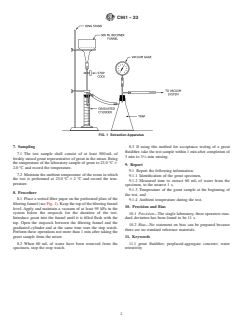
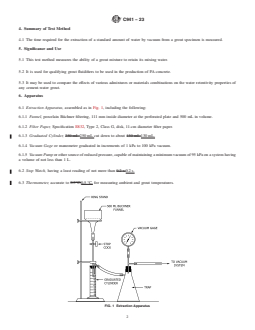
6.1 Extraction Apparatus, assembled as in Fig. 1, including the following:
6.1.1 Funnel, porcelain Büchner filtering, 111 mm inside diameter at the perforated plate and 500 mL in volume.
6.1.2 Filter Paper, Specification E832, Type 2, Class G, disk, 11-cm diameter filter paper.
6.1.3 Graduated Cylinder
...