


ASTM F2803-09(2015)
(Test Method)Standard Test Method for Evaluating Rim Slip Performance of Tires and Wheels
Standard Test Method for Evaluating Rim Slip Performance of Tires and Wheels
SIGNIFICANCE AND USE
5.1 This test method establishes a standard procedure of comparative testing, for driven wheel rim slip, between candidate tire group(s) and a control tire group. This test method is suitable for research and development purposes where tire and rim specimens are compared during a brief testing time period. They may not be suitable for regulatory or specification acceptance purposes because the values obtained may not necessarily agree or correlate, either in rank order or absolute value, with those obtained under other conditions (for example, different locations or different seasonal time periods on the same test course).
SCOPE
1.1 This test method is performed to determine the amount of rotational slip occurring at the tire/wheel interface while under heavy longitudinal load conditions.
1.2 This test method is suitable for research and development purposes where tires are compared during a single series of tests. They may not be suitable for regulatory statutes or specification acceptance because the values obtained may not necessarily agree or correlate either in rank order or absolute performance level with those obtained under other environmental conditions on other surfaces or the same surface after additional use.
1.3 The values stated in SI units are to be regarded as the standard. The values given in parentheses are for information only.
1.4 This standard does not purport to address all of the safety concerns, if any, associated with its use. It is the responsibility of the user of this standard to establish appropriate safety and health practices and determine the applicability of regulatory limitations prior to use.
General Information
Buy Standard
Standards Content (Sample)
NOTICE: This standard has either been superseded and replaced by a new version or withdrawn.
Contact ASTM International (www.astm.org) for the latest information
Designation: F2803 − 09 (Reapproved 2015)
Standard Test Method for
Evaluating Rim Slip Performance of Tires and Wheels
This standard is issued under the fixed designation F2803; the number immediately following the designation indicates the year of
original adoption or, in the case of revision, the year of last revision. A number in parentheses indicates the year of last reapproval. A
superscript epsilon (´) indicates an editorial change since the last revision or reapproval.
1. Scope 3.1.1 bead, n—of a tire, the part of a tire that comes in
contact with the rim and is shaped to secure the tire to the rim.
1.1 This test method is performed to determine the amount
F538
of rotational slip occurring at the tire/wheel interface while
under heavy longitudinal load conditions.
3.1.2 candidate tire, n—test tire that is part of a test
program. F538
1.2 This test method is suitable for research and develop-
ment purposes where tires are compared during a single series
3.1.3 control tire, n—reference tire used in a specified
of tests. They may not be suitable for regulatory statutes or
manner throughout a test program. F538
specification acceptance because the values obtained may not
3.1.4 deflection, n—difference between the unloaded and
necessarily agree or correlate either in rank order or absolute
loaded section heights. SAE J2013
performance level with those obtained under other environ-
mental conditions on other surfaces or the same surface after 3.1.5 drawbar, n—device for coupling a hauling vehicle to a
additional use. load.
1.3 The values stated in SI units are to be regarded as the
3.1.6 dynamometer, n—machine used to measure torque and
standard. The values given in parentheses are for information
rotational speed (rpm) from which power produced by an
only.
engine, motor or other rotating prime mover can be calculated.
1.4 This standard does not purport to address all of the 3.1.6.1 Discussion—For the purpose of this test method, a
dynamometer can be any vehicle or trailer that can be towed
safety concerns, if any, associated with its use. It is the
responsibility of the user of this standard to establish appro- and produce longitudinal resistance.
priate safety and health practices and determine the applica-
3.1.7 longitudinal force, n—of a tire, the component of the
bility of regulatory limitations prior to use.
tire force vector in the X direction. F538
3.1.8 longitudinal slip velocity [L/T], n—effective rolling
2. Referenced Documents
radius multiplied by the difference between the spin velocity
2.1 ASTM Standards:
(in rad/unit time) of a driven or braked tire and that of a free
F538 Terminology Relating to the Characteristics and Per-
rolling tire when each is traveling in a straight line. F538
formance of Tires
3 3.1.9 maximum load rating [M], n—of a passenger tire, the
2.2 SAE Standards:
load rating at the maximum permissible cold inflation pressure
SAE J2013 Military Tire Glossary
for that tire. F538
SAE J670e Vehicle Dynamics Terminology
3.1.10 paved road, n—two or more lanes, all weather,
3. Terminology
maintained, hard surface roads with good driving visibility
used for heavy and high-density traffic, in accordance with the
3.1 Definitions:
U.S. Federal Highway Administration. F538
3.1.11 rim, n—specially shaped circular periphery to which
This test method is under the jurisdiction of ASTM Committee F09 on Tires a tire may be mounted with appropriate bead fitment. F538
and is the direct responsibility of Subcommittee F09.20 on Vehicular Testing.
3.1.12 rim slip, n—circumferential distance along the rim
Current edition approved May 1, 2015. Published June 2015. Originally
approved in 2009. Last previous edition approved in 2009 as F2803 – 09. DOI:
flange between the corresponding marks.
10.1520/F2803-09R15.
3.1.13 section height, n—radial height of a tire section,
For referenced ASTM standards, visit the ASTM website, www.astm.org, or
contact ASTM Customer Service at service@astm.org. For Annual Book of ASTM
expressed as one half the difference between the outside
Standards volume information, refer to the standard’s Document Summary page on
diameteroftheunloadedtireandthenominalrimdiameter;the
the ASTM website.
outside diameter is measured on a tire-wheel assembly with the
Available from SAE International (SAE), 400 Commonwealth Dr.,Warrendale,
PA 15096-0001, http://www.sae.org. tire inflated to rated inflation pressure. F538
Copyright © ASTM International, 100 Barr Harbor Drive, PO Box C700, West Conshohocken, PA 19428-2959. United States
F2803 − 09 (2015)
3.1.14 sidewall, n—of a tire, that portion of a tire between locations, a dynamometer, load cell, calibrated speedometer,
the tread and the bead. F538 and tire/wheel specimens. The test course shall be a smooth,
less than 2 % grade, dry pavement surface. The surface and
3.1.15 test, n—technical procedure performed on an object
ambient temperature must be above 0°C (32°F).
(or set of objects) using specified equipment, that produces
data,whichareusedtoevaluateormodelselectedpropertiesor
8. Reagents and Materials
characteristics of the object (or set of objects). F538
8.1 This test method requires a paint pen or equivalent
3.1.16 test tire, n—tire used in a test. F538
device capable of marking tires and rim surfaces.
3.1.17 torque [FL], n—of a wheel, the external torque
applied to a tire from a vehicle about the wheel spin axis. F538
9. Hazards
3.1.18 tractive effort, n—total force output of the traction
9.1 The towing vehicle shall be secured with a load cell and
device acting parallel to the surface of the ground and in the
a cable/drawbar that is suitable to provide safety for testing
direction of travel of a driving wheel.
personnel.
3.1.18.1 Discussion—Tractive effort is expressed as a ratio
of load to vehicle weight. SAE J2013
10. Sampling, Test Specimens, and Test Units
4. Summary of Test Method
10.1 The speed and drawbar load data shall be acquired at a
4.1 This test method is used to quantify the amount a driven minimum of 10 Hz. The speed data shall be accurate to 61
tire rotates relative to a rim under severe conditions. This km/h (0.6 mph). The drawbar load cell shall be accurate to
method is designed to produce the greatest amount of rim slip within 2 % for the maximum reading.
in the shortest amount of time using a test vehicle that is
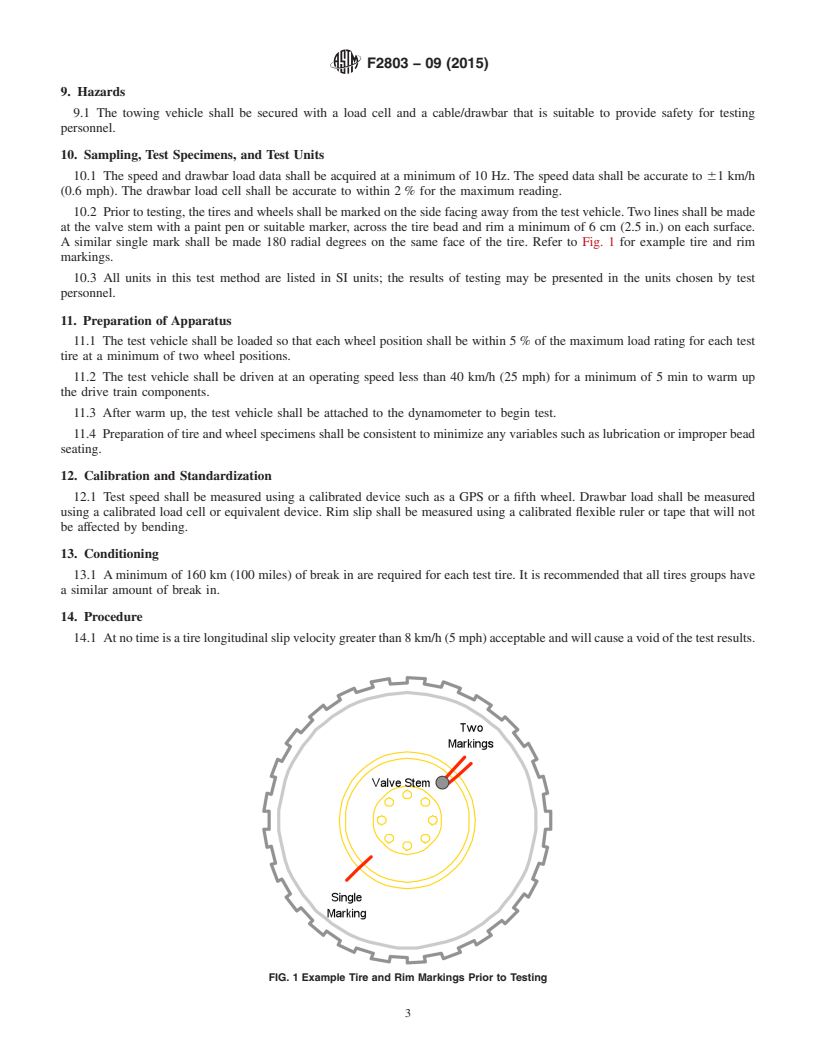
10.2 Priortotesting,thetiresandwheelsshallbemarkedon
capable of 60 % tractive effort. The 60 % tractive effort is a
the side facing away from the test vehicle. Two lines shall be
target from military requirements but can be adjusted to fit a
made at the valve stem with a paint pen or suitable marker,
commercial application. This test method can be modified to
across the tire bead and rim a minimum of 6 cm (2.5 in.) on
accommodatedifferentobjectivesincludinglongerdistancesor
each surface. A similar single mark shall be made 180 radial
various drawbar loads. Test tire results are compared to a
degreesonthesamefaceofthetire.RefertoFig.1forexample
control tire to evaluate the relative change in performance and
tire and rim markings.
to negate affects from environmental conditions.
10.3 All units in this test method are listed in SI units; the
5. Significance and Use
results of testing may be presented in the units chosen by test
personnel.
5.1 This test method establishes a standard procedure of
comparative testing, for driven wheel rim slip, between candi-
11. Preparation of Apparatus
date tire group(s) and a control tire group. This test method is
suitable for research and development purposes where tire and
11.1 The test vehicle shall be loaded so that each wheel
rim specimens are compared during a brief testing time period.
position shall be within 5 % of the maximum load rating for
They may not be suitable for regulatory or specification
each test tire at a minimum of two wheel positions.
acceptance purposes because the values obtained may not
necessarily agree or correlate, either in rank order or absolute
value,withthoseobtainedunderotherconditions(forexample,
different locations or different seasonal time periods on the
same test course).
6. Interferences
6.1 The absolute values of the parameters obtained with this
test method are dependent upon the characteristics of the
vehicle, the selected test pavement(s), and the environmental
conditio
...
This document is not an ASTM standard and is intended only to provide the user of an ASTM standard an indication of what changes have been made to the previous version. Because
it may not be technically possible to adequately depict all changes accurately, ASTM recommends that users consult prior editions as appropriate. In all cases only the current version
of the standard as published by ASTM is to be considered the official document.
Designation: F2803 − 09 F2803 − 09 (Reapproved 2015)
Standard Test Method for
Evaluating Rim Slip Performance of Tires and Wheels
This standard is issued under the fixed designation F2803; the number immediately following the designation indicates the year of
original adoption or, in the case of revision, the year of last revision. A number in parentheses indicates the year of last reapproval. A
superscript epsilon (´) indicates an editorial change since the last revision or reapproval.
1. Scope
1.1 This test method is performed to determine the amount of rotational slip occurring at the tire/wheel interface while under
heavy longitudinal load conditions.
1.2 This test method is suitable for research and development purposes where tires are compared during a single series of tests.
They may not be suitable for regulatory statutes or specification acceptance because the values obtained may not necessarily agree
or correlate either in rank order or absolute performance level with those obtained under other environmental conditions on other
surfaces or the same surface after additional use.
1.3 The values stated in SI units are to be regarded as the standard. The values given in parentheses are for information only.
1.4 This standard does not purport to address all of the safety concerns, if any, associated with its use. It is the responsibility
of the user of this standard to establish appropriate safety and health practices and determine the applicability of regulatory
limitations prior to use.
2. Referenced Documents
2.1 ASTM Standards:
F538 Terminology Relating to the Characteristics and Performance of Tires
2.2 SAE Standards:
SAE J2013 Military Tire Glossary
SAE J670e Vehicle Dynamics Terminology
3. Terminology
3.1 Definitions:
3.1.1 bead, n—of a tire, the part of a tire that comes in contact with the rim and is shaped to secure the tire to the rim. F538
3.1.2 candidate tire, n—test tire that is part of a test program. F538
3.1.3 control tire, n—reference tire used in a specified manner throughout a test program. F538
3.1.4 deflection, n—difference between the unloaded and loaded section heights. SAE J2013
3.1.5 drawbar, n—device for coupling a hauling vehicle to a load.
3.1.6 dynamometer, n—machine used to measure torque and rotational speed (rpm) from which power produced by an engine,
motor or other rotating prime mover can be calculated.
This test method is under the jurisdiction of ASTM Committee F09 on Tires and is the direct responsibility of Subcommittee F09.20 on Vehicular Testing.
Current edition approved Nov. 1, 2009May 1, 2015. Published December 2009June 2015. Originally approved in 2009. Last previous edition approved in 2009 as
F2803 – 09. DOI: 10.1520/F2803-09.10.1520/F2803-09R15.
For referenced ASTM standards, visit the ASTM website, www.astm.org, or contact ASTM Customer Service at service@astm.org. For Annual Book of ASTM Standards
volume information, refer to the standard’s Document Summary page on the ASTM website.
Available from SAE International (SAE), 400 Commonwealth Dr., Warrendale, PA 15096-0001, http://www.sae.org.
3.1.6.1 Discussion—
For the purpose of this test method, a dynamometer can be any vehicle or trailer that can be towed and produce longitudinal
resistance.
3.1.7 longitudinal force, n—of a tire, the component of the tire force vector in the X direction. F538
Copyright © ASTM International, 100 Barr Harbor Drive, PO Box C700, West Conshohocken, PA 19428-2959. United States
F2803 − 09 (2015)
3.1.8 longitudinal slip velocity [L/T], n—effective rolling radius multiplied by the difference between the spin velocity (in
rad/unit time) of a driven or braked tire and that of a free rolling tire when each is traveling in a straight line. F538
3.1.9 maximum load rating [M], n—of a passenger tire, the load rating at the maximum permissible cold inflation pressure for
that tire. F538
3.1.10 paved road, n—two or more lanes, all weather, maintained, hard surface roads with good driving visibility used for heavy
and high-density traffic, in accordance with the U.S. Federal Highway Administration. F538
3.1.11 rim, n—specially shaped circular periphery to which a tire may be mounted with appropriate bead fitment. F538
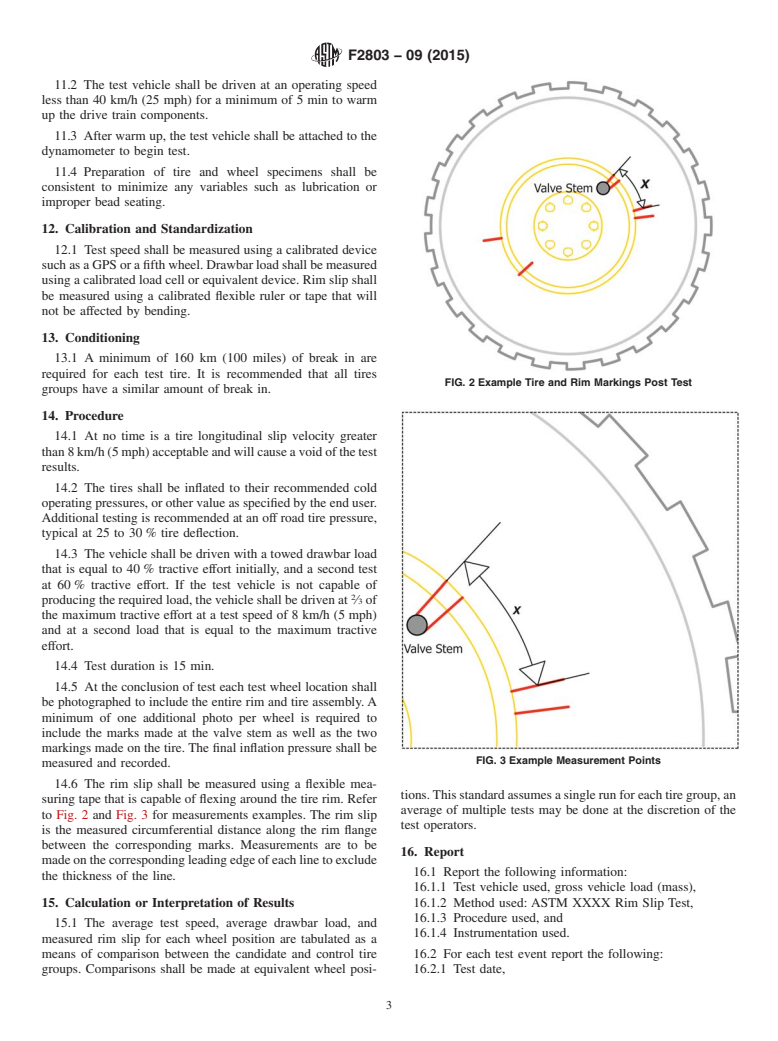
3.1.12 rim slip, n—circumferential distance along the rim flange between the corresponding marks.
3.1.13 section height, n—radial height of a tire section, expressed as one half the difference between the outside diameter of the
unloaded tire and the nominal rim diameter; the outside diameter is measured on a tire-wheel assembly with the tire inflated to
rated inflation pressure. F538
3.1.14 sidewall, n—of a tire, that portion of a tire between the tread and the bead. F538
3.1.15 test, n—technical procedure performed on an object (or set of objects) using specified equipment, that produces data,
which are used to evaluate or model selected properties or characteristics of the object (or set of objects). F538
3.1.16 test tire, n—tire used in a test. F538
3.1.17 torque [FL], n—of a wheel, the external torque applied to a tire from a vehicle about the wheel spin axis. F538
3.1.18 tractive effort, n—total force output of the traction device acting parallel to the surface of the ground and in the direction
of travel of a driving wheel.
3.1.18.1 Discussion—
Tractive effort is expressed as a ratio of load to vehicle weight. SAE J2013
4. Summary of Test Method
4.1 This test method is used to quantify the amount a driven tire rotates relative to a rim under severe conditions. This method
is designed to produce the greatest amount of rim slip in the shortest amount of time using a test vehicle that is capable of 60 %
tractive effort. The 60 % tractive effort is a target from military requirements but can be adjusted to fit a commercial application.
This test method can be modified to accommodate different objectives including longer distances or various drawbar loads. Test
tire results are compared to a control tire to evaluate the relative change in performance and to negate affects from environmental
conditions.
5. Significance and Use
5.1 This test method establishes a standard procedure of comparative testing, for driven wheel rim slip, between candidate tire
group(s) and a control tire group. This test method is suitable for research and development purposes where tire and rim specimens
are compared during a brief testing time period. They may not be suitable for regulatory or specification acceptance purposes
because the values obtained may not necessarily agree or correlate, either in rank order or absolute value, with those obtained under
other conditions (for example, different locations or different seasonal time periods on the same test course).
6. Interferences
6.1 The absolute values of the parameters obtained with this test method are dependent upon the characteristics of the vehicle,
the selected test pavement(s), and the environmental conditions at the test course. A change in any of these factors may change
the absolute values and may also change the relative rating of the tires and wheels so tested. It is recommended that all testing occur
at similar conditions and in as short a time frame as possible to reduce this variability.
6.2 Wheel condition, lubrication, and the elapsed time from tire mounting may affect the results of testing. It is recommended
tires are mounted consistently, without lube if possible, between tire and wheel specimens.
7. Apparatus
7.1 The testing apparatus shall consist of a wheeled vehicle capable of providing consistent torque to the test wheel locations,
a dynamometer, load cell, calibrated speedometer, and tire/wheel specimens. The test course shall be a smooth, less than 2 % grade,
dry pavement surface. The surface and ambient temperature must be above 0°C (32°F).
8. Reagents and Materials
8.1 This test method requires a paint pen or equivalent device capable of marking tires and rim surfaces.
F2803 − 09 (2015)
9. Hazards
9.1 The towing vehicle shall be secured with a load cell and a cable/drawbar that is suitable to provide safety for testing
personnel.
10. Sampling, Test Specimens, and Test Units
10.1 The speed and drawbar load data shall be acquired at a minimum of 10 Hz. The speed data shall be
...
Questions, Comments and Discussion
Ask us and Technical Secretary will try to provide an answer. You can facilitate discussion about the standard in here.