

ASTM D3170/D3170M-14(2022)
(Test Method)Standard Test Method for Chipping Resistance of Coatings
General Information
- Abstract
SIGNIFICANCE AND USE
4.1 Owners consider chipping of coatings, particularly on the leading faces and edges of automobile surfaces, unacceptable. In formulating a coating or coating system to meet service requirements, the resistance to chipping damage by flying objects such as gravel is one of the properties of importance since it can vary considerably as other properties are adjusted. Since resistance to chipping decreases at lower temperatures partly as the result of decreased flexibility, the test may be more directly related to service conditions by performing it at a low temperature. This test method is designed to produce a controlled amount of impact by the media on the coated panel in order to enhance reproducibility.
SCOPE
1.1 This test method covers the determination of the resistance of coatings to chipping damage by stones or other flying objects.
Note 1: This test method is similar to SAE J-400.
1.2 All dimensions are nominal unless otherwise specified.
1.3 The values stated in either SI units or inch-pound units are to be regarded separately as standard. The values stated in each system are not necessarily exact equivalents; therefore, to ensure conformance with the standard, each system shall be used independently of the other, and values from the two systems shall not be combined.
1.4 This standard does not purport to address all of the safety concerns, if any, associated with its use. It is the responsibility of the user of this standard to establish appropriate safety, health, and environmental practices and determine the applicability of regulatory limitations prior to use.
1.5 This international standard was developed in accordance with internationally recognized principles on standardization established in the Decision on Principles for the Development of International Standards, Guides and Recommendations issued by the World Trade Organization Technical Barriers to Trade (TBT) Committee.
- Status
- Published
- Publication Date
- 30-Jun-2022
- Technical Committee
- D01 - Paint and Related Coatings, Materials, and Applications
- Drafting Committee
- D01.55 - Factory Applied Coatings on Preformed Products
Overview
ASTM D3170/D3170M-14(2022), Standard Test Method for Chipping Resistance of Coatings, is an internationally recognized standard developed by ASTM International. It outlines a test method to evaluate the resistance of coatings-particularly automotive and industrial finishes-to chipping damage caused by flying objects such as stones and gravel. This evaluation is crucial for coatings applied to the leading edges and surfaces of automobiles and other products where chipping damage is often unacceptable.
Chipping resistance is a significant factor in coating formulation, as it impacts durability, appearance, and overall product quality. The test is designed to simulate real-world conditions, including assessments at lower temperatures where coating flexibility is reduced, ensuring the results closely reflect actual service performance.
Key Topics
Test Purpose and Significance
- Evaluates the ability of coatings to resist chipping caused by impacting particles.
- Particularly relevant for automotive panels and similar applications exposed to road debris.
- Addresses how chipping resistance can change with environmental conditions, especially lower temperatures.
Testing Conditions
- Uses a controlled apparatus (gravelometer) to project standardized road gravel at coated specimens.
- Test temperatures typically include room temperature and -29 ± 3 °C (-20 ± 5 °F), to emulate service environments.
- Panels and gravel are conditioned before testing to ensure consistency and reproducibility.
Assessment and Rating Methods
- Loose or damaged coating is removed with standardized tape for accurate evaluation.
- Two principal rating systems:
- Physical count: Counting chip numbers in defined size categories.
- Visual comparison: Matching test results to photographic chipping standards.
Result Reporting
- Chipping resistance is reported using a number-letter system that specifies chip size, quantity, and point of failure within the coating system.
- Results support formulation decisions and service life forecasts for painted or coated products.
Applications
Automotive Industry
- Specification of coatings for vehicles' leading edges, hoods, fenders, and other surfaces susceptible to chipping from road debris.
- Ensures vehicle finishes maintain appearance and corrosion resistance throughout service life.
Industrial Coatings
- Protects machinery, appliances, and equipment in harsh environments where impact from small objects is expected.
- Guides manufacturers in selection or formulation of coating systems tailored to specific exposure conditions.
Quality Assurance and R&D
- Used by coating manufacturers and end-users to evaluate new products or batches.
- Enables benchmarking against required performance standards during product development or certification processes.
Related Standards
- SAE J-400: Test for Chip Resistance of Surface Coatings, a closely related automotive industry reference.
- ASTM D609: Practice for Preparation of Cold-Rolled Steel Panels for Testing Paint and Related Coatings.
- ASTM D1005: Test Method for Measurement of Dry-Film Thickness of Organic Coatings Using Micrometers.
- ASTM D823: Practices for Producing Films of Uniform Thickness of Paint and Related Products on Test Panels.
- ASTM D2201: Practice for Preparation of Zinc-Coated Steel Panels for Testing Paint and Related Coating Products.
Practical Value
By following ASTM D3170/D3170M-14(2022), professionals can ensure coatings deliver reliable protection and appearance, supporting product quality, durability, and consumer satisfaction. This standard provides a reproducible, objective method to assess chipping resistance, making it essential for industries where coated surfaces are exposed to mechanical damage from impact. Adherence to this test procedure facilitates regulatory compliance and streamlines product comparisons in global markets.
Keywords: chipping resistance, gravelometer, coatings testing, automotive coatings, ASTM D3170, surface durability, paint impact test, chip rating standards, gravel impact test
Relations
- Effective Date
- 01-Jun-2020
- Effective Date
- 01-Dec-2017
- Effective Date
- 01-Nov-2012
- Effective Date
- 01-Jun-2012
- Effective Date
- 01-Jul-2011
- Effective Date
- 01-Nov-2007
- Effective Date
- 01-Jun-2007
- Effective Date
- 01-Nov-2006
- Effective Date
- 01-Nov-2006
- Effective Date
- 01-Jan-2001
- Effective Date
- 01-Jan-2001
- Effective Date
- 01-Jan-2001
- Effective Date
- 01-Jan-2001
- Effective Date
- 10-Apr-2000
- Effective Date
- 10-Dec-1999
Frequently Asked Questions
ASTM D3170/D3170M-14(2022) is a standard published by ASTM International. Its full title is "Standard Test Method for Chipping Resistance of Coatings". This standard covers: SIGNIFICANCE AND USE 4.1 Owners consider chipping of coatings, particularly on the leading faces and edges of automobile surfaces, unacceptable. In formulating a coating or coating system to meet service requirements, the resistance to chipping damage by flying objects such as gravel is one of the properties of importance since it can vary considerably as other properties are adjusted. Since resistance to chipping decreases at lower temperatures partly as the result of decreased flexibility, the test may be more directly related to service conditions by performing it at a low temperature. This test method is designed to produce a controlled amount of impact by the media on the coated panel in order to enhance reproducibility. SCOPE 1.1 This test method covers the determination of the resistance of coatings to chipping damage by stones or other flying objects. Note 1: This test method is similar to SAE J-400. 1.2 All dimensions are nominal unless otherwise specified. 1.3 The values stated in either SI units or inch-pound units are to be regarded separately as standard. The values stated in each system are not necessarily exact equivalents; therefore, to ensure conformance with the standard, each system shall be used independently of the other, and values from the two systems shall not be combined. 1.4 This standard does not purport to address all of the safety concerns, if any, associated with its use. It is the responsibility of the user of this standard to establish appropriate safety, health, and environmental practices and determine the applicability of regulatory limitations prior to use. 1.5 This international standard was developed in accordance with internationally recognized principles on standardization established in the Decision on Principles for the Development of International Standards, Guides and Recommendations issued by the World Trade Organization Technical Barriers to Trade (TBT) Committee.
SIGNIFICANCE AND USE 4.1 Owners consider chipping of coatings, particularly on the leading faces and edges of automobile surfaces, unacceptable. In formulating a coating or coating system to meet service requirements, the resistance to chipping damage by flying objects such as gravel is one of the properties of importance since it can vary considerably as other properties are adjusted. Since resistance to chipping decreases at lower temperatures partly as the result of decreased flexibility, the test may be more directly related to service conditions by performing it at a low temperature. This test method is designed to produce a controlled amount of impact by the media on the coated panel in order to enhance reproducibility. SCOPE 1.1 This test method covers the determination of the resistance of coatings to chipping damage by stones or other flying objects. Note 1: This test method is similar to SAE J-400. 1.2 All dimensions are nominal unless otherwise specified. 1.3 The values stated in either SI units or inch-pound units are to be regarded separately as standard. The values stated in each system are not necessarily exact equivalents; therefore, to ensure conformance with the standard, each system shall be used independently of the other, and values from the two systems shall not be combined. 1.4 This standard does not purport to address all of the safety concerns, if any, associated with its use. It is the responsibility of the user of this standard to establish appropriate safety, health, and environmental practices and determine the applicability of regulatory limitations prior to use. 1.5 This international standard was developed in accordance with internationally recognized principles on standardization established in the Decision on Principles for the Development of International Standards, Guides and Recommendations issued by the World Trade Organization Technical Barriers to Trade (TBT) Committee.
ASTM D3170/D3170M-14(2022) is classified under the following ICS (International Classification for Standards) categories: 87.040 - Paints and varnishes. The ICS classification helps identify the subject area and facilitates finding related standards.
ASTM D3170/D3170M-14(2022) has the following relationships with other standards: It is inter standard links to ASTM D1005-95(2020), ASTM D823-17, ASTM D823-95(2012), ASTM D609-00(2012), ASTM D2201-99(2011), ASTM D1005-95(2007), ASTM D823-95(2007), ASTM D2201-99(2006), ASTM D609-00(2006), ASTM D1005-95(2001), ASTM D823-95(2001), ASTM D823-95, ASTM D1005-95, ASTM D609-00, ASTM D2201-99. Understanding these relationships helps ensure you are using the most current and applicable version of the standard.
ASTM D3170/D3170M-14(2022) is available in PDF format for immediate download after purchase. The document can be added to your cart and obtained through the secure checkout process. Digital delivery ensures instant access to the complete standard document.
Standards Content (Sample)
This international standard was developed in accordance with internationally recognized principles on standardization established in the Decision on Principles for the
Development of International Standards, Guides and Recommendations issued by the World Trade Organization Technical Barriers to Trade (TBT) Committee.
Designation: D3170/D3170M − 14 (Reapproved 2022)
Standard Test Method for
Chipping Resistance of Coatings
This standard is issued under the fixed designation D3170/D3170M; the number immediately following the designation indicates the
year of original adoption or, in the case of revision, the year of last revision. A number in parentheses indicates the year of last
reapproval. A superscript epsilon (´) indicates an editorial change since the last revision or reapproval.
This standard has been approved for use by agencies of the U.S. Department of Defense.
1. Scope D1005 Test Method for Measurement of Dry-Film Thick-
ness of Organic Coatings Using Micrometers
1.1 This test method covers the determination of the resis-
D1186 Test Methods for Nondestructive Measurement of
tance of coatings to chipping damage by stones or other flying
Dry Film Thickness of Nonmagnetic Coatings Applied to
objects.
a Ferrous Base (Withdrawn 2006)
NOTE 1—This test method is similar to SAE J-400.
D1400 TestMethodforNondestructiveMeasurementofDry
1.2 All dimensions are nominal unless otherwise specified. Film Thickness of Nonconductive Coatings Applied to a
Nonferrous Metal Base (Withdrawn 2006)
1.3 The values stated in either SI units or inch-pound units
D1733 Method for Preparation of Aluminum Alloy Panels
are to be regarded separately as standard. The values stated in
for Testing Paint, Varnish, Lacquer, and Related Products
each system are not necessarily exact equivalents; therefore, to
(Withdrawn 1979)
ensure conformance with the standard, each system shall be
D2201 Practice for Preparation of Zinc-Coated and Zinc-
used independently of the other, and values from the two
Alloy-Coated Steel Panels for Testing Paint and Related
systems shall not be combined.
Coating Products
1.4 This standard does not purport to address all of the
2.2 Other Documents:
safety concerns, if any, associated with its use. It is the 4
Test for Chip Resistance of Surface Coatings (J-400)
responsibility of the user of this standard to establish appro-
priate safety, health, and environmental practices and deter-
3. Summary of Test Method
mine the applicability of regulatory limitations prior to use.
3.1 Standardized road gravel is projected by means of a
1.5 This international standard was developed in accor-
controlled air blast at the coated specimens. All testing is
dance with internationally recognized principles on standard-
conducted under controlled temperature conditions, generally
ization established in the Decision on Principles for the
either at ambient (room) temperature or at -29 6 3 °C [-20 6
Development of International Standards, Guides and Recom-
5 °F]. After the gravel impact, tape is applied to remove any
mendations issued by the World Trade Organization Technical
loose coating chips and the degree of chipping is determined.
Barriers to Trade (TBT) Committee.
4. Significance and Use
2. Referenced Documents
4.1 Owners consider chipping of coatings, particularly on
2.1 ASTM Standards:
the leading faces and edges of automobile surfaces, unaccept-
D609 Practice for Preparation of Cold-Rolled Steel Panels
able.Informulatingacoatingorcoatingsystemtomeetservice
for Testing Paint, Varnish, Conversion Coatings, and
requirements, the resistance to chipping damage by flying
Related Coating Products
objects such as gravel is one of the properties of importance
D823 Practices for Producing Films of Uniform Thickness
since it can vary considerably as other properties are adjusted.
of Paint, Coatings and Related Products on Test Panels
Since resistance to chipping decreases at lower temperatures
partly as the result of decreased flexibility, the test may be
more directly related to service conditions by performing it at
This test method is under the jurisdiction of ASTM Committee D01 on Paint
a low temperature. This test method is designed to produce a
and Related Coatings, Materials, andApplications and is the direct responsibility of
controlled amount of impact by the media on the coated panel
Subcommittee D01.55 on Factory Applied Coatings on Preformed Products.
in order to enhance reproducibility.
Current edition approved July 1, 2022. Published July 2022. Originally approved
in 1973. Last previous edition approved in 2014 as D3170 – 14. DOI: 10.1520/
D3170_D3170M-14R22.
2 3
For referenced ASTM standards, visit the ASTM website, www.astm.org, or The last approved version of this historical standard is referenced on
contact ASTM Customer Service at service@astm.org. For Annual Book of ASTM www.astm.org.
Standards volume information, refer to the standard’s Document Summary page on Available from Society of Automotive Engineers (SAE), 400 Commonwealth
the ASTM website. Dr., Warrendale, PA 15096-0001, http://www.sae.org.
Copyright © ASTM International, 100 Barr Harbor Drive, PO Box C700, West Conshohocken, PA 19428-2959. United States
D3170/D3170M − 14 (2022)
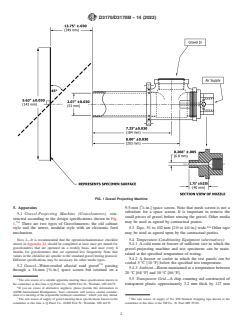
FIG. 1 Gravel Projecting Machine
5. Apparatus 9.5-mm [ ⁄8-in.] space screen. Note that mesh screen is not a
substitute for a space screen. It is important to remove the
5.1 Gravel-Projecting Machine (Gravelometer), con-
small pieces of gravel before reusing the gravel. Other media
structed according to the design specifications shown in Fig.
5,6
may be used as agreed by contractual parties.
1. There are two types of Gravelometers: the old cabinet
8,6
style and the newer, modular style with an electronic feed 5.3 Tape, 51 to 102 mm [2.0 to 4.0 in.] wide. Other tape
mechanism. may be used as agreed upon by the contractual parties.
5.4 Temperature-Conditioning Equipment (alternatives):
NOTE 2—It is recommended that the operation/maintenance checklist
shown in Appendix X1 should be completed at least once per month for
5.4.1 A cold room or freezer of sufficient size in which the
gravelometers that are operated on a weekly basis, and once every 6
gravel-projecting machine and test specimens can be main-
months for gravelometers that are operated less frequently. Note that
tained at the specified temperature of testing.
values in the checklist are specific to the standard gravel testing protocol.
5.4.2 A freezer or cooler in which the test panels can be
Different specifications may be necessary for other media types.
cooled 5 °C [10 °F] below the specified test temperature.
7,6
5.2 Gravel—Water-eroded alluvial road gravel passing
5.4.3 Ambient—Room maintained at a temperature between
through a 16-mm [ ⁄8-in.] space screen but retained on a
20 °C [68 °F] and 30 °C [86 °F].
5 5.5 Transparent Grid—A chip counting aid constructed of
The sole source of a suitable apparatus meeting these specifications known to
the committee at this time is Q-Panel Co., 26200 First St., Westlake, OH 44135. transparent plastic approximately 3.2 mm thick by 127 mm
If you are aware of alternative suppliers, please provide this information to
ASTM International Headquarters. Your comments will receive careful consider-
ation at a meeting of the responsible technical committee, which you may attend.
7 8
The sole source of supply of gravel meeting these specifications known to the The sole source of supply of No. 898 filament strapping tape known to the
committee at this time is Q-Panel Co., 26200 First St., Westlake, OH 44135. committee at this time is the 3M Co., St. Paul MN 55101.
D3170/D3170M − 14 (2022)
NOTE 1—Reprinted with permission from SAE EA-400 (c) 1985, Society of Automotive Engineers, Inc.
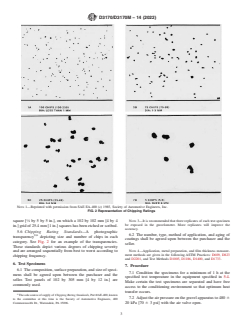
FIG. 2 Representation of Chipping Ratings
NOTE 3—It is recommended that three replicates of each test specimen
square [ ⁄8 by 5 by 5 in.], on which a 102 by 102 mm [4 by 4
be exposed in the gravelometer. More replicates will improve the
in.] grid of 25.4 mm [1 in.] squares has been etched or scribed.
accuracy.
5.6 Chipping Rating Standards—A photographic
6.2 The number, type, method of application, and aging of
9,6
transparency depicting size and number of chips in each
coatings shall be agreed upon between the purchaser and the
category. See Fig. 2 for an example of the transparencies.
seller.
These standards depict various degrees of chipping severity
NOTE 4—Application, metal preparation, and film thickness measure-
and are arranged sequentially from best to worst according to
ment methods are given in the following ASTM Practices: D609, D823
chipping frequency.
and D2201, and Test Methods D1005, D1186, D1400, and D1733.
6. Test Specimens
7. Procedure
6.1 The composition, surface preparation, and size of speci-
7.1 Condition the specimens for a minimum of1hatthe
mens shall be agreed upon between the purchaser and the
specified test temperature in the equipment specified in 5.4.
seller. Test panels of 102 by 305 mm [4 by 12 in.] are
Make certain the test specimens are separated and have free
commonly used.
access to the conditioning environment so that optimum heat
transfer occurs.
The sole source of supply ofChippingRatingStandards, Part #AE-400, known
7.2 Adjust the air pressure on the gravel apparatus to 480 6
to the committee at this time is the Society of Automotive Engineers, 400
Commonwealth Dr., Warrendale, PA 15096. 20 kPa [70 6 3 psi] with the air valve open.
D3170/D3170M − 14 (2022)
NOTE 5—For cabinet type gravelometers, keep the lid to the gravel
7.4.4 When the test has been completed, remove the test
chamber closed during this operation as a safety precaution. Other air
panel from the specimen holder by pulling back on the
pressures can be used as agreed upon by the contractual parties.
Specimen Mounting Clamp and removing the test specimen.
7.3 Cabinet Style Gravelometer: 7.4.5 Remove the gravel from the return receptacle and
screen before reuse.
7.3.1 After adjusting the air pressure, shut off the air valve,
openthelidtothegravelchamberandcollect473mL(1.00US
7.5 Allow the test specimens to return to room temperature
Liquid Pint) of graded gravel (approximately 250 to 300
and dry with a soft cloth to remove any condensation.
stones) in a suitable container. Collect the gravel by scraping
7.6 Use the tape referenced in 5.3 to remove all loose or
across the screen to allow fines to fall through.
damaged paint.
7.3.2 Place one test specimen at the desired test temperature
7.6.1 Cover the entire test area of the specimen with a
in the panel holder with the coated side facing the front of the
strip(s) of tape.
apparatus and close the lid to the panel chamber.
(1) For 51 to 56 mm [2.0 to 2.2 in.] wide tape, apply the
7.3.3 Open the gravel feed door and pour gravel from the
strips side by side over the evaluation area.
onepintcontainerobtainedfrom7.3.1intothetopofthegravel
(2) For 56 to 102 mm [2.2 to 4.0 in.] wide tape, strip(s)
hopper. Do not allow gravel to fall into the nozzle entrance.
may be applied consecutively with the first strip covering only
7.3.4 Opentheairvalvetoallowtheairtoprojectthegravel partofthetestarea.Thesecondstrip,ifneeded,isappliedafter
at the specimen. removal of the first strip and covers the remaining test area as
well as overlapping part of the test area covered by the first
NOTE 6—The gravel hopper must empty in 7 to 10 s. If gravel remains
strip.
in the hopper after 10 s, stop the test and investigate the cause. T
...