

ASTM D1533-20
(Test Method)Standard Test Method for Water in Insulating Liquids by Coulometric Karl Fischer Titration
General Information
- Abstract
SIGNIFICANCE AND USE
4.1 Electrical characteristics of an insulating liquid may be affected deleteriously by excessive water content. A high water content may make a dielectric liquid unsuitable for some electrical applications due to deterioration of properties such as the dielectric breakdown voltage.
4.2 This test is suitable for use in acceptance specifications, in control of processing, and in evaluating the condition of dielectric liquids in service.
SCOPE
1.1 This test method covers the measurement of water present in insulating liquids by coulometric Karl Fischer titration. This test method is used commonly for test specimens below 100 % relative saturation of water in oil. The coulometric test method is known for its high degree of sensitivity (typically 10 μg H2O). This test method requires the use of equipment specifically designed for coulometric titration.
1.2 This test method recommends the use of commercially available coulometric Karl Fischer titrators and reagents.
1.3 The values stated in SI units are to be regarded as standard. No other units of measurement are included in this standard.
1.4 This standard does not purport to address all of the safety concerns, if any, associated with its use. It is the responsibility of the user of this standard to establish appropriate safety, health, and environmental practices and determine the applicability of regulatory limitations prior to use. For specific precautionary statements see 8.1 and A2.1.
1.5 This international standard was developed in accordance with internationally recognized principles on standardization established in the Decision on Principles for the Development of International Standards, Guides and Recommendations issued by the World Trade Organization Technical Barriers to Trade (TBT) Committee.
- Status
- Published
- Publication Date
- 31-Oct-2020
- Technical Committee
- D27 - Electrical Insulating Liquids and Gases
- Drafting Committee
- D27.06 - Chemical Test
Buy Documents
ASTM D1533-20 - Standard Test Method for Water in Insulating Liquids by Coulometric Karl Fischer Titration
REDLINE ASTM D1533-20 - Standard Test Method for Water in Insulating Liquids by Coulometric Karl Fischer Titration
Overview
ASTM D1533-20: Standard Test Method for Water in Insulating Liquids by Coulometric Karl Fischer Titration outlines a precise and sensitive method for measuring water content in electrical insulating liquids. Excess water in dielectric liquids can negatively affect electrical properties, including dielectric breakdown voltage, making accurate measurement crucial for quality control, acceptance testing, and condition assessment of insulating fluids used in electrical equipment. This standard utilizes the coulometric Karl Fischer titration technique, which is highly sensitive and suitable for low-level water determination, employing specialized automatic titrators and reagents.
Key Topics
- Purpose: Measures water in insulating liquids to ensure dielectric performance and safe operation.
- Scope: Applies to samples with water levels below 100% relative saturation; uses SI units exclusively.
- Technique: Employs coulometric Karl Fischer titration-renowned for sensitivity, typically detecting as little as 10 μg H₂O.
- Equipment & Reagents: Requires commercially available automatic titrators, reagents specific to the Karl Fischer method, and suitable sample handling tools (e.g., glass syringes, metal containers).
- Interferences: Certain chemical substances (aldehydes, ketones, acids, oxidizers) and improper sample storage may interfere with results, and proper cleaning of apparatus is vital.
- Safety: Users must observe all safety, health, and environmental requirements when handling reagents, and follow manufacturers’ instructions and material safety data sheets.
- Calibration & Verification: System calibration with known verification solutions is necessary to ensure result accuracy before sample testing.
Applications
- Utility and Industrial Equipment: Critical in testing transformer oils and other insulating fluids for power and industrial equipment to prevent electrical failure due to moisture.
- Product Acceptance and Specification Compliance: Used by manufacturers and testing laboratories for verifying fluids meet required specifications at point of purchase or installation.
- Routine Maintenance and Condition Monitoring: Enables ongoing assessment of insulating liquids’ fitness during operation, supporting preventive maintenance programs.
- Quality Control in Production: Ensures manufacturing processes for electrical insulating liquids are maintained within moisture control limits, enhancing product reliability.
Related Standards
- ASTM D923: Practices for Sampling Electrical Insulating Liquids, providing guidance on correct sampling techniques for reliable water content analysis.
- IEC 60814: International standard for determination of water in oil-impregnated paper and pressboard via coulometric Karl Fischer titration.
- ASTM D877 and D1816: Additional ASTM standards for testing electrical insulating liquids to evaluate their insulating properties.
- General Karl Fischer Titration Methods: Other international procedures for moisture analysis by volumetric and coulometric methods for various industries.
Practical Value
- Enhances Safety and Reliability: Monitoring water in insulating liquids protects equipment from moisture-induced failures.
- Supports Regulatory Compliance: Fulfills customer and industry requirements for quality assurance in insulating liquids.
- Reduces Maintenance Costs: Early detection of moisture facilitates timely maintenance, reducing the risk of disruptive equipment breakdowns.
- Improves Data Precision: The method’s sensitivity and precision offer confidence in analytical results for both new and used insulating oils.
ASTM D1533-20 is a cornerstone standard for electrical insulation fluid testing, ensuring accurate, repeatable, and internationally recognized methods for safeguarding electric power systems and related equipment.
Relations
- Effective Date
- 01-Dec-2023
- Effective Date
- 01-Oct-2015
- Effective Date
- 15-Jul-2007
- Effective Date
- 10-Oct-1997
Buy Documents
ASTM D1533-20 - Standard Test Method for Water in Insulating Liquids by Coulometric Karl Fischer Titration
REDLINE ASTM D1533-20 - Standard Test Method for Water in Insulating Liquids by Coulometric Karl Fischer Titration
Get Certified
Connect with accredited certification bodies for this standard

IMQ S.p.A. (Certification)
Italian electrical product certification.

SLG Prüf- und Zertifizierungs GmbH
German testing and certification body.

UL Solutions
Global safety science company with testing, inspection and certification.
Sponsored listings
Frequently Asked Questions
ASTM D1533-20 is a standard published by ASTM International. Its full title is "Standard Test Method for Water in Insulating Liquids by Coulometric Karl Fischer Titration". This standard covers: SIGNIFICANCE AND USE 4.1 Electrical characteristics of an insulating liquid may be affected deleteriously by excessive water content. A high water content may make a dielectric liquid unsuitable for some electrical applications due to deterioration of properties such as the dielectric breakdown voltage. 4.2 This test is suitable for use in acceptance specifications, in control of processing, and in evaluating the condition of dielectric liquids in service. SCOPE 1.1 This test method covers the measurement of water present in insulating liquids by coulometric Karl Fischer titration. This test method is used commonly for test specimens below 100 % relative saturation of water in oil. The coulometric test method is known for its high degree of sensitivity (typically 10 μg H2O). This test method requires the use of equipment specifically designed for coulometric titration. 1.2 This test method recommends the use of commercially available coulometric Karl Fischer titrators and reagents. 1.3 The values stated in SI units are to be regarded as standard. No other units of measurement are included in this standard. 1.4 This standard does not purport to address all of the safety concerns, if any, associated with its use. It is the responsibility of the user of this standard to establish appropriate safety, health, and environmental practices and determine the applicability of regulatory limitations prior to use. For specific precautionary statements see 8.1 and A2.1. 1.5 This international standard was developed in accordance with internationally recognized principles on standardization established in the Decision on Principles for the Development of International Standards, Guides and Recommendations issued by the World Trade Organization Technical Barriers to Trade (TBT) Committee.
SIGNIFICANCE AND USE 4.1 Electrical characteristics of an insulating liquid may be affected deleteriously by excessive water content. A high water content may make a dielectric liquid unsuitable for some electrical applications due to deterioration of properties such as the dielectric breakdown voltage. 4.2 This test is suitable for use in acceptance specifications, in control of processing, and in evaluating the condition of dielectric liquids in service. SCOPE 1.1 This test method covers the measurement of water present in insulating liquids by coulometric Karl Fischer titration. This test method is used commonly for test specimens below 100 % relative saturation of water in oil. The coulometric test method is known for its high degree of sensitivity (typically 10 μg H2O). This test method requires the use of equipment specifically designed for coulometric titration. 1.2 This test method recommends the use of commercially available coulometric Karl Fischer titrators and reagents. 1.3 The values stated in SI units are to be regarded as standard. No other units of measurement are included in this standard. 1.4 This standard does not purport to address all of the safety concerns, if any, associated with its use. It is the responsibility of the user of this standard to establish appropriate safety, health, and environmental practices and determine the applicability of regulatory limitations prior to use. For specific precautionary statements see 8.1 and A2.1. 1.5 This international standard was developed in accordance with internationally recognized principles on standardization established in the Decision on Principles for the Development of International Standards, Guides and Recommendations issued by the World Trade Organization Technical Barriers to Trade (TBT) Committee.
ASTM D1533-20 is classified under the following ICS (International Classification for Standards) categories: 29.040.10 - Insulating oils. The ICS classification helps identify the subject area and facilitates finding related standards.
ASTM D1533-20 has the following relationships with other standards: It is inter standard links to ASTM D923-15(2023), ASTM D923-15, ASTM D923-07, ASTM D923-97. Understanding these relationships helps ensure you are using the most current and applicable version of the standard.
ASTM D1533-20 is available in PDF format for immediate download after purchase. The document can be added to your cart and obtained through the secure checkout process. Digital delivery ensures instant access to the complete standard document.
Standards Content (Sample)
This international standard was developed in accordance with internationally recognized principles on standardization established in the Decision on Principles for the
Development of International Standards, Guides and Recommendations issued by the World Trade Organization Technical Barriers to Trade (TBT) Committee.
Designation: D1533 − 20
Standard Test Method for
Water in Insulating Liquids by Coulometric Karl Fischer
Titration
This standard is issued under the fixed designation D1533; the number immediately following the designation indicates the year of
original adoption or, in the case of revision, the year of last revision. A number in parentheses indicates the year of last reapproval. A
superscript epsilon (´) indicates an editorial change since the last revision or reapproval.
1. Scope 3. Summary of Test Method
3.1 This test method is based on the reduction of iodine
1.1 This test method covers the measurement of water
containing reagent according to the traditional Karl Fischer
present in insulating liquids by coulometric Karl Fischer
reaction. The proposed reaction mechanism is as follows:
titration.Thistestmethodisusedcommonlyfortestspecimens
below 100 % relative saturation of water in oil. The coulomet-
SO 1CH OH1RN 5 @RNH#SO CH (1)
2 3 3 3
ric test method is known for its high degree of sensitivity
H O1I 1 RNH SO CH 12RN 5 RNH SO CH 12 RNH I
@ # @ # @ #
2 2 3 3 4 3
(typically 10 µg H O). This test method requires the use of
equipment specifically designed for coulometric titration.
RN 5 Base
~ !
1.2 This test method recommends the use of commercially
The endpoint is determined amperometrically with a plati-
available coulometric Karl Fischer titrators and reagents.
num electrode that senses a sharp change in cell resistance
when the iodine has reacted with all of the water in the test
1.3 The values stated in SI units are to be regarded as
specimen.
standard. No other units of measurement are included in this
standard. 3.2 The coulometric Karl Fischer test method requires the
use of an automatic titrator with commercially available
1.4 This standard does not purport to address all of the
reagents. Karl Fischer instruments regenerate iodine coulo-
safety concerns, if any, associated with its use. It is the
metrically from the iodide in the Karl Fischer reagent. The test
responsibility of the user of this standard to establish appro-
specimen is injected into a titration cell where the iodine
priate safety, health, and environmental practices and deter-
consumed by the reaction with water is electrolytically regen-
mine the applicability of regulatory limitations prior to use.
erated by anodic oxidation of iodide. The completion of the
For specific precautionary statements see 8.1 and A2.1.
reaction is detected with a platinum sensing electrode. The
1.5 This international standard was developed in accor-
coulombs of electricity required to generate the necessary
dance with internationally recognized principles on standard-
amount of iodine then is converted into the amount of water
ization established in the Decision on Principles for the
present in the test specimen by use of the Faraday equation.
Development of International Standards, Guides and Recom-
3.3 Titration Cell—The coulometric titration cell consists of
mendations issued by the World Trade Organization Technical
either a sealed vessel containing both an anode and cathode
Barriers to Trade (TBT) Committee.
which are separated by a diaphragm or a sealed vessel
containing an anode and cathode which are not separated by a
2. Referenced Documents
diaphragm. In both cells the anode compartment contains a
solution consisting of sulfur dioxide, iodide, and an amine in a
2.1 ASTM Standards:
solvent containing methanol/chloroform or methanol/longer
D923 Practices for Sampling Electrical Insulating Liquids
chain alcohol. In the cell with a diaphragm the cathode
compartment contains similar reagents optimized for cathodic
reduction.
This test method is under the jurisdiction of ASTM Committee D27 on
Electrical Insulating Liquids and Gasesand is the direct responsibility of Subcom-
4. Significance and Use
mittee D27.06 on Chemical Test.
Current edition approved Nov. 1, 2020. Published November 2020. Originally
4.1 Electrical characteristics of an insulating liquid may be
approved in 1958. Last previous edition approved in 2012 as D1533 – 12. DOI:
affected deleteriously by excessive water content.Ahigh water
10.1520/D1533-20.
For referenced ASTM standards, visit the ASTM website, www.astm.org, or
contact ASTM Customer Service at service@astm.org. For Annual Book of ASTM
Standards volume information, refer to the standard’s Document Summary page on Scholz, E., “Karl-Fischer Titration,” Springer-Verlag, Berlin, Heidelberg, New
the ASTM website. York, Tokyo, 1984, 140 pp.
Copyright © ASTM International, 100 Barr Harbor Drive, PO Box C700, West Conshohocken, PA 19428-2959. United States
D1533 − 20
content may make a dielectric liquid unsuitable for some 6.1.1 Detector Electrodes—This electrode pair ampero-
electricalapplicationsduetodeteriorationofpropertiessuchas metrically determines the end point of titration by measuring a
the dielectric breakdown voltage. sharp change in cell resistance.
6.1.2 Generator Electrodes—This electrode pair performs
4.2 This test is suitable for use in acceptance specifications,
the cathodic reduction of iodide, which allows the Karl Fischer
in control of processing, and in evaluating the condition of
reaction to take place. It may consist of two platinum meshes
dielectric liquids in service.
or wires separated by a diaphragm within a glass assembly or
two platinum meshes or wires not separated by a diaphragm.
5. Interferences
6.2 Titration Flask—The titration flask will be of suitable
5.1 Compounds such as aldehydes, ketones, free halogens,
capacity and will be protected against atmospheric moisture.A
most acids, and oxidizing or reducing agents may interfere
bottom drain cock is desirable but not necessary for removing
with coulometric Karl Fischer titrators. If a drifting end point
reagents.
is noted, an alternative solvent system or another titration
method is warranted. If this drifting end point cannot be 6.3 Stirrers—Means for agitation during titration will con-
sist of a magnetic stirrer with a glass or TFE-fluorocarbon-
corrected, the water values should be regarded as suspect. A
detailed discussion of interfering substances can be found in covered stirring bar about 2 to 5 cm long or appropriate to the
titration vessel. The bar should be cleaned thoroughly, rinsed
the treatise on aquametry.
with methanol, dried in an oven for1hat 100°C, and stored in
5.2 Studies have shown that the water content of an insu-
a desiccator until used. In a sealed system, recleaning and
lating liquid sample may be influenced significantly by the
5 redrying are not necessary for routine use.
sample container. A sample may either gain or lose water on
6.4 Transfer Syringes—Syringes shall be used of a suitable
storage in a glass container depending upon the initial water
content of the sample, the manner in which the container is size to accommodate instrument manufacturers’ recommenda-
tion of sample size. Syringes may be glass or plastic. Glass
cleaned and dried, and the length of storage time before
analysis. In addition, sample bottles should not be dried at syringes shall be cleaned and dried for1hat 100°C prior to
use. Plastic syringes shall be disposed of following each
temperature in excess of 110°C and should be rinsed with the
liquid being tested prior to taking the test specimen. Plastic sample use.
containersshouldnotbeused.Glasssyringesormetalcansthat
6.5 Needles—Needles that are to be fitted to the transfer
can be filled to the very top and capped are the most suitable
syringes shall be long enough to inject samples directly below
containers for this test.
the surface of the Karl Fischer reagent. They should be of a
5.3 Erroneous low readings may be obtained if previous large enough gauge to allow for easy transfer of the sample.
spent oil test specimens are not removed from the solvent
6.6 Septums, used to seal sample port, allowing the intro-
system on a routine basis. Excess oil may not mix thoroughly
duction of test specimens with a minimum amount of contami-
with the solvent system thus preventing the total water content
nation from atmospheric moisture.
of that test specimen from being measured properly. Stirring
6.7 Sealing Grease—If the apparatus does not have a gasket
should be at such a rate that an oil layer will not form on top
seal, use a sealing grease to seal the titration chamber against
of the reagent. If such an oil layer does form while at the
atmospheric moisture.
instruments maximum stirrer speed, stop testing and remove
the oil layer. If accurate results can not be obtained, the 6.8 Drying Oven, vacuum or air circulating.
solution should be discarded.
6.9 Desiccator, standard laboratory type with color change
5.4 Upon setting up of the titration vessel and solvent indicator.
system, the walls of the titration vessel should be wetted by
6.10 Analytical Balance, capable of weighing to 6 0.001 g.
swirling the solvent system solution around in the vessel.
5.5 Some solvent systems may not perform well with 7. Reagents
natural esters.Alternate solvent systems should be explored to
7.1 Purity of Reagents—Unless otherwise indicated, all
provide the best analysis.
reagents shall conform to the specifications of the Committee
on Analytical Reagents of the American Chemical Society,
6. Apparatus
where such specifications are available.
6.1 Coulometric Titrator, consisting of a detector electrode,
7.2 Coulometric Karl Fischer Reagent, can be obtained
generator electrode, titration vessel, magnetic stirrer, and
commercially. Refer to Annex A1 for information on alterna-
control unit.
tive solvent systems.
4 6
Mitchell, J., Jr. and Smith, D. M., “Aquametry—A Treatise on Methods for the Reagent Chemicals, American Chemical Society Specifications, American
Determination of Water, Part III—the Karl Fischer Reagent,” 2nd ed., J. Wiley and Chemical Society, Washington, DC. For suggestions on the testing of reagents not
Sons, Inc., New York, NY 1977. listed by the American Chemical Society, see Analar Standards for Laboratory
Gedemer, T., “Determination of Water in Oil by Karl Fischer Method, Part II, Chemicals, BDH Ltd., Poole, Dorset, U.K., and the United States Pharmacopeia
Changes in Moisture Content During Storage,” American Laboratory, 7 (10), pp. and National Formulary, U.S. Pharmacopeial Convention, Inc. (USPC), Rockville,
43-50, 1975. MD.
D1533 − 20
7.2.1 Anode Reagent, frequently referred to as vessel solu- Follow the instructions provided in Annex A2 for detailed
tion. instructions on cleaning.
7.2.2 Cathode Reagent, frequently referred to as generator
10.2 Fill reagent reservoirs with appropriate reagents ac-
solution.
cording to the manufacturer’s instructions.
7.3 Verification Solutions—Verification solutions are avail-
10.3 Turn the instrument on and allow to stabilize.
able commercially. Verification solutions may be formulated
in-house from long chain alcohols.
11. Verification of System Operation
7.3.1 The moisture content of water-saturated octanol is:
11.1 Theaccuracyoftitrationoftheinstrumentandreagents
Water-saturated 1-Octanol 39.2 ± 0.85 mg/mL of solution
shall be verified prior to beginning of testing by use of a
7.3.2 Thewater-saturatedalcoholcanbepreparedbyadding
suitable verification solution (see 7.3) containing a known
deionized water to the alcohol (ACS reagent grade) at 25°C
quantity of water. It is desirable to verify the system operation
such that the final mixture consists of a two-phase system in
using a solution that approximates the same range of water
which the lower water phase is at least 2 cm high. Initially, this
expected to be in the samples. Verification solutions shall be
solution should be mixed thoroughly and allowed to stand at
run with new reagents prior to test
...
This document is not an ASTM standard and is intended only to provide the user of an ASTM standard an indication of what changes have been made to the previous version. Because
it may not be technically possible to adequately depict all changes accurately, ASTM recommends that users consult prior editions as appropriate. In all cases only the current version
of the standard as published by ASTM is to be considered the official document.
Designation: D1533 − 12 D1533 − 20
Standard Test Method for
Water in Insulating Liquids by Coulometric Karl Fischer
Titration
This standard is issued under the fixed designation D1533; the number immediately following the designation indicates the year of
original adoption or, in the case of revision, the year of last revision. A number in parentheses indicates the year of last reapproval. A
superscript epsilon (´) indicates an editorial change since the last revision or reapproval.
1. Scope
1.1 This test method covers the measurement of water present in insulating liquids by coulometric Karl Fischer titration. This test
method is used commonly for test specimens below 100 % relative saturation of water in oil. The coulometric test method is known
for its high degree of sensitivity (typically 10 μg H O). This test method requires the use of equipment specifically designed for
coulometric titration.
1.2 This test method recommends the use of commercially available coulometric Karl Fischer titrators and reagents.
1.3 The values stated in SI units are to be regarded as standard. No other units of measurement are included in this standard.
1.4 This standard does not purport to address all of the safety concerns, if any, associated with its use. It is the responsibility
of the user of this standard to establish appropriate safety and health practicesafety, health, and environmental practices and
determine the applicability of regulatory limitations prior to use. For specific precautionary statements see 8.1 and A2.1.
1.5 This international standard was developed in accordance with internationally recognized principles on standardization
established in the Decision on Principles for the Development of International Standards, Guides and Recommendations issued
by the World Trade Organization Technical Barriers to Trade (TBT) Committee.
2. Referenced Documents
2.1 ASTM Standards:
D923 Practices for Sampling Electrical Insulating Liquids
2.2 IEC Standard:
IEC 60814: Insulating Liquids—Oil-Impregnated Paper and Pressboard—Determination of Water by Automatic Coulometric
Karl Fischer Titration
3. Summary of Test Method
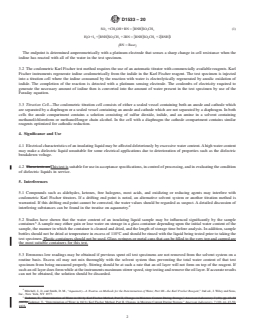
3.1 This test method is based on the reduction of iodine containing reagent according to the traditional Karl Fischer reaction. The
proposed reaction mechanism is as follows:
This test method is under the jurisdiction of ASTM Committee D27 on Electrical Insulating Liquids and Gasesand is the direct responsibility of Subcommittee D27.06
on Chemical Test.
Current edition approved Dec. 1, 2012Nov. 1, 2020. Published December 2012November 2020. Originally approved in 1958. Last previous edition approved in 20052012
as D1533 – 00D1533 – 12.(2005). DOI: 10.1520/D1533-12.10.1520/D1533-20.
For referenced ASTM standards, visit the ASTM website, www.astm.org, or contact ASTM Customer Service at service@astm.org. For Annual Book of ASTM Standards
volume information, refer to the standard’s Document Summary page on the ASTM website.
Scholz, E., “Karl-Fischer Titration,” Springer-Verlag, Berlin, Heidelberg, New York, Tokyo, 1984, 140 pp.
Copyright © ASTM International, 100 Barr Harbor Drive, PO Box C700, West Conshohocken, PA 19428-2959. United States
D1533 − 20
SO 1CH OH1RN 5 RNH SO CH (1)
@ #
2 3 3 3
H O1I 1@RNH#SO CH 12RN 5 @RNH#SO CH 12@RNH#I
2 2 3 3 4 3
~RN 5 Base!
The endpoint is determined amperometrically with a platinum electrode that senses a sharp change in cell resistance when the
iodine has reacted with all of the water in the test specimen.
3.2 The coulometric Karl Fischer test method requires the use of an automatic titrator with commercially available reagents. Karl
Fischer instruments regenerate iodine coulometrically from the iodide in the Karl Fischer reagent. The test specimen is injected
into a titration cell where the iodine consumed by the reaction with water is electrolytically regenerated by anodic oxidation of
iodide. The completion of the reaction is detected with a platinum sensing electrode. The coulombs of electricity required to
generate the necessary amount of iodine then is converted into the amount of water present in the test specimen by use of the
Faraday equation.
3.3 Titration Cell—The coulometric titration cell consists of either a sealed vessel containing both an anode and cathode which
are separated by a diaphragm or a sealed vessel containing an anode and cathode which are not separated by a diaphragm. In both
cells the anode compartment contains a solution consisting of sulfur dioxide, iodide, and an amine in a solvent containing
methanol/chloroform or methanol/longer chain alcohol. In the cell with a diaphragm the cathode compartment contains similar
reagents optimized for cathodic reduction.
4. Significance and Use
4.1 Electrical characteristics of an insulating liquid may be affected deleteriously by excessive water content. A high water content
may make a dielectric liquid unsuitable for some electrical applications due to deterioration of properties such as the dielectric
breakdown voltage.
4.2 These tests areThis test is suitable for use in acceptance specifications, in control of processing, and in evaluating the condition
of dielectric liquids in service.
5. Interferences
5.1 Compounds such as aldehydes, ketones, free halogens, most acids, and oxidizing or reducing agents may interfere with
coulometric Karl Fischer titrators. If a drifting end point is noted, an alternative solvent system or another titration method is
warranted. If this drifting end point cannot be corrected, the water values should be regarded as suspect. A detailed discussion of
interfering substances can be found in the treatise on aquametry.
5.2 Studies have shown that the water content of an insulating liquid sample may be influenced significantly by the sample
container. A sample may either gain or lose water on storage in a glass container depending upon the initial water content of the
sample, the manner in which the container is cleaned and dried, and the length of storage time before analysis. In addition, sample
bottles should not be dried at temperature in excess of 110°C and should be rinsed with the liquid being tested prior to taking the
test specimen. Plastic containers should not be used. Glass syringes or metal cans that can be filled to the very top and capped are
the most suitable containers for this test.
5.3 Erroneous low readings may be obtained if previous spent oil test specimens are not removed from the solvent system on a
routine basis. Excess oil may not mix thoroughly with the solvent system thus preventing the total water content of that test
specimen from being measured properly. Stirring should be at such a rate that an oil layer will not form on top of the reagent. If
such an oil layer does form while at the instruments maximum stirrer speed, stop testing and remove the oil layer. If accurate results
can not be obtained, the solution should be discarded.
Mitchell, J., Jr. and Smith, D. M., “Aquametry—A Treatise on Methods for the Determination of Water, Part III—the Karl Fischer Reagent,” 2nd ed., J. Wiley and Sons,
Inc., New York, NY 1977.
Gedemer, T., “Determination of Water in Oil by Karl Fischer Method, Part II, Changes in Moisture Content During Storage,” American Laboratory 7 (10), pp. 43–50
(1975).Gedemer, T., “Determination of Water in Oil by Karl Fischer Method, Part II, Changes in Moisture Content During Storage,” American Laboratory, 7 (10), pp. 43-50,
1975.
D1533 − 20
5.4 Upon setting up of the titration vessel and solvent system, the walls of the titration vessel should be wetted by swirling the
solvent system solution around in the vessel.
5.5 Some solvent systems may not perform well with natural esters. Alternate solvent systems should be explored to provide the
best analysis.
6. Apparatus
6.1 Coulometric Titrator, consisting of a detector electrode, generator electrode, titration vessel, magnetic stirrer, and control unit.
6.1.1 Detector Electrodes—This electrode pair amperometrically determines the end point of titration by measuring a sharp change
in cell resistance.
6.1.2 Generator Electrodes—This electrode pair performs the cathodic reduction of iodide, which allows the Karl Fischer reaction
to take place. It may consist of two platinum meshes or wires separated by a diaphragm within a glass assembly or two platinum
meshes or wires not separated by a diaphragm.
6.2 Titration Flask—The titration flask will be of suitable capacity and will be protected against atmospheric moisture. A bottom
drain cock is desirable but not necessary for removing reagents.
6.3 Stirrers—Means for agitation during titration will consist of a magnetic stirrer with a glass or TFE-fluorocarbon-covered
stirring bar about 2 to 5 cm long or appropriate to the titration vessel. The bar should be cleaned thoroughly, rinsed with methanol,
dried in an oven for 1 h at 100°C, and stored in a desiccator until used. In a sealed system, recleaning and redrying are not necessary
for routine use.
6.4 Transfer Syringes—Syringes shall be used of a suitable size to accommodate instrument manufacturers’ recommendation of
sample size. Syringes may be glass or plastic. Glass syringes shall be cleaned and dried for 1 h at 100°C prior to use. Plastic
syringes shall be disposed of following each sample use.
6.5 Needles—Needles that are to be fitted to the transfer syringes shall be long enough to inject samples directly below the surface
of the Karl Fischer reagent. They should be of a large enough gauge to allow for easy transfer of the sample.
6.6 Septums, used to seal sample port, allowing the introduction of test specimens with a minimum amount of contamination from
atmospheric moisture.
6.7 Sealing Grease—If the apparatus does not have a gasket seal, use a sealing grease to seal the titration chamber against
atmospheric moisture.
6.8 Drying Oven, vacuum or air circulating.
6.9 Desiccator, standard laboratory type with color change indicator.
6.10 Analytical Balance, capable of weighing to 6 0.001 g.
7. Reagents
7.1 Purity of Reagents—Unless otherwise indicated, all reagents shall conform to the specifications of the Committee on
Analytical Reagents of the American Chemical Society, where such specifications are available.
Reagent Chemicals, American Chemical Society Specifications, American Chemical Society, Washington, DC. For suggestions on the testing of reagents not listed by
the American Chemical Society, see Analar Standards for Laboratory Chemicals, BDH Ltd., Poole, Dorset, U.K., and the United States Pharmacopeia and National
Formulary, U.S. Pharmacopeial Convention, Inc. (USPC), Rockville, MD.
D1533 − 20
7.2 Coulometric Karl Fischer Reagent, can be obtained commercially. Refer to Annex A1 for information on alternative solvent
systems.
7.2.1 Anode Reagent, frequently referred to as vessel solution.
7.2.2 Cathode Reagent, frequently referred to as generator solution.
7.3 Verification Solutions—Verification solutions are available commercially. Verification solutions may be formulated in-house
from long chain alcohols.
7.3.1 The moisture content of water-saturated octanol is:
Water-saturated 1-Octanol 39.2 ± 0.85 mg/mL of solution
7.3.2 The water-saturated alcohol can be prepared by adding deionized water to the alcohol (ACS reagent grade) at 25°C such that
the final mixture consists of a two-phase system in which the lower water phase is at least 2 cm high. Initially, this solution should
be mixed thoroughly and allowed to stand at room temperature for at least three days to achieve complete equilibration.
NOTE 1—For the best accuracy the solution should not be mixed or shaken after standing. Remove the sample aliquot from the top phase and inject it
immediately into the titration cell. The degree of saturation of the water-saturated 1-Octanol varies <1 % between 10 and 30°C.
7.3.3 The response of the instrument shall be verified with 1 to 2 μL of water; this can give a response value of 1000 to 2000 μg
within the specified precision of the instrument.
8. Safety Precautions
8.1 Pyridine was the organic amine that was traditionally used in Karl Fischer reag
...