

ASTM D8240-22e1
(Specification)Standard Specification for Less-Flammable Synthetic Ester Liquids Used in Electrical Apparatus
General Information
- Abstract
SCOPE
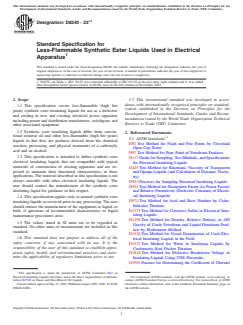
1.1 This specification covers less-flammable (high fire point) synthetic ester insulating liquids for use as a dielectric and cooling in new and existing electrical power apparatus including power and distribution transformers, switchgear, and other associated equipment
1.2 Synthetic ester insulating liquids differ from conventional mineral oil and other less-flammable (high fire point) liquids in that they are products derived from the chemical reaction, processing, and physical treatments of a carboxylic acid and an alcohol.
1.3 This specification is intended to define synthetic ester electrical insulating liquids that are compatible with typical materials of construction of existing apparatus and are expected to maintain their functional characteristics in these applications. The material described in this specification is not always miscible with other electrical insulating liquids. The user should contact the manufacturer of the synthetic ester insulating liquid for guidance in this respect.
1.4 This specification applies only to unused synthetic ester insulating liquids as received prior to any processing. The user should contact the manufacturer of the equipment or liquid, or both, if questions of recommended characteristics or liquid maintenance procedures arise.
1.5 The values stated in SI units are to be regarded as standard. No other units of measurement are included in this standard.
1.6 This standard does not purport to address all of the safety concerns, if any, associated with its use. It is the responsibility of the user of this standard to establish appropriate safety, health, and environmental practices and determine the applicability of regulatory limitations prior to use.
1.7 This international standard was developed in accordance with internationally recognized principles on standardization established in the Decision on Principles for the Development of International Standards, Guides and Recommendations issued by the World Trade Organization Technical Barriers to Trade (TBT) Committee.
- Status
- Published
- Publication Date
- 14-Jul-2022
- Technical Committee
- D27 - Electrical Insulating Liquids and Gases
- Drafting Committee
- D27.02 - Gases and Non-Mineral Oil Liquids

Overview
ASTM D8240-22e1 is the international standard specification developed by ASTM for less-flammable synthetic ester liquids used in electrical apparatus. These synthetic ester insulating liquids are designed for use as both a dielectric and cooling medium in new and existing electrical power equipment, such as power and distribution transformers, switchgear, and related devices. The primary focus of this standard is to ensure the compatibility, safety, and performance of synthetic ester liquids that offer increased fire safety compared to traditional mineral oils.
Key Topics
- Less-flammable Insulating Liquids: Synthetic ester fluids are categorized by their high fire point, making them suitable for critical electrical applications where fire risk must be minimized.
- Chemical Composition: Synthetic ester insulating liquids result from the chemical reaction between a carboxylic acid and an alcohol, producing distinct physical and chemical properties compared to conventional mineral oils.
- Material Compatibility: These fluids are formulated to be compatible with typical construction materials used in electrical apparatus. However, they may not be miscible with other types of insulating liquids, so consultation with manufacturers is recommended when considering their use in existing equipment.
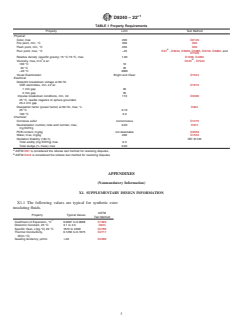
- Strict Quality Requirements: The standard specifies criteria for unused synthetic ester insulating liquids only, with defined property limits such as fire point, dielectric breakdown voltage, water content, pour point, and acid number.
- Testing and Measurements: Only SI units are used in this standard for all testing and reporting. Referenced ASTM and IEC methods are prescribed for determining each required property.
Applications
ASTM D8240-22e1 is intended to guide manufacturers, specifiers, and users of electrical insulating liquids in the selection and application of less-flammable synthetic esters. Key practical applications include:
- Power and Distribution Transformers: Offering enhanced fire safety, synthetic esters are increasingly used in urban and indoor transformer installations, where fire risk from insulating fluids is a major concern.
- Switchgear and Electrical Equipment: Synthetic esters provide both dielectric insulation and thermal management, making them suitable for a variety of power distribution components.
- Retrofitting Existing Apparatus: When upgrading from mineral oil or other less-flammable fluids, synthetic ester insulating liquids can be used (with manufacturer guidance on compatibility).
- Improved Asset Life: The specified properties, such as low water content and neutralization number, are aimed at maximizing insulation system performance and extending equipment service life.
Related Standards
ASTM D8240-22e1 references multiple ASTM and IEC standards essential for testing, sampling, and defining the properties of insulating liquids. Key related standards include:
- ASTM D92: Test Method for Flash and Fire Points by Cleveland Open Cup Tester
- ASTM D97: Test Method for Pour Point of Petroleum Products
- ASTM D117: Guide for Sampling, Test Methods, and Specifications for Electrical Insulating Liquids
- ASTM D445: Test Method for Kinematic Viscosity
- ASTM D923: Practices for Sampling Electrical Insulating Liquids
- ASTM D924: Test Method for Dissipation Factor and Dielectric Constant
- IEC 61099: Specifications for Unused Synthetic Organic Esters for Electrical Purposes
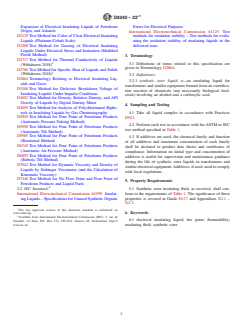
- IEC 61125: Test methods for evaluating oxidation stability of insulating liquids
ASTM D8240-22e1 aligns with international standardization principles as established by the World Trade Organization Technical Barriers to Trade (TBT) Committee, ensuring global applicability and market access.
Practical Value
Adopting ASTM D8240-22e1 helps users and manufacturers ensure reliable performance, increased fire safety, and regulatory compliance of insulating liquids in critical electrical infrastructure. By specifying rigorous requirements and standardized test methods, the standard supports safer, more sustainable, and higher-performing power networks.
Relations
- Effective Date
- 01-Apr-2024
- Effective Date
- 01-Mar-2024
- Effective Date
- 15-Jan-2024
- Effective Date
- 01-Dec-2023
- Effective Date
- 01-Dec-2023
- Effective Date
- 01-Nov-2023
- Refers
ASTM D5985-02(2020) - Standard Test Method for Pour Point of Petroleum Products (Rotational Method) - Effective Date
- 01-May-2020
- Effective Date
- 01-May-2020
- Effective Date
- 01-Oct-2019
- Effective Date
- 01-Dec-2018
- Effective Date
- 01-May-2018
- Effective Date
- 01-Mar-2017
- Effective Date
- 01-Feb-2017
- Effective Date
- 01-Jan-2017
- Effective Date
- 01-Jan-2017
Get Certified
Connect with accredited certification bodies for this standard

IMQ S.p.A. (Certification)
Italian electrical product certification.

SLG Prüf- und Zertifizierungs GmbH
German testing and certification body.

UL Solutions
Global safety science company with testing, inspection and certification.
Sponsored listings
Frequently Asked Questions
ASTM D8240-22e1 is a technical specification published by ASTM International. Its full title is "Standard Specification for Less-Flammable Synthetic Ester Liquids Used in Electrical Apparatus". This standard covers: SCOPE 1.1 This specification covers less-flammable (high fire point) synthetic ester insulating liquids for use as a dielectric and cooling in new and existing electrical power apparatus including power and distribution transformers, switchgear, and other associated equipment 1.2 Synthetic ester insulating liquids differ from conventional mineral oil and other less-flammable (high fire point) liquids in that they are products derived from the chemical reaction, processing, and physical treatments of a carboxylic acid and an alcohol. 1.3 This specification is intended to define synthetic ester electrical insulating liquids that are compatible with typical materials of construction of existing apparatus and are expected to maintain their functional characteristics in these applications. The material described in this specification is not always miscible with other electrical insulating liquids. The user should contact the manufacturer of the synthetic ester insulating liquid for guidance in this respect. 1.4 This specification applies only to unused synthetic ester insulating liquids as received prior to any processing. The user should contact the manufacturer of the equipment or liquid, or both, if questions of recommended characteristics or liquid maintenance procedures arise. 1.5 The values stated in SI units are to be regarded as standard. No other units of measurement are included in this standard. 1.6 This standard does not purport to address all of the safety concerns, if any, associated with its use. It is the responsibility of the user of this standard to establish appropriate safety, health, and environmental practices and determine the applicability of regulatory limitations prior to use. 1.7 This international standard was developed in accordance with internationally recognized principles on standardization established in the Decision on Principles for the Development of International Standards, Guides and Recommendations issued by the World Trade Organization Technical Barriers to Trade (TBT) Committee.
SCOPE 1.1 This specification covers less-flammable (high fire point) synthetic ester insulating liquids for use as a dielectric and cooling in new and existing electrical power apparatus including power and distribution transformers, switchgear, and other associated equipment 1.2 Synthetic ester insulating liquids differ from conventional mineral oil and other less-flammable (high fire point) liquids in that they are products derived from the chemical reaction, processing, and physical treatments of a carboxylic acid and an alcohol. 1.3 This specification is intended to define synthetic ester electrical insulating liquids that are compatible with typical materials of construction of existing apparatus and are expected to maintain their functional characteristics in these applications. The material described in this specification is not always miscible with other electrical insulating liquids. The user should contact the manufacturer of the synthetic ester insulating liquid for guidance in this respect. 1.4 This specification applies only to unused synthetic ester insulating liquids as received prior to any processing. The user should contact the manufacturer of the equipment or liquid, or both, if questions of recommended characteristics or liquid maintenance procedures arise. 1.5 The values stated in SI units are to be regarded as standard. No other units of measurement are included in this standard. 1.6 This standard does not purport to address all of the safety concerns, if any, associated with its use. It is the responsibility of the user of this standard to establish appropriate safety, health, and environmental practices and determine the applicability of regulatory limitations prior to use. 1.7 This international standard was developed in accordance with internationally recognized principles on standardization established in the Decision on Principles for the Development of International Standards, Guides and Recommendations issued by the World Trade Organization Technical Barriers to Trade (TBT) Committee.
ASTM D8240-22e1 is classified under the following ICS (International Classification for Standards) categories: 29.040.10 - Insulating oils; 29.080.01 - Electrical insulation in general. The ICS classification helps identify the subject area and facilitates finding related standards.
ASTM D8240-22e1 has the following relationships with other standards: It is inter standard links to ASTM D445-24, ASTM D6749-24, ASTM D1275-24, ASTM D924-23, ASTM D923-15(2023), ASTM D445-23, ASTM D5985-02(2020), ASTM D6892-03(2020), ASTM D1816-12(2019), ASTM D4059-00(2018), ASTM D6749-02(2018), ASTM D2864-17a, ASTM D2864-17, ASTM D2300-08(2017), ASTM D2129-17. Understanding these relationships helps ensure you are using the most current and applicable version of the standard.
ASTM D8240-22e1 is available in PDF format for immediate download after purchase. The document can be added to your cart and obtained through the secure checkout process. Digital delivery ensures instant access to the complete standard document.
Standards Content (Sample)
This international standard was developed in accordance with internationally recognized principles on standardization established in the Decision on Principles for the
Development of International Standards, Guides and Recommendations issued by the World Trade Organization Technical Barriers to Trade (TBT) Committee.
´1
Designation:D8240 −22
Standard Specification for
Less-Flammable Synthetic Ester Liquids Used in Electrical
Apparatus
This standard is issued under the fixed designation D8240; the number immediately following the designation indicates the year of
original adoption or, in the case of revision, the year of last revision. A number in parentheses indicates the year of last reapproval. A
superscript epsilon (´) indicates an editorial change since the last revision or reapproval.
ε NOTE—In Table 1, IEC 51125 was corrected editorially to IEC 61125 in the last entry right column and % was added
after Dissipation factor (power factor) at 60 Hz, max in the left column in November 2022.
1. Scope 1.7 This international standard was developed in accor-
dance with internationally recognized principles on standard-
1.1 This specification covers less-flammable (high fire
ization established in the Decision on Principles for the
point) synthetic ester insulating liquids for use as a dielectric
Development of International Standards, Guides and Recom-
and cooling in new and existing electrical power apparatus
mendations issued by the World Trade Organization Technical
including power and distribution transformers, switchgear, and
Barriers to Trade (TBT) Committee.
other associated equipment
1.2 Synthetic ester insulating liquids differ from conven-
2. Referenced Documents
tional mineral oil and other less-flammable (high fire point)
2.1 ASTM Standards:
liquids in that they are products derived from the chemical
D92 Test Method for Flash and Fire Points by Cleveland
reaction, processing, and physical treatments of a carboxylic
Open Cup Tester
acid and an alcohol.
D97 Test Method for Pour Point of Petroleum Products
1.3 This specification is intended to define synthetic ester
D117 Guide for Sampling, Test Methods, and Specifications
electrical insulating liquids that are compatible with typical
for Electrical Insulating Liquids
materials of construction of existing apparatus and are ex-
D445 Test Method for Kinematic Viscosity of Transparent
pected to maintain their functional characteristics in these
and Opaque Liquids (and Calculation of Dynamic Viscos-
applications. The material described in this specification is not
ity)
always miscible with other electrical insulating liquids. The
D923 Practices for Sampling Electrical Insulating Liquids
user should contact the manufacturer of the synthetic ester
D924 Test Method for Dissipation Factor (or Power Factor)
insulating liquid for guidance in this respect.
and Relative Permittivity (Dielectric Constant) of Electri-
cal Insulating Liquids
1.4 This specification applies only to unused synthetic ester
D974 Test Method for Acid and Base Number by Color-
insulating liquids as received prior to any processing. The user
Indicator Titration
should contact the manufacturer of the equipment or liquid, or
D1275 Test Method for Corrosive Sulfur in Electrical Insu-
both, if questions of recommended characteristics or liquid
lating Liquids
maintenance procedures arise.
D1298 Test Method for Density, Relative Density, or API
1.5 The values stated in SI units are to be regarded as
Gravity of Crude Petroleum and Liquid Petroleum Prod-
standard. No other units of measurement are included in this
ucts by Hydrometer Method
standard.
D1524 Test Method for Visual Examination of Used Elec-
1.6 This standard does not purport to address all of the
trical Insulating Liquids in the Field
safety concerns, if any, associated with its use. It is the
D1533 Test Method for Water in Insulating Liquids by
responsibility of the user of this standard to establish appro-
Coulometric Karl Fischer Titration
priate safety, health, and environmental practices and deter-
D1816 Test Method for Dielectric Breakdown Voltage of
mine the applicability of regulatory limitations prior to use.
Insulating Liquids Using VDE Electrodes
D1903 Practice for Determining the Coefficient of Thermal
This specification is under the jurisdiction of ASTM Committee D27 on
Electrical Insulating Liquids and Gases and is the direct responsibility of Subcom- For referenced ASTM standards, visit the ASTM website, www.astm.org, or
mittee D27.02 on Gases and Non-Mineral Oil Liquids. contact ASTM Customer Service at service@astm.org. For Annual Book of ASTM
Current edition approved July 15, 2022. Published August 2022. DOI: 10.1520/ Standards volume information, refer to the standard’s Document Summary page on
D8240-22E01. the ASTM website.
Copyright © ASTM International, 100 Barr Harbor Drive, PO Box C700, West Conshohocken, PA 19428-2959. United States
´1
D8240−22
Expansion of Electrical Insulating Liquids of Petroleum Esters for Electrical Purposes
Origin, and Askarels International Electrotechnical Commission 61125 Test
D2129 Test Method for Color of Clear Electrical Insulating
methods for oxidation stability – Test methods for evalu-
Liquids (Platinum-Cobalt Scale)
ating the oxidation stability of insulating liquids in the
D2300 Test Method for Gassing of Electrical Insulating
delivered state
Liquids Under Electrical Stress and Ionization (Modified
Pirelli Method)
3. Terminology
D2717 Test Method for Thermal Conductivity of Liquids
3.1 Definitions of terms related to this specification are
(Withdrawn 2018)
given in Terminology D2864.
D2766 Test Method for Specific Heat of Liquids and Solids
(Withdrawn 2018)
3.2 Definitions:
D2864 Terminology Relating to Electrical Insulating Liq-
3.2.1 synthetic ester liquid, n—an insulating liquid for
uids and Gases
transformers and similar equipment formed from an esterifica-
D3300 Test Method for Dielectric Breakdown Voltage of
tion reaction of chemicals (not necessarily biological feed-
Insulating Liquids Under Impulse Conditions
stock) involving an alcohol and a carboxylic acid.
D4052 Test Method for Density, Relative Density, and API
Gravity of Liquids by Digital Density Meter
4. Sampling and Testing
D4059 Test Method for Analysis of Polychlorinated Biphe-
nyls in Insulating Liquids by Gas Chromatography 4.1 Take all liquid samples in accordance with Practices
D5949 Test Method for Pour Point of Petroleum Products
D923.
(Automatic Pressure Pulsing Method)
4.2 Perform each test in accordance with theASTM or IEC
D5950 Test Method for Pour Point of Petroleum Products
test method specified in Table 1.
(Automatic Tilt Method)
D5985 Test Method for Pour Point of Petroleum Products
4.3 If additives are used, the chemical family and function
(Rotational Method)
of all additives and maximum concentration of each family
D6749 Test Method for Pour Point of Petroleum Products
shall be declared in product data sheets and certificates of
(Automatic Air Pressure Method)
compliance. Information on initial type and concentration of
D6892 Test Method for Pour Point of Petroleum Products
additives is useful for supervision and maintenance guidance
(Robotic Tilt Method)
during the life of synthetic ester liquids in transformers and
D7042 Test Method for Dynamic Viscosity and Density of
similarelectricalequipment.Additives,ifused,needtocomply
Liquids by Stabinger Viscometer (and the Calculation of
with local regulations.
Kinematic Viscosity)
D7346 Test Method for No Flow Point and Pour Point of
5. Pr
...