

ASTM C550-15(2020)
(Test Method)Standard Test Method for Measuring Trueness and Squareness of Rigid Block and Board Thermal Insulation
General Information
- Abstract
SIGNIFICANCE AND USE
4.1 It is possible that insulating blocks or boards that are not true or square will not fit properly. It is possible that extra labor will be required to obtain proper fit and that this could affect the product performance as well as the appearance of the finished installation.
4.2 This test method provides terminology and describes locations for obtaining consistent measurements of trueness and squareness of blocks and boards.
SCOPE
1.1 This test method covers locations for measuring the trueness and squareness of rigid block/board thermal insulation. This test method does not purport to address the variability in board thickness. Thickness is addressed in other ASTM standards.
1.2 The values stated in inch-pound units are to be regarded as standard. The values given in parentheses are mathematical conversions to SI units that are provided for information only and are not considered standard.
1.3 This standard does not purport to address all of the safety concerns, if any, associated with its use. It is the responsibility of the user of this standard to establish appropriate safety, health, and environmental practices and determine the applicability of regulatory limitations prior to use.
1.4 This international standard was developed in accordance with internationally recognized principles on standardization established in the Decision on Principles for the Development of International Standards, Guides and Recommendations issued by the World Trade Organization Technical Barriers to Trade (TBT) Committee.
- Status
- Published
- Publication Date
- 31-Aug-2020
- Technical Committee
- C16 - Thermal Insulation
- Drafting Committee
- C16.32 - Mechanical Properties

Overview
ASTM C550-15(2020) is the internationally recognized standard test method for measuring the trueness and squareness of rigid block and board thermal insulation. Developed by ASTM Committee C16 on Thermal Insulation, this standard sets out clear and consistent procedures for assessing the shape-related properties critical to the performance, fit, and appearance of insulation products. By following ASTM C550-15(2020), manufacturers, installers, and quality control professionals can ensure that thermal insulation blocks and boards meet precise dimensional criteria before installation.
Key Topics
- Trueness: Refers to the lack of deviation from straightness or flatness in block and board insulation materials.
- Squareness: Measures how closely board or block corners and edges match ideal right angles, a key factor for fitting and joint integrity.
- Consistent Measurement Locations: The standard specifies precise locations for measurement to reduce variability and enable repeatable, reliable results.
- Critical Performance Factors:
- Proper fit and function of insulation systems
- Visual uniformity and professional finish of insulation installations
- Reduction of material waste and labor time caused by off-spec product shapes
Applications
ASTM C550-15(2020) is used in a variety of scenarios where precise fitting and reliable performance of thermal insulation are required:
- Manufacturing Quality Control: Ensures product dimensions for rigid block and board insulation meet specifications before shipment, minimizing returns and warranty claims.
- Onsite Inspection and Acceptance: Provides contractors and inspectors a standardized method to evaluate insulation materials upon delivery and prior to installation, preventing downstream issues.
- Specification Compliance: Supports compliance with building codes, engineering specifications, and energy efficiency standards that call for precise installation of insulation materials.
- Product Research and Development: Used by researchers and developers to benchmark new insulation products against established trueness and squareness criteria, facilitating product innovation.
Related Standards
ASTM C550-15(2020) integrates with other ASTM and industry standards to provide a comprehensive quality framework for thermal insulation, including:
- ASTM C168: Terminology Relating to Thermal Insulation, providing definitions for key terms.
- ASTM C390: Practice for Sampling and Acceptance of Thermal Insulation Lots, which stipulates procedures for sample selection and lot acceptance.
- ASTM E177: Practice for Use of the Terms Precision and Bias in ASTM Test Methods, supporting statistical evaluation of test results.
- Other standards addressing insulation thickness and specific material properties may be referenced for a complete assessment.
Practical Value
By adhering to ASTM C550-15(2020), stakeholders can:
- Minimize Installation Issues: Reduce costly onsite modifications and labor time by ensuring proper fit.
- Optimize Thermal Performance: Maintain the designed R-value and energy efficiency by eliminating gaps and voids caused by misshapen products.
- Enhance Durability and Appearance: Achieve consistent, professional finishes for insulated systems, boosting client satisfaction.
- Ensure Regulatory Compliance: Meet local and international standards required for commercial building projects and governmental approvals.
Keywords
thermal insulation, rigid board, block insulation, trueness, squareness, ASTM C550, measurement, quality control, installation, building standards, product validation
Relations
- Effective Date
- 15-Apr-2024
- Effective Date
- 01-Mar-2024
- Effective Date
- 01-Sep-2019
- Effective Date
- 15-Apr-2018
- Effective Date
- 01-Jun-2017
- Effective Date
- 15-Oct-2015
- Effective Date
- 01-Jun-2015
- Effective Date
- 01-May-2014
- Effective Date
- 01-Nov-2013
- Effective Date
- 01-May-2013
- Effective Date
- 01-Apr-2013
- Effective Date
- 01-Oct-2010
- Effective Date
- 01-Jan-2010
- Effective Date
- 15-Dec-2008
- Effective Date
- 01-Oct-2008
Get Certified
Connect with accredited certification bodies for this standard

DIBt (Deutsches Institut für Bautechnik)
German Institute for Building Technology.
DIN CERTCO
DIN Group product certification.

Aboma Certification B.V.
Specialized in construction, metal, and transport sectors.
Sponsored listings
Frequently Asked Questions
ASTM C550-15(2020) is a standard published by ASTM International. Its full title is "Standard Test Method for Measuring Trueness and Squareness of Rigid Block and Board Thermal Insulation". This standard covers: SIGNIFICANCE AND USE 4.1 It is possible that insulating blocks or boards that are not true or square will not fit properly. It is possible that extra labor will be required to obtain proper fit and that this could affect the product performance as well as the appearance of the finished installation. 4.2 This test method provides terminology and describes locations for obtaining consistent measurements of trueness and squareness of blocks and boards. SCOPE 1.1 This test method covers locations for measuring the trueness and squareness of rigid block/board thermal insulation. This test method does not purport to address the variability in board thickness. Thickness is addressed in other ASTM standards. 1.2 The values stated in inch-pound units are to be regarded as standard. The values given in parentheses are mathematical conversions to SI units that are provided for information only and are not considered standard. 1.3 This standard does not purport to address all of the safety concerns, if any, associated with its use. It is the responsibility of the user of this standard to establish appropriate safety, health, and environmental practices and determine the applicability of regulatory limitations prior to use. 1.4 This international standard was developed in accordance with internationally recognized principles on standardization established in the Decision on Principles for the Development of International Standards, Guides and Recommendations issued by the World Trade Organization Technical Barriers to Trade (TBT) Committee.
SIGNIFICANCE AND USE 4.1 It is possible that insulating blocks or boards that are not true or square will not fit properly. It is possible that extra labor will be required to obtain proper fit and that this could affect the product performance as well as the appearance of the finished installation. 4.2 This test method provides terminology and describes locations for obtaining consistent measurements of trueness and squareness of blocks and boards. SCOPE 1.1 This test method covers locations for measuring the trueness and squareness of rigid block/board thermal insulation. This test method does not purport to address the variability in board thickness. Thickness is addressed in other ASTM standards. 1.2 The values stated in inch-pound units are to be regarded as standard. The values given in parentheses are mathematical conversions to SI units that are provided for information only and are not considered standard. 1.3 This standard does not purport to address all of the safety concerns, if any, associated with its use. It is the responsibility of the user of this standard to establish appropriate safety, health, and environmental practices and determine the applicability of regulatory limitations prior to use. 1.4 This international standard was developed in accordance with internationally recognized principles on standardization established in the Decision on Principles for the Development of International Standards, Guides and Recommendations issued by the World Trade Organization Technical Barriers to Trade (TBT) Committee.
ASTM C550-15(2020) is classified under the following ICS (International Classification for Standards) categories: 91.100.60 - Thermal and sound insulating materials. The ICS classification helps identify the subject area and facilitates finding related standards.
ASTM C550-15(2020) has the following relationships with other standards: It is inter standard links to ASTM C168-24, ASTM C390-08(2024), ASTM C390-08(2019), ASTM C168-18, ASTM C168-17, ASTM C168-15a, ASTM C168-15, ASTM E177-14, ASTM C390-08(2013), ASTM E177-13, ASTM C168-13, ASTM E177-10, ASTM C168-10, ASTM C168-08b, ASTM E177-08. Understanding these relationships helps ensure you are using the most current and applicable version of the standard.
ASTM C550-15(2020) is available in PDF format for immediate download after purchase. The document can be added to your cart and obtained through the secure checkout process. Digital delivery ensures instant access to the complete standard document.
Standards Content (Sample)
This international standard was developed in accordance with internationally recognized principles on standardization established in the Decision on Principles for the
Development of International Standards, Guides and Recommendations issued by the World Trade Organization Technical Barriers to Trade (TBT) Committee.
Designation: C550 − 15 (Reapproved 2020)
Standard Test Method for
Measuring Trueness and Squareness of Rigid Block and
Board Thermal Insulation
This standard is issued under the fixed designation C550; the number immediately following the designation indicates the year of
original adoption or, in the case of revision, the year of last revision. A number in parentheses indicates the year of last reapproval. A
superscript epsilon (´) indicates an editorial change since the last revision or reapproval.
This standard has been approved for use by agencies of the U.S. Department of Defense.
1. Scope 3. Terminology
3.1 Definitions—For definitions of terms used in this test
1.1 This test method covers locations for measuring the
method, refer to Terminology C168.
trueness and squareness of rigid block/board thermal insula-
3.2 Definitions of Terms Specific to This Standard:
tion. This test method does not purport to address the variabil-
3.2.1 squareness—the lack of deviation from a right angle.
ity in board thickness. Thickness is addressed in other ASTM
standards.
3.2.2 trueness—the lack of deviation from straightness or
flatness.
1.2 The values stated in inch-pound units are to be regarded
as standard. The values given in parentheses are mathematical
4. Significance and Use
conversions to SI units that are provided for information only
4.1 It is possible that insulating blocks or boards that are not
and are not considered standard.
true or square will not fit properly. It is possible that extra labor
1.3 This standard does not purport to address all of the
will be required to obtain proper fit and that this could affect
safety concerns, if any, associated with its use. It is the
the product performance as well as the appearance of the
responsibility of the user of this standard to establish appro-
finished installation.
priate safety, health, and environmental practices and deter-
4.2 This test method provides terminology and describes
mine the applicability of regulatory limitations prior to use.
locations for obtaining consistent measurements of trueness
1.4 This international standard was developed in accor-
and squareness of blocks and boards.
dance with internationally recognized principles on standard-
ization established in the Decision on Principles for the
5. Apparatus
Development of International Standards, Guides and Recom-
5.1 Straightedge, minimum length equal to the maximum
mendations issued by the World Trade Organization Technical
Barriers to Trade (TBT) Committee. dimension of the block or board with a maximum out of
trueness of 6 0.003 in./ft (60.25 mm/m).
2. Referenced Documents
5.2 Rigid Ruler, graduated to 0.03 in. (1.0 mm) or finer.
2.1 ASTM Standards:
5.3 Square, shall have sides at least as long as the longest
C168 Terminology Relating to Thermal Insulation side of the block. If the longest side of the block is greater than
C390 Practice for Sampling and Acceptance of Thermal
20 in. (500 mm), then the length of the square must be at least
Insulation Lots
20 in. (500 mm).The maximum deviation from 90° shall be no
E177 Practice for Use of the Terms Precision and Bias in
more than 63 min (60.9 mrad).
ASTM Test Methods
5.4 Flat Surface, large enough to accommodate the block or
board in its full length and width dimensions, with a trueness
of 60.008 in./ft (60.65 mm/m).
ThistestmethodisunderthejurisdictionofASTMCommitteeC16onThermal
5.5 Feeler Gage Set, from 0.001 to 0.020 in. (0.03 to 0.50
Insulation and is the direct responsibility of Subcommittee C16.32 on Mechanical
mm).
Properties.
Current edition approved Sept. 1, 2020. Published October 2020. Originally
5.6 Tape Measure,steel,longenoughtomeasurethelongest
approved in 1964. Last previous edition approved in 2015 as C550 – 15. DOI:
side of the block, graduated in 0.031 in. (1 mm) intervals.
10.1520/C0550-15R20.
For referenced ASTM standards, visit the ASTM website, www.astm.org, or
contact ASTM Customer Service at service@astm.org. For Annual Book of ASTM
6. Test Specimens
Standards volume information, refer to the standard’s Document Summary page on
the ASTM website. 6.1 The test specimens shall be of commercial size.
Copyright © ASTM International, 100 Barr Harbor Drive, PO Box C700, West Conshohocken, PA 19428-2959. United States
C550 − 15 (2020)
6.2 The number of test specimens shall be defined by the
appropriate product specification.
6.3 When the appropriate product specification does not
cover sampling, samples shall be selected in accordance with
Practice C390 inspection requirements.
7. Procedure
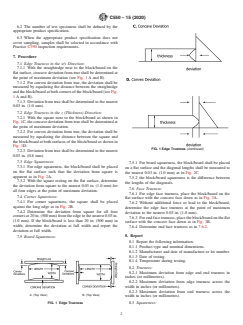
7.1 Edge Trueness in the x/y Direction:
7.1.1 With the straightedge next to the block/board on the
flat surface, concave deviation from true shall be determined at
the point of maximum deviation (see Fig. 1 A and B).
7.1.2 For convex deviation from true, the deviation shall be
measured by equalizing the distance between the straightedge
andtheblock/boardatbothcornersoftheblock/board(seeFig.
1 A and B).
7.1.3 Deviation from true shall be determined to the nearest
0.03 in. (1.0 mm).
7.2 Edge Trueness in the z (Thickness) Direction:
7.2.1 With the square next to the block/board as shown in
Fig. 1C, the concave deviation from true shall be determined at
the point of maximum deviation.
7.2.2 For convex deviation from true, the deviation shall be
measured by equalizing the distance between the square and
the block/board at both surfaces of the block/board as shown in
Fig. 1D.
FIG. 1 Edge Trueness (continued)
7.2.3 Deviation from true shall be determined to the nearest
0.03 in. (0.8 mm).
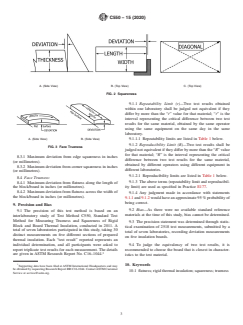
7.3 Edge Squareness:
7.5.1 For board squareness, the block/board shall be placed
7.3.1 For edge squareness, the block/board shall be placed
on a flat surface and the diagonal lengths shall be measured to
on the flat surface such that the deviation from square is
the nearest 0.03 in. (1.0 mm) as in Fig. 2C.
apparent as in Fig. 2A.
7.5.2 the block/board squareness is the difference between
7.3.2 With the square resting on the flat surface, determine
the lengths of the diagonals.
the deviation from square to the nearest 0.03 in. (1.0 mm) for
7.6 Face Trueness:
all four edges at the point of maximum deviation.
7.6.1 For edge face trueness, place the block/board on the
7.4 Corner Squareness:
flat surface with the concave face down as in Fig. 3A.
7.4.1 For corner squareness, the square shall be placed
7.6.2 Without additional force or load to the block/board,
against the long edge as in Fig
...