

ASTM F404-21
(Specification)Standard Consumer Safety Specification for High Chairs
General Information
- Abstract
SCOPE
1.1 This consumer safety specification covers the performance requirements and methods of test to ensure the satisfactory performance of the high chair and high chairs created by using a high chair conversion kit and component(s) from another product.
1.2 This consumer safety specification is intended to minimize injuries to children resulting from normal usage and reasonably foreseeable misuse or abuse of high chairs.
Note 1: This consumer safety specification is not intended to address accidents and injuries resulting from the interaction of older children with children in the high chair or the accidents resulting from abuse and misuse by persons over three years of age.
1.3 No high chair or high chair conversion kit produced after the approval date of this consumer safety specification shall, either by label or other means, indicate compliance with this specification unless it conforms to all requirements contained herein.
1.4 The values stated in inch-pound units are to be regarded as standard. The values given in parentheses are mathematical conversions to SI units that are provided for information only and are not considered standard.
1.5 The following precautionary caveat pertains only to the test methods portion, Section 7, of this specification: This standard does not purport to address all of the safety concerns, if any, associated with its use. It is the responsibility of the user of this standard to establish appropriate safety, health, and environmental practices and determine the applicability of regulatory limitations prior to use.
Note 2: This consumer safety specification includes the following sections:
Title
Section
Scope
1
Referenced Documents
2
Terminology
3
Calibration and Standardization
4
General Requirements
5
Compliance When Used With
Conversion Kits
5.3
Threaded Fasteners
5.5
Latching or Locking Mechanisms
5.9
Labeling
5.10
Openings
5.11
Toys
5.12
Performance Requirements
6
Protective Components
6.1
Removable Tray or Front Torso Support
Performance Integrity
6.2
Tray or Front Torso Support Performance –
Pull Test
6.3
Static Load
6.4
Stability
6.5
Exposed Coil Springs
6.6
Scissoring, Shearing, and Pinching
6.7
Restraint System
6.8
Passive Crotch Restraint System
6.9
Structural Integrity
6.10
Tray Latch Release Mechanisms
6.11
Side Containment
6.12
Protrusions
6.13
Test Methods
7
Locking Mechanisms
7.1
Protective Components
7.2
Tray or Front Torso Support – Drop Test
7.3
Tray or Front Torso Support Disengagement –
Horizontal Pull Test
7.4
Tray or Front Torso Support Disengagement –
Vertical Pull Test
7.5
Static Load Testing
7.6
Stability Testing
7.7
Restraint System Retention Test
7.8
Permanency of Labels and Warnings
7.9
Dynamic High Chair Test
7.10
Completely Bounded Openings
7.11
Tray Latch Release Mechanism – Accessibility
7.12
Side Containment Openings
7.14
Marking and Labeling
8
Instructional Literature
9
Keywords
10
Rationale
Appendix X1
1.6 This international standard was developed in accordance with internationally recognized principles on standardization established in the Decision on Principles for the Development of International Standards, Guides and Recommendations issued by the World Trade Organization Technical Barriers to Trade (TBT) Committee.
- Status
- Published
- Publication Date
- 14-Nov-2021
- Technical Committee
- F15 - Consumer Products
- Drafting Committee
- F15.16 - Highchairs and Hook-On Chairs
Overview
ASTM F404-21: Standard Consumer Safety Specification for High Chairs specifies safety and performance requirements, along with methods of testing, for high chairs and high chair conversion kits. Developed by ASTM International, this standard focuses on reducing injuries to children under normal, foreseeable use and foreseeable misuse of high chairs. The goal is to ensure products are tested and built to rigorous safety expectations before entering the consumer market.
Key Topics
- Performance Requirements: Sets performance standards related to stability, structural integrity, restraint systems, tray security, and protective components to minimize risk of falls, entrapment, scissoring, or pinching.
- Test Methods: Details procedures for testing locking mechanisms, load-bearing capacities, stability, restraint retention, and durability of labels and warnings.
- Labeling & Instructions: Requires clear, permanent warnings and instructional literature for consumers, including appropriate safety labels in accordance with relevant regulations.
- High Chair Conversion Kits: Outlines compliance for products converted to high chairs using kits or components, ensuring converted products meet the same safety benchmarks as standalone high chairs.
- Component Safety: Addresses requirements for fasteners, openings, coatings, toys, and protrusions to limit hazards such as choking, ingestion, sharp edges, lead exposure, and entrapment.
Applications
The ASTM F404-21 standard applies to a wide spectrum of high chairs and products convertible to high chairs, reinforcing consumer and child safety across the following areas:
- Children’s Furniture Manufacturing: Furniture producers, designers, and engineers must demonstrate compliance in both manufacturing and instructional documentation to legally produce and market high chairs.
- Retail and Import Compliance: Retailers and importers confirm product safety by referencing compliance with ASTM F404-21, essential for market entry and liability reduction.
- Product Certification & Quality Assurance: Conformance testing as required by the standard is utilized for certification, ongoing quality control, and risk assessment during product development and production.
- Consumer Safety Advocacy & Education: Organizations and authorities use this standard to promote better product selection, educate on correct use of restraint systems, and inform about safe assembly and conversion practices.
Related Standards
ASTM F404-21 is closely connected with several important consumer product safety standards and regulatory requirements for children’s products, including:
- ASTM F963: Standard Consumer Safety Specification for Toy Safety
- ASTM F406: Consumer Safety Specification for Non-Full-Size Baby Cribs/Play Yards
- ASTM F833: Consumer Safety Performance Specification for Carriages and Strollers
- 16 CFR 1500, 1501, 1303, 1227: Federal U.S. regulations covering hazardous substances, small parts, and lead in children’s products
- ANSI Z535 Series: Standards for safety colors, product safety signs and labels, and safety information in product literature
Practical Value
By aligning with the ASTM F404-21 standard, manufacturers, retailers, and regulatory bodies help ensure high chairs on the market are designed to minimize risks of falls, entrapment, tip-over, and other hazards. The standard’s robust testing and labeling requirements give parents and caregivers added confidence in product safety. Adhering to ASTM F404-21 is not only a mark of quality and responsibility but is often a prerequisite for market access and regulatory compliance in multiple countries.
Keywords
ASTM F404, high chair safety, consumer safety, child product standards, stability testing, restraint systems, product labeling, high chair conversion kits, product compliance, children’s furniture safety, performance standard, safety requirements.
Relations
- Effective Date
- 01-Aug-2023
- Effective Date
- 01-Dec-2017
- Effective Date
- 01-Aug-2016
- Effective Date
- 01-Nov-2015
- Effective Date
- 01-Nov-2015
- Refers
ASTM F833-13b - Standard Consumer Safety Performance Specification for Carriages and Strollers - Effective Date
- 01-Nov-2013
- Refers
ASTM F833-13a - Standard Consumer Safety Performance Specification for Carriages and Strollers - Effective Date
- 15-Sep-2013
- Effective Date
- 01-May-2013
- Effective Date
- 01-Apr-2013
- Refers
ASTM F406-12a - Standard Consumer Safety Specification for Non-Full-Size Baby Cribs/Play Yards - Effective Date
- 01-May-2012
- Effective Date
- 15-Jan-2012
- Effective Date
- 01-Dec-2011
- Refers
ASTM F406-11b - Standard Consumer Safety Specification for Non-Full-Size Baby Cribs/Play Yards - Effective Date
- 15-Aug-2011
- Refers
ASTM F406-11a - Standard Consumer Safety Specification for Non-Full-Size Baby Cribs/Play Yards - Effective Date
- 01-Jul-2011
- Effective Date
- 15-May-2011
Frequently Asked Questions
ASTM F404-21 is a technical specification published by ASTM International. Its full title is "Standard Consumer Safety Specification for High Chairs". This standard covers: SCOPE 1.1 This consumer safety specification covers the performance requirements and methods of test to ensure the satisfactory performance of the high chair and high chairs created by using a high chair conversion kit and component(s) from another product. 1.2 This consumer safety specification is intended to minimize injuries to children resulting from normal usage and reasonably foreseeable misuse or abuse of high chairs. Note 1: This consumer safety specification is not intended to address accidents and injuries resulting from the interaction of older children with children in the high chair or the accidents resulting from abuse and misuse by persons over three years of age. 1.3 No high chair or high chair conversion kit produced after the approval date of this consumer safety specification shall, either by label or other means, indicate compliance with this specification unless it conforms to all requirements contained herein. 1.4 The values stated in inch-pound units are to be regarded as standard. The values given in parentheses are mathematical conversions to SI units that are provided for information only and are not considered standard. 1.5 The following precautionary caveat pertains only to the test methods portion, Section 7, of this specification: This standard does not purport to address all of the safety concerns, if any, associated with its use. It is the responsibility of the user of this standard to establish appropriate safety, health, and environmental practices and determine the applicability of regulatory limitations prior to use. Note 2: This consumer safety specification includes the following sections: Title Section Scope 1 Referenced Documents 2 Terminology 3 Calibration and Standardization 4 General Requirements 5 Compliance When Used With Conversion Kits 5.3 Threaded Fasteners 5.5 Latching or Locking Mechanisms 5.9 Labeling 5.10 Openings 5.11 Toys 5.12 Performance Requirements 6 Protective Components 6.1 Removable Tray or Front Torso Support Performance Integrity 6.2 Tray or Front Torso Support Performance – Pull Test 6.3 Static Load 6.4 Stability 6.5 Exposed Coil Springs 6.6 Scissoring, Shearing, and Pinching 6.7 Restraint System 6.8 Passive Crotch Restraint System 6.9 Structural Integrity 6.10 Tray Latch Release Mechanisms 6.11 Side Containment 6.12 Protrusions 6.13 Test Methods 7 Locking Mechanisms 7.1 Protective Components 7.2 Tray or Front Torso Support – Drop Test 7.3 Tray or Front Torso Support Disengagement – Horizontal Pull Test 7.4 Tray or Front Torso Support Disengagement – Vertical Pull Test 7.5 Static Load Testing 7.6 Stability Testing 7.7 Restraint System Retention Test 7.8 Permanency of Labels and Warnings 7.9 Dynamic High Chair Test 7.10 Completely Bounded Openings 7.11 Tray Latch Release Mechanism – Accessibility 7.12 Side Containment Openings 7.14 Marking and Labeling 8 Instructional Literature 9 Keywords 10 Rationale Appendix X1 1.6 This international standard was developed in accordance with internationally recognized principles on standardization established in the Decision on Principles for the Development of International Standards, Guides and Recommendations issued by the World Trade Organization Technical Barriers to Trade (TBT) Committee.
SCOPE 1.1 This consumer safety specification covers the performance requirements and methods of test to ensure the satisfactory performance of the high chair and high chairs created by using a high chair conversion kit and component(s) from another product. 1.2 This consumer safety specification is intended to minimize injuries to children resulting from normal usage and reasonably foreseeable misuse or abuse of high chairs. Note 1: This consumer safety specification is not intended to address accidents and injuries resulting from the interaction of older children with children in the high chair or the accidents resulting from abuse and misuse by persons over three years of age. 1.3 No high chair or high chair conversion kit produced after the approval date of this consumer safety specification shall, either by label or other means, indicate compliance with this specification unless it conforms to all requirements contained herein. 1.4 The values stated in inch-pound units are to be regarded as standard. The values given in parentheses are mathematical conversions to SI units that are provided for information only and are not considered standard. 1.5 The following precautionary caveat pertains only to the test methods portion, Section 7, of this specification: This standard does not purport to address all of the safety concerns, if any, associated with its use. It is the responsibility of the user of this standard to establish appropriate safety, health, and environmental practices and determine the applicability of regulatory limitations prior to use. Note 2: This consumer safety specification includes the following sections: Title Section Scope 1 Referenced Documents 2 Terminology 3 Calibration and Standardization 4 General Requirements 5 Compliance When Used With Conversion Kits 5.3 Threaded Fasteners 5.5 Latching or Locking Mechanisms 5.9 Labeling 5.10 Openings 5.11 Toys 5.12 Performance Requirements 6 Protective Components 6.1 Removable Tray or Front Torso Support Performance Integrity 6.2 Tray or Front Torso Support Performance – Pull Test 6.3 Static Load 6.4 Stability 6.5 Exposed Coil Springs 6.6 Scissoring, Shearing, and Pinching 6.7 Restraint System 6.8 Passive Crotch Restraint System 6.9 Structural Integrity 6.10 Tray Latch Release Mechanisms 6.11 Side Containment 6.12 Protrusions 6.13 Test Methods 7 Locking Mechanisms 7.1 Protective Components 7.2 Tray or Front Torso Support – Drop Test 7.3 Tray or Front Torso Support Disengagement – Horizontal Pull Test 7.4 Tray or Front Torso Support Disengagement – Vertical Pull Test 7.5 Static Load Testing 7.6 Stability Testing 7.7 Restraint System Retention Test 7.8 Permanency of Labels and Warnings 7.9 Dynamic High Chair Test 7.10 Completely Bounded Openings 7.11 Tray Latch Release Mechanism – Accessibility 7.12 Side Containment Openings 7.14 Marking and Labeling 8 Instructional Literature 9 Keywords 10 Rationale Appendix X1 1.6 This international standard was developed in accordance with internationally recognized principles on standardization established in the Decision on Principles for the Development of International Standards, Guides and Recommendations issued by the World Trade Organization Technical Barriers to Trade (TBT) Committee.
ASTM F404-21 is classified under the following ICS (International Classification for Standards) categories: 97.140 - Furniture. The ICS classification helps identify the subject area and facilitates finding related standards.
ASTM F404-21 has the following relationships with other standards: It is inter standard links to ASTM F963-23, ASTM F406-17, ASTM F963-16, ASTM F833-15, ASTM F406-15, ASTM F833-13b, ASTM F833-13a, ASTM F406-13, ASTM F833-13, ASTM F406-12a, ASTM F406-12, ASTM F963-11, ASTM F406-11b, ASTM F406-11a, ASTM F406-11. Understanding these relationships helps ensure you are using the most current and applicable version of the standard.
ASTM F404-21 is available in PDF format for immediate download after purchase. The document can be added to your cart and obtained through the secure checkout process. Digital delivery ensures instant access to the complete standard document.
Standards Content (Sample)
This international standard was developed in accordance with internationally recognized principles on standardization established in the Decision on Principles for the
Development of International Standards, Guides and Recommendations issued by the World Trade Organization Technical Barriers to Trade (TBT) Committee.
Designation: F404 − 21
Standard Consumer Safety Specification for
High Chairs
This standard is issued under the fixed designation F404; the number immediately following the designation indicates the year of original
adoption or, in the case of revision, the year of last revision. A number in parentheses indicates the year of last reapproval. A superscript
epsilon (´) indicates an editorial change since the last revision or reapproval.
INTRODUCTION
This consumer safety specification addresses high chair incidents that were identified by the U.S.
Consumer Product Safety Commission (CPSC).
CPSC identified injuries to children associated with tray disengagement, falls resulting when
children stood up on the seat of a high chair, entrapment between the tray and the seat, and tipover.
By far the most common injury resulted from children falling when they were able to stand up on the
seat of the high chair because they were not secured by the restraint system. In response to the incident
data developed by the Commission, this consumer safety performance specification attempts to
minimize the above listed problems.
This consumer safety performance specification does not cover high chairs that are either blatantly
misused or are used in a careless manner that disregards the warnings and safety instructions that are
provided with each high chair.
This consumer safety performance specification is written within the current state-of-the-art of high
chair technology. It is intended that this specification will be updated whenever substantive
information becomes available that necessitates additional requirements or justifies the revision of
existing requirements.
1. Scope 1.4 The values stated in inch-pound units are to be regarded
as standard. The values given in parentheses are mathematical
1.1 This consumer safety specification covers the perfor-
conversions to SI units that are provided for information only
mance requirements and methods of test to ensure the satis-
and are not considered standard.
factory performance of the high chair and high chairs created
1.5 The following precautionary caveat pertains only to the
by using a high chair conversion kit and component(s) from
test methods portion, Section 7, of this specification: This
another product.
standard does not purport to address all of the safety concerns,
1.2 This consumer safety specification is intended to mini-
if any, associated with its use. It is the responsibility of the user
mize injuries to children resulting from normal usage and
of this standard to establish appropriate safety, health, and
reasonably foreseeable misuse or abuse of high chairs.
environmental practices and determine the applicability of
NOTE 1—This consumer safety specification is not intended to address
regulatory limitations prior to use.
accidents and injuries resulting from the interaction of older children with
NOTE 2—This consumer safety specification includes the following
children in the high chair or the accidents resulting from abuse and misuse
sections:
by persons over three years of age.
Title Section
1.3 No high chair or high chair conversion kit produced
Scope 1
after the approval date of this consumer safety specification
Referenced Documents 2
Terminology 3
shall, either by label or other means, indicate compliance with
Calibration and Standardization 4
this specification unless it conforms to all requirements con-
General Requirements 5
tained herein.
Compliance When Used With 5.3
Conversion Kits
Threaded Fasteners 5.5
Latching or Locking Mechanisms 5.9
This consumer safety specification is under the jurisdiction of ASTM Commit-
Labeling 5.10
tee F15 on Consumer Products and is the direct responsibility of Subcommittee
Openings 5.11
F15.16 on Highchairs and Hook-On Chairs.
Toys 5.12
Current edition approved Nov. 15, 2021. Published January 2022. Originally
Performance Requirements 6
approved in 1975. Last previous edition approved in 2020 as F404 – 20. DOI:
Protective Components 6.1
10.1520/F0404-21.
Copyright © ASTM International, 100 Barr Harbor Drive, PO Box C700, West Conshohocken, PA 19428-2959. United States
F404 − 21
Sharp Metal or Glass Edge in Toys or Other Articles
Removable Tray or Front Torso Support 6.2
Performance Integrity
Intended for Use by Children Under Eight Years of Age
Tray or Front Torso Support Performance – 6.3
16 CFR 1501 Method for Identifying Toys and Other Ar-
Pull Test
Static Load 6.4 ticles Intended for Use by Children Under Three Years of
Stability 6.5
Age Which Present Choking, Aspiration, or Ingestion
Exposed Coil Springs 6.6
Hazards Because of Small Parts
Scissoring, Shearing, and Pinching 6.7
Restraint System 6.8
2.3 ANSI Standards:
Passive Crotch Restraint System 6.9
ANSI Z535.1 Safety Colors
Structural Integrity 6.10
Tray Latch Release Mechanisms 6.11 ANSI Z535.4 Product Safety Signs and Labels
Side Containment 6.12
ANSI Z535.6 Product Safety Information in Product
Protrusions 6.13
Manuals, Instructions, and Other Collateral Materials
Test Methods 7
Locking Mechanisms 7.1
2.4 Other References:
Protective Components 7.2
CAMI Infant Dummy Mark II 17.5 lb (7.9 kg)
Tray or Front Torso Support – Drop Test 7.3
Tray or Front Torso Support Disengagement – 7.4
CAMI Newborn Dummy 7.5 lb (3.4 kg)
Horizontal Pull Test
Tray or Front Torso Support Disengagement – 7.5
3. Terminology
Vertical Pull Test
Static Load Testing 7.6
3.1 Definitions of Terms Specific to This Standard:
Stability Testing 7.7
Restraint System Retention Test 7.8 3.1.1 accessory, n—component, included with a high chair
Permanency of Labels and Warnings 7.9
or sold separately by the manufacturer of the high chair.
Dynamic High Chair Test 7.10
Completely Bounded Openings 7.11 3.1.2 conspicuous, adj—visible, when the high chair is in all
Tray Latch Release Mechanism – Accessibility 7.12
manufacturer’s recommended use positions and an occupant is
Side Containment Openings 7.14
sitting in the high chair, to a person standing near the high chair
Marking and Labeling 8
Instructional Literature 9 at any one position around the high chair but not necessarily
Keywords 10
visible from all positions.
Rationale Appendix X1
3.1.3 double action release system, n—a mechanism requir-
1.6 This international standard was developed in accor-
ing either two consecutive actions, the first of which must be
dance with internationally recognized principles on standard-
maintained while the second is carried out, or two separate and
ization established in the Decision on Principles for the
independent simultaneous actions to fully release.
Development of International Standards, Guides and Recom-
3.1.4 fabric, n—any woven, knit, coated, laminated,
mendations issued by the World Trade Organization Technical
extruded, or calendared flexible material which is intended to
Barriers to Trade (TBT) Committee.
be sewn, welded, heat sealed, or glued together as an assembly.
2. Referenced Documents
3.1.5 flexible passive crotch restraint, n—a passive crotch
2.1 ASTM Standards: restraint made of flexible material, such as fabric or webbing.
D3359 Test Methods for Rating Adhesion by Tape Test
3.1.6 front torso support, n—a barrier extending horizon-
F406 Consumer Safety Specification for Non-Full-Size
tally across the seat of the high chair that is the primary support
Baby Cribs/Play Yards
intended to restrict forward movement of the occupant’s torso
F833 Consumer Safety Performance Specification for Car-
when the tray is removed and creates a completely or partially
riages and Strollers
bounded opening in front of the occupant.
F963 Consumer Safety Specification for Toy Safety
3.1.7 high chair, n—a free-standing chair for a child up to 3
2.2 Federal Regulations:
years of age which has a seating surface more than 15 in.
16 CFR Part 1227 Safety Standard for Carriages and Stroll-
(38.1 cm) above the floor and elevates the child normally for
ers
the purposes of feeding or eating.
16 CFR 1303 Ban of Lead-Containing Paint and Certain
3.1.7.1 Discussion—A high chair may be sold with or
Consumer Products Bearing Lead-Containing Paint
without a tray and may be height adjustable to higher or lower
16 CFR 1500 Hazardous Substances Act Regulations Includ-
ing Sections:
16 CFR 1500.48 Technical Requirements for Determining a
Sharp Point in Toys or Other Articles Intended for Use by
Available from American National Standards Institute (ANSI), 25 W. 43rd St.,
4th Floor, New York, NY 10036, http://www.ansi.org.
Children Under Eight Years of Age
Available from Department of Transportation Memorandum Report AAC-119-
16 CFR 1500.49 Technical Requirements for Determining a
74-14, Revision II, Drawing No. SA-1001 by Richard Chandler, July 2, 1974.
Federal Aviation Administration, Civil Aeromedical Institute, Protection and Sur-
vival Laboratory, Aeromedical Center, Oklahoma City, OK 73125.
2 6
For referenced ASTM standards, visit the ASTM website, www.astm.org, or Drawing numbers 126-0000 through 126-0015 (sheets 1 through 3), 126-0017
contact ASTM Customer Service at service@astm.org. For Annual Book of ASTM through 126-0027, a parts list entitled “Parts List for CAMI Newborn Dummy,” and
Standards volume information, refer to the standard’s Document Summary page on a construction manual entitled, “Construction of the Newborn Infant Dummy” (July
the ASTM website. 1992). Copies of the materials may be inspected at NHTSA’s Docket Section 400
Available from U.S. Government Printing Office Superintendent of Documents, Seventh Street, SW, Room 5109, Washington, DC, or at the Office of the Federal
732 N. Capitol St., NW, Mail Stop: SDE, Washington, DC 20401. Register, 800 North Capitol Street, NW, Suite 700, Washington, DC.
F404 − 21
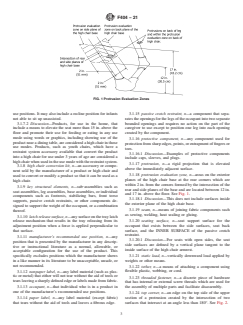
FIG. 1 Protrusion Evaluation Zones
use positions. It may also include a recline position for infants 3.1.15 passive crotch restraint, n—a component that sepa-
not able to sit up unassisted. rates the openings for the legs of the occupant into two separate
3.1.7.2 Discussion—Products, for use in the home, that bounded openings and requires no action on the part of the
include a means to elevate the seat more than 15 in. above the caregiver to use except to position one leg into each opening
floor and promote their use for feeding or eating in any use created by the component.
mode using words or graphics, including showing use of the
3.1.16 protective component, n—any component used for
product near a dining table, are considered a high chair in those
protection from sharp edges, points, or entrapment of fingers or
use modes. Products, such as youth chairs, which have a
toes.
restraint system accessory available that convert the product
3.1.16.1 Discussion—Examples of protective components
into a high chair for use under 3 years of age are considered a
include caps, sleeves, and plugs.
high chair when used in the use mode with the restraint system.
3.1.17 protrusion, n—a rigid projection that is elevated
3.1.8 high chair conversion kit, n—an accessory or compo-
above the immediately adjacent surface.
nent sold by the manufacturer of a product or high chair and
3.1.18 protrusion evaluation zone, n—areas on the exterior
used to convert or modify a product so that it can be used as a
planes of the high chair base at the rear corners which are
high chair.
within 2 in. from the corners formed by the intersection of the
3.1.9 key structural elements, n—sub{assemblies such as
rear and side planes of the base and are located between 12 in.
seat assemblies, leg assemblies, base assemblies, or individual
and 17 in. above the floor. See Fig. 1.
components such as footrests, stabilizing bars, front torso
3.1.18.1 Discussion—This does not include surfaces inside
supports, passive crotch restraints, or other components de-
the exterior plane of the high chair base.
signed to support the weight of the occupant, or a combination
3.1.19 seam, n—means of joining fabric components such
thereof.
as sewing, welding, heat sealing or gluing.
3.1.10 latch release surface, n—any surface on the tray latch
3.1.20 seating surface, n—seat support surface for the
release mechanism that results in the tray releasing from its
occupant that exists between the side surfaces, seat back
adjustment position when a force is applied perpendicular to
surface, and the INNER SURFACE of the passive crotch
that surface.
restraint.
3.1.11 manufacturer’s recommended use position, n—any
3.1.20.1 Discussion—For seats with open sides, the seat
position that is presented by the manufacturer in any descrip-
side surfaces are defined by a vertical plane tangent to the
tive or instructional literature as a normal, allowable, or
inside surface of the high chair armrest.
acceptable configuration for the use of the product. This
3.1.21 static load, n—vertically downward load applied by
specifically excludes positions which the manufacturer shows
in a like manner in its literature to be unacceptable, unsafe, or weights or other means.
not recommended.
3.1.22 tether, n—a means of attaching a component using
3.1.12 nonpaper label, n—any label material (such as plas- flexible plastic, webbing, or cord.
tic or metal) that either will not tear without the aid of tools or
3.1.23 threaded fastener, n—a discrete piece of hardware
tears leaving a sharply defined edge or labels made from fabric.
that has internal or external screw threads which are used for
the assembly of multiple parts and facilitate disassembly.
3.1.13 occupant, n—that individual who is in a product in
one of the manufacturer’s recommended use positions.
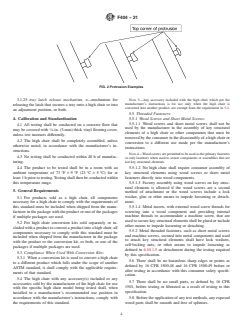
3.1.24 top corner, n—an edge on the top side of the upper
3.1.14 paper label, n—any label material (except fabric) section of a protrusion created by the intersection of two
that tears without the aid of tools and leaves a fibrous edge. surfaces that intersect at an angle less than 180°. See Fig. 2.
F404 − 21
FIG. 2 Protrusion Examples
NOTE 3—Any accessory included with the high chair which per the
3.1.25 tray latch release mechanism, n—mechanism for
manufacturer’s instructions is for use only when the high chair is
releasing the latch that secures a tray onto a high chair or into
converted into another product, are exempt from the requirement in 5.4.
an adjustment position, or both.
5.5 Threaded Fasteners:
4. Calibration and Standardization
5.5.1 Wood Screws and Sheet Metal Screws:
5.5.1.1 Wood screws and sheet metal screws shall not be
4.1 All testing shall be conducted on a concrete floor that
used by the manufacturer in the assembly of key structural
may be covered with ⁄8-in. (3-mm) thick vinyl flooring cover,
elements of a high chair or other components that must be
unless test instructs differently.
removed by the consumer in the disassembly of a high chair or
4.2 The high chair shall be completely assembled, unless
conversion to a different use mode per the manufacturer’s
otherwise noted, in accordance with the manufacturer’s in-
instructions.
structions.
NOTE 4—Wood screws are permitted to be used as the primary fasteners
4.3 No testing shall be conducted within 48 h of manufac-
or only fasteners when used to secure components or assemblies that are
turing.
not key structural elements.
4.4 The product to be tested shall be in a room with an 5.5.1.2 No high chair shall require consumer assembly of
ambient temperature of 73 °F 6 9 °F (23 °C 6 5 °C) for at
key structural elements using wood screws or sheet metal
least 1 h prior to testing. Testing shall then be conducted within
fasteners directly into wood components.
this temperature range.
5.5.1.3 Factory assembly using wood screws on key struc-
tural elements is allowed if the wood screws are a second
5. General Requirements
method of attachment or the wood screws include a lock
washer, glue or other means to impede loosening or detach-
5.1 For products sold as a high chair, all components
ment.
necessary for a high chair to comply with the requirements of
5.5.1.4 Metal inserts, with external wood screw threads for
this standard must be included when shipped from the manu-
screwing into a wood component and providing internal
facturer in the package with the product or one of the packages
machine threads to accommodate a machine screw, that are
if multiple packages are used.
used to secure key structural elements shall be glued or include
5.2 For high chair conversion kits sold separately or in-
other means to impede loosening or detaching.
cluded with a product to convert a product into a high chair, all
5.5.2 Metal threaded fasteners, such as sheet metal screws
components necessary to comply with this standard must be
and machine screws, secured into metal components and used
included when shipped from the manufacturer in the package
to attach key structural elements shall have lock washers,
with the product or the conversion kit, or both, or one of the
self{locking nuts, or other means to impede loosening as
packages if multiple packages are used.
defined in 6.10.1.5 or detachment during the testing required
5.3 Compliance When Used With Conversion Kits:
by this specification.
5.3.1 When a conversion kit is used to convert a high chair
5.6 There shall be no hazardous sharp edges or points as
to a different product which falls under the scope of another
defined by 16 CFR 1500.48 and 16 CFR 1500.49 before or
ASTM standard, it shall comply with the applicable require-
after testing in accordance with this consumer safety specifi-
ments of that standard.
cation.
5.4 The high chair with any accessory(s) included or any
5.7 There shall be no small parts, as defined by 16 CFR
accessories sold by the manufacturer of the high chair for use
1501, before testing or liberated as a result of testing to this
with the specific high chair model being tested shall, when
specification.
installed in a manufacturer’s recommended use position in
accordance with the manufacturer’s instructions, comply with 5.8 Before the application of any test methods, any exposed
the requirements of this standard. wood parts shall be smooth and free of splinters.
F404 − 21
FIG. 3 Opening Example
5.9 Latching or Locking Mechanisms—Any unit that folds 5.11 Openings—Holes or slots that extend entirely through
shall have a latching or locking device or other provision in a a wall section of any rigid material less than 0.375 in.
design that will prevent the unit from unintentionally folding (9.53 mm) thick and admit a 0.210-in. (5.33-mm) diameter rod
when properly placed in the manufacturer’s recommended use
shall also admit a 0.375-in. (9.53-mm) diameter rod. Holes or
position. During and upon completion of the testing in accor-
slots that are between 0.210 in. and 0.375 in. (5.33 mm and
dance with 7.1, the unit shall remain in its manufacturer’s
9.53 mm) in diameter and have a wall thickness less than 0.375
recommended use position. If a unit is designed with a latching
in. (9.53 mm), but are limited in depth to 0.375 in. (9.53 mm)
or locking device, that device shall remain engaged and
maximum by another rigid surface shall be permissible (see
operative after testing.
Fig. 3). The product shall be evaluated in all manufacturer’s
recommended use positions.
5.10 Labeling:
5.10.1 Warning labels, whether paper or non{paper, shall be
5.12 Toys—Toy accessories attached to, removable from, or
permanent when tested per 7.9.1 – 7.9.3.
sold with a high chair or high chair accessory, as well as their
5.10.2 Warning statements applied directly onto the surface
means of attachment, shall comply with the applicable require-
of the product by hot stamping, heat transfer, printing, wood
ments of Consumer Safety Specification F963.
burning, etc. shall be permanent when tested per 7.9.4.
5.13 All paints and surface coatings on the product shall
5.10.3 Non{paper labels shall not liberate small parts when
tested in accordance with 7.9.5. comply with 16 CFR 1303.
F404 − 21
5.14 Product must comply with the applicable requirements the CAMI dummy when tested in accordance with 7.7.3 in the
of the Consumer Product Safety Improvement Act (CPSIA). forward, rearward, and sideways directions.
6.6 Exposed Coil Springs—Any exposed coil spring which
6. Performance Requirements
is accessible to the occupant, having or capable of generating
NOTE 5—The loading in this section may be simplified by the use of a
a space between coils of 0.210 in. (5.3 mm) or greater during
simple test frame that will permit the loads to be applied by dead weights
static load testing in accordance with 7.6 shall be covered or
operating over a ball bearing pulley through a rope. Vertical force tests are
otherwise designed to prevent injury from entrapment.
greatly aided with the use of an overhead pulley.
6.7 Scissoring, Shearing, and Pinching—The high chair,
6.1 Protective Components—If the child can grasp protec-
when in the manufacturer’s recommended use position(s), shall
tive components between the thumb and forefinger, or teeth, or
be designed and constructed so as to prevent injury to the
if there is at least a 0.04-in. (1.0-mm) gap between the
occupant from any scissoring, shearing, or pinching when
component and its adjacent parent component, such component
members or components rotate about a common axis or
shall not be removed when tested in accordance with 7.2. All
fastening point, slide, pivot, fold, or otherwise move relative to
protective components that are accessible to a child sitting in
one another. Scissoring, shearing, or pinching that may cause
the high chair or accessible to a child from any position around
injury exists when the edges of the rigid parts admit a probe
the high chair shall be evaluated.
greater than 0.210 in. (5.33 mm) and less than 0.375 in.
6.2 Removable Tray or Front Torso Support Performance
(9.53 mm) in diameter at any accessible point throughout the
Integrity—All removable trays and front torso supports shall
range of motion of such parts.
remain functional with respect to the chair and exhibit no sharp
NOTE 6—The requirement for scissoring, shearing, and pinching in 6.7
points, sharp edges, or small parts when subjected to a drop test
above does not apply to components of the high chair that either (1) can
in accordance with 7.3. A tray or front torso support is
be adjusted, installed, or removed by the caregiver while the occupant is
considered removable if it can be removed from the high chair
in the high chair or (2) do not move relative to one another when the high
without the use of tools (for example, screw driver or wrench).
chair is in the manufacturer’s recommended use position(s).
6.3 Tray or Front Torso Support Performance – Pull Test—
6.8 Restraint System:
The tray or front torso support shall not become disengaged or
6.8.1 A restraint system shall be provided to secure a child
dislocated from its original adjustment position, when tested in
in the seated position in any of the manufacturer’s recom-
accordance with 7.4 and 7.5. Components that do not function
mended use positions.
as a front torso support such as trays, tray inserts, or snack trays
6.8.1.1 The restraint system shall include both waist and
are exempt from this requirement.
crotch restraint designed such that the crotch restraint’s use is
mandatory when the restraint system is in use.
6.4 Static Load—A chair shall support static loads without
6.8.2 The restraint system and its closing means (for
causing any hazardous conditions as identified within this
example, buckle) shall not break, separate, or permit removal
consumer safety specification. Tests shall be conducted in
of the CAMI test dummy from the high chair when tested in
accordance with 7.6.
accordance with 7.8.
6.5 Stability:
6.8.2.1 If during test in 7.8.5.1, the posterior of the test
6.5.1 High chairs and high chair accessories that have
dummy is pulled past the front edge of the seat, the dummy
adjustment positions that, per the manufacturer’s instructions,
shall be considered removed.
are recommended for use only for children able to sit upright
6.8.2.2 If during test in 7.8.5.3, the dummy with the force
unassisted (approximately 6 months of age) or weighing more
applied reaches a vertical position with the bottom of its feet
than 20 lb (9.1 kg) shall comply with 6.5.1.1 to 6.5.1.3 in all
touching or off the seat, the dummy shall be considered
those manufacturer’s recommended use and adjustment posi-
removed.
tions.
6.8.3 The waist restraint shall be capable of adjustment with
6.5.1.1 Forward and Sideways Stability—A high chair shall
a positive, self-locking mechanism that is capable, when
not tip over when setup as defined in 7.7.2.1 – 7.7.2.4, and then
locked, of withstanding the forces of tests in 7.8 without
tested in accordance with 7.7.2.5 and 7.7.2.6.
allowing restraint movement or slippage of more than 1 in.
6.5.1.2 Rearward Stability—When setup as defined in
(25.4 mm).
7.7.2.1 – 7.7.2.4, and then tested in accordance with 7.7.2.7,
6.8.4 A connecting means and adjustment means for the
the high chair shall have a Rearward Stability Index of 50 or
waist restraint shall be capable of usage independent of one
more.
another. The connecting means shall not be an adjustment
6.5.1.3 Stability with Child Climbing into Chair—A high means but may have one integrally attached to it.
chair shall not tip over when tested in accordance with 7.7.4.
6.8.5 The restraint system anchorages shall not separate
6.5.2 High chairs and high chair accessories that have from their attachment points when tested in accordance with
7.8.6.
adjustment positions that are manufacturer’s recommended use
positions for use with children who are unable to sit upright 6.8.6 Before shipment, the restraint system should be com-
unassisted (birth to approximately 6 months of age) or weigh pletely attached to the high chair in the location for use in at
20 lb (9.1 kg) or less, when adjusted into the most onerous least one of the manufacturer’s recommended use position(s)
manufacturer’s recommended use and/or adjustment position and in such a manner as to not become detached through
for each direction to be tested, shall not tip over and shall retain normal use.
F404 − 21
6.9 Completely bounded openings forward of the occupant 6.10 Structural Integrity:
shall comply with 6.9.1 and 6.9.2.
6.10.1 During and upon completion of the testing in accor-
6.9.1 Completely Bounded Leg Openings forward of the
dance with 7.10, the high chair shall comply with all of the
occupant that include a Passive Crotch Restraint:
following:
6.9.1.1 High chairs that have completely bounded leg open-
6.10.1.1 The high chair shall not exhibit an instantaneous
ings forward of the occupant in any position shall also have a
change in the height of the occupant seating surface above the
passive crotch restraint which complies with 6.9.1.2, 6.9.1.3,
floor of more than 3 in. (75 mm) during one cycle of the weight
and 6.9.1.4 in all such positions.
drop. During and after a change in the height of the seating
6.9.1.2 There shall be no vertical gap between the passive
surface, the high chair must comply with the requirements for
crotch restraint and either the tray, front torso support, or
openings as defined in 6.6 and scissoring, shearing, and
seating surface that allows free passage of a 1.5-in. (38-mm)
pinching as defined in 6.7.
diameter by 3-in. (76-mm) long rod from one leg opening to
6.10.1.2 There shall be no breakage of any structural com-
the other.
ponent.
6.9.1.3 Adjust the seat back to the most upright position and
6.10.1.3 Latching or locking devices which prevent folding
the passive crotch restraint to the position furthest from the seat
of the high chair shall remain engaged.
back. The distance between the front surface of the noncom-
6.10.1.4 The angle of the occupant seating surface relative
pressed seat back and the passive crotch restraint shall be less
to the floor shall not change more than 10°.
than 8.5 in. (216 mm) when measured horizontally 2.0 in.
6.10.1.5 After testing in accordance with the procedure in
(50 mm) above the lowest point on the noncompressed seating
7.10, threaded fasteners that are used for key structural
surface.
elements shall not have separated by more than 0.04 in. (1.00
6.9.1.4 The leg openings on each side of the passive crotch
mm) upon completion of testing.
restraint shall not allow complete passage of the wedge block
when tested in accordance with 7.11.
6.11 Tray Latch Release Mechanisms:
NOTE 7—A passive crotch restraint does not meet the restraint system
6.11.1 High chairs that have completely bounded leg open-
requirement of 6.8.1.1, which requires a crotch restraint as part of the
ings in front of the occupant, on each side of a passive crotch
restraint system.
restraint, when the tray is removed are exempt from the
6.9.1.5 A passive crotch restraint, except a flexible passive
following tray latch release mechanism requirements.
crotch restraint addressed in 6.9.1.5(1) or a passive crotch
6.11.2 Tray latch release mechanisms located on the front of
restraint per 6.9.1.5(2), shall be permanently attached to the
the tray or forward of the occupant shall comply with 6.11.2.1
high chair or tray before shipment such that it cannot be
or 6.11.2.2 or 6.11.2.3. Tray latch release mechanisms which
removed without the use of a tool. Permanent attachment
only allow for a change in adjustment position of the tray and
requires either attachment in a manufacturer’s recommended
do not allow the tray to be detached from any attachment point
use position or attachment to the high chair or tray, including
to the high chair and trays on high chairs with a front torso
attachment by a tether, in a manufacturer’s recommended use
support are exempt from the requirements in this section.
position, that requires some repositioning or final assembly, or
6.11.2.1 Latch release surfaces on a tray latch release
both, by the end user, and the assembly can be completed
mechanism shall be inaccessible by the foot of the occupant as
without removal of the tether. In the case of a tether, the total
defined in Item 1 (below) or comply with Item 2.
exposed length of flexible material when measured in accor-
(1) The bottom surface of the leg/foot probe assembly, Fig.
dance with 7.15 shall be less than 7.4 in. (188 mm).
4, shall not contact any latch release surface on the tray latch
(1) A flexible passive crotch restraint shall be permanently
release mechanism when tested per 7.12.1.
attached to the high chair in the manufacturer’s recommended
(2) If a latch release surface is contactable by the bottom of
use position such that it cannot be removed without the use of
the foot on the leg/foot probe assembly, the angle between
a tool.
Plane “A” on the foot and Plane “B” at the lower end of the leg
(2) A passive crotch restraint that comes with a high chair
when tested per 7.12.2 shall be 30° or greater (see Fig. 5).
or sold separately as an accessory shall be exempt from the
6.11.2.2 The direction to actuate the tray latch release
assembly requirements in 6.9.1.5 if the tray and passive crotch
mechanism must push toward the occupant.
restraint comply with both 6.9.1.5(2)(a) and 6.9.1.5(2)(b).
6.11.2.3 The tray latch release mechanism is a double action
(a) The passive crotch must be assembled to the chair in
release system.
order to attach a tray to the high chair.
6.11.3 Tray latch release mechanisms located at the side of
(b) The passive crotch restraint must be assembled to the
high chair for the passive crotch restraint and tray to create a tray shall comply with 6.11.3.1, 6.11.3.2, 6.11.3.3, or
6.11.3.4.
completely bounded openings forward of the occupant.
6.9.2 Completely bounded openings forward of the occu-
6.11.3.1 For single action tray latch release mechanisms, the
pant that do not include a passive crotch restraint:
tray shall not become detached from the high chair in any
6.9.2.1 Completely bounded openings between the tray and latching position when tested in accordance with 7.13. A
other structural elements that are located forward of the change in the adjustment position of the tray is allowed
occupant shall not allow complete passage of the wedge block provided that the tray cannot be detached from either side of
when tested in accordance with 7.11. the high chair.
F404 − 21
NOTE 1—Leg/Foot Size Rationale:
Foot Breadth = 1.5 in. (37 mm) (6 to 8 month 95th percentile)
Foot Length = 5.5 in. (140 mm) (20 to 23 month 95th percentile)
Foot Height = 0.39 in. (10 mm)
Leg Length A (Rump to Sole) = 10.1 in. (257 mm) (6 to 8 month 5th percentile)
Leg Length B (Rump to Sole) = 17.9 in. (455 mm) (20 to 23 month 95th percentile)
Ankle Breadth = 1.22 in. (31 mm) (8 month 5th percentile – tube diameter)
NOTE 2—Foot dimensions are very close to the probe used in EN1930 (Template for Footholds) 1.4 by 4.7 by 0.39 in. (35 by 120 by 10 mm).
FIG. 4 Leg/Foot Probe
FIG. 5 30° Angle Block
F404 − 21
6.11.3.2 Each tray latch release mechanism shall be a
double action release system. For purposes of this requirement,
each tray latch release mechanism is to be considered indepen-
dently.
6.11.3.3 Two or more tray latch release mechanisms are
interdependent such that the tray cannot be fully released from
either side of the high chair without actuating at least two tray
latch release mechanisms. The interconnection must require
either two consecutive actions, the first of which must be
maintained while the second is carried out or two separate and
independent actions that must be carried out simultaneously to
fully release the tray. An attempt to actuate any one of the tray
latch release mechanisms independently shall not allow either
side of the tray to fully release from the high chair.
6.11.3.4 Tray latch release mechanism shall not be visible to
the occupant and the direction of release mechanism must be
no less than 85° from the direction of tray release or removal.
FIG. 6 Ring Gauge
Visibility is to be determined when the seat is in the upright
position and tray is in any manufacturer’s use position. A tray
latch release mechanism is considered not visible to the
occupant if the latch is flush to or recessed back from the plane
perpendicular to the outer edge of the tray in the area of the tray
latch release mechanism.
6.12 Side Containment—Completely bounded openings in
the surfaces that act as the sides of the seating area that are
below the top surface of the tray and above the seat bottom
surface shall not allow complete passage of the wedge block
when tested in accordance with 7.14.
6.13 Protrusions—Each protrusion that is completely con-
tained within the protrusion evaluation zone and on a surface
that is angled out from the seating area between 20° and 30°
from the vertical when in one of the manufacturer’s recom-
mended use positions per 7.16 shall comply with either 6.13.1
or 6.13.2.
FIG. 7 Protrusion Accessibility Gauge
6.13.1 The protrusion shall not have an undercut below its
top surface (for example, rivets, latch tabs, tray storage hooks).
the location deemed the most likely to cause failure. Apply the
6.13.2 A protrusion with an undercut below its top surface
force gradually over a 5 s period and maintain for an additional
(for example, rivets, latch tabs, tray storage hooks) shall meet
10 s before releasing the force.
either 6.13.2.1 or 6.13.2.2.
7.1.4 Perform this procedure five times within a 2 min
6.13.2.1 The top corner of a protrusion shall not protrude
period.
farther than the thickness of the ring gauge (Fig. 6) when tested
per 7.16, 7.16.1, and 7.16.3. 7.2 Removal of Protective Components Test (see 6.1):
6.13.2.2 The top corner of a protrusion shall not be con- 7.2.1 Any protective component shall be tested in accor-
tactable by the protrusion accessibility gauge (Fig. 7) when dance with each of the following methods in the sequence
tested per 7.16, 7.16.2, and 7.16.3. listed.
7.2.2 Secure the high chair so that it cannot move during the
7. Test Methods performance of the following tests.
NOTE 8—All wood blocks are fabricated from 1 in. (25 mm) nominal 7.2.3 Torque Test—Apply a torque of 4 lbf·in. (0.5 N·m)
thickness lumber having a finished thickness of ⁄4 in. (19 mm) unless
gradually within a period of 5 s in a clockwise direction until
otherwise specified.
a rotation of 180° from the original position has been attained
7.1 Locking Mechanisms (see 5.9):
or 4 lbf·in. (0.5 N·m) has been reached. Maintain the torque or
7.1.1 Erect the high chair in accordance with the manufac- maximum rotation for an additional 10 s. Then remove the
turer’s instructions.
torque and permit the test components to return to a relaxed
7.1.2 Secure the chair so that the normal folding motion is condition. Then repeat this procedure in the counter clockwise
not impeded.
direction.
7.1.3 Apply a force of 45 lbf (200 N) to the high chair in the 7.2.4 Tension Test:
direction normally associated with folding the high chair. 7.2.4.1 Attach a force gauge to the protective component by
Apply the force on a 2 by 2-in. (50 by 50-mm) wood block at means of any suitable device. For components that cannot
F404 − 21
chairs without a front torso support, attach the tray to the high
chair and adjust into the manufacturer’s recommended use
position deemed most likely to fail. For high chairs with a front
torso support, attach the front torso support to the high chair
and adjust into the manufacturer’s recommended use position
deemed most likely to fail.
7.4.2.2 Attach a test device to the center front or back of the
tray or front torso support in such a manner that the force will
be exerted on a pad not exceeding 2 in. (51 mm) in any
direction. For high chairs with a front torso support, remove the
tray prior to performing this test. Other components such as
tray inserts, or snack trays, should be removed prior to
performing this test.
7.4.2.3 Gradually apply a horizontal force of 45 lbf (200 N)
to the tray or front torso support within a 5 s period and
maintain for an additional 10 s.
7.4.2.4 Repeat this procedure four more times for a total of
five applications in both front and rear directions for all
adjustable tray or front torso support positions.
7.4.3 Horizontal Pull Test (Sides):
7.4.3.1 Perform this test under the same conditions as in
7.4.2.1. Apply a horizontal force of 45 lbf (200 N) perpendicu-
FIG. 8 Tension Test Adapter/Clamp
lar to the center of a side of the tray or front torso support
within 5 s and maintain for an additional 10 s. The tray or front
reasonably be expected to be grasped between thumb and
torso support shall be placed in the manufacturer’s recom-
forefinger, or teeth, on their outer diameter but have a gap of mended use position deemed most likely to cause failure.
0.04 in. (1.0 mm) or more between the rear surface of the
7.4.3.2 Repeat this procedure four more times for a total of
component and the structural member of the high chair to
five applications on each side of the tray.
which they are attached, a clamp such as shown in Fig. 8 may
7.5 Tray or Front Torso Support Disengagement – Vertical
be a suitable device.
Pull Test (see 6.3)—Secure the chair in its normal standing
7.2.4.2 Be sure the attachment device does not compress or
position so that all legs have contact with the floor and so that
expand the component to hinder removal of the component.
it cannot move in the direction of force being applied. For high
7.2.4.3 Gradually apply a 15 lbf (67 N) force in the direction
chairs without a front torso support, attach the tray to the high
that would normally be associated with the removal of the
chair and adjust into the manufacturer’s recommended use
component. Apply the force within 5 s and maintain for an
position deemed most likely to fail. For high chairs with a front
additional 10 s.
torso support, attach the front torso support to the high chair
7.3 Tray or Front Torso Support – Drop Test (see
and adjust into the manufacturer’s recommended use position
6.2)—From a height of 36 in. (900 mm) measured from the
deemed most likely to fail. Other components that do not
center point of the tray or front torso support, drop any
function as a front torso support, such as trays, tray inserts, or
removable tray and any removable front torso support on vinyl
snack trays, should be removed prior to performing this test.
tile over concrete flooring once on each of four different
7.5.1 Vertical Pull Test (Rear):
surfaces, one surface of which shall include the attaching
7.5.1.1 Attach a test device to the rear center of the tray or
mechanism. Each removable tray and front torso support shall
front torso support in such a manner that the force will be
be tested separately and independently.
exerted on a pad not exceeding 2 in. (51 mm) in any direction.
7.5.1.2 Gradually apply a vertically upward force of 45 lbf
NOTE 9—For the purposes of this test only, the center point of the tray
or front torso support coincides with the center of the smallest rectangle (200 N) at the rear of the tray or front torso support within 5 s
that circumscribes the component in the plane of the component.
and maintain for an additional 10 s.
7.5.1.3 Repeat this procedure four more times for a total of
7.4 Tray or Front Torso Support Disengagement – Horizon-
five applications.
tal Pull Test (see 6.3):
7.4.1 Perform this test on either the tray of a high chair 7.5.2 Vertical Pull Test (Sides):
without a front torso support or on the front torso support of a 7.5.2.1 For high chairs without a front torso support, attach
high chair. If the tray or front torso support is required to be the tray to the high chair. For high chairs with a front torso
tested in accordance with 6.2, perform this test on a tray or support, attach the front torso support to the high chair. Attach
front torso support that has been tested in accordance with 7.3. a test device to the side of the tray or front torso support at the
7.4.2 Horizontal Pull Test (Front and Rear): center line of the locking mechanism, attachment point, or
7.4.2.1 Secure the chair in its normal standing position so centered between the two attachment points that are spaced the
that all legs have contact with the floor and so that it cannot farthest distance apart if more than one attachment point is
move in the direction of the force being applied. For high used to secure the tray or front torso support on the side being
F404 − 21
tested in such a manner that the force will be exerted on a pad (1) Secure the chair with the seat back in the most upright
not exceeding 2 in. (51 mm) in any direction. Other compo- position with all legs on the floor. If the tray is adjustable,
nents that do not function as a front torso support, such as trays, adjust it to the rear position, closest to the high chair seat back.
such as tray inserts, or snack trays, should be removed prior to (2) Place a 3-in. by 6-in. (75-mm by 150-mm) wood block
performing this test. at the center top surface of the tray.
(3) Gradually apply a static load of 50 lb (22.7 kg) on the
7.5.2.2 Gradually apply a vertically upward force of 45 lbf
wood block within a period of 5 s and maintain for an
(200 N) at the side of the tray or front torso support within 5 s
additional 60 s.
and maintain for an additional 10 s.
7.6.3.2 High chairs for use only with children weighing
7.5.2.3 Repeat this procedure four more times for a total of
five applications on each side of the tray or front torso support. 20 lb (9 kg) or less:
(1) Secure the chair with the seat back adjusted into the
7.6 Static Load Testing (see 6.4):
most upright position with all legs on the floor. If the tray is
7.6.1 Seat Static Load Test:
adjustable, adjust it to the rear position, closest to the high chair
7.6.1.1 High chairs that include use for children weighing
seat back.
more than 20 lb (9 kg).
(2) Place a 3-in. by 6-in. (75-mm by 150-mm) wood block
(1) Secure the chair with the seat back adjusted into the
at the center top surface of the tray.
most upright position with all legs on the floor.
(3) Gradually apply a static load of 25 lb (11.4 kg) on the
(2) Place a 6-in. by 6-in. (150-mm by 150-mm) wood block
wood block within a period of 5 s and maintain for an
on the center of the seat bottom surface.
additional 60 s.
(3) Gradually apply a static load of 100
...
This document is not an ASTM standard and is intended only to provide the user of an ASTM standard an indication of what changes have been made to the previous version. Because
it may not be technically possible to adequately depict all changes accurately, ASTM recommends that users consult prior editions as appropriate. In all cases only the current version
of the standard as published by ASTM is to be considered the official document.
Designation: F404 − 20 F404 − 21
Standard Consumer Safety Specification for
High Chairs
This standard is issued under the fixed designation F404; the number immediately following the designation indicates the year of original
adoption or, in the case of revision, the year of last revision. A number in parentheses indicates the year of last reapproval. A superscript
epsilon (´) indicates an editorial change since the last revision or reapproval.
INTRODUCTION
This consumer safety specification addresses high chair incidents that were identified by the U.S.
Consumer Product Safety Commission (CPSC).
CPSC identified injuries to children associated with tray disengagement, falls resulting when
children stood up on the seat of a high chair, entrapment between the tray and the seat, and tipover.
By far the most common injury resulted from children falling when they were able to stand up on the
seat of the high chair because they were not secured by the restrainingrestraint system. In response to
the incident data developed by the Commission, this consumer safety performance specification
attempts to minimize the above listed problems.
This consumer safety performance specification does not cover high chairs that are either blatantly
misused or are used in a careless manner that disregards the warnings and safety instructions that are
provided with each high chair.
This consumer safety performance specification is written within the current state-of-the-art of high
chair technology. It is intended that this specification will be updated whenever substantive
information becomes available that necessitates additional requirements or justifies the revision of
existing requirements.
1. Scope
1.1 This consumer safety specification covers the performance requirements and methods of test to ensure the satisfactory
performance of the high chair and high chairs created by using a high chair conversion kit and component(s) from another product.
1.2 This consumer safety specification is intended to minimize injuries to children resulting from normal usage and reasonably
foreseeable misuse or abuse of high chairs.
NOTE 1—This consumer safety specification is not intended to address accidents and injuries resulting from the interaction of older children with children
in the high chair or the accidents resulting from abuse and misuse by persons over three years of age.
1.3 No high chair or high chair conversion kit produced after the approval date of this consumer safety specification shall, either
by label or other means, indicate compliance with this specification unless it conforms to all requirements contained herein.
1.4 The values stated in inch-pound units are to be regarded as standard. The values given in parentheses are mathematical
conversions to SI units that are provided for information only and are not considered standard.
This consumer safety specification is under the jurisdiction of ASTM Committee F15 on Consumer Products and is the direct responsibility of Subcommittee F15.16
on Highchairs, Hook-On Chairs and Expandable Gates.
Current edition approved Oct. 1, 2020Nov. 15, 2021. Published December 2020January 2022. Originally approved in 1975. Last previous edition approved in 20182020
as F404 – 18a.F404 – 20. DOI: 10.1520/F0404-20.10.1520/F0404-21.
Copyright © ASTM International, 100 Barr Harbor Drive, PO Box C700, West Conshohocken, PA 19428-2959. United States
F404 − 21
1.5 The following precautionary caveat pertains only to the test methods portion, Section 7, of this specification: This standard
does not purport to address all of the safety concerns, if any, associated with its use. It is the responsibility of the user of this
standard to establish appropriate safety, health, and environmental practices and determine the applicability of regulatory
limitations prior to use.
NOTE 2—This consumer safety specification includes the following sections:
Title Section
Scope 1
Referenced Documents 2
Terminology 3
Calibration and Standardization 4
General Requirements 5
Compliance When Used With 5.3
Conversion Kits
Threaded Fasteners 5.5
Latching or Locking Mechanisms 5.9
Labeling 5.10
Openings 5.11
Toys 5.12
Performance Requirements 6
Protective Components 6.1
Removable Tray or Front Torso Support 6.2
Performance Integrity
Tray or Front Torso Support Performance – 6.3
Pull Test
Static Load 6.4
Stability 6.5
Exposed Coil Springs 6.6
Scissoring, Shearing, and Pinching 6.7
Restraint System 6.8
Passive Crotch Restraint System 6.9
Structural Integrity 6.10
Tray Latch Release Mechanisms 6.11
Side Containment 6.12
Protrusions 6.13
Test Methods 7
Locking Mechanisms 7.1
Protective Components 7.2
Tray or Front Torso Support – Drop Test 7.3
Tray or Front Torso Support Disengagement – 7.4
Horizontal Pull Test
Tray or Front Torso Support Disengagement – 7.5
Vertical Pull Test
Static Load Testing 7.6
Stability Testing 7.7
Restraint System Retention Test 7.8
Permanency of Labels and Warnings 7.9
Dynamic High Chair Test 7.10
Completely Bounded Openings 7.11
Tray Latch Release Mechanism – Accessibility 7.12
Side Containment Openings 7.14
Marking and Labeling 8
Instructional Literature 9
Keywords 10
Rationale Appendix X1
1.6 This international standard was developed in accordance with internationally recognized principles on standardization
established in the Decision on Principles for the Development of International Standards, Guides and Recommendations issued
by the World Trade Organization Technical Barriers to Trade (TBT) Committee.
2. Referenced Documents
2.1 ASTM Standards:
D3359 Test Methods for Rating Adhesion by Tape Test
F406 Consumer Safety Specification for Non-Full-Size Baby Cribs/Play Yards
F833 Consumer Safety Performance Specification for Carriages and Strollers
For referenced ASTM standards, visit the ASTM website, www.astm.org, or contact ASTM Customer Service at service@astm.org. For Annual Book of ASTM Standards
volume information, refer to the standard’s Document Summary page on the ASTM website.
F404 − 21
F963 Consumer Safety Specification for Toy Safety
2.2 Federal Regulations:
16 CFR Part 1227 Safety Standard for Carriages and Strollers
16 CFR 1303 Ban of Lead-Containing Paint and Certain Consumer Products Bearing Lead-Containing Paint
16 CFR 1500 Hazardous Substances Act Regulations Including Sections:
16 CFR 1500.48 Technical Requirements for Determining a Sharp Point in Toys or Other Articles Intended for Use by Children
Under Eight Years of Age
16 CFR 1500.49 Technical Requirements for Determining a Sharp Metal or Glass Edge in Toys or Other Articles Intended for
Use by Children Under Eight Years of Age
16 CFR 1501 Method for Identifying Toys and Other Articles Intended for Use by Children Under Three Years of Age Which
Present Choking, Aspiration, or Ingestion Hazards Because of Small Parts
2.3 ANSI Standards:
ANSI Z535.1 Safety Colors
ANSI Z535.4 Product Safety Signs and Labels
ANSI Z535.6 Product Safety Information in Product Manuals, Instructions, and Other Collateral Materials
2.4 Other References:
CAMI Infant Dummy Mark II 17.5 lb (7.9 kg)
CAMI Newborn Dummy 7.5 lb (3.4 kg)
3. Terminology
3.1 Definitions of Terms Specific to This Standard:
3.1.1 accessory, n—component, included with a high chair or sold separately by the manufacturer of the high chair.
3.1.2 conspicuous, adj—visible, when the high chair is in all manufacturer’s recommended use positions and an occupant is sitting
in the high chair, to a person standing near the high chair at any one position around the high chair but not necessarily visible from
all positions.
3.1.3 double action release system, n—a mechanism requiring either two consecutive actions, the first of which must be
maintained while the second is carried out, or two separate and independent simultaneous actions to fully release.
3.1.4 fabric, n—any woven, knit, coated, laminated, extruded, or calendared flexible material which is intended to be sewn,
welded, heat sealed, or glued together as an assembly.
3.1.5 flexible passive crotch restraint, n—a passive crotch restraint made of flexible material, such as fabric or webbing.
3.1.6 front torso support, n—a barrier extending horizontally across the seat of the high chair that is the primary support intended
to restrict forward movement of the occupant’s torso when the tray is removed and creates a completely or partially bounded
opening in front of the occupant.
3.1.7 high chair, n—a free-standing chair for a child up to 3 years of age which has a seating surface more than 15 in. (38.1 cm)
above the floor and elevates the child normally for the purposes of feeding or eating.
3.1.7.1 Discussion—
A high chair may be sold with or without a tray and may be height adjustable to higher or lower use positions. It may also include
a recline position for infants not able to sit up unassisted.
3.1.7.2 Discussion—
Products, for use in the home, that include a means to elevate the seat more than 15 in. above the floor and promote their use for
feeding or eating in any use mode using words or graphics, including showing use of the product near a dining table, are considered
Available from U.S. Government Printing Office Superintendent of Documents, 732 N. Capitol St., NW, Mail Stop: SDE, Washington, DC 20401.
Available from American National Standards Institute (ANSI), 25 W. 43rd St., 4th Floor, New York, NY 10036, http://www.ansi.org.
Available from Department of Transportation Memorandum Report AAC-119-74-14, Revision II, Drawing No. SA-1001 by Richard Chandler, July 2, 1974. Federal
Aviation Administration, Civil Aeromedical Institute, Protection and Survival Laboratory, Aeromedical Center, Oklahoma City, OK 73125.
Drawing numbers 126-0000 through 126-0015 (sheets 1 through 3), 126-0017 through 126-0027, a parts list entitled “Parts List for CAMI Newborn Dummy,” and a
construction manual entitled, “Construction of the Newborn Infant Dummy” (July 1992). Copies of the materials may be inspected at NHTSA’s Docket Section 400 Seventh
Street, SW, Room 5109, Washington, DC, or at the Office of the Federal Register, 800 North Capitol Street, NW, Suite 700, Washington, DC.
F404 − 21
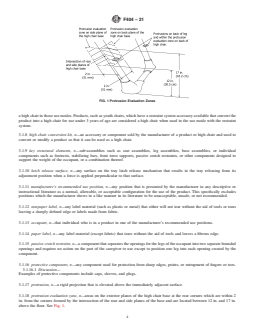
FIG. 1 Protrusion Evaluation Zones
a high chair in those use modes. Products, such as youth chairs, which have a restraint system accessory available that convert the
product into a high chair for use under 3 years of age are considered a high chair when used in the use mode with the restraint
system.
3.1.8 high chair conversion kit, n—an accessory or component sold by the manufacturer of a product or high chair and used to
convert or modify a product so that it can be used as a high chair.
3.1.9 key structural elements, n—sub{assemblies such as seat assemblies, leg assemblies, base assemblies, or individual
components such as footrests, stabilizing bars, front torso supports, passive crotch restraints, or other components designed to
support the weight of the occupant, or a combination thereof.
3.1.10 latch release surface, n—any surface on the tray latch release mechanism that results in the tray releasing from its
adjustment position when a force is applied perpendicular to that surface.
3.1.11 manufacturer’s recommended use position, n—any position that is presented by the manufacturer in any descriptive or
instructional literature as a normal, allowable, or acceptable configuration for the use of the product. This specifically excludes
positions which the manufacturer shows in a like manner in its literature to be unacceptable, unsafe, or not recommended.
3.1.12 nonpaper label, n—any label material (such as plastic or metal) that either will not tear without the aid of tools or tears
leaving a sharply defined edge or labels made from fabric.
3.1.13 occupant, n—that individual who is in a product in one of the manufacturer’s recommended use positions.
3.1.14 paper label, n—any label material (except fabric) that tears without the aid of tools and leaves a fibrous edge.
3.1.15 passive crotch restraint, n—a component that separates the openings for the legs of the occupant into two separate bounded
openings and requires no action on the part of the caregiver to use except to position one leg into each opening created by the
component.
3.1.16 protective component, n—any component used for protection from sharp edges, points, or entrapment of fingers or toes.
3.1.16.1 Discussion—
Examples of protective components include caps, sleeves, and plugs.
3.1.17 protrusion, n—a rigid projection that is elevated above the immediately adjacent surface.
3.1.18 protrusion evaluation zone, n—areas on the exterior planes of the high chair base at the rear corners which are within 2
in. from the corners formed by the intersection of the rear and side planes of the base and are located between 12 in. and 17 in.
above the floor. See Fig. 1.
F404 − 21
FIG. 2 Protrusion Examples
3.1.18.1 Discussion—
This does not include surfaces inside the exterior plane of the high chair base.
3.1.19 seam, n—means of joining fabric components such as sewing, welding, heat sealing or gluing.
3.1.20 seating surface, n—seat support surface for the occupant that exists between the side surfaces, seat back surface, and the
INNER SURFACE of the passive crotch restraint.
3.1.20.1 Discussion—
For seats with open sides, the seat side surfaces are defined by a vertical plane tangent to the inside surface of the high chair
armrest.
3.1.21 static load, n—vertically downward load applied by weights or other means.
3.1.22 tether, n—a means of attaching a component using flexible plastic, webbing, or cord.
3.1.23 threaded fastener, n—a discrete piece of hardware that has internal or external screw threads which are used for the
assembly of multiple parts and facilitate disassembly.
3.1.24 top corner, n—an edge on the top side of the upper section of a protrusion created by the intersection of two surfaces that
intersect at an angle less than 180°. See Fig. 2.
3.1.25 tray latch release mechanism, n—mechanism for releasing the latch that secures a tray onto a high chair or into an
adjustment position, or both.
4. Calibration and Standardization
4.1 All testing shall be conducted on a concrete floor that may be covered with ⁄8-in. (3-mm) thick vinyl flooring cover, unless
test instructs differently.
4.2 The high chair shall be completely assembled, unless otherwise noted, in accordance with the manufacturer’s instructions.
4.3 No testing shall be conducted within 48 h of manufacturing.
4.4 The product to be tested shall be in a room with an ambient temperature of 73 °F 6 9 °F (23 °C 6 5 °C) for at least 1 h prior
to testing. Testing shall then be conducted within this temperature range.
5. General Requirements
5.1 For products sold as a high chair, all components necessary for a high chair to comply with the requirements of this standard
must be included when shipped from the manufacturer in the package with the product or one of the packages if multiple packages
are used.
F404 − 21
5.2 For high chair conversion kits sold separately or included with a product to convert a product into a high chair, all components
necessary to comply with this standard must be included when shipped from the manufacturer in the package with the product or
the conversion kit, or both, or one of the packages if multiple packages are used.
5.3 Compliance When Used With Conversion Kits:
5.3.1 When a conversion kit is used to convert a high chair to a different product which falls under the scope of another ASTM
standard, it shall comply with the applicable requirements of that standard.
5.4 The high chair with any accessory(s) included or any accessories sold by the manufacturer of the high chair for use with the
specific high chair model being tested shall, when installed in a manufacturer’s recommended use position in accordance with the
manufacturer’s instructions, comply with the requirements of this standard.
NOTE 3—Any accessory included with the high chair which per the manufacturer’s instructions is for use only when the high chair is converted into
another product, are exempt from the requirement in 5.4.
5.5 Threaded Fasteners:
5.5.1 Wood Screws and Sheet Metal Screws:
5.5.1.1 Wood screws and sheet metal screws shall not be used by the manufacturer in the assembly of key structural elements of
a high chair or other components that must be removed by the consumer in the disassembly of a high chair or conversion to a
different use mode per the manufacturer’s instructions.
NOTE 4—Wood screws are permitted to be used as the primary fasteners or only fasteners when used to secure components or assemblies that are not
key structural elements.
5.5.1.2 No high chair shall require consumer assembly of key structural elements using wood screws or sheet metal fasteners
directly into wood components.
5.5.1.3 Factory assembly using wood screws on key structural elements is allowed if the wood screws are a second method of
attachment or the wood screws include a lock washer, glue or other means to impede loosening or detachment.
5.5.1.4 Metal inserts, with external wood screw threads for screwing into a wood component and providing internal machine
threads to accommodate a machine screw, that are used to secure key structural elements shall be glued or include other means
to impede loosening or detaching.
5.5.2 Metal threaded fasteners, such as sheet metal screws and machine screws, secured into metal components and used to attach
key structural elements shall have lock washers, self{locking nuts, or other means to impede loosening as defined in 6.10.1.5 or
detachment during the testing required by this specification.
5.6 There shall be no hazardous sharp edges or points as defined by 16 CFR 1500.48 and 16 CFR 1500.49 before or after testing
in accordance with this consumer safety specification.
5.7 There shall be no small parts, as defined by 16 CFR 1501, before testing or liberated as a result of testing to this specification.
5.8 Before the application of any test methods, any exposed wood parts shall be smooth and free of splinters.
5.9 Latching or Locking Mechanisms—Any unit that folds shall have a latching or locking device or other provision in a design
that will prevent the unit from unintentionally folding when properly placed in the manufacturer’s recommended use position.
During and upon completion of the testing in accordance with 7.1, the unit shall remain in its manufacturer’s recommended use
position. If a unit is designed with a latching or locking device, that device shall remain engaged and operative after testing.
5.10 Labeling:
F404 − 21
FIG. 3 Opening Example
5.10.1 Warning labels, whether paper or non{paper, shall be permanent when tested per 7.9.1 – 7.9.3.
5.10.2 Warning statements applied directly onto the surface of the product by hot stamping, heat transfer, printing, wood burning,
etc. shall be permanent when tested per 7.9.4.
5.10.3 Non{paper labels shall not liberate small parts when tested in accordance with 7.9.5.
5.11 Openings—Holes or slots that extend entirely through a wall section of any rigid material less than 0.375 in. (9.53 mm) thick
and admit a 0.210-in. (5.33-mm) diameter rod shall also admit a 0.375-in. (9.53-mm) diameter rod. Holes or slots that are between
0.210 in. and 0.375 in. (5.33 mm and 9.53 mm) in diameter and have a wall thickness less than 0.375 in. (9.53 mm), but are limited
in depth to 0.375 in. (9.53 mm) maximum by another rigid surface shall be permissible (see Fig. 3). The product shall be evaluated
in all manufacturer’s recommended use positions.
5.12 Toys—Toy accessories attached to, removable from, or sold with a high chair or high chair accessory, as well as their means
of attachment, shall comply with the applicable requirements of Consumer Safety Specification F963.
5.13 All paints and surface coatings on the product shall comply with 16 CFR 1303.
F404 − 21
5.14 Product must comply with the applicable requirements of the Consumer Product Safety Improvement Act (CPSIA).
6. Performance Requirements
NOTE 5—The loading in this section may be simplified by the use of a simple test frame that will permit the loads to be applied by dead weights operating
over a ball bearing pulley through a rope. Vertical force tests are greatly aided with the use of an overhead pulley.
6.1 Protective Components—If the child can grasp protective components between the thumb and forefinger, or teeth, or if there
is at least a 0.04-in. (1.0-mm) gap between the component and its adjacent parent component, such component shall not be
removed when tested in accordance with 7.2. All protective components that are accessible to a child sitting in the high chair or
accessible to a child from any position around the high chair shall be evaluated.
6.2 Removable Tray or Front Torso Support Performance Integrity—All removable trays and front torso supports shall remain
functional with respect to the chair and exhibit no sharp points, sharp edges, or small parts when subjected to a drop test in
accordance with 7.3. A tray or front torso support is considered removable if it can be removed from the high chair without the
use of tools (for example, screw driver or wrench).
6.3 Tray or Front Torso Support Performance – Pull Test—The tray or front torso support shall not become disengaged or
dislocated from its original adjustment position, when tested in accordance with 7.4 and 7.5. Components that do not function as
a front torso support such as trays, tray inserts, or snack trays are exempt from this requirement.
6.4 Static Load—A chair shall support static loads without causing any hazardous conditions as identified within this consumer
safety specification. Tests shall be conducted in accordance with 7.6.
6.5 Stability:
6.5.1 High chairs and high chair accessories that have adjustment positions that, per the manufacturer’s instructions, are
recommended for use only for children able to sit upright unassisted (approximately 6 months of age) or weighing more than 20
lb (9.1 kg) shall comply with 6.5.1.1 to 6.5.1.3 in all those manufacturer’s recommended use and adjustment positions.
6.5.1.1 Forward and Sideways Stability—A high chair shall not tip over when setup as defined in 7.7.2.1 – 7.7.2.37.7.2.4, and then
when tested in accordance with 7.7.2.47.7.2.5 and 7.7.2.57.7.2.6.
6.5.1.2 Rearward Stability—When setup as defined in 7.7.2.1 – 7.7.2.37.7.2.4, and then tested in accordance with 7.7.2.67.7.2.7,
the high chair shall have a Rearward Stability Index of 50 or more.
6.5.1.3 Stability with Child Climbing into Chair—A high chair shall not tip over when tested in accordance with 7.7.4.
6.5.2 High chairs and high chair accessories that have adjustment positions that are manufacturer’s recommended use positions
for use with children who are unable to sit upright unassisted (birth to approximately 6 months of age) or weigh 20 lb (9.1 kg)
or less, when adjusted into the most onerous manufacturer’s recommended use and/or adjustment position for each direction to be
tested, shall not tip over and shall retain the CAMI dummy when tested in accordance with 7.7.3 in the forward, rearward, and
sideways directions.
6.6 Exposed Coil Springs—Any exposed coil spring which is accessible to the occupant, having or capable of generating a space
between coils of 0.210 in. (5.3 mm) or greater during static load testing in accordance with 7.6 shall be covered or otherwise
designed to prevent injury from entrapment.
6.7 Scissoring, Shearing, and Pinching—The high chair, when in the manufacturer’s recommended use position(s), shall be
designed and constructed so as to prevent injury to the occupant from any scissoring, shearing, or pinching when members or
components rotate about a common axis or fastening point, slide, pivot, fold, or otherwise move relative to one another. Scissoring,
shearing, or pinching that may cause injury exists when the edges of the rigid parts admit a probe greater than 0.210 in. (5.33 mm)
and less than 0.375 in. (9.53 mm) in diameter at any accessible point throughout the range of motion of such parts.
NOTE 6—The requirement for scissoring, shearing, and pinching in 6.7 above does not apply to components of the high chair that either (1) can be
F404 − 21
adjusted, installed, or removed by the caregiver while the occupant is in the high chair or (2) do not move relative to one another when the high chair
is in the manufacturer’s recommended use position(s).
6.8 Restraint System:
6.8.1 A restraint system shall be provided to secure a child in the seated position in any of the manufacturer’s recommended use
positions.
6.8.1.1 The restraint system shall include both waist and crotch restraint designed such that the crotch restraint’s use is mandatory
when the restraint system is in use.
6.8.2 The restraint system and its closing means (for example, buckle) shall not break, separate, or permit removal of the CAMI
test dummy from the high chair when tested in accordance with 7.8.
6.8.2.1 If during test in 7.8.5.1, the posterior of the test dummy is pulled past the front edge of the seat, the dummy shall be
considered removed.
6.8.2.2 If during test in 7.8.5.3, the dummy with the force applied reaches a vertical position with the bottom of its feet touching
or off the seat, the dummy shall be considered removed.
6.8.3 The waist restraint shall be capable of adjustment with a positive, self-locking mechanism that is capable, when locked, of
withstanding the forces of tests in 7.8 without allowing restraint movement or slippage of more than 1 in. (25.4 mm).
6.8.4 A connecting means and adjustment means for the waist restraint shall be capable of usage independent of one another. The
connecting means shall not be an adjustment means but may have one integrally attached to it.
6.8.5 The restraint system anchorages shall not separate from their attachment points when tested in accordance with 7.8.6.
6.8.6 Before shipment, the restraint system should be completely attached to the high chair in the location for use in at least one
of the manufacturer’s recommended use position(s) and in such a manner as to not become detached through normal use.
6.9 Completely bounded openings forward of the occupant shall comply with 6.9.1 and 6.9.2.
6.9.1 Completely Bounded Leg Openings forward of the occupant that include a Passive Crotch Restraint:
6.9.1.1 High chairs that have completely bounded leg openings forward of the occupant in any position shall also have a passive
crotch restraint which complies with 6.9.1.2, 6.9.1.3, and 6.9.1.4 in all such positions.
6.9.1.2 There shall be no vertical gap between the passive crotch restraint and either the tray, front torso support, or seating surface
that allows free passage of a 1.5-in. (38-mm) diameter by 3-in. (76-mm) long rod from one leg opening to the other.
6.9.1.3 Adjust the seat back to the most upright position and the passive crotch restraint to the position furthest from the seat back.
The distance between the front surface of the noncompressed seat back and the passive crotch restraint shall be less than 8.5 in.
(216 mm) when measured horizontally 2.0 in. (50 mm) above the lowest point on the noncompressed seating surface.
6.9.1.4 The leg openings on each side of the passive crotch restraint shall not allow complete passage of the wedge block when
tested in accordance with 7.11.
NOTE 7—A passive crotch restraint does not meet the restraint system requirement of 6.8.1.1, which requires a crotch restraint as part of the restraint
system.
6.9.1.5 A passive crotch restraint, except a flexible passive crotch restraint addressed in 6.9.1.5(1) or a passive crotch restraint per
6.9.1.5(2), shall be permanently attached to the high chair or tray before shipment such that it cannot be removed without the use
of a tool. Permanent attachment requires either attachment in a manufacturer’s recommended use position or attachment to the high
chair or tray, including attachment by a tether, in a manufacturer’s recommended use position, that requires some repositioning or
final assembly, or both, by the end user, and the assembly can be completed without removal of the tether. In the case of a tether,
the total exposed length of flexible material when measured in accordance with 7.15 shall be less than 7.4 in. (188 mm).
F404 − 21
(1) A flexible passive crotch restraint shall be permanently attached to the high chair in the manufacturer’s recommended use
position such that it cannot be removed without the use of a tool.
(2) A passive crotch restraint that comes with a high chair or sold separately as an accessory shall be exempt from the assembly
requirements in 6.9.1.5 if the tray and passive crotch restraint comply with both 6.9.1.5(2)(a) and 6.9.1.5(2)(b).
(a) The passive crotch must be assembled to the chair in order to attach a tray to the high chair.
(b) The passive crotch restraint must be assembled to the high chair for the passive crotch restraint and tray to create
completely bounded openings forward of the occupant.
6.9.2 Completely bounded openings forward of the occupant that do not include a passive crotch restraint:
6.9.2.1 Completely bounded openings between the tray and other structural elements that are located forward of the occupant shall
not allow complete passage of the wedge block when tested in accordance with 7.11.
6.10 Structural Integrity:
6.10.1 During and upon completion of the testing in accordance with 7.10, the high chair shall comply with all of the following:
6.10.1.1 The high chair shall not exhibit an instantaneous change in the height of the occupant seating surface above the floor of
more than 3 in. (75 mm) during one cycle of the weight drop. During and after a change in the height of the seating surface, the
high chair must comply with the requirements for openings as defined in 6.6 and scissoring, shearing, and pinching as defined in
6.7.
6.10.1.2 There shall be no breakage of any structural component.
6.10.1.3 Latching or locking devices which prevent folding of the high chair shall remain engaged.
6.10.1.4 The angle of the occupant seating surface relative to the floor shall not change more than 10°.
6.10.1.5 After testing in accordance with the procedure in 7.10, threaded fasteners that are used for key structural elements shall
not have separated by more than 0.04 in. (1.00 mm) upon completion of testing.
6.11 Tray Latch Release Mechanisms:
6.11.1 High chairs that have completely bounded leg openings in front of the occupant, on each side of a passive crotch restraint,
when the tray is removed are exempt from the following tray latch release mechanism requirements.
6.11.2 Tray latch release mechanisms located on the front of the tray or forward of the occupant shall comply with 6.11.2.1 or
6.11.2.2 or 6.11.2.3. Tray latch release mechanisms which only allow for a change in adjustment position of the tray and do not
allow the tray to be detached from any attachment point to the high chair and trays on high chairs with a front torso support are
exempt from the requirements in this section.
6.11.2.1 Latch release surfaces on a tray latch release mechanism shall be inaccessible by the foot of the occupant as defined in
Item 1 (below) or comply with Item 2.
(1) The bottom surface of the leg/foot probe assembly, Fig. 4, shall not contact any latch release surface on the tray latch release
mechanism when tested per 7.12.1.
(2) If a latch release surface is contactable by the bottom of the foot on the leg/foot probe assembly, the angle between Plane
“A” on the foot and Plane “B” at the lower end of the leg when tested per 7.12.2 shall be 30° or greater (see Fig. 5).
6.11.2.2 The direction to actuate the tray latch release mechanism must push toward the occupant.
6.11.2.3 The tray latch release mechanism is a double action release system.
6.11.3 Tray latch release mechanisms located at the side of a tray shall comply with 6.11.3.1, 6.11.3.2, 6.11.3.3, or 6.11.3.4.
6.11.3.1 For single action tray latch release mechanisms, the tray shall not become detached from the high chair in any latching
position when tested in accordance with 7.13. A change in the adjustment position of the tray is allowed provided that the tray
cannot be detached from either side of the high chair.
F404 − 21
NOTE 1—Leg/Foot Size Rationale:
Foot Breadth = 1.5 in. (37 mm) (6 to 8 month 95th percentile)
Foot Length = 5.5 in. (140 mm) (20 to 23 month 95th percentile)
Foot Height = 0.39 in. (10 mm)
Leg Length A (Rump to Sole) = 10.1 in. (257 mm) (6 to 8 month 5th percentile)
Leg Length B (Rump to Sole) = 17.9 in. (455 mm) (20 to 23 month 95th percentile)
Ankle Breadth = 1.22 in. (31 mm) (8 month 5th percentile – tube diameter)
NOTE 2—Foot dimensions are very close to the probe used in EN1930 (Template for Footholds) 1.4 by 4.7 by 0.39 in. (35 by 120 by 10 mm).
FIG. 4 Leg/Foot Probe
FIG. 5 30° Angle Block
F404 − 21
FIG. 6 Ring Gauge
6.11.3.2 Each tray latch release mechanism shall be a double action release system. For purposes of this requirement, each tray
latch release mechanism is to be considered independently.
6.11.3.3 Two or more tray latch release mechanisms are interdependent such that the tray cannot be fully released from either side
of the high chair without actuating at least two tray latch release mechanisms. The interconnection must require either two
consecutive actions, the first of which must be maintained while the second is carried out or two separate and independent actions
that must be carried out simultaneously to fully release the tray. An attempt to actuate any one of the tray latch release mechanisms
independently shall not allow either side of the tray to fully release from the high chair.
6.11.3.4 Tray latch release mechanism shall not be visible to the occupant and the direction of release mechanism must be no less
than 85° from the direction of tray release or removal. Visibility is to be determined when the seat is in the upright position and
tray is in any manufacturer’s use position. A tray latch release mechanism is considered not visible to the occupant if the latch is
flush to or recessed back from the plane perpendicular to the outer edge of the tray in the area of the tray latch release mechanism.
6.12 Side Containment—Completely bounded openings in the surfaces that act as the sides of the seating area that are below the
top surface of the tray and above the seat bottom surface shall not allow complete passage of the wedge block when tested in
accordance with 7.14.
6.13 Protrusions—Each protrusion that is completely contained within the protrusion evaluation zone and on a surface that is
angled out from the seating area between 20° and 30° from the vertical when in one of the manufacturer’s recommended use
positions per 7.16 shall comply with either 6.13.1 or 6.13.2.
6.13.1 The protrusion shall not have an undercut below its top surface (for example, rivets, latch tabs, tray storage hooks).
6.13.2 A protrusion with an undercut below its top surface (for example, rivets, latch tabs, tray storage hooks) shall meet either
6.13.2.1 or 6.13.2.2.
6.13.2.1 The top corner of a protrusion shall not protrude farther than the thickness of the ring gauge (Fig. 6) when tested per 7.16,
7.16.1, and 7.16.3.
6.13.2.2 The top corner of a protrusion shall not be contactable by the protrusion accessibility gauge (Fig. 7) when tested per 7.16,
7.16.2, and 7.16.3.
7. Test Methods
NOTE 8—All wood blocks are fabricated from 1 in. (25 mm) nominal thickness lumber having a finished thickness of ⁄4 in. (19 mm) unless otherwise
specified.
F404 − 21
FIG. 7 Protrusion Accessibility Gauge
7.1 Locking Mechanisms (see 5.9):
7.1.1 Erect the high chair in accordance with the manufacturer’s instructions.
7.1.2 Secure the chair so that the normal folding motion is not impeded.
7.1.3 Apply a force of 45 lbf (200 N) to the high chair in the direction normally associated with folding the high chair. Apply the
force on a 2 by 2-in. (50 by 50-mm) wood block at the location deemed the most likely to cause failure. Apply the force gradually
over a 5 s period and maintain for an additional 10 s before releasing the force.
7.1.4 Perform this procedure five times within a 2 min period.
7.2 Removal of Protective Components Test (see 6.1):
7.2.1 Any protective component shall be tested in accordance with each of the following methods in the sequence listed.
7.2.2 Secure the high chair so that it cannot move during the performance of the following tests.
7.2.3 Torque Test—Apply a torque of 4 lbf·in. (0.5 N·m) gradually within a period of 5 s in a clockwise direction until a rotation
of 180° from the original position has been attained or 4 lbf·in. (0.5 N·m) has been reached. Maintain the torque or maximum
rotation for an additional 10 s. Then remove the torque and permit the test components to return to a relaxed condition. Then repeat
this procedure in the counter clockwise direction.
7.2.4 Tension Test:
7.2.4.1 Attach a force gauge to the protective component by means of any suitable device. For components that cannot reasonably
be expected to be grasped between thumb and forefinger, or teeth, on their outer diameter but have a gap of 0.04 in. (1.0 mm) or
more between the rear surface of the component and the structural member of the high chair to which they are attached, a clamp
such as shown in Fig. 8 may be a suitable device.
7.2.4.2 Be sure the attachment device does not compress or expand the component to hinder removal of the component.
7.2.4.3 Gradually apply a 15 lbf (67 N) force in the direction that would normally be associated with the removal of the
component. Apply the force within 5 s and maintain for an additional 10 s.
7.3 Tray or Front Torso Support – Drop Test (see 6.2)—From a height of 36 in. (900 mm) measured from the center point of the
tray or front torso support, drop any removable tray and any removable front torso support on vinyl tile over concrete flooring once
on each of four different surfaces, one surface of which shall include the attaching mechanism. Each removable tray and front torso
support shall be tested separately and independently.
F404 − 21
FIG. 8 Tension Test Adapter/Clamp
NOTE 9—For the purposes of this test only, the center point of the tray or front torso support coincides with the center of the smallest rectangle that
circumscribes the component in the plane of the component.
7.4 Tray or Front Torso Support Disengagement – Horizontal Pull Test (see 6.3):
7.4.1 Perform this test on either the tray of a high chair without a front torso support or on the front torso support of a high chair.
If the tray or front torso support is required to be tested in accordance with 6.2, perform this test on a tray or front torso support
that has been tested in accordance with 7.3.
7.4.2 Horizontal Pull Test (Front and Rear):
7.4.2.1 Secure the chair in its normal standing position so that all legs have contact with the floor and so that it cannot move in
the direction of the force being applied. For high chairs without a front torso support, attach the tray to the high chair and adjust
into the manufacturer’s recommended use position deemed most likely to fail. For high chairs with a front torso support, attach
the front torso support to the high chair and adjust into the manufacturer’s recommended use position deemed most likely to fail.
7.4.2.2 Attach a test device to the center front or back of the tray or front torso support in such a manner that the force will be
exerted on a pad not exceeding 2 in. (51 mm) in any direction. For high chairs with a front torso support, remove the tray prior
to performing this test. Other components such as tray inserts, or snack trays, should be removed prior to performing this test.
7.4.2.3 Gradually apply a horizontal force of 45 lbf (200 N) to the tray or front torso support within a 5 s period and maintain
for an additional 10 s.
7.4.2.4 Repeat this procedure four more times for a total of five applications in both front and rear directions for all adjustable
tray or front torso support positions.
7.4.3 Horizontal Pull Test (Sides):
7.4.3.1 Perform this test under the same conditions as in 7.4.2.1. Apply a horizontal force of 45 lbf (200 N) perpendicular to the
center of a side of the tray or front torso support within 5 s and maintain for an additional 10 s. The tray or front torso support
shall be placed in the manufacturer’s recommended use position deemed most likely to cause failure.
7.4.3.2 Repeat this procedure four more times for a total of five applications on each side of the tray.
F404 − 21
7.5 Tray or Front Torso Support Disengagement – Vertical Pull Test (see 6.3)—Secure the chair in its normal standing position
so that all legs have contact with the floor and so that it cannot move in the direction of force being applied. For high chairs without
a front torso support, attach the tray to the high chair and adjust into the manufacturer’s recommended use position deemed most
likely to fail. For high chairs with a front torso support, attach the front torso support to the high chair and adjust into the
manufacturer’s recommended use position deemed most likely to fail. Other components that do not function as a front torso
support, such as trays, tray inserts, or snack trays, should be removed prior to performing this test.
7.5.1 Vertical Pull Test (Rear):
7.5.1.1 Attach a test device to the rear center of the tray or front torso support in such a manner that the force will be exerted on
a pad not exceeding 2 in. (51 mm) in any direction.
7.5.1.2 Gradually apply a vertically upward force of 45 lbf (200 N) at the rear of the tray or front torso support within 5 s and
maintain for an additional 10 s.
7.5.1.3 Repeat this procedure four more times for a total of five applications.
7.5.2 Vertical Pull Test (Sides):
7.5.2.1 For high chairs without a front torso support, attach the tray to the high chair. For high chairs with a front torso support,
attach the front torso support to the high chair. Attach a test device to the side of the tray or front torso support at the center line
of the locking mechanism, attachment point, or centered between the two attachment points that are spaced the farthest distance
apart if more than one attachment point is used to secure the tray or front torso support on the side being tested in such a manner
that the force will be exerted on a pad not exceeding 2 in. (51 mm) in any direction. Other components that do not function as
a front torso support, such as trays, such as tray inserts, or snack trays, should be removed prior to performing this test.
7.5.2.2 Gradually apply a vertically upward force of 45 lbf (200 N) at the side of the tray or front torso support within 5 s and
maintain for an additional 10 s.
7.5.2.3 Repeat this procedure four more times for a total of five applications on each side of the tray or front torso support.
7.6 Static Load Testing (see 6.4):
7.6.1 Seat Static Load Test:
7.6.1.1 High chairs that include use for children weighing more than 20 lb (9 kg).
(1) Secure the chair with the seat back adjusted into the most upright position with all legs on the floor.
(2) Place a 6-in. by 6-in. (150-mm by 150-mm) wood block on the center of the seat bottom surface.
(3) Gradually apply a static load of 100 lb (45 kg) at the center of the wood block within a period of 5 s and maintain for an
additional 60 s.
7.6.1.2 High chairs for use only with children weighing 20 lb (9 kg) or less or with reclined seat position(s) for use with children
who are unable to sit upright unassisted or weigh 20 lb (9 kg) or less.
(1) Secure the high chair or product with the high chair accessory attached with the seat back adjusted into the most upright
position for use with children weighing 20
...