

ASTM F2613-22
(Specification)Standard Consumer Safety Specification for Children's Chairs and Stools
General Information
- Abstract
SCOPE
1.1 This consumer safety specification establishes testing requirements for structural integrity and performance requirements for children’s chairs and stools. It also provides requirements for labeling. The standard does not apply to products used in a commercial setting or to products that do not have a rigid frame such as bean bag chairs or foam chairs. This standard does not apply to seats with restraint systems, infant or infant/toddler rockers, children’s step stools, or children’s potty chairs. The term unit or product will refer to a child’s chair or stool.
1.2 This specification covers a chair or stool intended to be used by a single child who can get in and get out of the product unassisted and with a seat height 15 in. or less, with or without a rocking base.
1.3 No product produced after the approval date of this consumer safety specification shall, either by label or other means, indicate compliance with this specification unless it conforms to all applicable requirements contained herein, before and after all testing.
1.4 The values stated in inch-pound units are to be regarded as standard. The values given in parentheses are mathematical conversions to SI units that are provided for information only and are not considered standard.
1.5 This standard does not purport to address all of the safety concerns, if any, associated with its use. It is the responsibility of the user of this standard to establish appropriate safety, health, and environmental practices and determine the applicability of regulatory limitations prior to use.
1.6 This international standard was developed in accordance with internationally recognized principles on standardization established in the Decision on Principles for the Development of International Standards, Guides and Recommendations issued by the World Trade Organization Technical Barriers to Trade (TBT) Committee.
- Status
- Published
- Publication Date
- 30-Jun-2022
- Technical Committee
- F15 - Consumer Products
- Drafting Committee
- F15.59 - Children’s Chair and Stools
Buy Documents
ASTM F2613-22 - Standard Consumer Safety Specification for Children's Chairs and Stools
REDLINE ASTM F2613-22 - Standard Consumer Safety Specification for Children's Chairs and Stools
Overview
ASTM F2613-22: Standard Consumer Safety Specification for Children's Chairs and Stools is a comprehensive safety standard developed by ASTM International. It outlines performance and labeling requirements specifically for children’s chairs and stools intended for home use. This standard focuses on reducing the risk of injuries such as lacerations, fractures, pinches, and amputations that can occur due to structural failures or poor design-especially at folding mechanisms. Products covered are those with a rigid frame and intended for a child to use independently, with a seat height of 15 inches or less.
ASTM F2613-22 does not apply to commercial-use furniture, products without rigid frames (e.g., bean bags, foam chairs), or products with restraint systems, infant/toddler rockers, step stools, or potty chairs. The document aligns with internationally recognized principles and is regularly updated for relevance and thoroughness.
Key Topics
- Structural Integrity: Specifies testing protocols to ensure chairs and stools can withstand typical use without collapsing or deforming dangerously.
- Mechanical Hazards: Addresses risks from folding mechanisms, requiring features to prevent finger pinching and entrapment.
- Labeling Requirements: Ensures warnings are clear, durable, and compliant with ANSI Z535.4 standards for safety labels. Labels must include manufacturer identification, date of manufacture, and be conspicuously placed and permanent.
- Materials and Surface Safety: Specifies that products must have smooth surfaces free of splinters, hazardous sharp points, or edges. Paint and coatings must comply with lead content regulations.
- Small Parts and Flammability: Prohibits detachable small parts and the use of flammable materials as defined by federal safety codes.
- Stability Testing: Requires all products to undergo rearward and, where applicable, sideways stability testing to minimize the risk of tip-overs.
- Head Entrapment Prevention: Sets limits on opening sizes and head probe tests to reduce strangulation or entrapment hazards for children.
Applications
Compliance with ASTM F2613-22 is vital for:
- Manufacturers and Importers: Ensuring products meet U.S. and international safety requirements to reduce product liability and access retail markets.
- Quality Assurance Teams: Designing and executing testing programs for new children’s furniture products.
- Product Designers: Integrating safety features in early design phases, particularly for folding mechanisms, locking systems, and materials selection.
- Retailers and Distributors: Confirming stock meets current safety specifications before offering products to consumers.
- Regulatory Professionals: Verifying products are properly labeled and tested as required by law.
Meeting ASTM F2613-22 requirements enhances consumer confidence and demonstrates a clear commitment to child safety in home environments.
Related Standards
When referencing or applying ASTM F2613-22, consider these associated standards and regulations for comprehensive compliance:
- ASTM F404: Consumer Safety Specification for High Chairs
- ASTM F406: Consumer Safety Specification for Non-Full-Size Baby Cribs/Play Yards
- ASTM F963: Consumer Safety Specification for Toy Safety
- ANSI Z535.4: American National Standard for Product Safety Signs and Labels
- 16 CFR 1303: Ban of Lead-Containing Paint
- 16 CFR 1500.48/49 & 1501: Requirements for identifying sharp points, sharp edges, and small parts in children's products
These standards collectively ensure that children’s chairs and stools meet stringent requirements for construction, chemical safety, labeling, and overall safety performance. Adhering to ASTM F2613-22 supports safer environments for children while helping manufacturers and retailers achieve regulatory compliance and consumer trust.
Relations
- Effective Date
- 01-Aug-2023
- Effective Date
- 15-Feb-2018
- Effective Date
- 01-Dec-2017
- Effective Date
- 01-Oct-2017
- Effective Date
- 01-Feb-2017
- Effective Date
- 01-Aug-2016
- Effective Date
- 01-Jul-2016
- Effective Date
- 15-Jan-2016
- Effective Date
- 01-Nov-2015
- Effective Date
- 15-May-2015
- Effective Date
- 01-Sep-2014
- Effective Date
- 01-Jan-2014
- Effective Date
- 01-Nov-2013
- Effective Date
- 01-Jul-2013
- Effective Date
- 01-May-2013
Buy Documents
ASTM F2613-22 - Standard Consumer Safety Specification for Children's Chairs and Stools
REDLINE ASTM F2613-22 - Standard Consumer Safety Specification for Children's Chairs and Stools
Frequently Asked Questions
ASTM F2613-22 is a technical specification published by ASTM International. Its full title is "Standard Consumer Safety Specification for Children's Chairs and Stools". This standard covers: SCOPE 1.1 This consumer safety specification establishes testing requirements for structural integrity and performance requirements for children’s chairs and stools. It also provides requirements for labeling. The standard does not apply to products used in a commercial setting or to products that do not have a rigid frame such as bean bag chairs or foam chairs. This standard does not apply to seats with restraint systems, infant or infant/toddler rockers, children’s step stools, or children’s potty chairs. The term unit or product will refer to a child’s chair or stool. 1.2 This specification covers a chair or stool intended to be used by a single child who can get in and get out of the product unassisted and with a seat height 15 in. or less, with or without a rocking base. 1.3 No product produced after the approval date of this consumer safety specification shall, either by label or other means, indicate compliance with this specification unless it conforms to all applicable requirements contained herein, before and after all testing. 1.4 The values stated in inch-pound units are to be regarded as standard. The values given in parentheses are mathematical conversions to SI units that are provided for information only and are not considered standard. 1.5 This standard does not purport to address all of the safety concerns, if any, associated with its use. It is the responsibility of the user of this standard to establish appropriate safety, health, and environmental practices and determine the applicability of regulatory limitations prior to use. 1.6 This international standard was developed in accordance with internationally recognized principles on standardization established in the Decision on Principles for the Development of International Standards, Guides and Recommendations issued by the World Trade Organization Technical Barriers to Trade (TBT) Committee.
SCOPE 1.1 This consumer safety specification establishes testing requirements for structural integrity and performance requirements for children’s chairs and stools. It also provides requirements for labeling. The standard does not apply to products used in a commercial setting or to products that do not have a rigid frame such as bean bag chairs or foam chairs. This standard does not apply to seats with restraint systems, infant or infant/toddler rockers, children’s step stools, or children’s potty chairs. The term unit or product will refer to a child’s chair or stool. 1.2 This specification covers a chair or stool intended to be used by a single child who can get in and get out of the product unassisted and with a seat height 15 in. or less, with or without a rocking base. 1.3 No product produced after the approval date of this consumer safety specification shall, either by label or other means, indicate compliance with this specification unless it conforms to all applicable requirements contained herein, before and after all testing. 1.4 The values stated in inch-pound units are to be regarded as standard. The values given in parentheses are mathematical conversions to SI units that are provided for information only and are not considered standard. 1.5 This standard does not purport to address all of the safety concerns, if any, associated with its use. It is the responsibility of the user of this standard to establish appropriate safety, health, and environmental practices and determine the applicability of regulatory limitations prior to use. 1.6 This international standard was developed in accordance with internationally recognized principles on standardization established in the Decision on Principles for the Development of International Standards, Guides and Recommendations issued by the World Trade Organization Technical Barriers to Trade (TBT) Committee.
ASTM F2613-22 is classified under the following ICS (International Classification for Standards) categories: 97.140 - Furniture; 97.190 - Equipment for children. The ICS classification helps identify the subject area and facilitates finding related standards.
ASTM F2613-22 has the following relationships with other standards: It is inter standard links to ASTM F963-23, ASTM F404-18, ASTM F406-17, ASTM F404-17a, ASTM F404-17, ASTM F963-16, ASTM F404-16a, ASTM F404-16, ASTM F406-15, ASTM F404-15, ASTM F404-14a, ASTM F404-14, ASTM F404-13a, ASTM F404-13, ASTM F406-13. Understanding these relationships helps ensure you are using the most current and applicable version of the standard.
ASTM F2613-22 is available in PDF format for immediate download after purchase. The document can be added to your cart and obtained through the secure checkout process. Digital delivery ensures instant access to the complete standard document.
Standards Content (Sample)
This international standard was developed in accordance with internationally recognized principles on standardization established in the Decision on Principles for the
Development of International Standards, Guides and Recommendations issued by the World Trade Organization Technical Barriers to Trade (TBT) Committee.
Designation:F2613 −22
Standard Consumer Safety Specification for
Children’s Chairs and Stools
This standard is issued under the fixed designation F2613; the number immediately following the designation indicates the year of
original adoption or, in the case of revision, the year of last revision. A number in parentheses indicates the year of last reapproval. A
superscript epsilon (´) indicates an editorial change since the last revision or reapproval.
INTRODUCTION
This consumer safety specification addresses incidents associated with children’s chairs and stools
that were identified by the U.S. Consumer Product Safety Commission (CPSC). Incidents identified
by the CPSC and addressed in this standard involve lacerations, fractures, pinches and amputations of
children’s fingers in folding mechanisms. This specification also addresses structural integrity and
labeling for the product.This specification is not intended to cover children’s chairs and stools that are
either blatantly misused or abused. This specification is written within current state-of-the-art
children’schairsandstoolsandisintendedtobeupdatedifsubstantiveinformationbecomesavailable
that necessitates additional requirements or justifies revision of existing requirements.
1. Scope responsibility of the user of this standard to establish appro-
priate safety, health, and environmental practices and deter-
1.1 This consumer safety specification establishes testing
mine the applicability of regulatory limitations prior to use.
requirements for structural integrity and performance require-
1.6 This international standard was developed in accor-
ments for children’s chairs and stools. It also provides require-
dance with internationally recognized principles on standard-
ments for labeling. The standard does not apply to products
ization established in the Decision on Principles for the
used in a commercial setting or to products that do not have a
Development of International Standards, Guides and Recom-
rigid frame such as bean bag chairs or foam chairs. This
mendations issued by the World Trade Organization Technical
standard does not apply to seats with restraint systems, infant
Barriers to Trade (TBT) Committee.
or infant/toddler rockers, children’s step stools, or children’s
potty chairs. The term unit or product will refer to a child’s
2. Referenced Documents
chair or stool.
2.1 ASTM Standards:
1.2 This specification covers a chair or stool intended to be
D3359 Test Methods for Rating Adhesion by Tape Test
used by a single child who can get in and get out of the product
F404 Consumer Safety Specification for High Chairs
unassisted and with a seat height 15 in. or less, with or without
F406 Consumer Safety Specification for Non-Full-Size
a rocking base.
Baby Cribs/Play Yards
1.3 No product produced after the approval date of this
F963 Consumer Safety Specification for Toy Safety
consumer safety specification shall, either by label or other
F1561 Performance Requirements for Plastic Chairs for
means, indicate compliance with this specification unless it
Outdoor Use (Withdrawn 2019)
conforms to all applicable requirements contained herein, 4
2.2 Federal Regulations:
before and after all testing.
16 CFR 1303 Ban of Lead-Containing Paint and Certain
1.4 The values stated in inch-pound units are to be regarded
Consumer Products Bearing Lead-Containing Paint
as standard. The values given in parentheses are mathematical
16 CFR 1500.3 (c) (6) (vi) Definition of “Flammable Solid”
conversions to SI units that are provided for information only
16 CFR 1500.48 Technical Requirements for Determining a
and are not considered standard.
1.5 This standard does not purport to address all of the
For referenced ASTM standards, visit the ASTM website, www.astm.org, or
safety concerns, if any, associated with its use. It is the
contact ASTM Customer Service at service@astm.org. For Annual Book of ASTM
Standards volume information, refer to the standard’s Document Summary page on
This consumer safety specification is under the jurisdiction ofASTM Commit- the ASTM website.
tee F15 on Consumer Products and is the direct responsibility of Subcommittee The last approved version of this historical standard is referenced on
F15.59 on Childrenφs Chair and Stools. www.astm.org.
Current edition approved July 1, 2022. Published August 2022. Originally AvailablefromU.S.GovernmentPrintingOfficeSuperintendentofDocuments,
approved in 2007. Last previous edition approved in 2021 as F2613 – 21. DOI: 732 N. Capitol St., NW, Mail Stop: SDE, Washington, DC 20401, http://
10.1520/F2613-22. www.access.gpo.gov.
Copyright © ASTM International, 100 Barr Harbor Drive, PO Box C700, West Conshohocken, PA 19428-2959. United States
F2613−22
Sharp Point In Toys and Other Articles Intended for Use 3.1.10 non-paper label, n—label material (such as plastic or
By Children Under Eight Years of Age metal) that either will not tear without the aid of tools or tears
16 CFR 1500.49 Technical Requirements for Determining a leaving a sharply defined edge or labels made from fabric.
Sharp Metal or Glass Edge in Toys or Other Articles
3.1.11 occupant, n—that individual who is in a product that
Intended for Use By Children Under Eight Years of Age
is set up in one of the manufacturer’s recommended use
16 CFR 1501 Method for Identifying Toys and Other Ar-
positions.
ticles Intended for Use By Children Under Three Years of
3.1.12 occupant space, n—product space that is bordered by
Age Which Present Choking, Aspiration, or Ingestion
the seat back, seat bottom, side containment, arm rest, leg rest,
Hazards Because of Small Parts
and underside of the canopy (if present).
2.3 ANSI Standards:
3.1.13 paper label, n—any label material that tears without
ANSI Z535.4 – 2011 American National Standard for Prod-
the aid of tools and leaves a fibrous edge.
uct Safety Signs and Labels
3.1.14 rigid frame, n—a structure or support of stiff mate-
3. Terminology
rials such as wood, plastic, or metal.
3.1 Definitions of Terms Specific to This Standard: 3.1.15 strap, n—piece of flexible material of which the
3.1.1 chairs with side containment—a children’s chair or width is significantly greater than the thickness.
folding chair with armrests or otherwise designed in a shape
4. Calibration and Standardization
which provides barriers in the vertical direction above the
seating surface to the occupant’s left and right which can act
4.1 All testing shall be conducted on a concrete floor that
like arms or other side structures.
may be covered with ⁄8-in. (3-mm) thick vinyl flooring cover,
unless test instructs differently.
3.1.2 children’s chair, n—seating furniture with a rigid
frame that is intended to be used as a support for the body,
4.2 The unit shall be completely assembled, unless other-
limbs, or feet of a child when sitting or resting in an upright or
wisenoted,inaccordancewiththemanufacturer’sinstructions.
reclining position.
4.3 No testing shall be conducted within 48 h of manufac-
3.1.3 children’s stool, n—children’s chair without back or
turing.
armrests.
4.4 The product to be tested shall be preconditioned in a
3.1.3.1 Discussion—This includes children’s ottomans.
room with ambient temperature of 73 °F 6 9 °F (23 °C 6
3.1.4 conspicuous, adj—visible to a person standing near
5 °C) for at least 1 h prior to testing. Testing shall then be
the unit at any one position around the unit but not necessarily
conducted within this temperature range.
visible from all positions, when the unit is in a manufacturer’s
4.5 All testing required by this specification shall be con-
recommended use position with an occupant seated.
ducted on the same unit unless otherwise specified.
3.1.5 cord, n—length of slender flexible material including
monofilaments, rope, woven and twisted cord, plastic and
5. General Requirements
textile tapes, ribbon, and those materials commonly called
5.1 Prior to testing, any exposed wood parts shall be smooth
string.
and free of splinters.
3.1.6 double-action release system, n—a mechanism requir-
5.2 There shall be no hazardous sharp points or edges as
ing either two consecutive actions, the first of which must be
defined by 16 CFR 1500.48 and 16 CFR 1500.49 before or
maintained while the second is carried out, or two separate and
after testing to this specification.
independent simultaneous actions to fully release.
5.3 There shall be no small parts, as defined by 16 CFR
3.1.7 elasticized component, n—length of slender flexible
1501, before testing or liberated as a result of testing in
material that returns to its original length or shape after being
accordance with this specification.
stretched.
3.1.7.1 Discussion—Cords and straps may be elasticized 5.4 The paint and surface coating on the product shall
components. comply with 16 CFR 1303.
3.1.8 folding chair, folding stool, n—a children’s chair or
5.5 Thereshallbenoflammablesolidsasdefinedin16CFR
stool which can be folded for transport or storage. 1500.3 (c) (6) (vi) before or after testing in accordance with
this specification.
3.1.9 manufacturer’s recommended use position, n—any
position that is presented by the manufacturer in any descrip-
5.6 Toy accessories attached to, removable from, or sold
tive or instructional literature as a normal, allowable, or
withaproduct,aswellastheirmeansofattachment,mustmeet
acceptable configuration for use of the product. This specifi-
applicable requirements of Consumer Safety Specification
cally excludes positions that the manufacturer shows in a like
F963.
manner in its literature to be unacceptable, unsafe, or not
5.7 Scissoring, Shearing, or Pinching—The product, when
recommended.
in the manufacturer’s recommended use position, shall be
designed and constructed to prevent injury to the occupant
from any scissoring, shearing, or pinching when members or
Available from American National Standards Institute (ANSI), 25 W. 43rd St.,
4th Floor, New York, NY 10036, http://www.ansi.org. components rotate about a common axis or fastening point,
F2613−22
slide, pivot, fold, or otherwise move relative to one another. 5.8.2 Products without Latching and Locking
Scissoring, shearing, or pinching that may cause injury exists Mechanisms—Products without latching and locking mecha-
when the edges of the rigid parts admit a probe that is greater
nisms shall be constructed such that a ⁄2-in. (13-mm) diameter
than 0.210 in. (5.30 mm) and less than 0.375 in. (9.50 mm) in
rod can be admitted at all positions between any adjacent
diameter at any accessible point throughout the range of
moving parts and between any moving part and an adjacent
motion of such parts.
stationary part along the entire length of the clearance, as
shown in Fig. 1. The entire length of the clearance shall be
5.8 Products that Fold—Products that fold shall comply
assessed during folding and unfolding the product.
with either 5.8.1 or 5.8.2. These requirements are intended to
eliminate possible crushing, laceration, or pinching hazards
5.9 Circular Holes in Rigid Materials—This requirement is
thatmightoccurinlatchingorlockingmechanismsandhinges.
intendedtopreventfingerentrapment(whichmaycutoffblood
Examples are the sudden collapse or unexpected motion of a
circulation) in accessible holes in sheet metal and other rigid
latching or locking mechanism or hinge that produces a scissor
materials (non-circular holes are believed to present no signifi-
action; and the changing clearances at the hinge line between
cant hazard of cutting off blood circulation in entrapped
two hinged portions, such that the gap will admit fingers at one
fingers).Ifanaccessible,circularholeinanyrigidmaterialless
position of the hinge but not at all positions.
than 0.062 in. (1.58 mm) in thickness can admit a ⁄4-in.
5.8.1 Latching and Locking Mechanisms:
(6-mm) diameter rod to a depth of ⁄8 in. (10 mm) or greater, it
5.8.1.1 Products shall have a latching or locking mechanism
shall also admit a ⁄2-in. (13-mm) diameter rod. The product
or other means to prevent folding of the product.
shall be evaluated in all manufacturer’s recommended use
5.8.1.2 Latching and locking mechanisms and other means
positions.
to prevent folding of the product shall engage automatically
5.9.1 Rationale—Based on requirements for toys from Con-
when the product is placed in any manufacturer’s recom-
sumer Safety Specification F963, since the age range of
mended use position. Latching and locking mechanisms may
children using chairs and stools is similar to that for children
be manually activated to allow placement of the product into
using toys.
the use position but must engage automatically when released.
During and upon completion of the testing in 6.1, the unit shall
5.10 Labeling:
remain in its recommended use position.
5.10.1 Warning labels (whether paper or non-paper) shall be
5.8.1.3 If the product is designed with a latching and
permanent when tested in accordance with 6.2.
locking mechanism that prevents unintentional folding, the
5.10.2 Warning statements applied directly onto the surface
latching and locking mechanism either shall have a double-
of the product by hot stamping, heat transfer, printing, wood
action release system or shall not release and remain operative
burning, and so forth shall be permanent when tested in
when tested in accordance with 6.8.
accordance with 6.3.
5.8.1.4 Noproductshallgivetheappearanceofbeinginany
5.10.3 Non-paper labels shall not liberate small parts when
manufacturer’s recommended use position unless the latching
and locking mechanism is fully engaged. tested in accordance with 6.4.
FIG. 1Examples of Evaluation Between Moving Parts and Between Moving and Stationary Parts
F2613−22
5.11 Protective Components—If the child can grasp compo- failure using a ⁄4-in. (19-mm) diameter clamp surface. Gradu-
nents between the thumb and forefinger or teeth (such as caps, ally apply the force over 5 s and maintain for an additional
sleeves, or plugs used for protection from sharp edges, points, 10 s.
or entrapment of fingers or toes), or if there is at least a
6.3 Adhesion test for warnings applied directly onto the
0.040-in. (1.00-mm) gap between the component and its
surface of the product.
adjacent parent component, such component shall not be
6.3.1 Apply the tape test defined in Test Method B–Cross-
removed when tested in accordance with 6.5.
Cut Tape Test of Test Methods D3359, eliminating parallel
cuts.
5.12 Strength Requirements—Products shall be tested in
accordance with 6.6, and shall not generate any sharp edges, 6.3.2 Perform this test once in each different location where
warnings are applied.
sharp corners, sharp points, or any scissoring, shearing, or
pinch points. The product shall remain functional upon 6.3.3 The warning statements shall be considered perma-
completion of the testing. Some deformation of the product is nentiftheprintingintheareatestedisstilllegibleandattached
permissible provided that the preceding requirements are met. after being subjected to this test.
These requirements shall apply to products with either rigid
6.4 A non-paper label, during an attempt to remove it
seating surfaces or sling-type flexible seating surfaces sus-
without the aid of tools or solvents, shall not be removed or
pendedfromaframe(forexample,director’schairs)regardless
shall not fit entirely within the small parts cylinder defined in
of whether the available seating width of the product is limited
16 CFR 1501 if it can be removed.
by a structure such as arm rests.
6.5 Removal of Protective Components:
5.13 Stability—All products shall not tip over backwards
6.5.1 Test components in accordance with each of the
when tested in accordance with 6.7.1 and 6.7.2. Chairs with
following methods in the sequence listed:
Side Containment shall not tip over sideways when tested in
6.5.2 Secure the unit so that it cannot move during the
accordance with 6.7.1 and 6.7.3. Tip over occurs when the
performance of the following tests.
product moves past equilibrium and begins to overturn.
6.5.3 Torque Test—Apply a torque of 3 lbf-in. (0.5-Nm)
5.14 Head Entrapment—Any completely bounded opening gradually within a period of5sina clockwise direction until
a rotation of 180° from the original position has been attained
within the occupant space that includes a cord(s), strap(s), or
other elasticized component(s) as any part(s) of its boundaries or 3 lbf-in. (0.5-Nm) has been reached. Maintain the torque or
maximum rotation for an additional 10 s. Maintain, then
shall not allow the complete passage of the small head probe
unless it allows the complete passage of the large head probe, remove the torque and permit the test components to return to
a relaxed condition, then repeat this procedure in the counter-
when tested in accordance with 6.9.
clockwise direction.
6. Test Methods 6.5.4 Tension Test:
6.5.4.1 Attach a force gauge to the component cap, sleeve,
6.1 Locking Mechanism Test:
orplugbyanysuitabledevice.Forcomponentshavingagapof
6.1.1 Erect the product in accordance with any manufactur-
0.040 in. (1.0 mm) or more between the rear surface of the
er’s instructions.
component and the structural member of the unit to which they
6.1.2 Secure the product so that the normal folding motion
are attached, a clamp such as shown in Fig. 2 may be a suitable
is not impeded.
device.
6.1.3 Apply a force of 45 lbf (200 N) to the product in the
6.5.4.2 Be sure the attachment device does not compress or
direction normally associated with folding. Apply the force
expand the component to hinder removal of the component.
gradually over a 5-s period and maintain for an additional 10 s
6.5.4.3 Gradually apply a 15-lbf (67-N) force in the direc-
before releasing the force.
tion that would normally be associated with the removal of the
6.1.4 Perform this procedure five times within a 2-min
component. Apply the force within 5 s and maintain for an
period.
additional 10 s.
6.2 Permanency of Lab
...
This document is not an ASTM standard and is intended only to provide the user of an ASTM standard an indication of what changes have been made to the previous version. Because
it may not be technically possible to adequately depict all changes accurately, ASTM recommends that users consult prior editions as appropriate. In all cases only the current version
of the standard as published by ASTM is to be considered the official document.
Designation: F2613 − 21 F2613 − 22
Standard Consumer Safety Specification for
Children’s Chairs and Stools
This standard is issued under the fixed designation F2613; the number immediately following the designation indicates the year of
original adoption or, in the case of revision, the year of last revision. A number in parentheses indicates the year of last reapproval. A
superscript epsilon (´) indicates an editorial change since the last revision or reapproval.
INTRODUCTION
This consumer safety specification addresses incidents associated with children’s chairs and stools
that were identified by the U.S. Consumer Product Safety Commission (CPSC). Incidents identified
by the CPSC and addressed in this standard involve lacerations, fractures, pinches and amputations of
children’s fingers in folding mechanisms. This specification also addresses structural integrity and
labeling for the product. This specification is not intended to cover children’s chairs and stools that are
either blatantly misused or abused. This specification is written within current state-of-the-art
children’s chairs and stools and is intended to be updated if substantive information becomes available
that necessitates additional requirements or justifies revision of existing requirements.
1. Scope
1.1 This consumer safety specification establishes testing requirements for structural integrity and performance requirements for
children’s chairs and stools. It also provides requirements for labeling. The standard does not apply to products used in a
commercial setting or to products that do not have a rigid frame such as bean bag chairs or foam chairs. This standard does not
apply to seats with restraint systems, infant or infant/toddler rockers, children’s step stools, or children’s potty chairs. The term unit
or product will refer to a child’s chair or stool.
1.2 This specification covers a chair or stool intended to be used by a single child who can get in and get out of the product
unassisted and with a seat height 15 in. or less, with or without a rocking base.
1.3 No product produced after the approval date of this consumer safety specification shall, either by label or other means, indicate
compliance with this specification unless it conforms to all applicable requirements contained herein, before and after all testing.
1.4 The values stated in inch-pound units are to be regarded as standard. The values given in parentheses are mathematical
conversions to SI units that are provided for information only and are not considered standard.
1.5 This standard does not purport to address all of the safety concerns, if any, associated with its use. It is the responsibility
of the user of this standard to establish appropriate safety, health, and environmental practices and determine the applicability of
regulatory limitations prior to use.
1.6 This international standard was developed in accordance with internationally recognized principles on standardization
established in the Decision on Principles for the Development of International Standards, Guides and Recommendations issued
by the World Trade Organization Technical Barriers to Trade (TBT) Committee.
This consumer safety specification is under the jurisdiction of ASTM Committee F15 on Consumer Products and is the direct responsibility of Subcommittee F15.59
on Children’s Folding ChairsChildrenφs Chair and Stools.
Current edition approved Feb. 1, 2021July 1, 2022. Published February 2021August 2022. Originally approved in 2007. Last previous edition approved in 20192021 as
F2613 – 19.F2613 – 21. DOI: 10.1520/F2613-21.10.1520/F2613-22.
Copyright © ASTM International, 100 Barr Harbor Drive, PO Box C700, West Conshohocken, PA 19428-2959. United States
F2613 − 22
2. Referenced Documents
2.1 ASTM Standards:
D3359 Test Methods for Rating Adhesion by Tape Test
F404 Consumer Safety Specification for High Chairs
F406 Consumer Safety Specification for Non-Full-Size Baby Cribs/Play Yards
F963 Consumer Safety Specification for Toy Safety
F1561 Performance Requirements for Plastic Chairs for Outdoor Use (Withdrawn 2019)
2.2 Federal Regulations:
16 CFR 1303 Ban of Lead-Containing Paint and Certain Consumer Products Bearing Lead-Containing Paint
16 CFR 1500.3 (c) (6) (vi) Definition of “Flammable Solid”
16 CFR 1500.48 Technical Requirements for Determining a Sharp Point In Toys and Other Articles Intended for Use By
Children Under Eight Years of Age
16 CFR 1500.49 Technical Requirements for Determining a Sharp Metal or Glass Edge in Toys or Other Articles Intended for
Use By Children Under Eight Years of Age
16 CFR 1501 Method for Identifying Toys and Other Articles Intended for Use By Children Under Three Years of Age Which
Present Choking, Aspiration, or Ingestion Hazards Because of Small Parts
2.3 ANSI Standards:
ANSI Z535.4 – 2011 American National Standard for Product Safety Signs and Labels
3. Terminology
3.1 Definitions of Terms Specific to This Standard:
3.1.1 chairs with side containment—a children’s chair or folding chair with armrests or otherwise designed in a shape which
provides barriers in the vertical direction above the seating surface to the occupant’s left and right which can act like arms or other
side structures.
3.1.2 children’s chair, n—seating furniture with a rigid frame that is intended to be used as a support for the body, limbs, or feet
of a child when sitting or resting in an upright or reclining position.
3.1.3 children’s stool, n—children’s chair without back or armrests.
3.1.3.1 Discussion—
This includes children’s ottomans.
3.1.4 conspicuous, adj—visible to a person standing near the unit at any one position around the unit but not necessarily visible
from all positions, when the unit is in a manufacturer’s recommended use position with an occupant seated.
3.1.5 cord, n—length of slender flexible material including monofilaments, rope, woven and twisted cord, plastic and textile tapes,
ribbon, and those materials commonly called string.
3.1.6 double action double-action release system, n—a mechanism requiring either two consecutive actions, the first of which must
be maintained while the second is carried out, or two separate and independent simultaneous actions to fully release.
3.1.7 elasticized component, n—length of slender flexible material that returns to its original length or shape after being stretched.
3.1.7.1 Discussion—
Cords and straps may be elasticized components.
3.1.8 folding chair, folding stool, n—a children’s chair or stool which can be folded for transport or storage.
3.1.9 manufacturer’s recommended use position, n—any position that is presented by the manufacturer in any descriptive or
For referenced ASTM standards, visit the ASTM website, www.astm.org, or contact ASTM Customer Service at service@astm.org. For Annual Book of ASTM Standards
volume information, refer to the standard’s Document Summary page on the ASTM website.
The last approved version of this historical standard is referenced on www.astm.org.
Available from U.S. Government Printing Office Superintendent of Documents, 732 N. Capitol St., NW, Mail Stop: SDE, Washington, DC 20401, http://
www.access.gpo.gov.
Available from American National Standards Institute (ANSI), 25 W. 43rd St., 4th Floor, New York, NY 10036, http://www.ansi.org.
F2613 − 22
instructional literature as a normal, allowable, or acceptable configuration for use of the product. This specifically excludes
positions that the manufacturer shows in a like manner in its literature to be unacceptable, unsafe, or not recommended.
3.1.10 non-paper label, n—label material (such as plastic or metal) that either will not tear without the aid of tools or tears leaving
a sharply defined edge or labels made from fabric.
3.1.11 occupant, n—that individual who is in a product that is set up in one of the manufacturer’s recommended use positions.
3.1.12 occupant space, n—product space that is bordered by the seat back, seat bottom, side containment, arm rest, leg rest, and
underside of the canopy (if present).
3.1.13 paper label, n—any label material that tears without the aid of tools and leaves a fibrous edge.
3.1.14 rigid frame, n—a structure or support of stiff materials such as wood, plastic, or metal.
3.1.15 strap, n—piece of flexible material of which the width is significantly greater than the thickness.
4. Calibration and Standardization
4.1 All testing shall be conducted on a concrete floor that may be covered with ⁄8-in. (3-mm) thick vinyl flooring cover, unless
test instructs differently.
4.2 The unit shall be completely assembled, unless otherwise noted, in accordance with the manufacturer’s instructions.
4.3 No testing shall be conducted within 48 h of manufacturing.
4.4 The product to be tested shall be preconditioned in a room with ambient temperature of 73 °F 6 9 °F (23 °C 6 5 °C) for at
least 1 h prior to testing. Testing shall then be conducted within this temperature range.
4.5 All testing required by this specification shall be conducted on the same unit unless otherwise specified.
5. General Requirements
5.1 Prior to testing, any exposed wood parts shall be smooth and free of splinters.
5.2 There shall be no hazardous sharp points or edges as defined by 16 CFR 1500.48 and 16 CFR 1500.49 before or after testing
to this specification.
5.3 There shall be no small parts, as defined by 16 CFR 1501, before testing or liberated as a result of testing in accordance with
this specification.
5.4 The paint and surface coating on the product shall comply with 16 CFR 1303.
5.5 There shall be no flammable solids as defined in 16 CFR 1500.3 (c) (6) (vi) before or after testing in accordance with this
specification.
5.6 Toy accessories attached to, removable from, or sold with a product, as well as their means of attachment, must meet
applicable requirements of Consumer Safety Specification F963.
5.7 Scissoring, Shearing, or Pinching—The product, when in the manufacturer’s recommended use position, shall be designed and
constructed to prevent injury to the occupant from any scissoring, shearing, or pinching when members or components rotate about
a common axis or fastening point, slide, pivot, fold, or otherwise move relative to one another. Scissoring, shearing, or pinching
that may cause injury exists when the edges of the rigid parts admit a probe that is greater than 0.210 in. (5.30 mm) and less than
0.375 in. (9.50 mm) in diameter at any accessible point throughout the range of motion of such parts.
F2613 − 22
5.8 Products that Fold—Products that fold shall comply with either 5.8.1 or 5.8.2. These requirements are intended to eliminate
possible crushing, laceration, or pinching hazards that might occur in latching or locking mechanisms and hinges. Examples are
the sudden collapse or unexpected motion of a latching or locking mechanism or hinge that produces a scissor action; and the
changing clearances at the hinge line between two hinged portions, such that the gap will admit fingers at one position of the hinge
but not at all positions.
5.8.1 Latching and Locking Mechanisms:
5.8.1.1 Products shall have a latching or locking mechanism or other means to prevent folding of the product.
5.8.1.2 Latching and locking mechanisms and other means to prevent folding of the product shall engage automatically when the
product is placed in any manufacturer’s recommended use position. Latching and locking mechanisms may be manually activated
to allow placement of the product into the use position but must engage automatically when released. During and upon completion
of the testing in 6.1, the unit shall remain in its recommended use position.
5.8.1.3 If the product is designed with a latching and locking mechanism that prevents unintentional folding, the latching and
locking mechanism either shall have a double action double-action release system or shall not release and remain operative when
tested in accordance with 6.8.
5.8.1.4 No product shall give the appearance of being in any manufacturer’s recommended use position unless the latching and
locking mechanism is fully engaged.
5.8.2 Products without Latching and Locking Mechanisms—Products without latching and locking mechanisms shall be
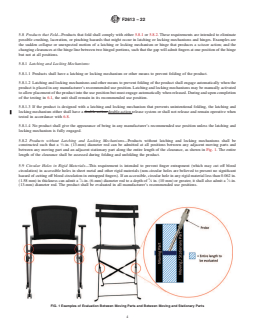
constructed such that a ⁄2-in. (13-mm) diameter rod can be admitted at all positions between any adjacent moving parts and
between any moving part and an adjacent stationary part along the entire length of the clearance, as shown in Fig. 1. The entire
length of the clearance shall be assessed during folding and unfolding the product.
5.9 Circular Holes in Rigid Materials—This requirement is intended to prevent finger entrapment (which may cut off blood
circulation) in accessible holes in sheet metal and other rigid materials (non-circular holes are believed to present no significant
hazard of cutting off blood circulation in entrapped fingers). If an accessible, circular hole in any rigid material less than 0.062 in.
1 3 1
(1.58 mm) in thickness can admit a ⁄4-in. (6-mm) diameter rod to a depth of ⁄8 in. (10 mm) or greater, it shall also admit a ⁄2-in.
(13-mm) diameter rod. The product shall be evaluated in all manufacturer’s recommended use positions.
FIG. 1 Examples of Evaluation Between Moving Parts and Between Moving and Stationary Parts
F2613 − 22
5.9.1 Rationale—Based on requirements for toys from Consumer Safety Specification F963, since the age range of children using
chairs and stools is similar to that for children using toys.
5.10 Labeling:
5.10.1 Warning labels (whether paper or non-paper) shall be permanent when tested in accordance with 6.2.
5.10.2 Warning statements applied directly onto the surface of the product by hot stamping, heat transfer, printing, wood burning,
and so forth shall be permanent when tested in accordance with 6.3.
5.10.3 Non-paper labels shall not liberate small parts when tested in accordance with 6.4.
5.11 Protective Components—If the child can grasp components between the thumb and forefinger or teeth (such as caps, sleeves,
or plugs used for protection from sharp edges, points, or entrapment of fingers or toes), or if there is at least a 0.040-in. (1.00-mm)
gap between the component and its adjacent parent component, such component shall not be removed when tested in accordance
with 6.5.
5.12 Strength Requirements—Products shall be tested in accordance with 6.6, and shall not generate any sharp edges, sharp
corners, sharp points, or any scissoring, shearing, or pinch points. The product shall remain functional upon completion of the
testing. Some deformation of the product is permissible provided that the preceding requirements are met. These requirements shall
apply to products with either rigid seating surfaces or sling-type flexible seating surfaces suspended from a frame (for example,
director’s chairs) regardless of whether the available seating width of the product is limited by a structure such as arm rests.
5.13 Stability—All products shall not tip over backwards when tested in accordance with 6.7.1 and 6.7.2. Chairs with Side
Containment shall not tip over sideways when tested in accordance with 6.7.1 and 6.7.3. Tip over occurs when the product moves
past equilibrium and begins to overturn.
5.14 Head Entrapment—Any completely bounded opening within the occupant space that includes a cord(s), strap(s), or other
elasticized component(s) as any part(s) of its boundaries shall not allow the complete passage of the small head probe unless it
allows the complete passage of the large head probe, when tested in accordance with 6.9.
6. Test Methods
6.1 Locking Mechanism Test:
6.1.1 Erect the product in accordance with any manufacturer’s instructions.
6.1.2 Secure the product so that the normal folding motion is not impeded.
6.1.3 Apply a force of 45 lbf (200 N) to the product in the direction normally associated with folding. Apply the force gradually
over a 5-s period and maintain for an additional 10 s before releasing the force.
6.1.4 Perform this procedure five times within a 2-min period.
6.2 Permanency of Labels and Warnings:
6.2.1 A paper label (excluding labels attached by a seam) shall be considered permanent if, during an attempt to remove it without
the aid of tools or solvents, it cannot be removed, it tears into pieces upon removal, or such action damages the surface to which
it is attached.
6.2.2 A non-paper label (excluding labels attached by a seam) shall be considered permanent if, during an attempt to remove it
without the aid of tools or solvents, it cannot be removed or such action damages the surface to which it is attached.
6.2.3 A warning label attached by a seam shall be considered permanent if it does not detach when subjected to a 15-lbf (67-N)
F2613 − 22
pull force applied in any direction most likely to cause failure using a ⁄4-in. (19-mm) diameter clamp surface. Gradually apply the
force over 5 s and maintain for an additional 10 s.
6.3 Adhesion test for warnings applied directly onto the surface of the product.
6.3.1 Apply the tape test defined in Test Method B–Cross-Cut Tape Test of Test Methods D3359, eliminating parallel cuts.
6.3.2 Perform this test once in each different location where warnings are applied.
6.3.3 The warning statements shall be considered permanent if the printing in the area tested is still legible and attached after being
subjected to this test.
6.4 A non-paper label, during an attempt to remove it without the aid of tools or solvents, shall not be removed or shall not fit
entirely within the small parts cylinder defined in 16 CFR 1501 if it can be removed.
6.5 Removal of Protective Components:
6.5.1 Test components in accordance with each of the following methods in the sequence listed:
6.5.2 Secure the unit so that it cannot move during the performance of the following tests.
6.5.3 Torque Test—Apply a torque of 3 lbf-in. (0.5-Nm) gradually within a period of 5 s in a clockwise direction until a rotation
of 180° from the original position has been attained or 3 lbf-in. (0.5-Nm) has been reached. Maintain the torque or maximum
rotation for an additional 10 s. Maintain, then remove the torque and permit the test components to return to a relaxed condition,
then repeat this procedure in the counterclockwise direction.
6.5.4 Tensi
...