

ASTM F2906-23
(Specification)Standard Consumer Safety Specification for Bedside Sleepers
General Information
- Abstract
ABSTRACT
This specification is intended for consumer safety and establishes performance requirements, test methods, and marking requirements to promote safe use of bedside sleepers. It explains the test methods that are conducted on all bedside sleepers, namely the product disengagement test method, the product disengagement rationale, and the folding latch test method.
SCOPE
1.1 This consumer safety specification establishes performance requirements, test methods, and marking requirements to promote safe use of bedside sleepers.
1.2 This consumer safety specification is intended to minimize the risk of injury to an infant from the normal use and reasonably foreseeable misuse of a bedside sleeper.
1.3 This consumer safety performance specification covers products intended to provide sleeping space for an infant up to approximately 5 months of age (or when child begins to push up on hands and knees). These products are intended to be secured to the side of an adult bed for the purpose of having a baby sleep in close proximity to an adult.
1.4 No bedside sleeper produced after the approval date of this consumer safety specification shall, either by label or other means, indicate compliance with the specification unless it complies with all of the requirements contained herein.
1.5 This consumer safety performance specification is not intended to address incidents and injuries resulting from alteration or unreasonable abuse or misuse of the product by a child or child care provider.
1.6 The values stated in inch-pound units are to be regarded as standard. The values given in parentheses are mathematical conversions to SI units that are provided for information only and are not considered standard.
1.7 The following precautionary caveat pertains only to the test method portion, Section 6 of this consumer safety performance specification. This standard may involve the use of hazardous materials, operations and equipment. This standard does not purport to address all of the safety concerns, if any, associated with its use. It is the responsibility of the user of this standard to establish appropriate safety, health, and environmental practices and determine the applicability of regulatory limitations prior to use.
1.8 This international standard was developed in accordance with internationally recognized principles on standardization established in the Decision on Principles for the Development of International Standards, Guides and Recommendations issued by the World Trade Organization Technical Barriers to Trade (TBT) Committee.
- Status
- Published
- Publication Date
- 31-Dec-2022
- Technical Committee
- F15 - Consumer Products
Overview
ASTM F2906-23: Standard Consumer Safety Specification for Bedside Sleepers provides critical guidelines to ensure the safe design, construction, and use of bedside sleepers for infants. Published by ASTM International, this standard establishes comprehensive performance requirements, testing protocols, and labeling mandates aimed at minimizing the risk of injury during both normal and reasonably foreseeable misuse of bedside sleepers. By adhering to ASTM F2906-23, manufacturers deliver safer products that help reduce incidents linked to unsafe design, improper assembly, or user misunderstanding.
Key Topics
Scope and Applicability
- Applies to bedside sleeper products designed for infants up to approximately 5 months of age or until the child begins to push up on hands and knees.
- Products must be secured to the side of an adult bed, supporting a safe sleep environment next to caregivers.
Performance Requirements
- Specifies strict standards to address occupant retention, product disengagement, and the structural integrity of bedside sleepers.
- Includes requirements for the attachment system to adult beds, minimum side heights, and structural barriers around the sleep area.
Test Methods
- Details robust test procedures, including the product disengagement test and folding latch test, to evaluate resistance to separation and locking mechanism strength.
- Provides rationale for force levels used in tests to simulate both infant and adult interactions.
Marking, Labeling, and Instructions
- Mandates clear, permanent warning labels and consumer information-critical for product safety and correct usage.
- Includes packaging and product warnings regarding bed compatibility, assembly, and safe attachment.
- Outlines requirements for instructional literature to ensure caregivers assemble and use bedside sleepers correctly.
Applications
ASTM F2906-23 is essential for manufacturers, testing laboratories, and regulatory authorities involved in the infant sleep products industry. Practical applications include:
Product Design and Manufacturing
- Guides design engineers and quality assurance teams in creating bedside sleepers that reduce entrapment, suffocation, and fall hazards.
- Ensures consistency across multiple product designs, including multi-mode products (e.g., those that convert between bassinet, play yard, and bedside sleeper).
Compliance and Safety Testing
- Testing facilities utilize specified methods for product verification, confirming that each unit meets the required strength, stability, and safety parameters.
- Facilitates product certification and helps demonstrate regulatory compliance in jurisdictions requiring adherence to ASTM standards.
Consumer Awareness and Retail
- Retailers and importers use certified markings to identify compliant bedside sleepers, supporting informed purchasing decisions for caregivers.
- Enhanced labeling and instructional requirements help reduce misuse by end users.
Related Standards
- ASTM F2194 - Consumer Safety Specification for Bassinets and Cradles
- ASTM F2085 - Consumer Safety Specification for Portable Bed Rails
These related ASTM standards support a comprehensive approach to infant sleep product safety, working alongside ASTM F2906-23 to address various types of sleep environments.
Keywords: bedside sleeper safety, ASTM F2906-23, infant sleep products, bedside sleeper standard, product testing, consumer labeling requirements, multi-mode sleep products, infant product compliance, ASTM International
Relations
- Effective Date
- 01-Nov-2019
- Effective Date
- 01-May-2019
- Effective Date
- 15-Apr-2016
- Effective Date
- 01-Sep-2013
- Effective Date
- 01-Apr-2013
- Effective Date
- 01-Oct-2012
- Effective Date
- 01-Sep-2012
- Effective Date
- 01-Jun-2012
- Effective Date
- 01-Jan-2012
- Effective Date
- 01-Oct-2010
- Effective Date
- 15-May-2010
- Effective Date
- 01-Apr-2010
- Effective Date
- 01-Apr-2009
- Effective Date
- 01-Dec-2008
- Effective Date
- 01-May-2008
Frequently Asked Questions
ASTM F2906-23 is a technical specification published by ASTM International. Its full title is "Standard Consumer Safety Specification for Bedside Sleepers". This standard covers: ABSTRACT This specification is intended for consumer safety and establishes performance requirements, test methods, and marking requirements to promote safe use of bedside sleepers. It explains the test methods that are conducted on all bedside sleepers, namely the product disengagement test method, the product disengagement rationale, and the folding latch test method. SCOPE 1.1 This consumer safety specification establishes performance requirements, test methods, and marking requirements to promote safe use of bedside sleepers. 1.2 This consumer safety specification is intended to minimize the risk of injury to an infant from the normal use and reasonably foreseeable misuse of a bedside sleeper. 1.3 This consumer safety performance specification covers products intended to provide sleeping space for an infant up to approximately 5 months of age (or when child begins to push up on hands and knees). These products are intended to be secured to the side of an adult bed for the purpose of having a baby sleep in close proximity to an adult. 1.4 No bedside sleeper produced after the approval date of this consumer safety specification shall, either by label or other means, indicate compliance with the specification unless it complies with all of the requirements contained herein. 1.5 This consumer safety performance specification is not intended to address incidents and injuries resulting from alteration or unreasonable abuse or misuse of the product by a child or child care provider. 1.6 The values stated in inch-pound units are to be regarded as standard. The values given in parentheses are mathematical conversions to SI units that are provided for information only and are not considered standard. 1.7 The following precautionary caveat pertains only to the test method portion, Section 6 of this consumer safety performance specification. This standard may involve the use of hazardous materials, operations and equipment. This standard does not purport to address all of the safety concerns, if any, associated with its use. It is the responsibility of the user of this standard to establish appropriate safety, health, and environmental practices and determine the applicability of regulatory limitations prior to use. 1.8 This international standard was developed in accordance with internationally recognized principles on standardization established in the Decision on Principles for the Development of International Standards, Guides and Recommendations issued by the World Trade Organization Technical Barriers to Trade (TBT) Committee.
ABSTRACT This specification is intended for consumer safety and establishes performance requirements, test methods, and marking requirements to promote safe use of bedside sleepers. It explains the test methods that are conducted on all bedside sleepers, namely the product disengagement test method, the product disengagement rationale, and the folding latch test method. SCOPE 1.1 This consumer safety specification establishes performance requirements, test methods, and marking requirements to promote safe use of bedside sleepers. 1.2 This consumer safety specification is intended to minimize the risk of injury to an infant from the normal use and reasonably foreseeable misuse of a bedside sleeper. 1.3 This consumer safety performance specification covers products intended to provide sleeping space for an infant up to approximately 5 months of age (or when child begins to push up on hands and knees). These products are intended to be secured to the side of an adult bed for the purpose of having a baby sleep in close proximity to an adult. 1.4 No bedside sleeper produced after the approval date of this consumer safety specification shall, either by label or other means, indicate compliance with the specification unless it complies with all of the requirements contained herein. 1.5 This consumer safety performance specification is not intended to address incidents and injuries resulting from alteration or unreasonable abuse or misuse of the product by a child or child care provider. 1.6 The values stated in inch-pound units are to be regarded as standard. The values given in parentheses are mathematical conversions to SI units that are provided for information only and are not considered standard. 1.7 The following precautionary caveat pertains only to the test method portion, Section 6 of this consumer safety performance specification. This standard may involve the use of hazardous materials, operations and equipment. This standard does not purport to address all of the safety concerns, if any, associated with its use. It is the responsibility of the user of this standard to establish appropriate safety, health, and environmental practices and determine the applicability of regulatory limitations prior to use. 1.8 This international standard was developed in accordance with internationally recognized principles on standardization established in the Decision on Principles for the Development of International Standards, Guides and Recommendations issued by the World Trade Organization Technical Barriers to Trade (TBT) Committee.
ASTM F2906-23 is classified under the following ICS (International Classification for Standards) categories: 97.140 - Furniture; 97.190 - Equipment for children. The ICS classification helps identify the subject area and facilitates finding related standards.
ASTM F2906-23 has the following relationships with other standards: It is inter standard links to ASTM F2085-19, ASTM F2085-12(2019), ASTM F2194-16, ASTM F2194-13a, ASTM F2194-13, ASTM F2194-12b, ASTM F2194-12a, ASTM F2194-12, ASTM F2085-12, ASTM F2085-10a, ASTM F2085-10, ASTM F2194-10, ASTM F2085-09, ASTM F2085-08a, ASTM F2085-08. Understanding these relationships helps ensure you are using the most current and applicable version of the standard.
ASTM F2906-23 is available in PDF format for immediate download after purchase. The document can be added to your cart and obtained through the secure checkout process. Digital delivery ensures instant access to the complete standard document.
Standards Content (Sample)
This international standard was developed in accordance with internationally recognized principles on standardization established in the Decision on Principles for the
Development of International Standards, Guides and Recommendations issued by the World Trade Organization Technical Barriers to Trade (TBT) Committee.
Designation:F2906 −23
Standard Consumer Safety Specification for
Bedside Sleepers
This standard is issued under the fixed designation F2906; the number immediately following the designation indicates the year of
original adoption or, in the case of revision, the year of last revision. A number in parentheses indicates the year of last reapproval. A
superscript epsilon (´) indicates an editorial change since the last revision or reapproval.
INTRODUCTION
This consumer safety specification is intended to address incidents reported by the U.S. Consumer
Product Safety Commission (CPSC) relating to bedside sleepers.
In response to the incident data compiled by the CPSC, this consumer safety specification attempts
to minimize the hazards associated with these products from the following: (1) occupant retention, (2)
structural integrity and product assembly, and (3) deficiency of consumer education regarding product
use.This consumer safety specification is intended to deal with reasonably foreseeable use and misuse
of the products. This consumer safety specification does not apply to products that are blatantly
misused, nor does it apply to products used by consumers in a careless manner that violate normal
practice or disregard the instructions or warnings provided with the product, or both.
1. Scope conversions to SI units that are provided for information only
and are not considered standard.
1.1 This consumer safety specification establishes perfor-
1.7 The following precautionary caveat pertains only to the
mance requirements, test methods, and marking requirements
test method portion, Section 6 of this consumer safety perfor-
to promote safe use of bedside sleepers.
mance specification. This standard may involve the use of
1.2 This consumer safety specification is intended to mini-
hazardous materials, operations and equipment. This standard
mize the risk of injury to an infant from the normal use and
does not purport to address all of the safety concerns, if any,
reasonably foreseeable misuse of a bedside sleeper.
associated with its use. It is the responsibility of the user of this
1.3 This consumer safety performance specification covers
standard to establish appropriate safety, health, and environ-
products intended to provide sleeping space for an infant up to
mental practices and determine the applicability of regulatory
approximately 5 months of age (or when child begins to push
limitations prior to use.
up on hands and knees). These products are intended to be
1.8 This international standard was developed in accor-
secured to the side of an adult bed for the purpose of having a
dance with internationally recognized principles on standard-
baby sleep in close proximity to an adult.
ization established in the Decision on Principles for the
Development of International Standards, Guides and Recom-
1.4 No bedside sleeper produced after the approval date of
mendations issued by the World Trade Organization Technical
this consumer safety specification shall, either by label or other
Barriers to Trade (TBT) Committee.
means, indicate compliance with the specification unless it
complies with all of the requirements contained herein.
2. Referenced Documents
1.5 This consumer safety performance specification is not
2.1 ASTM Standards:
intended to address incidents and injuries resulting from
F2085 ConsumerSafetySpecificationforPortableBedRails
alteration or unreasonable abuse or misuse of the product by a
F2194 Consumer Safety Specification for Bassinets and
child or child care provider.
Cradles
1.6 The values stated in inch-pound units are to be regarded
as standard. The values given in parentheses are mathematical
3. Terminology
3.1 Definitions:
This consumer safety specification is under the jurisdiction ofASTM Commit-
tee F15 on Consumer Products and is the direct responsibility of Subcommittee
F15.18 on Cribs, Toddler Beds, Play Yards, Bassinets, Cradles and Baby Changing
Products. For referenced ASTM standards, visit the ASTM website, www.astm.org, or
Current edition approved Jan. 1, 2023. Published January 2023. Originally contact ASTM Customer Service at service@astm.org. For Annual Book of ASTM
approved in 2011. Last previous edition approved in 2022 as F2906 – 22. DOI: Standards volume information, refer to the standard’s Document Summary page on
10.1520/F2906-23. the ASTM website.
Copyright © ASTM International, 100 Barr Harbor Drive, PO Box C700, West Conshohocken, PA 19428-2959. United States
F2906−23
3.1.1 attachment system, n—the means used to attach the 4. Calibration and Standardization
bedside sleeper to the adult bed.
4.1 All testing shall be conducted on a concrete floor that
3.1.2 bedside sleeper, n—a rigid frame assembly that may
may be covered with ⁄8 in. (3 mm) thick vinyl floor covering,
be combined with a fabric or mesh assembly, or both, used to
unless test instructs differently.
function as sides, ends, or floor or a combination thereof, and
4.2 The product shall be completely assembled in accor-
that is intended to provide a sleeping environment for infants
dance with the manufacturer’s instructions.
and is secured to an adult bed.
4.3 No testing shall be conducted within 48 h of manufac-
3.1.3 bedside sleeper accessory, n—an elevated sleep sur-
ture.
facethatattachestoaplayyarddesignedtoconverttheproduct
intoabedsidesleeperandisintendedtohaveahorizontalsleep 4.4 The product to be tested shall be at an ambient tempera-
surface while in a rest (non-rocking) position.
tureof73 °F 69 °F(23 °C 65 °C)foratleastonehourbefore
testing.Alltestingshallbeconductedinthistemperaturerange.
3.1.4 bedside sleeper accessory attachment components,
n—the components that provide the means of attachment for a
4.5 All testing required by this consumer safety specifica-
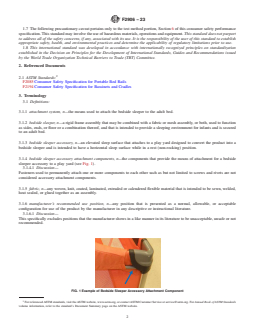
bedside sleeper accessory to a play yard (see Fig. 1).
tion shall be conducted on the same unit in the order presented
3.1.4.1 Discussion—Fasteners used to permanently attach
in this specification.
one or more components to each other such as but not limited
to screws and rivets are not considered accessory attachment
5. Performance Requirements
components.
5.1 Prior to or immediately after testing to this consumer
3.1.5 fabric, n—any woven, knit, coated, laminated, ex-
safety specification, the bedside sleeper must be tested to
truded or calendered flexible material that is intended to be
Consumer Safety Specification F2194. Multi-mode products
sewn, welded, heat sealed, or glued together as an assembly.
must also be tested to each applicable standard. When testing
3.1.6 manufacturer’s recommended use position, n—any
to Consumer Safety Specification F2194 the unit shall be free
position that is presented as a normal, allowable, or acceptable
standing, and not be secured to the test platform as dictated
configuration for use of the product by the manufacturer in any
elsewhere in this standard.
descriptive or instructional literature.
5.1.1 The bassinet minimum side height shall be as required
3.1.6.1 Discussion—This specifically excludes positions
in Consumer Safety Specification F2194 with the exception of
that the manufacturer shows in a like manner in its literature to
a lowered side rail as permitted in 5.4.
be unacceptable, unsafe or not recommended.
5.2 When the product is secured to the Test Platform 2 from
3.1.7 multi-mode product, n—a unit that is designed and
7.1.2 of Consumer Safety Specification F2085, per the manu-
intendedtobeusedinmorethanonemode(forexample,aplay
facturer’s recommended method, there shall be no more than
yard, bassinet, changing table, hand held carrier, or bedside
⁄2 in. (13 mm) separation from the bed measured at any point
sleeper).
along the length of the line of contact between the product and
3.1.8 occupant, n—the infant who is placed in the bedside
the test platform.
sleeper product in one of the manufacturer’s recommended use
5.3 Product Disengagement:
positions.
5.3.1 The bedside sleeper shall not separate from the test
3.1.9 occupant retention space, n—space enclosed by the
platform more than 1 in. (2.5 cm) at any point of attachment to
surfaces, for example, side walls or the floor, or both, of a
the test platform when tested in accordance with 6.1.1 – 6.1.3.
bedside sleeper that contains the occupant.
5.3.2 The bedside sleeper may separate from the test plat-
3.1.10 shell, n—atextilecoverforbedsidesleeperaccessory
form more than 1 in. (2.5 cm) during application of the force
that incorporates structural elements such as tubing, perma- in 6.1.4 but shall not remain separated more than 1 in. (2.5 cm)
nently attached clips or hooks, or other elements which allow
after removal of the force.
it to be suspended from the play yard frame.
5.4 The bedside sleeper shall have a barrier around the
entire perimeter of the occupant retention space. If a bedside
sleeper is equipped with a side or end portion which is lower
or partially lowers by any means, the height of the side rail in
the lowest position shall be no less than 4 in. (10.2 cm) when
measured from the top of the uncompressed bedside sleeper
mattress to the top of the lowered side rail, when the mattress
support is in its highest position.
5.4.1 Four-Inch Nest Rationale—Thecenterofgravity(CG)
of a child lying down on his/her side is roughly the centerline
of the body. Since maximum shoulder breadth for 3 to 5 month
olds is 21.8 cm (8.6 in.) (Snyder, 1977), half of that is 10.9 cm
(4.3 in.).Also, maximum hip breadth for the same age range is
18.2 cm (7.2 in.), half of which is 9.1 cm (3.6 in.). Assuming
FIG. 1 Example of Bedside Sleeper Accessory Attachment Com-
ponent that the CG lies approximately along the centerline of the body
F2906−23
and the child is laying with one side flat on the mattress, the bounded opening shall not be created that allows the complete
CG will likely lie roughly between 9 cm and 11 cm above the passage of the torso probe (Fig. 2) when tested in accordance
mattress.
with 6.3.
5.5 If a bedside sleeper is equipped with a side or end
5.8 Bedside Sleeper Accessories—Missing Accessory At-
portion which partially lowers by any means, it shall remain
tachment Components:
engaged and operative after testing as follows:
5.8.1 Bedside sleeper accessories that have all accessory
5.5.1 Each single-action locking or latching device that is
attachment components permanently attached to the bedside
provided to prevent folding shall require a minimum force of
sleeper accessory, or by any permanent means prohibiting their
10 lbf (45 N) to activate the release mechanism when tested in
removal from the bedside sleeper accessory, are exempt from
accordance with 6.2.
the requirements in 5.8.2.
5.5.2 Each double-action locking or latching device that is
5.8.2 Bedside sleeper accessories which require consumer
provided to prevent folding shall require two distinct and
separate actions for release. There are no force requirements assembly of accessory attachment component(s), and that can
for double-action locking or latching devices. be assembled and attached to the product with any accessory
attachment component(s) missing, shall meet either 5.8.2.1 or
5.6 The bedside sleeper shall provide a means to be secured
5.8.2.2 when each accessory attachment component not per-
to an adult bed. The bedside sleeper rail that is adjacent to the
manently attached is removed.
adult bed shall be at or below the acceptable adult bed height
range specified in the manufacturer’s instructions except for 5.8.2.1 The bedside sleeper accessory shall collapse when
any portion of the rail that is 7.5 in. or higher when measured any part of the mattress pad contacts the bottom floor of the
according to the side height requirement found in Consumer
play yard or is not able to support the 4.0 lbm test mass when
Safety Specification F2194.
tested to 6.4.
5.7 Bedside Sleeper Accessory Fabric Sided Enclosed 5.8.2.2 The bedside sleeper accessory sleep surface shall tilt
Openings—For bedside sleeper accessories, a completely more than 30° when tested to 6.4.
NOTE 1—The probe dimensions represent the t
...
This document is not an ASTM standard and is intended only to provide the user of an ASTM standard an indication of what changes have been made to the previous version. Because
it may not be technically possible to adequately depict all changes accurately, ASTM recommends that users consult prior editions as appropriate. In all cases only the current version
of the standard as published by ASTM is to be considered the official document.
Designation: F2906 − 22 F2906 − 23
Standard Consumer Safety Specification for
Bedside Sleepers
This standard is issued under the fixed designation F2906; the number immediately following the designation indicates the year of
original adoption or, in the case of revision, the year of last revision. A number in parentheses indicates the year of last reapproval. A
superscript epsilon (´) indicates an editorial change since the last revision or reapproval.
INTRODUCTION
This consumer safety specification is intended to address incidents reported by the U.S. Consumer
Product Safety Commission (CPSC) relating to bedside sleepers.
In response to the incident data compiled by the CPSC, this consumer safety specification attempts
to minimize the hazards associated with these products from the following: (1) occupant retention, (2)
structural integrity and product assembly, and (3) deficiency of consumer education regarding product
use. This consumer safety specification is intended to deal with reasonably foreseeable use and misuse
of the products. This consumer safety specification does not apply to products that are blatantly
misused, nor does it apply to products used by consumers in a careless manner that violate normal
practice or disregard the instructions or warnings provided with the product, or both.
1. Scope
1.1 This consumer safety specification establishes performance requirements, test methods, and marking requirements to promote
safe use of bedside sleepers.
1.2 This consumer safety specification is intended to minimize the risk of injury to an infant from the normal use and reasonably
foreseeable misuse of a bedside sleeper.
1.3 This consumer safety performance specification covers products intended to provide sleeping space for an infant up to
approximately 5 months of age (or when child begins to push up on hands and knees). These products are intended to be secured
to the side of an adult bed for the purpose of having a baby sleep in close proximity to an adult.
1.4 No bedside sleeper produced after the approval date of this consumer safety specification shall, either by label or other means,
indicate compliance with the specification unless it complies with all of the requirements contained herein.
1.5 This consumer safety performance specification is not intended to address incidents and injuries resulting from alteration or
unreasonable abuse or misuse of the product by a child or child care provider.
1.6 The values stated in inch-pound units are to be regarded as standard. The values given in parentheses are mathematical
conversions to SI units that are provided for information only and are not considered standard.
This consumer safety specification is under the jurisdiction of ASTM Committee F15 on Consumer Products and is the direct responsibility of Subcommittee F15.18
on Cribs, Toddler Beds, Play Yards, Bassinets, Cradles and Baby Changing Products.
Current edition approved Oct. 1, 2022Jan. 1, 2023. Published November 2022January 2023. Originally approved in 2011. Last previous edition approved in 20192022
as F2906 – 13 (2019).F2906 – 22. DOI: 10.1520/F2906-22.10.1520/F2906-23.
Copyright © ASTM International, 100 Barr Harbor Drive, PO Box C700, West Conshohocken, PA 19428-2959. United States
F2906 − 23
1.7 The following precautionary caveat pertains only to the test method portion, Section 6 of this consumer safety performance
specification. This standard may involve the use of hazardous materials, operations and equipment. This standard does not purport
to address all of the safety concerns, if any, associated with its use. It is the responsibility of the user of this standard to establish
appropriate safety, health, and environmental practices and determine the applicability of regulatory limitations prior to use.
1.8 This international standard was developed in accordance with internationally recognized principles on standardization
established in the Decision on Principles for the Development of International Standards, Guides and Recommendations issued
by the World Trade Organization Technical Barriers to Trade (TBT) Committee.
2. Referenced Documents
2.1 ASTM Standards:
F2085 Consumer Safety Specification for Portable Bed Rails
F2194 Consumer Safety Specification for Bassinets and Cradles
3. Terminology
3.1 Definitions:
3.1.1 attachment system, n—the means used to attach the bedside sleeper to the adult bed.
3.1.2 bedside sleeper, n—a rigid frame assembly that may be combined with a fabric or mesh assembly, or both, used to function
as sides, ends, or floor or a combination thereof, and that is intended to provide a sleeping environment for infants and is secured
to an adult bed.
3.1.3 bedside sleeper accessory, n—an elevated sleep surface that attaches to a play yard designed to convert the product into a
bedside sleeper and is intended to have a horizontal sleep surface while in a rest (non-rocking) position.
3.1.4 bedside sleeper accessory attachment components, n—the components that provide the means of attachment for a bedside
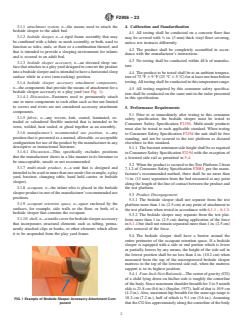
sleeper accessory to a play yard (see Fig. 1).
3.1.4.1 Discussion—
Fasteners used to permanently attach one or more components to each other such as but not limited to screws and rivets are not
considered accessory attachment components.
3.1.5 fabric, n—any woven, knit, coated, laminated, extruded or calendered flexible material that is intended to be sewn, welded,
heat sealed, or glued together as an assembly.
3.1.6 manufacturer’s recommended use position, n—any position that is presented as a normal, allowable, or acceptable
configuration for use of the product by the manufacturer in any descriptive or instructional literature.
3.1.6.1 Discussion—
This specifically excludes positions that the manufacturer shows in a like manner in its literature to be unacceptable, unsafe or not
recommended.
FIG. 1 Example of Bedside Sleeper Accessory Attachment Component
For referenced ASTM standards, visit the ASTM website, www.astm.org, or contact ASTM Customer Service at service@astm.org. For Annual Book of ASTM Standards
volume information, refer to the standard’s Document Summary page on the ASTM website.
F2906 − 23
3.1.7 multi-mode product, n—a unit that is designed and intended to be used in more than one mode (for example, a play yard,
bassinet, changing table, hand held carrier, or bedside sleeper).
3.1.8 occupant, n—the infant who is placed in the bedside sleeper product in one of the manufacturer’s recommended use
positions.
3.1.9 occupant retention space, n—space enclosed by the surfaces, for example, side walls or the floor, or both, of a bedside
sleeper that contains the occupant.
3.1.10 shell, n—a textile cover for bedside sleeper accessory that incorporates structural elements such as tubing, permanently
attached clips or hooks, or other elements which allow it to be suspended from the play yard frame.
4. Calibration and Standardization
4.1 All testing shall be conducted on a concrete floor that may be covered with ⁄8 in. (3 mm) thick vinyl floor covering, unless
test instructs differently.
4.2 The product shall be completely assembled in accordance with the manufacturer’s instructions.
4.3 No testing shall be conducted within 48 h of manufacture.
4.4 The product to be tested shall be at an ambient temperature of 73 °F 6 9 °F (23 °C 6 5 °C) for at least one hour before testing.
All testing shall be conducted in this temperature range.
4.5 All testing required by this consumer safety specification shall be conducted on the same unit in the order presented in this
specification.
5. Performance Requirements
5.1 Prior to or immediately after testing to this consumer safety specification, the bedside sleeper must be tested to Consumer
Safety Specification F2194. Multi-mode products must also be tested to each applicable standard. When testing to Consumer
Safety Specification F2194 the unit shall be free standing, and not be secured to the test platform as dictated elsewhere in this
standard.
5.1.1 The bassinet minimum side height shall be as required in Consumer Safety Specification F2194 with the exception of a
lowered side rail as permitted in 5.4.
5.2 When the product is secured to the Test Platform 2 from 7.1.2 of Consumer Safety Specification F2085, per the manufacturer’s
recommended method, there shall be no more than ⁄2 in. (13 mm) separation from the bed measured at any point along the length
of the line of contact between the product and the test platform.
5.3 Product Disengagement:
5.3.1 The bedside sleeper shall not separate from the test platform more than 1 in. (2.5 cm) at any point of attachment to the test
platform when tested in accordance with 6.1.1 – 6.1.3.
5.3.2 The bedside sleeper may separate from the test platform more than 1 in. (2.5 cm) during application of the force in 6.1.4
but shall not remain separated more than 1 in. (2.5 cm) after removal of the force.
5.4 The bedside sleeper shall have a barrier around the entire perimeter of the occupant retention space. If a bedside sleeper is
equipped with a side or end portion which is lower or partially lowers by any means, the height of the side rail in the lowest position
shall be no less than 4 in. (10.2 cm) when measured from the top of the uncompressed bedside sleeper mattress to the top of the
lowered side rail, when the mattress support is in its highest position.
F2906 − 23
5.4.1 Four-Inch Nest Rationale—The center of gravity (CG) of a child lying down on his/her side is roughly the centerline of the
body. Since maximum shoulder breadth for 3 to 5 month olds is 21.8 cm (8.6 in.) (Snyder, 1977), half of that is 10.9 cm (4.3 in.).
Also, maximum hip breadth for the same age range is 18.2 cm (7.2 in.), half of which is 9.1 cm (3.6 in.). Assuming that the CG
lies approximately along the centerline of the body and the child is laying with one side flat on the mattress, the CG will likely
lie roughly between 9 cm and 11 cm above the mattress.
5.5 If a bedside sleeper is equipped with a side or end portion which partially lowers by any means, it shall remain engaged and
operative after testing as follows:
5.5.1 Each single-action locking or latching device that is provided to prevent folding shall require a minimum force of 10 lbf (45
N) to activate the release mechanism when tested in accordance with 6.2.
5.5.2 Each double-action locking or latching device that is provided to prevent folding shall require two distinct and separate
actions for release. There are no force requirements for double-action locking or latching devices.
5.6 The bedside sleeper shall provide a means to be secured to an adult bed. The top of any lowered portion of the side rail
designed to be bedside sleeper rail that is adjacent to the adult bed shall be at or below the acceptable adult bed height range
specified in the instructional literature. Any fixed portion or component manufacturer’s instructions except for any portion of the
rail that is adjacent to the adult bed is exempt from this requirement.7.5 in. or higher when measured according to the side height
requirement found in Consumer Safety Specification F2194.
5.7 Bedside Sleeper Accessory Fabric Sided Enclosed Openings—For bedside sleeper accessories, a completely bounded opening
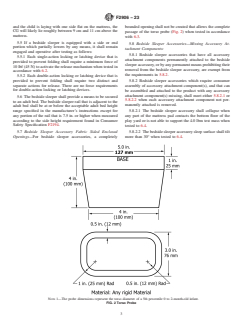
shall not be created that allows the complete passage of the torso probe (Fig. 2) when tested in accordance with 6.3.
5.8 Bedside Sleeper Accessories—Missing Accessory Attachment Components:
5.8.1 Bedside sleeper accessories that have all accessory attachment components permanently attached to the bedside sleeper
accessory, or by any permanent means prohibiting their removal from the bedside sleeper accessory, are exempt from the
requirements in 5.8.2.
5.8.2 Bedside sleeper accessories which require consumer assembly of accessory attachment component(s), and that can be
assembled and attached to the product with any accessory attachment component(s) missing, shall meet either 5.8.2.1 or 5.8.2.2
when each accessory attachment component not permanently attached is removed.
5.8.2.1 The bedside sleeper accessory shall collapse when any part of the mattress pad contacts the bottom floor of the play yard
or is not able to support the 4.0 lbm test mass when tested to 6.4.
5.8.2.2 The bedside sleeper access
...