

ASTM E124-94(2022)
(Specification)Standard Specification for Weighing and Drying Apparatus for Microchemical Analysis
General Information
- Abstract
ABSTRACT
This specification covers the general requirements for the components that comprise the apparatus used for the weighing and drying operations in the laboratory practice of microchemical analysis. The components covered here are the following: combustion boats; weighing bottles, cup, and tubes; spatulas; forceps; tare flasks; metal cooling block; metal crucible container with glass cover; and micro glass desiccator with metal insert.
SCOPE
1.1 This specification covers apparatus used for weighing and drying operations in microchemical laboratory practice.
1.2 The values stated in inch-pound units are to be regarded as the standard. The metric equivalents may be approximate.
Note 1: This specification was originally developed by the Committee on Microchemical Apparatus, Division of Analytical Chemistry, American Chemical Society.2
1.3 This international standard was developed in accordance with internationally recognized principles on standardization established in the Decision on Principles for the Development of International Standards, Guides and Recommendations issued by the World Trade Organization Technical Barriers to Trade (TBT) Committee.
- Status
- Published
- Publication Date
- 31-Dec-2021
- Technical Committee
- E41 - Laboratory Apparatus
- Drafting Committee
- E41.01 - Laboratory Ware and Supplies
Overview
ASTM E124-94(2022): Standard Specification for Weighing and Drying Apparatus for Microchemical Analysis establishes the general requirements for laboratory apparatus used in weighing and drying operations critical to microchemical analysis. Developed by ASTM International, this standard ensures consistency and reliability by specifying the key components and their essential features for accurate microchemical laboratory operations.
ASTM E124-94(2022) covers a range of apparatus including combustion boats, weighing bottles, cups, and tubes, spatulas, forceps, tare flasks, metal cooling blocks, metal crucible containers with glass covers, and micro glass desiccators with metal inserts. These tools are essential for precise sample preparation, weighing, and drying in microchemical analysis, supporting both laboratory accuracy and methodological compatibility.
Key Topics
Scope and Applicability
- Defines apparatus used for micro-level weighing and drying in laboratory analysis.
- Emphasizes the use of inch-pound units as the standard for all measurements.
Apparatus Components
- Combustion Boats: Different sizes and materials for sample combustion.
- Weighing Bottles, Cups, and Tubes: Varied capacities and materials, suitable for many sample types, including hygroscopic materials.
- Spatulas and Forceps: Designed for precise material handling, available in different types for different substances and weighing techniques.
- Tare Flasks: Glass vessels for accurate tare weight measurements.
- Metal Cooling Blocks and Crucible Containers: For safe cooling, storage, and transport of samples and utensils.
- Micro Glass Desiccator: Provides controlled drying environments, incorporates metal inserts for additional functionality.
Material and Design Requirements
- Focuses on materials such as platinum-rhodium alloys, stainless steel, nickel-plated steel, soda-lime glass, and borosilicate glass.
- Emphasizes durability, resistance to corrosion and abrasion, and suitability for microchemical work.
Referenced Standards
- Lists related ASTM standards to ensure apparatus performance, packaging, and stress limits in glassware.
Applications
The standard is essential in laboratories that conduct microchemical analysis, where small sample sizes require extremely precise handling and measurement. Applications include:
Analytical Chemistry Laboratories
- Preparation and analysis of samples as small as a few milligrams.
- Precise weighing and drying of hygroscopic and other sensitive materials.
Quality Assurance and Research
- Ensures traceability and repeatability in sample measurements.
- Supports accurate development, verification, and validation of microanalytical methods.
Materials Science and Forensic Testing
- Facilitates safe handling, transport, and measurement of micro-samples in controlled environments.
Using apparatus conforming to ASTM E124-94(2022) minimizes contamination, measurement errors, and inconsistencies, thereby enhancing analytical integrity and compliance with international laboratory standards.
Related Standards
ASTM E124-94(2022) references several related ASTM standards that provide additional guidance and requirements:
- ASTM E671 – Specification for Maximum Permissible Thermal Residual Stress in Annealed Glass Laboratory Apparatus
- ASTM E920 – Specification for Commercially Packaged Laboratory Apparatus
- ASTM E921 – Specification for Export Packaged Laboratory Apparatus
- ASTM E1133 – Practice for Performance Testing of Packaged Laboratory Apparatus for United States Government Procurements
- ASTM E1157 – Specification for Sampling and Testing of Reusable Laboratory Glassware
These referenced standards offer guidelines on packaging, safety, performance testing, and the mechanical properties of laboratory glassware, providing a comprehensive framework for laboratory equipment used in microchemical analysis.
Keywords: weighing and drying apparatus, microchemical analysis, ASTM E124, laboratory equipment, analytical chemistry, microanalysis, laboratory standard, precision weighing, desiccator, combustion boat, weighing bottle.
Relations
- Effective Date
- 01-Jul-2019
- Effective Date
- 01-Nov-2013
- Effective Date
- 01-Dec-2011
- Effective Date
- 01-Dec-2011
- Effective Date
- 01-Sep-2010
- Effective Date
- 15-May-2010
- Effective Date
- 01-Apr-2010
- Effective Date
- 01-Nov-2008
- Effective Date
- 01-Nov-2006
- Effective Date
- 01-Oct-2005
- Effective Date
- 01-May-2004
- Effective Date
- 01-Jan-2000
- Effective Date
- 01-Jan-2000
- Effective Date
- 10-Apr-1998
- Effective Date
- 10-Nov-1997
Get Certified
Connect with accredited certification bodies for this standard

ECOCERT
Organic and sustainability certification.

Eurofins Food Testing Global
Global leader in food, environment, and pharmaceutical product testing.

Intertek Bangladesh
Intertek certification and testing services in Bangladesh.
Sponsored listings
Frequently Asked Questions
ASTM E124-94(2022) is a technical specification published by ASTM International. Its full title is "Standard Specification for Weighing and Drying Apparatus for Microchemical Analysis". This standard covers: ABSTRACT This specification covers the general requirements for the components that comprise the apparatus used for the weighing and drying operations in the laboratory practice of microchemical analysis. The components covered here are the following: combustion boats; weighing bottles, cup, and tubes; spatulas; forceps; tare flasks; metal cooling block; metal crucible container with glass cover; and micro glass desiccator with metal insert. SCOPE 1.1 This specification covers apparatus used for weighing and drying operations in microchemical laboratory practice. 1.2 The values stated in inch-pound units are to be regarded as the standard. The metric equivalents may be approximate. Note 1: This specification was originally developed by the Committee on Microchemical Apparatus, Division of Analytical Chemistry, American Chemical Society.2 1.3 This international standard was developed in accordance with internationally recognized principles on standardization established in the Decision on Principles for the Development of International Standards, Guides and Recommendations issued by the World Trade Organization Technical Barriers to Trade (TBT) Committee.
ABSTRACT This specification covers the general requirements for the components that comprise the apparatus used for the weighing and drying operations in the laboratory practice of microchemical analysis. The components covered here are the following: combustion boats; weighing bottles, cup, and tubes; spatulas; forceps; tare flasks; metal cooling block; metal crucible container with glass cover; and micro glass desiccator with metal insert. SCOPE 1.1 This specification covers apparatus used for weighing and drying operations in microchemical laboratory practice. 1.2 The values stated in inch-pound units are to be regarded as the standard. The metric equivalents may be approximate. Note 1: This specification was originally developed by the Committee on Microchemical Apparatus, Division of Analytical Chemistry, American Chemical Society.2 1.3 This international standard was developed in accordance with internationally recognized principles on standardization established in the Decision on Principles for the Development of International Standards, Guides and Recommendations issued by the World Trade Organization Technical Barriers to Trade (TBT) Committee.
ASTM E124-94(2022) is classified under the following ICS (International Classification for Standards) categories: 71.040.20 - Laboratory ware and related apparatus. The ICS classification helps identify the subject area and facilitates finding related standards.
ASTM E124-94(2022) has the following relationships with other standards: It is inter standard links to ASTM E920-97(2019), ASTM E920-97(2013), ASTM E1157-87(2011), ASTM E1157-87(2018)e1, ASTM E1133-86(2010), ASTM E921-97(2010), ASTM E671-98(2010), ASTM E920-97(2008), ASTM E1157-87(2006), ASTM E1133-86(2005), ASTM E671-98(2004), ASTM E1133-86(2000), ASTM E1133-86(1996)e1, ASTM E671-98, ASTM E920-97(2003). Understanding these relationships helps ensure you are using the most current and applicable version of the standard.
ASTM E124-94(2022) is available in PDF format for immediate download after purchase. The document can be added to your cart and obtained through the secure checkout process. Digital delivery ensures instant access to the complete standard document.
Standards Content (Sample)
This international standard was developed in accordance with internationally recognized principles on standardization established in the Decision on Principles for the
Development of International Standards, Guides and Recommendations issued by the World Trade Organization Technical Barriers to Trade (TBT) Committee.
Designation:E124 −94 (Reapproved 2022)
Standard Specification for
Weighing and Drying Apparatus for Microchemical Analysis
This standard is issued under the fixed designation E124; the number immediately following the designation indicates the year of
original adoption or, in the case of revision, the year of last revision. A number in parentheses indicates the year of last reapproval. A
superscript epsilon (´) indicates an editorial change since the last revision or reapproval.
1. Scope 3. Combustion Boats
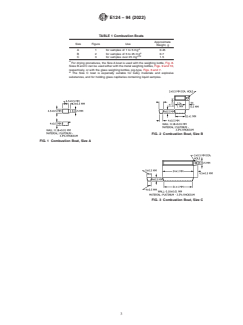
3.1 Combustion boats of three sizes shall conform to the
1.1 This specification covers apparatus used for weighing
requirements in Table 1 and Fig. 1, Fig. 2, and Fig. 3. These
and drying operations in microchemical laboratory practice.
boats shall be made of platinum-rhodium alloy containing
1.2 The values stated in inch-pound units are to be regarded
3.5 % rhodium.
as the standard. The metric equivalents may be approximate.
4. Weighing Bottles
NOTE 1—This specification was originally developed by the Committee
on MicrochemicalApparatus, Division ofAnalytical Chemistry,American
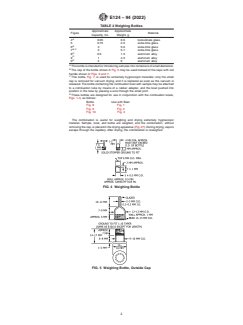
4.1 Weighing bottles of seven capacities shall conform to
Chemical Society.
the requirements in Table 2 and Figs. 4-9, inclusive.
1.3 This international standard was developed in accor-
5. Weighing Cup
dance with internationally recognized principles on standard-
ization established in the Decision on Principles for the
5.1 The weighing cup shall conform to the requirements
Development of International Standards, Guides and Recom-
shown in Fig. 11, and shall be made of platinum-rhodium alloy
mendations issued by the World Trade Organization Technical
containing 3.5 % rhodium. The cup is designed to be used as a
Barriers to Trade (TBT) Committee.
sample container to fit into the weighing bottle shown in Fig.
5, and is useful for weighing hygroscopic materials.
2. Referenced Documents
3 6. Weighing Tubes
2.1 ASTM Standards:
6.1 Weighing tubes of three types shall conform to the
E671 Specification for Maximum Permissible Thermal Re-
sidual Stress in Annealed Glass Laboratory Apparatus requirements shown in Fig. 12, Fig. 13, and Fig. 14. These
tubes should preferably be made of soda-lime glass.
E920 Specification for Commercially Packaged Laboratory
Apparatus
7. Spatulas
E921 Specification for Export Packaged Laboratory Appa-
ratus
7.1 Spatulas of four types, and preferably made of stainless
E1133 Practice for Performance Testing of Packaged Labo-
steel, shall conform to the following requirements:
ratory Apparatus for United States Government Procure-
7.1.1 TypeA(Fig. 15)—This spatula is generally useful.The
ments
top can be used for crushing crystals and the bent blade for
E1157 Specification for Sampling and Testing of Reusable
scraping containers.
Laboratory Glassware
7.1.2 TypeB(Fig. 16)—This spatula has a flat bent portion
at one end and a V-shaped scoop at the other end. It is
particularly useful for weighing samples.
1 7.1.3 TypeC(Fig.17)—Thisspatulaissuitableforthelarger
This specification is under the jurisdiction of ASTM Committee E41 on
Laboratory Apparatus and is the direct responsibility of Subcommittee E41.01 on samples commonly encountered in semimicro and preparative
Laboratory Ware and Supplies.
work.IthasaU-shapedscoopatoneendandaV-shapedscoop
Current edition approved Jan. 1, 2022. Published February 2022. Originally
at the other end. The spatula can be used to add shot or beads
approvedin1956.Lastpreviouseditionapprovedin2016asE124 – 94(2016).DOI:
to tare flasks and for measuring and introducing solid reagent
10.1520/E0124-94R22.
See the “1949 Report on Recommended Specifications for Microchemical
into combustion tubes.
Apparatus, Carbon-Hydrogen, Dumas Nitrogen, Sulfur and Halogen,” Analytical
7.1.4TypeD(Fig. 18)—This spatula is useful in many
Chemistry, Vol 21, December 1949, p. 1555; and the “1953 Report on Recom-
microchemical applications.
mended Specifications for Microchemical Apparatus, Weighing and Drying,”
Analytical Chemistry, Vol 26, July 1954, p. 1186.
For referenced ASTM standards, visit the ASTM website, www.astm.org, or 8. Forceps
contact ASTM Customer Service at service@astm.org. For Annual Book of ASTM
8.1 Forceps of two types, made of nickel-plated steel, shall
Standards volume information, refer to the standard’s Document Summary page on
the ASTM website. conform to the following requirements:
Copyright © ASTM International, 100 Barr Harbor Drive, PO Box C700, West Conshohocken, PA 19428-2959. United States
E124−94 (2022)
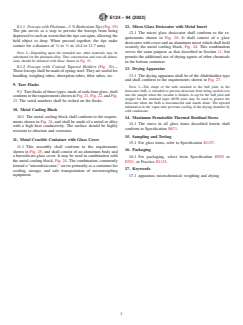
8.1.1 ForcepswithPlatinum—5%RutheniumTips(Fig.19) 12. Micro Glass Desiccator with Metal Insert
The pin serves as a stop to prevent the forceps from being
12.1 The micro glass desiccator shall conform to the re-
depressed to such an extent that the tips can open, allowing the
quirements shown in Fig. 26. It shall consist of a glass
held object to drop. When pressed together, the tips make
desiccator with cover and an aluminum insert which shall hold
1 1
contact for a distance of ⁄4 to ⁄2 in. (6.4 to 12.7 mm).
securely the metal cooling block, Fig. 24. This combination
serves the same purpose as that described in Section 11, but
NOTE 2—Depending upon the intended use, other materials may be
substituted for the platinum alloy. Thec construction and over-all dimen-
permits the additional use of drying agents of other chemicals
sions should be identical with those shown in Fig. 19.
in the bottom container.
8.1.2 Forceps with Conical Tapered Holders (Fig. 20)—
13. Drying Apparatus
These forceps shall be made of spring steel.They are useful for
13.1 The drying apparatus shall be of theAbderhalden type
handling weighing tubes, absorption tubes, filter tubes, etc.
and shall conform to the requirements shown in Fig. 27.
9. Tare Flasks
NOTE 3—The shape of the tube attached to the ball joint, in the
desiccator bulb, is intended to prevent desiccant from being carried over
9.1 Tare flasks of three types, made of soda-lime glass, shall
into the sample when the vacuum is broken. A cap for the ball joint and
conformtotherequirementsshowninFig.21,Fig.22,andFig.
stopper for the standard taper 40/50 joint may be used to protect the
23. The serial numbers shall be etched on the flasks.
desiccant
...