


ASTM D1683/D1683M-17(2018)
(Test Method)Standard Test Method for Failure in Sewn Seams of Woven Fabrics
Standard Test Method for Failure in Sewn Seams of Woven Fabrics
SIGNIFICANCE AND USE
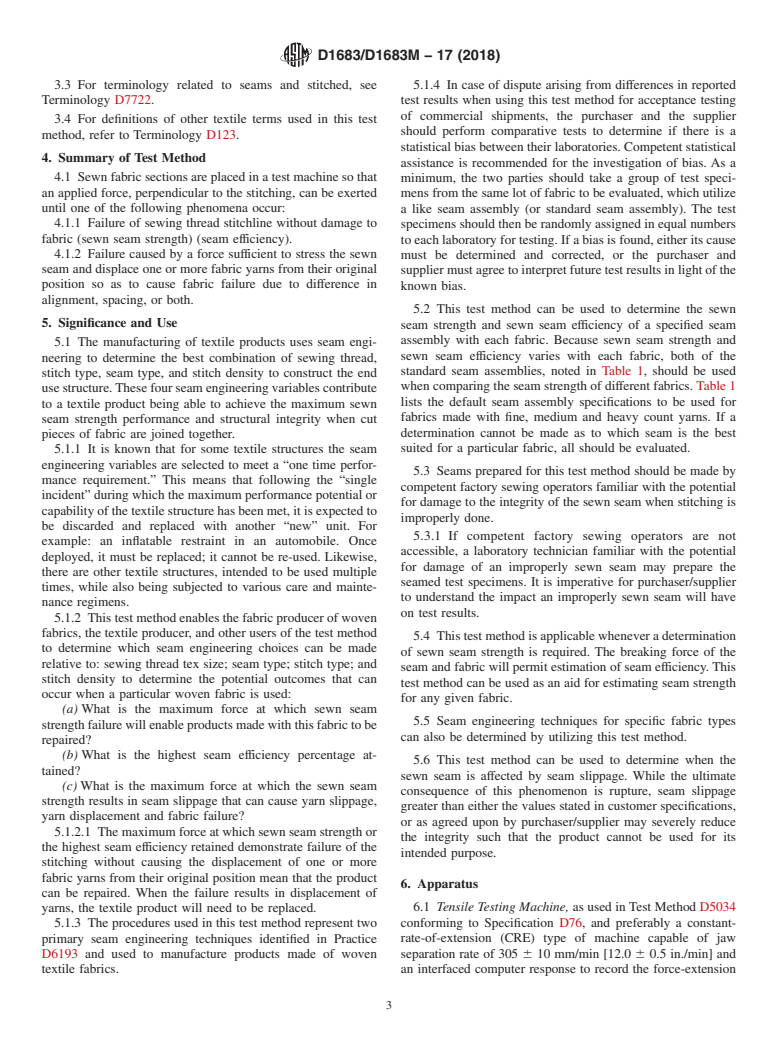
5.1 The manufacturing of textile products uses seam engineering to determine the best combination of sewing thread, stitch type, seam type, and stitch density to construct the end use structure. These four seam engineering variables contribute to a textile product being able to achieve the maximum sewn seam strength performance and structural integrity when cut pieces of fabric are joined together.
5.1.1 It is known that for some textile structures the seam engineering variables are selected to meet a “one time performance requirement.” This means that following the “single incident” during which the maximum performance potential or capability of the textile structure has been met, it is expected to be discarded and replaced with another “new” unit. For example: an inflatable restraint in an automobile. Once deployed, it must be replaced; it cannot be re-used. Likewise, there are other textile structures, intended to be used multiple times, while also being subjected to various care and maintenance regimens.
5.1.2 This test method enables the fabric producer of woven fabrics, the textile producer, and other users of the test method to determine which seam engineering choices can be made relative to: sewing thread tex size; seam type; stitch type; and stitch density to determine the potential outcomes that can occur when a particular woven fabric is used:
(a) What is the maximum force at which sewn seam strength failure will enable products made with this fabric to be repaired?
(b) What is the highest seam efficiency percentage attained?
(c) What is the maximum force at which the sewn seam strength results in seam slippage that can cause yarn slippage, yarn displacement and fabric failure?
5.1.2.1 The maximum force at which sewn seam strength or the highest seam efficiency retained demonstrate failure of the stitching without causing the displacement of one or more fabric yarns from their original position mean that the product can be repaired. When the...
SCOPE
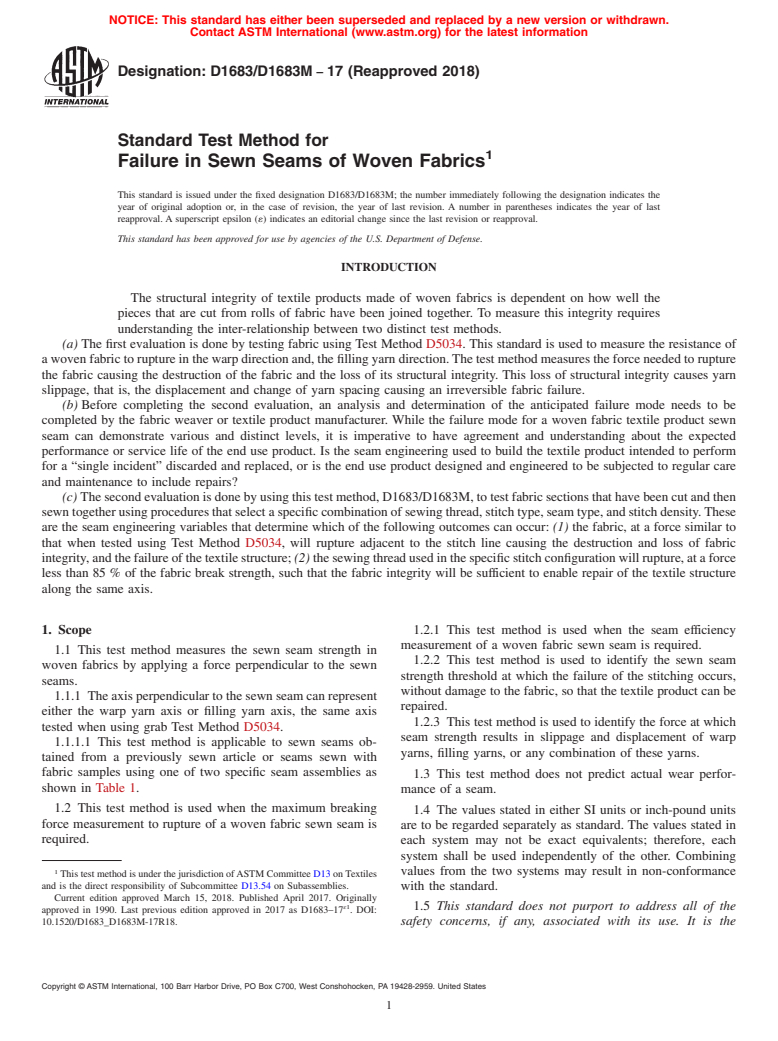
1.1 This test method measures the sewn seam strength in woven fabrics by applying a force perpendicular to the sewn seams.
1.1.1 The axis perpendicular to the sewn seam can represent either the warp yarn axis or filling yarn axis, the same axis tested when using grab Test Method D5034.
1.1.1.1 This test method is applicable to sewn seams obtained from a previously sewn article or seams sewn with fabric samples using one of two specific seam assemblies as shown in Table 1. (A) A complete description of seam types and stitch types can be found in Practice D6193.
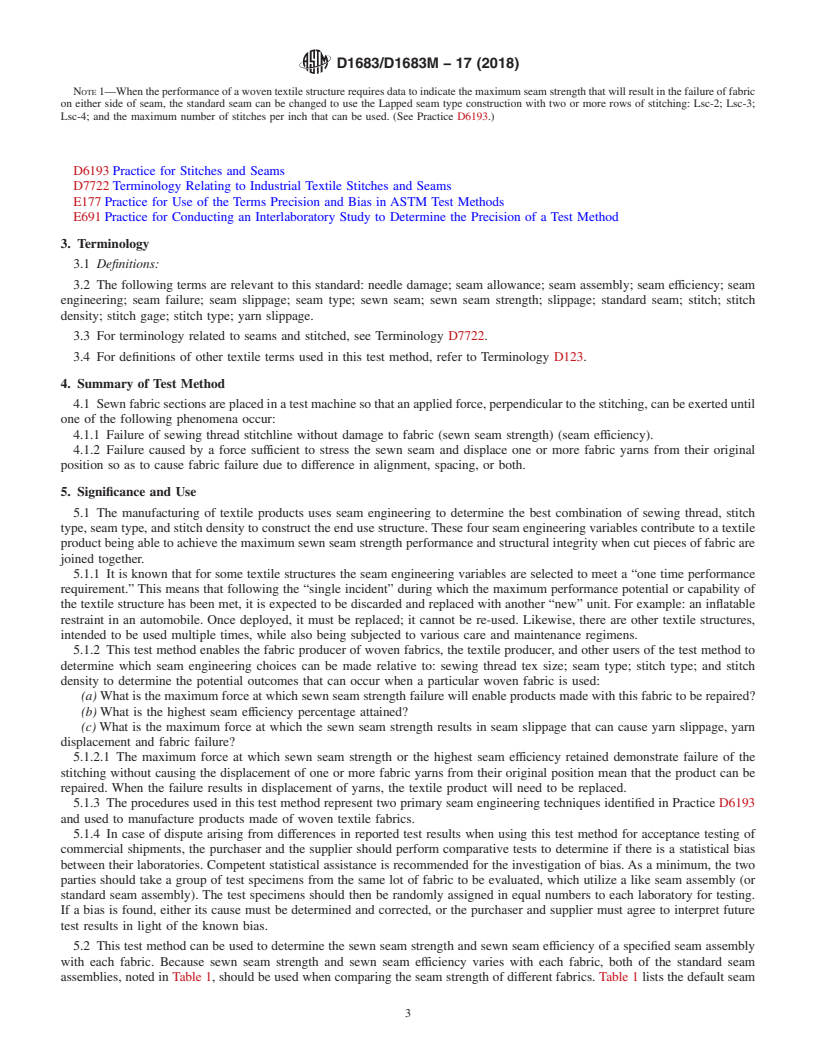
Note 1: When the performance of a woven textile structure requires data to indicate the maximum seam strength that will result in the failure of fabric on either side of seam, the standard seam can be changed to use the Lapped seam type construction with two or more rows of stitching: Lsc-2; Lsc-3; Lsc-4; and the maximum number of stitches per inch that can be used. (See Practice D6193.)
1.2 This test method is used when the maximum breaking force measurement to rupture of a woven fabric sewn seam is required.
1.2.1 This test method is used when the seam efficiency measurement of a woven fabric sewn seam is required.
1.2.2 This test method is used to identify the sewn seam strength threshold at which the failure of the stitching occurs, without damage to the fabric, so that the textile product can be repaired.
1.2.3 This test method is used to identify the force at which seam strength results in slippage and displacement of warp yarns, filling yarns, or any combination of these yarns.
1.3 This test method does not predict actual wear performance of a seam.
1.4 The values stated in either SI units or inch-pound units are to be regarded separately as standard. The values stated in each system may not be exact equivalents; therefore, each system shall be used independently of the other. Combining values from the two systems may result in non-...
General Information
Buy Standard
Standards Content (Sample)
NOTICE: This standard has either been superseded and replaced by a new version or withdrawn.
Contact ASTM International (www.astm.org) for the latest information
Designation:D1683/D1683M −17 (Reapproved 2018)
Standard Test Method for
Failure in Sewn Seams of Woven Fabrics
This standard is issued under the fixed designation D1683/D1683M; the number immediately following the designation indicates the
year of original adoption or, in the case of revision, the year of last revision. A number in parentheses indicates the year of last
reapproval. A superscript epsilon (´) indicates an editorial change since the last revision or reapproval.
This standard has been approved for use by agencies of the U.S. Department of Defense.
INTRODUCTION
The structural integrity of textile products made of woven fabrics is dependent on how well the
pieces that are cut from rolls of fabric have been joined together. To measure this integrity requires
understanding the inter-relationship between two distinct test methods.
(a) The first evaluation is done by testing fabric using Test Method D5034. This standard is used to measure the resistance of
awovenfabrictoruptureinthewarpdirectionand,thefillingyarndirection.Thetestmethodmeasurestheforceneededtorupture
the fabric causing the destruction of the fabric and the loss of its structural integrity. This loss of structural integrity causes yarn
slippage, that is, the displacement and change of yarn spacing causing an irreversible fabric failure.
(b) Before completing the second evaluation, an analysis and determination of the anticipated failure mode needs to be
completed by the fabric weaver or textile product manufacturer. While the failure mode for a woven fabric textile product sewn
seam can demonstrate various and distinct levels, it is imperative to have agreement and understanding about the expected
performance or service life of the end use product. Is the seam engineering used to build the textile product intended to perform
for a “single incident” discarded and replaced, or is the end use product designed and engineered to be subjected to regular care
and maintenance to include repairs?
(c) Thesecondevaluationisdonebyusingthistestmethod,D1683/D1683M,totestfabricsectionsthathavebeencutandthen
sewntogetherusingproceduresthatselectaspecificcombinationofsewingthread,stitchtype,seamtype,andstitchdensity.These
are the seam engineering variables that determine which of the following outcomes can occur: (1) the fabric, at a force similar to
that when tested using Test Method D5034, will rupture adjacent to the stitch line causing the destruction and loss of fabric
integrity,andthefailureofthetextilestructure; (2)thesewingthreadusedinthespecificstitchconfigurationwillrupture,ataforce
less than 85 % of the fabric break strength, such that the fabric integrity will be sufficient to enable repair of the textile structure
along the same axis.
1. Scope 1.2.1 This test method is used when the seam efficiency
measurement of a woven fabric sewn seam is required.
1.1 This test method measures the sewn seam strength in
1.2.2 This test method is used to identify the sewn seam
woven fabrics by applying a force perpendicular to the sewn
strength threshold at which the failure of the stitching occurs,
seams.
without damage to the fabric, so that the textile product can be
1.1.1 The axis perpendicular to the sewn seam can represent
repaired.
either the warp yarn axis or filling yarn axis, the same axis
1.2.3 This test method is used to identify the force at which
tested when using grab Test Method D5034.
seam strength results in slippage and displacement of warp
1.1.1.1 This test method is applicable to sewn seams ob-
yarns, filling yarns, or any combination of these yarns.
tained from a previously sewn article or seams sewn with
fabric samples using one of two specific seam assemblies as
1.3 This test method does not predict actual wear perfor-
shown in Table 1.
mance of a seam.
1.2 This test method is used when the maximum breaking
1.4 The values stated in either SI units or inch-pound units
force measurement to rupture of a woven fabric sewn seam is
are to be regarded separately as standard. The values stated in
required.
each system may not be exact equivalents; therefore, each
system shall be used independently of the other. Combining
1 values from the two systems may result in non-conformance
This test method is under the jurisdiction ofASTM Committee D13 on Textiles
and is the direct responsibility of Subcommittee D13.54 on Subassemblies.
with the standard.
Current edition approved March 15, 2018. Published April 2017. Originally
ɛ1
1.5 This standard does not purport to address all of the
approved in 1990. Last previous edition approved in 2017 as D1683–17 . DOI:
10.1520/D1683_D1683M-17R18. safety concerns, if any, associated with its use. It is the
Copyright © ASTM International, 100 Barr Harbor Drive, PO Box C700, West Conshohocken, PA 19428-2959. United States
D1683/D1683M−17 (2018)
A
TABLE 1 Standard/Default Seam Assembly Specification
2 2
Fabric Mass:# 4 oz/yd [130 g/m ]
Procedure A Procedure B
2 2 2 2
Mass up to 4 oz/yd [130 g ⁄m ] up to 4 oz/yd [130 g ⁄m ]
Seam allowance 13 mm [0.5 in.] 13 mm [0.5 in.]
Needle:
Size Metric 90 [0.036 in.] Metric 90 [0.036 in.]
Finish chrome chrome
Point thin ball (No. 1/No. 23) thin ball (No. 1/No. 23)
Sewing thread size:
Spun Polyester Tex 40 Tex 40
Polyester-Core Tex 40 Tex 40
Seam Type Ssa-1 Ssa-1
Stitch Type 301 401
1 1
Stitch Density 4.7 ± ⁄2 stitches per centimetre 4.7 ± ⁄2 stitches per centimetre
1 1
[12 ± ⁄2 stitches per inch] [12 ± ⁄2 stitches per inch]
2 2 2 2
Fabric Mass: > 4 oz/yd [130 g/m ]# 8 oz/yd [270 g/m ]
Procedure A Procedure B
2 2 2
2 2 2 2 2
Mass 4 oz/yd [130 g/m ] up to 8 oz/yd 270 g/m 4 oz/yd [130 g/m ]upto270g/m [8 oz/yd ]
Seam Allowance 13 mm [0.5 in.] 13 mm [0.5 in.]
Needle:
Size Metric 110 [0.044 in.] Metric 110 [0.044 in.]
Finish chrome chrome
Point ball ball
Sewing Thread:
Spun Polyester Tex 60 Tex 60
Polyester-Core Tex 60 Tex 60
Seam type SSa-1 SSa-1
Stitch type 301 401
1 1
Stitch density 3.1 ± ⁄2 stitches per centimetre 3.1 ± ⁄2 stitches per centimetre
1 1
[8 ± ⁄2 stitches per inch] [8.5 ± ⁄2 stitches per inch]
2 2 2 2
Fabric Mass: > 8 oz/yd [270 g/m ]# 12 oz/yd [405 g/m ]
2 2 2 2 2 2 2 2
Mass 8 oz/yd [270 g/m ]upto12oz/yd [405 g/m ] 8 oz/yd [270 g/m ]upto12oz/yd [405 g/m ]
Seam allowance 13 mm [0.5 in.] 13 mm [0.5 in.]
Needle:
Size Metric 120 Metric 120
Finish chrome chrome
Point ball ball
Sewing thread size:
Spun Polyester Tex 80 Tex 80
Polyester-Core Tex 80 Tex 80
Seam type Ssa-1 SSa-1
Stitch type 301 401
1 1
Stitch density 3.1 ± ⁄2 stitches per centimetre 3.1 ± ⁄2 stitches per centimetre
1 1
[8 ± ⁄2 stitches per inch] [8.5 ± ⁄2 stitches per inch]
A
A complete description of seam types and stitch types can be found in Practice D6193.
NOTE 1—When the performance of a woven textile structure requires data to indicate the maximum seam strength that will result in the failure of fabric
on either side of seam, the standard seam can be changed to use the Lapped seam type construction with two or more rows of stitching: Lsc-2; Lsc-3;
Lsc-4; and the maximum number of stitches per inch that can be used. (See Practice D6193.)
responsibility of the user of this standard to establish appro- D1776 Practice for Conditioning and Testing Textiles
priate safety, health, and environmental practices and deter- D5034 TestMethodforBreakingStrengthandElongationof
mine the applicability of regulatory limitations prior to use. Textile Fabrics (Grab Test)
1.6 This international standard was developed in accor- D6193 Practice for Stitches and Seams
dance with internationally recognized principles on standard- D7722 Terminology Relating to Industrial Textile Stitches
ization established in the Decision on Principles for the and Seams
Development of International Standards, Guides and Recom- E177 Practice for Use of the Terms Precision and Bias in
mendations issued by the World Trade Organization Technical ASTM Test Methods
Barriers to Trade (TBT) Committee. E691 Practice for Conducting an Interlaboratory Study to
Determine the Precision of a Test Method
2. Referenced Documents
2.1 ASTM Standards: 3. Terminology
D76 Specification for Tensile Testing Machines for Textiles
3.1 Definitions:
D123 Terminology Relating to Textiles
3.2 Thefollowingtermsarerelevanttothisstandard:needle
damage; seam allowance; seam assembly; seam efficiency;
For referenced ASTM standards, visit the ASTM website, www.astm.org, or
seam engineering; seam failure; seam slippage; seam type;
contact ASTM Customer Service at service@astm.org. For Annual Book of ASTM
sewn seam; sewn seam strength; slippage; standard seam;
Standards volume information, refer to the standard’s Document Summary page on
the ASTM website. stitch; stitch density; stitch gage; stitch type; yarn slippage.
D1683/D1683M−17 (2018)
3.3 For terminology related to seams and stitched, see 5.1.4 In case of dispute arising from differences in reported
Terminology D7722. test results when using this test method for acceptance testing
of commercial shipments, the purchaser and the supplier
3.4 For definitions of other textile terms used in this test
should perform comparative tests to determine if there is a
method, refer to Terminology D123.
statistical bias between their laboratories. Competent statistical
4. Summary of Test Method
assistance is recommended for the investigation of bias. As a
4.1 Sewn fabric sections are placed in a test machine so that minimum, the two parties should take a group of test speci-
an applied force, perpendicular to the stitching, can be exerted
mens from the same lot of fabric to be evaluated, which utilize
until one of the following phenomena occur: a like seam assembly (or standard seam assembly). The test
4.1.1 Failure of sewing thread stitchline without damage to
specimens should then be randomly assigned in equal numbers
fabric (sewn seam strength) (seam efficiency).
to each laboratory for testing. If a bias is found, either its cause
4.1.2 Failure caused by a force sufficient to stress the sewn
must be determined and corrected, or the purchaser and
seam and displace one or more fabric yarns from their original
supplier must agree to interpret future test results in light of the
position so as to cause fabric failure due to difference in
known bias.
alignment, spacing, or both.
5.2 This test method can be used to determine the sewn
5. Significance and Use
seam strength and sewn seam efficiency of a specified seam
assembly with each fabric. Because sewn seam strength and
5.1 The manufacturing of textile products uses seam engi-
sewn seam efficiency varies with each fabric, both of the
neering to determine the best combination of sewing thread,
standard seam assemblies, noted in Table 1, should be used
stitch type, seam type, and stitch density to construct the end
when comparing the seam strength of different fabrics. Table 1
usestructure.Thesefourseamengineeringvariablescontribute
lists the default seam assembly specifications to be used for
to a textile product being able to achieve the maximum sewn
fabrics made with fine, medium and heavy count yarns. If a
seam strength performance and structural integrity when cut
determination cannot be made as to which seam is the best
pieces of fabric are joined together.
suited for a particular fabric, all should be evaluated.
5.1.1 It is known that for some textile structures the seam
engineering variables are selected to meet a “one time perfor-
5.3 Seams prepared for this test method should be made by
mance requirement.” This means that following the “single
competent factory sewing operators familiar with the potential
incident” during which the maximum performance potential or
for damage to the integrity of the sewn seam when stitching is
capability of the textile structure has been met, it is expected to
improperly done.
be discarded and replaced with another “new” unit. For
5.3.1 If competent factory sewing operators are not
example: an inflatable restraint in an automobile. Once
accessible, a laboratory technician familiar with the potential
deployed, it must be replaced; it cannot be re-used. Likewise,
for damage of an improperly sewn seam may prepare the
there are other textile structures, intended to be used multiple
seamed test specimens. It is imperative for purchaser/supplier
times, while also being subjected to various care and mainte-
to understand the impact an improperly sewn seam will have
nance regimens.
on test results.
5.1.2 This test method enables the fabric producer of woven
fabrics, the textile producer, and other users of the test method
5.4 This test method is applicable whenever a determination
to determine which seam engineering choices can be made
of sewn seam strength is required. The breaking force of the
relative to: sewing thread tex size; seam type; stitch type; and
seam and fabric will permit estimation of seam efficiency. This
stitch density to determine the potential outcomes that can
test method can be used as an aid for estimating seam strength
occur when a particular woven fabric is used:
for any given fabric.
(a) What is the maximum force at which sewn seam
5.5 Seam engineering techniques for specific fabric types
strengthfailurewillenableproductsmadewiththisfabrictobe
can also be determined by utilizing this test method.
repaired?
(b) What is the highest seam efficiency percentage at-
5.6 This test method can be used to determine when the
tained?
sewn seam is affected by seam slippage. While the ultimate
(c) What is the maximum force at which the sewn seam
consequence of this phenomenon is rupture, seam slippage
strength results in seam slippage that can cause yarn slippage,
greater than either the values stated in customer specifications,
yarn displacement and fabric failure?
or as agreed upon by purchaser/supplier may severely reduce
5.1.2.1 The maximum force at which sewn seam strength or
the integrity such that the product cannot be used for its
the highest seam efficiency retained demonstrate failure of the
intended purpose.
stitching without causing the displacement of one or more
fabric yarns from their original position mean that the product
6. Apparatus
can be repaired. When the failure results in displacement of
yarns, the textile product will need to be replaced. 6.1 Tensile Testing Machine, as used in Test Method D5034
conforming to Specification D76, and preferably a constant-
5.1.3 The procedures used in this test method represent two
primary seam engineering techniques identified in Practice rate-of-extension (CRE) type of machine capable of jaw
separation rate of 305 6 10 mm/min [12.0 6 0.5 in./min] and
D6193 and used to manufacture products made of woven
textile fabrics. an interfaced computer response to record the force-extension
...
This document is not an ASTM standard and is intended only to provide the user of an ASTM standard an indication of what changes have been made to the previous version. Because
it may not be technically possible to adequately depict all changes accurately, ASTM recommends that users consult prior editions as appropriate. In all cases only the current version
of the standard as published by ASTM is to be considered the official document.
´1
Designation: D1683/D1683M − 17 D1683/D1683M − 17 (Reapproved 2018)
Standard Test Method for
Failure in Sewn Seams of Woven Fabrics
This standard is issued under the fixed designation D1683/D1683M; the number immediately following the designation indicates the
year of original adoption or, in the case of revision, the year of last revision. A number in parentheses indicates the year of last
reapproval. A superscript epsilon (´) indicates an editorial change since the last revision or reapproval.
This standard has been approved for use by agencies of the U.S. Department of Defense.
ε NOTE—In Table 1, the second and third column headings were corrected from “Fabric Mass: ≥ .” to “Fabric Mass:
>.” in September 2017.
INTRODUCTION
The structural integrity of textile products made of woven fabrics is dependent on how well the
pieces that are cut from rolls of fabric have been joined together. To measure this integrity requires
understanding the inter-relationship between two distinct test methods.
(a) The first evaluation is done by testing fabric using Test Method D5034. This standard is used to measure the resistance of
a woven fabric to rupture in the warp direction and, the filling yarn direction. The test method measures the force needed to rupture
the fabric causing the destruction of the fabric and the loss of its structural integrity. This loss of structural integrity causes yarn
slippage, that is, the displacement and change of yarn spacing causing an irreversible fabric failure.
(b) Before completing the second evaluation, an analysis and determination of the anticipated failure mode needs to be
completed by the fabric weaver or textile product manufacturer. While the failure mode for a woven fabric textile product sewn
seam can demonstrate various and distinct levels, it is imperative to have agreement and understanding about the expected
performance or service life of the end use product. Is the seam engineering used to build the textile product intended to perform
for a “single incident” discarded and replaced, or is the end use product designed and engineered to be subjected to regular care
and maintenance to include repairs?
(c) The second evaluation is done by using this test method, D1683/D1683M, to test fabric sections that have been cut and then
sewn together using procedures that select a specific combination of sewing thread, stitch type, seam type, and stitch density. These
are the seam engineering variables that determine which of the following outcomes can occur: (1) the fabric, at a force similar to
that when tested using Test Method D5034, will rupture adjacent to the stitch line causing the destruction and loss of fabric
integrity, and the failure of the textile structure; (2) the sewing thread used in the specific stitch configuration will rupture, at a force
less than 85 % of the fabric break strength, such that the fabric integrity will be sufficient to enable repair of the textile structure
along the same axis.
1. Scope
1.1 This test method measures the sewn seam strength in woven fabrics by applying a force perpendicular to the sewn seams.
1.1.1 The axis perpendicular to the sewn seam can represent either the warp yarn axis or filling yarn axis, the same axis tested
when using grab Test Method D5034.
1.1.1.1 This test method is applicable to sewn seams obtained from a previously sewn article or seams sewn with fabric samples
using one of two specific seam assemblies as shown in Table 1.
1.2 This test method is used when the maximum breaking force measurement to rupture of a woven fabric sewn seam is
required.
1.2.1 This test method is used when the seam efficiency measurement of a woven fabric sewn seam is required.
1.2.2 This test method is used to identify the sewn seam strength threshold at which the failure of the stitching occurs, without
damage to the fabric, so that the textile product can be repaired.
1.2.3 This test method is used to identify the force at which seam strength results in slippage and displacement of warp yarns,
filling yarns, or any combination of these yarns.
This test method is under the jurisdiction of ASTM Committee D13 on Textiles and is the direct responsibility of Subcommittee D13.54 on Subassemblies.
Current edition approved March 1, 2017March 15, 2018. Published April 2017. Originally approved in 1990. Last previous edition approved in 20162017 as
ɛ1
D1683–16.–17 . DOI: 10.1520/D1683_D1683M-17E01.10.1520/D1683_D1683M-17R18.
Copyright © ASTM International, 100 Barr Harbor Drive, PO Box C700, West Conshohocken, PA 19428-2959. United States
D1683/D1683M − 17 (2018)
A
TABLE 1 Standard/Default Seam Assembly Specification
2 2
Fabric Mass: # 4 oz/yd [130 g/m ]
Procedure A Procedure B
2 2 2 2
Mass up to 4 oz/yd [130 g ⁄m ] up to 4 oz/yd [130 g ⁄m ]
Seam allowance 13 mm [0.5 in.] 13 mm [0.5 in.]
Needle:
Size Metric 90 [0.036 in.] Metric 90 [0.036 in.]
Finish chrome chrome
Point thin ball (No. 1/No. 23) thin ball (No. 1/No. 23)
Sewing thread size:
Spun Polyester Tex 40 Tex 40
Polyester-Core Tex 40 Tex 40
Seam Type Ssa-1 Ssa-1
Stitch Type 301 401
1 1
Stitch Density 4.7 ± ⁄2 stitches per centimetre 4.7 ± ⁄2 stitches per centimetre
1 1
[12 ± ⁄2 stitches per inch] [12 ± ⁄2 stitches per inch]
2 2 2 2
Fabric Mass: > 4 oz/yd [130 g/m ] # 8 oz/yd [270 g/m ]
Procedure A Procedure B
2 2 2
2 2 2 2 2
Mass 4 oz/yd [130 g/m ] up to 8 oz/yd 270 g/m 4 oz/yd [130 g/m ] up to 270 g/m [8 oz/yd ]
Seam Allowance 13 mm [0.5 in.] 13 mm [0.5 in.]
Needle:
Size Metric 110 [0.044 in.] Metric 110 [0.044 in.]
Finish chrome chrome
Point ball ball
Sewing Thread:
Spun Polyester Tex 60 Tex 60
Polyester-Core Tex 60 Tex 60
Seam type SSa-1 SSa-1
Stitch type 301 401
1 1
Stitch density 3.1 ± ⁄2 stitches per centimetre 3.1 ± ⁄2 stitches per centimetre
1 1
[8 ± ⁄2 stitches per inch] [8.5 ± ⁄2 stitches per inch]
2 2 2 2
Fabric Mass: > 8 oz/yd [270 g/m ] # 12 oz/yd [405 g/m ]
2 2 2 2 2 2 2 2
Mass 8 oz/yd [270 g/m ] up to 12 oz/yd [405 g/m ] 8 oz/yd [270 g/m ] up to 12 oz/yd [405 g/m ]
Seam allowance 13 mm [0.5 in.] 13 mm [0.5 in.]
Needle:
Size Metric 120 Metric 120
Finish chrome chrome
Point ball ball
Sewing thread size:
Spun Polyester Tex 80 Tex 80
Polyester-Core Tex 80 Tex 80
Seam type Ssa-1 SSa-1
Stitch type 301 401
1 1
Stitch density 3.1 ± ⁄2 stitches per centimetre 3.1 ± ⁄2 stitches per centimetre
1 1
[8 ± ⁄2 stitches per inch] [8.5 ± ⁄2 stitches per inch]
A
A complete description of seam types and stitch types can be found in Practice D6193.
1.3 This test method does not predict actual wear performance of a seam.
1.4 The values stated in either SI units or inch-pound units are to be regarded separately as standard. The values stated in each
system may not be exact equivalents; therefore, each system shall be used independently of the other. Combining values from the
two systems may result in non-conformance with the standard.
1.5 This standard does not purport to address all of the safety concerns, if any, associated with its use. It is the responsibility
of the user of this standard to establish appropriate safety, health, and environmental practices and determine the applicability of
regulatory limitations prior to use.
1.6 This international standard was developed in accordance with internationally recognized principles on standardization
established in the Decision on Principles for the Development of International Standards, Guides and Recommendations issued
by the World Trade Organization Technical Barriers to Trade (TBT) Committee.
2. Referenced Documents
2.1 ASTM Standards:
D76 Specification for Tensile Testing Machines for Textiles
D123 Terminology Relating to Textiles
D1776 Practice for Conditioning and Testing Textiles
D5034 Test Method for Breaking Strength and Elongation of Textile Fabrics (Grab Test)
For referenced ASTM standards, visit the ASTM website, www.astm.org, or contact ASTM Customer Service at service@astm.org. For Annual Book of ASTM Standards
volume information, refer to the standard’s Document Summary page on the ASTM website.
D1683/D1683M − 17 (2018)
NOTE 1—When the performance of a woven textile structure requires data to indicate the maximum seam strength that will result in the failure of fabric
on either side of seam, the standard seam can be changed to use the Lapped seam type construction with two or more rows of stitching: Lsc-2; Lsc-3;
Lsc-4; and the maximum number of stitches per inch that can be used. (See Practice D6193.)
D6193 Practice for Stitches and Seams
D7722 Terminology Relating to Industrial Textile Stitches and Seams
E177 Practice for Use of the Terms Precision and Bias in ASTM Test Methods
E691 Practice for Conducting an Interlaboratory Study to Determine the Precision of a Test Method
3. Terminology
3.1 Definitions:
3.2 The following terms are relevant to this standard: needle damage; seam allowance; seam assembly; seam efficiency; seam
engineering; seam failure; seam slippage; seam type; sewn seam; sewn seam strength; slippage; standard seam; stitch; stitch
density; stitch gage; stitch type; yarn slippage.
3.3 For terminology related to seams and stitched, see Terminology D7722.
3.4 For definitions of other textile terms used in this test method, refer to Terminology D123.
4. Summary of Test Method
4.1 Sewn fabric sections are placed in a test machine so that an applied force, perpendicular to the stitching, can be exerted until
one of the following phenomena occur:
4.1.1 Failure of sewing thread stitchline without damage to fabric (sewn seam strength) (seam efficiency).
4.1.2 Failure caused by a force sufficient to stress the sewn seam and displace one or more fabric yarns from their original
position so as to cause fabric failure due to difference in alignment, spacing, or both.
5. Significance and Use
5.1 The manufacturing of textile products uses seam engineering to determine the best combination of sewing thread, stitch
type, seam type, and stitch density to construct the end use structure. These four seam engineering variables contribute to a textile
product being able to achieve the maximum sewn seam strength performance and structural integrity when cut pieces of fabric are
joined together.
5.1.1 It is known that for some textile structures the seam engineering variables are selected to meet a “one time performance
requirement.” This means that following the “single incident” during which the maximum performance potential or capability of
the textile structure has been met, it is expected to be discarded and replaced with another “new” unit. For example: an inflatable
restraint in an automobile. Once deployed, it must be replaced; it cannot be re-used. Likewise, there are other textile structures,
intended to be used multiple times, while also being subjected to various care and maintenance regimens.
5.1.2 This test method enables the fabric producer of woven fabrics, the textile producer, and other users of the test method to
determine which seam engineering choices can be made relative to: sewing thread tex size; seam type; stitch type; and stitch
density to determine the potential outcomes that can occur when a particular woven fabric is used:
(a) What is the maximum force at which sewn seam strength failure will enable products made with this fabric to be repaired?
(b) What is the highest seam efficiency percentage attained?
(c) What is the maximum force at which the sewn seam strength results in seam slippage that can cause yarn slippage, yarn
displacement and fabric failure?
5.1.2.1 The maximum force at which sewn seam strength or the highest seam efficiency retained demonstrate failure of the
stitching without causing the displacement of one or more fabric yarns from their original position mean that the product can be
repaired. When the failure results in displacement of yarns, the textile product will need to be replaced.
5.1.3 The procedures used in this test method represent two primary seam engineering techniques identified in Practice D6193
and used to manufacture products made of woven textile fabrics.
5.1.4 In case of dispute arising from differences in reported test results when using this test method for acceptance testing of
commercial shipments, the purchaser and the supplier should perform comparative tests to determine if there is a statistical bias
between their laboratories. Competent statistical assistance is recommended for the investigation of bias. As a minimum, the two
parties should take a group of test specimens from the same lot of fabric to be evaluated, which utilize a like seam assembly (or
standard seam assembly). The test specimens should then be randomly assigned in equal numbers to each laboratory for testing.
If a bias is found, either its cause must be determined and corrected, or the purchaser and supplier must agree to interpret future
test results in light of the known bias.
5.2 This test method can be used to determine the sewn seam strength and sewn seam efficiency of a specified seam assembly
with each fabric. Because sewn seam strength and sewn seam efficiency varies with each fabric, both of the standard seam
assemblies, noted in Table 1, should be used when comparing the seam strength of different fabrics. Table 1 lists the default seam
D1683/D1683M − 17 (2018)
assembly specifications to be used for fabrics made with fine, medium and heavy count yarns. If a determination cannot be made
as to which seam is the best suited for a particular fabric, all should be evaluated.
5.3 Seams prepared for this test method should be made by competent factory sewing operators familiar with the potential for
damage to the integrity of the sewn seam when stitching is improperly done.
5.3.1 If competent factory sewing operators are not accessible, a laboratory technician familiar with the potential for damage
of an improperly sewn seam may prepare the seamed test specimens. It is imperative for purchaser/supplier to understand the
impact an improperly sewn seam will have on test results.
5.4 This test method is applicable whenever a determination of sewn seam strength is required. The breaking force of the seam
and fabric will permit estimation of seam efficiency. This test method can be used as an aid for estimating seam strength for any
given fabric.
5.5 Seam engineering techniques for specific fabric types can also be determined by utilizing this test method.
5.6 This test method can be used to determ
...
Questions, Comments and Discussion
Ask us and Technical Secretary will try to provide an answer. You can facilitate discussion about the standard in here.