

ASTM D7588-11(2018)
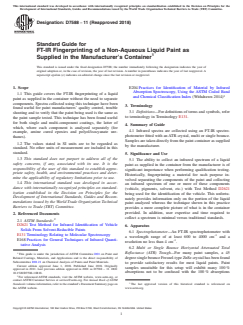
(Guide)Standard Guide for FT-IR Fingerprinting of a Non-Aqueous Liquid Paint as Supplied in the Manufacturer's Container
General Information
- Abstract
SIGNIFICANCE AND USE
5.1 The ability to collect an infrared spectrum of a liquid paint as supplied in the container from the manufacturer is of significant importance when performing qualification testing. Historically, fingerprinting a material for such purpose involved separating the components of the paint and collecting an infrared spectrum of one or more of these components (vehicle, pigments, solvent, etc.) with Test Method D2621 being used for the identification of the vehicle. This unfortunately provides information only on the portion of the liquid paint analyzed whereas the technique shown in this practice provides a more complete picture of what is in the container provided. In addition, user expertise and time required to collect a spectrum is minimal versus traditional standards.
SCOPE
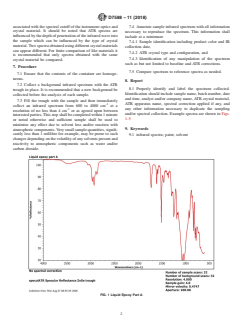
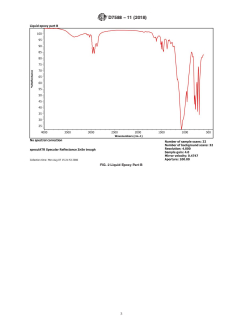
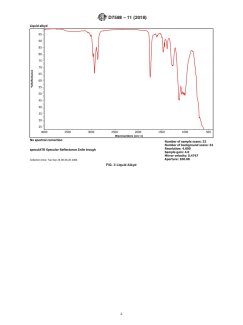
1.1 This guide covers the FT-IR fingerprinting of a liquid paint as supplied in the container without the need to separate components. Spectra collected using this technique have been found useful for paint manufacturers' quality control, trouble shooting and to verify that the paint being used is the same as the paint sample tested. This technique has been found useful for both single and multi-component coatings, the latter of which, where each component is analyzed separately (for example, amine cured epoxies and polyol/isocyanate urethanes).
1.2 The values stated in SI units are to be regarded as standard. No other units of measurement are included in this standard.
1.3 This standard does not purport to address all of the safety concerns, if any, associated with its use. It is the responsibility of the user of this standard to establish appropriate safety, health, and environmental practices and determine the applicability of regulatory limitations prior to use.
1.4 This international standard was developed in accordance with internationally recognized principles on standardization established in the Decision on Principles for the Development of International Standards, Guides and Recommendations issued by the World Trade Organization Technical Barriers to Trade (TBT) Committee.
- Status
- Published
- Publication Date
- 31-May-2018
- Technical Committee
- D01 - Paint and Related Coatings, Materials, and Applications
- Drafting Committee
- D01.21 - Chemical Analysis of Paints and Paint Materials
Overview
ASTM D7588-11(2018), “Standard Guide for FT-IR Fingerprinting of a Non-Aqueous Liquid Paint as Supplied in the Manufacturer's Container,” provides essential guidance for the rapid and effective fingerprinting of liquid paints using Fourier Transform Infrared (FT-IR) Spectroscopy. Published by ASTM International, this standard enables laboratories and manufacturers to verify the composition and ensure quality control of non-aqueous liquid paints without separating individual components. By analyzing the paint as supplied in the manufacturer's container, FT-IR fingerprinting streamlines traditional testing processes, requiring less expertise and offering a more comprehensive view of the material present.
Key Topics
- FT-IR Fingerprinting Process: The standard outlines methods for collecting infrared spectra from liquid paints directly from the container using attenuated total reflectance (ATR) techniques.
- Quality Control and Verification: FT-IR spectra provide a distinctive fingerprint for paint batches, aiding in troubleshooting and confirming product consistency during quality control operations.
- Simplified Protocol: Unlike traditional methods that involve separating pigments, vehicles, solvents, or other components, this approach analyzes the whole liquid paint, giving a more holistic profile.
- Applicability: The guide is suitable for single and multi-component coatings, including systems like amine-cured epoxies and polyol/isocyanate urethanes, where components can also be analyzed individually.
- Data Integrity and Reporting: The standard emphasizes clear identification, documentation, and reproducibility of spectra, including details such as sample identification, ATR crystal material, and any spectrum manipulation applied.
- Instrument Requirements: Recommendations for the FT-IR spectrophotometer and specific ATR accessories ensure reliable results across different laboratories.
Applications
ASTM D7588-11(2018) is highly valuable in a range of practical scenarios, including:
- Manufacturing Quality Control: Paint manufacturers can use FT-IR fingerprinting to quickly check incoming products, monitor consistency between batches, and identify issues early in the production process.
- Troubleshooting Product Issues: When performance anomalies or customer complaints arise, FT-IR spectra help to determine if the paint in use matches the original qualified material, thus aiding root cause analysis.
- Regulatory and Compliance Testing: The standard supports objective verification of product identity for regulatory compliance without the need for complex separations or destructive analyses.
- Multi-Component Verification: For complex coating systems with multiple parts, the procedure allows individual analysis of each component, enhancing traceability and batch matching.
By using ASTM D7588, laboratories and manufacturers save time and reduce the need for highly specialized personnel while gaining confidence in the integrity and traceability of their paint products.
Related Standards
For laboratories and quality managers working with paint and coatings analysis, the following documents provide complementary techniques and terminology:
- ASTM D2621 - Test Method for Infrared Identification of Vehicle Solids from Solvent-Reducible Paints: Focuses on the analysis of isolated paint vehicles.
- ASTM E131 - Terminology Relating to Molecular Spectroscopy: Standard definitions for key terms in spectroscopy.
- ASTM E168 - Practices for General Techniques of Infrared Quantitative Analysis: Guidelines for broader practices in infrared analysis.
- Withdrawn ASTM E204 - Practices for Identification of Materials by Infrared Absorption Spectroscopy using the ASTM Coded Band and Chemical Classification Index.
By integrating ASTM D7588-11(2018) and related infrared spectroscopy standards, companies improve their analytical efficiency, enhance compliance, and ensure the continued reliability of paint products in their supply chain.
Keywords: FT-IR fingerprinting, liquid paint analysis, quality control, ASTM D7588, non-aqueous paint, ATR spectroscopy, coating verification, infrared spectra.
Relations
- Effective Date
- 01-Jun-2018
- Effective Date
- 01-Dec-2016
- Effective Date
- 01-Jun-2011
- Effective Date
- 01-Mar-2010
- Effective Date
- 01-Dec-2007
- Effective Date
- 01-Mar-2006
- Effective Date
- 01-Sep-2005
- Effective Date
- 01-Jul-2005
- Refers
ASTM E168-99(2004) - Standard Practices for General Techniques of Infrared Quantitative Analysis - Effective Date
- 01-Feb-2004
- Effective Date
- 10-Sep-2002
- Effective Date
- 10-Sep-2000
- Effective Date
- 01-Jan-2000
- Effective Date
- 01-Jan-2000
- Effective Date
- 10-Oct-1999
- Effective Date
- 10-Dec-1998
Frequently Asked Questions
ASTM D7588-11(2018) is a guide published by ASTM International. Its full title is "Standard Guide for FT-IR Fingerprinting of a Non-Aqueous Liquid Paint as Supplied in the Manufacturer's Container". This standard covers: SIGNIFICANCE AND USE 5.1 The ability to collect an infrared spectrum of a liquid paint as supplied in the container from the manufacturer is of significant importance when performing qualification testing. Historically, fingerprinting a material for such purpose involved separating the components of the paint and collecting an infrared spectrum of one or more of these components (vehicle, pigments, solvent, etc.) with Test Method D2621 being used for the identification of the vehicle. This unfortunately provides information only on the portion of the liquid paint analyzed whereas the technique shown in this practice provides a more complete picture of what is in the container provided. In addition, user expertise and time required to collect a spectrum is minimal versus traditional standards. SCOPE 1.1 This guide covers the FT-IR fingerprinting of a liquid paint as supplied in the container without the need to separate components. Spectra collected using this technique have been found useful for paint manufacturers' quality control, trouble shooting and to verify that the paint being used is the same as the paint sample tested. This technique has been found useful for both single and multi-component coatings, the latter of which, where each component is analyzed separately (for example, amine cured epoxies and polyol/isocyanate urethanes). 1.2 The values stated in SI units are to be regarded as standard. No other units of measurement are included in this standard. 1.3 This standard does not purport to address all of the safety concerns, if any, associated with its use. It is the responsibility of the user of this standard to establish appropriate safety, health, and environmental practices and determine the applicability of regulatory limitations prior to use. 1.4 This international standard was developed in accordance with internationally recognized principles on standardization established in the Decision on Principles for the Development of International Standards, Guides and Recommendations issued by the World Trade Organization Technical Barriers to Trade (TBT) Committee.
SIGNIFICANCE AND USE 5.1 The ability to collect an infrared spectrum of a liquid paint as supplied in the container from the manufacturer is of significant importance when performing qualification testing. Historically, fingerprinting a material for such purpose involved separating the components of the paint and collecting an infrared spectrum of one or more of these components (vehicle, pigments, solvent, etc.) with Test Method D2621 being used for the identification of the vehicle. This unfortunately provides information only on the portion of the liquid paint analyzed whereas the technique shown in this practice provides a more complete picture of what is in the container provided. In addition, user expertise and time required to collect a spectrum is minimal versus traditional standards. SCOPE 1.1 This guide covers the FT-IR fingerprinting of a liquid paint as supplied in the container without the need to separate components. Spectra collected using this technique have been found useful for paint manufacturers' quality control, trouble shooting and to verify that the paint being used is the same as the paint sample tested. This technique has been found useful for both single and multi-component coatings, the latter of which, where each component is analyzed separately (for example, amine cured epoxies and polyol/isocyanate urethanes). 1.2 The values stated in SI units are to be regarded as standard. No other units of measurement are included in this standard. 1.3 This standard does not purport to address all of the safety concerns, if any, associated with its use. It is the responsibility of the user of this standard to establish appropriate safety, health, and environmental practices and determine the applicability of regulatory limitations prior to use. 1.4 This international standard was developed in accordance with internationally recognized principles on standardization established in the Decision on Principles for the Development of International Standards, Guides and Recommendations issued by the World Trade Organization Technical Barriers to Trade (TBT) Committee.
ASTM D7588-11(2018) is classified under the following ICS (International Classification for Standards) categories: 87.040 - Paints and varnishes. The ICS classification helps identify the subject area and facilitates finding related standards.
ASTM D7588-11(2018) has the following relationships with other standards: It is inter standard links to ASTM D7588-11, ASTM D2621-87(2016), ASTM D2621-87(2011), ASTM E131-10, ASTM E204-98(2007), ASTM E168-06, ASTM E131-05, ASTM D2621-87(2005), ASTM E168-99(2004), ASTM E131-02, ASTM E131-00a, ASTM D2621-87(1995)e1, ASTM D2621-87(2000), ASTM E168-99, ASTM E204-98(2002). Understanding these relationships helps ensure you are using the most current and applicable version of the standard.
ASTM D7588-11(2018) is available in PDF format for immediate download after purchase. The document can be added to your cart and obtained through the secure checkout process. Digital delivery ensures instant access to the complete standard document.
Standards Content (Sample)
This international standard was developed in accordance with internationally recognized principles on standardization established in the Decision on Principles for the
Development of International Standards, Guides and Recommendations issued by the World Trade Organization Technical Barriers to Trade (TBT) Committee.
Designation: D7588 − 11 (Reapproved 2018)
Standard Guide for
FT-IR Fingerprinting of a Non-Aqueous Liquid Paint as
Supplied in the Manufacturer’s Container
This standard is issued under the fixed designation D7588; the number immediately following the designation indicates the year of
original adoption or, in the case of revision, the year of last revision. A number in parentheses indicates the year of last reapproval. A
superscript epsilon (´) indicates an editorial change since the last revision or reapproval.
1. Scope E204 Practices for Identification of Material by Infrared
Absorption Spectroscopy, Using the ASTM Coded Band
1.1 This guide covers the FT-IR fingerprinting of a liquid
and Chemical Classification Index (Withdrawn 2014)
paint as supplied in the container without the need to separate
components. Spectra collected using this technique have been
3. Terminology
found useful for paint manufacturers’ quality control, trouble
3.1 Definitions—For definitions of terms and symbols, refer
shooting and to verify that the paint being used is the same as
to terminology in Terminology E131.
the paint sample tested. This technique has been found useful
for both single and multi-component coatings, the latter of
4. Summary of Guide
which, where each component is analyzed separately (for
4.1 Infrared spectra are collected using an FT-IR spectro-
example, amine cured epoxies and polyol/isocyanate ure-
photometer fitted with an ATR crystal, multi or single bounce.
thanes).
Samples are taken directly from the paint container as supplied
1.2 The values stated in SI units are to be regarded as
by the manufacturer.
standard. No other units of measurement are included in this
standard.
5. Significance and Use
1.3 This standard does not purport to address all of the
5.1 The ability to collect an infrared spectrum of a liquid
safety concerns, if any, associated with its use. It is the
paint as supplied in the container from the manufacturer is of
responsibility of the user of this standard to establish appro-
significant importance when performing qualification testing.
priate safety, health, and environmental practices and deter-
Historically, fingerprinting a material for such purpose in-
mine the applicability of regulatory limitations prior to use.
volved separating the components of the paint and collecting
1.4 This international standard was developed in accor-
an infrared spectrum of one or more of these components
dance with internationally recognized principles on standard-
(vehicle, pigments, solvent, etc.) with Test Method D2621
ization established in the Decision on Principles for the
being used for the identification of the vehicle. This unfortu-
Development of International Standards, Guides and Recom-
nately provides information only on the portion of the liquid
mendations issued by the World Trade Organization Technical
paint analyzed whereas the technique shown in this practice
Barriers to Trade (TBT) Committee.
provides a more complete picture of what is in the container
provided. In addition, user expertise and time required to
2. Referenced Documents
collect a spectrum is minimal versus traditional standards.
2.1 ASTM Standards:
D2621 Test Method for Infrared Identification of Vehicle
6. Apparatus
Solids From Solvent-Reducible Paints
6.1 Spectrophotometer—An FT-IR spectrophotometer with
E131 Terminology Relating to Molecular Spectroscopy
-1
a wavelength range of at least 600 to 4000 cm and a
E168 Practices for General Techniques of Infrared Quanti-
-1
resolution no less than 4 cm .
tative Analysis
6.2 Multi or Single Bounce Horizontal Attenuated Total
1 Reflectance (ATR) Trough—For many paint samples, a 45
This guide is under the jurisdiction of ASTM Committee D01 on Paint and
Related Coatings, Materials, and Applications and is the direct responsibility of degree single bounce Fresnel-type ZnSe crystal has been found
Subcommittee D01.21 on Chemical Analysis of Paints and Paint Materials.
to provide satisfactory results for most liquid paints. Paint
Current edition approved June 1, 2018. Published June 2018. Originally
samples unsuitable for this setup will exhibit many 100 %
approved in 2011. Last previous edition approved in 2001 as D7588 – 11. DOI:
absorptions not to be confused with the 100 % absorptions
10.1520/D7588-11R18.
For referenced ASTM stan
...