

ASTM E1760-16
(Guide)Standard Guide for Unrestricted Disposition of Bulk Materials Containing Residual Amounts of Radioactivity
General Information
- Abstract
SIGNIFICANCE AND USE
6.1 Materials encountered during D&D may contain residual radioactivity varying in amounts from that in irradiated fuel to barely detectable quantities in or on building materials. It is clear that highly radioactive materials have to be disposed as radioactive waste pursuant to 10 CFR 60 and 10 CFR 61. Conversely, it is not reasonable to expend a disproportionate amount of resources to isolate materials that contain minute quantities of radioactive materials that will not cause even statistically measurable health effects.
6.2 This guide provides a rationale and methodology for distinguishing between materials that contain sufficient radioactivity to warrant isolation of some type (such as storage awaiting decay, near-surface disposal, disposal with intruder protection, or placement in a deep repository) from materials with insignificant radioactive content. Materials with insignificant radioactive content can be recycled in the economy or disposed of in conventional (landfill) facilities without adverse health effects. Materials that meet the criteria identified in this guide are not simply excluded from regulation because they do not fall precisely in the regulatory scope. They are sufficiently free of radioactive material so that no further efforts at control are justified for radiation protection purposes. Therefore, the release of materials for unrestricted use in accordance with this guide meets the criteria for being an “as low as reasonably achievable” (ALARA) activity.
6.3 For the purpose of this guide, the return of materials containing residual radioactivity to society without regulatory restrictions is referred to as “unrestricted release based on the absence of the credible potential for adverse health effects.” This guide asserts that materials recycled this way will have no statistically measurable health effects regardless of use. It does not guarantee that the materials are suitable for use in every possible application, for example, trace am...
SCOPE
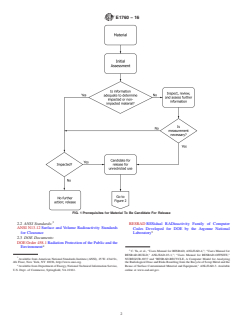
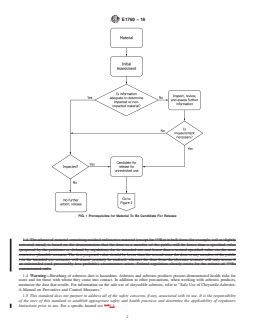
1.1 This guide provides an approach for developing a basis for obtaining approval for release of bulk materials to be removed from a decontamination and decommissioning (D&D) or environmental remediation site from regulatory control. This would be addressed in the decommissioning plan (Guide E1281). Fig. 1 follows the logic described in the MARSAME for determining the materials that could be considered for release. Materials that negotiate this logic tree are referred to as “candidate for release based on dose.”
1.2 For purposes of this guide, bulk materials shall consist of, for example, building materials, concrete rubble, soils, and internally contaminated or activated equipment and facility components.
1.3 This guide is intended to apply to those equipment and materials to be removed from the site for their disposition as opposed to real property (buildings and grounds) that are to remain.
1.4 Warning—Breathing of asbestos dust is hazardous. Asbestos and asbestos products present demonstrated health risks for users and for those with whom they come into contact. In addition to other precautions, when working with asbestos products, minimize the dust that results. For information on the safe use of chrysoltile asbestos, refer to “Safe Use of Chrysotile Asbestos: A Manual on Preventive and Control Measures.”
1.5 This standard does not purport to address all of the safety concerns, if any, associated with its use. It is the responsibility of the user of this standard to establish appropriate safety and health practices and determine the applicability of regulatory limitations prior to use. For a specific hazard see 1.4.
- Status
- Published
- Publication Date
- 30-Jun-2016
- Technical Committee
- E10 - Nuclear Technology and Applications
Buy Documents
ASTM E1760-16 - Standard Guide for Unrestricted Disposition of Bulk Materials Containing Residual Amounts of Radioactivity
REDLINE ASTM E1760-16 - Standard Guide for Unrestricted Disposition of Bulk Materials Containing Residual Amounts of Radioactivity
Overview
ASTM E1760-16 is the Standard Guide for Unrestricted Disposition of Bulk Materials Containing Residual Amounts of Radioactivity. Developed by ASTM International, this guide provides a framework for assessing whether bulk materials from decontamination and decommissioning (D&D) or environmental remediation sites can be safely released from regulatory control. The standard supports decisions on recycling or conventional disposal of such materials without undue risk to public health, provided that the content of residual radioactivity is insignificant.
By establishing rational methodology and documentation practices, ASTM E1760-16 helps ensure compliance with regulatory requirements and promotes the safe, effective, and resource-efficient management of materials with residual radioactivity.
Key Topics
Scope and Purpose
- Applies to bulk materials such as building materials, concrete rubble, soils, and internally contaminated equipment removed from D&D or remediation sites
- Does not apply to real property (e.g., buildings, grounds) that remain in place
- Differentiates between materials requiring controlled disposal and those suitable for unrestricted release
Significance and Use
- Addresses the need for proportionality in managing residual radioactivity risks
- Materials with negligible radioactivity can be recycled or disposed of in conventional facilities, meeting “as low as reasonably achievable” (ALARA) practices
- Supports documentation for regulatory approval, ensuring all decisions are traceable
Release Criteria
- Establishes that unrestricted disposition of materials is justified when it can be demonstrated that potential radiation doses-both from intended and plausible unintended uses-are below regulatory limits
- Guidance includes consideration of future uses and worst-case exposure scenarios
Process and Methodology
- Identification and characterization of materials, including radionuclide types and concentrations
- Determination of intended and unplanned use scenarios, with dose assessments using recognized models such as RESRAD
- Preparation of a comprehensive record package for regulatory review
Special Considerations
- Includes warnings related to other hazards such as asbestos
- Requires consideration of chemical or toxic hazards in addition to radiological risks
Applications
ASTM E1760-16 is highly relevant in several contexts:
Decontamination and Decommissioning (D&D) of Nuclear Facilities
- Enables organizations to systematically determine whether bulk debris can be released or must be controlled as radioactive waste
Environmental Remediation Projects
- Facilitates efficient disposition of soils, building materials, or equipment by distinguishing materials suitable for release from those needing containment
Regulatory Compliance
- Assists licensees, contractors, and regulators in applying a robust, transparent, and technically sound approach to the unrestricted release of materials
Recycling and Waste Management
- Encourages recycling or conventional landfill disposal of materials that meet safety criteria, supporting both environmental stewardship and economic efficiency
Documentation and Record Keeping
- Standardizes the process of compiling and submitting documentation to demonstrate compliance with radiological release criteria
Related Standards
For comprehensive and compliant implementation, ASTM E1760-16 should be used alongside several key standards and regulatory references:
- ASTM E1281 - Guide for Nuclear Facility Decommissioning Plans
- ASTM E1892 - Guide for Preparing Characterization Plans for Decommissioning Nuclear Facilities
- ASTM E2216 - Guide for Evaluating Disposal Options for Concrete from Nuclear Facility Decommissioning
- ASTM E1893 - Guide for Selection and Use of Portable Radiological Survey Instruments for Unrestricted Release
- ANSI N13.12 - Surface and Volume Radioactivity Standards for Clearance
- MARSAME/MARSSIM - Manuals for Radiation Survey and Assessment of Materials and Equipment
- RESRAD Codes - Computer models for radiological dose and risk assessment
- US NRC and EPA Regulations - 10 CFR 20, 10 CFR 60, 10 CFR 61, 40 CFR 192
Practical Value
Implementing ASTM E1760-16 facilitates informed, defensible, and cost-effective decision-making regarding the unrestricted disposition of bulk materials with residual radioactivity. The standard ensures protection of public health, optimizes resource utilization, and provides a consistent approach for regulatory approval, benefiting D&D projects, regulators, and the broader nuclear and environmental sectors.
Relations
- Effective Date
- 01-Jul-2016
- Effective Date
- 01-Jan-2013
- Effective Date
- 01-Oct-2010
- Effective Date
- 01-Jun-2009
- Effective Date
- 01-Nov-2008
- Effective Date
- 01-Jun-2008
- Effective Date
- 01-Jan-2008
- Effective Date
- 01-Aug-2005
- Effective Date
- 10-Jun-2002
- Effective Date
- 10-Jun-1997
- Effective Date
- 10-Jun-1997
- Effective Date
- 10-Jun-1997
- Effective Date
- 01-Jan-1989
- Effective Date
- 01-Jul-2016
- Effective Date
- 01-Jul-2016
Buy Documents
ASTM E1760-16 - Standard Guide for Unrestricted Disposition of Bulk Materials Containing Residual Amounts of Radioactivity
REDLINE ASTM E1760-16 - Standard Guide for Unrestricted Disposition of Bulk Materials Containing Residual Amounts of Radioactivity
Get Certified
Connect with accredited certification bodies for this standard

CIS Institut d.o.o.
Personal Protective Equipment (PPE) certification body. Notified Body NB-2890 for EU Regulation 2016/425 PPE.

Kiwa BDA Testing
Building and construction product certification.
Kmetijski inštitut Slovenije
Agricultural Institute of Slovenia. Soil testing, plant health, agricultural product analysis.
Sponsored listings
Frequently Asked Questions
ASTM E1760-16 is a guide published by ASTM International. Its full title is "Standard Guide for Unrestricted Disposition of Bulk Materials Containing Residual Amounts of Radioactivity". This standard covers: SIGNIFICANCE AND USE 6.1 Materials encountered during D&D may contain residual radioactivity varying in amounts from that in irradiated fuel to barely detectable quantities in or on building materials. It is clear that highly radioactive materials have to be disposed as radioactive waste pursuant to 10 CFR 60 and 10 CFR 61. Conversely, it is not reasonable to expend a disproportionate amount of resources to isolate materials that contain minute quantities of radioactive materials that will not cause even statistically measurable health effects. 6.2 This guide provides a rationale and methodology for distinguishing between materials that contain sufficient radioactivity to warrant isolation of some type (such as storage awaiting decay, near-surface disposal, disposal with intruder protection, or placement in a deep repository) from materials with insignificant radioactive content. Materials with insignificant radioactive content can be recycled in the economy or disposed of in conventional (landfill) facilities without adverse health effects. Materials that meet the criteria identified in this guide are not simply excluded from regulation because they do not fall precisely in the regulatory scope. They are sufficiently free of radioactive material so that no further efforts at control are justified for radiation protection purposes. Therefore, the release of materials for unrestricted use in accordance with this guide meets the criteria for being an “as low as reasonably achievable” (ALARA) activity. 6.3 For the purpose of this guide, the return of materials containing residual radioactivity to society without regulatory restrictions is referred to as “unrestricted release based on the absence of the credible potential for adverse health effects.” This guide asserts that materials recycled this way will have no statistically measurable health effects regardless of use. It does not guarantee that the materials are suitable for use in every possible application, for example, trace am... SCOPE 1.1 This guide provides an approach for developing a basis for obtaining approval for release of bulk materials to be removed from a decontamination and decommissioning (D&D) or environmental remediation site from regulatory control. This would be addressed in the decommissioning plan (Guide E1281). Fig. 1 follows the logic described in the MARSAME for determining the materials that could be considered for release. Materials that negotiate this logic tree are referred to as “candidate for release based on dose.” 1.2 For purposes of this guide, bulk materials shall consist of, for example, building materials, concrete rubble, soils, and internally contaminated or activated equipment and facility components. 1.3 This guide is intended to apply to those equipment and materials to be removed from the site for their disposition as opposed to real property (buildings and grounds) that are to remain. 1.4 Warning—Breathing of asbestos dust is hazardous. Asbestos and asbestos products present demonstrated health risks for users and for those with whom they come into contact. In addition to other precautions, when working with asbestos products, minimize the dust that results. For information on the safe use of chrysoltile asbestos, refer to “Safe Use of Chrysotile Asbestos: A Manual on Preventive and Control Measures.” 1.5 This standard does not purport to address all of the safety concerns, if any, associated with its use. It is the responsibility of the user of this standard to establish appropriate safety and health practices and determine the applicability of regulatory limitations prior to use. For a specific hazard see 1.4.
SIGNIFICANCE AND USE 6.1 Materials encountered during D&D may contain residual radioactivity varying in amounts from that in irradiated fuel to barely detectable quantities in or on building materials. It is clear that highly radioactive materials have to be disposed as radioactive waste pursuant to 10 CFR 60 and 10 CFR 61. Conversely, it is not reasonable to expend a disproportionate amount of resources to isolate materials that contain minute quantities of radioactive materials that will not cause even statistically measurable health effects. 6.2 This guide provides a rationale and methodology for distinguishing between materials that contain sufficient radioactivity to warrant isolation of some type (such as storage awaiting decay, near-surface disposal, disposal with intruder protection, or placement in a deep repository) from materials with insignificant radioactive content. Materials with insignificant radioactive content can be recycled in the economy or disposed of in conventional (landfill) facilities without adverse health effects. Materials that meet the criteria identified in this guide are not simply excluded from regulation because they do not fall precisely in the regulatory scope. They are sufficiently free of radioactive material so that no further efforts at control are justified for radiation protection purposes. Therefore, the release of materials for unrestricted use in accordance with this guide meets the criteria for being an “as low as reasonably achievable” (ALARA) activity. 6.3 For the purpose of this guide, the return of materials containing residual radioactivity to society without regulatory restrictions is referred to as “unrestricted release based on the absence of the credible potential for adverse health effects.” This guide asserts that materials recycled this way will have no statistically measurable health effects regardless of use. It does not guarantee that the materials are suitable for use in every possible application, for example, trace am... SCOPE 1.1 This guide provides an approach for developing a basis for obtaining approval for release of bulk materials to be removed from a decontamination and decommissioning (D&D) or environmental remediation site from regulatory control. This would be addressed in the decommissioning plan (Guide E1281). Fig. 1 follows the logic described in the MARSAME for determining the materials that could be considered for release. Materials that negotiate this logic tree are referred to as “candidate for release based on dose.” 1.2 For purposes of this guide, bulk materials shall consist of, for example, building materials, concrete rubble, soils, and internally contaminated or activated equipment and facility components. 1.3 This guide is intended to apply to those equipment and materials to be removed from the site for their disposition as opposed to real property (buildings and grounds) that are to remain. 1.4 Warning—Breathing of asbestos dust is hazardous. Asbestos and asbestos products present demonstrated health risks for users and for those with whom they come into contact. In addition to other precautions, when working with asbestos products, minimize the dust that results. For information on the safe use of chrysoltile asbestos, refer to “Safe Use of Chrysotile Asbestos: A Manual on Preventive and Control Measures.” 1.5 This standard does not purport to address all of the safety concerns, if any, associated with its use. It is the responsibility of the user of this standard to establish appropriate safety and health practices and determine the applicability of regulatory limitations prior to use. For a specific hazard see 1.4.
ASTM E1760-16 is classified under the following ICS (International Classification for Standards) categories: 13.030.40 - Installations and equipment for waste disposal and treatment. The ICS classification helps identify the subject area and facilitates finding related standards.
ASTM E1760-16 has the following relationships with other standards: It is inter standard links to ASTM E1760-09, ASTM E2216-02(2013), ASTM E1281-10, ASTM E1892-09, ASTM E1893-08a, ASTM E1893-08, ASTM E2216-02(2008), ASTM E1281-89(2005), ASTM E2216-02, ASTM E1892-97, ASTM E1892-97(2003), ASTM E1893-97(2003), ASTM E1281-89(1996)e1, ASTM E2216-02(2020), ASTM E1281-15(2021). Understanding these relationships helps ensure you are using the most current and applicable version of the standard.
ASTM E1760-16 is available in PDF format for immediate download after purchase. The document can be added to your cart and obtained through the secure checkout process. Digital delivery ensures instant access to the complete standard document.
Standards Content (Sample)
This international standard was developed in accordance with internationally recognized principles on standardization established in the Decision on Principles for the
Development of International Standards, Guides and Recommendations issued by the World Trade Organization Technical Barriers to Trade (TBT) Committee.
Designation: E1760 − 16
Standard Guide for
Unrestricted Disposition of Bulk Materials Containing
Residual Amounts of Radioactivity
This standard is issued under the fixed designation E1760; the number immediately following the designation indicates the year of
original adoption or, in the case of revision, the year of last revision. A number in parentheses indicates the year of last reapproval. A
superscript epsilon (´) indicates an editorial change since the last revision or reapproval.
INTRODUCTION
The feasibility of recycling bulk material containing trace amounts of radioactive contamination
depends on the dose to the public that could occur as a result. However, the assessment of this dose
depends not only on the measurements of contaminants present, but also on the future use of the
material and the pathways by which persons can be exposed. This guide provides a recommended
approach to support a petition (to a regulatory agency) seeking approval for the recycle or disposal of
the material outside of the radioactive materials regulatory control.
Since dose rate limits to the public have been established by regulation for decommissioning by
NRC (25 mRem/y) and remediation sites by EPA (15 mRem/y), this guide provides an approach to
demonstrate compliance with those regulations.
Thisguidedescribesthestepsneededtoimplementrecommendationsforthedevelopmentofadata
package to support the petition and to serve as a permanent record.
1. Scope risksforusersandforthosewithwhomtheycomeintocontact.
In addition to other precautions, when working with asbestos
1.1 This guide provides an approach for developing a basis
products,minimizethedustthatresults.Forinformationonthe
for obtaining approval for release of bulk materials to be
safe use of chrysoltile asbestos, refer to “Safe Use of Chryso-
removed from a decontamination and decommissioning
tileAsbestos:AManual on Preventive and Control Measures.”
(D&D) or environmental remediation site from regulatory
1.5 This standard does not purport to address all of the
control. This would be addressed in the decommissioning plan
safety concerns, if any, associated with its use. It is the
(Guide E1281). Fig. 1 follows the logic described in the
responsibility of the user of this standard to establish appro-
MARSAME for determining the materials that could be
priate safety and health practices and determine the applica-
considered for release. Materials that negotiate this logic tree
bility of regulatory limitations prior to use. For a specific
are referred to as “candidate for release based on dose.”
hazard see 1.4.
1.2 For purposes of this guide, bulk materials shall consist
of, for example, building materials, concrete rubble, soils, and
2. Referenced Documents
internally contaminated or activated equipment and facility
2.1 ASTM Standards:
components.
E2216 Guide for Evaluating Disposal Options for Concrete
1.3 This guide is intended to apply to those equipment and
from Nuclear Facility Decommissioning
materials to be removed from the site for their disposition as
E1892 Guide for Preparing Characterization Plans for De-
opposed to real property (buildings and grounds) that are to
commissioning Nuclear Facilities
remain.
E1893 Guide for Selection and Use of Portable Radiological
1.4 Warning—Breathing of asbestos dust is hazardous.
Survey Instruments for Performing In Situ Radiological
Asbestos and asbestos products present demonstrated health
Assessments to Support Unrestricted Release from Fur-
ther Regulatory Controls
E1281 Guide for Nuclear Facility Decommissioning Plans
This guide is under the jurisdiction of ASTM Committee E10 on Nuclear
Technology and Applications and is the direct responsibility of Subcommittee
E10.03 on Radiological Protection for Decontamination and Decommissioning of
Nuclear Facilities and Components. For referenced ASTM standards, visit the ASTM website, www.astm.org, or
Current edition approved July 1, 2016. Published August 2016. Originally contact ASTM Customer Service at service@astm.org. For Annual Book of ASTM
approved in 1996. Last previous edition approved in 2009 as E1760-09. DOI: Standards volume information, refer to the standard’s Document Summary page on
10.1520/E1760-16. the ASTM website.
Copyright © ASTM International, 100 Barr Harbor Drive, PO Box C700, West Conshohocken, PA 19428-2959. United States
E1760 − 16
FIG. 1 Prerequisites for Material To Be Candidate For Release
2.2 ANSI Standards: RESRAD RESidual RADioactivity Family of Computer
ANSI N13.12 Surface and Volume Radioactivity Standards Codes Developed for DOE by the Argonne National
for Clearance
Laboratory
2.3 DOE Documents:
DOE Order 458.1 Radiation Protection of the Public and the
Environment
C. Yu, et al., “Users Manual for RESRAD, ANL/EAD-4,”; “Users Manual for
RESRAD-BUILD,” ANL/EAD-03-1,”; “Users Manual for RESRAD-OFFSITE,”
Available fromAmerican National Standards Institute (ANSI), 25 W. 43rd St., NUREG/CR-6937 and “RESRAD-RECYCLE, A Computer Model for Analyzing
4th Floor, New York, NY 10036, http://www.ansi.org. the Radiological Dose and Risks Resulting from the Recycle of Scrap Metal and the
Available from Department of Energy, NationalTechnical Information Service, Reuse of Surface Contaminated Material and Equipment,” ANL/EAD-3. Available
U.S. Dept. of Commerce, Springfield, VA 22161. online at www.ead.anl.gov.
E1760 − 16
2.4 International Atomic Energy Agency Document: 3.1.7 initial assessment, n—the first step in the investigation
Application of Exemption Principles to the Recycle and of material and equipment, similar to the historical site
Reuse of Materials from Nuclear Facilities assessment in MARSSIM.
IAEATECDOC-855 Clearance Levels for Radionuclides in
3.1.8 non-impacted, adj—term that applies to material and
Solid Materials
equipment where there is no reasonable potential to contain
2.5 Nuclear Regulatory Commission Documents: radionuclide concentration(s) or radioactivity above back-
ground.
NUREG/CR-5512, Residual Radioactive Contamination
from Decommissioning
3.1.9 impacted, adj—term that applies to material and
NUREG-1575, Rev. 1 Multi-Agency Radiation Survey and
equipment that is not classified as non-impacted.
Site Investigation Manual (MARSSIM)
NUREG-1576 Multi-Agency Radiological Laboratory Ana-
4. Objective
lytical Protocols (MARLAP)
4.1 The objective of this guide is to provide a methodology
NUREG-1575 Supplement 1, Multi-Agency Radiation Sur-
for distinguishing between material that must be carefully
vey and Assessment of Materials and Equipment (MAR-
isolated to prevent human contact from that which can be
SAME)
recycled or otherwise disposed of. It applies to material in
Regulatory Guide 1.86 Termination of Operating Licenses
which the radioactivity is dispersed more or less uniformly
for Nuclear Reactors
throughout the volume of the material (termed residual in bulk
NRC Inspection and Enforcement (IE) Circular 81-
form) as opposed to surface contaminated objects.
07 Control of Radioactively Contaminated Material
4.2 Surface contaminated objects are materials externally
2.6 U.S. Government Documents:
contaminated with radioactive material. Provisions already
10 CFR 20 , Standards for Protection Against Radiation,
exist for their release for recycle if it can be shown that they
Subpart E, Radiological Criteria for License Termination
meet applicable federal and state regulatory requirements for
10 CFR 20 , Standards for Protection Against Radiation,
surface contamination. NRC IE Circular 81–07, Regulatory
Subpart K, Waste Disposal
Guide 1.86 and DOE Order 458.1 provide guidance on
40 CFR 192 , Health and Environmental Protection Stan-
radioactive surface contamination levels on material to be
dards for Uranium and Thorium Mill Tailings
released for unrestricted use.
10 CFR 60 , Disposal of High-Level Radioactive Wastes in
4.3 The release of bulk material containing residual radio-
Geological Repositories
10 CFR 61 , Licensing Requirements for Land Disposal of active material (except for Ra), such as soil, equipment and
building rubble or slightly activated metal, is based on the
Radioactive Waste
40 CFR 117 , Determination of Reportable Quantities for demonstration that the dose to a member of the public will be
lower than a specified value (proposed by the petitioner or
Hazardous Substances
40 CFR 261 , Identification and Listing of Hazardous Waste defined by regulation) for its intended use and lower than a
second specified value via the most restrictive plausible sce-
40 CFR 268 , Land Disposal Restrictions
40 CFR 712 , Chemical Information Rules nario.Thefirstproposedvalueshouldbelowerthanthesecond
since the dose to any member of the public (via the intended
40 CFR 716 , Health and Safety Data Reporting
use scenario) will almost certainly be realized, whereas the
dose from the alternate scenario will only accrue if an
3. Terminology
unintended (and presumably less probable) circumstance
3.1 Definitions of Terms Specific to This Standard:
arises.Federalregulationalreadyexistsforthereleaseof Ra
3.1.1 credible, adj—offering reasonable grounds for being
contaminated soils (40 CFR 192).
believed.
3.1.2 intended use, n—the first use planned for the material
5. Summary of Guide
proposed to be released from radiological controls.
5.1 The owner of the material must first determine if the
3.1.3 primary dose limit, n—the limit for exposures that
material is candidate for release. To do this one must take
could occur via the intended use scenario.
representative samples of the bulk material and identify the
3.1.4 secondary dose limit, n—the limit for exposure that
radioactive contaminants and concentrations. The MARLAP
could occur via the unplanned use scenario.
documentpresentslaboratoryprotocolsthatprovideassurances
for the quality and accuracy of the sample analysis. Sampling
3.1.5 unplanned use, n—any use other than the planned use
should be done using standard statistical inspection methods.
that may occur after the intended use or by accident.
The MARSSIM document provides guidance for design of
3.1.6 TRU, transuranic, n—those elements above uranium
sampling protocols in accordance with accepted statistical
in the periodic table.
standards. For bulk materials contaminated on the exposed
surfaces only, Guide E1893 provides guidance for measure-
ment and assessment of this radioactivity. The kinds of
International Atomic Energy Agency, Wagramerstrasse 5, P.O. Box 100,
analyses shall be appropriate for the potential contaminant
A-1400 Vienna, Austria.
expected, and performed using standard techniques (E1892).
Available from the Superintendent of Documents, U.S. Government Printing
3 14
Office, Washington, DC 20402. Forsomeoftheseanalyses,forexample, Hor Cinactivated
E1760 − 16
concrete or Fe in steel, the standard techniques are beyond as radioactive waste pursuant to 10 CFR 60 and 10 CFR 61.
the capabilities of many laboratories. Material that passes the Conversely, it is not reasonable to expend a disproportionate
logic diagram shown in Fig. 1 is candidate for release. The amount of resources to isolate materials that contain minute
sampling, analysis, and determination of candidacy must be quantities of radioactive materials that will not cause even
documentedandincludedintherecordpackage.TheRESRAD statistically measurable health effects.
family of computer codes, particularly RESRAD-RECYCLE,
6.2 This guide provides a rationale and methodology for
provide a methodology for correlating unrestricted disposition
distinguishing between materials that contain sufficient radio-
criteria with the measurable radiological quantities contained
activity to warrant isolation of some type (such as storage
withinthebulkmaterials.Forexample,end-pointreceptordose
awaiting decay, near-surface disposal, disposal with intruder
may be correlated to radioactive concentration through site-
protection, or placement in a deep repository) from materials
specific pathways.
with insignificant radioactive content. Materials with insignifi-
5.2 Fig. 2 diagrammatically shows how a material that is cant radioactive content can be recycled in the economy or
candidate for release should be treated to justify its release
disposed of in conventional (landfill) facilities without adverse
from radiological restriction use. Section 8 describes the health effects. Materials that meet the criteria identified in this
methodology shown. guide are not simply excluded from regulation because they do
not fall precisely in the regulatory scope. They are sufficiently
6. Significance and Use
free of radioactive material so that no further efforts at control
6.1 Materials encountered during D&D may contain re- are justified for radiation protection purposes. Therefore, the
sidual radioactivity varying in amounts from that in irradiated release of materials for unrestricted use in accordance with this
fuel to barely detectable quantities in or on building materials. guide meets the criteria for being an “as low as reasonably
It is clear that highly radioactive materials have to be disposed achievable” (ALARA) activity.
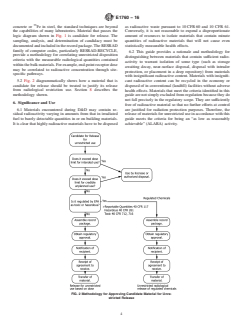
FIG. 2 Methodology for Approving Candidate Material for Unre-
stricted Release
E1760 − 16
6.3 For the purpose of this guide, the return of materials Sometypesofbuildingmaterialfrombothgroupsthatcouldbe
containing residual radioactivity to society without regulatory cost effectively released are described in 8.1.1 – 8.1.6.
restrictions is referred to as “unrestricted release based on the
NOTE 1—In the following sections, references to “release criteria” refer
absence of the credible potential for adverse health effects.”
to criteria approved by the regulatory approval for unrestricted release.
This guide asserts that materials recycled this way will have no
8.1.1 Miscellaneous and structural steel that is not intended
statistically measurable health effects regardless of use. It does
foruse“asis”(onthebasisofsurfacecontamination)wouldbe
not guarantee that the materials are suitable for use in every
smelted. Contaminant levels in the melt would be minimized
possible application, for example, trace amounts of radionu-
by avoiding the selection of steel from highly contaminated
clides in materials may not be acceptable for certain photo-
areas or surface cleaning the steel before smelting. In addition,
graphic and electronic applications.
the slagging process also generally reduces the concentration
6.4 This guide also asserts that the owner of the materials is
of contaminants in the melt. If the metal ingot met applicable
responsible for ensuring that society’s criteria for “no measur-
release criteria it would not have to be disposed of as
able health effects” is met before release, and that the respon-
radioactive waste. At worst it would be disposed of in a
sibility for providing materials with the purity required for a
sanitary landfill. Preferably it would be recycled.
special application rests not with the owner, but with the
8.1.2 Asbestos insulation is a porous bulk material that is
developer of that application.
not amenable to surface surveys. Economical decontamination
7. Criteria for Unrestricted Release
methods for asbestos insulation have not been demonstrated.
Ordinarily, most of the asbestos in a facility is not contami-
7.1 There are three criteria for the release of bulk materials
nated or is very slightly contaminated, but cannot be shown to
that are candidates for release (that is, that have negotiated the
be absolutely free of radioactivity.Asbestos could be disposed
logic diagram shown in Fig. 1). First, the material must not be
of in a permitted landfill instead of a licensed radioactive
expected to cause more than the inte
...
This document is not an ASTM standard and is intended only to provide the user of an ASTM standard an indication of what changes have been made to the previous version. Because
it may not be technically possible to adequately depict all changes accurately, ASTM recommends that users consult prior editions as appropriate. In all cases only the current version
of the standard as published by ASTM is to be considered the official document.
Designation: E1760 − 09 E1760 − 16
Standard Guide for
Unrestricted Disposition of Bulk Materials Containing
Residual Amounts of Radioactivity
This standard is issued under the fixed designation E1760; the number immediately following the designation indicates the year of
original adoption or, in the case of revision, the year of last revision. A number in parentheses indicates the year of last reapproval. A
superscript epsilon (´) indicates an editorial change since the last revision or reapproval.
INTRODUCTION
The feasibility of the recycle of recycling bulk material containing trace amounts of radioactive
contamination depends on the dose to the public that could occur as a result. However, the assessment
of this dose depends not only on the measurements of contaminants present, but also on the future use
of the material and the pathways by which persons can be exposed. This guide provides a
recommended approach to support a petition (to a regulatory agency) seeking approval for the recycle
or disposal of the material outside of the radioactive materials regulatory arena.control.
Since dose rate limits to the public have been established by regulation, this approach is a
recommended way regulation for decommissioning by NRC (25 mRem/y) and remediation sites by
EPA (15 mRem/y), this guide provides an approach to demonstrate compliance with them.those
regulations.
The Scope defines the range of applicability of this guide; the Summary identifies the two major
steps that comprise the method; and the significance of the guide is given in Section This guide 5.
Section 6 discusses the need for dose rate based release criteria, and Section 7 delineates the steps for
deciding whether or not a material should be considered for recycle. Section 8describes the steps
needed to implement the recommendations of this guide including recommendations for the
development of a data package to support the petition and to serve as a permanent record.
1. Scope
1.1 This guide covers the techniques for provides an approach for developing a basis for obtaining approval for release of
materials encountered in bulk materials to be removed from a decontamination and decommissioning (D&D) from restricted use.or
environmental remediation site from regulatory control. This would be addressed in the decommissioning plan ((Guide E1281).
It applies to materials that do not meet any of the requirements for regulatory control because of radioactivity content. Fig. 1
showsfollows the logic diagram described in the MARSAME for determining the materials that could be considered for release.
Materials that negotiate this logic tree are referred to as “candidate for release based on dose.”
1.2 For purposes of this guide, bulk materials shall consist of, for example, building materials, concrete rubble, soils, and
internally contaminated or activated equipment and facility components.
1.3 The objective of this This guide is to provide a methodology for distinguishing between material that must be carefully
isolated to prevent human contact from that that can be recycled or otherwise disposed of. It applies to material in which the
radioactivity is dispersed more or less uniformly throughout the volume of the material (termed residual in bulk form) intended
to apply to those equipment and materials to be removed from the site for their disposition as opposed to surface contaminated
objects.real property (buildings and grounds) that are to remain.
1.3 Surface contaminated objects are materials externally contaminated with radioactive material. Provisions already exist for
their release for recycle if it can be shown that they meet applicable federal and state regulations for surface contamination.
Regulatory Guide 1.86 and DOE Order 5400.5 specify the upper limits for radioactive surface contamination on material to be
released for unrestricted use.
This guide is under the jurisdiction of ASTM Committee E10 on Nuclear Technology and Applications and is the direct responsibility of Subcommittee E10.03 on
Radiological Protection for Decontamination and Decommissioning of Nuclear Facilities and Components.
Current edition approved June 1, 2009July 1, 2016. Published June 2009August 2016. Originally approved in 1996. Last previous edition approved in 20032009 as
ε1
E1760-96(2003)E1760 .-09. DOI: 10.1520/E1760-09.10.1520/E1760-16.
Copyright © ASTM International, 100 Barr Harbor Drive, PO Box C700, West Conshohocken, PA 19428-2959. United States
E1760 − 16
FIG. 1 Prerequisites for Material To Be Candidate For Release
1.4 The release of material containing residual radioactive material (except for Ra) in bulk form (for example, soil or slightly
activated metal) is based on the demonstration that the dose to a member of the public will be lower than a specified value
(proposed by the petitioner or defined by regulation) for its intended use and lower than a second specified value via the most
restrictive plausible scenario. The first proposed value should be lower than the second since the dose to any member of the public
(via the intended use scenario) will almost certainly be realized, whereas the dose from the alternate scenario will only accrue if
an unintended (and presumably less probable) circumstance arises. Federal regulation already exists for the release of Ra
contaminated soils.
1.4 Warning—Breathing of asbestos dust is hazardous. Asbestos and asbestos products present demonstrated health risks for
users and for those with whom they come into contact. In addition to other precautions, when working with asbestos products,
minimize the dust that results. For information on the safe use of chrysoltile asbestos, refer to “Safe Use of Chrysotile Asbestos:
A Manual on Preventive and Control Measures.”
1.5 This standard does not purport to address all of the safety concerns, if any, associated with its use. It is the responsibility
of the user of this standard to establish appropriate safety and health practices and determine the applicability of regulatory
limitations prior to use. For a specific hazard see 1.51.4.
E1760 − 16
2. Referenced Documents
2.1 ASTM Standards:
E2216 Guide for Evaluating Disposal Options for Concrete from Nuclear Facility Decommissioning
E1892 Guide for Preparing Characterization Plans for Decommissioning Nuclear Facilities
E1893 Guide for Selection and Use of Portable Radiological Survey Instruments for Performing In Situ Radiological
Assessments to Support Unrestricted Release from Further Regulatory Controls
E1281 Guide for Nuclear Facility Decommissioning Plans
2.2 American Nuclear Insurers Document:ANSI Standards:
ANI/MAELU Information Bulletin 80-1A,ANSI N13.12 Nuclear Liability Insurance Records RetentionSurface and Volume
Radioactivity Standards for Clearance
2.3 DOE Documents:
DOE Order 5400.5458.1 Radiation Protection of the Public and the Environment
RESRAD RESidual RADioactivity Family of Computer Codes Developed for DOE by the Argonne National Laboratory
2.4 International Atomic Energy Agency Document:
Safety Series No. 111-P-1.1, Application of Exemption Principles to the Recycle and Reuse of Materials from Nuclear Facilities
IAEA TECDOC-855 Clearance Levels for Radionuclides in Solid Materials
2.5 Nuclear Regulatory Commission Documents:
NUREG/CR-5512, Residual Radioactive Contamination from Decommissioning
NUREG-1575, Rev. 1 Multi-Agency Radiation Survey and Site Investigation Manual (MARSSIM)
NUREG-1576 Multi-Agency Radiological Laboratory Analytical Protocols (MARLAP)
NUREG-1575 Supplement 1, Multi-Agency Radiation Survey and Assessment of Materials and Equipment (MARSAME)
Regulatory Guide 1.86 Termination of Operating Licenses for Nuclear Reactors
NRC Inspection and Enforcement (IE) Circular 81-07 Control of Radioactively Contaminated Material
2.6 U.S. Government Documents:
10 CFR 20 CFR 20, , Standards for Protection Against Radiation, Subpart E, Radiological Criteria for License Termination
10 CFR 20 , Standards for Protection Against Radiation, Subpart K, Waste Disposal
40 CFR 192 CFR 192, , Health and Environmental Protection Standards for Uranium and Thorium Mill Tailings
10 CFR 60 CFR 60, , Disposal of High-Level Radioactive Wastes in Geological Repositories
10 CFR 61 CFR 61, , Licensing Requirements for Land Disposal of Radioactive Waste
40 CFR 117 CFR 117, , Determination of Reportable Quantities for Hazardous Substances
40 CFR 261 CFR 261, , Identification and Listing of Hazardous Waste
40 CFR 268 CFR 268, , Land Disposal Restrictions
40 CFR 712 CFR 712, , Chemical Information Rules
40 CFR 716 CFR 716, , Health and Safety Data Reporting
3. Terminology
3.1 Definitions of Terms Specific to This Standard:
3.1.1 credible, adj—offering reasonable grounds for being believed.
3.1.2 intended use, n—the first use planned for the material proposed to be released from radiological controls.
3.1.3 primary dose limit, n—the limit for exposures that could occur via the intended use scenario.
3.1.4 secondary dose limit, n—the limit for exposure that could occur via the unplanned use scenario.
3.1.5 unplanned use, n—any use other than the planned use that may occur after the intended use or by accident.
3.1.6 TRU, transuranic, n—those elements above uranium in the periodic table.
3.1.7 initial assessment, n—the first step in the investigation of material and equipment, similar to the historical site assessment
in MARSSIM.
For referenced ASTM standards, visit the ASTM website, www.astm.org, or contact ASTM Customer Service at service@astm.org. For Annual Book of ASTM Standards
volume information, refer to the standard’s Document Summary page on the ASTM website.
Available from American Nuclear Insurers, 29 South Main, Suite 300 S, West Hartford, CT 06107-2445.National Standards Institute (ANSI), 25 W. 43rd St., 4th Floor,
New York, NY 10036, http://www.ansi.org.
Available from Department of Energy, National Technical Information Service, U.S. Dept. of Commerce, Springfield, VA 22161.
C. Yu, et al., “Users Manual for RESRAD, ANL/EAD-4,”; “Users Manual for RESRAD-BUILD,” ANL/EAD-03-1,”; “Users Manual for RESRAD-OFFSITE,”
NUREG/CR-6937 and “RESRAD-RECYCLE, A Computer Model for Analyzing the Radiological Dose and Risks Resulting from the Recycle of Scrap Metal and the Reuse
of Surface Contaminated Material and Equipment,” ANL/EAD-3. Available online at www.ead.anl.gov.
International Atomic Energy Agency, Wagramerstrasse 5, P.O. Box 100, A-1400 Vienna, Austria.
Available from the Superintendent of Documents, U.S. Government Printing Office, Washington, DC 20402.
E1760 − 16
3.1.8 non-impacted, adj—term that applies to material and equipment where there is no reasonable potential to contain
radionuclide concentration(s) or radioactivity above background.
3.1.9 impacted, adj—term that applies to material and equipment that is not classified as non-impacted.
4. Objective
4.1 The objective of this guide is to provide a methodology for distinguishing between material that must be carefully isolated
to prevent human contact from that which can be recycled or otherwise disposed of. It applies to material in which the radioactivity
is dispersed more or less uniformly throughout the volume of the material (termed residual in bulk form) as opposed to surface
contaminated objects.
4.2 Surface contaminated objects are materials externally contaminated with radioactive material. Provisions already exist for
their release for recycle if it can be shown that they meet applicable federal and state regulatory requirements for surface
contamination. NRC IE Circular 81–07, Regulatory Guide 1.86 and DOE Order 458.1 provide guidance on radioactive surface
contamination levels on material to be released for unrestricted use.
4.3 The release of bulk material containing residual radioactive material (except for Ra), such as soil, equipment and building
rubble or slightly activated metal, is based on the demonstration that the dose to a member of the public will be lower than a
specified value (proposed by the petitioner or defined by regulation) for its intended use and lower than a second specified value
via the most restrictive plausible scenario. The first proposed value should be lower than the second since the dose to any member
of the public (via the intended use scenario) will almost certainly be realized, whereas the dose from the alternate scenario will
only accrue if an unintended (and presumably less probable) circumstance arises. Federal regulation already exists for the release
of Ra contaminated soils (40 CFR 192).
5. Summary of Guide
5.1 The owner of the material must first determine if the material is candidate for release. To do this one must take representative
samples of the bulk material and identify the radioactive contaminants and concentrations. The MARLAP document presents
laboratory protocols that provide assurances for the quality and accuracy of the sample analysis. Sampling should be done using
standard statistical inspection methods. The MARSSIM document provides guidance for design of sampling protocols in
accordance with accepted statistical standards. For bulk materials contaminated on the exposed surfaces only, Guide E1893
provides guidance for measurement and assessment of this radioactivity. The kinds of analyses shall be appropriate for the potential
3 14
contaminant expected, and performed using standard techniques (E1892). For some of these analyses, for example, H or C in
activated concrete or Fe in steel, the standard techniques are beyond the capabilities of many laboratories. Material that passes
the logic diagram shown in Fig. 1 is candidate for release. The sampling, analysis, and determination of candidacy must be
documented and included in the record package. The RESRAD family of computer codes, particularly RESRAD-RECYCLE,
provide a methodology for correlating unrestricted disposition criteria with the measurable radiological quantities contained within
the bulk materials. For example, end-point receptor dose may be correlated to radioactive concentration through site-specific
pathways.
5.2 Fig. 2 diagrammatically shows how a material that is candidate for release should be treated to justify its release from
radiological restriction use. Section 78 describes the methodology shown.
6. Significance and Use
6.1 Materials encountered during D&D may contain residual radioactivity varying in amounts from that in irradiated fuel to
barely detectable quantities in or on building materials. It is clear that highly radioactive materials have to be disposed as
radioactive waste pursuant to 10 CFR 60 and 10 CFR 61. Conversely, it is not reasonable to expend a disproportionate amount of
resources to isolate materials that contain minute quantities of radioactive materials that will not cause even statistically measurable
health effects.
6.2 This guide provides a rationale and methodology for distinguishing between materials that contain sufficient radioactivity
to warrant isolation of some type (storage (such as storage awaiting decay, near-surface disposal, disposal with intruder protection,
or placement in a deep repository) from materials with insignificant radioactive content. Materials with insignificant radioactive
content can be recycled in the economy or disposed of in conventional (landfill) facilities without adverse health effects. Materials
that meet the criteria identified in this guide are not simply excluded from regulation because they do not fall precisely in the
regulatory scope. They are sufficiently free of radioactive material so that no further efforts at control are justified for radiation
protection purposes. Therefore, the release of materials for unrestricted use in accordance with this guide meets the criteria for
being an “as low as reasonably achievable” (ALARA) activity.
6.3 For the purpose of this guide, the return of materials containing residual radioactivity to society without regulatory
restrictions is referred to as “unrestricted release based on the absence of the credible potential for adverse health effects.” This
guide asserts that materials recycled this way will have no statistically measurable health effects regardless of use. It does not
guarantee that the materials are suitable for use in every possible application, for example, trace amounts of radionuclides in
materials may not be acceptable for certain photographic and electronic applications.
E1760 − 16
FIG. 2 Methodology for Approving Candidate Material for Unre-
stricted Release
6.4 This guide also asserts that the owner of the materials is responsible for ensuring that society’s criteria for “no measurable
health effects” is met before release, and that the responsibility for providing materials with the purity required for a special
application rests not with the owner, but with the developer of that application.
7. Criteria for Unrestricted Release
7.1 There are three criteria for the release of bulk materials that are candidates for release (that is, that have negotiated the logic
diagram shown in Fig. 1). First, the material must not be expected to cause more than the intended use dose limit when used for
the intended purpose. Second, the material must not be expected to cause more than the unplanned use dose limit when
...