

ASTM F594-22
(Specification)Standard Specification for Stainless Steel Nuts
General Information
- Abstract
ABSTRACT
This specification covers the requirements for stainless steel nuts in specified size, inclusive, in nominal diameter in a number of alloys in common use and intended for service applications requiring general corrosion resistance. Seven groups of stainless steel alloys are covered, including ten austenitic, two ferritic, four martensitic, and one precipitation hardening: Group 1; Group 2; Group 3; Group 4; Group 5; Group 6; and Group 7. The finished fasteners shall meet the applicable mechanical properties. Chemical tests; mechanical tests; and corrosion resistance shall be performed to conform with the specified requirements.
SIGNIFICANCE AND USE
15.1 For the purposes of determining compliance with the specified limits for properties listed in this specification, an observed value or calculated value shall be rounded in accordance with Practice E29.
SCOPE
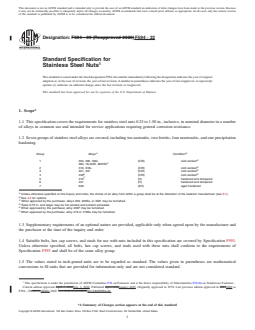
1.1 This specification covers the requirements for stainless steel nuts 0.25 to 1.50 in., inclusive, in nominal diameter in a number of alloys in common use and intended for service applications requiring general corrosion resistance.
1.2 Seven groups of stainless steel alloys are covered, including ten austenitic, two ferritic, four martensitic, and one precipitation hardening.
Group
AlloysA
ConditionB
1
304, 305, 304L
384, 18–9LW, 302HQC
(CW)
cold workedD
2
316, 316L
(CW)
cold workedD
3
321, 347
(CW)
cold workedD
4
430E
(CW)
cold workedD
5
410F
(H)
hardened and tempered
6
431
(H)
hardened and tempered
7
630
(AH)
aged hardened
1.3 Supplementary requirements of an optional nature are provided, applicable only when agreed upon by the manufacturer and the purchaser at the time of the inquiry and order.
1.4 Suitable bolts, hex cap screws, and studs for use with nuts included in this specification are covered by Specification F593. Unless otherwise specified, all bolts, hex cap screws, and studs used with these nuts shall conform to the requirements of Specification F593 and shall be of the same alloy group.
1.5 The values stated in inch-pound units are to be regarded as standard. The values given in parentheses are mathematical conversions to SI units that are provided for information only and are not considered standard.
1.6 This standard does not purport to address all of the safety concerns, if any, associated with its use. It is the responsibility of the user of this standard to establish appropriate safety, health, and environmental practices and determine the applicability of regulatory limitations prior to use.
1.7 This international standard was developed in accordance with internationally recognized principles on standardization established in the Decision on Principles for the Development of International Standards, Guides and Recommendations issued by the World Trade Organization Technical Barriers to Trade (TBT) Committee.
- Status
- Published
- Publication Date
- 31-Oct-2022
- Technical Committee
- F16 - Fasteners
- Drafting Committee
- F16.04 - Nonferrous Fasteners
Overview
ASTM F594-22: Standard Specification for Stainless Steel Nuts defines the requirements for nuts made from a range of stainless steel alloys in nominal diameters from 0.25 to 1.50 inches. Developed by ASTM International, this standard is widely referenced for applications requiring general corrosion resistance and mechanical performance in fastener assemblies. ASTM F594-22 specifies chemical, mechanical, and corrosion resistance criteria for seven groups of stainless steel alloys, including austenitic, ferritic, martensitic, and precipitation hardening grades.
Key Topics
Alloy Groups: The standard encompasses seven alloy groups, allowing flexibility for manufacturers and end users when selecting the appropriate material based on service requirements.
- Group 1: Common austenitic stainless steels (e.g., 304, 305, 304L, 384, 18–9LW, 302HQ)
- Group 2: Austenitic alloys 316, 316L
- Group 3: Austenitic alloys 321, 347
- Group 4: Ferritic alloy 430
- Group 5: Martensitic alloys 410F
- Group 6: Martensitic alloy 431
- Group 7: Precipitation hardening alloy 630
Mechanical Properties: Sets minimum proof stress and hardness levels for each group and condition, ensuring nuts maintain structural integrity under load.
Corrosion Resistance: Stainless steel nuts covered by ASTM F594-22 must possess corrosion resistance suitable for general service. Some alloys must pass intergranular corrosion testing based on referenced ASTM practices.
Dimensions and Threads: Requires compliance with ASME B1.1 for screw threads and ASME B18.2.2 for hex nuts unless otherwise specified.
Marking and Traceability: Nuts must be marked with the manufacturer's symbol and alloy or mechanical property designation for traceability.
Supplementary Requirements: The standard includes optional requirements-such as additional testing, heat control, or special packaging-to suit specific purchasing agreements.
Applications
Stainless steel nuts covered under ASTM F594-22 are essential components in a variety of industries and applications, thanks to their reliable corrosion resistance and mechanical strength. Typical uses include:
- Construction and Structural Engineering: For joining structural elements in commercial and infrastructure projects.
- Marine and Offshore: Provides critical resistance to saltwater corrosion for shipbuilding and ocean platforms.
- Petrochemical and Chemical Processing: Essential for maintaining integrity in corrosive process environments.
- Food Processing Equipment: Ensures sanitary, corrosion-resistant fastening in environments demanding cleanliness.
- General Industrial Machinery: Used wherever durable and corrosion-resistant fastener assemblies are needed.
The availability of multiple alloy and condition options allows users to select stainless steel nuts that balance cost, strength, corrosion resistance, and service requirements.
Related Standards
ASTM F594-22 references and aligns with several key standards to ensure comprehensive and consistent fastener quality:
- ASTM F593: Companion standard covering stainless steel bolts, hex cap screws, and studs for use with nuts specified in F594.
- ASME B1.1 & B18.2.2: Standards for screw threads and hex nut dimensions.
- ASTM A262: Practices for detecting susceptibility to intergranular attack in austenitic stainless steels.
- ASTM A342/A342M, A380, A493, A555/A555M: Covering aspects like material permeability, cleaning, and bar/rod requirements.
- ASTM F606/F606M: Test methods for determining mechanical properties of fasteners.
Adhering to ASTM F594-22 helps stakeholders ensure durable, high-quality stainless steel nut assemblies that meet international industrial expectations for performance and reliability.
Relations
- Effective Date
- 01-Nov-2023
- Effective Date
- 01-Oct-2023
- Effective Date
- 01-May-2019
- Effective Date
- 01-May-2018
- Effective Date
- 01-Sep-2016
- Effective Date
- 01-Mar-2016
- Effective Date
- 01-Jan-2016
- Effective Date
- 01-Dec-2015
- Effective Date
- 01-Nov-2014
- Effective Date
- 01-Mar-2014
- Effective Date
- 01-Mar-2014
- Effective Date
- 01-Dec-2013
- Effective Date
- 01-Dec-2013
- Effective Date
- 01-Oct-2013
- Effective Date
- 01-May-2013
Frequently Asked Questions
ASTM F594-22 is a technical specification published by ASTM International. Its full title is "Standard Specification for Stainless Steel Nuts". This standard covers: ABSTRACT This specification covers the requirements for stainless steel nuts in specified size, inclusive, in nominal diameter in a number of alloys in common use and intended for service applications requiring general corrosion resistance. Seven groups of stainless steel alloys are covered, including ten austenitic, two ferritic, four martensitic, and one precipitation hardening: Group 1; Group 2; Group 3; Group 4; Group 5; Group 6; and Group 7. The finished fasteners shall meet the applicable mechanical properties. Chemical tests; mechanical tests; and corrosion resistance shall be performed to conform with the specified requirements. SIGNIFICANCE AND USE 15.1 For the purposes of determining compliance with the specified limits for properties listed in this specification, an observed value or calculated value shall be rounded in accordance with Practice E29. SCOPE 1.1 This specification covers the requirements for stainless steel nuts 0.25 to 1.50 in., inclusive, in nominal diameter in a number of alloys in common use and intended for service applications requiring general corrosion resistance. 1.2 Seven groups of stainless steel alloys are covered, including ten austenitic, two ferritic, four martensitic, and one precipitation hardening. Group AlloysA ConditionB 1 304, 305, 304L 384, 18–9LW, 302HQC (CW) cold workedD 2 316, 316L (CW) cold workedD 3 321, 347 (CW) cold workedD 4 430E (CW) cold workedD 5 410F (H) hardened and tempered 6 431 (H) hardened and tempered 7 630 (AH) aged hardened 1.3 Supplementary requirements of an optional nature are provided, applicable only when agreed upon by the manufacturer and the purchaser at the time of the inquiry and order. 1.4 Suitable bolts, hex cap screws, and studs for use with nuts included in this specification are covered by Specification F593. Unless otherwise specified, all bolts, hex cap screws, and studs used with these nuts shall conform to the requirements of Specification F593 and shall be of the same alloy group. 1.5 The values stated in inch-pound units are to be regarded as standard. The values given in parentheses are mathematical conversions to SI units that are provided for information only and are not considered standard. 1.6 This standard does not purport to address all of the safety concerns, if any, associated with its use. It is the responsibility of the user of this standard to establish appropriate safety, health, and environmental practices and determine the applicability of regulatory limitations prior to use. 1.7 This international standard was developed in accordance with internationally recognized principles on standardization established in the Decision on Principles for the Development of International Standards, Guides and Recommendations issued by the World Trade Organization Technical Barriers to Trade (TBT) Committee.
ABSTRACT This specification covers the requirements for stainless steel nuts in specified size, inclusive, in nominal diameter in a number of alloys in common use and intended for service applications requiring general corrosion resistance. Seven groups of stainless steel alloys are covered, including ten austenitic, two ferritic, four martensitic, and one precipitation hardening: Group 1; Group 2; Group 3; Group 4; Group 5; Group 6; and Group 7. The finished fasteners shall meet the applicable mechanical properties. Chemical tests; mechanical tests; and corrosion resistance shall be performed to conform with the specified requirements. SIGNIFICANCE AND USE 15.1 For the purposes of determining compliance with the specified limits for properties listed in this specification, an observed value or calculated value shall be rounded in accordance with Practice E29. SCOPE 1.1 This specification covers the requirements for stainless steel nuts 0.25 to 1.50 in., inclusive, in nominal diameter in a number of alloys in common use and intended for service applications requiring general corrosion resistance. 1.2 Seven groups of stainless steel alloys are covered, including ten austenitic, two ferritic, four martensitic, and one precipitation hardening. Group AlloysA ConditionB 1 304, 305, 304L 384, 18–9LW, 302HQC (CW) cold workedD 2 316, 316L (CW) cold workedD 3 321, 347 (CW) cold workedD 4 430E (CW) cold workedD 5 410F (H) hardened and tempered 6 431 (H) hardened and tempered 7 630 (AH) aged hardened 1.3 Supplementary requirements of an optional nature are provided, applicable only when agreed upon by the manufacturer and the purchaser at the time of the inquiry and order. 1.4 Suitable bolts, hex cap screws, and studs for use with nuts included in this specification are covered by Specification F593. Unless otherwise specified, all bolts, hex cap screws, and studs used with these nuts shall conform to the requirements of Specification F593 and shall be of the same alloy group. 1.5 The values stated in inch-pound units are to be regarded as standard. The values given in parentheses are mathematical conversions to SI units that are provided for information only and are not considered standard. 1.6 This standard does not purport to address all of the safety concerns, if any, associated with its use. It is the responsibility of the user of this standard to establish appropriate safety, health, and environmental practices and determine the applicability of regulatory limitations prior to use. 1.7 This international standard was developed in accordance with internationally recognized principles on standardization established in the Decision on Principles for the Development of International Standards, Guides and Recommendations issued by the World Trade Organization Technical Barriers to Trade (TBT) Committee.
ASTM F594-22 is classified under the following ICS (International Classification for Standards) categories: 21.060.20 - Nuts. The ICS classification helps identify the subject area and facilitates finding related standards.
ASTM F594-22 has the following relationships with other standards: It is inter standard links to ASTM A493-23, ASTM D3951-18(2023), ASTM A564/A564M-19, ASTM D3951-18, ASTM F606/F606M-16, ASTM A493-16, ASTM A555/A555M-16, ASTM D3951-15, ASTM F606/F606M-14a, ASTM A555/A555M-05(2014), ASTM A751-14, ASTM F593-13a, ASTM F593-13ae1, ASTM A493-09(2013), ASTM A262-13. Understanding these relationships helps ensure you are using the most current and applicable version of the standard.
ASTM F594-22 is available in PDF format for immediate download after purchase. The document can be added to your cart and obtained through the secure checkout process. Digital delivery ensures instant access to the complete standard document.
Standards Content (Sample)
This international standard was developed in accordance with internationally recognized principles on standardization established in the Decision on Principles for the
Development of International Standards, Guides and Recommendations issued by the World Trade Organization Technical Barriers to Trade (TBT) Committee.
Designation:F594 −22
Standard Specification for
Stainless Steel Nuts
ThisstandardisissuedunderthefixeddesignationF594;thenumberimmediatelyfollowingthedesignationindicatestheyearoforiginal
adoptionor,inthecaseofrevision,theyearoflastrevision.Anumberinparenthesesindicatestheyearoflastreapproval.Asuperscript
epsilon (´) indicates an editorial change since the last revision or reapproval.
This standard has been approved for use by agencies of the U.S. Department of Defense.
1. Scope* 1.6 This standard does not purport to address all of the
safety concerns, if any, associated with its use. It is the
1.1 This specification covers the requirements for stainless
responsibility of the user of this standard to establish appro-
steel nuts 0.25 to 1.50 in., inclusive, in nominal diameter in a
priate safety, health, and environmental practices and deter-
number of alloys in common use and intended for service
mine the applicability of regulatory limitations prior to use.
applications requiring general corrosion resistance.
1.7 This international standard was developed in accor-
1.2 Seven groups of stainless steel alloys are covered,
dance with internationally recognized principles on standard-
including ten austenitic, two ferritic, four martensitic, and one
ization established in the Decision on Principles for the
precipitation hardening.
Development of International Standards, Guides and Recom-
A B
Group Alloys Condition
mendations issued by the World Trade Organization Technical
Barriers to Trade (TBT) Committee.
D
1 304, 305, 304L (CW) cold worked
C
384, 18–9LW, 302HQ
D
2. Referenced Documents
2 316, 316L (CW) cold worked
D
3 321, 347 (CW) cold worked
E D 2.1 ASTM Standards:
4 430 (CW) cold worked
F
5 410 (H) hardened and tempered A262Practices for Detecting Susceptibility to Intergranular
6 431 (H) hardened and tempered
Attack in Austenitic Stainless Steels
7 630 (AH) aged hardened
A342/A342MTest Methods for Permeability of Weakly
A Magnetic Materials
Unless otherwise specified on the inquiry and order, the choice of an alloy from
within a group shall be at the discretion of the fastener manufacturer (see 6.1).
A380Practice for Cleaning, Descaling, and Passivation of
B
See 4.2 for options.
Stainless Steel Parts, Equipment, and Systems
C
When approved by the purchaser, alloys 303, 303Se, or XM1 may be furnished.
D
A493Specification for Stainless Steel Wire and Wire Rods
Sizes 0.75 in. and larger may be hot worked and solution annealed.
E
When approved by the purchaser, alloy 430F may be furnished.
for Cold Heading and Cold Forging
F
When approved by the purchaser, alloy 416 or 416Se may be furnished.
A555/A555MSpecification for General Requirements for
1.3 Supplementary requirements of an optional nature are
Stainless Steel Wire and Wire Rods
provided, applicable only when agreed upon by the manufac-
A564/A564M Specification for Hot-Rolled and Cold-
turer and the purchaser at the time of the inquiry and order.
Finished Age-Hardening Stainless Steel Bars and Shapes
A582/A582MSpecification for Free-Machining Stainless
1.4 Suitable bolts, hex cap screws, and studs for use with
Steel Bars
nuts included in this specification are covered by Specification
A751Test Methods and Practices for Chemical Analysis of
F593.Unlessotherwisespecified,allbolts,hexcapscrews,and
Steel Products
studsusedwiththesenutsshallconformtotherequirementsof
D3951Practice for Commercial Packaging
Specification F593 and shall be of the same alloy group.
E29Practice for Using Significant Digits in Test Data to
1.5 The values stated in inch-pound units are to be regarded
Determine Conformance with Specifications
as standard. The values given in parentheses are mathematical
F593 Specification for Stainless Steel Bolts, Hex Cap
conversions to SI units that are provided for information only
Screws, and Studs
and are not considered standard.
F606/F606MTest Methods for Determining the Mechanical
Properties of Externally and Internally Threaded
Fasteners, Washers, Direct Tension Indicators, and Rivets
This specification is under the jurisdiction of ASTM Committee F16 on
Fasteners and is the direct responsibility of Subcommittee F16.04 on Nonferrous
Fasteners. For referenced ASTM standards, visit the ASTM website, www.astm.org, or
Current edition approved Nov. 1, 2022. Published January 2023. Originally contact ASTM Customer Service at service@astm.org. For Annual Book of ASTM
approvedin1978.Lastpreviouseditionapprovedin2020asF594–09(2020).DOI: Standards volume information, refer to the standard’s Document Summary page on
10.1520/F0594-22. the ASTM website.
*A Summary of Changes section appears at the end of this standard
Copyright © ASTM International, 100 Barr Harbor Drive, PO Box C700, West Conshohocken, PA 19428-2959. United States
F594−22
E1470Test Method for Characterization of Proteins by
Condition Furnished
Alloy Group Unless Otherwise Optional Conditions
Electrophoretic Mobility (Withdrawn 2014)
Specified (must be specified)
2.2 ASME Standards:
1, 2, 3 CW AF, A, SH
B1.1Unified Inch Screw Threads
4CW A
B18.2.2Square and Hex Nuts
5H HT
6H HT
NOTE 1—The following ASTM standards are noted for information
7 AH none
only as suitable sources of material for the manufacture of nuts to this
A— Machined from annealed or solution annealed stock thus
specification:
retaining the properties of the original material; or hot formed
Specifications A493, A564/A564M, and A582/A582M.
and solution annealed.
AF— Annealed after all threading is completed.
AH— Solution annealed and age hardened after forming.
3. Ordering Information
CW— Annealed and cold worked. Sizes 0.75 in. and larger may be
hot worked and solution annealed.
3.1 Orders for nuts under this specification shall include the
H— Hardened and tempered at 1050 °F (565 °C) minimum.
following:
HT— Hardened and tempered at 525 °F (274 °C) minimum.
SH— Machined from strain hardened stock.
3.1.1 Quantity (number of pieces of each item and size),
3.1.2 Name of item,
5. Heat Treatment
3.1.3 Size (diameter and threads per inch),
5.1 Alloy Groups 1, 2, and 3 (Austenitic Alloys 303, 303Se,
3.1.4 Alloy group number (see 6.2.1), and
304, 304L, 305, 316, 316L, 321, 347, 384, XM1, 18–9LW, and
3.1.5 Condition (see 4.2). 302HQ):
5.1.1 Condition A—When Condition A is specified, the
3.1.6 Orders for nuts under this specification may include
austenitic alloys shall be heated to 1900 6 50°F (1038 6
the following optional requirements:
28°C), at which time the chromium carbide will go into the
3.1.6.1 Forming (see 4.1.1),
solution, be held for a sufficient time, and then be cooled at a
3.1.6.2 Composition (see 6.2),
rate sufficient to prevent precipitation of the carbide and to
3.1.6.3 Corrosion resistance (see 8.1),
provide the specified properties.
3.1.6.4 Thread class (see 9.2),
5.1.2 Condition CW—When Condition CW is specified, the
3.1.6.5 Finish (see 10.3),
austeniticalloysshallbeannealedasspecifiedin5.1.1andthen
3.1.6.6 Test report (see 17.2),
cold worked to develop the specified properties.
3.1.6.7 Rejection (see 16.1),
5.1.3 Condition AF—When Condition AF is specified, the
3.1.6.8 Test rejection (see 16.1), and austenitic alloys shall be annealed as specified in 5.1.1 after all
cold working, including forming and threading.
3.1.6.9 Special packaging (see 19.2).
3.1.7 Supplementaryrequirements,ifany,tobespecifiedon 5.2 Alloy Group 4 (Ferritic Alloys 430 and 430F):
the order (see S1 through S8), and 5.2.1 Condition A—The ferritic alloys shall be heated to a
temperature of 1450 6 50°F (788 6 28°C), held for an
3.1.8 ASTM specification and date of issue. When date of
appropriate time, and then air cooled to provide the specified
issue is not specified, fasteners shall be furnished to the latest
properties.
issue.
5.2.2 Condition CW—When Condition CW is specified, the
NOTE2—Example:10000pieces,HexNut,0.250in.−20,AlloyGroup
ferritic alloys shall be annealed in accordance with 5.2.1,
1, Condition CW, Furnish Test Report, Supplementary Requirement S3.
generally by the raw material manufacturer, and then cold
worked to develop the specified properties.
4. Manufacture
5.3 Alloy Group 5 (Martensitic Alloys 410, 416, and 416Se):
4.1 Manufacture:
5.3.1 Condition H—When Condition H is specified, the
4.1.1 Forming—Unless otherwise specified, the nuts shall
martensitic alloys 410, 416, and 416Se shall be hardened and
be hot formed, cold formed, or machined from suitable
temperedbyheatingto1850 650°F(1010 628°C)sufficient
material, at the option of the manufacturer. 1
for austenitization, held for at least ⁄2 h and rapid air- or
oil-quenched,thenreheatingto1050°F(565°C)minimumfor
4.2 Condition—The fasteners shall be furnished in the
at least 1 h and air cooled to provide the specified properties.
followingconditions,unlessspecifiedtobefurnishedinoneof
5.3.2 Condition HT—When Condition HT is specified, the
the optional conditions:
martensitic alloys 410, 416, and 416Se shall be hardened and
temperedbyheatingto1850 650°F(1010 628°C)sufficient
for austenitization, held for at least ⁄2h and rapid air- or
The last approved version of this historical standard is referenced on
oil-quenched, then reheating to 525°F (274°C) minimum for
www.astm.org.
4 at least 1 h and air cooled to provide the specified properties.
Available from Global Engineering Documents, 15 Inverness Way, East
Englewood, CO 80112-5704, http://www.global.ihs.com.
F594−22
5.4 Alloy Group 6 (Martensitic Alloy 431): 8. Corrosion Resistance
5.4.1 Conditions H and HT—Themartensiticalloy431shall
8.1 Carbide Precipitation:
be hardened and tempered as specified in 5.3.1 and 5.3.2 as
8.1.1 Rod, bar, and wire in the austeniticAlloy Groups 1, 2,
applicable.
and 3, except the free-machining grades, 303 and 303Se used
tomakefastenersinaccordancewiththisspecification,shallbe
5.5 Alloy Group 7 (Precipitation Hardening Alloy 630):
capable of passing the test for susceptibility to intergranular
5.5.1 Condition AH—The precipitation hardening alloy 630
corrosion as specified in Practice E of Practice A262.
shallbesolutionannealedandagedbyheatingto1900 625°F
8.1.2 As stated in Practice A262, samples may be subjected
(1038 6 14°C) for at least ⁄2 h and rapid air or oil quenched
to the faster and more severe screening test in accordance with
to 80°F (27°C) maximum, then reheating to a temperature of
Practice A. Failing Practice A, specimens may be tested in
1150 6 15°F (621 6 8°C) for 4 h and air cooled to provide
accordance with Practice E and be considered satisfactory if
the specified properties.
passing Practice E.
6. Chemical Composition
9. Dimensions
6.1 Alloy Groups—It is the intent of this specification that
9.1 Nuts:
fasteners shall be ordered by alloy group numbers that include
9.1.1 Unless otherwise specified, the dimensions shall be in
alloys considered to be chemically equivalent for general
accordance with the requirements of ASME B18.2.2 for Hex
purpose use. The alloy groupings are as shown below. When
Nuts.
required, however, a specific alloy may be specified as permit-
9.1.2 When specified, the dimensions of nuts shall be in
ted by 6.2.2.
accordance with the requirements of ASME B18.2.2 (type as
Alloy Group Alloys
specified), or such other dimensions as may be specified.
1 304, 305, 304L
9.2 Threads (see Table 4)—Unless otherwise specified, the
A
384, 18–9LW, 302HQ
2 316, 316L nuts shall have Class 2B threads in accordance with ASME
3 321, 347
B1.1.
B
4 430
C
5 410
10. Workmanship, Finish, and Appearance
6 431
7 630 10.1 Workmanship—The nuts shall have a workmanlike
finish, free of injurious burrs, seams, laps, irregular surfaces,
A
When approved by the purchaser, alloys 303, 303Se, or XM1 may be furnished.
and other defects affecting serviceability.
B
When approved by the purchaser, alloy 430F may be furnished.
C
When approved by the purchaser, alloys 416 or 416Se may be furnished. 10.2 Surface Finish—The nuts shall have a surface finish
produced in accordance with Practice A380.
6.2 Chemical Composition Limits:
6.2.1 Ordering by Alloy Group—Unless otherwise specified 10.3 Protective Finishes—Unless otherwise specified, the
on the inquiry and order (see Supplementary Requirement S4), nutsshallbefurnishedwithoutanadditivechemicalormetallic
the choice of an alloy from within a group shall be at the finish.
discretion of the fastener manufacturer as required by his
11. Sampling
method of fastener fabrication and material availability. The
11.1 Alot,forthepurposesofselectingtestspecimens,shall
specificalloyusedbythefastenermanufacturershallbeclearly
consist of not more than 100000 pieces offered for inspection
identified on any certification required by the order and shall
at one time having the following common characteristics:
have a chemical composition conforming to the requirements
11.1.1 One type of item,
of Table 1 for the specific alloy.
11.1.2 Same alloy and condition, and
6.2.2 Ordering by Specific Alloy—When ordered by a spe-
11.1.3 One nominal diameter and thread series.
cific alloy number, the fasteners shall conform to the chemical
composition limits of Table 1 for the specific alloy.
12. Number of Tests and Retests
6.3 Product Analysis:
12.1 Number of Tests:
6.3.1 Product analysis may be made by the purchaser from
12.1.1 Mechanical Tests—The mechanical requirements of
finished nuts representing each lot. The chemical composition
this specification shall be met in continuous mass production
thus determined shall conform to the requirements of Table 1
for stock. The manufacturer shall make sample inspections as
for the specific alloy subject to the ProductAnalysisTolerance
specifiedbelowtoensuretheproductconformstothespecified
in Specification A555/A555M.
requirements.When tests of individual shipments are required,
6.3.2 In the event of discrepancy, a referee chemical analy-
Supplementary Requirement S1 must be specified in the
sis of samples from each lot shall be made in accordance with
inquiry and order.
14.1.
Acceptance Criteria
Number of Pieces in Lot Number Acceptance Rejection
7. Mechanical Properties
of Tests Number Number
7.1 The finished fasteners shall meet the applicable me-
2to50 2 0 1
chanical properties of Table 2 for the specified alloy group and
51 to 500 3 0 1
condition when tested in accordance with the mechanical 501 to 35 000 5 0 1
35 001 to 100 000 8 0 1
property requirements as specified herein (see also Table 3).
F594−22
TABLE 1 Chemical Requirements
UNS Composition, % maximum except as shown, ellipses indicate no requirement for listed element
Alloy
Desig-
Alloy
Manga- Phos- Others
Group
Carbon Sulfur Silicon Chromium Nickel Copper Molybdenum
nation
nese phorus
Austenitic Alloys
A
1 S30300 303 0.15 2.00 0.20 0.15 min 1.00 17.0 to 8.0 to . . . 0.60 .
19.0 10.0
1 S30323 303Se 0.15 2.00 0.20 0.060 1.00 17.0 to 8.0 to . . . . . . Se 0.15 min
19.0 10.0
B
1 S30400 304 0.08 2.00 0.045 0.030 1.00 18.0 to 8.0 to . .
20.0 10.5
...
This document is not an ASTM standard and is intended only to provide the user of an ASTM standard an indication of what changes have been made to the previous version. Because
it may not be technically possible to adequately depict all changes accurately, ASTM recommends that users consult prior editions as appropriate. In all cases only the current version
of the standard as published by ASTM is to be considered the official document.
Designation: F594 − 09 (Reapproved 2020) F594 − 22
Standard Specification for
Stainless Steel Nuts
This standard is issued under the fixed designation F594; the number immediately following the designation indicates the year of original
adoption or, in the case of revision, the year of last revision. A number in parentheses indicates the year of last reapproval. A superscript
epsilon (´) indicates an editorial change since the last revision or reapproval.
This standard has been approved for use by agencies of the U.S. Department of Defense.
1. Scope*
1.1 This specification covers the requirements for stainless steel nuts 0.25 to 1.50 in., inclusive, in nominal diameter in a number
of alloys in common use and intended for service applications requiring general corrosion resistance.
1.2 Seven groups of stainless steel alloys are covered, including ten austenitic, two ferritic, four martensitic, and one precipitation
hardening.
A B
Group Alloys Condition
D
1 304, 305, 304L (CW) cold worked
C
384, 18–9LW, 302HQ
D
2 316, 316L (CW) cold worked
D
3 321, 347 (CW) cold worked
E D
4 430 (CW) cold worked
F
5 410 (H) hardened and tempered
6 431 (H) hardened and tempered
7 630 (AH) aged hardened
A
Unless otherwise specified on the inquiry and order, the choice of an alloy from within a group shall be at the discretion of the fastener manufacturer (see 6.1).
B
See 4.2 for options.
C
When approved by the purchaser, alloys 303, 303Se, or XM1 may be furnished.
D
Sizes 0.75 in. and larger may be hot worked and solution annealed.
E
When approved by the purchaser, alloy 430F may be furnished.
F
When approved by the purchaser, alloy 416 or 416Se may be furnished.
1.3 Supplementary requirements of an optional nature are provided, applicable only when agreed upon by the manufacturer and
the purchaser at the time of the inquiry and order.
1.4 Suitable bolts, hex cap screws, and studs for use with nuts included in this specification are covered by Specification F593.
Unless otherwise specified, all bolts, hex cap screws, and studs used with these nuts shall conform to the requirements of
Specification F593 and shall be of the same alloy group.
1.5 The values stated in inch-pound units are to be regarded as standard. The values given in parentheses are mathematical
conversions to SI units that are provided for information only and are not considered standard.
This specification is under the jurisdiction of ASTM Committee F16 on Fasteners and is the direct responsibility of Subcommittee F16.04 on Nonferrous Fasteners.
Current edition approved April 1, 2020Nov. 1, 2022. Published April 2020January 2023. Originally approved in 1978. Last previous edition approved in 20152020 as
F594 – 09(2015).(2020). DOI: 10.1520/F0594-09R20.10.1520/F0594-22.
*A Summary of Changes section appears at the end of this standard
Copyright © ASTM International, 100 Barr Harbor Drive, PO Box C700, West Conshohocken, PA 19428-2959. United States
F594 − 22
1.6 This standard does not purport to address all of the safety concerns, if any, associated with its use. It is the responsibility
of the user of this standard to establish appropriate safety, health, and environmental practices and determine the applicability of
regulatory limitations prior to use.
1.7 This international standard was developed in accordance with internationally recognized principles on standardization
established in the Decision on Principles for the Development of International Standards, Guides and Recommendations issued
by the World Trade Organization Technical Barriers to Trade (TBT) Committee.
2. Referenced Documents
2.1 ASTM Standards:
A262 Practices for Detecting Susceptibility to Intergranular Attack in Austenitic Stainless Steels
A342/A342M Test Methods for Permeability of Weakly Magnetic Materials
A380 Practice for Cleaning, Descaling, and Passivation of Stainless Steel Parts, Equipment, and Systems
A493 Specification for Stainless Steel Wire and Wire Rods for Cold Heading and Cold Forging
A555/A555M Specification for General Requirements for Stainless Steel Wire and Wire Rods
A564/A564M Specification for Hot-Rolled and Cold-Finished Age-Hardening Stainless Steel Bars and Shapes
A582/A582M Specification for Free-Machining Stainless Steel Bars
A751 Test Methods and Practices for Chemical Analysis of Steel Products
D3951 Practice for Commercial Packaging
E29 Practice for Using Significant Digits in Test Data to Determine Conformance with Specifications
F593 Specification for Stainless Steel Bolts, Hex Cap Screws, and Studs
F606F606/F606M Test Methods for Determining the Mechanical Properties of Externally and Internally Threaded Fasteners,
Washers, and Rivets (Metric) F0606_F0606M Direct Tension Indicators, and Rivets
E1470 Test Method for Characterization of Proteins by Electrophoretic Mobility (Withdrawn 2014)
2.2 ASME Standards:
B1.1 Unified Inch Screw Threads
B18.2.2 Square and Hex Nuts
NOTE 1—The following ASTM standards are noted for information only as suitable sources of material for the manufacture of nuts to this specification:
Specifications A493, A564/A564M, and A582/A582M.
3. Ordering Information
3.1 Orders for nuts under this specification shall include the following:
3.1.1 Quantity (number of pieces of each item and size),
3.1.2 Name of item,
3.1.3 Size (diameter and threads per inch),
3.1.4 Alloy group number (see 6.2.1), and
3.1.5 Condition (see 4.2).
3.1.6 Orders for nuts under this specification may include the following optional requirements:
3.1.6.1 Forming (see 4.1.1),
3.1.6.2 Composition (see 6.2),
3.1.6.3 Corrosion resistance (see 8.1),
3.1.6.4 Thread class (see 9.2),
For referenced ASTM standards, visit the ASTM website, www.astm.org, or contact ASTM Customer Service at service@astm.org. For Annual Book of ASTM Standards
volume information, refer to the standard’s Document Summary page on the ASTM website.
The last approved version of this historical standard is referenced on www.astm.org.
Available from Global Engineering Documents, 15 Inverness Way, East Englewood, CO 80112-5704, http://www.global.ihs.com.
F594 − 22
3.1.6.5 Finish (see 10.3),
3.1.6.6 Test report (see 17.2),
3.1.6.7 Rejection (see 16.1),
3.1.6.8 Test rejection (see 16.1), and
3.1.6.9 Special packaging (see 19.2).
3.1.7 Supplementary requirements, if any, to be specified on the order (see S1 through S8), and
3.1.8 ASTM specification and date of issue. When date of issue is not specified, fasteners shall be furnished to the latest issue.
NOTE 2—Example: 10 000 pieces, Hex Nut, 0.250 in. −20, Alloy Group 1, Condition CW, Furnish Test Report, Supplementary Requirement S3.
4. Manufacture
4.1 Manufacture:
4.1.1 Forming—Unless otherwise specified, the nuts shall be hot formed, cold formed, or machined from suitable material, at the
option of the manufacturer.
4.2 Condition—The fasteners shall be furnished in the following conditions, unless specified to be furnished in one of the optional
conditions:
Condition Furnished
Alloy Group Unless Otherwise Optional Conditions
Specified (must be specified)
1, 2, 3 CW AF, A, SH
4 CW A
5 H HT
6 H HT
7 AH none
A— Machined from annealed or solution annealed stock thus
retaining the properties of the original material; or hot formed
and solution annealed.
AF— Annealed after all threading is completed.
AH— Solution annealed and age hardened after forming.
CW— Annealed and cold worked. Sizes 0.75 in. and larger may be
hot worked and solution annealed.
H— Hardened and tempered at 1050 °F (565 °C) minimum.
HT— Hardened and tempered at 525 °F (274 °C) minimum.
SH— Machined from strain hardened stock.
5. Heat Treatment
5.1 Alloy Groups 1, 2, and 3 (Austenitic Alloys 303, 303Se, 304, 304L, 305, 316, 316L, 321, 347, 384, XM1, 18–9LW, and 302HQ):
5.1.1 Condition A—When Condition A is specified, the austenitic alloys shall be heated to 1900 6 50 °F (1038 6 28 °C), at which
time the chromium carbide will go into the solution, be held for a sufficient time, and then be cooled at a rate sufficient to prevent
precipitation of the carbide and to provide the specified properties.
5.1.2 Condition CW—When Condition CW is specified, the austenitic alloys shall be annealed as specified in 5.1.1 and then cold
worked to develop the specified properties.
5.1.3 Condition AF—When Condition AF is specified, the austenitic alloys shall be annealed as specified in 5.1.1 after all cold
working, including forming and threading.
F594 − 22
5.2 Alloy Group 4 (Ferritic Alloys 430 and 430F):
5.2.1 Condition A—The ferritic alloys shall be heated to a temperature of 1450 6 50 °F (788 6 28 °C), held for an appropriate
time, and then air cooled to provide the specified properties.
5.2.2 Condition CW—When Condition CW is specified, the ferritic alloys shall be annealed in accordance with 5.2.1, generally
by the raw material manufacturer, and then cold worked to develop the specified properties.
5.3 Alloy Group 5 (Martensitic Alloys 410, 416, and 416Se):
5.3.1 Condition H—When Condition H is specified, the martensitic alloys 410, 416, and 416Se shall be hardened and tempered
by heating to 1850 6 50 °F (1010 6 28 °C) sufficient for austenitization, held for at least ⁄2 h and rapid air- or oil-quenched, then
reheating to 1050 °F (565 °C) minimum for at least 1 h and air cooled to provide the specified properties.
5.3.2 Condition HT—When Condition HT is specified, the martensitic alloys 410, 416, and 416Se shall be hardened and tempered
by heating to 1850 6 50 °F (1010 6 28 °C) sufficient for austenitization, held for at least ⁄2 h and rapid air- or oil-quenched, then
reheating to 525 °F (274 °C) minimum for at least 1 h and air cooled to provide the specified properties.
F594 − 22
5.4 Alloy Group 6 (Martensitic Alloy 431):
5.4.1 Conditions H and HT—The martensitic alloy 431 shall be hardened and tempered as specified in 5.3.1 and 5.3.2 as
applicable.
5.5 Alloy Group 7 (Precipitation Hardening Alloy 630):
5.5.1 Condition AH—The precipitation hardening alloy 630 shall be solution annealed and aged by heating to 1900 6 25 °F (1038
6 14 °C) for at least ⁄2 h and rapid air or oil quenched to 80 °F (27 °C) maximum, then reheating to a temperature of 1150 6 15 °F
(621 6 8 °C) for 4 h and air cooled to provide the specified properties.
6. Chemical Composition
6.1 Alloy Groups—It is the intent of this specification that fasteners shall be ordered by alloy group numbers that include alloys
considered to be chemically equivalent for general purpose use. The alloy groupings are as shown below. When required, however,
a specific alloy may be specified as permitted by 6.2.2.
Alloy Group Alloys
1 304, 305, 304L
A
384, 18–9LW, 302HQ
2 316, 316L
3 321, 347
B
4 430
C
5 410
6 431
7 630
A
When approved by the purchaser, alloys 303, 303Se, or XM1 may be furnished.
B
When approved by the purchaser, alloy 430F may be furnished.
C
When approved by the purchaser, alloys 416 or 416Se may be furnished.
6.2 Chemical Composition Limits:
6.2.1 Ordering by Alloy Group—Unless otherwise specified on the inquiry and order (see Supplementary Requirement S4), the
choice of an alloy from within a group shall be at the discretion of the fastener manufacturer as required by his method of fastener
fabrication and material availability. The specific alloy used by the fastener manufacturer shall be clearly identified on any
certification required by the order and shall have a chemical composition conforming to the requirements of Table 1 for the specific
alloy.
6.2.2 Ordering by Specific Alloy—When ordered by a specific alloy number, the fasteners shall conform to the chemical
composition limits of Table 1 for the specific alloy.
6.3 Product Analysis:
6.3.1 Product analysis may be made by the purchaser from finished nuts representing each lot. The chemical composition thus
determined shall conform to the requirements of Table 1 for the specific alloy subject to the Product Analysis Tolerance in
Specification A555/A555M.
6.3.2 In the event of discrepancy, a referee chemical analysis of samples from each lot shall be made in accordance with 14.1.
7. Mechanical Properties
7.1 The finished fasteners shall meet the applicable mechanical properties of Table 2 for the specified alloy group and condition
when tested in accordance with the mechanical property requirements as specified herein (see also Table 3).
8. Corrosion Resistance
8.1 Carbide Precipitation:
F594 − 22
TABLE 1 Chemical Requirements
UNS Composition, % maximum except as shownshown, ellipses indicate no requirement for listed element
Alloy
Desig-
Alloy
Manga- Phos- Others
Group
Carbon Sulfur Silicon Chromium Nickel Copper Molybdenum
nation
nese phorus
Austenitic Alloys
A
1 S30300 303 0.15 2.00 0.20 0.15 min 1.00 17.0 to 8.0 to . . . 0.60max . . .
19.0 10.0
A
1 S30300 303 0.15 2.00 0.20 0.15 min 1.00 17.0 to 8.0 to . . . 0.60 . . .
19.0 10.0
1 S30323 303Se 0.15 2.00 0.20 0.060 1.00 17.0 to 8.0 to . . . . . . Se 0.15 min
19.0 10.0
1 S30400 304 0.08 2.00 0.045 0.030 1.00 18.0 to 8.0 to 1.00 . . . . . .
20.0 10.5
B
1 S30400 304 0.08 2.00 0.045 0.030 1.00 18.0 to 8.0 to . . . . . .
20.0 10.5
1 S30403 304L 0.03 2.00 0.045 0.030 1.00 18.0 to 8.0 to 1.00 . . . . . .
20.0 12.0
B
1 S30403 304L 0.03 2.00 0.045 0.030 1.00 18.0 to 8.0 to . . . . . .
20.0 12.0
1 S30500 305 0.12 2.00 0.045 0.030 1.00 17.0 to 10.5 to 1.00 . . . . . .
19.0 13.0
B
1 S30500 305 0.12 2.00 0.045 0.030 1.00 17.0 to 10.0 to . . . . . .
19.0 13.0
1 S38400 384 0.08 2.00 0.045 0.030 1.00 15.0 to 17.0 to . . . . . . . . .
17.0 19.0
A
1 S20300 XM1 0.08 5.0 to 6.5 0.040 0.18 to 1.00 16.0 to 5.0 to 1.75 to 0.50 max . . .
0.35 18.0 6.5 2.25
1 S20300 XM1 0.08 5.0 to 6.5 0.040 0.18 to 1.00 16.0 to 5.0 to 1.75 to 0.50 . . .
0.35 18.0 6.5 2.25
1 S30430 18–9LW 0.10 2.00 0.045 0.030 1.00 17.0 to 8.0 to 3.0 to 4.0 . . . . . .
19.0 10.0
1 S30433 302HQ 0.03 2.00 0.045 0.030 1.00 17.0 to 8.0 to 3.0 to 4.0 . . . . . .
19.0 10.0
2 S31603 316L 0.03 2.00 0.045 0.030 1.00 16.0 to 10.0 to . . . 2.00–3.00 . . .
18.0 14.0
2 S31600 316 0.08 2.00 0.045 0.030 1.00 16.0 to 10.0 to . . . 2.00–3.00 . . .
18.0 14.0
3 S32100 321 0.08 2.00 0.045 0.030 1.00 17.0 to 9.0 to . . . . . . Ti 5 × C
19.0 12.0 min
3 S34700 347 0.08 2.00 0.045 0.030 1.00 17.0 to 9.0 to . . . . . . Cb + Ta
19.0 13.0 10 × C
min
3 S34700 347 0.08 2.00 0.045 0.030 1.00 17.0 to 9.0 to . . . . . . Nb
19.0 13.0 10 × C
C
min
Ferritic Alloys
4 S43000 430 0.12 1.00 0.040 0.030 1.00 16.0 to . . . . . . . . .
A
S43020 430F 0.12 1.25 0.060 0.15 min 1.00 18.0 0.60max
16.0 to
18.0
4 S43000 430 0.12 1.00 0.040 0.030 1.00 16.0 to . . . . . . . . .
A
S43020 430F 0.12 1.25 0.060 0.15 min 1.00 18.0 0.60
16.0 to
18.0
Martensitic Alloys
5 S41000 410 0.15 1.00 0.040 0.030 1.00 11.5 to . . . . . . . . . . . .
13.5
A
5 S41600 416 0.15 1.25 0.060 0.15 min 1.00 12.0 to . . . . . . 0.60max . . .
14.0
A
5 S41600 416 0.15 1.25 0.060 0.15 min 1.00 12.0 to . . . . . . 0.60 . . .
14.0
5 S41623 416Se 0.15 1.25 0.060 0.060 1.00 12.0 to . . . . . . . . . Se 0.15 min
14.0
6 S43100 431 0.20 1.00 0.040 0.030 1.00 15.0 to 1.25 to . . . . . . . . .
17.0 2.50
Precipitation Hardening Alloy
7 S17400 630 0.07 1.00 0.040 0.030 1.00 15.0 to 3.0 to 3.0 to 5.0 . . . Cb + Ta
17.5 5.0 0.15–0.45
7 S17400 630 0.07 1.00 0.040 0.030 1.00 15.0 to 3.0 to 3.0 to 5.0 . . . Nb
C
17.5 5.0 0.15–0.45
A
At manufacturer’s option, determined only when intentionally added.
B
1.00 % Cu max allowed by this standard for formability at manufacturer’s option.
C
Niobium formerly known as Colombium (Cb).
F594 − 22
A
TABLE 2 Mechanical Property Requirements
Stainless Alloy Alloy Mechanical Nominal Diam- Proof Stress, Proof Stress, Rockwell
B
Group Condition Property Marking eter, in. Hex Nuts Heavy Hex Nuts Hardness
C
ksi, min ksi, min
Austenitic Alloys
1 1
AF F594A
...