

ASTM D8292-20
(Test Method)Standard Test Method for Permanent Deformation Behavior and Rutting Resistance of Compacted Asphalt Mix in the Modified Loaded Wheel Tracker Test Utilizing Controlled Confining Pressure
General Information
- Abstract
SIGNIFICANCE AND USE
5.1 This test method measures the permanent deformation behavior and rutting resistance of an asphalt mixture specimen.
5.2 This method can also measure moisture susceptibility of an asphalt mixture specimen if required by the agency.
Note 1: The quality of the results produced by this standard are dependent on the competence of the personnel performing the procedure and the capability, calibration, and maintenance of the equipment used. Agencies that meet the criteria of Specification D3666 are generally considered capable of competent and objective testing, sampling, inspection, etc. Users of this standard are cautioned that compliance with Specification D3666 alone does not completely ensure reliable results. Reliable results depend on many factors; following the suggestions of Specification D3666 or some similar acceptable guideline provides a means of evaluating and controlling some of those factors.
SCOPE
1.1 This test method describes a procedure for testing permanent deformation behavior and rutting resistance of compacted asphalt mixtures using a modified version of a loaded wheel tracker device2 utilizing controlled confining pressure. The test specimen is tested either dry or moisture conditioned. A laboratory roller compactor or its equivalent is used to prepare test slabs of 305 mm by 305 mm [12 in. by 12 in.] and thickness 50 mm, 75 mm, or 100 mm [2 in., 3 in., or 4 in.] depending on the nominal maximum aggregate size. The thickness of the specimen must be at least two and half times the nominal maximum aggregate size. Alternatively, saw-cut slab specimens with dimensions 305 mm by 305 mm [12 in. by 12 in.] and thickness 50 mm to 100 mm [2 in. to 4 in.] may be secured from the field.
1.2 Units—The values stated in either SI units or inch-pound units are to be regarded separately as standard. The values stated in each system may not be exact equivalents; therefore, each system shall be used independently of the other. Combining values from the two systems may result in nonconformance with the standard.
1.3 The text of this standard references notes and footnotes which provide explanatory material. These notes and footnotes (excluding those in tables and figures) shall not be considered as requirements of the standard.
1.4 Since a precision estimate for this standard has not been fully developed, the test method is to be used for research and informational purposes only. Therefore, this standard should not be used for acceptance or rejection of a material for purchasing purposes.
1.5 This standard does not purport to address all of the safety concerns, if any, associated with its use. It is the responsibility of the user of this standard to establish appropriate safety, health, and environmental practices and determine the applicability of regulatory limitations prior to use.
1.6 This international standard was developed in accordance with internationally recognized principles on standardization established in the Decision on Principles for the Development of International Standards, Guides and Recommendations issued by the World Trade Organization Technical Barriers to Trade (TBT) Committee.
- Status
- Published
- Publication Date
- 31-Jan-2020
- Technical Committee
- D04 - Road and Paving Materials
- Drafting Committee
- D04.20 - Mechanical Tests of Asphalt Mixtures
Overview
ASTM D8292-20 is the standard test method for determining the permanent deformation behavior and rutting resistance of compacted asphalt mixes using a modified loaded wheel tracker with controlled confining pressure. Developed by ASTM, this standard provides a laboratory procedure for simulating field-like conditions to assess the durability and performance of asphalt mixtures, an essential aspect of pavement engineering. This method is suitable for researching the resistance of asphalt pavements to rutting and permanent deformation, and can also be used to evaluate the moisture susceptibility of asphalt mixtures when required.
Key Topics
- Permanent Deformation and Rutting Resistance: Measures how a compacted asphalt mix deforms under repeated wheel loading, simulating the effects of traffic on pavement and helping to predict rutting performance.
- Controlled Confining Pressure: Utilizes confining pressure during testing to closely replicate in-service conditions, making results more representative of actual field behavior.
- Testing Conditions: Supports both dry and moisture-conditioned specimens, allowing evaluation of moisture susceptibility if needed.
- Specimen Preparation: Provides detailed guidelines for preparing slab specimens, either from laboratory or field sources, to ensure consistent, reliable test conditions.
- Test Parameters: Records and evaluates vertical and horizontal deformations, passes of the wheel, test temperature, confining pressure, and air void content.
- Standardization and Reliability: Stresses the importance of qualified personnel, properly calibrated equipment, and adherence to referenced guidelines, such as ASTM D3666, for consistent and repeatable results.
Applications
The practical value of implementing ASTM D8292-20 includes:
- Research & Development: Ideal for pavement engineers, highway agencies, and materials laboratories conducting research on asphalt mixture performance and new material formulations.
- Asphalt Mix Design Evaluation: Enables detailed comparison of different asphalt mixtures for their rutting resistance, aiding in selection and optimization during the mix design phase.
- Moisture Susceptibility Assessment: When required, the method offers the ability to test asphalt specimen behavior when exposed to moisture, an important factor in longer-term pavement performance.
- Quality Control & Improvement: While not intended for purchase specification acceptance, this standard supports internal quality control and performance verification, contributing to improved pavement durability.
- Field and Laboratory Use: Accepts both plant-produced and field-extracted asphalt slabs, making it versatile for in-situ assessment and research purposes.
Related Standards
This standard references and works alongside several key documents in asphalt testing and pavement engineering, including:
- ASTM D8 - Terminology Relating to Materials for Roads and Pavements
- ASTM D2041/D2041M - Theoretical Maximum Specific Gravity and Density of Asphalt Mixtures
- ASTM D3203/D3203M - Percent Air Voids in Compacted Asphalt Mixtures
- ASTM D3666 - Minimum Requirements for Agencies Testing and Inspecting Road and Paving Materials
- ASTM D8079 - Preparation of Compacted Slab Asphalt Mix Samples Using a Segmented Rolling Compactor
- AASHTO R30 - Mixture Conditioning of Hot Mix Asphalt (HMA)
- Other ASTM specifications related to sampling, calibration, and measurement instruments
Summary
Adopting ASTM D8292-20 enables a more rigorous and realistic evaluation of permanent deformation behavior and rutting resistance in compacted asphalt mixtures. This standard supports the drive for more durable, reliable, and longer-lasting road pavements by providing researchers and engineers with a robust framework for laboratory analysis and performance prediction.
Keywords: ASTM D8292-20, permanent deformation, rutting resistance, asphalt mix, loaded wheel tracker, confining pressure, moisture susceptibility, pavement engineering, asphalt testing standards.
Relations
- Effective Date
- 01-Jan-2024
- Effective Date
- 01-Nov-2023
- Effective Date
- 01-Nov-2023
- Effective Date
- 01-Aug-2019
- Effective Date
- 01-Jun-2019
- Effective Date
- 01-May-2019
- Effective Date
- 15-Dec-2018
- Effective Date
- 15-Aug-2018
- Effective Date
- 15-Aug-2018
- Effective Date
- 01-Jul-2018
- Effective Date
- 01-Feb-2018
- Effective Date
- 15-Jul-2017
- Effective Date
- 15-Jun-2017
- Effective Date
- 01-Jun-2017
- Effective Date
- 01-Jun-2017
Get Certified
Connect with accredited certification bodies for this standard

DIBt (Deutsches Institut für Bautechnik)
German Institute for Building Technology.
DIN CERTCO
DIN Group product certification.
Zavod za gradbeništvo Slovenije (ZAG) - Inšpekcija
ZAG inspection body for construction products, structures, and materials.
Sponsored listings
Frequently Asked Questions
ASTM D8292-20 is a standard published by ASTM International. Its full title is "Standard Test Method for Permanent Deformation Behavior and Rutting Resistance of Compacted Asphalt Mix in the Modified Loaded Wheel Tracker Test Utilizing Controlled Confining Pressure". This standard covers: SIGNIFICANCE AND USE 5.1 This test method measures the permanent deformation behavior and rutting resistance of an asphalt mixture specimen. 5.2 This method can also measure moisture susceptibility of an asphalt mixture specimen if required by the agency. Note 1: The quality of the results produced by this standard are dependent on the competence of the personnel performing the procedure and the capability, calibration, and maintenance of the equipment used. Agencies that meet the criteria of Specification D3666 are generally considered capable of competent and objective testing, sampling, inspection, etc. Users of this standard are cautioned that compliance with Specification D3666 alone does not completely ensure reliable results. Reliable results depend on many factors; following the suggestions of Specification D3666 or some similar acceptable guideline provides a means of evaluating and controlling some of those factors. SCOPE 1.1 This test method describes a procedure for testing permanent deformation behavior and rutting resistance of compacted asphalt mixtures using a modified version of a loaded wheel tracker device2 utilizing controlled confining pressure. The test specimen is tested either dry or moisture conditioned. A laboratory roller compactor or its equivalent is used to prepare test slabs of 305 mm by 305 mm [12 in. by 12 in.] and thickness 50 mm, 75 mm, or 100 mm [2 in., 3 in., or 4 in.] depending on the nominal maximum aggregate size. The thickness of the specimen must be at least two and half times the nominal maximum aggregate size. Alternatively, saw-cut slab specimens with dimensions 305 mm by 305 mm [12 in. by 12 in.] and thickness 50 mm to 100 mm [2 in. to 4 in.] may be secured from the field. 1.2 Units—The values stated in either SI units or inch-pound units are to be regarded separately as standard. The values stated in each system may not be exact equivalents; therefore, each system shall be used independently of the other. Combining values from the two systems may result in nonconformance with the standard. 1.3 The text of this standard references notes and footnotes which provide explanatory material. These notes and footnotes (excluding those in tables and figures) shall not be considered as requirements of the standard. 1.4 Since a precision estimate for this standard has not been fully developed, the test method is to be used for research and informational purposes only. Therefore, this standard should not be used for acceptance or rejection of a material for purchasing purposes. 1.5 This standard does not purport to address all of the safety concerns, if any, associated with its use. It is the responsibility of the user of this standard to establish appropriate safety, health, and environmental practices and determine the applicability of regulatory limitations prior to use. 1.6 This international standard was developed in accordance with internationally recognized principles on standardization established in the Decision on Principles for the Development of International Standards, Guides and Recommendations issued by the World Trade Organization Technical Barriers to Trade (TBT) Committee.
SIGNIFICANCE AND USE 5.1 This test method measures the permanent deformation behavior and rutting resistance of an asphalt mixture specimen. 5.2 This method can also measure moisture susceptibility of an asphalt mixture specimen if required by the agency. Note 1: The quality of the results produced by this standard are dependent on the competence of the personnel performing the procedure and the capability, calibration, and maintenance of the equipment used. Agencies that meet the criteria of Specification D3666 are generally considered capable of competent and objective testing, sampling, inspection, etc. Users of this standard are cautioned that compliance with Specification D3666 alone does not completely ensure reliable results. Reliable results depend on many factors; following the suggestions of Specification D3666 or some similar acceptable guideline provides a means of evaluating and controlling some of those factors. SCOPE 1.1 This test method describes a procedure for testing permanent deformation behavior and rutting resistance of compacted asphalt mixtures using a modified version of a loaded wheel tracker device2 utilizing controlled confining pressure. The test specimen is tested either dry or moisture conditioned. A laboratory roller compactor or its equivalent is used to prepare test slabs of 305 mm by 305 mm [12 in. by 12 in.] and thickness 50 mm, 75 mm, or 100 mm [2 in., 3 in., or 4 in.] depending on the nominal maximum aggregate size. The thickness of the specimen must be at least two and half times the nominal maximum aggregate size. Alternatively, saw-cut slab specimens with dimensions 305 mm by 305 mm [12 in. by 12 in.] and thickness 50 mm to 100 mm [2 in. to 4 in.] may be secured from the field. 1.2 Units—The values stated in either SI units or inch-pound units are to be regarded separately as standard. The values stated in each system may not be exact equivalents; therefore, each system shall be used independently of the other. Combining values from the two systems may result in nonconformance with the standard. 1.3 The text of this standard references notes and footnotes which provide explanatory material. These notes and footnotes (excluding those in tables and figures) shall not be considered as requirements of the standard. 1.4 Since a precision estimate for this standard has not been fully developed, the test method is to be used for research and informational purposes only. Therefore, this standard should not be used for acceptance or rejection of a material for purchasing purposes. 1.5 This standard does not purport to address all of the safety concerns, if any, associated with its use. It is the responsibility of the user of this standard to establish appropriate safety, health, and environmental practices and determine the applicability of regulatory limitations prior to use. 1.6 This international standard was developed in accordance with internationally recognized principles on standardization established in the Decision on Principles for the Development of International Standards, Guides and Recommendations issued by the World Trade Organization Technical Barriers to Trade (TBT) Committee.
ASTM D8292-20 is classified under the following ICS (International Classification for Standards) categories: 91.100.50 - Binders. Sealing materials; 93.080.20 - Road construction materials. The ICS classification helps identify the subject area and facilitates finding related standards.
ASTM D8292-20 has the following relationships with other standards: It is inter standard links to ASTM D6027/D6027M-24, ASTM D6857/D6857M-23, ASTM D8079-23, ASTM D8-19, ASTM D2041/D2041M-19, ASTM E2877-12(2019), ASTM D8-18c, ASTM D6857/D6857M-18, ASTM D8-18b, ASTM D8-18a, ASTM D8-18, ASTM D8-17c, ASTM D8-17b, ASTM D6857/D6857M-17, ASTM D2726/D2726M-17. Understanding these relationships helps ensure you are using the most current and applicable version of the standard.
ASTM D8292-20 is available in PDF format for immediate download after purchase. The document can be added to your cart and obtained through the secure checkout process. Digital delivery ensures instant access to the complete standard document.
Standards Content (Sample)
This international standard was developed in accordance with internationally recognized principles on standardization established in the Decision on Principles for the
Development of International Standards, Guides and Recommendations issued by the World Trade Organization Technical Barriers to Trade (TBT) Committee.
Designation:D8292 −20
Standard Test Method for
Permanent Deformation Behavior and Rutting Resistance of
Compacted Asphalt Mix in the Modified Loaded Wheel
Tracker Test Utilizing Controlled Confining Pressure
This standard is issued under the fixed designation D8292; the number immediately following the designation indicates the year of
original adoption or, in the case of revision, the year of last revision. A number in parentheses indicates the year of last reapproval. A
superscript epsilon (´) indicates an editorial change since the last revision or reapproval.
1. Scope 1.5 This standard does not purport to address all of the
safety concerns, if any, associated with its use. It is the
1.1 This test method describes a procedure for testing
responsibility of the user of this standard to establish appro-
permanent deformation behavior and rutting resistance of
priate safety, health, and environmental practices and deter-
compacted asphalt mixtures using a modified version of a
2 mine the applicability of regulatory limitations prior to use.
loaded wheel tracker device utilizing controlled confining
1.6 This international standard was developed in accor-
pressure. The test specimen is tested either dry or moisture
dance with internationally recognized principles on standard-
conditioned. A laboratory roller compactor or its equivalent is
ization established in the Decision on Principles for the
used to prepare test slabs of 305 mm by 305 mm [12 in. by
Development of International Standards, Guides and Recom-
12 in.] and thickness 50 mm, 75 mm, or 100 mm [2 in., 3 in.,
mendations issued by the World Trade Organization Technical
or 4 in.] depending on the nominal maximum aggregate size.
Barriers to Trade (TBT) Committee.
The thickness of the specimen must be at least two and half
times the nominal maximum aggregate size. Alternatively,
2. Referenced Documents
saw-cut slab specimens with dimensions 305 mm by 305 mm
2.1 ASTM Standards:
[12 in. by 12 in.] and thickness 50 mm to 100 mm [2 in. to
D8 Terminology Relating to Materials for Roads and Pave-
4 in.] may be secured from the field.
ments
1.2 Units—The values stated in either SI units or inch-
D2041/D2041M Test Method for Theoretical Maximum
pound units are to be regarded separately as standard. The
Specific Gravity and Density of Asphalt Mixtures
values stated in each system may not be exact equivalents;
D2493/D2493M Practice for Viscosity-Temperature Chart
therefore,eachsystemshallbeusedindependentlyoftheother.
for Asphalt Binders
Combining values from the two systems may result in noncon-
D2726/D2726M Test Method for Bulk Specific Gravity and
formance with the standard.
Density of Non-Absorptive Compacted Asphalt Mixtures
1.3 The text of this standard references notes and footnotes
D3203/D3203M Test Method for PercentAir Voids in Com-
which provide explanatory material. These notes and footnotes
pacted Asphalt Mixtures
(excluding those in tables and figures) shall not be considered
D3666 Specification for Minimum Requirements for Agen-
as requirements of the standard.
cies Testing and Inspecting Road and Paving Materials
D5361/D5361M Practice for Sampling Compacted Asphalt
1.4 Since a precision estimate for this standard has not been
Mixtures for Laboratory Testing
fully developed, the test method is to be used for research and
D6027/D6027M Practice for Calibrating Linear Displace-
informational purposes only. Therefore, this standard should
ment Transducers for Geotechnical Purposes
not be used for acceptance or rejection of a material for
D6857/D6857M Test Method for Maximum Specific Grav-
purchasing purposes.
ity and Density of Asphalt Mixtures Using Automatic
Vacuum Sealing Method
D8079 Practice for Preparation of Compacted Slab Asphalt
This test method is under the jurisdiction of ASTM Committee D04 on Road
and Paving Materials and is the direct responsibility of Subcommittee D04.20 on Mix Samples Using a Segmented Rolling Compactor
Mechanical Tests of Asphalt Mixtures.
E1 Specification for ASTM Liquid-in-Glass Thermometers
Current edition approved Feb. 1, 2020. Published February 2020. DOI: 10.1520/
D8292-20.
The modified wheel tracker is covered by a patent. Interested parties are invited
to submit information regarding the identification of an alternative(s) to this For referenced ASTM standards, visit the ASTM website, www.astm.org, or
patented item to theASTM International Headquarters.Your comments will receive contact ASTM Customer Service at service@astm.org. For Annual Book of ASTM
careful consideration at a meeting of the responsible technical committee, which Standards volume information, refer to the standard’s Document Summary page on
you may attend. the ASTM website.
Copyright © ASTM International, 100 Barr Harbor Drive, PO Box C700, West Conshohocken, PA 19428-2959. United States
D8292−20
Specification D3666 alone does not completely ensure reliable results.
E2877 Guide for Digital Contact Thermometers
Reliable results depend on many factors; following the suggestions of
2.2 AASHTO Standard:
Specification D3666 or some similar acceptable guideline provides a
R30 Standard Practice for Mixture Conditioning of Hot Mix
means of evaluating and controlling some of those factors.
Asphalt (HMA)
6. Apparatus
3. Terminology
6.1 The device must be capable of moving 203 6 2.0 mm
3.1 Definitions—Refer to Terminology D8.
[7.99 6 0.08 in.] diameter, 50 6 2 mm [1.97 6 0.08 in.] wide
3.2 Definitions of Terms Specific to This Standard:
pneumatic non-treaded rubber tire with tire pressure of 700 6
3.2.1 inflection point, n—the point at which the second
50 kPa [101.5 6 7.25 psi] or solid rubber tire of 20 62mm
derivative of the permanent deformation relative to the number
[0.79 6 0.08 in.] thickness wheel over the center of the test
of passes will change from positive to negative, or vice versa.
specimen. The tire shall have a hardness number of 80 6 10
The number of passes at this point is denoted as the flow
IRHD units. The load on the wheel is 700 6 4.5 N [157.37 6
number.
1.01 lb]. The wheel reciprocates over the specimen with the
position varying sinusoidally over time with travel distance of
3.2.2 permanent deformation (δ), n—the cumulative irre-
coverable deformation after each loading pass. 230 6 5 mm [9.06 6 0.20 in.]. The frequency of the wheel
rangesfrom53 63passesperminuteacrossthespecimen.The
3.2.3 primary deformation phase or post-compaction phase,
average speed of the wheel is 0.203 6 0.012 m/s [0.67 6
n—the initial densification of the compacted specimen which
0.04 ft⁄s].
occursatadeceleratedrateuntilitbecomesconstantatthestart
of secondary phase.
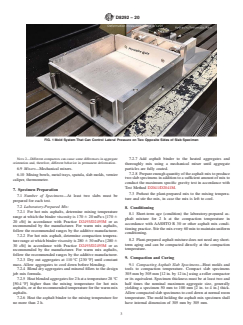
6.2 Specimen Mounting System—The test specimen must be
tested under controlled confining pressures during the test.The
3.2.4 secondary deformation phase, n—the permanent de-
confining pressure must remain constant during the entire
formations occurring after the end of the post-compaction
duration of the test. The confining pressures are controlled
phase and before the inflection point. The slope of the
eitherbypneumatic,hydraulicsystemorothermeansasshown
secondary phase is termed as the creep slope.
in Fig. 1. Fig. 1 shows an example of a mold system that
3.2.5 tertiary deformation phase, n—the permanent defor-
controls confining pressures on two opposite sides of the slab
mations accumulating after the inflection point. The slope of
specimenwhiletheothertwosidesremainfixed.Theconfining
the permanent deformation curve for the tertiary phase is
pressure system must be capable of applying a wide range of
termed as the stripping slope.
confining pressures over a range from zero for unconfined
condition and up to 50 6 1 kPa [7.25 6 0.15 psi]. The mold
4. Summary of Test Method
holding the asphalt mix specimen shall have internal dimen-
4.1 The compacted asphalt specimen is placed in a mold
sions of 305 mm by 305 mm [12 by 12 in.].
under controlled confining pressures during the test. The
confining pressures must remain constant during the test. The 6.3 Temperature Control—The device must be provided
with a temperature control system to maintain the specimen
test specimen must be tested in an air-temperature-controlled
cabinet that maintains constant temperature during the test temperature constant during the test within 61°C[61.8 °F].
The system must be able to apply a range of test temperatures
within 61°C [61.8 °F]. The test specimen is repeatedly
loaded by loaded wheel and the vertical and horizontal from 30 to 70 °C [86 to 158 °F].
permanent deformations are recorded against the number of
6.4 Deformation Measuring Devices—The system must be
wheel passes. If the moisture susceptibility is required, the
provided with displacement transducer devices calibrated ac-
asphalt specimen must be conditioned in a separate thermo-
cording to Practice D6027/D6027M and capable of measuring
statically controlled water bath at the required temperature and
the depth of the vertical permanent deformation and the lateral
for the duration specified by the agency.
flow of the specimen along the length of the wheel’s path, to
within 60.15 mm [60.006 in.], over a minimum range of 0 to
5. Significance and Use
20 mm [0 to 0.79 in.] or when 50 000 passes are achieved,
5.1 This test method measures the permanent deformation
whichever occurs first. The system must continuously measure
behavior and rutting resistance of an asphalt mixture specimen.
the vertical and lateral permanent deformations at least every
5.2 This method can also measure moisture susceptibility of 100 passes.
an asphalt mixture specimen if required by the agency.
6.5 Number of Passes Counter—The system must be ca-
NOTE 1—The quality of the results produced by this standard are pable of recording the number of passes of the loaded wheel.
dependent on the competence of the personnel performing the procedure
6.6 Ovens, for drying and heating aggregates and asphalt
and the capability, calibration, and maintenance of the equipment used.
binder to the mixing and compaction temperatures.
Agencies that meet the criteria of Specification D3666 are generally
considered capable of competent and objective testing, sampling,
6.7 Balances, for weighing and batching asphalt mixes with
inspection, etc. Users of this standard are cautioned that compliance with
capacity of at least 15 000 g [33.07 lb] and accuracy of at least
60.1g[60.0002 lb].
Available from American Association of State Highway and Transportation
6.8 Compactors—Roller compactor for slab specimens in
Officials (AASHTO), 444 N. Capitol St., NW, Suite 249, Washington, DC 20001,
http://www.transportation.org. accordance with Practice D8079; see Note 2.
D8292−20
FIG. 1Mold System That Can Control Lateral Pressure on Two Opposite Sides of Slab Specimen
NOTE 2—Different compactors can cause some differences in aggregate
7.2.7 Add asphalt binder to the heated aggregates and
orientation and, therefore, different behavior in permanent deformation.
thoroughly mix using a mechanical mixer until aggregate
6.9 Mixers—Mechanical mixers. particles are fully coated.
7.2.8 Prepare enough quantity of the asphalt mix to produce
6.10 Mixing bowls, metal trays, spatula, slab molds, vernier
two slab specimens in addition to a sufficient amount of mix to
caliper, thermometer.
conduct the maximum specific gravity test in accordance with
Test Method D2041/D2041M.
7. Specimen Preparation
7.3 Preheat the plant-prepared mix to the mixing tempera-
7.1 Number of Specimens—At least two slabs must be
ture and stir the mix, in case the mix is left to cool.
prepared for each test.
7.2 Laboratory-Prepared Mix:
8. Conditioning
7.2.1 For hot mix asphalts, determine mixing temperature
8.1 Short-term age (condition) the laboratory-prepared as-
range at which the binder viscosity is 170 6 20 mPa·s [170 6
phalt mixture for2hatthe compaction temperature in
20 cSt] in accordance with Practice D2493/D2493M or as
accordance with AASHTO R 30 or other asphalt mix condi-
recommended by the manufacturer. For warm mix asphalts,
tioning practice. Stir the mix every 60 min to maintain uniform
follow the recommended ranges by the additive manufacturer.
conditioning.
7.2.2 For hot mix asphalt, determine compaction tempera-
8.2 Plant-prepared asphalt mixture does not need any short-
ture range at which binder viscosity is 280 6 30 mPa·s [280 6
term aging and can be compacted directly at the compaction
30 cSt] in accordance with Practice D2493/D2493M or as
temperature.
recommended by the manufacturer. For warm mix asphalts,
follow the recommended ranges by the additive manufacturer.
9. Compaction and Curing
7.2.3 Dry out aggregates at 110 °C [230 °F] until constant
mass. Allow aggregates to cool down before blending. 9.1 Compacting Asphalt Slab Specimens—Heat molds and
7.2.4 Blend dry aggregates and mineral fillers to the design tools to compaction temperature. Compact slab specimens
job mix formula. 305 mm by 305 mm [12 in. by 12 in.] using a roller compactor
7.2.5 Heatblendedaggregatesfor2hatatemperature28 °C or its equivalent. Specimen thickness must be at least two and
[50.4 °F] higher than the mixing temperature for hot mix half times the nominal maximum aggregate size, generally
asphalts, or at the recommended temperature for the warm mix yielding a specimen 50 mm to 100 mm [2 in. to
...