

ASTM D2013/D2013M-21
(Practice)Standard Practice for Preparing Coal Samples for Analysis
General Information
- Abstract
SIGNIFICANCE AND USE
5.1 Other standards are used to collect the gross sample: Practice D2234/D2234M allows for one division of the gross sample before crushing. The mass and top size of the gross or divided sample collected by using these guides and practices are usually too large for chemical or physical testing. Practice D2013/D2013M provides instructions for reducing and dividing the gross or divided sample, by on-line or off-line processes, or both, to a top size and mass suitable to the performance of testing. Any bias in the gross or divided sample before adherence to this practice will remain in the final sample resulting from use of this practice. Therefore, carefully select the standard to be used to collect the gross sample.
5.2 Division and reduction of a sample may occur at more than one location. Most often, the sample is collected, reduced, and divided (one or more times) by use of a mechanical sampling system. The remaining sample may be further divided on-site to facilitate transporting it to the laboratory where further reduction and division likely occurs before analysis.
5.3 In places, this practice requires air drying the sample before subsequent reduction. Procedures for air drying and air-dry loss determination are provided in Test Method D3302/D3302M.
5.4 Most often, samples are reduced and divided to an analysis sample. However, some tests may require a sample of different mass or top size. This procedure may be used to provide a sample of any mass and size consist from the gross or divided sample to, and including, the analysis sample.
5.5 This practice also specifies how to prepare composite samples, if required.
SCOPE
1.1 This practice2 covers the reduction and division of gross or divided samples, and the preparation of composite samples, up to and including the individual portions for laboratory analysis.
1.2 Reduction and division procedures are prescribed for coals of the following groups:
1.2.1 Group A includes coals that have been cleaned in all sizes.
1.2.2 Group B includes all other coals. Unknown coals are to be considered under Group B.
1.2.3 Group A allows smaller weight laboratory samples to be retained than Group B. These lower weights may be used for particular coals if they have been shown, by using the procedures of A1.2, to give a sample preparation and analysis variance which is no more than 20 % of the total analysis variance.
1.3 Units—The values stated in either SI units or inch-pound units are to be regarded separately as standard. The values stated in each system are not necessarily exact equivalents; therefore, to ensure conformance with the standard, each system shall be used independently of the other, and values from the two systems shall not be combined.
1.4 This standard does not purport to address all of the safety concerns, if any, associated with its use. It is the responsibility of the user of this standard to establish appropriate safety, health, and environmental practices and determine the applicability of regulatory limitations prior to use.
1.5 This international standard was developed in accordance with internationally recognized principles on standardization established in the Decision on Principles for the Development of International Standards, Guides and Recommendations issued by the World Trade Organization Technical Barriers to Trade (TBT) Committee.
- Status
- Published
- Publication Date
- 30-Sep-2021
- Technical Committee
- D05 - Coal and Coke
- Drafting Committee
- D05.23 - Sampling
Overview
ASTM D2013/D2013M-21, titled "Standard Practice for Preparing Coal Samples for Analysis," is a globally recognized ASTM standard that defines recommended practices for coal sample preparation before laboratory analysis. The standard details processes for reducing and dividing gross or divided samples, ensuring sample masses and sizes are suitable for accurate chemical and physical property testing. Its methodologies help avoid sample bias and maintain consistency in laboratory testing, forming a critical part of the coal quality assurance workflow.
Key Topics
- Sample Reduction and Division: Provides systematic procedures for reducing the mass and top size of coal samples, making them suitable for analytical testing. Includes both manual and mechanical methods.
- Sample Types: Covers requirements for Group A (all-size cleaned coals) and Group B (all other coals), helping users select appropriate sample preparation approaches based on coal type.
- Moisture Handling: Addresses sample air drying practices, referencing specific test methods to determine air-dry loss and ensure moisture levels are controlled during preparation.
- Composite Sample Preparation: Outlines procedures for creating composite samples from multiple increments, ensuring accurate characterization of coal lots or consignments.
- Quality and Precision: Contains guidance on evaluating the precision of sample division and analysis, helping laboratories maintain and verify the reliability of their results.
- Equipment Requirements: Specifies apparatus such as crushers, grinders, riffles, mechanical sample dividers, mixing devices, and appropriate sample storage containers.
Applications
ASTM D2013/D2013M-21 is widely used in the coal industry for:
- Laboratory Sample Preparation: Standardizes how coal samples are prepared for analysis, ensuring uniform test results for quality control or contractual compliance.
- Quality Control: Supports coal mines, power plants, and laboratories in achieving reliable and representative data for moisture, ash, grindability, and other key coal parameters.
- Contract Compliance: Ensures sample preparation methods are consistent with contractual terms or regulatory requirements, minimizing disputes over analytical results.
- Research and Development: Lays the foundation for reproducible testing in research and product development involving coal and its derivatives.
- On-Site and Laboratory Workflows: Facilitates sample handling both at collection sites and in laboratories, enabling seamless transition from gross sample to analysis-ready material.
Related Standards
For a complete and accurate coal sampling and analysis workflow, the following standards are closely linked with ASTM D2013/D2013M-21:
- ASTM D2234/D2234M: Practice for Collection of a Gross Sample of Coal
- ASTM D3302/D3302M: Test Method for Total Moisture in Coal
- ASTM D3173/D3173M: Test Method for Moisture in the Analysis Sample of Coal and Coke
- ASTM D3174: Test Method for Ash in the Analysis Sample of Coal and Coke
- ASTM D3180: Practice for Calculating Coal and Coke Analyses from As-Determined to Different Bases
- ASTM D4749: Test Method for Sieve Analysis of Coal
- ASTM D7430: Practice for Mechanical Sampling of Coal
- ISO 13909: Hard Coal and Coke - Mechanical Sampling
Practical Value
Implementing ASTM D2013/D2013M-21 enhances the accuracy and reliability of coal analyses. Proper sample reduction and division minimize analytical errors and maintain sample representativeness, critical for decision-making in coal trading, blending, quality control, and regulatory compliance. By integrating this standard into coal sampling workflows, stakeholders in the coal supply chain ensure that laboratory data reflect the true characteristics of the coal being tested, supporting both operational efficiency and compliance with international best practices.
Keywords: coal sample preparation, ASTM D2013, coal quality control, coal sample division, moisture analysis, composite coal sample, laboratory coal testing, coal sample reduction.
Relations
- Effective Date
- 01-Apr-2024
- Effective Date
- 01-Mar-2024
- Effective Date
- 01-Dec-2023
- Effective Date
- 01-Dec-2023
- Effective Date
- 01-Apr-2022
- Effective Date
- 01-Dec-2019
- Effective Date
- 15-Apr-2018
- Effective Date
- 01-Mar-2018
- Effective Date
- 01-Nov-2017
- Effective Date
- 15-Oct-2017
- Effective Date
- 01-Oct-2017
- Effective Date
- 01-Oct-2017
- Refers
ASTM D3173/D3173M-17 - Standard Test Method for Moisture in the Analysis Sample of Coal and Coke - Effective Date
- 01-Feb-2017
- Effective Date
- 15-Sep-2016
- Effective Date
- 15-Sep-2016
Get Certified
Connect with accredited certification bodies for this standard

Bureau Veritas Chile
Bureau Veritas certification services in Chile.
Bureau Veritas Peru
Bureau Veritas certification services in Peru.
BVQI Peru
Bureau Veritas certification in Peru.
Sponsored listings
Frequently Asked Questions
ASTM D2013/D2013M-21 is a standard published by ASTM International. Its full title is "Standard Practice for Preparing Coal Samples for Analysis". This standard covers: SIGNIFICANCE AND USE 5.1 Other standards are used to collect the gross sample: Practice D2234/D2234M allows for one division of the gross sample before crushing. The mass and top size of the gross or divided sample collected by using these guides and practices are usually too large for chemical or physical testing. Practice D2013/D2013M provides instructions for reducing and dividing the gross or divided sample, by on-line or off-line processes, or both, to a top size and mass suitable to the performance of testing. Any bias in the gross or divided sample before adherence to this practice will remain in the final sample resulting from use of this practice. Therefore, carefully select the standard to be used to collect the gross sample. 5.2 Division and reduction of a sample may occur at more than one location. Most often, the sample is collected, reduced, and divided (one or more times) by use of a mechanical sampling system. The remaining sample may be further divided on-site to facilitate transporting it to the laboratory where further reduction and division likely occurs before analysis. 5.3 In places, this practice requires air drying the sample before subsequent reduction. Procedures for air drying and air-dry loss determination are provided in Test Method D3302/D3302M. 5.4 Most often, samples are reduced and divided to an analysis sample. However, some tests may require a sample of different mass or top size. This procedure may be used to provide a sample of any mass and size consist from the gross or divided sample to, and including, the analysis sample. 5.5 This practice also specifies how to prepare composite samples, if required. SCOPE 1.1 This practice2 covers the reduction and division of gross or divided samples, and the preparation of composite samples, up to and including the individual portions for laboratory analysis. 1.2 Reduction and division procedures are prescribed for coals of the following groups: 1.2.1 Group A includes coals that have been cleaned in all sizes. 1.2.2 Group B includes all other coals. Unknown coals are to be considered under Group B. 1.2.3 Group A allows smaller weight laboratory samples to be retained than Group B. These lower weights may be used for particular coals if they have been shown, by using the procedures of A1.2, to give a sample preparation and analysis variance which is no more than 20 % of the total analysis variance. 1.3 Units—The values stated in either SI units or inch-pound units are to be regarded separately as standard. The values stated in each system are not necessarily exact equivalents; therefore, to ensure conformance with the standard, each system shall be used independently of the other, and values from the two systems shall not be combined. 1.4 This standard does not purport to address all of the safety concerns, if any, associated with its use. It is the responsibility of the user of this standard to establish appropriate safety, health, and environmental practices and determine the applicability of regulatory limitations prior to use. 1.5 This international standard was developed in accordance with internationally recognized principles on standardization established in the Decision on Principles for the Development of International Standards, Guides and Recommendations issued by the World Trade Organization Technical Barriers to Trade (TBT) Committee.
SIGNIFICANCE AND USE 5.1 Other standards are used to collect the gross sample: Practice D2234/D2234M allows for one division of the gross sample before crushing. The mass and top size of the gross or divided sample collected by using these guides and practices are usually too large for chemical or physical testing. Practice D2013/D2013M provides instructions for reducing and dividing the gross or divided sample, by on-line or off-line processes, or both, to a top size and mass suitable to the performance of testing. Any bias in the gross or divided sample before adherence to this practice will remain in the final sample resulting from use of this practice. Therefore, carefully select the standard to be used to collect the gross sample. 5.2 Division and reduction of a sample may occur at more than one location. Most often, the sample is collected, reduced, and divided (one or more times) by use of a mechanical sampling system. The remaining sample may be further divided on-site to facilitate transporting it to the laboratory where further reduction and division likely occurs before analysis. 5.3 In places, this practice requires air drying the sample before subsequent reduction. Procedures for air drying and air-dry loss determination are provided in Test Method D3302/D3302M. 5.4 Most often, samples are reduced and divided to an analysis sample. However, some tests may require a sample of different mass or top size. This procedure may be used to provide a sample of any mass and size consist from the gross or divided sample to, and including, the analysis sample. 5.5 This practice also specifies how to prepare composite samples, if required. SCOPE 1.1 This practice2 covers the reduction and division of gross or divided samples, and the preparation of composite samples, up to and including the individual portions for laboratory analysis. 1.2 Reduction and division procedures are prescribed for coals of the following groups: 1.2.1 Group A includes coals that have been cleaned in all sizes. 1.2.2 Group B includes all other coals. Unknown coals are to be considered under Group B. 1.2.3 Group A allows smaller weight laboratory samples to be retained than Group B. These lower weights may be used for particular coals if they have been shown, by using the procedures of A1.2, to give a sample preparation and analysis variance which is no more than 20 % of the total analysis variance. 1.3 Units—The values stated in either SI units or inch-pound units are to be regarded separately as standard. The values stated in each system are not necessarily exact equivalents; therefore, to ensure conformance with the standard, each system shall be used independently of the other, and values from the two systems shall not be combined. 1.4 This standard does not purport to address all of the safety concerns, if any, associated with its use. It is the responsibility of the user of this standard to establish appropriate safety, health, and environmental practices and determine the applicability of regulatory limitations prior to use. 1.5 This international standard was developed in accordance with internationally recognized principles on standardization established in the Decision on Principles for the Development of International Standards, Guides and Recommendations issued by the World Trade Organization Technical Barriers to Trade (TBT) Committee.
ASTM D2013/D2013M-21 is classified under the following ICS (International Classification for Standards) categories: 73.040 - Coals. The ICS classification helps identify the subject area and facilitates finding related standards.
ASTM D2013/D2013M-21 has the following relationships with other standards: It is inter standard links to ASTM D7582-24, ASTM D121-15(2024), ASTM D7582-15(2023), ASTM D3180-15(2023), ASTM E456-13a(2022)e1, ASTM D2234/D2234M-19, ASTM D7430-18a, ASTM D7430-18, ASTM D7430-17, ASTM D2234/D2234M-17, ASTM E456-13A(2017)e3, ASTM E456-13A(2017)e1, ASTM D3173/D3173M-17, ASTM D7430-16b, ASTM D7430-16be1. Understanding these relationships helps ensure you are using the most current and applicable version of the standard.
ASTM D2013/D2013M-21 is available in PDF format for immediate download after purchase. The document can be added to your cart and obtained through the secure checkout process. Digital delivery ensures instant access to the complete standard document.
Standards Content (Sample)
This international standard was developed in accordance with internationally recognized principles on standardization established in the Decision on Principles for the
Development of International Standards, Guides and Recommendations issued by the World Trade Organization Technical Barriers to Trade (TBT) Committee.
Designation: D2013/D2013M − 21
Standard Practice for
Preparing Coal Samples for Analysis
This standard is issued under the fixed designation D2013/D2013M; the number immediately following the designation indicates the
year of original adoption or, in the case of revision, the year of last revision. A number in parentheses indicates the year of last
reapproval. A superscript epsilon (´) indicates an editorial change since the last revision or reapproval.
This standard has been approved for use by agencies of the U.S. Department of Defense.
1. Scope 2. Referenced Documents
2 3
1.1 This practice covers the reduction and division of gross 2.1 ASTM Standards:
or divided samples, and the preparation of composite samples, D121 Terminology of Coal and Coke
up to and including the individual portions for laboratory D2234/D2234M Practice for Collection of a Gross Sample
analysis. of Coal
D3173/D3173M Test Method for Moisture in the Analysis
1.2 Reduction and division procedures are prescribed for
Sample of Coal and Coke
coals of the following groups:
D3174 Test Method forAsh in theAnalysis Sample of Coal
1.2.1 Group A includes coals that have been cleaned in all
and Coke from Coal
sizes.
D3180 Practice for Calculating Coal and Coke Analyses
1.2.2 Group B includes all other coals. Unknown coals are
from As-Determined to Different Bases
to be considered under Group B.
D3302/D3302M Test Method for Total Moisture in Coal
1.2.3 Group A allows smaller weight laboratory samples to
D4749 Test Method for Performing the Sieve Analysis of
beretainedthanGroupB.Theselowerweightsmaybeusedfor
Coal and Designating Coal Size
particular coals if they have been shown, by using the
D7430 Practice for Mechanical Sampling of Coal
procedures of A1.2, to give a sample preparation and analysis
D7582 Test Methods for Proximate Analysis of Coal and
variance which is no more than 20 % of the total analysis
Coke by Macro Thermogravimetric Analysis
variance.
E11 Specification for Woven Wire Test Sieve Cloth and Test
1.3 Units—The values stated in either SI units or inch-
Sieves
pound units are to be regarded separately as standard. The
E177 Practice for Use of the Terms Precision and Bias in
values stated in each system are not necessarily exact equiva-
ASTM Test Methods
lents; therefore, to ensure conformance with the standard, each
E456 Terminology Relating to Quality and Statistics
system shall be used independently of the other, and values
2.2 ISO Standard:
from the two systems shall not be combined.
ISO 13909 Hard Coal and Coke—Mechanical Sampling
1.4 This standard does not purport to address all of the
safety concerns, if any, associated with its use. It is the
3. Terminology
responsibility of the user of this standard to establish appro-
3.1 Definitions of Terms Specific to This Standard—No
priate safety, health, and environmental practices and deter-
terms are used which are specific to this practice. Many terms
mine the applicability of regulatory limitations prior to use.
used in this practice may be found in Terminologies D121 and
1.5 This international standard was developed in accor-
E456 and in Practice E177.
dance with internationally recognized principles on standard-
ization established in the Decision on Principles for the
4. Summary of Practice
Development of International Standards, Guides and Recom-
4.1 Three processes of sample division and reduction are
mendations issued by the World Trade Organization Technical
covered as follows:
Barriers to Trade (TBT) Committee.
This practice is under the jurisdiction of ASTM Committee D05 on Coal and
Coke and is the direct responsibility of Subcommittee D05.23 on Sampling. For referenced ASTM standards, visit the ASTM website, www.astm.org, or
Current edition approved Oct. 1, 2021. Published December 2021. Originally contact ASTM Customer Service at service@astm.org. For Annual Book of ASTM
approved in 1962. Last previous edition approved in 2020 as D2013/D2013M – 20. Standards volume information, refer to the standard’s Document Summary page on
DOI: 10.1520/D2013_D2013M-21. the ASTM website.
Formoredetailedexplanationofthispractice,seeKeller,G.E.,“Determination Available from International Organization for Standardization (ISO), ISO
of Quantities Needed in Coal Sample Preparation and Analysis,” Transactions,Vol Central Secretariat, BIBC II, Chemin de Blandonnet 8, CP 401, 1214 Vernier,
232, 1965, pp. 218–226. Geneva, Switzerland, http://www.iso.org.
Copyright © ASTM International, 100 Barr Harbor Drive, PO Box C700, West Conshohocken, PA 19428-2959. United States
D2013/D2013M − 21
4.1.1 Procedure A—Manual riffles are used for division of height with smooth, hard, well-rounded, flint pebbles, or
the sample and mechanical crushing equipment for the reduc- equivalent, that do not increase ash content of the sample.
tion of the sample.
6.1.4 Bucking Board (Chrome Steel) or Mortar (Agate or
4.1.2 Procedure B—Mechanical sample dividers are used Equivalent) and Pestle—Only for reducing the small fraction
for the division of the sample and mechanical crushing of sample, not passing a 250 µm [No. 60] sieve after pulveri-
equipment for the reduction of the sample. zation.
4.1.3 Combined Procedure A and B—The two procedures
6.2 Sample Dividers:
may be combined at any stage.
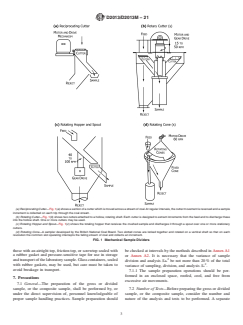
6.2.1 Mechanical—A mechanical sample divider using a
reciprocating or rotating cutter, a rotating hopper and spout, a
5. Significance and Use
rotating slotted cone, a reciprocating hopper and fixed cutter,
bucket cutter with either bottom dump or inverting discharge,
5.1 Other standards are used to collect the gross sample:
Practice D2234/D2234M allows for one division of the gross slotted belt, rotary disk divider, mechanical stopped or moving
belt sweeper, or other acceptable devices for dividing the
sample before crushing. The mass and top size of the gross or
divided sample collected by using these guides and practices sample. Typical mechanical sample dividers are shown in Fig.
1.Theseillustratevariousdesigns,butotheracceptabledesigns
are usually too large for chemical or physical testing. Practice
D2013/D2013M provides instructions for reducing and divid- are available.
ing the gross or divided sample, by on-line or off-line
6.2.2 Riffle—A manual sample divider that splits the coal
processes, or both, to a top size and mass suitable to the stream into two parts when it is directed through alternating
performanceoftesting.Anybiasinthegrossordividedsample
slots. Riffle slots shall be at least three times the top size of the
beforeadherencetothispracticewillremaininthefinalsample coal being divided and have an even number of alternating
resulting from use of this practice. Therefore, carefully select
slots, in order to achieve similar mass delivered to each catch
the standard to be used to collect the gross sample. pan. Riffles shall be enclosed. The slope of the feed chutes and
riffles shall be at least 60°.
5.2 Division and reduction of a sample may occur at more
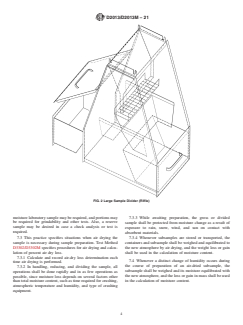
6.2.2.1 Large Riffle—A manual sample divider with at least
than one location. Most often, the sample is collected, reduced,
fourteen 12.7 mm [ ⁄2 in.] to 25.4 mm [1 in.] divisions for
and divided (one or more times) by use of a mechanical
dividing subsamples of coal passing 2.36 mm [No. 8], and
sampling system. The remaining sample may be further di-
4.75 mm [No. 4] sieves. See Fig. 2.
videdon-sitetofacilitatetransportingittothelaboratorywhere
6.2.2.2 Small Riffle—A manual sample divider with at least
further reduction and division likely occurs before analysis.
1 3
twenty-four 6.35 mm [ ⁄4 in.] to 9.52 mm [ ⁄8 in.] divisions for
5.3 In places, this practice requires air drying the sample
dividing the subsamples of coal passing 250 µm [No. 60]. See
before subsequent reduction. Procedures for air drying and
Fig. 3.
air-dry loss determination are provided in Test Method D3302/
6.2.2.3 Feed Scoop—A feed scoop or pan having straight
D3302M.
sides and a width equal to the effective width of the riffle shall
5.4 Most often, samples are reduced and divided to an be used to feed the riffle.
analysis sample. However, some tests may require a sample of 6.2.2.4 Feed Chute—Afeed chute shall be used as shown in
different mass or top size. This procedure may be used to
Fig. 2. The minimum discharge opening of the feed chute shall
provide a sample of any mass and size consist from the gross be the same width as the riffle slot opening.
or divided sample to, and including, the analysis sample.
6.3 Mixing Wheel—One type of a mechanical device used
5.5 This practice also specifies how to prepare composite
for mixing the analysis sample. In this device, the samples are
samples, if required. in closed containers attached to the rim of a wheel at an angle
of 45° with the horizontal wheel shaft. The wheel provides
6. Apparatus spaceforanumberofcontainersdependingonitsdiameterand
is turned slowly by a small motor and reduction gear. The
6.1 Crushers or Grinders—Jaw, cone, or rotary crusher;
wheel should be rotated at a speed so that the particles fall
hammer mill; roll; or other suitable crusher to reduce the
gently from top to bottom of the container, mixing the sample
sample to pass the sieve designated in 6.4. Hard steel or chilled
thoroughly. The container should be about half full and never
iron plate with tamper, sledge, or hand bar may be used for
more than two-thirds full to obtain good mixing of the sample.
preliminary crushing of any large lumps in the sample before
feeding into the crusher. Crushers should be designed and 6.4 Sieves—A set of sieves whose dimensions are in accor-
operated in a manner to minimize the effect of induced air dance with Specification E11, of the following sizes, with
circulation and thus the potential for drying the coal. cover and receiver:
6.1.1 Pulverizer or Mill—For final reduction of laboratory
No. Size
sample to the 250 µm [No. 60] sieve size, the following
4 4.75 mm
equipment may be used:
8 2.36 mm
6.1.2 Hammer Mill—Completely enclosed to avoid loss of
20 850 µm
60 250 µm
dust or moisture.
6.1.3 Porcelain-Jar Ball Mill—This mill shall be approxi- 6.5 Laboratory Sample Containers—Heavy vapor-
mately 230 mm [9.0 in.] in diameter and 250 mm [10.0 in.] in imperviousbags,properlysealed,ornoncorrodingcanssuchas
D2013/D2013M − 21
(a)ReciprocatingCutter—Fig. 1(a) shows a section of a cutter which is moved across a stream of coal. At regular intervals, the cutter movement is reversed and a sample
increment is collected on each trip through the coal stream.
(b) Rotating Cutter—Fig. 1(b) shows two cutters attached to a hollow, rotating shaft. Each cutter is designed to extract increments from the feed and to discharge these
into the hollow shaft. One or more cutters may be used.
(c) Rotating Hopper and Spout—Fig. 1(c) shows the totaling hopper that receives the crushed sample and discharges it through a spout over one or more stationary
cutters.
(d) Rotating Cone—A sampler developed by the British National Coal Board. Two slotted cones are locked together and rotated on a vertical shaft so that on each
revolution the common slot operating intercepts the falling stream of coal and collects an increment.
FIG. 1 Mechanical Sample Dividers
those with an airtight top, friction top, or screwtop sealed with be checked at intervals by the methods described in AnnexA1
a rubber gasket and pressure-sensitive tape for use in storage or Annex A2. It is necessary that the variance of sample
andtransportofthelaboratorysample.Glasscontainers,sealed
division and analysis S be not more than 20 % of the total
da
with rubber gaskets, may be used, but care must be taken to
variance of sampling, division, and analysis S .
o
avoid breakage in transport.
7.1.1 The sample preparation operations should be per-
formed in an enclosed space, roofed, cool, and free from
7. Precautions
excessive air movements.
7.1 General—The preparation of the gross or divided
7.2 Number of Tests—Before preparing the gross or divided
sample, or the composite sample, shall be performed by, or
under the direct supervision of, personnel knowledgeable of sample, or the composite sample, consider the number and
proper sample handling practices. Sample preparation should nature of the analysis and tests to be performed. A separate
D2013/D2013M − 21
FIG. 2 Large Sample Divider (Riffle)
moisture laboratory sample may be required, and portions may 7.3.3 While awaiting preparation, the gross or divided
be required for grindability and other tests. Also, a reserve sample shall be protected from moisture change as a result of
sample may be desired in case a check analysis or test is
exposure to rain, snow, wind, and sun on contact with
required.
absorbent materials.
7.3 This practice specifies situations when air drying the 7.3.4 Whenever subsamples are stored or transported, the
sample is necessary during sample preparation. Test Method containers and subsample shall be weighed and equilibrated to
D3302/D3302M specifies procedures for air drying and calcu-
the new atmosphere by air drying, and the weight loss or gain
lation of percent air dry loss.
shall be used in the calculation of moisture content.
7.3.1 Calculate and record air-dry loss determination each
7.4 Whenever a distinct change of humidity occurs during
time air drying is performed.
the course of preparation of an air-dried subsample, the
7.3.2 In handling, reducing, and dividing the sample, all
subsample shall be weighed and its moisture equilibrated with
operations shall be done rapidly and in as few operations as
the new atmosphere, and the loss or gain in mass shall be used
possible, since moisture loss depends on several factors other
in the calculation of moisture content.
than total moisture content, such as time required for crushing,
atmospheric temperature and humidity, and type of crushing
equipment.
D2013/D2013M − 21
FIG. 3 Small Sample Divider (Riffle)
TABLE 1 Preparation of Laboratory Sample
8. Sieve Tests
Divide to a minimum
Crush to pass at least 95 % through A
8.1 The errors of sample division are sensitive to the top weight of, g
sieve
size, and therefore, it is important to make a periodic sieve test
Group A Group B
of the product of the sample crusher. Sieve tests shall be made 4.75 mm [No. 4] 2000 4000
2.36 mm [No. 8] 500 1000
and reported in accordance with Test Method D4749.
850 µm [No. 20] 250 500
250 µm [No. 60] 50 50
9. Procedure
(100 % through)
A
9.1 Mass—The minimum allowable mass of the sample at If a moisture sample is required, increase the quantity of No. 4 [4.75 mm] or
No. 8 [2.36 mm] sieve subsample by 500 g.
any stage depends on the top size, the variability of the
constituent sought, and the degree of precision desired (Table
1).
9.2 Reduction and Division (See Fig. 4 for flowchart): 9.2.3.1 Reduce the gross or divided sample to a top size of
9.2.1 It is permissible to air dry the sample before crushing. 4.75 mm [No. 4] or 2.36 mm [No. 8] sieve, taking precautions
Samples may require air drying to feed properly through the in accordance with Section 7.
reduction and dividing equipment. Sometimes there is an 9.2.3.2 Determine the number of passes required in the
interest in determining the air-dry loss value before crushing. riffling operation from the total mass of the gross sample and
Air dry in accordance with Test Method D3302/D3302M. the minimum permissible mass in accordance with Table 1.
9.2.2 In the reduction and division of gross or divided 9.2.3.3 Divide the crushed sample by using a large riffle.
samples for which total moisture content is to be determined, Riffles properly used will reduce sample variability but cannot
the precautions in 7.3 and 7.4 must be followed. eliminate it. A typical enclosed riffle is shown in Fig. 2 and
9.2.3 Procedure A—Manual Riffling: described in 6.2.2. Pass the coal through the riffle from a feed
D2013/D2013M − 21
FIG. 4 Sample Preparation Flowchart
scoop, feed bucket, or riffle pan having a lip or opening the full coal to build up in or above the riffle slots. If it does not flow
width of the riffle. When using any of the preceding containers freely through the slots, shake or vibrate the riffle to facilitate
to feed the riffle, spread the coal evenly in the container, raise even flow.
the container, and hold it with its front edge resting on top of 9.2.3.4 If the initial crushing was only to 4.75 mm [No. 4]
the feed chute, then slowly tilt it so that the coal flows in a sieve size, reduce to 2.36 mm [No. 8] sieve size after dividing
uniform stream through the hopper straight down over the to no less than the quantity specified in Table 1 for a 4.75 mm
centeroftheriffleintoalltheslots,thenintotherifflepans,one [No. 4] sieve size.
half of the sample being collected in each pan. Under no 9.2.3.5 After reducing to 2.36 mm [No. 8] sieve size, divide
circumstances shovel the sample into the riffle or dribble into the subsample by riffling to no less than the quantity specified
the riffle from a small-mouthed container. Do not allow the in Table 1 for a 2.36 mm sieve size.
D2013/D2013M − 21
9.2.3.6 With suitable pulverizing equipment (see 6.1), re- percent moisture and other as-received basis data determined
duce the 2.36 mm [No. 8] sieve size subsample to a 250 µm onthecompositemaydifferslightlyfromtheweightedaverage
[No. 60] sieve size. Divide the ground subsample by riffling, of the individual samples. In addition, errors associated with
using the small riffle (see 6.2.2) until a minimum of 50 g is extraction of increments from multiple samples are unknown
obtained. Quickly pass the subsample through a 250 µm andcanvaryfromsampletosampleandwiththeabsolutelevel
[No. 60] sieve. Reduce the particles retained on the screen, on of each analyte. Taking these and other issues into account
a bucking board or mortar and pestle to pass the sieve, and add leads to the requirement that preparation of composites be
to what passed through the sieve and mix thoroughly. This is performed in accordance with the procedures described below.
the analysis sample. The details pertaining to the preparation of composite samples
9.2.3.7 As an alternative to the procedure of 9.2.3.6, the should be agreed to by all concerned parties.
NOTE 2—As used in this standard, the term represent (together with its
2.36 mm [No. 8] sieve size subsample may be reduced to pass
related forms) does not imply that samples satisfy a particular quantitative
95 % through a 850 µm [No. 20] sieve. Divide this subsample
or statistical relationship to the coal that was sampled. The term is used
by riffling with the small riffle to not less than the quantity
within Practice D2013/D2013M in the sense of its broad dictionary
specified in Table 1, and then reduce to 250 µm [No. 60] sieve
definition, that is, to simply stand for or symbolize larger quantities of
size in accordance with 9.2.3.6.
coal.
NOTE3—Asusedinthisstandard,parametersthatareadditivearethose
9.2.3.8 Thoroughly mix, preferably by mechanical means,
having values not affected by interactions between the physical and
the analysis sample, weighing not less than 50 g, before
chemical properties of the combined individual samples. Non-additive
extracting portions for analysis (see 6.3).
parameters are those for which such interactions may occur or those for
9.2.4 Procedure B—Mechanical Division:
which definitive information on interactions is not available.
9.2.4.1 Reduce the gross or divided sample in stages and
10.2 If two or more samples have been collected by a single
divide by suitable mechanical sample dividers (see 6.2.1)to
mechanical coal sampling system operated under constant
quantities not less than those shown in Table 1.
settings, prepare the composite by directly combining all of the
9.2.4.2 Mechanical division of the sample consists of auto-
material from all samples. If it is desired to decrease the total
matically collecting a large number of increments of the
mass of the composite, it is acceptable to combine equal
properly reduced sample. Distribute this large number of
percentages (for example, 75 % or 50 %) of each individual
increments equally throughout the entire discharge from the
sample,allofwhichhavebeendividedinthesamemannerand
sample crusher because crushers can introduce appreciable
according to this standard. Determine whether sample masses
segregation. At each stage of division, take at least 60
have been decreased prior to arrival of samples at the labora-
increments.
tory and, if so, by what percentages.Account for that informa-
tion when making the composite. The samples may be reduced
NOTE 1—It is recommended that, in the case of mechanical division in
which an increment is not thoroughly mixed with other increments before in nominal top size (for example, to pass a 2.36 mm [No. 8]
division, a portion of each increment be collected by the subsequent stage
sieve) to facilitate the compositing process. Adhere to the
increment collection process.
minimum masses required in Table 1. Observe the precautions
9.2.4.3 Thoroughly mix the analysis sample, 100 % through ofPracticeD7430andTestMethodD3302/D3302M,aswellas
250 µm [No. 60] sieve and weighing not less than 50 g, in
those found in this standard, to guard against unaccounted-for
accordance with 9.2.3.8 before extracting portions for analysis. changes in moisture. It is advisable to mix the composite
sample thoroughly, but without altering the moisture content,
10. Preparation of Composite Samples to Represent Lot- before reducing or dividing to smaller quantities.
Size (or Consignment-Size) Quantities of Coal
10.3 Iftwoormoresampleshavebeencollectedbymultiple
10.1 There are several issues to consider when deciding mechanical coal sampling systems, or if manual sampling
whether to make a physical composite of separate samples practices have been used and only additive parameters are
collected to represent different parts of the same lot (or required for analysis, the individual samples can be tested
consignment). See Note 2. When the analytical parameters of separately and a ton-weighted mathematical average
interest are additive (for example, proximate and ultimate performed, or a composite sample
...
This document is not an ASTM standard and is intended only to provide the user of an ASTM standard an indication of what changes have been made to the previous version. Because
it may not be technically possible to adequately depict all changes accurately, ASTM recommends that users consult prior editions as appropriate. In all cases only the current version
of the standard as published by ASTM is to be considered the official document.
Designation: D2013/D2013M − 20 D2013/D2013M − 21
Standard Practice for
Preparing Coal Samples for Analysis
This standard is issued under the fixed designation D2013/D2013M; the number immediately following the designation indicates the
year of original adoption or, in the case of revision, the year of last revision. A number in parentheses indicates the year of last
reapproval. A superscript epsilon (´) indicates an editorial change since the last revision or reapproval.
This standard has been approved for use by agencies of the U.S. Department of Defense.
1. Scope
1.1 This practice covers the reduction and division of gross or divided samples, and the preparation of composite samples, up
to and including the individual portions for laboratory analysis.
1.2 Reduction and division procedures are prescribed for coals of the following groups:
1.2.1 Group A includes coals that have been cleaned in all sizes.
1.2.2 Group B includes all other coals. Unknown coals are to be considered under Group B.
1.2.3 Group A allows smaller weight laboratory samples to be retained than Group B. These lower weights may be used for
particular coals if they have been shown, by using the procedures of A1.2, to give a sample preparation and analysis variance which
is no more than 20 % of the total analysis variance.
1.3 Units—The values stated in either SI units or inch-pound units are to be regarded separately as standard. The values stated in
each system are not necessarily exact equivalents; therefore, to ensure conformance with the standard, each system shall be used
independently of the other, and values from the two systems shall not be combined.
1.4 This standard does not purport to address all of the safety concerns, if any, associated with its use. It is the responsibility
of the user of this standard to establish appropriate safety, health, and environmental practices and determine the applicability of
regulatory limitations prior to use.
1.5 This international standard was developed in accordance with internationally recognized principles on standardization
established in the Decision on Principles for the Development of International Standards, Guides and Recommendations issued
by the World Trade Organization Technical Barriers to Trade (TBT) Committee.
2. Referenced Documents
2.1 ASTM Standards:
D121 Terminology of Coal and Coke
D2234/D2234M Practice for Collection of a Gross Sample of Coal
D3173/D3173M Test Method for Moisture in the Analysis Sample of Coal and Coke
This practice is under the jurisdiction of ASTM Committee D05 on Coal and Coke and is the direct responsibility of Subcommittee D05.23 on Sampling.
Current edition approved Feb. 1, 2020Oct. 1, 2021. Published February 2020December 2021. Originally approved in 1962. Last previous edition approved in 20182020
as D2013/D2013M – 18.D2013/D2013M – 20. DOI: 10.1520/D2013_D2013M-20.10.1520/D2013_D2013M-21.
For more detailed explanation of this practice, see Keller, G. E., “Determination of Quantities Needed in Coal Sample Preparation and Analysis,” Transactions, Vol 232,
1965, pp. 218–226.
For referenced ASTM standards, visit the ASTM website, www.astm.org, or contact ASTM Customer Service at service@astm.org. For Annual Book of ASTM Standards
volume information, refer to the standard’s Document Summary page on the ASTM website.
Copyright © ASTM International, 100 Barr Harbor Drive, PO Box C700, West Conshohocken, PA 19428-2959. United States
D2013/D2013M − 21
D3174 Test Method for Ash in the Analysis Sample of Coal and Coke from Coal
D3180 Practice for Calculating Coal and Coke Analyses from As-Determined to Different Bases
D3302/D3302M Test Method for Total Moisture in Coal
D4749 Test Method for Performing the Sieve Analysis of Coal and Designating Coal Size
D7430 Practice for Mechanical Sampling of Coal
D7582 Test Methods for Proximate Analysis of Coal and Coke by Macro Thermogravimetric Analysis
E11 Specification for Woven Wire Test Sieve Cloth and Test Sieves
E177 Practice for Use of the Terms Precision and Bias in ASTM Test Methods
E456 Terminology Relating to Quality and Statistics
2.2 ISO Standard:
ISO 13909 Hard Coal and Coke—Mechanical Sampling
3. Terminology
3.1 Definitions of Terms Specific to This Standard—No terms are used which are specific to this practice. Many terms used in this
practice may be found in Terminologies D121 and E456 and in Practice E177.
4. Summary of Practice
4.1 Three processes of sample division and reduction are covered as follows:
4.1.1 Procedure A—Manual riffles are used for division of the sample and mechanical crushing equipment for the reduction of the
sample.
4.1.2 Procedure B—Mechanical sample dividers are used for the division of the sample and mechanical crushing equipment for
the reduction of the sample.
4.1.3 Combined Procedure A and B—The two procedures may be combined at any stage.
5. Significance and Use
5.1 Other standards are used to collect the gross sample: Practice D2234/D2234M allows for one division of the gross sample
before crushing. The mass and top size of the gross or divided sample collected by using these guides and practices are usually
too large for chemical or physical testing. Practice D2013/D2013M provides instructions for reducing and dividing the gross or
divided sample, by on-line or off-line processes, or both, to a top size and mass suitable to the performance of testing. Any bias
in the gross or divided sample before adherence to this practice will remain in the final sample resulting from use of this practice.
Therefore, carefully select the standard to be used to collect the gross sample.
5.2 Division and reduction of a sample may occur at more than one location. Most often, the sample is collected, reduced, and
divided (one or more times) by use of a mechanical sampling system. The remaining sample may be further divided on-site to
facilitate transporting it to the laboratory where further reduction and division likely occurs before analysis.
5.3 In places, this practice requires air drying the sample before subsequent reduction. Procedures for air drying and air-dry loss
determination are provided in Test Method D3302/D3302M.
5.4 Most often, samples are reduced and divided to an analysis sample. However, some tests may require a sample of different
mass or top size. This procedure may be used to provide a sample of any mass and size consist from the gross or divided sample
to, and including, the analysis sample.
5.5 This practice also specifies how to prepare composite samples, if required.
6. Apparatus
6.1 Crushers or Grinders—Jaw, cone, or rotary crusher; hammer mill; roll; or other suitable crusher to reduce the sample to pass
Available from International Organization for Standardization (ISO), ISO Central Secretariat, BIBC II, Chemin de Blandonnet 8, CP 401, 1214 Vernier, Geneva,
Switzerland, http://www.iso.org.
D2013/D2013M − 21
the sieve designated in 6.4. Hard steel or chilled iron plate with tamper, sledge, or hand bar may be used for preliminary crushing
of any large lumps in the sample before feeding into the crusher. Crushers should be designed and operated in a manner to
minimize the effect of induced air circulation and thus the potential for drying the coal.
6.1.1 Pulverizer or Mill—For final reduction of laboratory sample to the 250 μm [No. 60] sieve size, the following equipment may
be used:
6.1.2 Hammer Mill—Completely enclosed to avoid loss of dust or moisture.
6.1.3 Porcelain-Jar Ball Mill—This mill shall be approximately 230 mm [9.0 in.] in diameter and 250 mm [10.0 in.] in height with
smooth, hard, well-rounded, flint pebbles, or equivalent, that do not increase ash content of the sample.
6.1.4 Bucking Board (Chrome Steel) or Mortar (Agate or Equivalent) and Pestle—Only for reducing the small fraction of sample,
not passing a 250 μm [No. 60] sieve after pulverization.
6.2 Sample Dividers:
6.2.1 Mechanical—A mechanical sample divider using a reciprocating or rotating cutter, a rotating hopper and spout, a rotating
slotted cone, a reciprocating hopper and fixed cutter, bucket cutter with either bottom dump or inverting discharge, slotted belt,
rotary disk divider, mechanical stopped or moving belt sweeper, or other acceptable devices for dividing the sample. Typical
mechanical sample dividers are shown in Fig. 1. These illustrate various designs, but other acceptable designs are available.
6.2.2 Riffle—A manual sample divider that splits the coal stream into two parts when it is directed through alternating slots. Riffle
slots shall be at least three times the top size of the coal being divided and have an even number of alternating slots, in order to
achieve similar mass delivered to each catch pan. Riffles shall be enclosed. The slope of the feed chutes and riffles shall be at least
60°.
6.2.2.1 Large Riffle—A manual sample divider with at least fourteen 12.7 mm [ ⁄2 in.] to 25.4 mm [1 in.] divisions for dividing
subsamples of coal passing 2.36 mm [No. 8], and 4.75 mm [No. 4] sieves. See Fig. 2.
1 3
6.2.2.2 Small Riffle—A manual sample divider with at least twenty-four 6.35 mm [ ⁄4 in.] to 9.52 mm [ ⁄8 in.] divisions for dividing
the subsamples of coal passing 250 μm [No. 60]. See Fig. 3.
6.2.2.3 Feed Scoop—A feed scoop or pan having straight sides and a width equal to the effective width of the riffle shall be used
to feed the riffle.
6.2.2.4 Feed Chute—A feed chute shall be used as shown in Fig. 2. The minimum discharge opening of the feed chute shall be
the same width as the riffle slot opening.
6.3 Mixing Wheel—One type of a mechanical device used for mixing the analysis sample. In this device, the samples are in closed
containers attached to the rim of a wheel at an angle of 45° with the horizontal wheel shaft. The wheel provides space for a number
of containers depending on its diameter and is turned slowly by a small motor and reduction gear. The wheel should be rotated
at a speed so that the particles fall gently from top to bottom of the container, mixing the sample thoroughly. The container should
be about half full and never more than two-thirds full to obtain good mixing of the sample.
6.4 Sieves—A set of sieves whose dimensions are in accordance with Specification E11, of the following sizes, with cover and
receiver:
No. Size
4 4.75 mm
8 2.36 mm
20 850 μm
60 250 μm
6.5 Laboratory Sample Containers—Heavy vapor-impervious bags, properly sealed, or noncorroding cans such as those with an
airtight top, friction top, or screwtop sealed with a rubber gasket and pressure-sensitive tape for use in storage and transport of the
laboratory sample. Glass containers, sealed with rubber gaskets, may be used, but care must be taken to avoid breakage in transport.
D2013/D2013M − 21
(a) Reciprocating Cutter—Fig. 1(a) shows a section of a cutter which is moved across a stream of coal. At regular intervals, the cutter movement is reversed and a sample
increment is collected on each trip through the coal stream.
(b) Rotating Cutter—Fig. 1(b) shows two cutters attached to a hollow, rotating shaft. Each cutter is designed to extract increments from the feed and to discharge these
into the hollow shaft. One or more cutters may be used.
(c) Rotating Hopper and Spout—Fig. 1(c) shows the totaling hopper that receives the crushed sample and discharges it through a spout over one or more stationary
cutters.
(d) Rotating Cone—A sampler developed by the British National Coal Board. Two slotted cones are locked together and rotated on a vertical shaft so that on each
revolution the common slot operating intercepts the falling stream of coal and collects an increment.
FIG. 1 Mechanical Sample Dividers
7. Precautions
7.1 General—The preparation of the gross or divided sample, or the composite sample, shall be performed by, or under the direct
supervision of, personnel knowledgeable of proper sample handling practices. Sample preparation should be checked at intervals
by the methods described in Annex A1 or Annex A2. It is necessary that the variance of sample division and analysis S be not
da
more than 20 % of the total variance of sampling, division, and analysis S .
o
7.1.1 The sample preparation operations should be performed in an enclosed space, roofed, cool, and free from excessive air
movements.
7.2 Number of Tests—Before preparing the gross or divided sample, or the composite sample, consider the number and nature of
D2013/D2013M − 21
FIG. 2 Large Sample Divider (Riffle)
the analysis and tests to be performed. A separate moisture laboratory sample may be required, and portions may be required for
grindability and other tests. Also, a reserve sample may be desired in case a check analysis or test is required.
7.3 This practice specifies situations when air drying the sample is necessary during sample preparation. Test Method
D3302/D3302M specifies procedures for air drying and calculation of percent air dry loss.
7.3.1 Calculate and record air-dry loss determination each time air drying is performed.
7.3.2 In handling, reducing, and dividing the sample, all operations shall be done rapidly and in as few operations as possible,
since moisture loss depends on several factors other than total moisture content, such as time required for crushing, atmospheric
temperature and humidity, and type of crushing equipment.
7.3.3 While awaiting preparation, the gross or divided sample shall be protected from moisture change as a result of exposure to
rain, snow, wind, and sun on contact with absorbent materials.
7.3.4 Whenever subsamples are stored or transported, the containers and subsample shall be weighed and equilibrated to the new
atmosphere by air drying, and the weight loss or gain shall be used in the calculation of moisture content.
D2013/D2013M − 21
FIG. 3 Small Sample Divider (Riffle)
7.4 Whenever a distinct change of humidity occurs during the course of preparation of an air-dried subsample, the subsample shall
be weighed and its moisture equilibrated with the new atmosphere, and the loss or gain in mass shall be used in the calculation
of moisture content.
8. Sieve Tests
8.1 The errors of sample division are sensitive to the top size, and therefore, it is important to make a periodic sieve test of the
product of the sample crusher. Sieve tests shall be made and reported in accordance with Test Method D4749.
9. Procedure
9.1 Mass—The minimum allowable mass of the sample at any stage depends on the top size, the variability of the constituent
sought, and the degree of precision desired (Table 1).
9.2 Reduction and Division (See Fig. 4 for flowchart):
9.2.1 It is permissible to air dry the sample before crushing. Samples may require air drying to feed properly through the reduction
and dividing equipment. Sometimes there is an interest in determining the air-dry loss value before crushing. Air dry in accordance
with Test Method D3302/D3302M.
D2013/D2013M − 21
TABLE 1 Preparation of Laboratory Sample
Divide to a minimum
Crush to pass at least 95 % through A
weight of, g
sieve
Group A Group B
4.75 mm [No. 4] 2000 4000
2.36 mm [No. 8] 500 1000
850 μm [No. 20] 250 500
250 μm [No. 60] 50 50
(100 % through)
A
If a moisture sample is required, increase the quantity of No. 4 [4.75 mm] or
No. 8 [2.36 mm] sieve subsample by 500 g.
9.2.2 In the reduction and division of gross or divided samples for which total moisture content is to be determined, the precautions
in 7.3 and 7.4 must be followed.
9.2.3 Procedure A—Manual Riffling:
9.2.3.1 Reduce the gross or divided sample to a top size of 4.75 mm [No. 4] or 2.36 mm [No. 8] sieve, taking precautions in
accordance with Section 7.
9.2.3.2 Determine the number of passes required in the riffling operation from the total mass of the gross sample and the minimum
permissible mass in accordance with Table 1.
9.2.3.3 Divide the crushed sample by using a large riffle. Riffles properly used will reduce sample variability but cannot eliminate
it. A typical enclosed riffle is shown in Fig. 2 and described in 6.2.2. Pass the coal through the riffle from a feed scoop, feed bucket,
or riffle pan having a lip or opening the full width of the riffle. When using any of the preceding containers to feed the riffle, spread
the coal evenly in the container, raise the container, and hold it with its front edge resting on top of the feed chute, then slowly
tilt it so that the coal flows in a uniform stream through the hopper straight down over the center of the riffle into all the slots, then
into the riffle pans, one half of the sample being collected in each pan. Under no circumstances shovel the sample into the riffle
or dribble into the riffle from a small-mouthed container. Do not allow the coal to build up in or above the riffle slots. If it does
not flow freely through the slots, shake or vibrate the riffle to facilitate even flow.
9.2.3.4 If the initial crushing was only to 4.75 mm [No. 4] sieve size, reduce to 2.36 mm [No. 8] sieve size after dividing to no
less than the quantity specified in Table 1 for a 4.75 mm [No. 4] sieve size.
9.2.3.5 After reducing to 2.36 mm [No. 8] sieve size, divide the subsample by riffling to no less than the quantity specified in Table
1 for a 2.36 mm sieve size.
9.2.3.6 With suitable pulverizing equipment (see 6.1), reduce the 2.36 mm [No. 8] sieve size subsample to a 250 μm [No. 60] sieve
size. Divide the ground subsample by riffling, using the small riffle (see 6.2.2) until a minimum of 50 g is obtained. Quickly pass
the subsample through a 250 μm [No. 60] sieve. Reduce the particles retained on the screen, on a bucking board or mortar and
pestle to pass the sieve, and add to what passed through the sieve and mix thoroughly. This is the analysis sample.
9.2.3.7 As an alternative to the procedure of 9.2.3.6, the 2.36 mm [No. 8] sieve size subsample may be reduced to pass 95 %
through a 850 μm [No. 20] sieve. Divide this subsample by riffling with the small riffle to not less than the quantity specified in
Table 1, and then reduce to 250 μm [No. 60] sieve size in accordance with 9.2.3.6.
9.2.3.8 Thoroughly mix, preferably by mechanical means, the analysis sample, weighing not less than 50 g, before extracting
portions for analysis (see 6.3).
9.2.4 Procedure B—Mechanical Division:
9.2.4.1 Reduce the gross or divided sample in stages and divide by suitable mechanical sample dividers (see 6.2.1) to quantities
not less than those shown in Table 1.
9.2.4.2 Mechanical division of the sample consists of automatically collecting a large number of increments of the properly
reduced sample. Distribute this large number of increments equally throughout the entire discharge from the sample crusher
because crushers can introduce appreciable segregation. At each stage of division, take at least 60 increments.
D2013/D2013M − 21
FIG. 4 Sample Preparation Flowchart
NOTE 1—It is recommended that, in the case of mechanical division in which an increment is not thoroughly mixed with other increments before division,
a portion of each increment be collected by the subsequent stage increment collection process.
9.2.4.3 Thoroughly mix the analysis sample, 100 % through 250 μm [No. 60] sieve and weighing not less than 50 g, in accordance
with 9.2.3.8 before extracting portions for analysis.
10. Preparation of Composite Samples to Represent Lot-Size (or Consignment-Size) Quantities of Coal
10.1 There are several issues to consider when deciding whether to make a physical composite of separate samples collected to
D2013/D2013M − 21
represent different parts of the same lot (or consignment). See Note 2. When the analytical parameters of interest are additive (for
example, proximate and ultimate analyses), it is not unusual to test the individual samples and perform a ton-weighted
mathematical average to determine the result for the lot (or consignment). See Note 3. On the other hand, when the sought-after
parameters are non-additive (for example, ash fusibility, Hardgrove grindability, and rheological properties), analysis of a
composite sample is the only way to achieve a meaningful test result. Another consideration is that since there are no provisions
in this standard for dividing samples of top size larger than 250 μm [No. 60] by means other than riffling or mechanically
subsampling, the exact masses needed for preparation of composite samples containing larger particles are not attainable using
those processes alone. It is also important to realize that making a composite can sometimes result in unintended moisture changes
after which the percent moisture and other as-received basis data determined on the composite may differ slightly from the
weighted average of the individual samples. In addition, errors associated with extraction of increments from multiple samples are
unknown and can vary from sample to sample and with the absolute level of each analyte. Taking these and other issues into
account leads to the requirement that preparation of composites be performed in accordance with the procedures described below.
The details pertaining to the preparation of composite samples should be agreed to by all concerned parties.
NOTE 2—As used in this standard, the term represent (together with its related forms) does not imply that samples satisfy a particular quantitative or
statistical relationship to the coal that was sampled. The term is used within Practice D2013/D2013M in the sense of its broad dictionary definition, that
is, to simply stand for or symbolize larger quantities of coal.
NOTE 3—As used in this standard, parameters that are additive are those having values not affected by interactions between the physical and chemical
properties of the combined individual samples. Non-additive parameters are those for which such interactions may occur or those for which definitive
information on interactions is not available.
10.2 If two or more samples have been collected by a single mechanical coal sampling system operated under constant settings,
prepare the composite by directly combining all of the material from all samples. If it is desired to decrease the total mass of the
composite, it is acceptable to combine equal percentages (for example, 75 % or 50 %) of each individual sample, all of which have
been divided in the same manner and according to this standard.
...