

ASTM D7704-24
(Test Method)Standard Test Method for Total Aldehydes in Styrene Monomer by Potentiometric Titration
General Information
- Abstract
SIGNIFICANCE AND USE
4.1 This test method is suitable for determining the quantity of aldehydes, both for quality control and quality assurance of the product.
SCOPE
1.1 This test method covers the wet chemical determination of total aldehydes in styrene monomer. Total aldehydes are calculated and reported as benzaldehyde.
1.2 This test method is applicable to samples with aldehyde concentrations to 0.013 mass%. The Limit of Detection (LOD) is 0.0006 mass% and the Limit of Quantification (LOQ) is 0.0020 mass%. The LOD and LOQ were calculated based on the data in Table 1.
1.3 In determining conformance of the test results using this method to applicable specifications, results shall be rounded off in accordance with the rounding-off method of Practice E29.
1.4 The values stated in SI units are to be regarded as standard. No other units of measurement are included in this standard.
1.5 This standard does not purport to address all of the safety concerns, if any, associated with its use. It is the responsibility of the user of this standard to establish appropriate safety, health, and environmental practices and determine the applicability of regulatory limitations prior to use. For specific hazard statements, see Section 8.
1.6 This international standard was developed in accordance with internationally recognized principles on standardization established in the Decision on Principles for the Development of International Standards, Guides and Recommendations issued by the World Trade Organization Technical Barriers to Trade (TBT) Committee.
- Status
- Published
- Publication Date
- 31-Dec-2023
- Technical Committee
- D16 - Aromatic, Industrial, Specialty and Related Chemicals
- Drafting Committee
- D16.07 - Styrene, Ethylbenzene and C9 and C10 Aromatic Hydrocarbons
Buy Documents
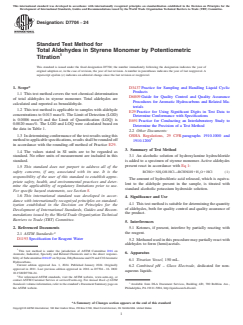
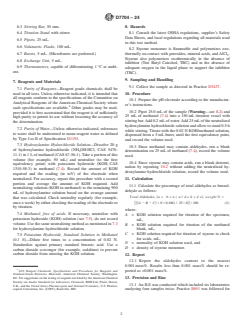
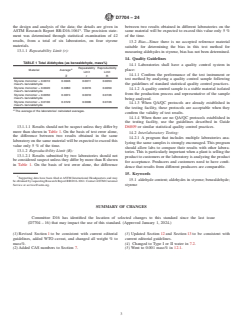

ASTM D7704-24 - Standard Test Method for Total Aldehydes in Styrene Monomer by Potentiometric Titration
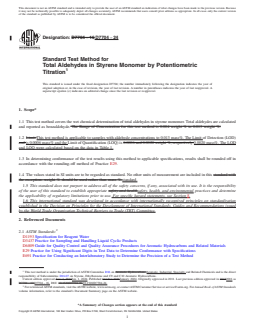
REDLINE ASTM D7704-24 - Standard Test Method for Total Aldehydes in Styrene Monomer by Potentiometric Titration
Overview
ASTM D7704-24 is the internationally recognized standard test method for determining the total aldehyde content in styrene monomer by potentiometric titration. Developed by ASTM International, this method provides a wet chemical approach where total aldehydes are quantified and reported as benzaldehyde, an important quality indicator in styrene production. The standard is vital for producers, laboratories, and regulatory bodies involved in the manufacture, quality assurance, and compliance of styrene monomer.
Key Topics
- Test Scope: The standard covers styrene samples with total aldehyde concentrations up to 0.013 mass%. It is designed for routine quality control and quality assurance in styrene manufacturing.
- Sensitivity: The method features a limit of detection (LOD) of 0.0006 mass% and a limit of quantification (LOQ) of 0.0020 mass%, ensuring accurate low-level aldehyde measurement.
- Potentiometric Titration: Aldehydes in styrene react with hydroxylamine hydrochloride in methanol. The reaction produces hydrochloric acid, which is titrated with standard potassium hydroxide, and the volume used correlates with aldehyde concentration.
- Quality and Precision: Established statistical guidelines and interlaboratory studies ensure both repeatability and reproducibility. Quality control measures are mandated for test instrument validation and sample integrity.
- SI Units: The standard mandates the use of SI units, specifically mass percentage, for all measurements and reporting.
Applications
ASTM D7704-24 is extensively applied in several operational and regulatory contexts:
- Quality Control: Ensures that styrene monomer meets established aldehyde specifications, supporting both in-process and final product testing.
- Process Optimization: Monitoring aldehyde levels helps optimize production processes and minimize impurities that can affect product quality or downstream reactions.
- Regulatory Compliance: Meets international requirements and supports compliance with industry standards as well as local health, safety, and environmental regulations.
- Interlaboratory Comparability: Facilitates harmonized testing results, critical for producers, buyers, and quality assurance bodies who require trustworthy and reproducible data.
- Troubleshooting: Rapid identification of elevated aldehyde levels can signal process upsets, oxidation, or contamination, prompting timely corrective actions.
Related Standards
Several referenced and companion standards are often used in conjunction with ASTM D7704-24 to ensure comprehensive quality assurance in the analysis of aromatic hydrocarbons and related materials:
- ASTM D1193: Specification for Reagent Water – Describes quality requirements for water used in chemical analysis.
- ASTM D3437: Practice for Sampling and Handling Liquid Cyclic Products – Outlines proper sampling and storage techniques for liquid petrochemicals.
- ASTM D6809: Guide for Quality Control and Quality Assurance Procedures for Aromatic Hydrocarbons and Related Materials – Details QA/QC program recommendations.
- ASTM E29: Practice for Using Significant Digits in Test Data to Determine Conformance with Specifications – Defines methods for rounding results.
- ASTM E691: Practice for Conducting an Interlaboratory Study – Provides guidance on evaluating the precision of test methods.
Practical Value
Adoption of ASTM D7704-24 enables laboratories and producers to:
- Achieve consistent, reliable aldehyde measurements in styrene monomer
- Facilitate compliance with international trade and safety standards
- Support process improvement and final product quality control
- Minimize disputes in producer-customer transactions by ensuring data comparability
By relying on this robust methodology, the styrene and petrochemical industries benefit from enhanced product reliability, market acceptance, and operational safety.
Relations
- Effective Date
- 01-Jan-2024
- Effective Date
- 01-Jan-2024
Buy Documents
ASTM D7704-24 - Standard Test Method for Total Aldehydes in Styrene Monomer by Potentiometric Titration
REDLINE ASTM D7704-24 - Standard Test Method for Total Aldehydes in Styrene Monomer by Potentiometric Titration
Get Certified
Connect with accredited certification bodies for this standard

ECOCERT
Organic and sustainability certification.

Eurofins Food Testing Global
Global leader in food, environment, and pharmaceutical product testing.

Intertek Bangladesh
Intertek certification and testing services in Bangladesh.
Sponsored listings
Frequently Asked Questions
ASTM D7704-24 is a standard published by ASTM International. Its full title is "Standard Test Method for Total Aldehydes in Styrene Monomer by Potentiometric Titration". This standard covers: SIGNIFICANCE AND USE 4.1 This test method is suitable for determining the quantity of aldehydes, both for quality control and quality assurance of the product. SCOPE 1.1 This test method covers the wet chemical determination of total aldehydes in styrene monomer. Total aldehydes are calculated and reported as benzaldehyde. 1.2 This test method is applicable to samples with aldehyde concentrations to 0.013 mass%. The Limit of Detection (LOD) is 0.0006 mass% and the Limit of Quantification (LOQ) is 0.0020 mass%. The LOD and LOQ were calculated based on the data in Table 1. 1.3 In determining conformance of the test results using this method to applicable specifications, results shall be rounded off in accordance with the rounding-off method of Practice E29. 1.4 The values stated in SI units are to be regarded as standard. No other units of measurement are included in this standard. 1.5 This standard does not purport to address all of the safety concerns, if any, associated with its use. It is the responsibility of the user of this standard to establish appropriate safety, health, and environmental practices and determine the applicability of regulatory limitations prior to use. For specific hazard statements, see Section 8. 1.6 This international standard was developed in accordance with internationally recognized principles on standardization established in the Decision on Principles for the Development of International Standards, Guides and Recommendations issued by the World Trade Organization Technical Barriers to Trade (TBT) Committee.
SIGNIFICANCE AND USE 4.1 This test method is suitable for determining the quantity of aldehydes, both for quality control and quality assurance of the product. SCOPE 1.1 This test method covers the wet chemical determination of total aldehydes in styrene monomer. Total aldehydes are calculated and reported as benzaldehyde. 1.2 This test method is applicable to samples with aldehyde concentrations to 0.013 mass%. The Limit of Detection (LOD) is 0.0006 mass% and the Limit of Quantification (LOQ) is 0.0020 mass%. The LOD and LOQ were calculated based on the data in Table 1. 1.3 In determining conformance of the test results using this method to applicable specifications, results shall be rounded off in accordance with the rounding-off method of Practice E29. 1.4 The values stated in SI units are to be regarded as standard. No other units of measurement are included in this standard. 1.5 This standard does not purport to address all of the safety concerns, if any, associated with its use. It is the responsibility of the user of this standard to establish appropriate safety, health, and environmental practices and determine the applicability of regulatory limitations prior to use. For specific hazard statements, see Section 8. 1.6 This international standard was developed in accordance with internationally recognized principles on standardization established in the Decision on Principles for the Development of International Standards, Guides and Recommendations issued by the World Trade Organization Technical Barriers to Trade (TBT) Committee.
ASTM D7704-24 is classified under the following ICS (International Classification for Standards) categories: 71.080.15 - Aromatic hydrocarbons. The ICS classification helps identify the subject area and facilitates finding related standards.
ASTM D7704-24 has the following relationships with other standards: It is inter standard links to ASTM D7704-16, ASTM D2827-19. Understanding these relationships helps ensure you are using the most current and applicable version of the standard.
ASTM D7704-24 is available in PDF format for immediate download after purchase. The document can be added to your cart and obtained through the secure checkout process. Digital delivery ensures instant access to the complete standard document.
Standards Content (Sample)
This international standard was developed in accordance with internationally recognized principles on standardization established in the Decision on Principles for the
Development of International Standards, Guides and Recommendations issued by the World Trade Organization Technical Barriers to Trade (TBT) Committee.
Designation: D7704 − 24
Standard Test Method for
Total Aldehydes in Styrene Monomer by Potentiometric
Titration
This standard is issued under the fixed designation D7704; the number immediately following the designation indicates the year of
original adoption or, in the case of revision, the year of last revision. A number in parentheses indicates the year of last reapproval. A
superscript epsilon (´) indicates an editorial change since the last revision or reapproval.
1. Scope* D3437 Practice for Sampling and Handling Liquid Cyclic
Products
1.1 This test method covers the wet chemical determination
D6809 Guide for Quality Control and Quality Assurance
of total aldehydes in styrene monomer. Total aldehydes are
Procedures for Aromatic Hydrocarbons and Related Ma-
calculated and reported as benzaldehyde.
terials
1.2 This test method is applicable to samples with aldehyde
E29 Practice for Using Significant Digits in Test Data to
concentrations to 0.013 mass%. The Limit of Detection (LOD)
Determine Conformance with Specifications
is 0.0006 mass% and the Limit of Quantification (LOQ) is
E691 Practice for Conducting an Interlaboratory Study to
0.0020 mass%. The LOD and LOQ were calculated based on
Determine the Precision of a Test Method
the data in Table 1.
2.2 Other Documents:
1.3 In determining conformance of the test results using this
OSHA Regulations, 29 CFR paragraphs 1910.1000 and
method to applicable specifications, results shall be rounded off
1910.1200
in accordance with the rounding-off method of Practice E29.
3. Summary of Test Method
1.4 The values stated in SI units are to be regarded as
3.1 An alcoholic solution of hydroxylamine hydrochloride
standard. No other units of measurement are included in this
is added to a specimen of styrene monomer. Active aldehydes
standard.
present react in accordance with Eq 1:
1.5 This standard does not purport to address all of the
RCHO1NH OH·HCl→RCHNOH1H O1HCl (1)
safety concerns, if any, associated with its use. It is the
2 2
responsibility of the user of this standard to establish appro-
The amount of hydrochloric acid released, which is equiva-
priate safety, health, and environmental practices and deter-
lent to the aldehyde present in the sample, is titrated with
mine the applicability of regulatory limitations prior to use.
standard alcoholic potassium hydroxide solution.
For specific hazard statements, see Section 8.
1.6 This international standard was developed in accor-
4. Significance and Use
dance with internationally recognized principles on standard-
4.1 This test method is suitable for determining the quantity
ization established in the Decision on Principles for the
of aldehydes, both for quality control and quality assurance of
Development of International Standards, Guides and Recom-
the product.
mendations issued by the World Trade Organization Technical
Barriers to Trade (TBT) Committee.
5. Interferences
2. Referenced Documents
5.1 Ketones, if present, interfere by partially reacting with
the reagent.
2.1 ASTM Standards:
D1193 Specification for Reagent Water
5.2 Methanol used in this procedure may partially react with
aldehydes to form (hemi)acetals.
This test method is under the jurisdiction of ASTM Committee D16 on
6. Apparatus
Aromatic, Industrial, Specialty and Related Chemicals and is the direct responsi-
bility of Subcommittee D16.07 on Styrene, Ethylbenzene and C9 and C10 Aromatic
6.1 Titration Vessel, 150 mL.
Hydrocarbons.
Current edition approved Jan. 1, 2024. Published January 2024. Originally
6.2 Combined pH – Glass Electrode, dedicated for non-
approved in 2011. Last previous edition approved in 2016 as D7704 – 16. DOI:
aqueous liquids.
10.1520/D7704-24.
For referenced ASTM standards, visit the ASTM website, www.astm.org, or
contact ASTM Customer Service at service@astm.org. For Annual Book of ASTM
Standards volume information, refer to the standard’s Document Summary page on Available from DLA Document Services, Building 4/D, 700 Robbins Ave.,
the ASTM website. Philadelphia, PA 19111-5094, http://quicksearch.dla.mil.
*A Summary of Changes section appears at the end of this standard
Copyright © ASTM International, 100 Barr Harbor Drive, PO Box C700, West Conshohocken, PA 19428-2959. United States
D7704 − 24
6.3 Stirring Bar, 30 mm. 8. Hazards
8.1 Consult the latest OSHA regulations, supplier’s Safety
6.4 Titration Stand with stirrer.
Data Sheets, and local regulations regarding all materials used
6.5 Pipets, 25 mL.
in this test method.
6.6 Volumetric Flasks, 100 mL.
8.2 Styrene monomer is flammable and polymerizes exo-
6.7 Burets, 5 mL. (Microburets are preferred.) thermally on contact with peroxides, mineral acids, and AlCl .
Styrene also polymerizes exothermically in the absence of
6.8 Exchange Unit, 5 mL.
inhibitor (Tert Butyl Catechol, TBC) and in the absence of
6.9 Thermometers, capable of differentiating 1 °C at ambi-
adequate oxygen in the liquid phase to support the inhibitor
ent.
(TBC).
9. Sampling and Handling
7. Reagents and Materials
9.1 Collect the sample as directed in Practice D3437.
7.1 Purity of Reagents—Reagent grade chemicals shall be
used in all tests. Unless otherwise indicated, it is intended that
10. Procedure
all reagents conform to the specifications of the Committee on
10.1 Prepare the pH electrode according to the manufactur-
Analytical Reagents of the American Chemical Society where
er’s instructions.
such specifications are available. Other grades may be used,
10.2 Pipet 25.0 mL of the sample (Warning—see 8.2) and
provided it is first ascertained that the reagent is of sufficiently
25 mL of methanol (7.4) into a 150 mL titration vessel with
high purity to permit its use without lessening the accuracy of
stirring bar. Add 0.2 mL of water. Add 25 mL of the neutralized
the determination.
hydroxylamine hydrochloride solution and allow to stand 0.5 h
7.2 Purity of Water—Unless otherwise indicated, references
while stirring. Titrate with the 0.02 N KOH/methanol solution,
to water shall be understood to mean reagent water as defined
dispensed from a 5 mL buret, until the first equivalence point,
by Type I or II of Specification D1193.
and record the volume used.
7.3 Hydroxylamine Hydrochloride Solution—Dissolve 20 g
10.3 Since methanol may contain aldehydes, run a blank
of hydroxylamine hydrochloride (NH OH·HCl, CAS 5470-
determination on 25 mL of methanol (7.4), record the volume
11-1) in 1 L of methanol (CAS 67-56-1). Take a portion of this
used.
volume (for example, 50 mL) and neutralize (to the first
10.4 Since styrene may contain acids, run a blank determi-
equivalency point) with potassium hydroxide (KOH, CAS
nation by repeating 10.2 without adding the neutralized hy-
1310-58-3) in methanol (7.4). Record the amount of KOH
droxylamine hydrochloride solution, record the volume used.
required and the reading (in mV) of the electrode when
neutralized. For accur
...
This document is not an ASTM standard and is intended only to provide the user of an ASTM standard an indication of what changes have been made to the previous version. Because
it may not be technically possible to adequately depict all changes accurately, ASTM recommends that users consult prior editions as appropriate. In all cases only the current version
of the standard as published by ASTM is to be considered the official document.
Designation: D7704 − 16 D7704 − 24
Standard Test Method for
Total Aldehydes in Styrene Monomer by Potentiometric
Titration
This standard is issued under the fixed designation D7704; the number immediately following the designation indicates the year of
original adoption or, in the case of revision, the year of last revision. A number in parentheses indicates the year of last reapproval. A
superscript epsilon (´) indicates an editorial change since the last revision or reapproval.
1. Scope*
1.1 This test method covers the wet chemical determination of total aldehydes in styrene monomer. Total aldehydes are calculated
and reported as benzaldehyde. The Range of Concentration for this test method is 0.004 weight % to 0.013 weight %.
1.2 Limit This test method is applicable to samples with aldehyde concentrations to 0.013 mass%. The Limit of Detection (LOD)
and is 0.0006 mass% and the Limit of Quantification (LOQ) is 0.0006 and 0.0020 weight %, respectively 0.0020 mass%. The LOD
and LOQ were calculated based on the data in Table 1.
1.3 In determining conformance of the test results using this method to applicable specifications, results shall be rounded off in
accordance with the rounding-off method of Practice E29.
1.4 The values stated in SI units are to be regarded as standard. No other units of measurement are included in this standard with
the exception: weight % should be used rather than mass %.standard.
1.5 This standard does not purport to address all of the safety concerns, if any, associated with its use. It is the responsibility
of the user of this standard to establish appropriate safety and healthsafety, health, and environmental practices and determine
the applicability of regulatory limitations prior to use. For specific hazard statements, see Section 8.
1.6 This international standard was developed in accordance with internationally recognized principles on standardization
established in the Decision on Principles for the Development of International Standards, Guides and Recommendations issued
by the World Trade Organization Technical Barriers to Trade (TBT) Committee.
2. Referenced Documents
2.1 ASTM Standards:
D1193 Specification for Reagent Water
D3437 Practice for Sampling and Handling Liquid Cyclic Products
D6809 Guide for Quality Control and Quality Assurance Procedures for Aromatic Hydrocarbons and Related Materials
E29 Practice for Using Significant Digits in Test Data to Determine Conformance with Specifications
E691 Practice for Conducting an Interlaboratory Study to Determine the Precision of a Test Method
This test method is under the jurisdiction of ASTM Committee D16 on Aromatic Hydrocarbons Aromatic, Industrial, Specialty and Related Chemicals and is the direct
responsibility of Subcommittee D16.07 on Styrene, Ethylbenzene and C9 and C10 Aromatic Hydrocarbons.
Current edition approved June 1, 2016Jan. 1, 2024. Published October 2016January 2024. Originally approved in 2011. Last previous edition approved in 20122016 as
D7704 – 12.D7704 – 16. DOI: 10.1520/D7704-16.10.1520/D7704-24.
For referenced ASTM standards, visit the ASTM website, www.astm.org, or contact ASTM Customer Service at service@astm.org. For Annual Book of ASTM Standards
volume information, refer to the standard’s Document Summary page on the ASTM website.
*A Summary of Changes section appears at the end of this standard
Copyright © ASTM International, 100 Barr Harbor Drive, PO Box C700, West Conshohocken, PA 19428-2959. United States
D7704 − 24
2.2 Other Documents:
OSHA Regulations, 29 CFR paragraphs 1910.1000 and 1910.1200
3. Summary of Test Method
3.1 An alcoholic solution of hydroxylamine hydrochloride is added to a specimen of styrene monomer. Active aldehydes present
react in accordance with Eq 1:
RCHO1NH OH·HCl→RCHNOH1H O1HCl (1)
2 2
The amount of hydrochloric acid released, which is equivalent to the aldehyde present in the sample, is titrated with standard
alcoholic potassium hydroxide solution.
4. Significance and Use
4.1 This test method is suitable for determining the quantity of aldehydes, both for quality control and quality assurance of the
product.
5. Interferences
5.1 Ketones, if present, interfere by partially reacting with the reagent.
5.2 Methanol used in this procedure may partially react with aldehydes to form (hemi)acetals.
6. Apparatus
6.1 Titration Vessel, 150 mL.
6.2 Combined pH – Glass Electrode, dedicated for non-aqueous liquids.
6.3 Stirring Bar, 30 mm.
6.4 Titration Stand with stirrer.
6.5 Pipets, 25 mL.
6.6 Volumetric Flasks, 100 mL.
6.7 Burets, 5 mL. (Microburets are preferred.)
6.8 Exchange Unit, 5 mL.
6.9 Thermometers, capable of differentiating 1°C1 °C at ambient.
7. Reagents and Materials
7.1 Purity of Reagents—Reagent grade chemicals shall be used in all tests. Unless otherwise indicated, it is intended that all
reagents conform to the specifications of the Committee on Analytical Reagents of the American Chemical Society where such
specifications are available. Other grades may be used, provided it is first ascertained that the reagent is of sufficiently high purity
to permit its use without lessening the accuracy of the determination.
Available from DLA Document Services, Building 4/D, 700 Robbins Ave., Philadelphia, PA 19111-5094, http://quicksearch.dla.mil.
Reagent Chemicals, American Chemical Society Specifications,ACS Reagent Chemicals, Specifications and Procedures for Reagents and Standard-Grade Reference
Materials, American Chemical Society, Washington, DC. For suggestions on the testing of reagents not listed by the American Chemical Society, see Analar Standards for
Laboratory Chemicals, BDH Ltd., Poole, Dorset, U.K., and the United States Pharmacopeia and National Formulary, U.S. Pharmacopeial Convention, Inc. (USPC),
Rockville, MD.
D7704 − 24
7.2 Purity of Water—Unless otherwise indicated, references to water shall be understood to mean reagent water as defined by Type
IIII or II of Specification D1193.
7.3 Hydroxylamine Hydrochloride Solution—Dissolve 20 g of hydroxylamine hydrochloride (NH OH·HCl) OH·HCl, CAS
5470-11-1) in 1 L of methanol. methanol (CAS 67-56-1). Take a portion of this volume (for example, 50 mL) and neutralize (to
the first equivalency point) with potassium hydroxide (KOH) (KOH, CAS 1310-58-3) in methanol (7.4). Record the amount of
KOH required and the reading (in mV) of the electrode when neutralized. For accuracy, repeat this procedure with a second portion
and average the amount of KOH required. Add neutralizing solution (KOH in methanol) to the remaining 900 mL of
hydroxylamine solution based on the average amount that was calculated. Check neutrality regularly (for example, once a week)
by either checking the reading of the electrode or by titration.
7.4 Methanol, free of acids. If necessary, neutralize with potassium hydroxide (KOH) solution (see 7.5), do not record volume.
Use the same neutralizing method as mentioned in 7.3 for hydroxylamine hydrochloride solution.
7.5 Potassium Hydroxide, Standard Solution in Methanol (0.1 N)—Dilute five times to a concentration of 0.02 N. Standardize
against primary standard benzoic acid. Use a carbon dioxide scavenger (for example, sodalime) to prevent carbon dioxide from
entering the KOH solution.
8. Hazards
8.1 Consult the latest OSHA regulations, supplier’s Safety Data Sheets, and local regulations regarding all materials used in this
test method.
8.2 Styrene monomer is flammable and polymerizes exothermally on contact with peroxides, mineral acids, and AlCl . Styrene
also polymerizes exothermically in the absence of inhibi
...