


ASTM D1209-05(2011)
(Test Method)Standard Test Method for Color of Clear Liquids (Platinum-Cobalt Scale)
Standard Test Method for Color of Clear Liquids (Platinum-Cobalt Scale)
SIGNIFICANCE AND USE
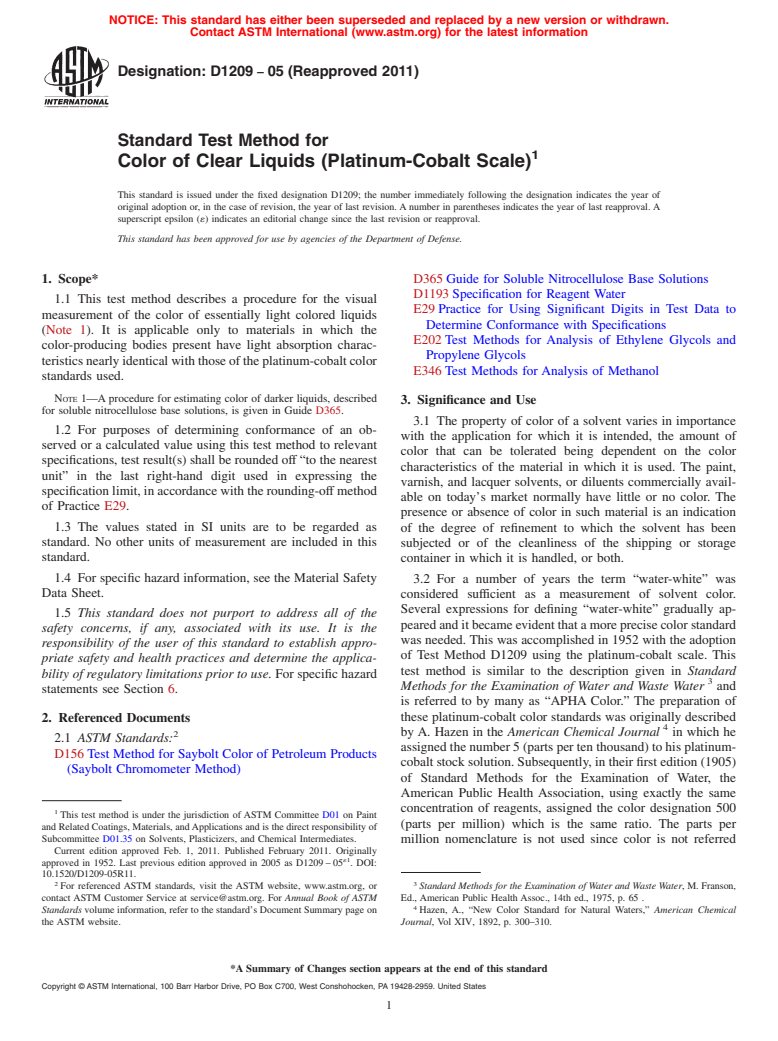
The property of color of a solvent varies in importance with the application for which it is intended, the amount of color that can be tolerated being dependent on the color characteristics of the material in which it is used. The paint, varnish, and lacquer solvents, or diluents commercially available on today's market normally have little or no color. The presence or absence of color in such material is an indication of the degree of refinement to which the solvent has been subjected or of the cleanliness of the shipping or storage container in which it is handled, or both.
For a number of years the term “water-white” was considered sufficient as a measurement of solvent color. Several expressions for defining “water-white” gradually appeared and it became evident that a more precise color standard was needed. This was accomplished in 1952 with the adoption of Test Method D1209 using the platinum-cobalt scale. This test method is similar to the description given in Standard Methods for the Examination of Water and Waste Water and is referred to by many as “APHA Color.” The preparation of these platinum-cobalt color standards was originally described by A. Hazen in the American Chemical Journal in which he assigned the number 5 (parts per ten thousand) to his platinum-cobalt stock solution. Subsequently, in their first edition (1905) of Standard Methods for the Examination of Water, the American Public Health Association, using exactly the same concentration of reagents, assigned the color designation 500 (parts per million) which is the same ratio. The parts per million nomenclature is not used since color is not referred directly to a weight relationship. It is therefore recommended that the incorrect term “Hazen Color” should not be used. Also, because it refers primarily to water, the term “APHA Color” is undesirable. The recommended nomenclature for referring to the color of organic liquids is “Platinum-Cobalt Color, Test Method D1209.”
The petroleum indus...
SCOPE
1.1 This test method describes a procedure for the visual measurement of the color of essentially light colored liquids (Note 1). It is applicable only to materials in which the color-producing bodies present have light absorption characteristics nearly identical with those of the platinum-cobalt color standards used.
Note 1—A procedure for estimating color of darker liquids, described for soluble nitrocellulose base solutions, is given in Guide D365.
1.2 For purposes of determining conformance of an observed or a calculated value using this test method to relevant specifications, test result(s) shall be rounded off “to the nearest unit” in the last right-hand digit used in expressing the specification limit, in accordance with the rounding-off method of Practice E29.
1.3 The values stated in SI units are to be regarded as standard. No other units of measurement are included in this standard.
1.4 For specific hazard information, see the Material Safety Data Sheet.
1.5 This standard does not purport to address all of the safety concerns, if any, associated with its use. It is the responsibility of the user of this standard to establish appropriate safety and health practices and determine the applicability of regulatory limitations prior to use. For specific hazard statements see Section 6.
General Information
Standards Content (Sample)
NOTICE: This standard has either been superseded and replaced by a new version or withdrawn.
Contact ASTM International (www.astm.org) for the latest information
Designation: D1209 − 05 (Reapproved 2011)
Standard Test Method for
Color of Clear Liquids (Platinum-Cobalt Scale)
This standard is issued under the fixed designation D1209; the number immediately following the designation indicates the year of
original adoption or, in the case of revision, the year of last revision. A number in parentheses indicates the year of last reapproval. A
superscript epsilon (´) indicates an editorial change since the last revision or reapproval.
This standard has been approved for use by agencies of the Department of Defense.
1. Scope* D365 Guide for Soluble Nitrocellulose Base Solutions
D1193 Specification for Reagent Water
1.1 This test method describes a procedure for the visual
E29 Practice for Using Significant Digits in Test Data to
measurement of the color of essentially light colored liquids
Determine Conformance with Specifications
(Note 1). It is applicable only to materials in which the
E202 Test Methods for Analysis of Ethylene Glycols and
color-producing bodies present have light absorption charac-
Propylene Glycols
teristicsnearlyidenticalwiththoseoftheplatinum-cobaltcolor
E346 Test Methods for Analysis of Methanol
standards used.
NOTE 1—A procedure for estimating color of darker liquids, described
3. Significance and Use
for soluble nitrocellulose base solutions, is given in Guide D365.
3.1 The property of color of a solvent varies in importance
1.2 For purposes of determining conformance of an ob-
with the application for which it is intended, the amount of
served or a calculated value using this test method to relevant
color that can be tolerated being dependent on the color
specifications, test result(s) shall be rounded off “to the nearest
characteristics of the material in which it is used. The paint,
unit” in the last right-hand digit used in expressing the
varnish, and lacquer solvents, or diluents commercially avail-
specification limit, in accordance with the rounding-off method
able on today’s market normally have little or no color. The
of Practice E29.
presence or absence of color in such material is an indication
1.3 The values stated in SI units are to be regarded as
of the degree of refinement to which the solvent has been
standard. No other units of measurement are included in this subjected or of the cleanliness of the shipping or storage
standard.
container in which it is handled, or both.
1.4 For specific hazard information, see the Material Safety 3.2 For a number of years the term “water-white” was
Data Sheet.
considered sufficient as a measurement of solvent color.
Several expressions for defining “water-white” gradually ap-
1.5 This standard does not purport to address all of the
pearedanditbecameevidentthatamoreprecisecolorstandard
safety concerns, if any, associated with its use. It is the
was needed. This was accomplished in 1952 with the adoption
responsibility of the user of this standard to establish appro-
of Test Method D1209 using the platinum-cobalt scale. This
priate safety and health practices and determine the applica-
test method is similar to the description given in Standard
bility of regulatory limitations prior to use. For specific hazard
Methods for the Examination of Water and Waste Water and
statements see Section 6.
is referred to by many as “APHA Color.” The preparation of
these platinum-cobalt color standards was originally described
2. Referenced Documents
by A. Hazen in the American Chemical Journal in which he
2.1 ASTM Standards:
assigned the number 5 (parts per ten thousand) to his platinum-
D156 Test Method for Saybolt Color of Petroleum Products
cobalt stock solution. Subsequently, in their first edition (1905)
(Saybolt Chromometer Method)
of Standard Methods for the Examination of Water, the
American Public Health Association, using exactly the same
concentration of reagents, assigned the color designation 500
This test method is under the jurisdiction of ASTM Committee D01 on Paint
(parts per million) which is the same ratio. The parts per
and Related Coatings, Materials, andApplications and is the direct responsibility of
Subcommittee D01.35 on Solvents, Plasticizers, and Chemical Intermediates.
million nomenclature is not used since color is not referred
Current edition approved Feb. 1, 2011. Published February 2011. Originally
´1
approved in 1952. Last previous edition approved in 2005 as D1209 – 05 . DOI:
10.1520/D1209-05R11.
2 3
For referenced ASTM standards, visit the ASTM website, www.astm.org, or Standard Methods for the Examination of Water and Waste Water, M. Franson,
contact ASTM Customer Service at service@astm.org. For Annual Book of ASTM Ed., American Public Health Assoc., 14th ed., 1975, p. 65 .
Standards volume information, refer to the standard’s Document Summary page on Hazen, A., “New Color Standard for Natural Waters,” American Chemical
the ASTM website. Journal, Vol XIV, 1892, p. 300–310.
*A Summary of Changes section appears at the end of this standard
Copyright © ASTM International, 100 Barr Harbor Drive, PO Box C700, West Conshohocken, PA 19428-2959. United States
D1209 − 05 (2011)
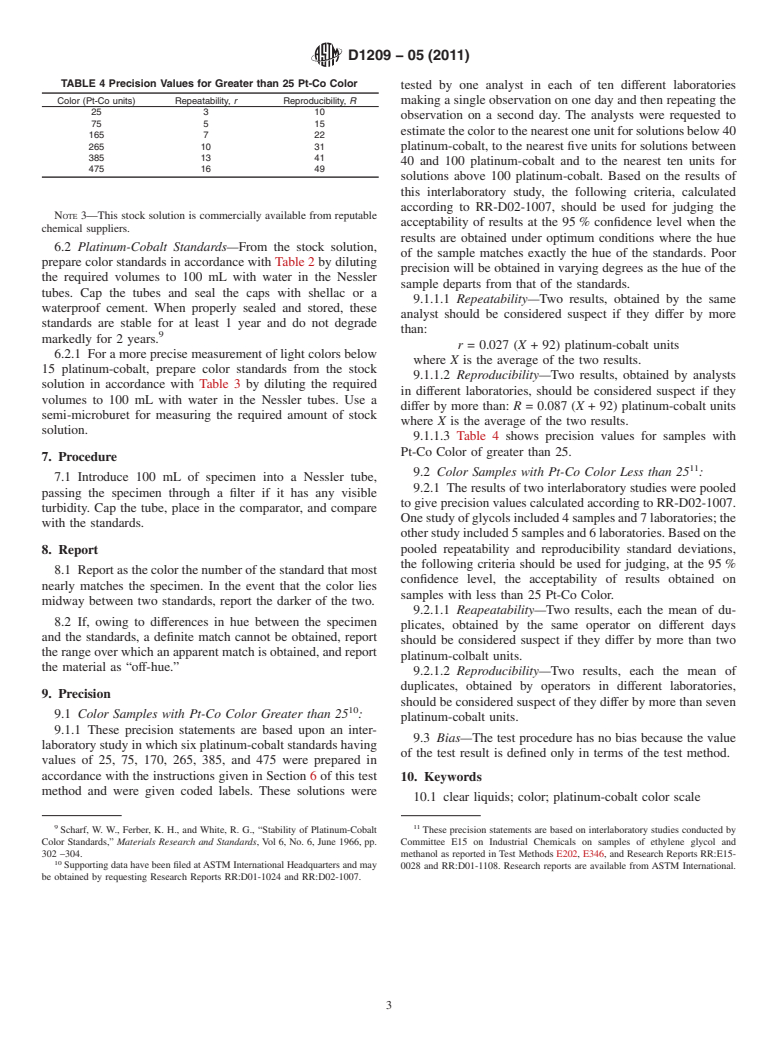
TABLE 1 Absorbance Tolerance Limits For No. 500 Platinum- with the instructions given in the Standards for Checking the Calibration
Cobalt Stock Solution
of Spectrophotometers (200 to 1000 nm).
Wavelength, nm Absorbance
4.2 Spectrophotometer Cells,matchedhavinga10-mmlight
430 0.110 to 0.120
path.
455 0.130 to 0.145
480 0.105 to 0.120 4.3 Color Comparison Tubes—Matched 100-mL, tall-form
510 0.055 to 0.065
Nessler tubes, provided with ground-on, optically clear, glass
caps.Tubesshouldbeselectedsothattheheightofthe100-mL
graduation mark is 275 to 295 mm above the bottom of the
TABLE 2 Platinum-Cobalt Color Standards
tube.
Color Standard Stock Solution, Color Standard Stock Solution,
Number mL Number mL 4.4 Color Comparator—A color comparator constructed to
5 1 70 14 permit visual comparison of light transmitted through tall-
10 2 100 20
form, 100-mL Nessler tubes in the direction of their longitu-
15 3 150 30
dinal axes.The comparator should be constructed so that white
20 4 200 40
light is passed through or reflected off a white glass plate and
25 5 250 50
30 6 300 60
directed with equal intensity through the tubes, and should be
35 7 350 70
shielded so that no light enters the tubes from the side.
40 8 400 80
50 10 450 90
A
60 12 500 100
5. Reagents
A
This is platinum-cobalt color No. 10 in Guide D365.
5.1 Purity of Reagents—Reagent grade chemicals shall be
used in all tests. Unless otherwise indicated, it is intended that
all reagents shall conform to the specifications of the Commit-
TABLE 3 Platinum-Cobalt Color Standards for Very Light Colors
tee onAnalytical Reagents of theAmerican Chemical Society,
Color Standard Stock Solution, Color Standard Stock Solution,
where such specifications are available. Other grades may be
Number mL Number mL
used, provided it is first ascertained that the reagent is of
1 0.20 9 1.80
2 0.40 10 2.00
sufficiently high purity to permit its use without lessening the
3 0.60 11 2.20
accuracy of the determination.
4 0.80 12 2.40
5 1.00 13 2.60
5.2 Purity of Water—Unless otherwise indicated, references
6 1.20 14 2.80
towatershallbeunderstoodtomeanreagentwaterconforming
7 1.40 15 3.00
to Type IV of Specification D1193.
8 1.60
5.3 Cobalt Chloride (CoCl ·6H O).
2 2
5.4 Hydrochloric Acid (sp gr 1.19)—Concentrated hydro-
chloric acid (HCl).
directly to a weight relationship. It is therefore recommended
5.5 Potassium Chloroplatinate (K PtCl ).
2 6
thattheincorrectterm“HazenColor”shouldnotbeused.Also,
because it refers primarily to water, the term “APHAColor” is
6. Platinum-Cobalt Reference Standards
undesirable. The recommended nomenclature for referring to
6.1 Platinum-Cobalt Stock Solution— Dissolve 1.245 g of
the color of organic liquids is “Platinum-Cobalt Color, Test
potassium chloroplatinate (K PtCl ) and 1.00 g of cobalt
2 6
Method D1209.”
chloride (CoCl ·6H O) in water. Carefully add 100 mL of
2 2
3.3 The petroleum industry uses the Saybolt colorimeter
hydrochloric acid (HCl, sp gr 1.19) and dilute to 1 L with
Test Method D156 for measuring and defining the color of
water. The absorbance of the 500 platinum-cobalt stock solu-
hydrocarbon solvents; however, this system of color measure-
tion in a cell having a 10-mm light path, with reagent water in
ment is not commonly employed outside of the petroleum 8
a matched cell as the refere
...
Questions, Comments and Discussion
Ask us and Technical Secretary will try to provide an answer. You can facilitate discussion about the standard in here.