

ASTM F3497-21
(Test Method)Standard Test Method for Evaluating the Oxidative Resistance of Polypropylene (PP) Piping Systems to Hot Chlorinated Water
General Information
- Abstract
SIGNIFICANCE AND USE
5.1 Environment or oxidative time-to-fail data derived from this test method, analyzed in accordance with Section 13, are suitable for extrapolation to typical end-use temperatures and hoop stresses. The extrapolated value(s) provides a relative indication of the resistance of the tested PP piping or system to the oxidative effects of hot, chlorinated water for conditions equivalent to those conditions under which the test data were obtained. The performance of a material or piping product under actual conditions of installation and use is dependent upon a number of factors including installation methods, use patterns, water quality, nature and magnitude of localized stresses, and other variables of an actual, operating hot-and-cold water distribution system that are not addressed in this test method. As such, the extrapolated values do not constitute a representation that a PP pipe or system with a given extrapolated time-to-failure value will perform for that period of time under actual use conditions.
SCOPE
1.1 This test method describes the general requirements for evaluating the long-term, chlorinated water, oxidative resistance of polypropylene (PP) piping produced in accordance with Specification F2389 used in hot-and-cold water distribution systems by exposure to hot, chlorinated water. This test method outlines the requirements of a pressurized flow-through test system, typical test pressures, test-fluid characteristics, failure type, and data analysis.
Note 1: Other known disinfecting systems (chlorine dioxide, ozone, and chloramines) are also used for protection of potable water. Free-chlorine is the most common disinfectant in use today. A PPI research project examined the relative aggressiveness of free chlorine and chloramines on PEX pipes, both at the same 4.0 ppm concentration and the same test temperatures. The results of the testing showed pipe failure times approximately 40 % longer when tested with chloramines compared to testing with free chlorine, at the tested conditions. Based on these results, the data suggests that chloramines are less aggressive than free chlorine to PEX pipes. This note is provided for information regarding testing different disinfecting systems on PEX tubing using Test Method F2023. The PPI research project did not include testing of polypropylene piping.
Note 2: This test method is based on Test Method F2023 and results from this method can be used for direct comparison with previous results on PP piping materials tested in accordance with Test Method F2023.
1.2 This test method is applicable to PP piping systems used for transport of potable water containing free-chlorine for disinfecting purposes. The oxidizing potential of the test-fluid specified in this test method exceeds that typically found in potable water systems across the United States.
1.3 The values stated in inch-pound units are to be regarded as standard. The values given in parentheses are mathematical conversions to SI units that are provided for information only and are not considered standard
1.4 The following precautionary caveat pertains only to the test method portion, Section 12, of this specification. This standard does not purport to address all of the safety concerns, if any, associated with its use. It is the responsibility of the user of this standard to establish appropriate safety, health, and environmental practices and determine the applicability of regulatory limitations prior to use.
1.5 This international standard was developed in accordance with internationally recognized principles on standardization established in the Decision on Principles for the Development of International Standards, Guides and Recommendations issued by the World Trade Organization Technical Barriers to Trade (TBT) Committee.
- Status
- Published
- Publication Date
- 14-Dec-2021
- Technical Committee
- F17 - Plastic Piping Systems
- Drafting Committee
- F17.40 - Test Methods
Overview
ASTM F3497-21 is the Standard Test Method for Evaluating the Oxidative Resistance of Polypropylene (PP) Piping Systems to Hot Chlorinated Water. Developed by ASTM International, this standard specifies a systematic approach to assess the long-term oxidative resistance of PP piping used in hot-and-cold water distribution systems exposed to hot, chlorinated water. By simulating rigorous service conditions, the method supports industry needs for durable potable water piping, ensuring user safety and infrastructure reliability.
The test data derived, when appropriately analyzed, provide a relative understanding of a PP piping system’s resistance to oxidation caused by disinfected water. However, actual long-term performance in real installations may also depend on factors not covered by the standard, such as local installation practices, water quality, and the nature of system stresses.
Key Topics
- Test Method Scope: The standard describes pressurized flow-through test systems, typical test pressures, test-fluid characteristics, failure types, and data analysis requirements for evaluating oxidative resistance.
- Material Applicability: The method applies to PP piping manufactured according to Specification ASTM F2389, specifically for potable water systems utilizing free-chlorine for disinfection.
- Data Analysis and Extrapolation: Results provide time-to-failure data that can be statistically analyzed and extrapolated to predict performance at typical operating temperatures and hoop stresses.
- Failure Types and Data Collection: Only oxidative (Stage III) failures are considered valid for data analysis, ensuring results specifically reflect oxidation-driven degradation.
- Quality and Reliability Controls: Strict requirements for test system accuracy (pressure, temperature, flow rate) and use of reverse osmosis (RO)/deionized (DI) water improve reproducibility across different laboratories.
Applications
ASTM F3497-21 is crucial in several practical settings in the plumbing and construction industries, focusing on the safety and longevity of plumbing systems:
- Product Development: Manufacturers can use the standard to qualify and compare PP piping materials for resistance to oxidative degradation, guiding material selection in product design and innovation.
- Compliance and Certification: Regulatory agencies and certification bodies rely on this method to ensure that PP piping products meet industry performance requirements for potable water applications.
- Quality Assurance: Construction and installation firms reference this standard to source and recommend piping systems with validated resistance to hot, chlorinated water-particularly in environments where oxidative stress is a known risk factor.
- Benchmarking: The method allows direct comparison of results with those obtained using similar ASTM or ISO standards (e.g., ASTM F2023), enabling benchmarking of materials from different sources or manufacturing processes.
Related Standards
ASTM F3497-21 interfaces with several other important standards in the field of plastic piping and water system safety:
- ASTM F2023: Standard Test Method for Evaluating the Oxidative Resistance of Crosslinked Polyethylene (PEX) Pipe, Tubing, and Systems to Hot Chlorinated Water.
- ASTM F2389: Specification for Pressure-rated Polypropylene (PP) Piping Systems.
- ISO 9080: Thermoplastic Pipe for Transport of Fluids-Methods of Extrapolation of Hydrostatic Stress Rupture Data to Determine Long Term Strength of Thermoplastic Pipe.
- ISO 13760: Plastic Pipe for Conveyance of Fluids Under Pressure-Miner’s Rule-Calculation Method for Cumulative Damage.
- NSF/ANSI 14: Plastic Piping System Components and Related Materials.
Practical Value
By adopting ASTM F3497-21, stakeholders ensure the selection and validation of PP piping systems that offer improved safety and longer service life under challenging conditions, such as hot water recirculation systems treated with chlorine. Adherence to this standard helps reduce failures caused by oxidative degradation, safeguarding water quality and infrastructure investments.
Keywords: ASTM F3497-21, oxidative resistance, polypropylene piping, hot chlorinated water, PP piping systems, potable water, ASTM standards, water distribution, plumbing durability, oxidative degradation, PP-R, PP-RCT, Miner’s Rule, hydrostatic stress testing.
Relations
- Effective Date
- 01-Apr-2020
- Effective Date
- 01-Jan-2019
- Refers
ASTM D1600-18 - Standard Terminology for Abbreviated Terms Relating to Plastics (Withdrawn 2024) - Effective Date
- 01-Jan-2018
- Effective Date
- 01-Aug-2017
- Effective Date
- 01-Feb-2017
- Effective Date
- 01-Feb-2017
- Effective Date
- 15-Jan-2017
- Effective Date
- 15-Nov-2016
- Effective Date
- 01-Aug-2016
- Effective Date
- 01-Aug-2015
- Effective Date
- 01-Jun-2015
- Refers
ASTM D2122-15 - Standard Test Method for Determining Dimensions of Thermoplastic Pipe and Fittings - Effective Date
- 15-Mar-2015
- Effective Date
- 01-Feb-2014
- Effective Date
- 01-Nov-2013
- Effective Date
- 15-Apr-2013
Get Certified
Connect with accredited certification bodies for this standard

Institut za varilstvo d.o.o. (Welding Institute)
Slovenia's leading welding institute since 1952. ISO 3834, EN 1090, pressure equipment certification, NDT personnel, welder qualification. Only IIW Au
Sponsored listings
Frequently Asked Questions
ASTM F3497-21 is a standard published by ASTM International. Its full title is "Standard Test Method for Evaluating the Oxidative Resistance of Polypropylene (PP) Piping Systems to Hot Chlorinated Water". This standard covers: SIGNIFICANCE AND USE 5.1 Environment or oxidative time-to-fail data derived from this test method, analyzed in accordance with Section 13, are suitable for extrapolation to typical end-use temperatures and hoop stresses. The extrapolated value(s) provides a relative indication of the resistance of the tested PP piping or system to the oxidative effects of hot, chlorinated water for conditions equivalent to those conditions under which the test data were obtained. The performance of a material or piping product under actual conditions of installation and use is dependent upon a number of factors including installation methods, use patterns, water quality, nature and magnitude of localized stresses, and other variables of an actual, operating hot-and-cold water distribution system that are not addressed in this test method. As such, the extrapolated values do not constitute a representation that a PP pipe or system with a given extrapolated time-to-failure value will perform for that period of time under actual use conditions. SCOPE 1.1 This test method describes the general requirements for evaluating the long-term, chlorinated water, oxidative resistance of polypropylene (PP) piping produced in accordance with Specification F2389 used in hot-and-cold water distribution systems by exposure to hot, chlorinated water. This test method outlines the requirements of a pressurized flow-through test system, typical test pressures, test-fluid characteristics, failure type, and data analysis. Note 1: Other known disinfecting systems (chlorine dioxide, ozone, and chloramines) are also used for protection of potable water. Free-chlorine is the most common disinfectant in use today. A PPI research project examined the relative aggressiveness of free chlorine and chloramines on PEX pipes, both at the same 4.0 ppm concentration and the same test temperatures. The results of the testing showed pipe failure times approximately 40 % longer when tested with chloramines compared to testing with free chlorine, at the tested conditions. Based on these results, the data suggests that chloramines are less aggressive than free chlorine to PEX pipes. This note is provided for information regarding testing different disinfecting systems on PEX tubing using Test Method F2023. The PPI research project did not include testing of polypropylene piping. Note 2: This test method is based on Test Method F2023 and results from this method can be used for direct comparison with previous results on PP piping materials tested in accordance with Test Method F2023. 1.2 This test method is applicable to PP piping systems used for transport of potable water containing free-chlorine for disinfecting purposes. The oxidizing potential of the test-fluid specified in this test method exceeds that typically found in potable water systems across the United States. 1.3 The values stated in inch-pound units are to be regarded as standard. The values given in parentheses are mathematical conversions to SI units that are provided for information only and are not considered standard 1.4 The following precautionary caveat pertains only to the test method portion, Section 12, of this specification. This standard does not purport to address all of the safety concerns, if any, associated with its use. It is the responsibility of the user of this standard to establish appropriate safety, health, and environmental practices and determine the applicability of regulatory limitations prior to use. 1.5 This international standard was developed in accordance with internationally recognized principles on standardization established in the Decision on Principles for the Development of International Standards, Guides and Recommendations issued by the World Trade Organization Technical Barriers to Trade (TBT) Committee.
SIGNIFICANCE AND USE 5.1 Environment or oxidative time-to-fail data derived from this test method, analyzed in accordance with Section 13, are suitable for extrapolation to typical end-use temperatures and hoop stresses. The extrapolated value(s) provides a relative indication of the resistance of the tested PP piping or system to the oxidative effects of hot, chlorinated water for conditions equivalent to those conditions under which the test data were obtained. The performance of a material or piping product under actual conditions of installation and use is dependent upon a number of factors including installation methods, use patterns, water quality, nature and magnitude of localized stresses, and other variables of an actual, operating hot-and-cold water distribution system that are not addressed in this test method. As such, the extrapolated values do not constitute a representation that a PP pipe or system with a given extrapolated time-to-failure value will perform for that period of time under actual use conditions. SCOPE 1.1 This test method describes the general requirements for evaluating the long-term, chlorinated water, oxidative resistance of polypropylene (PP) piping produced in accordance with Specification F2389 used in hot-and-cold water distribution systems by exposure to hot, chlorinated water. This test method outlines the requirements of a pressurized flow-through test system, typical test pressures, test-fluid characteristics, failure type, and data analysis. Note 1: Other known disinfecting systems (chlorine dioxide, ozone, and chloramines) are also used for protection of potable water. Free-chlorine is the most common disinfectant in use today. A PPI research project examined the relative aggressiveness of free chlorine and chloramines on PEX pipes, both at the same 4.0 ppm concentration and the same test temperatures. The results of the testing showed pipe failure times approximately 40 % longer when tested with chloramines compared to testing with free chlorine, at the tested conditions. Based on these results, the data suggests that chloramines are less aggressive than free chlorine to PEX pipes. This note is provided for information regarding testing different disinfecting systems on PEX tubing using Test Method F2023. The PPI research project did not include testing of polypropylene piping. Note 2: This test method is based on Test Method F2023 and results from this method can be used for direct comparison with previous results on PP piping materials tested in accordance with Test Method F2023. 1.2 This test method is applicable to PP piping systems used for transport of potable water containing free-chlorine for disinfecting purposes. The oxidizing potential of the test-fluid specified in this test method exceeds that typically found in potable water systems across the United States. 1.3 The values stated in inch-pound units are to be regarded as standard. The values given in parentheses are mathematical conversions to SI units that are provided for information only and are not considered standard 1.4 The following precautionary caveat pertains only to the test method portion, Section 12, of this specification. This standard does not purport to address all of the safety concerns, if any, associated with its use. It is the responsibility of the user of this standard to establish appropriate safety, health, and environmental practices and determine the applicability of regulatory limitations prior to use. 1.5 This international standard was developed in accordance with internationally recognized principles on standardization established in the Decision on Principles for the Development of International Standards, Guides and Recommendations issued by the World Trade Organization Technical Barriers to Trade (TBT) Committee.
ASTM F3497-21 is classified under the following ICS (International Classification for Standards) categories: 23.040.20 - Plastics pipes. The ICS classification helps identify the subject area and facilitates finding related standards.
ASTM F3497-21 has the following relationships with other standards: It is inter standard links to ASTM F412-20, ASTM F412-19, ASTM D1600-18, ASTM F412-17a, ASTM F2389-17a, ASTM F412-17, ASTM F2389-17, ASTM F412-16a, ASTM F412-16, ASTM F2389-15, ASTM F412-15, ASTM D2122-15, ASTM D1600-14, ASTM F2023-13, ASTM D1600-13. Understanding these relationships helps ensure you are using the most current and applicable version of the standard.
ASTM F3497-21 is available in PDF format for immediate download after purchase. The document can be added to your cart and obtained through the secure checkout process. Digital delivery ensures instant access to the complete standard document.
Standards Content (Sample)
This international standard was developed in accordance with internationally recognized principles on standardization established in the Decision on Principles for the
Development of International Standards, Guides and Recommendations issued by the World Trade Organization Technical Barriers to Trade (TBT) Committee.
Designation: F3497 − 21
Standard Test Method for
Evaluating the Oxidative Resistance of Polypropylene (PP)
Piping Systems to Hot Chlorinated Water
This standard is issued under the fixed designation F3497; the number immediately following the designation indicates the year of
original adoption or, in the case of revision, the year of last revision.Anumber in parentheses indicates the year of last reapproval.A
superscript epsilon (´) indicates an editorial change since the last revision or reapproval.
1. Scope environmental practices and determine the applicability of
regulatory limitations prior to use.
1.1 This test method describes the general requirements for
1.5 This international standard was developed in accor-
evaluating the long-term, chlorinated water, oxidative resis-
dance with internationally recognized principles on standard-
tance of polypropylene (PP) piping produced in accordance
ization established in the Decision on Principles for the
with Specification F2389 used in hot-and-cold water distribu-
Development of International Standards, Guides and Recom-
tion systems by exposure to hot, chlorinated water. This test
mendations issued by the World Trade Organization Technical
methodoutlinestherequirementsofapressurizedflow-through
Barriers to Trade (TBT) Committee.
test system, typical test pressures, test-fluid characteristics,
failure type, and data analysis.
2. Referenced Documents
NOTE 1—Other known disinfecting systems (chlorine dioxide, ozone,
and chloramines) are also used for protection of potable water. Free- 2.1 ASTM Standards:
chlorine is the most common disinfectant in use today. A PPI research
D1600TerminologyforAbbreviatedTermsRelatingtoPlas-
projectexaminedtherelativeaggressivenessoffreechlorineandchloram-
tics
ines on PEX pipes, both at the same 4.0 ppm concentration and the same
D2122Test Method for Determining Dimensions of Ther-
test temperatures. The results of the testing showed pipe failure times
moplastic Pipe and Fittings
approximately 40% longer when tested with chloramines compared to
testing with free chlorine, at the tested conditions. Based on these results, F412Terminology Relating to Plastic Piping Systems
thedatasuggeststhatchloraminesarelessaggressivethanfreechlorineto
F2023Test Method for Evaluating the Oxidative Resistance
PEX pipes. This note is provided for information regarding testing
of Crosslinked Polyethylene (PEX) Pipe, Tubing and
different disinfecting systems on PEX tubing using Test Method F2023.
Systems to Hot Chlorinated Water
The PPI research project did not include testing of polypropylene piping.
F2389Specification for Pressure-rated Polypropylene (PP)
NOTE 2—This test method is based on Test Method F2023 and results
from this method can be used for direct comparison with previous results
Piping Systems
on PP piping materials tested in accordance with Test Method F2023.
2.2 ISO Standards:
1.2 ThistestmethodisapplicabletoPPpipingsystemsused
ISO 9080Thermoplastic Pipe for Transport of Fluids—
for transport of potable water containing free-chlorine for
Methods of Extrapolation of Hydrostatic Stress Rupture
disinfecting purposes. The oxidizing potential of the test-fluid
Data to Determine the Long Term Strength of Thermo-
specified in this test method exceeds that typically found in
plastic Pipe
potable water systems across the United States.
ISO13760 PlasticPipefortheConveyanceofFluidsUnder
1.3 The values stated in inch-pound units are to be regarded Pressure—Miner’s Rule—Calculation Method for Cumu-
as standard. The values given in parentheses are mathematical lative Damage
conversions to SI units that are provided for information only
2.3 American Water Works Association (AWWA) Docu-
and are not considered standard 4
ment:
1.4 The following precautionary caveat pertains only to the
1996 WATER:\STATS Survey
test method portion, Section 12, of this specification. This
standard does not purport to address all of the safety concerns,
if any, associated with its use. It is the responsibility of the user
For referenced ASTM standards, visit the ASTM website, www.astm.org, or
of this standard to establish appropriate safety, health, and
contact ASTM Customer Service at service@astm.org. For Annual Book of ASTM
Standards volume information, refer to the standard’s Document Summary page on
the ASTM website.
1 3
This test method is under the jurisdiction ofASTM Committee F17 on Plastic Available from International Organization for Standardization (ISO), ISO
Piping Systems and is the direct responsibility of Subcommittee F17.40 on Test Central Secretariat, Chemin de Blandonnet 8, CP 401, 1214 Vernier, Geneva,
Methods. Switzerland, https://www.iso.org.
CurrenteditionapprovedDec.15,2021.PublishedJanuary2022.DOI:10.1520/ Available fromAmericanWaterWorksAssociation (AWWA), 6666W. Quincy
E3497–21 Ave., Denver, CO 80235, http://www.awwa.org.
Copyright © ASTM International, 100 Barr Harbor Drive, PO Box C700, West Conshohocken, PA 19428-2959. United States
F3497 − 21
2.4 NSF/ANSI Standard: fracture during final rupture. This micro-ductility does not
NSF/ANSI 14Plastic Piping System Components and Re- indicate a mixed-mode failure which is evidenced by a
lated Materials combination of brittle and macroscopic ductile failure modes
and these specimens are included as Stage III failures.
3. Terminology
3.1.5 hot-and-cold water distribution system, n—a combi-
3.1 Definitions:
nation of components such as pipe or tubing, fittings, valves,
3.1.1 Definitions are in accordance with Terminology F412
andsoforth,thatwheninstalledasacompletesystem,makeup
and abbreviations are in accordance with Terminology D1600,
the interior water supply system of a commercial or residential
unless otherwise indicated.
structure.
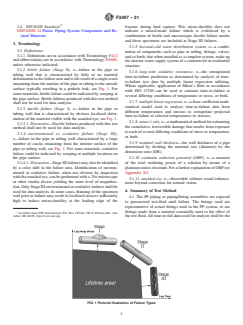
3.1.2 brittle failure (Stage II), n—failure in the pipe or
3.1.6 long-term oxidative resistance, n—the extrapolated
tubing wall that is characterized by little or no material
time-to-failure prediction as determined by analysis of time-
deformationinthefailureareaandistheresultofasinglecrack
to-failure test data by multiple linear regression utilizing.
emanating from the interior of the pipe or tubing to the outside
Where applicable, application of Miner’s Rule in accordance
surface typically resulting in a pinhole leak, see Fig. 1. For
with ISO 13760 can be used to estimate time-to-failure at
somematerials,brittlefailurecouldbeindicatedbyweepingat
several differing conditions of temperature or stress, or both.
thepipesurface.Brittlefailuresproducedwiththistestmethod
3.1.7 multiplelinearregression,n—athreecoefficientmath-
shall not be used for data analysis.
ematical model used to analyze time-to-failure data from
3.1.3 ductile failure (Stage I), n—failure in the pipe or
different temperatures and stresses to extrapolate projected
tubing wall that is characterized by obvious localized defor-
time-to-failure at selected temperatures or stresses.
mation of the material visible with the unaided eye, see Fig. 1.
3.1.8 miner’srule,n—amathematicalmethodforestimating
3.1.3.1 Discussion—Ductile failures produced with this test
the cumulative, irreversible damage that results from exposure
method shall not be used for data analysis.
to each of several differing conditions of stress or temperature,
3.1.4 environmental or oxidative failure (Stage III),
or both.
n—failure in the pipe or tubing wall characterized by a large
3.1.9 nominal wall thickness—the wall thickness of a pipe
number of cracks emanating from the interior surface of the
determined by dividing the nominal size (diameter) by the
pipe or tubing wall, see Fig. 1. For some materials, oxidative
dimension ratio (DR).
failure could be indicated by weeping at multiple locations on
the pipe surface. 3.1.10 oxidation reduction potential (ORP), n—a measure
3.1.4.1 Discussion—StageIIIfailuresmayalsobeidentified of the total oxidizing power of a solution by means of a
by a color shift in the failure area. Identification of environ- platinum-redoxelectrode.ForafurtherexplanationofORPsee
mental or oxidative failure, when not obvious by inspection Appendix X2.
withtheunaidedeye,canbeperformedwitha25×microscope
3.1.11 unaided eye, n—observable without visual enhance-
or other similar device yielding the same level of magnifica-
ment beyond correction for normal vision.
tion.OnlyStageIIIenvironmentaloroxidativefailuresshallbe
4. Summary of Test Method
used for data analysis. In some cases, thinning of the specimen
wallpriortofailuremayresultinlocalizedstressessufficiently
4.1 The PP piping or piping/fitting assemblies are exposed
high to induce micro-ductility at the leading edge of the
to pressurized test-fluid until failure. The fittings used are
representative of actual fittings used in the PP system, or are
5 fittings made from a material essentially inert to the effect of
Available from NSF International, P.O. Box 130140, 789 N. Dixboro Rd.,Ann
Arbor, MI 48105, http://www.nsf.org. thetestfluid.Alltime-to-faildatausedforanalysisshallbethe
FIG. 1 Pictorial Illustration of Failure Types
F3497 − 21
resultofoxidativedegradation(StageIII).Aminimumnumber the material being tested, the diameter/DR pipe size with the
of test temperature and hoop stress conditions are required to lowest wall thickness commercially produced by the manufac-
allow accurate data analysis and time-to-failure extrapolations. turer shall be tested.
7.2.1 Dimensions Measurement—Measure and record the
5. Significance and Use
critical dimensions for pipe and fittings. For pipe, measure the
5.1 Environment or oxidative time-to-fail data derived from
average outside diameter and wall-thickness in accordance
this test method, analyzed in accordance with Section 13, are with Test Method D2122. For fittings, measure those dimen-
suitable for extrapolation to typical end-use temperatures and
sions critical to the function of the joint, as well as minimum
hoop stresses. The extrapolated value(s) provides a relative body wall thickness.
indicationoftheresistanceofthetestedPPpipingorsystemto
7.3 Testing as a System—When testing PP pipe and related
the oxidative effects of hot, chlorinated water for conditions
system components (such as fittings) as a system, the other
equivalent to those conditions under which the test data were
components shall be attached to the PP pipe in the same
obtained. The performance of a material or piping product
manner as in actual service. For fittings, the particular fitting
under actual conditions of installation and use is dependent
style shall be installed in accordance with the manufacturer’s
upon a number of factors including installation methods, use
instructions or the ASTM specification when applicable.
patterns, water quality, nature and magnitude of localized
stresses, and other variables of an actual, operating hot-and- 7.4 Testing as piping—When testing PP piping, the joints
and connections to and between specimens shall be represen-
coldwaterdistributionsystemthatarenotaddressedinthistest
tative of actual fittings used in the PPsystem, or shall be made
method. As such, the extrapolated values do not constitute a
with fittings made from a material inert to the effect of the test
representation that a PP pipe or system with a given extrapo-
fluid.
lated time-to-failure value will perform for that period of time
under actual use conditions.
7.5 Minimum Required Test Units—A minimum of six test
units is required. A test unit is comprised of two or more
6. Apparatus
individual time-to-failure data points at the same temperature
6.1 Pressurized Flow-Through Test System—Asystemcom-
and hoop stress condition. Statistical reliability of the analysis
prised of the necessary pump(s), fittings, piping, heaters,
of the resultant data will be benefited by obtaining additional
sensors, and meters that is capable of maintaining the required
data points at each temperature/hoop stress condition.
test pressures within the tolerance specified in 9.1.3, the
7.5.1 Test Unit Distribution—Time-to-failure data points
required test temperatures within the tolerance of 9.1.2, and
shall be obtained at 2 test hoop stresses at each of a minimum
flow the test-fluid through the specimens continually at a flow
of 3 test temperatures for a minimum of 12 data points. Hoop
rate within the tolerance specified in 9.1.4. Cyclic pressure
stresses shall be separated by a least 80 psi (0.55 MPa).
variations, such as those produced by some pumping systems,
7.5.2 Test Temperature Selection—Temperatures of 239°F
shallnotproducepressureexcursionsthatexceedthetolerance
(115°C), 221°F (105°C), and 203°F (95°C) have been
stated in 9.1.3.
utilized in prior testing of PP.Adjacent test temperatures shall
6.1.1 Recirculating Test System—A flow-through test sys-
be separated by at least 18°F (10°C). Other test temperatures
tem that repeatedly reconditions the test-fluid and passes it
may be used, but the maximum test temperature shall not
through the specimens. For purposes of this test method, the
exceed 239°F (115°C).
test-fluid shall be monitored at a sufficient frequency to ensure
7.5.2.1 Relationship of Internal Pressure to Hoop Stress—
that it continuously meets the test-fluid parameters and water
The hoop stress in the pipe or tubing wall is calculated by the
quality criteria. A portion of the total system volume shall be
following expression, commonly known as the ISO equation:
purged and replaced with fresh test-fluid continually.
2S
6.1.2 Single-Pass Test System—A flow-through test system
5DR 21 (1)
that passes the test-fluid through the specimens only once and P
is discarded.
or
6.2 Specimen Holders—Test specimens shall be supported
2S D
o
to minimize or eliminate externally induced stresses. Speci-
5 21 (2)
P t
mens shall be allowed to freely expand bi-directionally.
where:
7. Sampling, Test Specimens, and Test Units
S = stress in the circumferential or hoop direction, psi
7.1 Sampling—Select at random a sufficient amount of pipe
(MPa),
tosatisfythespecimenrequirementsofthistestmethod.When P = internal pressure, psig (kPa),
testing as a system, randomly select a sufficient quantity of t = minimum wall thickness, in. (mm),
DR = dimension ratio, DR, and
fittings.
D = average outside diameter, in. (mm).
o
7.2 Test Specimen Size—The PP piping specimens shall be
12in. to 18 in. (300mm to 460 mm) in length between fitting
8. Calibration and Standardization
closures or between fitting joints. The specimens shall be
nominal size 20 and be DR 7.4 when measured in accordance 8.1 Measuring Equipment—All measuring and testing
with Specification F2389. If this size/DR is not available for equipment having an effect on the accuracy or validity of the
F3497 − 21
calibrations or tests shall be calibrated or verified, or both, ture 64.5°F (62.5°C). Direct, forced-air heating of the
before being put into service specimens shall not be used.
9. Test Fluid
11. Specimen Positioning
9.1 Internal Test Fluid—The test fluid shall be reverse
11.1 The specimens can be positioned vertically or horizon-
osmosis (RO) or deionized (DI) water prepared in accordance
tally.Horizontalpositioningrequiresspecialattentiontoensure
with 9.1.1.
that all entrapped air has been removed prior to starting the
9.1.1 RO or DI Water Test-Fluid Preparation—Test fluid
test. For vertically positioned specimens, the test fluid shall
prepared from RO or DI water shall have a pH in the range
flow into the specimens from the lower end.
from 6.5 to 8.0 and contain 2.5 ppm to 5 ppm (milligrams per
litre) of free-chlorine. The chosen pH shall be maintained to
12. Procedure
60.2 and the chosen free-chlorine concentration shall be
12.1 Perform the test procedure in accordance with 12.2 –
maintained to 60.2 ppm. The pH and fr
...