


ASTM F441/F441M-23
(Specification)Standard Specification for Chlorinated Poly(Vinyl Chloride) (CPVC) Plastic Pipe, Schedules 40 and 80
Standard Specification for Chlorinated Poly(Vinyl Chloride) (CPVC) Plastic Pipe, Schedules 40 and 80
ABSTRACT
This specification covers chlorinated poly(vinyl chloride) (CPVC) pipes made in Schedule 40 and 80 sizes and pressure-rated for water. These pipes are intended for use with the distribution of pressurized liquids only, which are chemically compatible with the piping materials. Included here are the criteria for classifying CPVC plastic pipe materials and CPVC plastic pipes, a system of nomenclature for CPVC plastic pipes, and requirements and test methods for materials, workmanship, dimensions, sustained pressure, burst pressure, accelerated regression, flattening resistance, and extrusion quality.
SCOPE
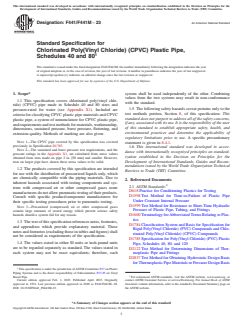
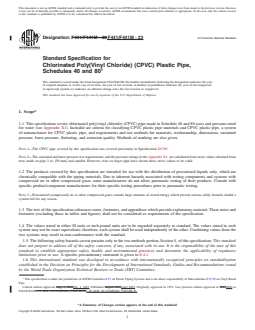
1.1 This specification covers chlorinated poly(vinyl chloride) (CPVC) pipe made in Schedule 40 and 80 sizes and pressure-rated for water (see Appendix X1). Included are criteria for classifying CPVC plastic pipe materials and CPVC plastic pipe, a system of nomenclature for CPVC plastic pipe, and requirements and test methods for materials, workmanship, dimensions, sustained pressure, burst pressure, flattening, and extrusion quality. Methods of marking are also given.
Note 1: The CPVC pipe covered by this specification was covered previously in Specification D1785.
Note 2: The sustained and burst pressure test requirements, and the pressure ratings in the Appendix X1, are calculated from stress values obtained from tests made on pipe 2 in. [50 mm] and smaller. However, tests on larger pipe have shown these stress values to be valid.
1.2 The products covered by this specification are intended for use with the distribution of pressurized liquids only, which are chemically compatible with the piping materials. Due to inherent hazards associated with testing components and systems with compressed air or other compressed gases some manufacturers do not allow pneumatic testing of their products. Consult with specific product/component manufacturers for their specific testing procedures prior to pneumatic testing.
Note 3: Pressurized (compressed) air or other compressed gases contain large amounts of stored energy which present serious safety hazards should a system fail for any reason.
1.3 The text of this specification references notes, footnotes, and appendixes which provide explanatory material. These notes and footnotes (excluding those in tables and figures) shall not be considered as requirements of the specification.
1.4 The values stated in either SI units or inch-pound units are to be regarded separately as standard. The values stated in each system may not be exact equivalents; therefore, each system shall be used independently of the other. Combining values from the two systems may result in non-conformance with the standard.
1.5 The following safety hazards caveat pertains only to the test methods portion, Section 8, of this specification: This standard does not purport to address all of the safety concerns, if any, associated with its use. It is the responsibility of the user of this standard to establish appropriate safety, health, and environmental practices and determine the applicability of regulatory limitations prior to use. A specific precautionary statement is given in 8.4.1.
1.6 This international standard was developed in accordance with internationally recognized principles on standardization established in the Decision on Principles for the Development of International Standards, Guides and Recommendations issued by the World Trade Organization Technical Barriers to Trade (TBT) Committee.
General Information
- Status
- Published
- Publication Date
- 31-Jan-2023
- Technical Committee
- F17 - Plastic Piping Systems
- Drafting Committee
- F17.25 - Vinyl Based Pipe
Relations
- Effective Date
- 01-Apr-2020
- Effective Date
- 15-Jan-2020
- Effective Date
- 01-Jan-2019
- Effective Date
- 01-Sep-2018
- Refers
ASTM D1600-18 - Standard Terminology for Abbreviated Terms Relating to Plastics (Withdrawn 2024) - Effective Date
- 01-Jan-2018
- Effective Date
- 01-Aug-2017
- Effective Date
- 01-Feb-2017
- Effective Date
- 15-Nov-2016
- Effective Date
- 01-Aug-2016
- Effective Date
- 01-Nov-2015
- Effective Date
- 01-Aug-2015
- Effective Date
- 01-Jun-2015
- Refers
ASTM D2122-15 - Standard Test Method for Determining Dimensions of Thermoplastic Pipe and Fittings - Effective Date
- 15-Mar-2015
- Effective Date
- 15-Apr-2014
- Effective Date
- 01-Feb-2014
Overview
ASTM F441/F441M-23 is the standard specification developed by ASTM International for chlorinated poly(vinyl chloride) (CPVC) plastic pipe in Schedule 40 and Schedule 80 sizes. This standard establishes specifications for pressure-rated CPVC pipes intended solely for the distribution of pressurized liquids that are chemically compatible with the piping material. The document outlines comprehensive criteria for classifying CPVC pipe materials, identifying proper nomenclature, and mandating specific requirements and test methods related to materials, workmanship, dimensions, pressure resistance, flattening resistance, and quality control. Compliance with this specification is essential for plumbing, industrial, and water supply systems utilizing CPVC pipe.
Key Topics
- Pipe Sizes and Types: Covers Schedule 40 and 80 CPVC plastic pipes suitable for water distribution under pressure.
- Material Classification: Describes requirements for CPVC materials, including hydrostatic design basis and compound classification per ASTM D1784.
- Performance Requirements:
- Sustained pressure tests
- Burst pressure tests
- Flattening resistance
- Dimensional tolerances
- Marking and Identification: Specifies marking requirements, such as nominal size, material designation, schedule, pressure ratings at 73 °F and 180 °F, ASTM designation, manufacturer’s name or trademark, and potable water certification where applicable.
- Test Methods: Lists essential ASTM test methods for performance evaluation, including D1598 (time-to-failure under constant pressure), D1599 (short-term burst pressure), and D2122 (dimensional assessment).
- Quality Assurance: Manufacturer must verify that pipes meet all standard requirements before shipment.
- Temperature and Pressure Ratings: Details pressure ratings at various temperatures and corresponding derating factors for use in elevated temperature applications.
- Health and Safety Considerations: Advises on appropriate practices for testing, installation, and use to mitigate hazards, especially regarding pneumatic testing.
Applications
- Pressurized Water Distribution: Widely used in residential, commercial, and industrial plumbing systems for cold and hot water supply thanks to high-temperature and pressure resistance.
- Chemical Process Piping: Suitable for transporting a range of industrial liquids provided they are chemically compatible with CPVC.
- Irrigation Systems: Applied in agricultural irrigation installations requiring robust pipe performance under pressure.
- Fire Protection Piping: Utilized in certain wet fire suppression systems where approved by code.
- Potable Water Systems: When properly certified, CPVC pipes per ASTM F441/F441M can be used for potable water conveyance, meeting NSF/ANSI Standard 61 requirements for health effects.
Related Standards
To ensure complete system compatibility and compliance, reference these related ASTM and industry standards:
- ASTM D1784: Classification of Rigid Poly(Vinyl Chloride) (PVC) and CPVC Compounds
- ASTM D1785: Specification for PVC Plastic Pipe, Schedules 40, 80, and 120
- ASTM D1598: Test Method for Time-to-Failure of Plastic Pipe Under Constant Internal Pressure
- ASTM D1599: Test Method for Resistance to Short-Time Hydraulic Pressure
- ASTM D2122: Test Method for Determining Dimensions of Thermoplastic Pipe and Fittings
- NSF/ANSI Standard 14 and Standard 61: Requirements for plastic piping systems and components for use in potable water applications
By following ASTM F441/F441M-23, manufacturers, specifiers, and installers ensure reliable performance, safety, and regulatory compliance of CPVC plastic pipe systems in a variety of pressure piping applications.
Buy Documents
ASTM F441/F441M-23 - Standard Specification for Chlorinated Poly(Vinyl Chloride) (CPVC) Plastic Pipe, Schedules 40 and 80
REDLINE ASTM F441/F441M-23 - Standard Specification for Chlorinated Poly(Vinyl Chloride) (CPVC) Plastic Pipe, Schedules 40 and 80
Get Certified
Connect with accredited certification bodies for this standard

Institut za varilstvo d.o.o. (Welding Institute)
Slovenia's leading welding institute since 1952. ISO 3834, EN 1090, pressure equipment certification, NDT personnel, welder qualification. Only IIW Au
Sponsored listings
Frequently Asked Questions
ASTM F441/F441M-23 is a technical specification published by ASTM International. Its full title is "Standard Specification for Chlorinated Poly(Vinyl Chloride) (CPVC) Plastic Pipe, Schedules 40 and 80". This standard covers: ABSTRACT This specification covers chlorinated poly(vinyl chloride) (CPVC) pipes made in Schedule 40 and 80 sizes and pressure-rated for water. These pipes are intended for use with the distribution of pressurized liquids only, which are chemically compatible with the piping materials. Included here are the criteria for classifying CPVC plastic pipe materials and CPVC plastic pipes, a system of nomenclature for CPVC plastic pipes, and requirements and test methods for materials, workmanship, dimensions, sustained pressure, burst pressure, accelerated regression, flattening resistance, and extrusion quality. SCOPE 1.1 This specification covers chlorinated poly(vinyl chloride) (CPVC) pipe made in Schedule 40 and 80 sizes and pressure-rated for water (see Appendix X1). Included are criteria for classifying CPVC plastic pipe materials and CPVC plastic pipe, a system of nomenclature for CPVC plastic pipe, and requirements and test methods for materials, workmanship, dimensions, sustained pressure, burst pressure, flattening, and extrusion quality. Methods of marking are also given. Note 1: The CPVC pipe covered by this specification was covered previously in Specification D1785. Note 2: The sustained and burst pressure test requirements, and the pressure ratings in the Appendix X1, are calculated from stress values obtained from tests made on pipe 2 in. [50 mm] and smaller. However, tests on larger pipe have shown these stress values to be valid. 1.2 The products covered by this specification are intended for use with the distribution of pressurized liquids only, which are chemically compatible with the piping materials. Due to inherent hazards associated with testing components and systems with compressed air or other compressed gases some manufacturers do not allow pneumatic testing of their products. Consult with specific product/component manufacturers for their specific testing procedures prior to pneumatic testing. Note 3: Pressurized (compressed) air or other compressed gases contain large amounts of stored energy which present serious safety hazards should a system fail for any reason. 1.3 The text of this specification references notes, footnotes, and appendixes which provide explanatory material. These notes and footnotes (excluding those in tables and figures) shall not be considered as requirements of the specification. 1.4 The values stated in either SI units or inch-pound units are to be regarded separately as standard. The values stated in each system may not be exact equivalents; therefore, each system shall be used independently of the other. Combining values from the two systems may result in non-conformance with the standard. 1.5 The following safety hazards caveat pertains only to the test methods portion, Section 8, of this specification: This standard does not purport to address all of the safety concerns, if any, associated with its use. It is the responsibility of the user of this standard to establish appropriate safety, health, and environmental practices and determine the applicability of regulatory limitations prior to use. A specific precautionary statement is given in 8.4.1. 1.6 This international standard was developed in accordance with internationally recognized principles on standardization established in the Decision on Principles for the Development of International Standards, Guides and Recommendations issued by the World Trade Organization Technical Barriers to Trade (TBT) Committee.
ABSTRACT This specification covers chlorinated poly(vinyl chloride) (CPVC) pipes made in Schedule 40 and 80 sizes and pressure-rated for water. These pipes are intended for use with the distribution of pressurized liquids only, which are chemically compatible with the piping materials. Included here are the criteria for classifying CPVC plastic pipe materials and CPVC plastic pipes, a system of nomenclature for CPVC plastic pipes, and requirements and test methods for materials, workmanship, dimensions, sustained pressure, burst pressure, accelerated regression, flattening resistance, and extrusion quality. SCOPE 1.1 This specification covers chlorinated poly(vinyl chloride) (CPVC) pipe made in Schedule 40 and 80 sizes and pressure-rated for water (see Appendix X1). Included are criteria for classifying CPVC plastic pipe materials and CPVC plastic pipe, a system of nomenclature for CPVC plastic pipe, and requirements and test methods for materials, workmanship, dimensions, sustained pressure, burst pressure, flattening, and extrusion quality. Methods of marking are also given. Note 1: The CPVC pipe covered by this specification was covered previously in Specification D1785. Note 2: The sustained and burst pressure test requirements, and the pressure ratings in the Appendix X1, are calculated from stress values obtained from tests made on pipe 2 in. [50 mm] and smaller. However, tests on larger pipe have shown these stress values to be valid. 1.2 The products covered by this specification are intended for use with the distribution of pressurized liquids only, which are chemically compatible with the piping materials. Due to inherent hazards associated with testing components and systems with compressed air or other compressed gases some manufacturers do not allow pneumatic testing of their products. Consult with specific product/component manufacturers for their specific testing procedures prior to pneumatic testing. Note 3: Pressurized (compressed) air or other compressed gases contain large amounts of stored energy which present serious safety hazards should a system fail for any reason. 1.3 The text of this specification references notes, footnotes, and appendixes which provide explanatory material. These notes and footnotes (excluding those in tables and figures) shall not be considered as requirements of the specification. 1.4 The values stated in either SI units or inch-pound units are to be regarded separately as standard. The values stated in each system may not be exact equivalents; therefore, each system shall be used independently of the other. Combining values from the two systems may result in non-conformance with the standard. 1.5 The following safety hazards caveat pertains only to the test methods portion, Section 8, of this specification: This standard does not purport to address all of the safety concerns, if any, associated with its use. It is the responsibility of the user of this standard to establish appropriate safety, health, and environmental practices and determine the applicability of regulatory limitations prior to use. A specific precautionary statement is given in 8.4.1. 1.6 This international standard was developed in accordance with internationally recognized principles on standardization established in the Decision on Principles for the Development of International Standards, Guides and Recommendations issued by the World Trade Organization Technical Barriers to Trade (TBT) Committee.
ASTM F441/F441M-23 is classified under the following ICS (International Classification for Standards) categories: 23.040.20 - Plastics pipes. The ICS classification helps identify the subject area and facilitates finding related standards.
ASTM F441/F441M-23 has the following relationships with other standards: It is inter standard links to ASTM F412-20, ASTM D1784-20, ASTM F412-19, ASTM D1599-18, ASTM D1600-18, ASTM F412-17a, ASTM F412-17, ASTM F412-16a, ASTM F412-16, ASTM D1598-15, ASTM D1785-15, ASTM F412-15, ASTM D2122-15, ASTM D1599-14, ASTM D1600-14. Understanding these relationships helps ensure you are using the most current and applicable version of the standard.
ASTM F441/F441M-23 is available in PDF format for immediate download after purchase. The document can be added to your cart and obtained through the secure checkout process. Digital delivery ensures instant access to the complete standard document.
Standards Content (Sample)
This international standard was developed in accordance with internationally recognized principles on standardization established in the Decision on Principles for the
Development of International Standards, Guides and Recommendations issued by the World Trade Organization Technical Barriers to Trade (TBT) Committee.
Designation: F441/F441M − 23 An American National Standard
Standard Specification for
Chlorinated Poly(Vinyl Chloride) (CPVC) Plastic Pipe,
Schedules 40 and 80
This standard is issued under the fixed designation F441/F441M; the number immediately following the designation indicates the year
of original adoption or, in the case of revision, the year of last revision. A number in parentheses indicates the year of last reapproval.
A superscript epsilon (´) indicates an editorial change since the last revision or reapproval.
This standard has been approved for use by agencies of the U.S. Department of Defense.
1. Scope* system shall be used independently of the other. Combining
values from the two systems may result in non-conformance
1.1 This specification covers chlorinated poly(vinyl chlo-
with the standard.
ride) (CPVC) pipe made in Schedule 40 and 80 sizes and
1.5 The following safety hazards caveat pertains only to the
pressure-rated for water (see Appendix X1). Included are
test methods portion, Section 8, of this specification: This
criteria for classifying CPVC plastic pipe materials and CPVC
standard does not purport to address all of the safety concerns,
plastic pipe, a system of nomenclature for CPVC plastic pipe,
if any, associated with its use. It is the responsibility of the user
and requirements and test methods for materials, workmanship,
of this standard to establish appropriate safety, health, and
dimensions, sustained pressure, burst pressure, flattening, and
environmental practices and determine the applicability of
extrusion quality. Methods of marking are also given.
regulatory limitations prior to use. A specific precautionary
NOTE 1—The CPVC pipe covered by this specification was covered
statement is given in 8.4.1.
previously in Specification D1785.
1.6 This international standard was developed in accor-
NOTE 2—The sustained and burst pressure test requirements, and the
dance with internationally recognized principles on standard-
pressure ratings in the Appendix X1, are calculated from stress values
ization established in the Decision on Principles for the
obtained from tests made on pipe 2 in. [50 mm] and smaller. However,
Development of International Standards, Guides and Recom-
tests on larger pipe have shown these stress values to be valid.
mendations issued by the World Trade Organization Technical
1.2 The products covered by this specification are intended
Barriers to Trade (TBT) Committee.
for use with the distribution of pressurized liquids only, which
are chemically compatible with the piping materials. Due to
2. Referenced Documents
inherent hazards associated with testing components and sys-
2.1 ASTM Standards:
tems with compressed air or other compressed gases some
D618 Practice for Conditioning Plastics for Testing
manufacturers do not allow pneumatic testing of their products.
D1598 Test Method for Time-to-Failure of Plastic Pipe
Consult with specific product/component manufacturers for
Under Constant Internal Pressure
their specific testing procedures prior to pneumatic testing.
D1599 Test Method for Resistance to Short-Time Hydraulic
NOTE 3—Pressurized (compressed) air or other compressed gases
Pressure of Plastic Pipe, Tubing, and Fittings
contain large amounts of stored energy which present serious safety
hazards should a system fail for any reason. D1600 Terminology for Abbreviated Terms Relating to Plas-
tics
1.3 The text of this specification references notes, footnotes,
D1784 Classification System and Basis for Specification for
and appendixes which provide explanatory material. These
Rigid Poly(Vinyl Chloride) (PVC) Compounds and Chlo-
notes and footnotes (excluding those in tables and figures) shall
rinated Poly(Vinyl Chloride) (CPVC) Compounds
not be considered as requirements of the specification.
D1785 Specification for Poly(Vinyl Chloride) (PVC) Plastic
1.4 The values stated in either SI units or inch-pound units
Pipe, Schedules 40, 80, and 120
are to be regarded separately as standard. The values stated in
D2122 Test Method for Determining Dimensions of Ther-
each system may not be exact equivalents; therefore, each
moplastic Pipe and Fittings
D2837 Test Method for Obtaining Hydrostatic Design Basis
for Thermoplastic Pipe Materials or Pressure Design Basis
This specification is under the jurisdiction of ASTM Committee F17 on Plastic
Piping Systems and is the direct responsibility of Subcommittee F17.25 on Vinyl
Based Pipe. For referenced ASTM standards, visit the ASTM website, www.astm.org, or
Current edition approved Feb. 1, 2023. Published April 2023. Originally contact ASTM Customer Service at service@astm.org. For Annual Book of ASTM
approved in 1974. Last previous edition approved in 2020 as F441/F441M– 20. Standards volume information, refer to the standard’s Document Summary page on
DOI: 10.1520/F0441_F0441M-23. the ASTM website.
*A Summary of Changes section appears at the end of this standard
Copyright © ASTM International, 100 Barr Harbor Drive, PO Box C700, West Conshohocken, PA 19428-2959. United States
F441/F441M − 23
for Thermoplastic Pipe Products 4. Classification
F412 Terminology Relating to Plastic Piping Systems
4.1 General—This specification covers CPVC pipe made
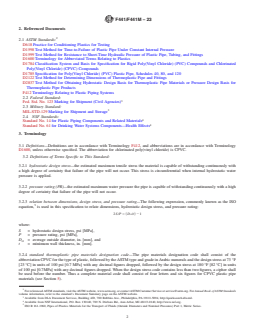
2.2 Federal Standard: from one (see X1.2) CPVC plastic pipe material in Schedule 40
Fed. Std. No. 123 Marking for Shipment (Civil Agencies) and 80 sizes.
4.2 Hydrostatic Design Stresses—This specification covers
2.3 Military Standard:
MIL-STD-129 Marking for Shipment and Storage CPVC pipe made from CPVC plastic as defined by hydrostatic
design stresses which have been developed on the basis of
2.4 NSF Standards:
long-term tests (see Appendix X1).
Standard No. 14 for Plastic Piping Components and Related
Materials NOTE 4—This specification does not include requirements for pipe
fittings intended to be used to vent combustion gases.
Standard No. 61 for Drinking Water Systems Components—
Health Effects
5. Materials
5.1 General—Chlorinated poly(vinyl chloride) plastics used
3. Terminology
to make pipe meeting the requirements of this specification are
3.1 Definitions—Definitions are in accordance with Termi-
categorized by means of two criteria, namely, (1) short-term
nology F412, and abbreviations are in accordance with Termi-
strength tests and (2) long-term hydrostatic strength tests at
nology D1600, unless otherwise specified. The abbreviation for
both 73 and 180 °F [23 and 82 °C].
chlorinated poly(vinyl chloride) is CPVC.
5.2 Basic Materials:
3.2 Definitions of Terms Specific to This Standard:
5.2.1 Basic Materials – Short-term Tests—This specification
3.2.1 hydrostatic design stress—the estimated maximum covers pipe made from CPVC plastics having certain physical
tensile stress the material is capable of withstanding continu-
properties as described in Classification D1784.
ously with a high degree of certainty that failure of the pipe 5.2.1.1 Compound—The CPVC compounds used for this
will not occur. This stress is circumferential when internal pipe shall equal or exceed the classification 23447 described in
hydrostatic water pressure is applied. Classification D1784.
5.2.2 Basic Materials – Long-term Test—This specification
3.2.2 pressure rating (PR)—the estimated maximum water
convers pipe made from CPVC plastics having certain Hydro-
pressure the pipe is capable of withstanding continuously with
static Design Bases (HDB) and Hydrostatic Design Stresses
a high degree of certainty that failure of the pipe will not occur.
(HDS) described in Test Method D2837
3.2.3 relation between dimensions, design stress, and pres-
5.2.2.1 Compound—The CPVC compounds used for this
sure rating—The following expression, commonly known as
pipe shall have a Hydrostatic Design Basis at 73 °F [23 °C] of
the ISO equation, is used in this specification to relate 4000 psi [28 MPa] and a Hydrostatic Design Basis at 180 °F
dimensions, hydrostatic design stress, and pressure rating:
[82 °C] of either 1000 psi [7.0 MPa] or 1250 psi [8.6 MPa]
when evaluated in accordance with Test Method D2837.
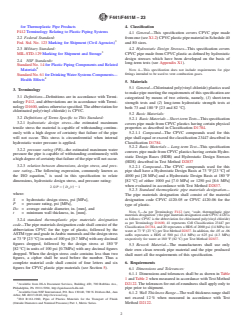
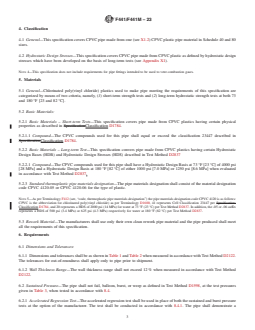
2 S/P 5 D /t 2 1
~ !
O
5.2.3 Standard thermoplastic pipe materials designation—
where:
The pipe materials designation shall consist of the material
S = hydrostatic design stress, psi [MPa],
designation code CPVC 4120-05 or CPVC 4120-06 for the
P = pressure rating, psi [MPa],
type of plastic.
D = average outside diameter, in. [mm], and
O
NOTE 5—As per Terminology F412 (see, “code, thermoplastic pipe
t = minimum wall thickness, in. [mm].
materials designation”) the pipe materials designation code CPVC 4120 is
as follows: CPVC is the abbreviation for chlorinated poly(vinyl chloride)
3.2.4 standard thermoplastic pipe materials designation
as per Terminology D1600, 41 represents Cell Classification 23447 per
code—The pipe materials designation code shall consist of the
Classification D1784, and 20 represents a HDS of 2000 psi (14 MPa) for
abbreviation CPVC for the type of plastic, followed by the
water at 73 °F (23 °C) per Test Method D2837. In addition, the -05 or -06
ASTM type and grade in Arabic numerals and the design stress
suffix represents a HDS of 500 psi (3.4 MPa) or 625 psi (4.3 MPa)
at 73 °F [23 °C] in units of 100 psi [0.7 MPa] with any decimal respectively for water at 180 °F (82 °C) per Test Method D2837.
figures dropped, followed by the design stress at 180 °F
5.3 Rework Material—The manufacturers shall use only
[82 °C] in units of 100 psi [0.7MPa] with any decimal figures
their own clean rework pipe material and the pipe produced
dropped. When the design stress code contains less than two
shall meet all the requirements of this specification.
figures, a cipher shall be used before the number. Thus a
6. Requirements
complete material code shall consist of four letters and six
figures for CPVC plastic pipe materials (see Section 5).
6.1 Dimensions and Tolerances:
6.1.1 Dimensions and tolerances shall be as shown in Table
1 and Table 2 when measured in accordance with Test Method
D2122. The tolerances for out-of-roundness shall apply only to
Available from DLA Document Services, Building 4/D, 700 Robbins Ave.,
Philadelphia, PA 19111-5094, http://quicksearch.dla.mil.
pipe prior to shipment.
Available from NSF International, P.O. Box 130140, 789 N. Dixboro Rd., Ann
6.1.2 Wall Thickness Range—The wall thickness range shall
Arbor, MI 48113-0140, http://www.nsf.org.
not exceed 12 % when measured in accordance with Test
ISO R 161-1960, Pipes of Plastics Materials for the Transport of Fluids
(Outside Diameters and Nominal Pressures) Part 1, Metric Series. Method D2122.
F441/F441M − 23
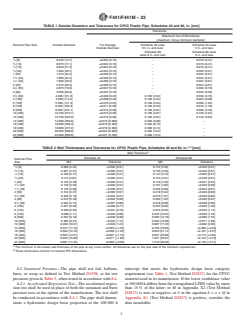
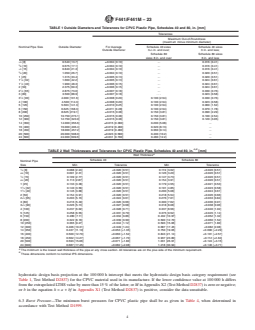
TABLE 1 Outside Diameters and Tolerances for CPVC Plastic Pipe, Schedules 40 and 80, in. [mm]
Tolerances
Maximum Out-of-Roundness
(maximum minus minimum diameter)
Nominal Pipe Size Outside Diameter For Average Schedule 40 sizes Schedule 40 sizes
Outside Diameter 3 ⁄2 in. and over; 3 in. and less;
Schedule 80 Schedule 80 sizes
sizes 8 in. and over 6 in. and less
⁄4 [8] 0.540 [13.7] ±0.004 [0.10] . 0.016 (0.41)
⁄8 [10] 0.675 [17.1] ±0.004 [0.10] . 0.016 (0.41)
⁄2 [15] 0.840 [21.3] ±0.004 [0.10] . 0.016 (0.41)
⁄4 [20] 1.050 [26.7] ±0.004 [0.10] . 0.020 (0.51)
1 [25] 1.315 [33.4] ±0.005 [0.13] . 0.020 (0.51)
1 ⁄4 [32] 1.660 [42.2] ±0.005 [0.13] . 0.024 (0.61)
1 ⁄2 [40] 1.900 [48.3] ±0.006 [0.15] . 0.024 (0.61)
2 [50] 2.375 [60.3] ±0.006 [0.15] . 0.024 (0.61)
2 ⁄2 [65] 2.875 [73.0] ±0.007 [0.18] . 0.030 (0.76)
3 [80] 3.500 [88.9] ±0.007 [0.18] . . . 0.023 (0.58)
3 ⁄2 [90] 4.000 [101.6] ±0.008 [0.20] 0.100 (2.54) 0.030 (0.76)
4 [100] 4.500 [114.3] ±0.008 [0.20] 0.100 (2.54) 0.023 (0.58)
5 [125] 5.563 [141.3] ±0.010 [0.25] 0.100 (2.54) 0.060 (1.52)
6 [150] 6.625 [168.3] ±0.011 [0.28] 0.100 (2.54) 0.070 (1.78)
8 [200] 8.625 [219.1] ±0.015 [0.38] 0.150 (3.81) 0.090 (2.29)
10 [250] 10.750 [273.1] ±0.015 [0.38] 0.150 (3.81) 0.100 (2.54)
12 [300] 12.750 [323.9] ±0.015 [0.38] 0.150 (3.81) 0.120 (3.05)
14 [350] 14.000 [355.6] ±0.015 [0.380] 0.200 (5.08) .
16 [400] 16.000 [406.4] ±0.019 [0.480] 0.320 (8.13) .
18 [450] 18.000 [457.2] ±0.019 [0.480] 0.360 (9.14) .
20 [500] 20.000 [508.0] ±0.023 [0.580] 0.400 (10.2) .
24 [600] 24.000 [609.6] ±0.031 [0.790] 0.480 (12.2) .
A,B
TABLE 2 Wall Thicknesses and Tolerances for CPVC Plastic Pipe, Schedules 40 and 80, in. [mm]
A
Wall Thickness
Schedule 40 Schedule 80
Nominal Pipe
Size Min Tolerance Min Tolerance
⁄4 [8] 0.088 [2.24] +0.020 [0.51] 0.119 [3.02] +0.020 [0.51]
⁄8 [10] 0.091 [2.31] +0.020 [0.51] 0.126 [3.20] +0.020 [0.51]
⁄2 [15] 0.109 [2.77] +0.020 [0.51] 0.147 [3.73] +0.020 [0.51]
⁄4 [20] 0.113 [2.87] +0.020 [0.51] 0.154 [3.91] +0.020 [0.51]
1 [25] 0.133 [3.38] +0.020 [0.51] 0.179 [4.55] +0.021 [0.53]
1 ⁄4 [32] 0.140 [3.56] +0.020 [0.51] 0.191 [4.85] +0.023 [0.58]
1 ⁄2 [40] 0.145 [3.68] +0.020 [0.51] 0.200 [5.08] +0.024 [0.61]
2 [50] 0.154 [3.91] +0.020 [0.51] 0.218 [5.54] +0.026 [0.66]
2 ⁄2 [65] 0.203 [5.16] +0.024 [0.61] 0.276 [7.01] +0.033 [0.84]
3 [80] 0.216 [5.49] +0.026 [0.66] 0.300 [7.62] +0.036 [0.91]
3 ⁄2 [90] 0.226 [5.74] +0.027 [0.68] 0.318 [8.08] +0.038 [0.96]
4 [100] 0.237 [6.02] +0.028 [0.71] 0.337 [8.56] +0.040 [1.02]
5 [125] 0.258 [6.55] +0.031 [0.79] 0.375 [9.52] +0.045 [1.14]
6 [150] 0.280 [7.11] +0.034 [0.86] 0.432 [10.97] +0.052 [1.32]
8 [200] 0.322 [8.18] +0.039 [0.99] 0.500 [12.70] +0.060 [1.52]
10 [250] 0.365 [9.27] +0.044 [1.12] 0.593 [15.06] +0.071 [1.80]
12 [300] 0.406 [10.31] +0.049 [1.24] 0.687 [17.45] +0.082 [2.08]
14 [350] 0.437 [11.10] +0.053 [+1.35] 0.750 [19.05] +0.090 [+2.29]
16 [400] 0.500 [12.70] +0.060 [+1.52] 0.843 [21.14] +0.101 [+2.57]
18 [450] 0.562 [14.27] +0.067 [+1.70] 0.937 [23.80] +0.112 [+2.84]
20 [500] 0.593 [15.06] +0.071 [+1.80] 1.031 [26.91] +0.124 [+3.15]
24 [600] 0.687 [17.45] +0.082 [+2.08] 1.218 [30.94] +0.146 [+3.71]
A
The minimum is the lowest wall thickness of the pipe at any cross section. All tolerances are on the plus side of the minimum requirement.
B
These dimensions conform to nominal IPS dimensions.
6.2 Sustained Pressure—The pipe shall not fail, balloon, intercept that meets the hydrostatic design basis category
burst, or weep as defined in Test Method D1598, at the test requirement (see Table 1, Test Method D2837) for the CPVC
pressures given in Table 3, when tested in accordance with 8.4. material used in its manufacture. If the lower confidence value
6.2.1 Accelerated Regression Test—The accelerated regres- at 100 000 h differs from the extrapolated LTHS value by more
sion test shall be used in place of both the sustained and burst than 15 % of the latter; or M in Appendix X2 (Test Method
pressure tests at the option of the manufacturer. The test shall D2837) is zero or negative; or b in the equation h = a + bf in
be conducted in accordance with 8.4.1. The pipe shall demon- Appendix X1 (Test Method D2837) is positive, consider the
strate a hydrostatic design basis projection at the 100 000 h data unsuitable.
F441/F441M − 23
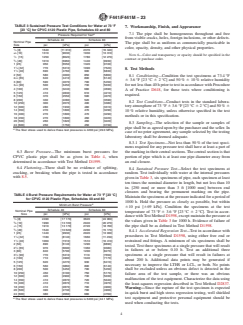
TABLE 3 Sustained Pressure Test Conditions for Water at 73 °F
7. Workmanship, Finish, and Appearance
[23 °C] for CPVC 4120 Plastic Pipe, Schedules 40 and 80
7.1 The pipe shall be homogeneous throughout and free
A
Pressure Required for Test
from visible cracks, holes, foreign inclusions, or other defects.
Schedule 40 Schedule 80
Nominal Pipe
The pipe shall be as uniform as commercially practicable in
Size psi [kPa] psi [kPa]
color, opacity, density, and other physical properties.
⁄4 [8] 1640 [11 310] 2370 [16 340]
⁄8 [10] 1310 [9030] 1930 [13 310]
NOTE 6—Color and transparency or opacity should be specified in the
⁄2 [15] 1250 [8620] 1780 [12 270]
contract or purchase order.
⁄4 [20] 1010 [6960] 1440 [9930]
1 [25] 950 [6550] 1320 [9100]
1 ⁄4 [32] 770 [5310] 1090 [7520]
8. Test Methods
1 ⁄2 [40] 690 [4760] 990 [6830]
2 [50] 580 [4000] 850 [5860]
8.1 Conditioning—Condition the test specimens at 73.4 °F
2 ⁄2 [65] 640 [4410] 890 [6140]
6 3.6 °F [23 °C 6 2 °C] and 50 % 6 10 % relative humidity
3 [80] 590 [4070] 790 [5450]
for not less than 40 h prior to test in accordance with Procedure
3 ⁄2 [90] 500 [3450] 730 [5030]
4 [100] 470 [3240] 680 [4690]
A of Practice D618, for those tests where conditioning is
5 [125] 410 [2830] 610 [4210]
required.
6 [150] 370 [2550] 590 [4070]
8 [200] 330 [2280] 520 [3590]
8.2 Test Conditions—Conduct tests in the standard labora-
10 [250] 300 [2070] 490 [3380]
tory atmosphere of 73 °F 6 3.6 °F [23 °C 6 2 °C] and 50 % 6
12 [300] 280 [1930] 480 [3310]
14 [350] 270 [1890] 470 [3290]
10 % relative humidity, unless otherwise specified in the test
16 [400] 270 [1890] 470 [3290]
methods or in this specification.
18 [450] 270 [1890] 460 [3220]
20 [500] 260 [1820] 460 [3220]
8.3 Sampling—The selection of the sample or samples of
24 [600] 250 [1750] 450 [3150]
pipe shall be as agreed upon by the purchaser and the seller. In
A
The fiber stress used to derive these test pressures is 4200 psi [29.0 MPa].
case of no prior agreement, any sample selected by the testing
laboratory shall be deemed adequate.
8.3.1 Test Specimens—Not less than 50 % of the test speci-
mens required for any pressure test shall have at least a part of
6.3 Burst Pressure—The minimum burst pressures for
the marking in their central sections. The central section is that
CPVC plastic pipe shall be as given in Table 4, when portion of pipe which is at least one pipe diameter away from
determined in accordance with Test Method D1599.
an end closure.
6.4 Flattening—There shall be no evidence of splitting,
8.4 Sustained Pressure Test—Select the test specimens at
cracking, or breaking when the pipe is tested in accordance
random. Test individually with water at the internal pressures
with 8.5.
given in Table 3, six specimens of pipe, each specimen at least
ten times the nomin
...
This document is not an ASTM standard and is intended only to provide the user of an ASTM standard an indication of what changes have been made to the previous version. Because
it may not be technically possible to adequately depict all changes accurately, ASTM recommends that users consult prior editions as appropriate. In all cases only the current version
of the standard as published by ASTM is to be considered the official document.
Designation: F441/F441M − 20 F441/F441M − 23 An American National Standard
Standard Specification for
Chlorinated Poly(Vinyl Chloride) (CPVC) Plastic Pipe,
Schedules 40 and 80
This standard is issued under the fixed designation F441/F441M; the number immediately following the designation indicates the year
of original adoption or, in the case of revision, the year of last revision. A number in parentheses indicates the year of last reapproval.
A superscript epsilon (´) indicates an editorial change since the last revision or reapproval.
This standard has been approved for use by agencies of the U.S. Department of Defense.
1. Scope*
1.1 This specification covers chlorinated poly(vinyl chloride) (CPVC) pipe made in Schedule 40 and 80 sizes and pressure-rated
for water (see Appendix X1). Included are criteria for classifying CPVC plastic pipe materials and CPVC plastic pipe, a system
of nomenclature for CPVC plastic pipe, and requirements and test methods for materials, workmanship, dimensions, sustained
pressure, burst pressure, flattening, and extrusion quality. Methods of marking are also given.
NOTE 1—The CPVC pipe covered by this specification was covered previously in Specification D1785.
NOTE 2—The sustained and burst pressure test requirements, and the pressure ratings in the Appendix X1, are calculated from stress values obtained from
tests made on pipe 2 in. [50 mm] and smaller. However, tests on larger pipe have shown these stress values to be valid.
1.2 The products covered by this specification are intended for use with the distribution of pressurized liquids only, which are
chemically compatible with the piping materials. Due to inherent hazards associated with testing components and systems with
compressed air or other compressed gases some manufacturers do not allow pneumatic testing of their products. Consult with
specific product/component manufacturers for their specific testing procedures prior to pneumatic testing.
NOTE 3—Pressurized (compressed) air or other compressed gases contain large amounts of stored energy which present serious safety hazards should a
system fail for any reason.
1.3 The text of this specification references notes, footnotes, and appendixes which provide explanatory material. These notes and
footnotes (excluding those in tables and figures) shall not be considered as requirements of the specification.
1.4 The values stated in either SI units or inch-pound units are to be regarded separately as standard. The values stated in each
system may not be exact equivalents; therefore, each system shall be used independently of the other. Combining values from the
two systems may result in non-conformance with the standard.
1.5 The following safety hazards caveat pertains only to the test methods portion, Section 8, of this specification: This standard
does not purport to address all of the safety concerns, if any, associated with its use. It is the responsibility of the user of this
standard to establish appropriate safety, health, and environmental practices and determine the applicability of regulatory
limitations prior to use. A specific precautionary statement is given in 8.4.1.
1.6 This international standard was developed in accordance with internationally recognized principles on standardization
established in the Decision on Principles for the Development of International Standards, Guides and Recommendations issued
by the World Trade Organization Technical Barriers to Trade (TBT) Committee.
This specification is under the jurisdiction of ASTM Committee F17 on Plastic Piping Systems and is the direct responsibility of Subcommittee F17.25 on Vinyl Based
Pipe.
Current edition approved Aug. 1, 2020Feb. 1, 2023. Published August 2020April 2023. Originally approved in 1974. Last previous edition approved in 20152020 as
F441/F441M– 15. DOI: 10.1520/F0441_F0441M-20.– 20. DOI: 10.1520/F0441_F0441M-23.
*A Summary of Changes section appears at the end of this standard
Copyright © ASTM International, 100 Barr Harbor Drive, PO Box C700, West Conshohocken, PA 19428-2959. United States
F441/F441M − 23
2. Referenced Documents
2.1 ASTM Standards:
D618 Practice for Conditioning Plastics for Testing
D1598 Test Method for Time-to-Failure of Plastic Pipe Under Constant Internal Pressure
D1599 Test Method for Resistance to Short-Time Hydraulic Pressure of Plastic Pipe, Tubing, and Fittings
D1600 Terminology for Abbreviated Terms Relating to Plastics
D1784 Classification System and Basis for Specification for Rigid Poly(Vinyl Chloride) (PVC) Compounds and Chlorinated
Poly(Vinyl Chloride) (CPVC) Compounds
D1785 Specification for Poly(Vinyl Chloride) (PVC) Plastic Pipe, Schedules 40, 80, and 120
D2122 Test Method for Determining Dimensions of Thermoplastic Pipe and Fittings
D2837 Test Method for Obtaining Hydrostatic Design Basis for Thermoplastic Pipe Materials or Pressure Design Basis for
Thermoplastic Pipe Products
F412 Terminology Relating to Plastic Piping Systems
2.2 Federal Standard:
Fed. Std. No. 123 Marking for Shipment (Civil Agencies)
2.3 Military Standard:
MIL-STD-129 Marking for Shipment and Storage
2.4 NSF Standards:
Standard No. 14 for Plastic Piping Components and Related Materials
Standard No. 61 for Drinking Water Systems Components—Health Effects
3. Terminology
3.1 Definitions—Definitions are in accordance with Terminology F412, and abbreviations are in accordance with Terminology
D1600, unless otherwise specified. The abbreviation for chlorinated poly(vinyl chloride) is CPVC.
3.2 Definitions of Terms Specific to This Standard:
3.2.1 hydrostatic design stress—the estimated maximum tensile stress the material is capable of withstanding continuously with
a high degree of certainty that failure of the pipe will not occur. This stress is circumferential when internal hydrostatic water
pressure is applied.
3.2.2 pressure rating (PR)—the estimated maximum water pressure the pipe is capable of withstanding continuously with a high
degree of certainty that failure of the pipe will not occur.
3.2.3 relation between dimensions, design stress, and pressure rating—The following expression, commonly known as the ISO
equation, is used in this specification to relate dimensions, hydrostatic design stress, and pressure rating:
2 S/P 5 D /t 2 1
~ !
O
where:
S = hydrostatic design stress, psi [MPa],
P = pressure rating, psi [MPa],
D = average outside diameter, in. [mm], and
O
t = minimum wall thickness, in. [mm].
3.2.4 standard thermoplastic pipe materials designation code—The pipe materials designation code shall consist of the
abbreviation CPVC for the type of plastic, followed by the ASTM type and grade in Arabic numerals and the design stress at 73 °F
[23 °C] in units of 100 psi [0.7 MPa] with any decimal figures dropped, followed by the design stress at 180 °F [82 °C] in units
of 100 psi [0.7MPa] with any decimal figures dropped. When the design stress code contains less than two figures, a cipher shall
be used before the number. Thus a complete material code shall consist of four letters and six figures for CPVC plastic pipe
materials (see Section 5).
For referenced ASTM standards, visit the ASTM website, www.astm.org, or contact ASTM Customer Service at service@astm.org. For Annual Book of ASTM Standards
volume information, refer to the standard’s Document Summary page on the ASTM website.
Available from DLA Document Services, Building 4/D, 700 Robbins Ave., Philadelphia, PA 19111-5094, http://quicksearch.dla.mil.
Available from NSF International, P.O. Box 130140, 789 N. Dixboro Rd., Ann Arbor, MI 48113-0140, http://www.nsf.org.
ISO R 161-1960, Pipes of Plastics Materials for the Transport of Fluids (Outside Diameters and Nominal Pressures) Part 1, Metric Series.
F441/F441M − 23
4. Classification
4.1 General—This specification covers CPVC pipe made from one (see X1.2) CPVC plastic pipe material in Schedule 40 and 80
sizes.
4.2 Hydrostatic Design Stresses—This specification covers CPVC pipe made from CPVC plastic as defined by hydrostatic design
stresses which have been developed on the basis of long-term tests (see Appendix X1).
NOTE 4—This specification does not include requirements for pipe fittings intended to be used to vent combustion gases.
5. Materials
5.1 General—Chlorinated poly(vinyl chloride) plastics used to make pipe meeting the requirements of this specification are
categorized by means of two criteria, namely, (1) short-term strength tests and (2) long-term hydrostatic strength tests at both 73
and 180 °F [23 and 82 °C].
5.2 Basic Materials:
5.2.1 Basic Materials – Short-term Tests—This specification covers pipe made from CPVC plastics having certain physical
properties as described in SpecificationClassification D1784.
5.2.1.1 Compound—The CPVC compounds used for this pipe shall equal or exceed the classification 23447 described in
SpecificationClassification D1784.
5.2.2 Basic Materials – Long-term Test—This specification convers pipe made from CPVC plastics having certain Hydrostatic
Design Bases (HDB) and Hydrostatic Design Stresses (HDS) described in Test Method D2837
5.2.2.1 Compound—The CPVC compounds used for this pipe shall have a Hydrostatic Design Basis at 73 °F [23 °C] of 4000 psi
[28 MPa] and a Hydrostatic Design Basis at 180 °F [82 °C] of either 1000 psi [7.0 MPa] or 1250 psi [8.6 MPa] when evaluated
in accordance with Test Method D2837.
5.2.3 Standard thermoplastic pipe materials designation—The pipe materials designation shall consist of the material designation
code CPVC 4120-05 or CPVC 4120-06 for the type of plastic.
NOTE 5—As per Terminology F412 (see, “code, thermoplastic pipe materials designation”) the pipe materials designation code CPVC 4120 is as follows:
CPVC is the abbreviation for chlorinated poly(vinyl chloride) as per Terminology D1600, 41 represents Cell Classification 23447 per Specification-
Classification D1784, and 20 represents a HDS of 2000 psi (14 MPa) for water at 73 °F (23 °C) per Test Method D2837. In addition, the -05 or -06 suffix
represents a HDS of 500 psi (3.4 MPa) or 625 psi (4.3 MPa) respectively for water at 180 °F (82 °C) per Test Method D2837.
5.3 Rework Material—The manufacturers shall use only their own clean rework pipe material and the pipe produced shall meet
all the requirements of this specification.
6. Requirements
6.1 Dimensions and Tolerances:
6.1.1 Dimensions and tolerances shall be as shown in Table 1 and Table 2 when measured in accordance with Test Method D2122.
The tolerances for out-of-roundness shall apply only to pipe prior to shipment.
6.1.2 Wall Thickness Range—The wall thickness range shall not exceed 12 % when measured in accordance with Test Method
D2122.
6.2 Sustained Pressure—The pipe shall not fail, balloon, burst, or weep as defined in Test Method D1598, at the test pressures
given in Table 3, when tested in accordance with 8.4.
6.2.1 Accelerated Regression Test—The accelerated regression test shall be used in place of both the sustained and burst pressure
tests at the option of the manufacturer. The test shall be conducted in accordance with 8.4.1. The pipe shall demonstrate a
F441/F441M − 23
TABLE 1 Outside Diameters and Tolerances for CPVC Plastic Pipe, Schedules 40 and 80, in. [mm]
Tolerances
Maximum Out-of-Roundness
(maximum minus minimum diameter)
Nominal Pipe Size Outside Diameter For Average Schedule 40 sizes Schedule 40 sizes
Outside Diameter 3 ⁄2 in. and over; 3 in. and less;
Schedule 80 Schedule 80 sizes
sizes 8 in. and over 6 in. and less
⁄4 [8] 0.540 [13.7] ±0.004 [0.10] . 0.016 (0.41)
⁄8 [10] 0.675 [17.1] ±0.004 [0.10] . 0.016 (0.41)
⁄2 [15] 0.840 [21.3] ±0.004 [0.10] . 0.016 (0.41)
⁄4 [20] 1.050 [26.7] ±0.004 [0.10] . 0.020 (0.51)
1 [25] 1.315 [33.4] ±0.005 [0.13] . 0.020 (0.51)
1 ⁄4 [32] 1.660 [42.2] ±0.005 [0.13] . 0.024 (0.61)
1 ⁄2 [40] 1.900 [48.3] ±0.006 [0.15] . 0.024 (0.61)
2 [50] 2.375 [60.3] ±0.006 [0.15] . 0.024 (0.61)
2 ⁄2 [65] 2.875 [73.0] ±0.007 [0.18] . 0.030 (0.76)
3 [80] 3.500 [88.9] ±0.007 [0.18] . . . 0.023 (0.58)
3 ⁄2 [90] 4.000 [101.6] ±0.008 [0.20] 0.100 (2.54) 0.030 (0.76)
4 [100] 4.500 [114.3] ±0.008 [0.20] 0.100 (2.54) 0.023 (0.58)
5 [125] 5.563 [141.3] ±0.010 [0.25] 0.100 (2.54) 0.060 (1.52)
6 [150] 6.625 [168.3] ±0.011 [0.28] 0.100 (2.54) 0.070 (1.78)
8 [200] 8.625 [219.1] ±0.015 [0.38] 0.150 (3.81) 0.090 (2.29)
10 [250] 10.750 [273.1] ±0.015 [0.38] 0.150 (3.81) 0.100 (2.54)
12 [300] 12.750 [323.9] ±0.015 [0.38] 0.150 (3.81) 0.120 (3.05)
14 [350] 14.000 [355.6] ±0.015 [0.380] 0.200 (5.08) .
16 [400] 16.000 [406.4] ±0.019 [0.480] 0.320 (8.13) .
18 [450] 18.000 [457.2] ±0.019 [0.480] 0.360 (9.14) .
20 [500] 20.000 [508.0] ±0.023 [0.580] 0.400 (10.2) .
24 [600] 24.000 [609.6] ±0.031 [0.790] 0.480 (12.2) .
A,B
TABLE 2 Wall Thicknesses and Tolerances for CPVC Plastic Pipe, Schedules 40 and 80, in. [mm]
A
Wall Thickness
Schedule 40 Schedule 80
Nominal Pipe
Size Min Tolerance Min Tolerance
⁄4 [8] 0.088 [2.24] +0.020 [0.51] 0.119 [3.02] +0.020 [0.51]
⁄8 [10] 0.091 [2.31] +0.020 [0.51] 0.126 [3.20] +0.020 [0.51]
⁄2 [15] 0.109 [2.77] +0.020 [0.51] 0.147 [3.73] +0.020 [0.51]
⁄4 [20] 0.113 [2.87] +0.020 [0.51] 0.154 [3.91] +0.020 [0.51]
1 [25] 0.133 [3.38] +0.020 [0.51] 0.179 [4.55] +0.021 [0.53]
1 ⁄4 [32] 0.140 [3.56] +0.020 [0.51] 0.191 [4.85] +0.023 [0.58]
1 ⁄2 [40] 0.145 [3.68] +0.020 [0.51] 0.200 [5.08] +0.024 [0.61]
2 [50] 0.154 [3.91] +0.020 [0.51] 0.218 [5.54] +0.026 [0.66]
2 ⁄2 [65] 0.203 [5.16] +0.024 [0.61] 0.276 [7.01] +0.033 [0.84]
3 [80] 0.216 [5.49] +0.026 [0.66] 0.300 [7.62] +0.036 [0.91]
3 ⁄2 [90] 0.226 [5.74] +0.027 [0.68] 0.318 [8.08] +0.038 [0.96]
4 [100] 0.237 [6.02] +0.028 [0.71] 0.337 [8.56] +0.040 [1.02]
5 [125] 0.258 [6.55] +0.031 [0.79] 0.375 [9.52] +0.045 [1.14]
6 [150] 0.280 [7.11] +0.034 [0.86] 0.432 [10.97] +0.052 [1.32]
8 [200] 0.322 [8.18] +0.039 [0.99] 0.500 [12.70] +0.060 [1.52]
10 [250] 0.365 [9.27] +0.044 [1.12] 0.593 [15.06] +0.071 [1.80]
12 [300] 0.406 [10.31] +0.049 [1.24] 0.687 [17.45] +0.082 [2.08]
14 [350] 0.437 [11.10] +0.053 [+1.35] 0.750 [19.05] +0.090 [+2.29]
16 [400] 0.500 [12.70] +0.060 [+1.52] 0.843 [21.14] +0.101 [+2.57]
18 [450] 0.562 [14.27] +0.067 [+1.70] 0.937 [23.80] +0.112 [+2.84]
20 [500] 0.593 [15.06] +0.071 [+1.80] 1.031 [26.91] +0.124 [+3.15]
24 [600] 0.687 [17.45] +0.082 [+2.08] 1.218 [30.94] +0.146 [+3.71]
A
The minimum is the lowest wall thickness of the pipe at any cross section. All tolerances are on the plus side of the minimum requirement.
B
These dimensions conform to nominal IPS dimensions.
hydrostatic design basis projection at the 100 000 h intercept that meets the hydrostatic design basis category requirement (see
Table 1, Test Method D2837) for the CPVC material used in its manufacture. If the lower confidence value at 100 000 h differs
from the extrapolated LTHS value by more than 15 % of the latter; or M in Appendix X2 (Test Method D2837) is zero or negative;
or b in the equation h = a + bf in Appendix X1 (Test Method D2837) is positive, consider the data unsuitable.
6.3 Burst Pressure—The minimum burst pressures for CPVC plastic pipe shall be as given in Table 4, when determined in
accordance with Test Method D1599.
F441/F441M − 23
TABLE 3 Sustained Pressure Test Conditions for Water at 73 °F
[23 °C] for CPVC 4120 Plastic Pipe, Schedules 40 and 80
A
Pressure Required for Test
Schedule 40 Schedule 80
Nominal Pipe
Size psi [kPa] psi [kPa]
⁄4 [8] 1640 [11 310] 2370 [16 340]
⁄8 [10] 1310 [9030] 1930 [13 310]
⁄2 [15] 1250 [8620] 1780 [12 270]
⁄4 [20] 1010 [6960] 1440 [9930]
1 [25] 950 [6550] 1320 [9100]
1 ⁄4 [32] 770 [5310] 1090 [7520]
1 ⁄2 [40] 690 [4760] 990 [6830]
2 [50] 580 [4000] 850 [5860]
2 ⁄2 [65] 640 [4410] 890 [6140]
3 [80] 590 [4070] 790 [5450]
3 ⁄2 [90] 500 [3450] 730 [5030]
4 [100] 470 [3240] 680 [4690]
5 [125] 410 [2830] 610 [4210]
6 [150] 370 [2550] 590 [4070]
8 [200] 330 [2280] 520 [3590]
10 [250] 300 [2070] 490 [3380]
12 [300] 280 [1930] 480 [3310]
14 [350] 270 [1890] 470 [3290]
16 [400] 270 [1890] 470 [3290]
18 [450] 270 [1890] 460 [3220]
20 [500] 260 [1820] 460 [3220]
24 [600] 250 [1750] 450 [3150]
A
The fiber stress used to derive these test pressures is 4200 psi [29.0 MPa].
TABLE 4 Burst Pressure Requirements for Water at 73 °F [23 °C]
for CPVC 4120 Plastic Pipe, Schedules 40 and 80
A
Minimum Burst Pressure
Schedule 40 Schedule 80
Nominal Pipe
Size psi [kPa] psi [kPa]
⁄4 [8] 2490 [17 170] 3620 [24 960]
⁄8 [10] 1990 [13 720] 2940 [20 270]
⁄2 [15] 1910 [13 170] 2720 [18 760]
⁄4 [20] 1540 [10 620] 2200 [15 170]
1 [25] 1440 [9930] 2020 [13 930]
1 ⁄4 [32] 1180 [8140] 1660 [11 450]
1 ⁄2 [40] 1060 [7310] 1510 [10 410]
2 [50] 890 [6140] 1290 [8890]
2 ⁄2 [65] 970 [6690] 1360 [9380]
3 [80] 840 [5790] 1200 [8270]
3 ⁄2 [90] 770 [5310] 1110 [7650]
4 [100] 710 [4900] 1040 [7170]
5 [125] 620 [4270] 930 [6410]
6 [150] 560 [3860] 890 [6140]
8 [200] 500 [3450] 790 [5450]
10 [250] 450 [3100] 750 [5170]
12 [300] 420 [2900] 730 [5030]
14 [350] 410 [2870] 720 [5040]
16 [400] 410 [2870] 710 [4970]
18 [450] 410 [2870] 700 [4900]
20 [500] 390 [2730] 700 [4900]
24 [600] 380 [2660] 680 [4760]
A
The fiber stress used to derive these test pressures is 6400 psi [44.1 MPa].
6.4 Flattening—There shall be no evidence of splitting, cracking, or breaking when the pipe is tested in accordance with 8.5.
7. Workmanship, Finish, and Appearance
7.1 The pipe shall be homogeneous throughout and free from visible cracks, holes, foreign inclusions, or other defects. The pipe
shall be as uniform as commercially practicable in color, opacity, density, and other physical properties.
NOTE 6—Color and transparency or opacity should be specified in the contract or purchase order.
F441/F441M − 23
8. Test Methods
8.1 Conditioning—Condition the test specimens at 73.473.4 °F 6 3.6 °F [23[23 °C 6 2 °C] and 5050 %
...
Questions, Comments and Discussion
Ask us and Technical Secretary will try to provide an answer. You can facilitate discussion about the standard in here.
Loading comments...