

ASTM D5080-20
(Test Method)Standard Test Method for Rapid Determination of Percent Compaction
General Information
- Abstract
SIGNIFICANCE AND USE
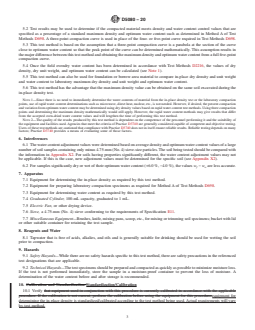
5.1 The rapid method is performed to quickly evaluate percent compaction and variation from optimum water content of soils used in construction without knowing the value of field water content at the time of the test.
5.1.1 Test results are usually determined within 1 to 2 h from the start of the test.
5.1.2 The value of percent compaction obtained using the rapid method will be the same as the percent compaction calculated using dry density values.
5.1.3 The value of the difference between field water content and optimum water content will be approximate, but will be within ±0.1 to 0.2 percentage point of the difference calculated once the field water content is known.
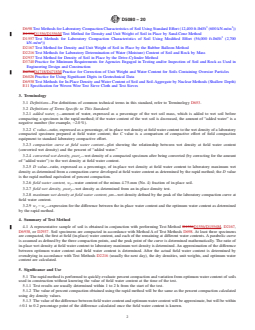
5.2 Test results may be used to determine if the compacted material meets density and water content control values that are specified as a percentage of a standard maximum density and optimum water content such as determined in Method A of Test Methods D698. A three-point compaction curve is used in place of the four- or five-point curve required in Test Methods D698.
5.3 This test method is based on the assumption that a three-point compaction curve is a parabola at the section of the curve close to optimum water content so that the peak point of the curve can be determined mathematically. This assumption results in the major difference between this test method and obtaining the maximum density and optimum water content from a full five-point compaction curve.
5.4 Once the field ovendry water content has been determined in accordance with Test Methods D2216, the values of dry density, dry unit weight, and optimum water content can be calculated (see Note 1).
5.5 This test method can also be used for foundation or borrow area material to compare in-place dry density and unit weight and water content to laboratory maximum dry density and unit weight and optimum water content.
5.6 This test method has the advantage that the maximum density value can be obtained on the same soil ...
SCOPE
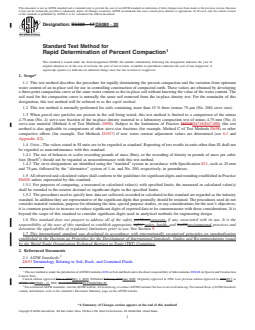
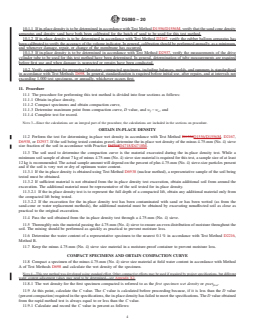
1.1 This test method describes the procedure for rapidly determining the percent compaction and the variation from optimum water content of an in-place soil for use in controlling construction of compacted earth. These values are obtained by developing a three-point compaction curve at the same water content as the in-place soil without knowing the value of the water content. The soil used for the compaction curve is normally the same soil removed from the in-place density test. For the remainder of this designation, this test method will be referred to as the rapid method.
1.2 This test method is normally performed for soils containing more than 15 % fines (minus 75-µm (No. 200) sieve size).
1.3 When gravel-size particles are present in the soil being tested, this test method is limited to a comparison of the minus 4.75-mm (No. 4) sieve-size fraction of the in-place density material to a laboratory compaction test of minus 4.75-mm (No. 4) sieve-size material (Method A of Test Methods D698). Subject to the limitations of Practice D4718/D4718M, this test method is also applicable to comparisons of other sieve-size fractions (for example, Method C of Test Methods D698) or other compactive efforts (for example, Test Methods D1557) if new water content adjustment values are determined (see 6.1 and Appendix X2).
1.4 Units—The values stated in SI units are to be regarded as standard. Reporting of test results in units other than SI shall not be regarded as nonconformance with this standard.
1.4.1 The use of balances or scales recording pounds of mass (lbm), or the recording of density in pounds of mass per cubic foot (lbm/ft3) should not be regarded as nonconformance with this test method.
1.4.2 The sieve designations are identified using the “standard” system in accordance with Specification E11, such as 25-mm and 75-μm, followed by the “alternative” system of 1-in. and No. 200, respectively, in parentheses.
...
- Status
- Published
- Publication Date
- 30-Apr-2020
- Technical Committee
- D18 - Soil and Rock
- Drafting Committee
- D18.08 - Special and Construction Control Tests
Overview
ASTM D5080-20: Standard Test Method for Rapid Determination of Percent Compaction is a key international standard developed by ASTM for the rapid evaluation of soil compaction in construction projects. This test method is widely used to quickly determine the percent compaction and variation from optimum water content of in-place soils, a crucial aspect for quality assurance in earthwork and soil compaction operations. The procedure, often called the "rapid method," enables results within 1 to 2 hours, which accelerates construction timelines and reduces the need for extended laboratory analysis.
The standard is specifically intended for soils containing more than 15% fines (particles passing the 75-μm, No. 200 sieve) and applies particularly to situations where knowing the exact field water content at the time of testing is not possible. By developing a three-point compaction curve using soil from the same location as the in-place density test, this method allows for efficient monitoring and control of soil compaction quality.
Key Topics
- Rapid Percent Compaction Determination: Enables quick assessment of soil compaction relative to laboratory-determined maximum density without requiring immediate determination of field water content.
- Three-Point Compaction Curve: Utilizes three data points to approximate the compaction curve near optimum water content, replacing more lengthy methods employing four or five points.
- Applicability: Primarily used for fine-grained soils with >15% passing the 75-μm (No. 200) sieve; adjustments and limitations exist when gravel-size particles are present.
- Field and Laboratory Comparison: Facilitates the comparison of in-place dry density and unit weight with laboratory maximum values, enhancing construction quality control.
- Adaptability: The method can be aligned with various ASTM compaction and density standards (e.g., ASTM D698, D1557) and can accommodate different compactive efforts and sieve size fractions when required.
- Use of SI and Imperial Units: The standard supports results reporting in either SI units or customary (imperial) units, providing flexibility for global and local applications.
Applications
ASTM D5080-20 is widely applied in both field and laboratory settings during earthwork construction projects, including:
- Construction Quality Control: Verifying that compacted soil layers meet specified density and moisture requirements, which is essential for the durability and stability of structures such as embankments, foundations, and roadways.
- Earthworks Monitoring: Enabling onsite engineering teams to make rapid adjustments to compaction techniques or moisture conditioning, minimizing rework and delays.
- Foundation and Borrow Area Evaluation: Assessing the suitability of soils for construction by comparing in-place density and moisture values to laboratory benchmarks.
- Time-Critical Construction: When rapid decisions are necessary to maintain construction progress, this standard provides a reliable and efficient method for field teams and laboratory technicians.
Related Standards
- ASTM D698 - Laboratory Compaction Characteristics of Soil Using Standard Effort
- ASTM D1557 - Laboratory Compaction Characteristics of Soil Using Modified Effort
- ASTM D1556/D1556M - Density and Unit Weight of Soil in Place by Sand-Cone Method
- ASTM D2167 - Density and Unit Weight of Soil in Place by the Rubber Balloon Method
- ASTM D2216 - Laboratory Determination of Water (Moisture) Content of Soil and Rock by Mass
- ASTM D2937 - Density of Soil in Place by Drive-Cylinder Method
- ASTM D6938 - In-Place Density and Water Content of Soil and Soil-Aggregate by Nuclear Methods
- ASTM D4718/D4718M - Correction of Unit Weight and Water Content for Soils Containing Oversize Particles
- ASTM E11 - Specification for Woven Wire Test Sieve Cloth and Test Sieves
ASTM D5080-20 is an essential resource for geotechnical engineers, contractors, and quality assurance specialists working in soil compaction and construction earthworks, ensuring compliance with internationally recognized testing procedures for soil density and compaction control.
Relations
- Effective Date
- 01-Nov-2023
- Effective Date
- 01-Oct-2019
- Effective Date
- 01-Mar-2019
- Effective Date
- 01-Mar-2017
- Refers
ASTM D2937-17e2 - Standard Test Method for Density of Soil in Place by the Drive-Cylinder Method - Effective Date
- 01-Feb-2017
- Refers
ASTM D2937-17 - Standard Test Method for Density of Soil in Place by the Drive-Cylinder Method - Effective Date
- 01-Feb-2017
- Refers
ASTM D2937-17e1 - Standard Test Method for Density of Soil in Place by the Drive-Cylinder Method - Effective Date
- 01-Feb-2017
- Effective Date
- 01-Aug-2015
- Effective Date
- 01-Jul-2015
- Effective Date
- 01-Feb-2015
- Effective Date
- 01-Feb-2015
- Effective Date
- 01-Aug-2014
- Effective Date
- 01-Oct-2013
- Effective Date
- 01-May-2012
- Effective Date
- 01-May-2012
Get Certified
Connect with accredited certification bodies for this standard

Zavod za gradbeništvo Slovenije (ZAG) - Inšpekcija
ZAG inspection body for construction products, structures, and materials.
Sponsored listings
Frequently Asked Questions
ASTM D5080-20 is a standard published by ASTM International. Its full title is "Standard Test Method for Rapid Determination of Percent Compaction". This standard covers: SIGNIFICANCE AND USE 5.1 The rapid method is performed to quickly evaluate percent compaction and variation from optimum water content of soils used in construction without knowing the value of field water content at the time of the test. 5.1.1 Test results are usually determined within 1 to 2 h from the start of the test. 5.1.2 The value of percent compaction obtained using the rapid method will be the same as the percent compaction calculated using dry density values. 5.1.3 The value of the difference between field water content and optimum water content will be approximate, but will be within ±0.1 to 0.2 percentage point of the difference calculated once the field water content is known. 5.2 Test results may be used to determine if the compacted material meets density and water content control values that are specified as a percentage of a standard maximum density and optimum water content such as determined in Method A of Test Methods D698. A three-point compaction curve is used in place of the four- or five-point curve required in Test Methods D698. 5.3 This test method is based on the assumption that a three-point compaction curve is a parabola at the section of the curve close to optimum water content so that the peak point of the curve can be determined mathematically. This assumption results in the major difference between this test method and obtaining the maximum density and optimum water content from a full five-point compaction curve. 5.4 Once the field ovendry water content has been determined in accordance with Test Methods D2216, the values of dry density, dry unit weight, and optimum water content can be calculated (see Note 1). 5.5 This test method can also be used for foundation or borrow area material to compare in-place dry density and unit weight and water content to laboratory maximum dry density and unit weight and optimum water content. 5.6 This test method has the advantage that the maximum density value can be obtained on the same soil ... SCOPE 1.1 This test method describes the procedure for rapidly determining the percent compaction and the variation from optimum water content of an in-place soil for use in controlling construction of compacted earth. These values are obtained by developing a three-point compaction curve at the same water content as the in-place soil without knowing the value of the water content. The soil used for the compaction curve is normally the same soil removed from the in-place density test. For the remainder of this designation, this test method will be referred to as the rapid method. 1.2 This test method is normally performed for soils containing more than 15 % fines (minus 75-µm (No. 200) sieve size). 1.3 When gravel-size particles are present in the soil being tested, this test method is limited to a comparison of the minus 4.75-mm (No. 4) sieve-size fraction of the in-place density material to a laboratory compaction test of minus 4.75-mm (No. 4) sieve-size material (Method A of Test Methods D698). Subject to the limitations of Practice D4718/D4718M, this test method is also applicable to comparisons of other sieve-size fractions (for example, Method C of Test Methods D698) or other compactive efforts (for example, Test Methods D1557) if new water content adjustment values are determined (see 6.1 and Appendix X2). 1.4 Units—The values stated in SI units are to be regarded as standard. Reporting of test results in units other than SI shall not be regarded as nonconformance with this standard. 1.4.1 The use of balances or scales recording pounds of mass (lbm), or the recording of density in pounds of mass per cubic foot (lbm/ft3) should not be regarded as nonconformance with this test method. 1.4.2 The sieve designations are identified using the “standard” system in accordance with Specification E11, such as 25-mm and 75-μm, followed by the “alternative” system of 1-in. and No. 200, respectively, in parentheses. ...
SIGNIFICANCE AND USE 5.1 The rapid method is performed to quickly evaluate percent compaction and variation from optimum water content of soils used in construction without knowing the value of field water content at the time of the test. 5.1.1 Test results are usually determined within 1 to 2 h from the start of the test. 5.1.2 The value of percent compaction obtained using the rapid method will be the same as the percent compaction calculated using dry density values. 5.1.3 The value of the difference between field water content and optimum water content will be approximate, but will be within ±0.1 to 0.2 percentage point of the difference calculated once the field water content is known. 5.2 Test results may be used to determine if the compacted material meets density and water content control values that are specified as a percentage of a standard maximum density and optimum water content such as determined in Method A of Test Methods D698. A three-point compaction curve is used in place of the four- or five-point curve required in Test Methods D698. 5.3 This test method is based on the assumption that a three-point compaction curve is a parabola at the section of the curve close to optimum water content so that the peak point of the curve can be determined mathematically. This assumption results in the major difference between this test method and obtaining the maximum density and optimum water content from a full five-point compaction curve. 5.4 Once the field ovendry water content has been determined in accordance with Test Methods D2216, the values of dry density, dry unit weight, and optimum water content can be calculated (see Note 1). 5.5 This test method can also be used for foundation or borrow area material to compare in-place dry density and unit weight and water content to laboratory maximum dry density and unit weight and optimum water content. 5.6 This test method has the advantage that the maximum density value can be obtained on the same soil ... SCOPE 1.1 This test method describes the procedure for rapidly determining the percent compaction and the variation from optimum water content of an in-place soil for use in controlling construction of compacted earth. These values are obtained by developing a three-point compaction curve at the same water content as the in-place soil without knowing the value of the water content. The soil used for the compaction curve is normally the same soil removed from the in-place density test. For the remainder of this designation, this test method will be referred to as the rapid method. 1.2 This test method is normally performed for soils containing more than 15 % fines (minus 75-µm (No. 200) sieve size). 1.3 When gravel-size particles are present in the soil being tested, this test method is limited to a comparison of the minus 4.75-mm (No. 4) sieve-size fraction of the in-place density material to a laboratory compaction test of minus 4.75-mm (No. 4) sieve-size material (Method A of Test Methods D698). Subject to the limitations of Practice D4718/D4718M, this test method is also applicable to comparisons of other sieve-size fractions (for example, Method C of Test Methods D698) or other compactive efforts (for example, Test Methods D1557) if new water content adjustment values are determined (see 6.1 and Appendix X2). 1.4 Units—The values stated in SI units are to be regarded as standard. Reporting of test results in units other than SI shall not be regarded as nonconformance with this standard. 1.4.1 The use of balances or scales recording pounds of mass (lbm), or the recording of density in pounds of mass per cubic foot (lbm/ft3) should not be regarded as nonconformance with this test method. 1.4.2 The sieve designations are identified using the “standard” system in accordance with Specification E11, such as 25-mm and 75-μm, followed by the “alternative” system of 1-in. and No. 200, respectively, in parentheses. ...
ASTM D5080-20 is classified under the following ICS (International Classification for Standards) categories: 93.020 - Earthworks. Excavations. Foundation construction. Underground works. The ICS classification helps identify the subject area and facilitates finding related standards.
ASTM D5080-20 has the following relationships with other standards: It is inter standard links to ASTM D3740-23, ASTM D3740-19, ASTM D2216-19, ASTM D6938-17, ASTM D2937-17e2, ASTM D2937-17, ASTM D2937-17e1, ASTM D6938-15, ASTM D2167-15, ASTM D1556/D1556M-15, ASTM D1556/D1556M-15e1, ASTM D653-14, ASTM E11-13, ASTM D698-12, ASTM D698-12e1. Understanding these relationships helps ensure you are using the most current and applicable version of the standard.
ASTM D5080-20 is available in PDF format for immediate download after purchase. The document can be added to your cart and obtained through the secure checkout process. Digital delivery ensures instant access to the complete standard document.
Standards Content (Sample)
This international standard was developed in accordance with internationally recognized principles on standardization established in the Decision on Principles for the
Development of International Standards, Guides and Recommendations issued by the World Trade Organization Technical Barriers to Trade (TBT) Committee.
Designation: D5080 − 20
Standard Test Method for
Rapid Determination of Percent Compaction
This standard is issued under the fixed designation D5080; the number immediately following the designation indicates the year of
original adoption or, in the case of revision, the year of last revision.Anumber in parentheses indicates the year of last reapproval.A
superscript epsilon (´) indicates an editorial change since the last revision or reapproval.
1. Scope* 1.5 All observed and calculated values shall conform to the
guidelines for significant digits and rounding established in
1.1 This test method describes the procedure for rapidly
Practice D6026 unless superseded by this standard.
determining the percent compaction and the variation from
1.5.1 For purposes of comparing, a measured or calculated
optimumwatercontentofanin-placesoilforuseincontrolling
value(s) with specified limits, the measured or calculated
construction of compacted earth. These values are obtained by
value(s) shall be rounded to the nearest decimal or significant
developing a three-point compaction curve at the same water
digits in the specified limits.
content as the in-place soil without knowing the value of the
1.5.2 Theproceduresusedtospecifyhowdataarecollected,
water content. The soil used for the compaction curve is
recorded or calculated in this standard are regarded as the
normally the same soil removed from the in-place density test.
industry standard. In addition they are representative of the
For the remainder of this designation, this test method will be
significant digits that generally should be retained. The proce-
referred to as the rapid method.
dures used do not consider material variation, purpose for
1.2 This test method is normally performed for soils con-
obtaining the data, special purpose studies, or any consider-
taining more than 15% fines (minus 75-µm (No. 200) sieve
ations for the user’s objectives; it is common practice to
size).
increase or reduce significant digits of reported data to be
commensuratewiththeseconsiderations.Itisbeyondthescope
1.3 When gravel-size particles are present in the soil being
tested, this test method is limited to a comparison of the minus of this standard to consider significant digits used in analytical
methods for engineering design.
4.75-mm (No. 4) sieve-size fraction of the in-place density
material to a laboratory compaction test of minus 4.75-mm
1.6 This standard does not purport to address all of the
(No. 4) sieve-size material (MethodAof Test Methods D698).
safety concerns, if any, associated with its use. It is the
Subject to the limitations of Practice D4718/D4718M, this test
responsibility of the user of this standard to establish appro-
method is also applicable to comparisons of other sieve-size
priate safety, health, and environmental practices and deter-
fractions (for example, Method C of Test Methods D698)or
mine the applicability of regulatory limitations prior to use.
othercompactiveefforts(forexample,TestMethodsD1557)if
See Section 9.
new water content adjustment values are determined (see 6.1
1.7 This international standard was developed in accor-
and Appendix X2).
dance with internationally recognized principles on standard-
ization established in the Decision on Principles for the
1.4 Units—The values stated in SI units are to be regarded
Development of International Standards, Guides and Recom-
asstandard.ReportingoftestresultsinunitsotherthanSIshall
mendations issued by the World Trade Organization Technical
not be regarded as nonconformance with this standard.
Barriers to Trade (TBT) Committee.
1.4.1 The use of balances or scales recording pounds of
mass (lbm), or the recording of density in pounds of mass per
2. Referenced Documents
cubicfoot(lbm/ft )shouldnotberegardedasnonconformance
with this test method.
2.1 ASTM Standards:
1.4.2 The sieve designations are identified using the “stan-
D653Terminology Relating to Soil, Rock, and Contained
dard” system in accordance with Specification E11, such as
Fluids
25-mm and 75-µm, followed by the “alternative” system of
D698Test Methods for Laboratory Compaction Character-
1-in. and No. 200, respectively, in parentheses.
istics of Soil Using Standard Effort (12,400 ft-lbf/ft (600
kN-m/m ))
ThistestmethodisunderthejurisdictionofASTMCommitteeD18onSoiland
Rock and is the direct responsibility of Subcommittee D18.08 on Special and
Construction Control Tests. For referenced ASTM standards, visit the ASTM website, www.astm.org, or
Current edition approved May 1, 2020. Published June 2020. Originally contact ASTM Customer Service at service@astm.org. For Annual Book of ASTM
approved in 1990. Last previous edition approved in 2017 as D5080–17. DOI: Standards volume information, refer to the standard’s Document Summary page on
10.1520/D5080-20. the ASTM website.
*A Summary of Changes section appears at the end of this standard
Copyright © ASTM International, 100 Barr Harbor Drive, PO Box C700, West Conshohocken, PA 19428-2959. United States
D5080 − 20
D1556/D1556MTest Method for Density and Unit Weight 3.2.8 maximum wet density at field water content, ρm—wet
of Soil in Place by Sand-Cone Method densitydefinedbythepeakofthelaboratorycompactioncurve
D1557Test Methods for Laboratory Compaction Character- at field water content.
istics of Soil Using Modified Effort (56,000 ft-lbf/ft
3.2.9 w −w —expression for the difference between the
f o
(2,700 kN-m/m ))
in-place water content and the optimum water content as
D2167Test Method for Density and Unit Weight of Soil in
determined by the rapid method.
Place by the Rubber Balloon Method
D2216Test Methods for Laboratory Determination ofWater
4. Summary of Test Method
(Moisture) Content of Soil and Rock by Mass
4.1 A representative sample of soil is obtained in conjunc-
D2937Test Method for Density of Soil in Place by the
tion with performing Test Method D1556/D1556M, D2167,
Drive-Cylinder Method
D6938,orD2937.Soilspecimensarecompactedinaccordance
D3740Practice for Minimum Requirements for Agencies
withMethodAofTestMethodsD698.Atleastthreespecimens
Engaged in Testing and/or Inspection of Soil and Rock as
are compacted, the first at field (in-place) water content, and
Used in Engineering Design and Construction
each of the remaining at different water contents. A parabolic
D4718/D4718MPractice for Correction of Unit Weight and
curve is assumed as defined by the three compaction points,
Water Content for Soils Containing Oversize Particles
and the peak point of the curve is determined mathematically.
D6026Practice for Using Significant Digits in Geotechnical
The ratio of in-place wet density at field water content to
Data
laboratory maximum wet density is determined. An approxi-
D6938TestMethodsforIn-PlaceDensityandWaterContent
mation of the difference between optimum water content and
of Soil and Soil-Aggregate by Nuclear Methods (Shallow
field water content is determined. After the actual field water
Depth)
content is determined by ovendrying in accordance with Test
E11Specification forWovenWireTest Sieve Cloth andTest
Methods D2216 (usually the next day), the dry densities, unit
Sieves
weights, and optimum water content are calculated.
3. Terminology
5. Significance and Use
3.1 Definitions—For definitions of common technical terms
5.1 The rapid method is performed to quickly evaluate
in this standard, refer to Terminology D653.
percent compaction and variation from optimum water content
3.2 Definitions of Terms Specific to This Standard:
ofsoilsusedinconstructionwithoutknowingthevalueoffield
3.2.1 added water, z—amount of water, expressed as a water content at the time of the test.
percentage of the wet soil mass, which is added to wet soil
5.1.1 Test results are usually determined within 1 to 2 h
beforecompactingaspecimenintherapidmethod;ifthewater
from the start of the test.
content of the wet soil is decreased, the amount of “added
5.1.2 The value of percent compaction obtained using the
water” is a negative number (for example, −2.0%).
rapid method will be the same as the percent compaction
calculated using dry density values.
3.2.2 C value—ratio, expressed as a percentage, of in-place
5.1.3 The value of the difference between field water
wet density at field water content to the wet density of a
content and optimum water content will be approximate, but
laboratorycompactedspecimenpreparedatfieldwatercontent;
will be within 60.1 to 0.2 percentage point of the difference
the C value is a comparison of compactive effort of field
calculated once the field water content is known.
compaction equipment to standard laboratory compactive ef-
fort.
5.2 Test results may be used to determine if the compacted
materialmeetsdensityandwatercontentcontrolvaluesthatare
3.2.3 compaction curve at field water content—plot show-
specified as a percentage of a standard maximum density and
ing the relationship between wet density at field water content
optimumwatercontentsuchasdeterminedinMethodAofTest
(converted wet density) and the percent of “added water.”
Methods D698. A three-point compaction curve is used in
3.2.4 converted wet density, ρwet —wet density of a com-
c
place of the four- or five-point curve required in Test Methods
pacted specimen after being converted (by correcting for the
D698.
amount of “added water”) to the wet density at field water
5.3 This test method is based on the assumption that a
content.
three-pointcompactioncurveisaparabolaatthesectionofthe
3.2.5 D value—ratio, expressed as a percentage, of in-place
curve close to optimum water content so that the peak point of
wet density at field water content to laboratory maximum wet
the curve can be determined mathematically. This assumption
density as determined from a compaction curve developed at
results in the major difference between this test method and
field water content as determined by the rapid method; the D
obtaining the maximum density and optimum water content
value is the rapid method equivalent of percent compaction.
from a full five-point compaction curve.
3.2.6 field water content, w —water content of the minus
f
5.4 Once the field ovendry water content has been deter-
4.75-mm (No. 4) fraction of in-place soil.
mined in accordance with Test Methods D2216, the values of
3.2.7 field wet density, ρwet —wet density as determined drydensity,dryunitweight,andoptimumwatercontentcanbe
f
from an in-place density test. calculated (see Note 1).
D5080 − 20
5.5 This test method can also be used for foundation or 8. Reagents and Water
borrow area material to compare in-place dry density and unit
8.1 Tapwater that is free of acids, alkalies, and oils and is
weight and water content to laboratory maximum dry density
generally suitable for drinking should be used for wetting the
and unit weight and optimum water content.
soil prior to compaction.
5.6 This test method has the advantage that the maximum
9. Hazards
density value can be obtained on the same soil excavated
during the in-place density test.
9.1 Safety Hazards—While there are no safety hazards
specific to this test method, there are safety precautions in the
NOTE 1—Since there is no need to immediately determine the water
referenced test designations that are applicable.
contents of material from the in-place density test or the laboratory
compaction points, use of rapid water content determinations such as
9.2 Technical Hazards—The test specimens should be pre-
microwave, direct heat, nuclear, etc., is not needed. However, if desired,
pared and compacted as quickly as possible to minimize
thepercentcompactionandvariationfromoptimumwatercontentmaybe
moisture loss. If the test is not performed immediately, store
determined using dry density values based on rapid water content test
the sample in a moisture-proof container to prevent the loss of
methods. Using three compaction points and determining the maximum
density mathematically would still apply. However, the rapid water
moisture.Adeterminationofthewatercontentbeforeandafter
content methods may give results that differ from the accepted oven-dried
storage is recommended.
water content values and will lengthen the time of performing this test
method.
10. Standardization/Calibration
NOTE 2—The quality of the results produced by this test method is
dependent on the competence of the personnel performing it and the
10.1 Verify equipment for determining the in-place density
suitability of the equipment and facilities used. Agencies that meet the
is standardized/calibrated according to the test method being
criteria of Practice D3740 are generally considered capable of competent
used. Actual requirements will vary by test method.
and objective testing. Users of these test methods are cautioned that
10.1.1 If in-place density is to be determined in accordance
compliance with Practice D3740 does not in itself ensure reliable results.
Reliable testing depends on many factors; Practice D3740 provides a with Test Method D1556/D1556M, verify that the sand cone
means of evaluating some of those factors.
density apparatus and density sand have both been calibrated
for the batch of sand to be used for this test method.
6. Interferences
10.1.2 If in-place density is to be determined in accordance
with Test Method D2167, verify the rubber balloon apparatus
6.1 The water content adjustment values were determined
has been calibrated to verify the accuracy of the volume
basedonaveragedensityandoptimumwatercontentvaluesof
indicator.Ingeneral,calibrationshouldbeperformedannually,
alargenumberofsoilsamplescontainingonlyminus4.75-mm
as a minimum, and whenever damage, repair, or change of the
(No. 4) sieve-size particles. The soil being tested should be
membrane has occurred.
compared with the information in Appendix X2. For soils
10.1.3 If in-place density is to be determined in accordance
having properties significantly different, the water content
withTestMethodD2937,verifythemeasurementsofthedrive
adjustment values may not be applicable. If this is the case,
cylinder tube to be used for this test method have been
newadjustmentvaluesmustbedeterminedforthespecificsoil
determined. In general, determination of tube measurements
(see Appendix X2).
are required before first use and when damage is suspected or
6.2 For samples significantly dry or wet of their optimum
repairs have been conducted.
water content (+6.0%, −4.0%), the values w −w are less
f o
10.2 Verify equipment for preparing laboratory compacted
accurate.
specimens, including balances, molds, and rammers is stan-
dardized in accordance with Test Methods D698. In general,
7. Apparatus
standardization is required before initial use, after repairs, and
7.1 Equipment for determining the in-place density as
at intervals not exceeding 1,000 test specimens, or annually,
required by this test method.
whichever occurs first.
7.2 Equipment for preparing laboratory compaction speci-
11. Procedure
mens as required for Method A of Test Methods D698.
11.1 The procedure for performing this test method is
7.3 Equipmentfordeterminingwatercontentasrequiredby
divided into four sections as follows:
this test method.
11.1.1 Obtain in-place density,
7.4 Graduated Cylinder, 100-mL capacity, graduated to 1
11.1.2 Compact specimens and obtain compaction curve,
mL.
11.1.3 Determine maximum point from compaction curve,
D value, and w − w , and
f o
7.5 Electric Fan, or other drying device.
11.1.4 Complete test for record.
7.6 Sieve, a 4.75-mm (No. 4) sieve conforming to the
NOTE3—Sincethecalculationsareanintegralpartoftheprocedure,the
requirements of Specification E11.
calculations are included in the sections on procedure.
7.7 Miscellaneous Equipment—Brushes, knife, mixing
OBTAIN IN-PLACE DENSITY
pans, scoop, etc., for mixing or trimming soil specimens;
bucket with lid or other suitable container for retaining the test 11.2 Performthetestfordeterminingin-placewetdensityin
sample. accordancewithTestMethodD1556/D1556M,D2167,D6938,
D5080 − 20
orD2937.Ifthesoilbeingtestedcontainsgravel,determinethe valueobtainedfromtherapidmethodtestisalwaysequaltoor
in-place wet density of the minus 4.75-mm (No. 4) sieve size less than the C value.
fraction of the soil in accordance with Practice D4718/
11.9.1 Calculate and record the C value in percent as
D4718M. follows:
ρwet
11.3 The soil used to determine the compaction curve is the
f
C value 5 3100 (1)
material excavated during the in-place density test. While a ρwet
first
minimum soil sample of about 7 kg of minus 4.75-mm (No. 4)
where:
sieve size material is required for this test, a sample size of at
C value = comparison of field compactive effort to standard
least 12 kg is recommended. The actual sample amount will
laboratory compactive effort, nearest 1%,
depend on the percent of plus 4.75-mm (No. 4) sieve-size
ρwet = wet density from the in-place density test, three
f
particles present and if the soil is very wet or dry of optimum
significant digits, Mg/m , and
water content.
ρwet = firstspecimenwetdensity,threesignificantdigits,
first
11.3.1 If the in-place density is obtained using Test Method 3
Mg/m .
D6938 (nuclear method), a representative sample of the soil
11.10 Prepare a second specimen for compaction with 2%
being tested must be obtained.
added water. This compaction specimen is referred to as the
11.3.2 Ifsufficientmaterialisnotobtainedfromthein-place
second specimen.
density test excavation, obtain additional soil from around the
excavation. The additional material must be representative of
NOTE 5—This test method is written with the second specimen always
the soil tested for in-place density. having 2% water added. When the in-place density is extremely wet of
the optimum water content, the second specimen may be a dried-back
11.3.2.1 If the in-place density test is to represent the full
specimenandthetestcompletedfollowingtheprinciplesdiscussedinthis
depth of a compacted lift, obtain any additional material only
test method.
from the compacted lift being tested.
11.10.1 Place 2.50 kg of soil from the original sample into
11.3.2.2 If the excavation for the in-place density test has
a mixing pan.
been contaminated with sand or has been wetted (as from the
11.10.2 Measure exactly 50 mL of water. This amount of
sand-cone or water replacement methods), the additional ma-
water will increase the water content of the soil approximately
terial must be obtained by excavating nonaffected soil as close
2.0%.This is referred to as 2 % added water (+2.0).Although
as practical to the original excavation.
any water increment of 1% or more may be used, the
11.4 Pass the soil obtained from the in-place density test
procedure is written for an increment of 2%.
through a 4.75-mm (No. 4) sieve.
11.10.3 Thoroughly mix the soil while sprinkling or spray-
ing the water onto the soil to ensure an even distribution of
11.5 Thoroughlymixthematerialpassingthe4.75-mm(No.
moisture throughout the material. The mixing should be
4) sieve to ensure an even distribution of moisture throughout
performed as quickly as possible to prevent moisture loss.
the soil. The mixing should be performed as quickly as
Cover the mixing pan with a plastic bag, wet towels, or other
practical to prevent moisture loss.
cover to prevent moisture loss.
11.6 Determine the water content of a representative speci-
11.10.4 Compactthespecimenandcalculatethewetdensity
men to the nearest 0.1% in accordance with Test Method
of the specimen in accordance with Test Methods D698.
D2216, Method B.
11.10.5 Calculate and record the converted wet density
(density at field water content) of the specimen as follows:
11.7 Keeptheminus4.75-mm(No.4)si
...
This document is not an ASTM standard and is intended only to provide the user of an ASTM standard an indication of what changes have been made to the previous version. Because
it may not be technically possible to adequately depict all changes accurately, ASTM recommends that users consult prior editions as appropriate. In all cases only the current version
of the standard as published by ASTM is to be considered the official document.
Designation: D5080 − 17 D5080 − 20
Standard Test Method for
Rapid Determination of Percent Compaction
This standard is issued under the fixed designation D5080; the number immediately following the designation indicates the year of
original adoption or, in the case of revision, the year of last revision. A number in parentheses indicates the year of last reapproval. A
superscript epsilon (´) indicates an editorial change since the last revision or reapproval.
1. Scope*
1.1 This test method describes the procedure for rapidly determining the percent compaction and the variation from optimum
water content of an in-place soil for use in controlling construction of compacted earth. These values are obtained by developing
a three-point compaction curve at the same water content as the in-place soil without knowing the value of the water content. The
soil used for the compaction curve is normally the same soil removed from the in-place density test. For the remainder of this
designation, this test method will be referred to as the rapid method.
1.2 This test method is normally performed for soils containing more than 15 % fines (minus 75-μm (No. 200) sieve size).
1.3 When gravel-size particles are present in the soil being tested, this test method is limited to a comparison of the minus
4.75-mm (No. 4) sieve-size fraction of the in-place density material to a laboratory compaction test of minus 4.75-mm (No. 4)
sieve-size material (Method A of Test Methods D698). Subject to the limitations of Practice D4718D4718/D4718M, this test
method is also applicable to comparisons of other sieve-size fractions (for example, Method C of Test Methods D698) or other
compactive efforts (for example, Test Methods D1557) if new water content adjustment values are determined (see 6.1 and
Appendix X2).
1.4 Units—The values stated in SI units are to be regarded as standard. Reporting of test results in units other than SI shall not
be regarded as nonconformance with this standard.
1.4.1 The use of balances or scales recording pounds of mass (lbm), or the recording of density in pounds of mass per cubic
foot (lbm/ft ) should not be regarded as nonconformance with this test method.
1.4.2 The sieve designations are identified using the “standard” system in accordance with Specification E11, such as 25-mm
and 75-μm, followed by the “alternative” system of 1-in. and No. 200, respectively, in parentheses.
1.5 All observed and calculated values shall conform to the guidelines for significant digits and rounding established in Practice
D6026 unless superseded by this standard.
1.5.1 For purposes of comparing, a measured or calculated value(s) with specified limits, the measured or calculated value(s)
shall be rounded to the nearest decimal or significant digits in the specified limits.
1.5.2 The procedures used to specify how data are collected, recorded or calculated in this standard are regarded as the industry
standard. In addition they are representative of the significant digits that generally should be retained. The procedures used do not
consider material variation, purpose for obtaining the data, special purpose studies, or any considerations for the user’s objectives;
it is common practice to increase or reduce significant digits of reported data to be commensurate with these considerations. It is
beyond the scope of this standard to consider significant digits used in analytical methods for engineering design.
1.6 This standard does not purport to address all of the safety problems,concerns, if any, associated with its use. It is the
responsibility of the user of this standard to establish appropriate safety safety, health, and healthenvironmental practices and
determine the applicability of regulatory limitations prior to use. See Section 9.
1.7 This international standard was developed in accordance with internationally recognized principles on standardization
established in the Decision on Principles for the Development of International Standards, Guides and Recommendations issued
by the World Trade Organization Technical Barriers to Trade (TBT) Committee.
2. Referenced Documents
2.1 ASTM Standards:
D653 Terminology Relating to Soil, Rock, and Contained Fluids
This test method is under the jurisdiction of ASTM Committee D18 on Soil and Rock and is the direct responsibility of Subcommittee D18.08 on Special and Construction
Control Tests.
Current edition approved Feb. 1, 2017May 1, 2020. Published February 2017June 2020. Originally approved in 1990. Last previous edition approved in 20082017 as
D5080 – 08.D5080 – 17. DOI: 10.1520/D5080-17.10.1520/D5080-20.
For referenced ASTM standards, visit the ASTM website, www.astm.org, or contact ASTM Customer Service at service@astm.org. For Annual Book of ASTM Standards
volume information, refer to the standard’s Document Summary page on the ASTM website.
*A Summary of Changes section appears at the end of this standard
Copyright © ASTM International, 100 Barr Harbor Drive, PO Box C700, West Conshohocken, PA 19428-2959. United States
D5080 − 20
3 3
D698 Test Methods for Laboratory Compaction Characteristics of Soil Using Standard Effort (12,400 ft-lbf/ft (600 kN-m/m ))
D1556D1556/D1556M Test Method for Density and Unit Weight of Soil in Place by Sand-Cone Method
D1557 Test Methods for Laboratory Compaction Characteristics of Soil Using Modified Effort (56,000 ft-lbf/ft (2,700
kN-m/m ))
D2167 Test Method for Density and Unit Weight of Soil in Place by the Rubber Balloon Method
D2216 Test Methods for Laboratory Determination of Water (Moisture) Content of Soil and Rock by Mass
D2937 Test Method for Density of Soil in Place by the Drive-Cylinder Method
D3740 Practice for Minimum Requirements for Agencies Engaged in Testing and/or Inspection of Soil and Rock as Used in
Engineering Design and Construction
D4718D4718/D4718M Practice for Correction of Unit Weight and Water Content for Soils Containing Oversize Particles
D6026 Practice for Using Significant Digits in Geotechnical Data
D6938 Test Methods for In-Place Density and Water Content of Soil and Soil-Aggregate by Nuclear Methods (Shallow Depth)
E11 Specification for Woven Wire Test Sieve Cloth and Test Sieves
3. Terminology
3.1 Definitions—For definitions of common technical terms in this standard, refer to Terminology D653.
3.2 Definitions of Terms Specific to This Standard:
3.2.1 added water, z—amount of water, expressed as a percentage of the wet soil mass, which is added to wet soil before
compacting a specimen in the rapid method; if the water content of the wet soil is decreased, the amount of “added water” is a
negative number (for example, −2.0 %).
3.2.2 C value—ratio, expressed as a percentage, of in-place wet density at field water content to the wet density of a laboratory
compacted specimen prepared at field water content; the C value is a comparison of compactive effort of field compaction
equipment to standard laboratory compactive effort.
3.2.3 compaction curve at field water content—plot showing the relationship between wet density at field water content
(converted wet density) and the percent of “added water.”
3.2.4 converted wet density, ρwet —wet density of a compacted specimen after being converted (by correcting for the amount
c
of “added water”) to the wet density at field water content.
3.2.5 D value—ratio, expressed as a percentage, of in-place wet density at field water content to laboratory maximum wet
density as determined from a compaction curve developed at field water content as determined by the rapid method; the D value
is the rapid method equivalent of percent compaction.
3.2.6 field water content, w —water content of the minus 4.75-mm (No. 4) fraction of in-place soil.
f
3.2.7 field wet density, ρwet —wet density as determined from an in-place density test.
f
3.2.8 maximum wet density at field water content, ρm—wet density defined by the peak of the laboratory compaction curve at
field water content.
3.2.9 w − w —expression for the difference between the in-place water content and the optimum water content as determined
f o
by the rapid method.
4. Summary of Test Method
4.1 A representative sample of soil is obtained in conjunction with performing Test Method D1556D1556/D1556M, D2167,
D6938, or D2937. Soil specimens are compacted in accordance with Method A of Test Methods D698. At least three specimens
are compacted, the first at field (in-place) water content, and each of the remaining at different water contents. A parabolic curve
is assumed as defined by the three compaction points, and the peak point of the curve is determined mathematically. The ratio of
in-place wet density at field water content to laboratory maximum wet density is determined. An approximation of the difference
between optimum water content and field water content is determined. After the actual field water content is determined by
ovendrying in accordance with Test Methods D2216 (usually the next day), the dry densities, unit weights, and optimum water
content are calculated.
5. Significance and Use
5.1 The rapid method is performed to quickly evaluate percent compaction and variation from optimum water content of soils
used in construction without knowing the value of field water content at the time of the test.
5.1.1 Test results are usually determined within 1 to 2 h from the start of the test.
5.1.2 The value of percent compaction obtained using the rapid method will be the same as the percent compaction calculated
using dry density values.
5.1.3 The value of the difference between field water content and optimum water content will be approximate, but will be within
60.1 to 0.2 percentage point of the difference calculated once the field water content is known.
D5080 − 20
5.2 Test results may be used to determine if the compacted material meets density and water content control values that are
specified as a percentage of a standard maximum density and optimum water content such as determined in Method A of Test
Methods D698. A three-point compaction curve is used in place of the four- or five-point curve required in Test Methods D698.
5.3 This test method is based on the assumption that a three-point compaction curve is a parabola at the section of the curve
close to optimum water content so that the peak point of the curve can be determined mathematically. This assumption results in
the major difference between this test method and obtaining the maximum density and optimum water content from a full five-point
compaction curve.
5.4 Once the field ovendry water content has been determined in accordance with Test Methods D2216, the values of dry
density, dry unit weight, and optimum water content can be calculated (see Note 1).
5.5 This test method can also be used for foundation or borrow area material to compare in-place dry density and unit weight
and water content to laboratory maximum dry density and unit weight and optimum water content.
5.6 This test method has the advantage that the maximum density value can be obtained on the same soil excavated during the
in-place density test.
NOTE 1—Since there is no need to immediately determine the water contents of material from the in-place density test or the laboratory compaction
points, use of rapid water content determinations such as microwave, direct heat, nuclear, etc., is not needed. However, if desired, the percent compaction
and variation from optimum water content may be determined using dry density values based on rapid water content test methods. Using three compaction
points and determining the maximum density mathematically would still apply. However, the rapid water content methods may give results that differ
from the accepted oven-dried water content values and will lengthen the time of performing this test method.
NOTE 2—The quality of the results produced by this test method is dependent on the competence of the personnel performing it and the suitability of
the equipment and facilities used. Agencies that meet the criteria of Practice D3740 are generally considered capable of competent and objective testing.
Users of these test methods are cautioned that compliance with Practice D3740 does not in itself ensure reliable results. Reliable testing depends on many
factors; Practice D3740 provides a means of evaluating some of those factors.
6. Interferences
6.1 The water content adjustment values were determined based on average density and optimum water content values of a large
number of soil samples containing only minus 4.75-mm (No. 4) sieve-size particles. The soil being tested should be compared with
the information in Appendix X2. For soils having properties significantly different, the water content adjustment values may not
be applicable. If this is the case, new adjustment values must be determined for the specific soil (see Appendix X2).
6.2 For samples significantly dry or wet of their optimum water content (+6.0 %, −4.0 %), the values w − w are less accurate.
f o
7. Apparatus
7.1 Equipment for determining the in-place density as required by this test method.
7.2 Equipment for preparing laboratory compaction specimens as required for Method A of Test Methods D698.
7.3 Equipment for determining water content as required by this test method.
7.4 Graduated Cylinder, 100-mL capacity, graduated to 1 mL.
7.5 Electric Fan, or other drying device.
7.6 Sieve, a 4.75-mm (No. 4) sieve conforming to the requirements of Specification E11.
7.7 Miscellaneous Equipment—Brushes, knife, mixing pans, scoop, etc., for mixing or trimming soil specimens; bucket with lid
or other suitable container for retaining the test sample.
8. Reagents and Water
8.1 Tapwater that is free of acids, alkalies, and oils and is generally suitable for drinking should be used for wetting the soil
prior to compaction.
9. Hazards
9.1 Safety Hazards—While there are no safety hazards specific to this test method, there are safety precautions in the referenced
test designations that are applicable.
9.2 Technical Hazards—The test specimens should be prepared and compacted as quickly as possible to minimize moisture loss.
If the test is not performed immediately, store the sample in a moisture-proof container to prevent the loss of moisture. A
determination of the water content before and after storage is recommended.
10. Calibration and Standardization Standardization/Calibration
10.1 Verify that equipment used in conjunction with this procedure is currently calibrated in accordance with the applicable
procedure. If the calibration is not current, perform the calibration before using the equipment for this procedure.equipment for
determining the in-place density is standardized/calibrated according to the test method being used. Actual requirements will vary
by test method.
D5080 − 20
10.1.1 If in-place density is to be determined in accordance with Test Method D1556/D1556M, verify that the sand cone density
apparatus and density sand have both been calibrated for the batch of sand to be used for this test method.
10.1.2 If in-place density is to be determined in accordance with Test Method D2167, verify the rubber balloon apparatus has
been calibrated to verify the accuracy of the volume indicator. In general, calibration should be performed annually, as a minimum,
and whenever damage, repair, or change of the membrane has occurred.
10.1.3 If in-place density is to be determined in accordance with Test Method D2937, verify the measurements of the drive
cylinder tube to be used for this test method have been determined. In general, determination of tube measurements are required
before first use and when damage is suspected or repairs have been conducted.
10.2 Verify equipment for preparing laboratory compacted specimens, including balances, molds, and rammers is standardized
in accordance with Test Methods D698. In general, standardization is required before initial use, after repairs, and at intervals not
exceeding 1,000 test specimens, or annually, whichever occurs first.
11. Procedure
11.1 The procedure for performing this test method is divided into four sections as follows:
11.1.1 Obtain in-place density,
11.1.2 Compact specimens and obtain compaction curve,
11.1.3 Determine maximum point from compaction curve, D value, and w − w , and
f o
11.1.4 Complete test for record.
NOTE 3—Since the calculations are an integral part of the procedure, the calculations are included in the sections on procedure.
OBTAIN IN-PLACE DENSITY
11.2 Perform the test for determining in-place wet density in accordance with Test Method D1556D1556/D1556M, D2167,
D6938, or D2937. If the soil being tested contains gravel, determine the in-place wet density of the minus 4.75-mm (No. 4) sieve
size fraction of the soil in accordance with Practice D4718D4718/D4718M.
11.3 The soil used to determine the compaction curve is the material excavated during the in-place density test. While a
minimum soil sample of about 7 kg of minus 4.75-mm (No. 4) sieve size material is required for this test, a sample size of at least
12 kg is recommended. The actual sample amount will depend on the percent of plus 4.75-mm (No. 4) sieve-size particles present
and if the soil is very wet or dry of optimum water content.
11.3.1 If the in-place density is obtained using Test Method D6938 (nuclear method), a representative sample of the soil being
tested must be obtained.
11.3.2 If sufficient material is not obtained from the in-place density test excavation, obtain additional soil from around the
excavation. The additional material must be representative of the soil tested for in-place density.
11.3.2.1 If the in-place density test is to represent the full depth of a compacted lift, obtain any additional material only from
the compacted lift being tested.
11.3.2.2 If the excavation for the in-place density test has been contaminated with sand or has been wetted (as from the
sand-cone or water replacement methods), the additional material must be obtained by excavating nonaffected soil as close as
practical to the original excavation.
11.4 Pass the soil obtained from the in-place density test through a 4.75-mm (No. 4) sieve.
11.5 Thoroughly mix the material passing the 4.75-mm (No. 4) sieve to ensure an even distribution of moisture throughout the
soil. The mixing should be performed as quickly as practical to prevent moisture loss.
11.6 Determine the water content of a representative specimen to the nearest 0.1 % in accordance with Test Method D2216,
Method B.
11.7 Keep the minus 4.75-mm (No. 4) sieve size material in a moisture-proof container to prevent moisture loss.
COMPACT SPECIMENS AND OBTAIN COMPACTION CURVE
11.8 Compact a specimen of the minus 4.75-mm (No. 4) sieve size material at field water content in accordance with Method
A of Test Methods D698 and calculate the wet density of the specimen.
NOTE 4—This test method was developed using standard effort. Other compactive efforts may be used if required by project specifications, but different
water content adjustment values may need to be determined—see Appendix X2.
11.8.1 The wet density for the first specimen compacted is referred to as the first specimen wet density or ρwet .
first
11.9 At this point, calculate the C value. The C value is calculated before proceeding because, if it is less than the D value
(percent compaction) required in the specifications, the in-place density has failed to meet the specifications. The D value obtained
from the rapid method test is always equal to or less than the C value.
11.9.1 Calculate and record the C value in percent as follows:
D5080 − 20
ρwet
f
C value 5 3100 (1)
ρwet
first
where:
C value = comparison of field compactive effort to standard laboratory compactive effort, nearest 1 %,
ρwet = wet density from the in-place density test, three significant digits, Mg/m , and
f
ρwet = first specimen wet density, three significant digits, Mg/m .
first
11.10 Prepare a second specimen for compaction with 2 % added water. This compaction specimen is referred to as the second
specimen.
NOTE 5—This test method is written with the second specimen always having 2 % water added. When the in-place density is extremely wet of the
optimum water content, the second specimen may be a dried-back specimen and the test completed following the principles discussed in this test method.
11.10.1 Place 2.50 kg of soil from the original sample into a mixing pan.
11.10.2 Measure exactly 50 mL of water. This amount of water will
...