

ASTM F2231-02(2024)
(Test Method)Standard Test Method for Charpy Impact Test on Thin Specimens of Polyethylene Used in Pressurized Pipes
General Information
- Abstract
SIGNIFICANCE AND USE
5.1 Brown and Lu4,5 show the Charpy impact energy is related to the ultimate critical temperature of the rapid crack propagation [RCP] behavior as measured by the ISO 13477, S-4 test.6
5.2 The test method may be used to determine the impact energy of polyethylene used in the manufacture of pipe . This test method involves the preparation of a small compression molded specimen of PE resin that is then notched in a specified manner. The specimen is then broken in a pendulum impact machine. The impact energy is recorded in joules. The value obtained is referred to as the Charpy impact energy.
SCOPE
1.1 This test method describes the specimen preparation and the method of measuring the impact energy of polyethylene used in pressurized pipes.
1.2 The test specimens are taken from compression molded plaques of the resin from pellets or pipe.
1.3 Units—The values stated in SI units are to be regarded as standard. No other units of measurement are included in this standard.
1.4 This standard does not purport to address all of the safety concerns, if any, associated with its use. It is the responsibility of the user of this standard to establish appropriate safety, health, and environmental practices and determine the applicability of regulatory limitations prior to use.
1.5 This international standard was developed in accordance with internationally recognized principles on standardization established in the Decision on Principles for the Development of International Standards, Guides and Recommendations issued by the World Trade Organization Technical Barriers to Trade (TBT) Committee.
- Status
- Published
- Publication Date
- 31-Jan-2024
- Technical Committee
- F17 - Plastic Piping Systems
- Drafting Committee
- F17.40 - Test Methods


Overview
ASTM F2231-02(2024) - Standard Test Method for Charpy Impact Test on Thin Specimens of Polyethylene Used in Pressurized Pipes establishes procedures for evaluating the impact energy of polyethylene (PE) materials used in the manufacture of pressurized pipe systems. This standard specifically outlines the preparation, conditioning, and testing of thin, notched specimens derived from compression-molded plaques of PE resin. The Charpy impact test described is fundamental for assessing the suitability of polyethylene resins regarding rapid crack propagation (RCP) resistance, an important property for ensuring the safety and longevity of plastic piping used under pressure.
Key Topics
- Charpy Impact Energy Measurement: This standard details how to determine the impact energy of PE specimens using a pendulum impact machine, recording results in joules. The Charpy impact energy provides crucial insights into the material's ability to resist sudden impacts, directly related to RCP performance.
- Specimen Preparation: The procedure involves creating compression-molded plaques from pipe or pellet resin, precisely machining specimens to specified dimensions, and notching as directed.
- Test Conditions and Parameters:
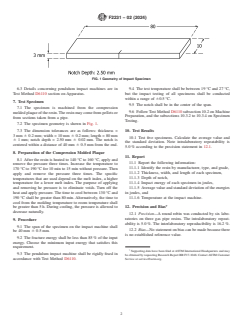
- Specimens: 3 mm thick, notched at center.
- Test Temperature: 19 °C to 27 °C, with a range not exceeding ±0.5 °C for all specimens tested.
- Machine: Impact tester with an input energy of 1 J to 3 J.
- Data Reporting: Results are reported as the impact energy of each specimen, including the average, standard deviation, specimen dimensions, resin identification, and test temperature, ensuring traceability and repeatability.
Applications
- Pipe Material Qualification: The Charpy impact test is essential for pipe manufacturers to qualify PE resins and ensure material compliance for pressurized applications such as water supply, gas transportation, and industrial fluids.
- Quality Control: Routine testing according to ASTM F2231 validates batch consistency and supports ongoing quality assurance in the manufacture of polyethylene pipes.
- Material Research and Development: R&D laboratories utilize this method to compare different PE grades, assess new formulations, or optimize processing conditions aimed at enhancing resistance to rapid crack propagation.
- Regulatory Compliance: Meeting the requirements of ASTM F2231 is often necessary for market access, certification, and alignment with international trade and safety protocols, especially where ISO 13477-based RCP testing is referenced.
Related Standards
- ASTM D6110: Test Method for Determining the Charpy Impact Resistance of Notched Specimens of Plastics - provides essential apparatus and procedural guidelines adopted in ASTM F2231.
- ASTM F412: Terminology Relating to Plastic Piping Systems - offers definitions and terms relevant to understanding and applying ASTM F2231.
- ISO 13477: Small Scale Steady State (S4) Test - an international test method closely linked to rapid crack propagation performance, referenced for correlation in ASTM F2231.
ASTM F2231-02(2024) is a critical reference for stakeholders in the plastic piping industry, including manufacturers, material scientists, laboratory technicians, and quality assurance professionals, supporting the production of safe, reliable, and high-performing pressurized polyethylene pipe systems. Implementing this standard enhances confidence in material durability, safety, and regulatory compliance globally.
Relations
- Effective Date
- 01-Feb-2024
Get Certified
Connect with accredited certification bodies for this standard

Institut za varilstvo d.o.o. (Welding Institute)
Slovenia's leading welding institute since 1952. ISO 3834, EN 1090, pressure equipment certification, NDT personnel, welder qualification. Only IIW Au
Sponsored listings
Frequently Asked Questions
ASTM F2231-02(2024) is a standard published by ASTM International. Its full title is "Standard Test Method for Charpy Impact Test on Thin Specimens of Polyethylene Used in Pressurized Pipes". This standard covers: SIGNIFICANCE AND USE 5.1 Brown and Lu4,5 show the Charpy impact energy is related to the ultimate critical temperature of the rapid crack propagation [RCP] behavior as measured by the ISO 13477, S-4 test.6 5.2 The test method may be used to determine the impact energy of polyethylene used in the manufacture of pipe . This test method involves the preparation of a small compression molded specimen of PE resin that is then notched in a specified manner. The specimen is then broken in a pendulum impact machine. The impact energy is recorded in joules. The value obtained is referred to as the Charpy impact energy. SCOPE 1.1 This test method describes the specimen preparation and the method of measuring the impact energy of polyethylene used in pressurized pipes. 1.2 The test specimens are taken from compression molded plaques of the resin from pellets or pipe. 1.3 Units—The values stated in SI units are to be regarded as standard. No other units of measurement are included in this standard. 1.4 This standard does not purport to address all of the safety concerns, if any, associated with its use. It is the responsibility of the user of this standard to establish appropriate safety, health, and environmental practices and determine the applicability of regulatory limitations prior to use. 1.5 This international standard was developed in accordance with internationally recognized principles on standardization established in the Decision on Principles for the Development of International Standards, Guides and Recommendations issued by the World Trade Organization Technical Barriers to Trade (TBT) Committee.
SIGNIFICANCE AND USE 5.1 Brown and Lu4,5 show the Charpy impact energy is related to the ultimate critical temperature of the rapid crack propagation [RCP] behavior as measured by the ISO 13477, S-4 test.6 5.2 The test method may be used to determine the impact energy of polyethylene used in the manufacture of pipe . This test method involves the preparation of a small compression molded specimen of PE resin that is then notched in a specified manner. The specimen is then broken in a pendulum impact machine. The impact energy is recorded in joules. The value obtained is referred to as the Charpy impact energy. SCOPE 1.1 This test method describes the specimen preparation and the method of measuring the impact energy of polyethylene used in pressurized pipes. 1.2 The test specimens are taken from compression molded plaques of the resin from pellets or pipe. 1.3 Units—The values stated in SI units are to be regarded as standard. No other units of measurement are included in this standard. 1.4 This standard does not purport to address all of the safety concerns, if any, associated with its use. It is the responsibility of the user of this standard to establish appropriate safety, health, and environmental practices and determine the applicability of regulatory limitations prior to use. 1.5 This international standard was developed in accordance with internationally recognized principles on standardization established in the Decision on Principles for the Development of International Standards, Guides and Recommendations issued by the World Trade Organization Technical Barriers to Trade (TBT) Committee.
ASTM F2231-02(2024) is classified under the following ICS (International Classification for Standards) categories: 23.040.20 - Plastics pipes. The ICS classification helps identify the subject area and facilitates finding related standards.
ASTM F2231-02(2024) has the following relationships with other standards: It is inter standard links to ASTM F2231-02(2019). Understanding these relationships helps ensure you are using the most current and applicable version of the standard.
ASTM F2231-02(2024) is available in PDF format for immediate download after purchase. The document can be added to your cart and obtained through the secure checkout process. Digital delivery ensures instant access to the complete standard document.
Standards Content (Sample)
This international standard was developed in accordance with internationally recognized principles on standardization established in the Decision on Principles for the
Development of International Standards, Guides and Recommendations issued by the World Trade Organization Technical Barriers to Trade (TBT) Committee.
Designation: F2231 − 02 (Reapproved 2024)
Standard Test Method for
Charpy Impact Test on Thin Specimens of Polyethylene
Used in Pressurized Pipes
This standard is issued under the fixed designation F2231; the number immediately following the designation indicates the year of
original adoption or, in the case of revision, the year of last revision. A number in parentheses indicates the year of last reapproval. A
superscript epsilon (´) indicates an editorial change since the last revision or reapproval.
1. Scope 3. Terminology
3.1 General—Definitions are in accordance with Terminol-
1.1 This test method describes the specimen preparation and
ogy F412 unless otherwise indicated.
the method of measuring the impact energy of polyethylene
used in pressurized pipes.
3.2 Definitions of Terms Specific to this Standard:
1.2 The test specimens are taken from compression molded 3.3 ultimate critical temperature, (CT)—for RCP in a pres-
surized pipe, the temperature above which RCP is not possible
plaques of the resin from pellets or pipe.
at any pressure based on ISO 13477.
1.3 Units—The values stated in SI units are to be regarded
as standard. No other units of measurement are included in this
4. Summary of Test Method
standard.
4.1 The Charpy specimen is 3 mm thick and taken from a
1.4 This standard does not purport to address all of the
compression-molded plaque of the resin. The specimen is
safety concerns, if any, associated with its use. It is the
notched precisely with a razor blade and tested between 19 °C
responsibility of the user of this standard to establish appro-
and 27 °C.
priate safety, health, and environmental practices and deter-
mine the applicability of regulatory limitations prior to use.
5. Significance and Use
4,5
1.5 This international standard was developed in accor-
5.1 Brown and Lu show the Charpy impact energy is
dance with internationally recognized principles on standard-
related to the ultimate critical temperature of the rapid crack
ization established in the Decision on Principles for the
propagation [RCP] behavior as measured by the ISO 13477,
Development of International Standards, Guides and Recom-
S-4 test.
mendations issued by the World Trade Organization Technical
5.2 The test method may be used to determine the impact
Barriers to Trade (TBT) Committee.
energy of polyethylene used in the manufacture of pipe . This
test method involves the preparation of a small compression
2. Referenced Documents
molded specimen of PE resin that is then notched in a specified
2.1 ASTM Standards:
manner. The specimen is then broken in a pendulum impact
D6110 Test Method for Determining the Charpy Impact
machine. The impact energy is recorded in joules. The value
Resistance of Notched Specimens of Plastics
obtained is referred to as the Charpy impact energy.
F412 Terminology Relating to Plastic Piping Systems
6. Apparatus
2.2 ISO Standard:
6.1 Impact Tester, with input energy of 1 J to 3 J and impact
ISO 13477 Small Scale Steady State S-4 Test
velocity of about 3.0 μs. The energy loss shall be measured
with a precision of 60.004 J.
6.2 Notching Machine, shall be capable of notching with a
This test method is under the jurisdiction of ASTM Committee F17 on Plastic
Piping Systems and is the direct responsibility of Subcommittee F17.40 on Test
razor blade with a precision of 60.01 mm and pressing the
Methods.
razor blade into the specimen.
Current edition approved Feb. 1, 2024. Published February 2024. Originally
approved in 2002. Last previous edition approved in 2019 as F2231 – 02 (2019).
DOI: 10.1520/F2231-02R24.
2 4
For referenced ASTM standards, visit the ASTM website, www.astm.org, or Brown, N. and Lu, X., “Dependence of Rapid Crack Propagation in PE Pipes
contact ASTM Customer Service at service@astm.org. For Annual Book of ASTM on the Plane Stress Fracture Energy of the Resin,” Polymer Engineering and Science
Standards volume information, refer to the standard’s Document Summary page on Vol 41, 2001, p. 1140.
the ASTM website. Brown, N. and Lu, X., “A Simple Test to Prevent Rapid Crack Propagation,”
Available from American National Standards Institute (ANSI), 25 W. 43rd St., Plastic Pipes XI, Munich, 2001, p. 583.
4th Floor, New York, NY 10036, http://www.ansi.org. The critical temperature is also related to the dimensions of the pipe.
Copyright © ASTM International, 100 Barr Harbor Drive, PO Box C700, West C
...