


ASTM C134-95(2016)
(Test Method)Standard Test Methods for Size, Dimensional Measurements, and Bulk Density of Refractory Brick and Insulating Firebrick
Standard Test Methods for Size, Dimensional Measurements, and Bulk Density of Refractory Brick and Insulating Firebrick
SIGNIFICANCE AND USE
3.1 Refractory brick are used as modular units in furnace construction and should not deviate significantly from the intended configuration with respect to size, bulk density, flat surfaces, and right angles. These test methods are particularly suited for use under field conditions and provide a means to determine whether the brick meets the requirements considered necessary to assure a satisfactory refractory construction.
SCOPE
1.1 These test methods cover procedures for measuring size, dimensional measurement, bulk density, warpage, and squareness of rectangular dense refractory brick and rectangular insulating firebrick. More precise determination of bulk density of refractory brick can be made by Test Methods C20. Stack height is generally determined only for dense refractories.
Note 1: Test Methods C830 and Test Method C914 are also used to determine bulk density of refractory brick, by different procedures.
1.2 The test methods appear in the following order:
Sections
Size and Bulk Density
4 through 7
Warpage of Refractory Brick
8 through 10
Squareness of Refractory Brick
11 through 14
1.3 The values stated in inch-pound units are to be regarded as standard. The values given in parentheses are mathematical conversions to SI units that are provided for information only and are not considered standard.
1.4 This standard does not purport to address all of the safety concerns, if any, associated with its use. It is the responsibility of the user of this standard to establish appropriate safety and health practices and determine the applicability of regulatory limitations prior to use.
General Information
Buy Standard
Standards Content (Sample)
NOTICE: This standard has either been superseded and replaced by a new version or withdrawn.
Contact ASTM International (www.astm.org) for the latest information
Designation: C134 − 95 (Reapproved 2016)
Standard Test Methods for
Size, Dimensional Measurements, and Bulk Density of
Refractory Brick and Insulating Firebrick
This standard is issued under the fixed designation C134; the number immediately following the designation indicates the year of
original adoption or, in the case of revision, the year of last revision. A number in parentheses indicates the year of last reapproval. A
superscript epsilon (´) indicates an editorial change since the last revision or reapproval.
1. Scope C914 Test Method for Bulk Density and Volume of Solid
Refractories by Wax Immersion
1.1 These test methods cover procedures for measuring size,
dimensional measurement, bulk density, warpage, and square-
3. Significance and Use
ness of rectangular dense refractory brick and rectangular
3.1 Refractory brick are used as modular units in furnace
insulating firebrick. More precise determination of bulk density
construction and should not deviate significantly from the
of refractory brick can be made by Test Methods C20. Stack
intended configuration with respect to size, bulk density, flat
height is generally determined only for dense refractories.
surfaces, and right angles. These test methods are particularly
NOTE 1—Test Methods C830 and Test Method C914 are also used to
suited for use under field conditions and provide a means to
determine bulk density of refractory brick, by different procedures.
determine whether the brick meets the requirements considered
1.2 The test methods appear in the following order:
necessary to assure a satisfactory refractory construction.
Sections
Size and Bulk Density 4 through 7 SIZE AND BULK DENSITY
Warpage of Refractory Brick 8 through 10
Squareness of Refractory Brick 11 through 14
4. Apparatus
1.3 The values stated in inch-pound units are to be regarded
4.1 Rule, steel, hook, 12 in. (305 mm) in length, graduated
as standard. The values given in parentheses are mathematical
in 0.02-in. (0.5-mm) divisions, for use in measuring individual
conversions to SI units that are provided for information only
brick. The rule has a rigid hardened steel hook consisting of a
and are not considered standard.
right-angled piece on one end to fix the zero point of the scale
1.4 This standard does not purport to address all of the
against one face of the brick. The hook is about ⁄4 in. (6 mm)
safety concerns, if any, associated with its use. It is the
in width and extends about ⁄4 in. beyond the back face or,
responsibility of the user of this standard to establish appro-
preferably, the edge of the rule.
priate safety and health practices and determine the applica-
4.2 Rule, stiff steel, hook, 36 in. (914 mm) in length,
bility of regulatory limitations prior to use.
graduated from each end in 0.02-in. (0.5-mm) divisions, for use
in measuring stack height and the larger individual brick. The
2. Referenced Documents
36-in. rule has the same design as the 12-in (305-mm) rule.
2.1 ASTM Standards:
NOTE 2—Check the hook rules periodically to determine that they have
C20 Test Methods for Apparent Porosity, Water Absorption,
not become worn or distorted in use. Other measuring equipment may be
Apparent Specific Gravity, and Bulk Density of Burned
used, provided the results are at least as accurate as those obtained with
Refractory Brick and Shapes by Boiling Water
the hook rule.
C830 Test Methods for Apparent Porosity, Liquid
4.3 Weighing Scale, having a capacity of 20 lb (9 kg) or
Absorption, Apparent Specific Gravity, and Bulk Density
more and a sensitivity under load of at least 0.01 lb (4.5 g).
of Refractory Shapes by Vacuum Pressure
5. Sampling
5.1 A sample consists of ten brick selected at random.
These test methods are under the jurisdiction of ASTM Committee C08 on
Refractories and are the direct responsibility of Subcommittee C08.03 on Physical
5.2 Preparation of Specimens—Remove any blisters or fins
Properties.
from the specimens by lightly rubbing them together. Omit this
Current edition approved June 1, 2016. Published June 2016. Originally
step in the case of insulating firebrick.
approved in 1938. Last previous edition approved in 2010 as C134 – 95 (2010).
DOI: 10.1520/C0134-95R16.
For referenced ASTM standards, visit the ASTM website, www.astm.org, or 6. Procedure
contact ASTM Customer Service at service@astm.org. For Annual Book of ASTM
6.1 Length and Width—Measure the length and width of
Standards volume information, refer to the standard’s Document Summary page on
the ASTM website. each of the ten specimens across the middle of each of the faces
Copyright © ASTM International, 100 Barr Harbor Drive, PO Box C700, West Conshohocken, PA 19428-2959. United States
C134 − 95 (2016)
of largest area to the nearest 0.02 in. (0.5 mm). Make and end. The wedge shall be graduated and numbered along the
record the individual measurements of the two opposite faces slope to show the thickness of the wedge between base AB and
of each specimen. slope AC in 0.02-in. (0.5-mm) divisions (Fig. 1).
8.2.1 Similar Wedges, of equivalent size and slope (that is,
6.2 Thickness—Determine the thickness of insulating fire-
rising 1 mm vertically for each 4 mm horizontally), and
brick and record in the same manner as the length and width,
graduated along the slope to show the thickness of the wedge
as indicated in 6.1. Make the thickness measurements at the
between base AB and the slope AC in SI units may be
centers of the longer sides of the brick. Determine the thickness
employed in conjunction with a straightedge calibrated in SI
of dense refractory brick in the same manner or, when required
units.
by specification, calculate the average thickness from the stack
height determined as in 6.3.
9. Procedure
6.3 Stack Height—Stack the ten specimens vertically on a
9.1 Measuring a Concave Surface:
plane surface with their faces of largest area together to form a
9.1.1 Measure and record the length of the diagonal of a
smooth column, without regard to the position of any brand
concave surface to the nearest 0.1 in. (3 mm) with the
marks on the specimens. Measure the height of the stack to the
graduated straightedge. Place the straightedge across the di-
nearest 0.02 in. (0.5 mm) from the plane surface to the top of
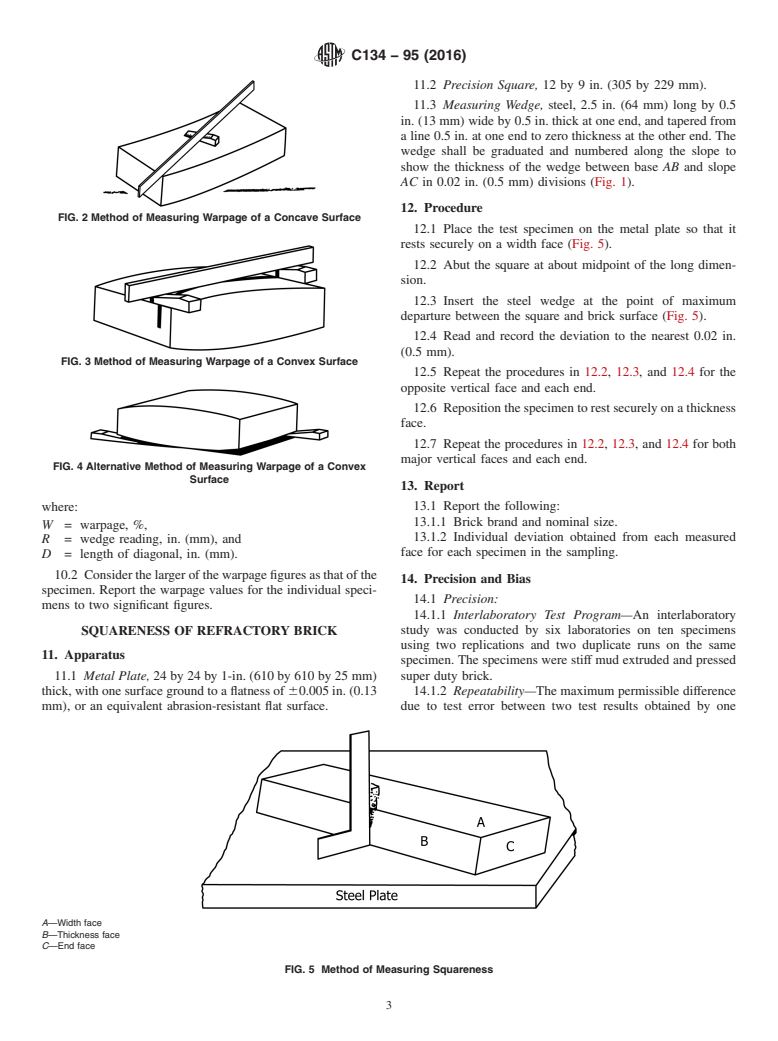
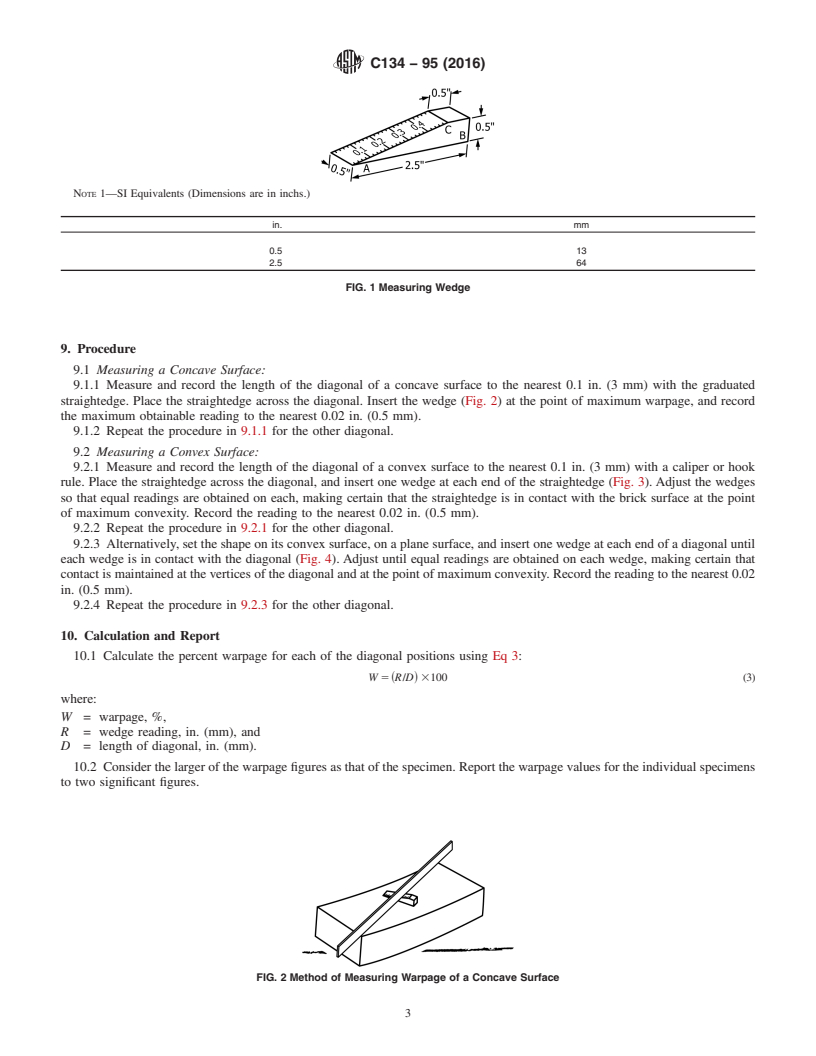
agonal. Insert the wedge (Fig. 2) at the point of maximum
the stack at the center of each side. Record the individual
warpage, and record the maximum obtainable reading to the
measurements of the four sides of the stack.
nearest 0.02 in. (0.5 mm).
6.4 Weight—Dry at 230°F (110°C), cool, and weigh each of
9.1.2 Repeat the procedure in 9.1.1 for the other diagonal.
the specimens to the nearest 0.01 lb (4.5 g), and record the
9.2 Measuring a Convex Surface:
weight.
9.2.1 Measure and record the length of the diagonal of a
convex surface to the nearest 0.1 in. (3 mm) with a caliper or
7. Calculation and Report
hook rule. Place the straightedge across the diagonal, and insert
7.1 Size—Report the individual measurements and the cal-
one wedge at each end of the straightedge (Fig. 3). Adjust the
culated average for the two individual measurements for
wedges so that equal readings are obtained on each, making
length, width, and thickness for each specimen.
certain that the straightedge is in contact with the brick surface
at the point of maximum convexity. Record the reading to the
7.2 Stack Height and Average Thickness—Report the indi-
nearest 0.02 in. (0.5 mm).
vidual measurements and the calculated stack height as the
9.2.2 Repeat the procedure in 9.2.1 for the other diagonal.
average of the individual measurements of the four sides of the
9.2.3 Alternatively, set the shape on its convex surface, on a
stack if required. Report “average thickness by stack height” as
plane surface, and insert one wedge
...
This document is not an ASTM standard and is intended only to provide the user of an ASTM standard an indication of what changes have been made to the previous version. Because
it may not be technically possible to adequately depict all changes accurately, ASTM recommends that users consult prior editions as appropriate. In all cases only the current version
of the standard as published by ASTM is to be considered the official document.
Designation: C134 − 95 (Reapproved 2010) C134 − 95 (Reapproved 2016)
Standard Test Methods for
Size, Dimensional Measurements, and Bulk Density of
Refractory Brick and Insulating Firebrick
This standard is issued under the fixed designation C134; the number immediately following the designation indicates the year of
original adoption or, in the case of revision, the year of last revision. A number in parentheses indicates the year of last reapproval. A
superscript epsilon (´) indicates an editorial change since the last revision or reapproval.
1. Scope
1.1 These test methods cover procedures for measuring size, dimensional measurement, bulk density, warpage, and squareness
of rectangular dense refractory brick and rectangular insulating firebrick. More precise determination of bulk density of refractory
brick can be made by Test Methods C20. Stack height is generally determined only for dense refractories.
NOTE 1—Test Methods C830 and Test Method C914 are also used to determine bulk density of refractory brick, by different procedures.
1.2 The test methods appear in the following order:
Sections
Size and Bulk Density 4 through 7
Warpage of Refractory Brick 8 through 10
Squareness of Refractory Brick 11 through 14
1.3 The values stated in inch-pound units are to be regarded as standard. The values given in parentheses are mathematical
conversions to SI units that are provided for information only and are not considered standard.
1.4 This standard does not purport to address all of the safety concerns, if any, associated with its use. It is the responsibility
of the user of this standard to establish appropriate safety and health practices and determine the applicability of regulatory
limitations prior to use.
2. Referenced Documents
2.1 ASTM Standards:
C20 Test Methods for Apparent Porosity, Water Absorption, Apparent Specific Gravity, and Bulk Density of Burned Refractory
Brick and Shapes by Boiling Water
C830 Test Methods for Apparent Porosity, Liquid Absorption, Apparent Specific Gravity, and Bulk Density of Refractory Shapes
by Vacuum Pressure
C914 Test Method for Bulk Density and Volume of Solid Refractories by Wax Immersion
3. Significance and Use
3.1 Refractory brick are used as modular units in furnace construction and should not deviate significantly from the intended
configuration with respect to size, bulk density, flat surfaces, and right angles. These test methods are particularly suited for use
under field conditions and provide a means to determine whether the brick meets the requirements considered necessary to assure
a satisfactory refractory construction.
SIZE AND BULK DENSITY
4. Apparatus
4.1 Rule, steel, hook, 12 in. (305 mm) in length, graduated in 0.02-in. (0.5-mm) divisions, for use in measuring individual brick.
The rule has a rigid hardened steel hook consisting of a right-angled piece on one end to fix the zero point of the scale against one
1 1
face of the brick. The hook is about ⁄4 in. (6 mm) in width and extends about ⁄4 in. beyond the back face or, preferably, the edge
of the rule.
These test methods are under the jurisdiction of ASTM Committee C08 on Refractories and are the direct responsibility of Subcommittee C08.03 on Physical Properties.
Current edition approved April 1, 2010June 1, 2016. Published May 2010June 2016. Originally approved in 1938. Last previous edition approved in 20052010 as
C134 – 95 (2005).(2010). DOI: 10.1520/C0134-95R10.10.1520/C0134-95R16.
For referenced ASTM standards, visit the ASTM website, www.astm.org, or contact ASTM Customer Service at service@astm.org. For Annual Book of ASTM Standards
volume information, refer to the standard’s Document Summary page on the ASTM website.
Copyright © ASTM International, 100 Barr Harbor Drive, PO Box C700, West Conshohocken, PA 19428-2959. United States
C134 − 95 (2016)
4.2 Rule, stiff steel, hook, 36 in. (914 mm) in length, graduated from each end in 0.02-in. (0.5-mm) divisions, for use in
measuring stack height and the larger individual brick. The 36-in. rule has the same design as the 12-in (305-mm) rule.
NOTE 2—Check the hook rules periodically to determine that they have not become worn or distorted in use. Other measuring equipment may be used,
provided the results are at least as accurate as those obtained with the hook rule.
4.3 Weighing Scale, having a capacity of 20 lb (9 kg) or more and a sensitivity under load of at least 0.01 lb (4.5 g).
5. Sampling
5.1 A sample consists of ten brick selected at random.
5.2 Preparation of Specimens—Remove any blisters or fins from the specimens by lightly rubbing them together. Omit this step
in the case of insulating firebrick.
6. Procedure
6.1 Length and Width—Measure the length and width of each of the ten specimens across the middle of each of the faces of
largest area to the nearest 0.02 in. (0.5 mm). Make and record the individual measurements of the two opposite faces of each
specimen.
6.2 Thickness—Determine the thickness of insulating firebrick and record in the same manner as the length and width, as
indicated in 6.1. Make the thickness measurements at the centers of the longer sides of the brick. Determine the thickness of dense
refractory brick in the same manner or, when required by specification, calculate the average thickness from the stack height
determined as in 6.3.
6.3 Stack Height—Stack the ten specimens vertically on a plane surface with their faces of largest area together to form a smooth
column, without regard to the position of any brand marks on the specimens. Measure the height of the stack to the nearest 0.02
in. (0.5 mm) from the plane surface to the top of the stack at the center of each side. Record the individual measurements of the
four sides of the stack.
6.4 Weight—Dry at 230°F (110°C), cool, and weigh each of the specimens to the nearest 0.01 lb (4.5 g), and record the weight.
7. Calculation and Report
7.1 Size—Report the individual measurements and the calculated average for the two individual measurements for length, width,
and thickness for each specimen.
7.2 Stack Height and Average Thickness—Report the individual measurements and the calculated stack height as the average
of the individual measurements of the four sides of the stack if required. Report “average thickness by stack height” as the average
stack height divided by ten. For bricks over 3 ⁄2 in. (89 mm) in thickness, report the average thickness of the individual specimens.
7.3 Bulk Density—Calculate and report the bulk density for each specimen, using Eq 1 or Eq 2 as appropriate and the average
dimensions obtained in accordance with 7.1 and the weight obtained in accordance with 6.4.
lb/ft B 5 d 3 1728 / l 3 w 3 t (1)
~ ! ~ !
or
B 5 d/l 3w 3t (2)
~ !
where:
B = bulk density, lb/ft (g/cc),
d = dry weight, lb (g),
l = length, in. (mm),
w = width, in. (mm), and
t = thickness, in. (mm).
WARPAGE OF REFRACTORY BRICK
8. Apparatus
8.1 Steel Straightedge, stiff, having sufficient length to span the diagonal of the largest shape to be measured, and graduated in
0.02-in. (0.5-mm) divisions.
8.2 Measuring Wedges, two, steel, 2.5-in. (64-mm) long by 0.5 in. (13 mm) wide by 0.5 in. thick at one end, and tapered from
a line 0.5 in. from one end to zero thickness at the other end. The wedge shall be graduated and numbered along the slope to show
the thickness of the wedge between base AB and slope AC in 0.02-in. (0.5-mm) divisions (Fig. 1).
8.2.1 Similar Wedges, of equivalent size and slope (that is, rising 1 mm vertically for each 4 mm horizontally), and graduated
along the slope to show the thickness of the wedge between base AB and the slope AC in SI units may be employed in conjunction
with a straightedge calibrate
...
Questions, Comments and Discussion
Ask us and Technical Secretary will try to provide an answer. You can facilitate discussion about the standard in here.