

ASTM D972-22
(Test Method)Standard Test Method for Evaporation Loss of Lubricating Greases and Oils
General Information
- Abstract
SIGNIFICANCE AND USE
5.1 The loss of volatile materials from greases and oils can adversely effect the original performance characteristics of a lubricant and therefore could be a significant factor in evaluating a lubricant for a specific use. Such volatiles can also be considered contaminants in the environment in which the lubricant is to be used. Correlation between results from this test method and service performance has not been established.
5.2 The test can be run at any agreed upon temperature between 100 °C and 150 °C (210 °F to 300 °F).
Note 1: The specified flow of air, 2.58 g/min ± 0.02 g/min, (2 L/min at standard temperature and pressure), assumes dry air. It is not known that the original work involved dry air but it has since been shown that this can be a factor in reproducibility and should be addressed. A dew point of less than 10 °C at standard temperature and pressure will be satisfactory.
Note 2: To determine evaporation loss at temperatures above 150 °C (300 °F), see Test Methods D2595.
SCOPE
1.1 This test method covers the determination of the loss in mass by evaporation of lubricating greases and oils for applications where evaporation loss is a factor. Evaporation loss data can be obtained at any temperature in the range from 100 °C to 150 °C (210 °F to 300 °F).
1.2 The values stated in SI units are to be regarded as standard.
1.2.1 Exception—The values given in parentheses are for information only.
1.3 This standard does not purport to address all of the safety concerns, if any, associated with its use. It is the responsibility of the user of this standard to establish appropriate safety, health, and environmental practices and determine the applicability of regulatory limitations prior to use.
1.4 This international standard was developed in accordance with internationally recognized principles on standardization established in the Decision on Principles for the Development of International Standards, Guides and Recommendations issued by the World Trade Organization Technical Barriers to Trade (TBT) Committee.
- Status
- Published
- Publication Date
- 30-Nov-2022
- Technical Committee
- D02 - Petroleum Products, Liquid Fuels, and Lubricants
- Drafting Committee
- D02.G0.03 - Physical Tests
Overview
ASTM D972-22: Standard Test Method for Evaporation Loss of Lubricating Greases and Oils establishes a reliable procedure to determine the loss in mass of lubricating greases and oils due to evaporation. Loss of volatile materials can significantly impact the performance characteristics of lubricants, which is critical for their evaluation and appropriate application. This test method is applicable for temperatures ranging from 100 °C to 150 °C (210 °F to 300 °F), making it suitable for a range of industrial applications where evaporation loss is a concern.
Evaporation loss is not only a measure of a lubricant's stability under heat but also an indicator of potential environmental contamination by volatile substances. Therefore, this standard is essential for ensuring product quality and environmental safety in lubrication-related industries.
Key Topics
- Purpose of the Test: Determines the mass loss caused by evaporation in lubricating greases and oils over a specific temperature range.
- Test Temperature Range: Allows testing at any agreed temperature between 100 °C to 150 °C (210 °F to 300 °F).
- Sample Preparation and Testing: Test procedures include the use of standardized evaporation cells, air supply systems, and oil baths to ensure reproducibility and accuracy.
- Significance: Results help evaluate the suitability of greases and oils for use in environments where high temperatures or volatile loss may impact functional performance.
- Environmental Impact: Highlights the importance of controlling volatile loss, as evaporated substances may be considered environmental contaminants.
- Precision: Provides guidelines for repeatability and reproducibility, ensuring the reliability of test results.
Applications
The ASTM D972-22 standard test method is widely used in both research and quality control environments for:
- Product Development: Assisting lubricant manufacturers in formulating greases and oils with lower evaporation tendencies, improving product stability.
- Quality Assurance: Supporting lubricant suppliers and users in verifying product consistency and compliance with contract specifications.
- Industrial Equipment Maintenance: Guiding engineers and maintenance professionals in selecting lubricants resistant to evaporation loss, thereby enhancing equipment reliability and lifespan.
- Environmental Compliance: Helping organizations monitor and mitigate the release of volatile substances from lubricants into operational environments.
Industries that benefit from applying this standard include automotive, aerospace, manufacturing, and any sector where high-temperature machinery or equipment relies on optimized lubrication performance.
Related Standards
- ASTM D2595: Test Method for Evaporation Loss of Lubricating Greases Over Wide-Temperature Range - for testing at temperatures above 150 °C (300 °F).
- ASTM D217: Test Methods for Cone Penetration of Lubricating Grease - used for characterizing grease consistency.
- ASTM D4175: Terminology Relating to Petroleum Products, Liquid Fuels, and Lubricants - provides definitions relevant to this and associated test methods.
- ASTM E2251: Specification for Liquid-in-Glass ASTM Thermometers with Low-Hazard Precision Liquids - specifies thermometers used in temperature control during testing.
- ASTM A240/A240M: Specification for Stainless Steel Plates, Sheets, and Strips - standards for materials used in constructing evaporation cells.
By adhering to ASTM D972-22 and these related international standards, organizations can assure product performance, customer confidence, and regulatory compliance in lubrication applications.
Relations
- Refers
ASTM D4175-23a - Standard Terminology Relating to Petroleum Products, Liquid Fuels, and Lubricants - Effective Date
- 15-Dec-2023
- Effective Date
- 01-Nov-2023
- Refers
ASTM D4175-23e1 - Standard Terminology Relating to Petroleum Products, Liquid Fuels, and Lubricants - Effective Date
- 01-Jul-2023
- Effective Date
- 01-Nov-2017
- Effective Date
- 01-Dec-2016
- Effective Date
- 01-May-2016
- Effective Date
- 01-Nov-2015
- Effective Date
- 01-Mar-2015
- Effective Date
- 01-Jan-2015
- Effective Date
- 01-May-2014
- Effective Date
- 01-Nov-2013
- Effective Date
- 01-Oct-2013
- Effective Date
- 01-May-2013
- Effective Date
- 01-Apr-2013
- Effective Date
- 01-Nov-2012
Get Certified
Connect with accredited certification bodies for this standard

Element Materials Technology
Materials testing and product certification.

ABS Group Brazil
ABS Group certification services in Brazil.

ABS Quality Evaluations Inc.
American Bureau of Shipping quality certification.
Sponsored listings
Frequently Asked Questions
ASTM D972-22 is a standard published by ASTM International. Its full title is "Standard Test Method for Evaporation Loss of Lubricating Greases and Oils". This standard covers: SIGNIFICANCE AND USE 5.1 The loss of volatile materials from greases and oils can adversely effect the original performance characteristics of a lubricant and therefore could be a significant factor in evaluating a lubricant for a specific use. Such volatiles can also be considered contaminants in the environment in which the lubricant is to be used. Correlation between results from this test method and service performance has not been established. 5.2 The test can be run at any agreed upon temperature between 100 °C and 150 °C (210 °F to 300 °F). Note 1: The specified flow of air, 2.58 g/min ± 0.02 g/min, (2 L/min at standard temperature and pressure), assumes dry air. It is not known that the original work involved dry air but it has since been shown that this can be a factor in reproducibility and should be addressed. A dew point of less than 10 °C at standard temperature and pressure will be satisfactory. Note 2: To determine evaporation loss at temperatures above 150 °C (300 °F), see Test Methods D2595. SCOPE 1.1 This test method covers the determination of the loss in mass by evaporation of lubricating greases and oils for applications where evaporation loss is a factor. Evaporation loss data can be obtained at any temperature in the range from 100 °C to 150 °C (210 °F to 300 °F). 1.2 The values stated in SI units are to be regarded as standard. 1.2.1 Exception—The values given in parentheses are for information only. 1.3 This standard does not purport to address all of the safety concerns, if any, associated with its use. It is the responsibility of the user of this standard to establish appropriate safety, health, and environmental practices and determine the applicability of regulatory limitations prior to use. 1.4 This international standard was developed in accordance with internationally recognized principles on standardization established in the Decision on Principles for the Development of International Standards, Guides and Recommendations issued by the World Trade Organization Technical Barriers to Trade (TBT) Committee.
SIGNIFICANCE AND USE 5.1 The loss of volatile materials from greases and oils can adversely effect the original performance characteristics of a lubricant and therefore could be a significant factor in evaluating a lubricant for a specific use. Such volatiles can also be considered contaminants in the environment in which the lubricant is to be used. Correlation between results from this test method and service performance has not been established. 5.2 The test can be run at any agreed upon temperature between 100 °C and 150 °C (210 °F to 300 °F). Note 1: The specified flow of air, 2.58 g/min ± 0.02 g/min, (2 L/min at standard temperature and pressure), assumes dry air. It is not known that the original work involved dry air but it has since been shown that this can be a factor in reproducibility and should be addressed. A dew point of less than 10 °C at standard temperature and pressure will be satisfactory. Note 2: To determine evaporation loss at temperatures above 150 °C (300 °F), see Test Methods D2595. SCOPE 1.1 This test method covers the determination of the loss in mass by evaporation of lubricating greases and oils for applications where evaporation loss is a factor. Evaporation loss data can be obtained at any temperature in the range from 100 °C to 150 °C (210 °F to 300 °F). 1.2 The values stated in SI units are to be regarded as standard. 1.2.1 Exception—The values given in parentheses are for information only. 1.3 This standard does not purport to address all of the safety concerns, if any, associated with its use. It is the responsibility of the user of this standard to establish appropriate safety, health, and environmental practices and determine the applicability of regulatory limitations prior to use. 1.4 This international standard was developed in accordance with internationally recognized principles on standardization established in the Decision on Principles for the Development of International Standards, Guides and Recommendations issued by the World Trade Organization Technical Barriers to Trade (TBT) Committee.
ASTM D972-22 is classified under the following ICS (International Classification for Standards) categories: 75.100 - Lubricants, industrial oils and related products. The ICS classification helps identify the subject area and facilitates finding related standards.
ASTM D972-22 has the following relationships with other standards: It is inter standard links to ASTM D4175-23a, ASTM A240/A240M-23a, ASTM D4175-23e1, ASTM A240/A240M-17, ASTM A240/A240M-16a, ASTM A240/A240M-16, ASTM A240/A240M-15b, ASTM A240/A240M-15a, ASTM A240/A240M-15, ASTM A240/A240M-14, ASTM A240/A240M-13c, ASTM A240/A240M-13b, ASTM A240/A240M-13a, ASTM A240/A240M-13, ASTM A240/A240M-12a. Understanding these relationships helps ensure you are using the most current and applicable version of the standard.
ASTM D972-22 is available in PDF format for immediate download after purchase. The document can be added to your cart and obtained through the secure checkout process. Digital delivery ensures instant access to the complete standard document.
Standards Content (Sample)
This international standard was developed in accordance with internationally recognized principles on standardization established in the Decision on Principles for the
Development of International Standards, Guides and Recommendations issued by the World Trade Organization Technical Barriers to Trade (TBT) Committee.
Designation: D972 − 22
Standard Test Method for
Evaporation Loss of Lubricating Greases and Oils
This standard is issued under the fixed designation D972; the number immediately following the designation indicates the year of
original adoption or, in the case of revision, the year of last revision. A number in parentheses indicates the year of last reapproval. A
superscript epsilon (´) indicates an editorial change since the last revision or reapproval.
This standard has been approved for use by agencies of the U.S. Department of Defense.
1. Scope* eters with Low-Hazard Precision Liquids
1.1 This test method covers the determination of the loss in
3. Terminology
mass by evaporation of lubricating greases and oils for
3.1 Definitions:
applications where evaporation loss is a factor. Evaporation
3.1.1 For definitions of terms used in this test method, refer
loss data can be obtained at any temperature in the range from
to Terminology D4175.
100 °C to 150 °C (210 °F to 300 °F).
3.1.2 lubricating grease, n—a semi-fluid to solid product of
1.2 The values stated in SI units are to be regarded as
a thickener in a liquid lubricant.
standard.
3.1.2.1 Discussion—The dispersion of the thickener forms a
1.2.1 Exception—The values given in parentheses are for
two-phase system and immobilizes the liquid lubricant by
information only.
surface tension and other physical forces. Other ingredients are
1.3 This standard does not purport to address all of the
commonly included to impart special properties.
safety concerns, if any, associated with its use. It is the
3.1.3 thickener, n—in lubricating grease, a substance com-
responsibility of the user of this standard to establish appro-
posed of finely divided particles dispersed in a liquid to form
priate safety, health, and environmental practices and deter-
the product’s structure.
mine the applicability of regulatory limitations prior to use.
3.1.3.1 Discussion—Thickeners can be fibers (such as vari-
1.4 This international standard was developed in accor-
ous metallic soaps) or plates or spheres (such as certain
dance with internationally recognized principles on standard-
non-soapthickeners),whichareinsolubleor,atmost,onlyvery
ization established in the Decision on Principles for the
slightly soluble in the liquid lubricant. The general require-
Development of International Standards, Guides and Recom-
ments are that the solid particles are extremely small, uni-
mendations issued by the World Trade Organization Technical
formly dispersed, and capable of forming a relatively stable,
Barriers to Trade (TBT) Committee.
gel-like structure with the liquid lubricant.
2. Referenced Documents
4. Summary of Test Method
2.1 ASTM Standards:
4.1 The weighed sample of lubricant in an evaporation cell
A240/A240M Specification for Chromium and Chromium-
is placed in a bath maintained at the desired test temperature.
Nickel Stainless Steel Plate, Sheet, and Strip for Pressure
Heated air is passed over its surface for 22 h. The evaporation
Vessels and for General Applications
loss is calculated from the loss in mass of the sample.
D2595 Test Method for Evaporation Loss of Lubricating
Greases Over Wide-Temperature Range 5. Significance and Use
D4175 Terminology Relating to Petroleum Products, Liquid
5.1 The loss of volatile materials from greases and oils can
Fuels, and Lubricants
adversely effect the original performance characteristics of a
E2251 Specification for Liquid-in-Glass ASTM Thermom-
lubricant and therefore could be a significant factor in evalu-
ating a lubricant for a specific use. Such volatiles can also be
considered contaminants in the environment in which the
This test method is under the jurisdiction of ASTM Committee D02 on
lubricant is to be used. Correlation between results from this
Petroleum Products, Liquid Fuels, and Lubricants and is the direct responsibility of
Subcommittee D02.G0.03 on Physical Tests.
test method and service performance has not been established.
Current edition approved Dec. 1, 2022. Published December 2022. Originally
5.2 The test can be run at any agreed upon temperature
approved in 1948. Last previous edition approved in 2016 as D972 – 16. DOI:
10.1520/D0972-22.
between 100 °C and 150 °C (210 °F to 300 °F).
For referenced ASTM standards, visit the ASTM website, www.astm.org, or
NOTE 1—The specified flow of air, 2.58 g ⁄min 6 0.02 g ⁄min, (2 L ⁄min
contact ASTM Customer Service at service@astm.org. For Annual Book of ASTM
Standards volume information, refer to the standard’s Document Summary page on atstandardtemperatureandpressure),assumesdryair.Itisnotknownthat
the ASTM website. the original work involved dry air but it has since been shown that this can
*A Summary of Changes section appears at the end of this standard
Copyright © ASTM International, 100 Barr Harbor Drive, PO Box C700, West Conshohocken, PA 19428-2959. United States
D972 − 22
be a factor in reproducibility and should be addressed.Adew point of less
(60 °F and 85 °F) (2 L⁄min at standard temperature and pres-
than 10 °C at standard temperature and pressure will be satisfactory.
sure). It shall be furnished with a needle valve and mounted as
NOTE 2—To determine evaporation loss at temperatures above 150 °C
shown in Fig. 1.
(300 °F), see Test Methods D2595.
7. Sampling
6. Apparatus
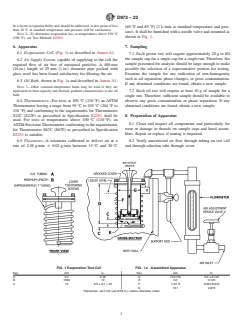
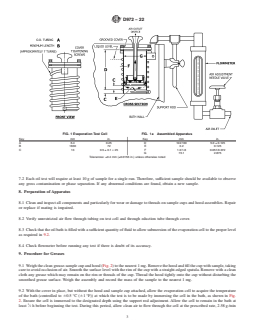
6.1 Evaporation Cell, (Fig. 1) as described in Annex A1.
7.1 Each grease test will require approximately 20 g to fill
the sample cup for a single cup for a single run. Therefore, the
6.2 Air Supply System, capable of supplying to the cell the
sample presented for analysis should be large enough to make
required flow of air free of entrained particles. A 400 mm
possible the selection of a representative portion for testing.
(16 in.) length of 25 mm (1 in.) diameter pipe packed with
glass wool has been found satisfactory for filtering the air. Examine the sample for any indication of non-homogenity
such as oil separation, phase changes, or gross contamination.
6.3 Oil Bath, shown in Fig. 1a and described in Annex A1.
If any abnormal conditions are found, obtain a new sample.
NOTE 3—Other constant-temperature baths may be used if they are
equivalent in heat capacity and thermal gradient characteristics to the oil 7.2 Each oil test will require at least 10 g of sample for a
bath.
single run. Therefore, sufficient sample should be available to
6.4 Thermometers—For tests at 100 °C (210 °F) an ASTM observe any gross contamination or phase separation. If any
Thermometer having a range from 95 °C to 103 °C (204 °F to
abnormal conditions are found, obtain a new sample.
218 °F) and conforming to the requirements for Thermometer
S22C (S22F) as prescribed in Specification E2251 shall be
8. Preparation of Apparatus
used. For tests at temperatures above 100 °C (210 °F), an
8.1 Clean and inspect all components and particularly for
ASTMPrecisionThermometerconformingtotherequirements
wear or damage to threads on sample cups and hood assem-
for Thermometer S67C (S67F) as prescribed in Specification
blies. Repair or replace if mating is impaired.
E2251 is suitable.
8.2 Verify unrestricted air flow through tubing on test cell
6.5 Flowmeter—A rotameter calibrated to deliver air at a
rate of 2.58 g⁄min 6 0.02 g⁄min between 15 °C and 30 °C and through eduction tube through cover.
FIG. 1 Evaporation Test Cell FIG. 1a Assembled Apparatus
Key mm in. Key mm in.
A 6.4 0.25 D 124/130 5.0 ± 0.125
B 1830 72 E 3.2 0.125
C
...
This document is not an ASTM standard and is intended only to provide the user of an ASTM standard an indication of what changes have been made to the previous version. Because
it may not be technically possible to adequately depict all changes accurately, ASTM recommends that users consult prior editions as appropriate. In all cases only the current version
of the standard as published by ASTM is to be considered the official document.
Designation: D972 − 16 D972 − 22
Standard Test Method for
Evaporation Loss of Lubricating Greases and Oils
This standard is issued under the fixed designation D972; the number immediately following the designation indicates the year of
original adoption or, in the case of revision, the year of last revision. A number in parentheses indicates the year of last reapproval. A
superscript epsilon (´) indicates an editorial change since the last revision or reapproval.
This standard has been approved for use by agencies of the U.S. Department of Defense.
1. Scope*
1.1 This test method covers the determination of the loss in mass by evaporation of lubricating greases and oils for applications
where evaporation loss is a factor. Evaporation loss data can be obtained at any temperature in the range from 100 °C to 150 °C
(210 °F to 300 °F).
1.2 The values stated in SI units are to be regarded as standard.
1.2.1 Exception—The values given in parentheses are for information only.
1.3 This standard does not purport to address all of the safety concerns, if any, associated with its use. It is the responsibility
of the user of this standard to establish appropriate safety safety, health, and healthenvironmental practices and determine the
applicability of regulatory limitations prior to use.
1.4 This international standard was developed in accordance with internationally recognized principles on standardization
established in the Decision on Principles for the Development of International Standards, Guides and Recommendations issued
by the World Trade Organization Technical Barriers to Trade (TBT) Committee.
2. Referenced Documents
2.1 ASTM Standards:
A240/A240M Specification for Chromium and Chromium-Nickel Stainless Steel Plate, Sheet, and Strip for Pressure Vessels and
for General Applications
D217 Test Methods for Cone Penetration of Lubricating Grease
D2595 Test Method for Evaporation Loss of Lubricating Greases Over Wide-Temperature Range
D4175 Terminology Relating to Petroleum Products, Liquid Fuels, and Lubricants
E2251 Specification for Liquid-in-Glass ASTM Thermometers with Low-Hazard Precision Liquids
3. Terminology
3.1 Definitions:
3.1.1 For definitions of terms used in this test method, refer to Terminology D4175.
3.1.2 lubricating grease, n—a semi-fluid to solid product of a thickener in a liquid lubricant.
This test method is under the jurisdiction of ASTM Committee D02 on Petroleum Products, Liquid Fuels, and Lubricants and is the direct responsibility of Subcommittee
D02.G0.03 on Physical Tests.
Current edition approved April 1, 2016Dec. 1, 2022. Published May 2016December 2022. Originally approved in 1948. Last previous edition approved in 20082016 as
D972 – 02 (2008).D972 – 16. DOI: 10.1520/D0972-16.10.1520/D0972-22.
For referenced ASTM standards, visit the ASTM website, www.astm.org, or contact ASTM Customer Service at service@astm.org. For Annual Book of ASTM Standards
volume information, refer to the standard’s Document Summary page on the ASTM website.
*A Summary of Changes section appears at the end of this standard
Copyright © ASTM International, 100 Barr Harbor Drive, PO Box C700, West Conshohocken, PA 19428-2959. United States
D972 − 22
3.1.2.1 Discussion—
The dispersion of the thickener forms a two-phase system and immobilizes the liquid lubricant by surface tension and other
physical forces. Other ingredients are commonly D217included to impart special properties.
3.1.3 thickener, n—in lubricating grease, a substance composed of finely divided particles dispersed in a liquid to form the
product’s structure.
3.1.3.1 Discussion—
Thickeners can be fibers (such as various metallic soaps) or plates or spheres (such as certain non-soap thickeners), which are
insoluble or, at most, only very slightly soluble in the liquid lubricant. The general requirements are that the solid particles are
extremely small, uniformly dispersed, and capable of forming a relatively stable, gel-like structure with the D217liquid lubricant.
4. Summary of Test Method
4.1 The weighed sample of lubricant in an evaporation cell is placed in a bath maintained at the desired test temperature. Heated
air is passed over its surface for 22 h. The evaporation loss is calculated from the loss in mass of the sample.
5. Significance and Use
5.1 The loss of volatile materials from greases and oils can adversely effect the original performance characteristics of a lubricant
and therefore could be a significant factor in evaluating a lubricant for a specific use. Such volatiles can also be considered
contaminants in the environment in which the lubricant is to be used. Correlation between results from this test method and service
performance has not been established.
5.2 The test can be run at any agreed upon temperature between 100 °C and 150 °C (210 °F to 300 °F).
NOTE 1—The specified flow of air, 2.58 g ⁄min 6 0.02 g ⁄min, (2 L ⁄min at standard temperature and pressure), assumes dry air. It is not known that the
original work involved dry air but it has since been shown that this can be a factor in reproducibility and should be addressed. A dew point of less than
10 °C at standard temperature and pressure will be satisfactory.
NOTE 2—To determine evaporation loss at temperatures above 150 °C (300 °F), see Test Methods D2595.
6. Apparatus
6.1 Evaporation Cell, (Fig. 1) as described in Annex A1.
6.2 Air Supply System, capable of supplying to the cell the required flow of air free of entrained particles. A 400 mm (16 in.) length
of 25 mm (1 in.) diameter pipe packed with glass wool has been found satisfactory for filtering the air.
6.3 Oil Bath, shown in Fig. 1a and described in Annex A1.
NOTE 3—Other constant-temperature baths may be used if they are equivalent in heat capacity and thermal gradient characteristics to the oil bath.
6.4 Thermometers—For tests at 100 °C (210 °F) an ASTM Thermometer having a range from 95 °C to 103 °C (204 °F to 218 °F)
and conforming to the requirements for Thermometer S22C (S22F) as prescribed in Specification E2251 shall be used. For tests
at temperatures above 100 °C (210 °F), an ASTM Precision Thermometer conforming to the requirements for Thermometer S67C
(S67F) as prescribed in Specification E2251 is suitable.
6.5 Flowmeter—A rotameter calibrated to deliver air at a rate of 2.58 g ⁄min 6 0.02 g ⁄min between 15 °C and 30 °C (60 °F and
85 °F) (2 L ⁄min at standard temperature and pressure). It shall be furnished with a needle valve and mounted as shown in Fig. 1.
7. Sampling
7.1 Each grease test will require approximately 20 g to fill the sample cup for a single cup for a single run. Therefore, the sample
presented for analysis should be large enough to make possible the selection of a representative portion for testing. Examine the
sample for any indication of non-homogenity such as oil separation, phase changes, or gross contamination. If any abnormal
conditions are found, obtain a new sample.
D972 − 22
FIG. 1 Evaporation Test Cell FIG. 1a Assembled Apparatus
Key mm in. Key mm in.
A 6.4 0.25 D 124/130 5.0 ± 0.125
B 1830 72 E 3.2 0.125
C 13 0.5 ± 0.1 = 25 F 1.3/1.8 0.051/0.072
G 73.1 2.875
Tolerances: ±0.4 mm (±0.0156 in.) unless otherwise noted
7.2 Each oil test will require at least 10 g of sample for a single run. Therefore, sufficient sample should be available to observe
any gross contamination or phase separation. If any abnormal conditions are found, obtain a new sample.
8. Preparation of Apparatus
8.1 Clean and inspect all components and particularly
...